
Utility Systems Process Systems Direct Impact Systems n
- Slides: 16
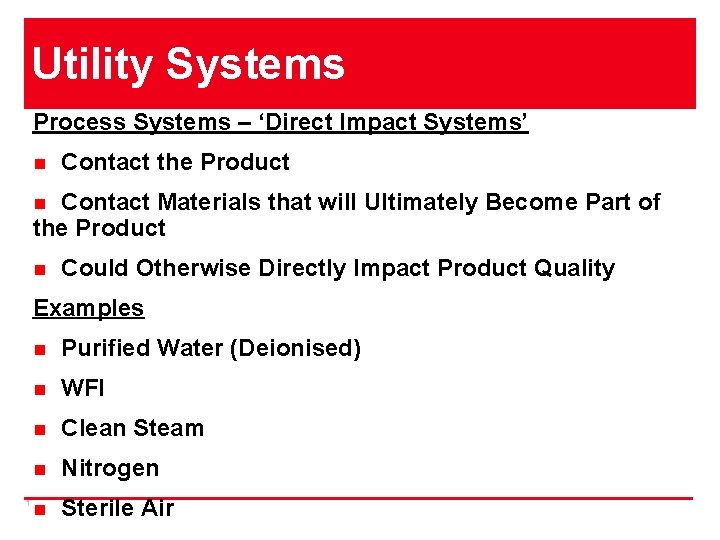
Utility Systems Process Systems – ‘Direct Impact Systems’ n Contact the Product Contact Materials that will Ultimately Become Part of the Product n n Could Otherwise Directly Impact Product Quality Examples 1 n Purified Water (Deionised) n WFI n Clean Steam n Nitrogen n Sterile Air
Utility Systems Process Systems – ‘Indirect Impact Systems’ n Do Not Contact the product or Material that will Ultimately Become part of the product n Generally Site or Building Systems (Not Tailored to Sterile Manufacturing Facilities) n Deal with a Side Effect of the Manufacturing Process Examples 2 n HVAC for non classified areas n Chilled Water n Potable Water n Floor Drains n Waste Disposal
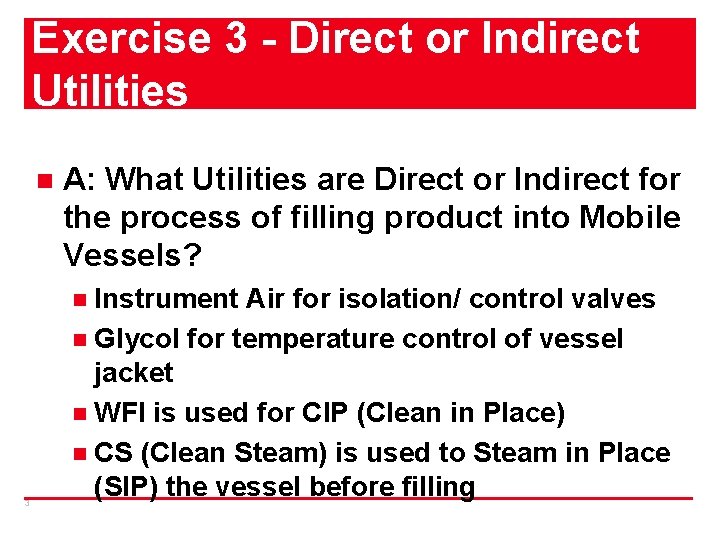
Exercise 3 - Direct or Indirect Utilities n A: What Utilities are Direct or Indirect for the process of filling product into Mobile Vessels? Instrument Air for isolation/ control valves n Glycol for temperature control of vessel jacket n WFI is used for CIP (Clean in Place) n CS (Clean Steam) is used to Steam in Place (SIP) the vessel before filling n 3
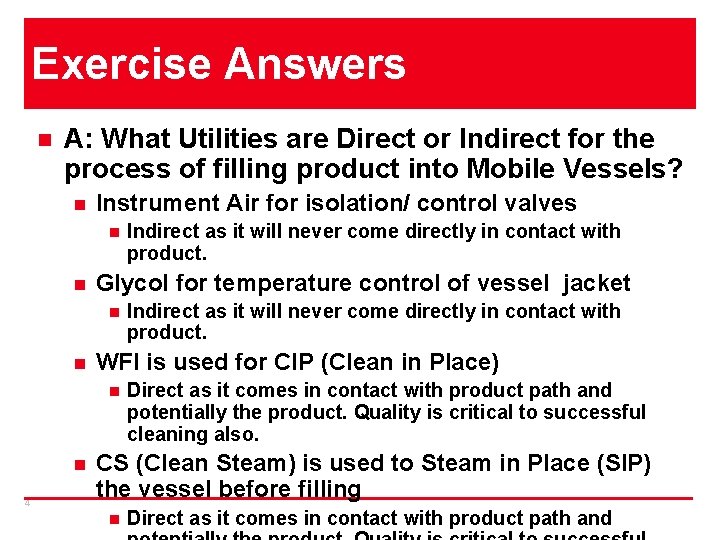
Exercise Answers n A: What Utilities are Direct or Indirect for the process of filling product into Mobile Vessels? n Instrument Air for isolation/ control valves n n Glycol for temperature control of vessel jacket n n 4 Indirect as it will never come directly in contact with product. WFI is used for CIP (Clean in Place) n n Indirect as it will never come directly in contact with product. Direct as it comes in contact with product path and potentially the product. Quality is critical to successful cleaning also. CS (Clean Steam) is used to Steam in Place (SIP) the vessel before filling n Direct as it comes in contact with product path and
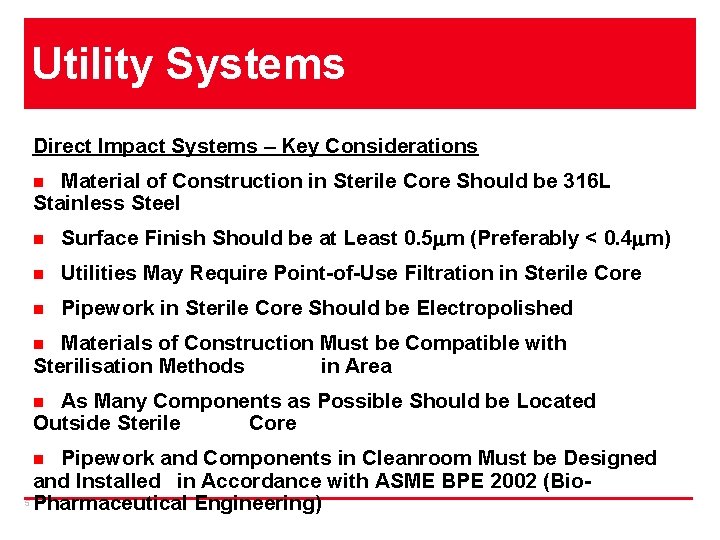
Utility Systems Direct Impact Systems – Key Considerations Material of Construction in Sterile Core Should be 316 L Stainless Steel n n Surface Finish Should be at Least 0. 5 m (Preferably < 0. 4 m) n Utilities May Require Point-of-Use Filtration in Sterile Core n Pipework in Sterile Core Should be Electropolished Materials of Construction Must be Compatible with Sterilisation Methods in Area n As Many Components as Possible Should be Located Outside Sterile Core n Pipework and Components in Cleanroom Must be Designed and Installed in Accordance with ASME BPE 2002 (Bio 5 Pharmaceutical Engineering) n
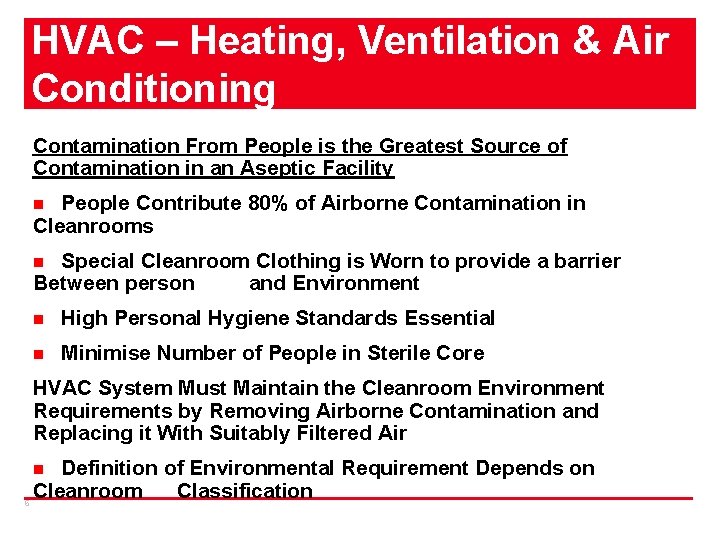
HVAC – Heating, Ventilation & Air Conditioning Contamination From People is the Greatest Source of Contamination in an Aseptic Facility People Contribute 80% of Airborne Contamination in Cleanrooms n Special Cleanroom Clothing is Worn to provide a barrier Between person and Environment n n High Personal Hygiene Standards Essential n Minimise Number of People in Sterile Core HVAC System Must Maintain the Cleanroom Environment Requirements by Removing Airborne Contamination and Replacing it With Suitably Filtered Air Definition of Environmental Requirement Depends on Cleanroom Classification 6 n
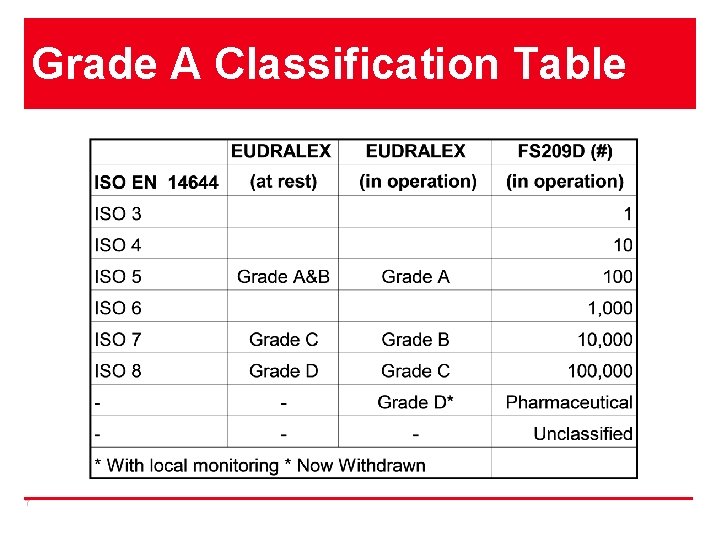
Grade A Classification Table 7
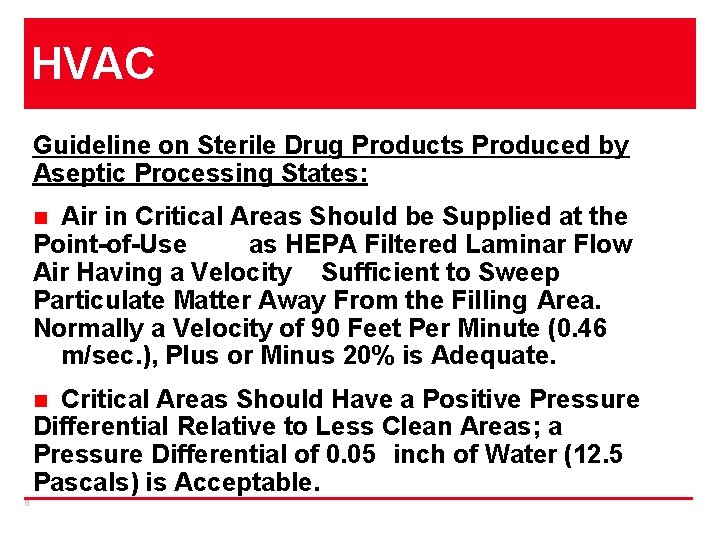
HVAC Guideline on Sterile Drug Products Produced by Aseptic Processing States: Air in Critical Areas Should be Supplied at the Point-of-Use as HEPA Filtered Laminar Flow Air Having a Velocity Sufficient to Sweep Particulate Matter Away From the Filling Area. Normally a Velocity of 90 Feet Per Minute (0. 46 m/sec. ), Plus or Minus 20% is Adequate. n Critical Areas Should Have a Positive Pressure Differential Relative to Less Clean Areas; a Pressure Differential of 0. 05 inch of Water (12. 5 Pascals) is Acceptable. n 8
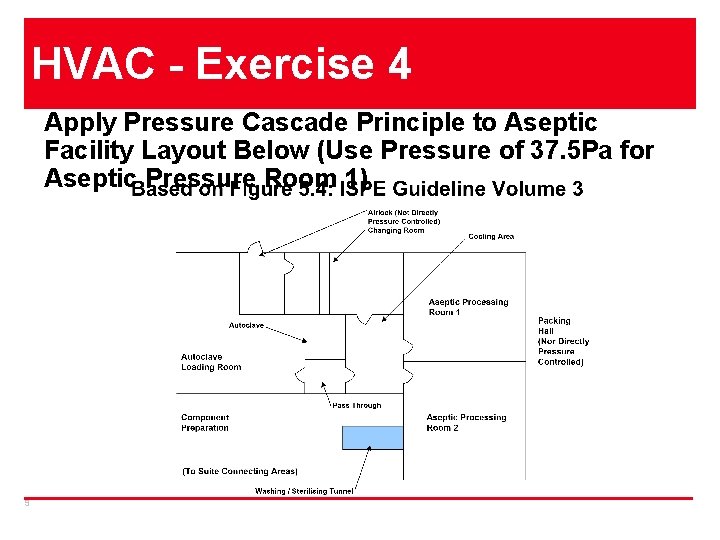
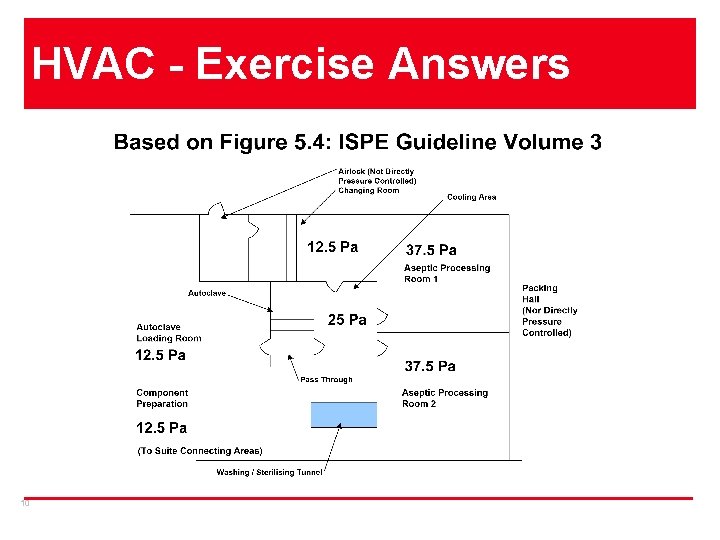
HVAC - Exercise 4 Apply Pressure Cascade Principle to Aseptic Facility Layout Below (Use Pressure of 37. 5 Pa for Aseptic Pressure Room 1) 9
HVAC - Exercise Answers 10
QUESTIONS? ? ? n 11 clement. farrar@gmail. com
Take 10 minutes! 12
Additional Slides Sterilisation Example 13
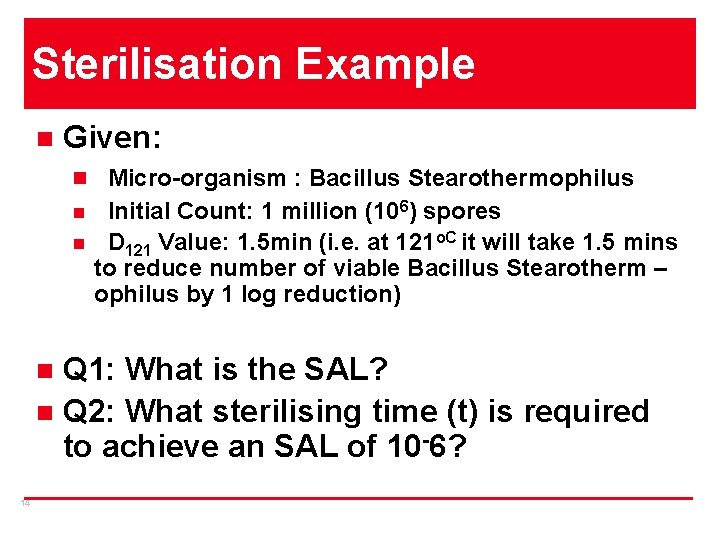
Sterilisation Example n Given: n Micro-organism : Bacillus Stearothermophilus n n Initial Count: 1 million (106) spores D 121 Value: 1. 5 min (i. e. at 121 o. C it will take 1. 5 mins to reduce number of viable Bacillus Stearotherm – ophilus by 1 log reduction) Q 1: What is the SAL? n Q 2: What sterilising time (t) is required to achieve an SAL of 10 -6? n 14
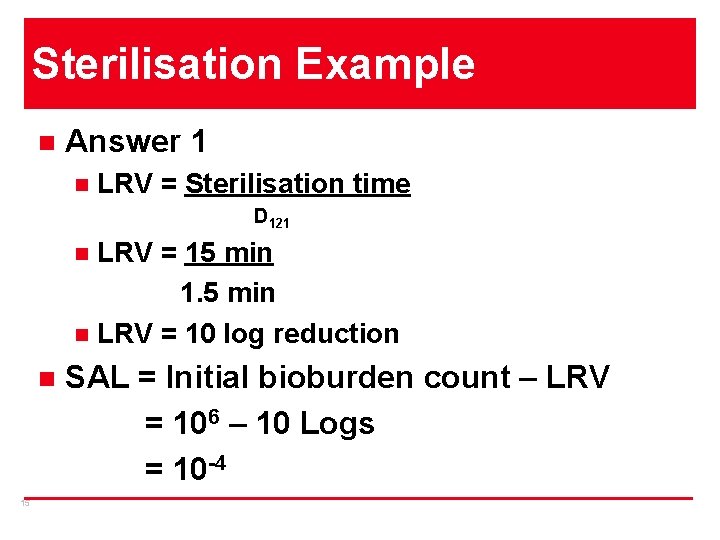
Sterilisation Example n Answer 1 n LRV = Sterilisation time D 121 LRV = 15 min 1. 5 min n LRV = 10 log reduction n n 15 SAL = Initial bioburden count – LRV = 106 – 10 Logs = 10 -4
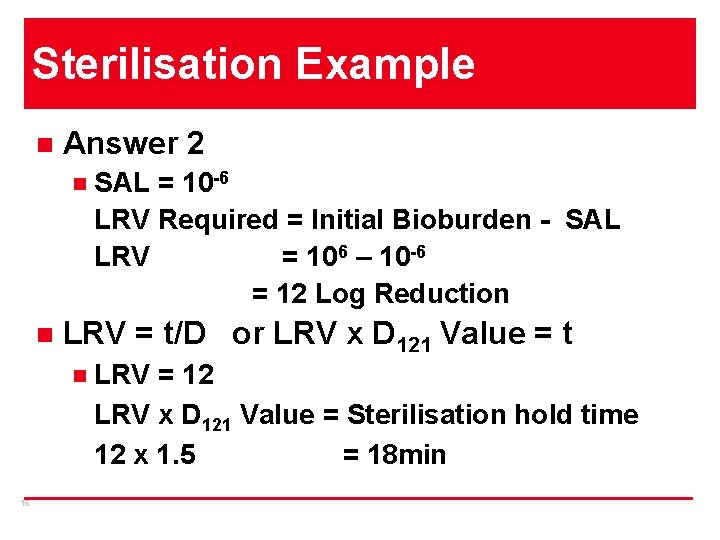
Sterilisation Example n Answer 2 n n LRV = t/D or LRV x D 121 Value = t n 16 SAL = 10 -6 LRV Required = Initial Bioburden - SAL LRV = 106 – 10 -6 = 12 Log Reduction LRV = 12 LRV x D 121 Value = Sterilisation hold time 12 x 1. 5 = 18 min