
Utilitarianism Utility net pleasure or happiness Utilitarians generally
- Slides: 24
Utilitarianism • Utility = net pleasure or happiness • Utilitarians generally use the terms happiness and utility interchangeably • The right act is that which maximizes utility or happiness • You can count yourself, but only as much as anyone else
Utilitarianism Two parts to Utilitarianism • Theory of Value = Hedonism – Only pleasure is intrinsically valuable • Theory of Action = Consequentialism – Only the results of an act are relevant to its moral evaluation – The motive of the agent or any qualities of the act itself are irrelevant
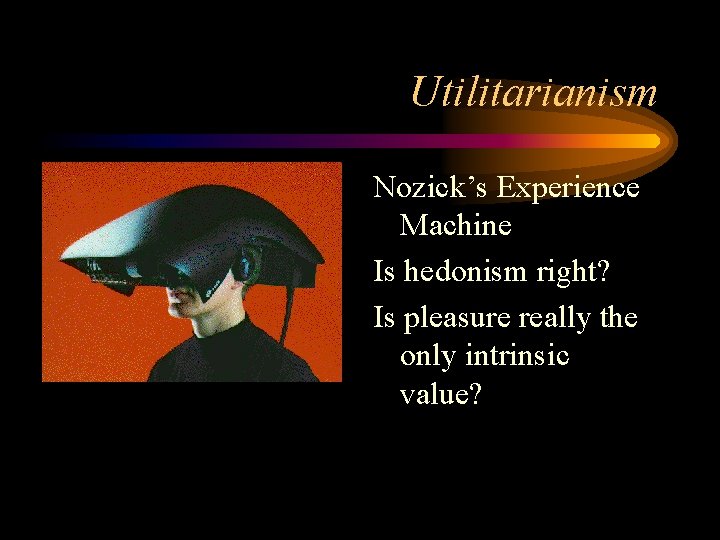
Utilitarianism Nozick’s Experience Machine Is hedonism right? Is pleasure really the only intrinsic value?
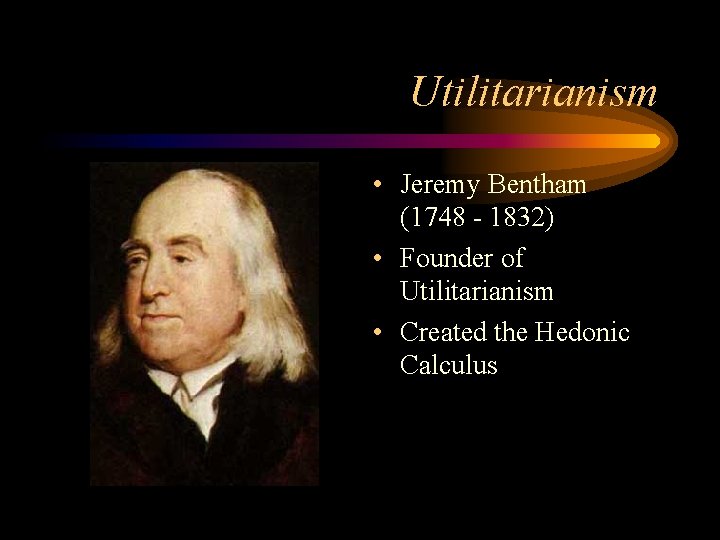
Utilitarianism • Jeremy Bentham (1748 - 1832) • Founder of Utilitarianism • Created the Hedonic Calculus
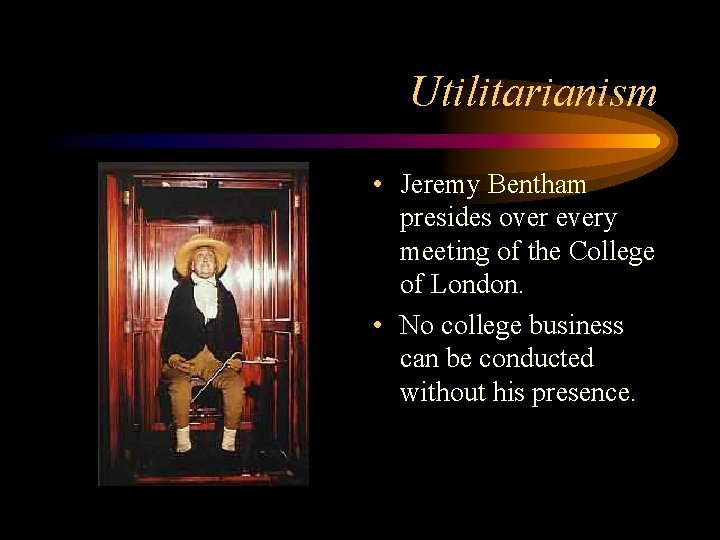
Utilitarianism • Jeremy Bentham presides over every meeting of the College of London. • No college business can be conducted without his presence.
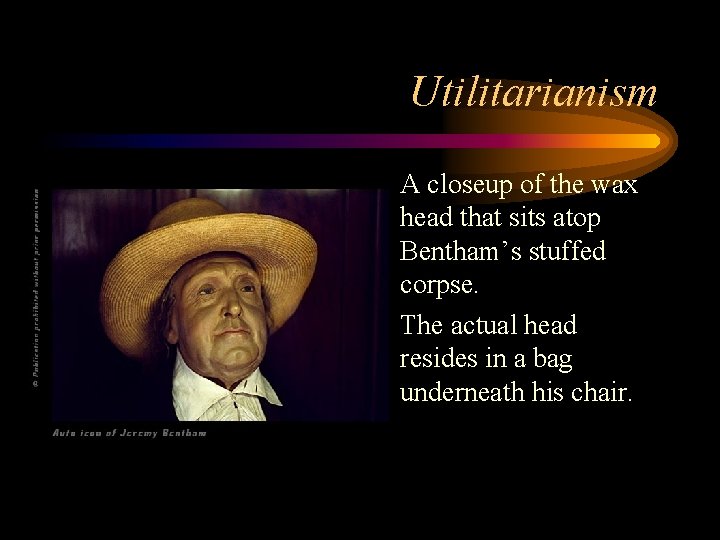
Utilitarianism • A closeup of the wax head that sits atop Bentham’s stuffed corpse. • The actual head resides in a bag underneath his chair.
Utilitarianism • Bentham: Founder of Utilitarianism – Social Reformer - reacting against stratification of society – Created the Hedonic Calculus: a practical way of maximizing utility or happiness
Utilitarianism • When calculating how much pleasure an action will produce, one should consider – Intensity – Duration – Fecundity (capacity for “growing” more pleasures)
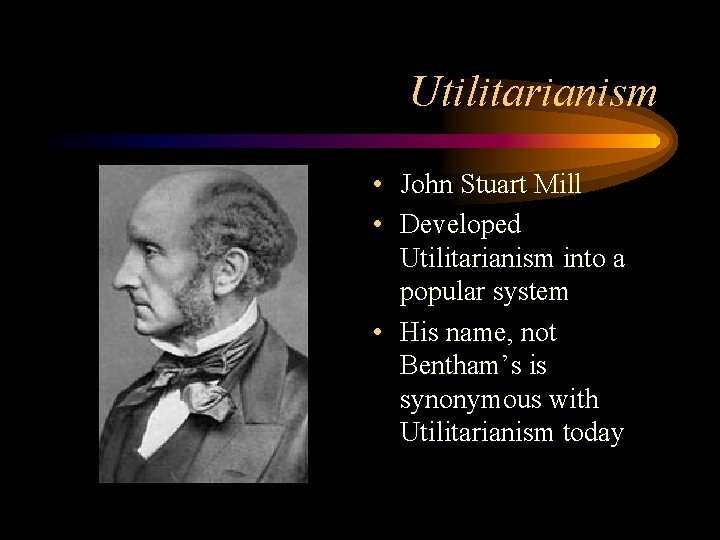
Utilitarianism • John Stuart Mill • Developed Utilitarianism into a popular system • His name, not Bentham’s is synonymous with Utilitarianism today
Utilitarianism • Objection: Utilitarianism is a crass, hedonistic philosophy • Mill’s reply: Some pleasure are qualitatively better than other (quality vs. quantity) • Different than Bentham’s calculus
Utilitarianism Some pleasures are qualitatively better than others. Bentham’s system treated all pleasures alike in kind, only differing in quantity.
Utilitarianism • Mill’s defense: “It is better to be a human being dissatisfied than a pig satisfied; better to be Socrates dissatisfied than a fool satisfied. ” • Not all pleasures are created equally. • We know some pleasure are better than others because people familiar with both prefer higher pleasures.
Utilitarianism Higher pleasures • Intellectual • Cultural Lower pleasures • Physical/bodily • Common, “blue-collar” pleasures of the uneducated masses
Utilitarianism Objections • Mill is smuggling in other values under the guise of higher quality – pleasure + knowledge – aesthetic (artistic) value • Mill is universalizing the values of the bourgeois elite (classist, ethnocentric)
Utilitarianism Objections to Mill’s distinction between higher and lower pleasures • Elitist, classist, ethnocentric (Mill: Educating the lower classes will allow them to enjoy higher pleasures also) • What you enjoy depends purely on conditioning (Mill: higher pleasures are those preferred by those who have experienced a wide range of pleasures)
Utilitarianism Mill: Educating the masses will allow them to experience higher pleasures also. Objection: What you find pleasurable is purely a matter of conditioning Reply: Man’s nature will gravitate towards learning, art and culture if afforded the opportunity
Utilitarianism: Objections Too permissive • Utilitarian response: (1) bite the bullet (2) try to show negative side-effects, long-term consequences • Rebuttal of the anti-utilitarian: The Publicity Requirement • Rejoinder: Just don’t get caught Too demanding
Utilitarianism: Objections Impractical - calculating takes too long or is too complicated to be practical Turns people into unfeeling calculating machines beholden to the results of hedonistic calculus Godless doctrine “Dirty Hands” objection: Requires one to compromise one’s principles and integrity for the greater good
Utilitarianism “Dirty Hands” objection: Requires one to compromise one’s principles and integrity for the greater good Utilitarian response: This is either squeamishness (caused by moral conditioning) or selfishness. The higher principle is the greater good.
Utilitarianism Thought experiments: • The Fat Man • The Drifter Hanged • The Unwilling Organ Donor • Torturing the Terrorist • The Drowning Child • The Bioweapons job • The Corrupt General and the Coerced Executioner
Utilitarianism Act Utilitarianism: The right act is that which maximizes happiness (only version we’ve been discussing thus far) Rule Utilitarianism: The right act is the act which is in accordance with the rule, which, if universally followed, would maximize happiness (response to the “too permissive” and “dirty hands” charges. )
Utilitarianism Objection: Rule utilitarianism “collapses” into act utilitarianism. Don’t kill unless its in self-defense. Or as a part of a war whose outcome brings a greater good. Or if by so doing you an avert the deaths of one or more innocents… OK, just don’t kill unless it maximizes happiness.
Utilitarianism Mill’s proof for utilitarianism • What’s desirable is what’s desired (intrinsically valuable) • Everyone desires happiness • Therefore happiness is desirable (intrinsically valuable) • Criticism: Naturalistic fallacy - “desired” is a fact but “desirable” is a value
Utilitarianism Peter Singer Does world poverty make Utilitarianism into a demanding philosophy after all? It is demanding, but that’s no objection, just shows we’re selfish. Examples • Bob’s Bugatti • Dora’s TV Set