
UTILITARIANISM Group 5 Ma Carmela Apelit Mary Divine


- Slides: 20
UTILITARIANISM Group 5 Ma. Carmela Apelit Mary Divine Atong Ma. Shiona Cusay Lyod Balbino Marian Jane Bolano Gemma Artates
Utilitarianism is a normative ethical theory that places the locus of right and wrong solely on the outcomes (consequences) of choosing one action/policy over other actions/policies. As such, it moves beyond the scope of one's own interests and takes into account the interests of others.
• Utilitarianism is an ethical theory that determines right from wrong by focusing on outcomes. It is a form of consequentialism. • Utilitarianism holds that the most ethical choice is the one that will produce the greatest good for the greatest number. It is the only moral framework that can be used to justify military force or war. It is also the most common approach to moral reasoning used in business because of the way in which it accounts for costs and benefits.
• However, because we cannot predict the future, it’s difficult to know with certainty whether the consequences of our actions will be good or bad. This is one of the limitations of utilitarianism. • Utilitarianism also has trouble accounting for values such as justice and individual rights. For example, assume a hospital has four people whose lives depend upon receiving organ transplants: a heart, lungs, a kidney, and a liver. If a healthy person wanders into the hospital, his organs could be harvested to save four lives at the expense of one life. This would arguably produce the greatest good for the greatest number. But few would consider it an acceptable course of action, let alone the most ethical one.
Utilitarians believe that the purpose of morality is to make life better by increasing the amount of good things (such as pleasure and happiness) in the world and decreasing the amount of bad things (such as pain and unhappiness). They reject moral codes or systems that consist of commands or taboos that are based on customs, traditions, or orders given by leaders or supernatural beings. Instead, utilitarians think that what makes a morality be true or justifiable is its positive contribution to human (and perhaps non-
THE 2 BRITISH UTILITARIANISM
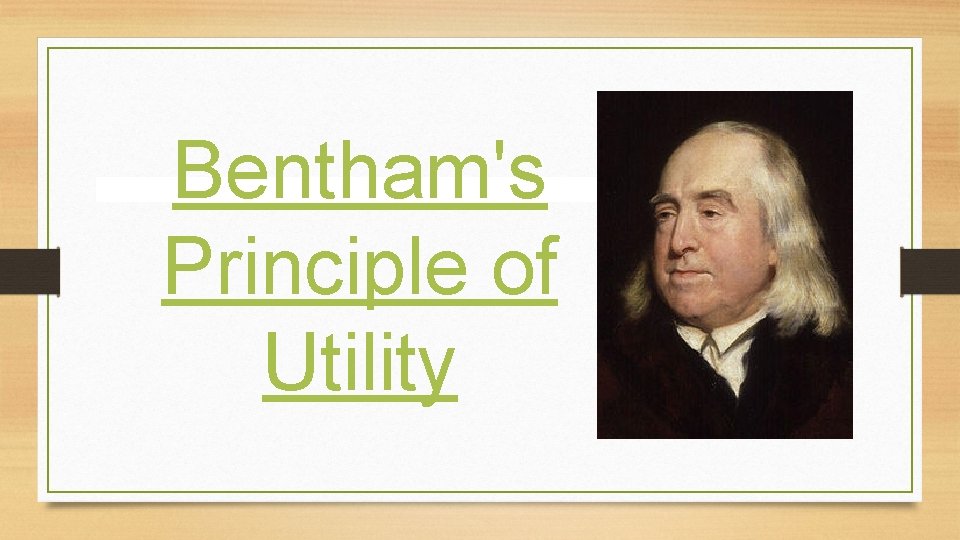
Bentham's Principle of Utility
(1)Recognizes the fundamental role of pain and pleasure in human life, (2)approves or disapproves of an action on the basis of the amount of pain or pleasure brought about i. e, consequences, (3)equates good with pleasure and evil with pain, and (4)asserts that pleasure and pain are capable of quantification (and hence 'measure').
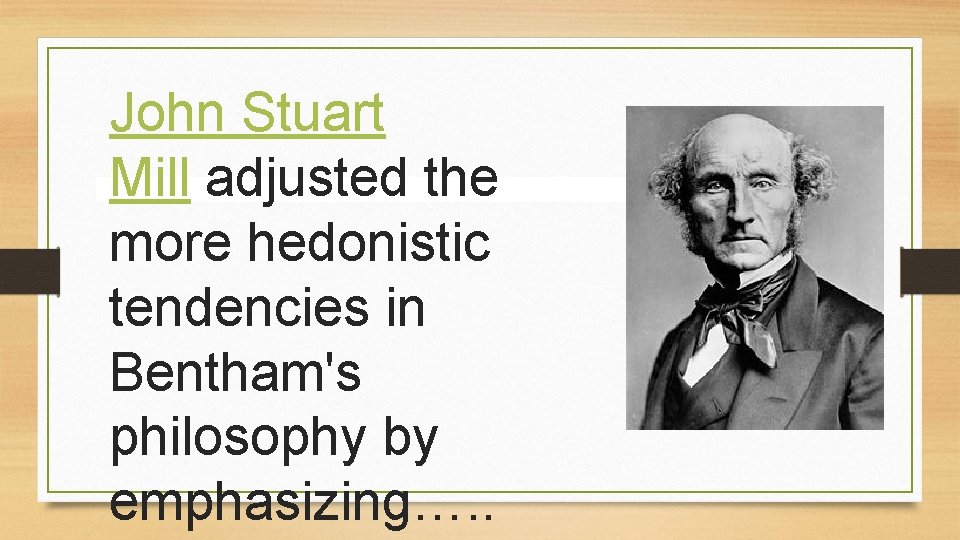
John Stuart Mill adjusted the more hedonistic tendencies in Bentham's philosophy by emphasizing…. .
(1) It is not the quantity of pleasure, but the quality of happiness that is central to utilitarianism, (2) the calculus is unreasonable -- qualities cannot be quantified (there is a distinction between 'higher' and 'lower' pleasures), and (3) utilitarianism refers to "the Greatest Happiness Principle" -- it seeks to promote the capability of achieving happiness (higher pleasures) for the most amount of people (this is its "extent").
Jeremy Bentham (1748 -1832) developed the principles of utility by defining it as a measure of maximizing pleasure while minimizing pain. Bentham wrote that everyone prefers pleasure over pain. It is with this belief that utilitarian moral principles are founded (Sandel, 2010). In developing theory of utilitarianism, Bentham may have meant pleasure as in “happiness” and pain as in “sadness”; however, Bentham’s rendering of utilitarianism sounded hedonistic, as if sensuality was the measure Bentham associated with pleasure (Hinman, 2013).
John Stuart Mill reconsidered the principles of utilitarianism and suggested that pleasure should not merely refer to sensual pleasure but also to mental pleasure, such as music, literature, and friendship. Mill sought to make intellectual pleasures preferable to sensual ones.
Hinman (2013) suggests there are four principle differences between pleasure and happiness: • Happiness is related to the mind, whereas pleasure is related to the body (for example sexual pleasure, eating, drinking) • Pleasure is of shorter duration than happiness. Happiness is long-term, focusing on the satisfaction of living well, or achieving life goals. • Happiness may encompass pleasure and pain. • There is an evaluative element in happiness versus pleasure.
Act and Rule Utilitarianism We can apply the principle of utility to either PARTICULAR ACTIONS or GENERAL RULES. The former is called "act-utilitarianism" and the latter is called "rule-utilitarianism. "
Act-utilitarianism -- The principle of utility is applied directly to each alternative act in a situation of choice. The right act is then defined as the one which brings about the best results (or the least amount of bad results).
Rule-utilitarianism -- The principle of utility is used to determine the validity of rules of conduct (moral principles). A rule like promisekeeping is established by looking at the consequences of a world in which people broke promises at will and a world in which promises were binding. Right and wrong are then defined as following or breaking those rules.
The Problems with Utilitarianism
1. Measuring happiness is difficult. 2. Utilitarian ethics is concerned about the consequences of our actions, regardless of the action itself. 3. Desired ethical consequences that actually result from our actions do not always happen immediately. 4. Happiness should not be the only consequence or goal that matters in some ethical dilemmas. 5. When utilitarian decisions benefit the majority at the expense of the minority, the minority’s rights may not be taken into account.
Here are some videos to farther discuss Utilitarianism