
Utilitarianism Dr Daniel Hampikian Utilitarianism and its application




- Slides: 49
Utilitarianism Dr. Daniel Hampikian
Utilitarianism and its application to moral issues Structure of this section: Understand Bentham’s utilitarianism and Mill’s important improvement. Understand Mill’s act utilitarianism and the difference between qualitatively superior and qualitatively inferior pleasures Learn to apply utilitarian moral reasoning to three contemporary issues: The moral status of euthanasia The legalization of marijuana Our obligations to animals Perform a peer based learning exercise comparing our moral obligations to developed fetuses and pregnant women and our moral obligations to animals.
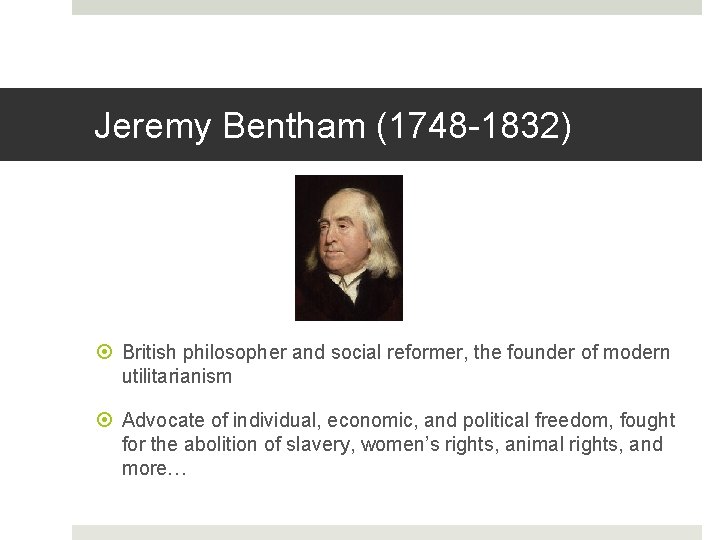
Jeremy Bentham (1748 -1832) British philosopher and social reformer, the founder of modern utilitarianism Advocate of individual, economic, and political freedom, fought for the abolition of slavery, women’s rights, animal rights, and more…
Auto-Icon http: //www. ucl. ac. uk/Bentham. Project/who/autoicon/Virtual_Auto_Icon
The view Bentham’s utilitarianism: To act morally is to do is what will cause the greatest happiness for the most people. To act immorally is to cause suffering. Happiness is pleasure, broadly construed to include all mental states that feel good Actions are to be evaluated in terms of their consequences the total pleasure or pain they produce
The radical innovation Morality is impartial, based on natural faculties shared by all persons (and all animals), and objective (not limited to a culture or religion). What reason is there to think that the only good, both moral and prudential, is pleasure? The only proof that happiness is desirable is that people do desire it (Compare: the only reason that something is visible is that people actually see it)
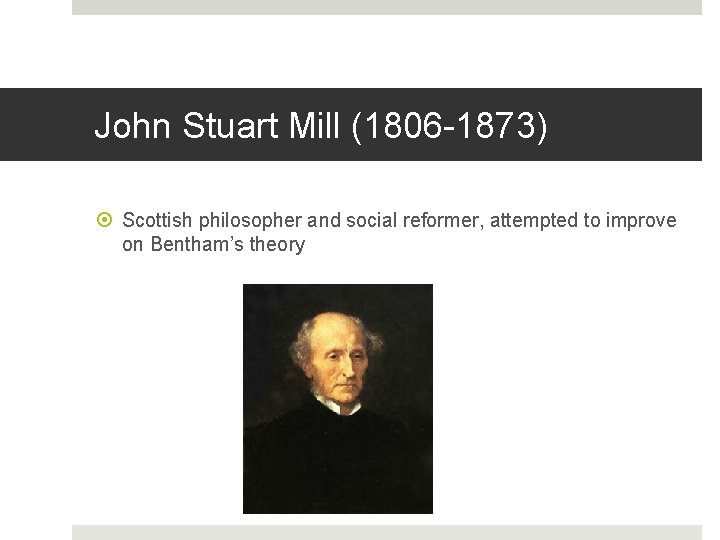
John Stuart Mill (1806 -1873) Scottish philosopher and social reformer, attempted to improve on Bentham’s theory
Initial problems for Bentham’s view Malicious pleasures (schadenfreude) Necessary elements of happiness that involve pain. Being in a semi permanent state of intense pleasure is not sufficient for happiness. These objections led Bentham’s follower Mill to argue that in such cases there is a difference in kind between certain mental pleasures and base or purely physical pleasure. Some pleasures are qualitatively different from the physical pleasures attended by sex, eating, schadenfreude, etc.
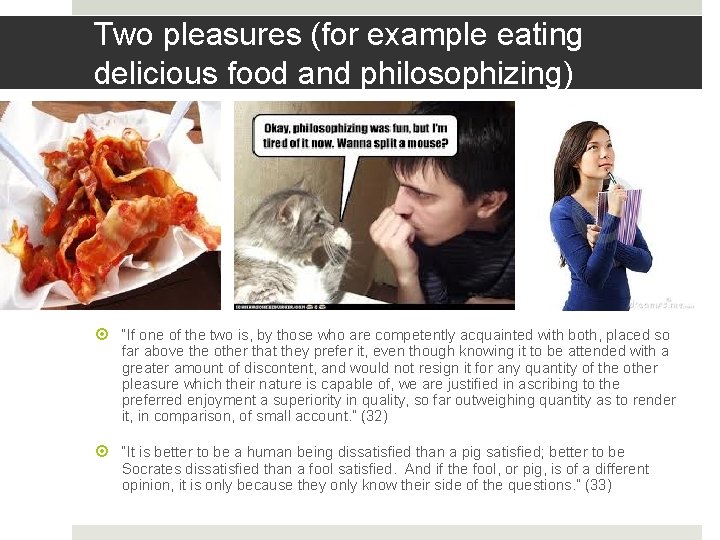
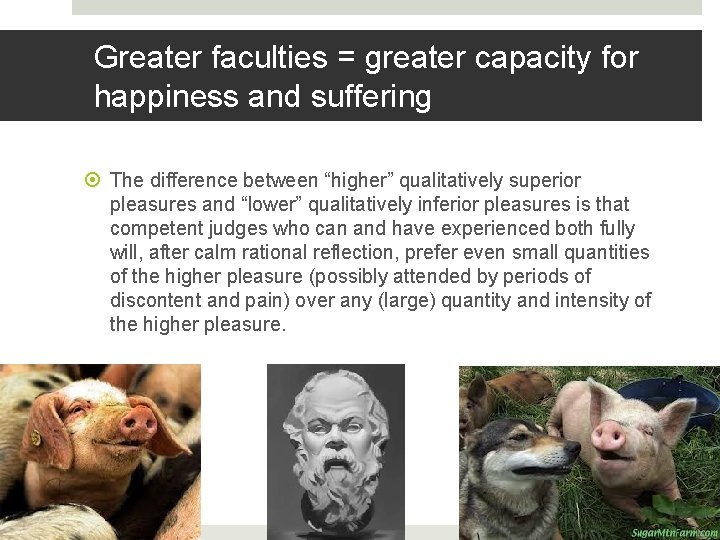
Two pleasures (for example eating delicious food and philosophizing) “If one of the two is, by those who are competently acquainted with both, placed so far above the other that they prefer it, even though knowing it to be attended with a greater amount of discontent, and would not resign it for any quantity of the other pleasure which their nature is capable of, we are justified in ascribing to the preferred enjoyment a superiority in quality, so far outweighing quantity as to render it, in comparison, of small account. ” (32) “It is better to be a human being dissatisfied than a pig satisfied; better to be Socrates dissatisfied than a fool satisfied. And if the fool, or pig, is of a different opinion, it is only because they only know their side of the questions. ” (33)
Greater faculties = greater capacity for happiness and suffering The difference between “higher” qualitatively superior pleasures and “lower” qualitatively inferior pleasures is that competent judges who can and have experienced both fully will, after calm rational reflection, prefer even small quantities of the higher pleasure (possibly attended by periods of discontent and pain) over any (large) quantity and intensity of the higher pleasure.
Mill’s act utilitarianism The higher pleasures of virtue, artistic creation, friendship, intellectual discovery and achievement, and so on are desirable both as a means to happiness and in and for themselves (they are part of happiness as well as a means to achieve it). What you should do is to act so as to bring about the optimal balance of higher quality pleasures over pains. This entails both acting to prevent suffering, and acting to promote happiness. You ought to act so as to cause the greatest possible amount of pleasure of the best quality in the most people. You ought to avoid or prevent actions to the extent that they produce the greatest possible amount of suffering of the worst quality in the most people.
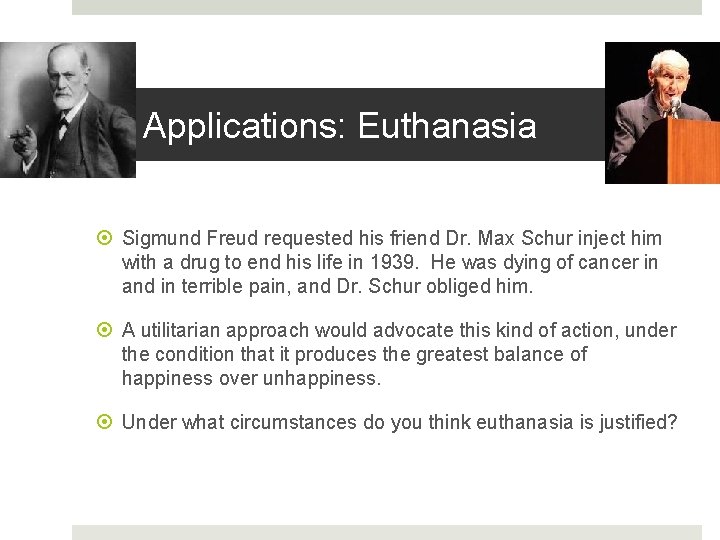
Applications: Euthanasia Sigmund Freud requested his friend Dr. Max Schur inject him with a drug to end his life in 1939. He was dying of cancer in and in terrible pain, and Dr. Schur obliged him. A utilitarian approach would advocate this kind of action, under the condition that it produces the greatest balance of happiness over unhappiness. Under what circumstances do you think euthanasia is justified?
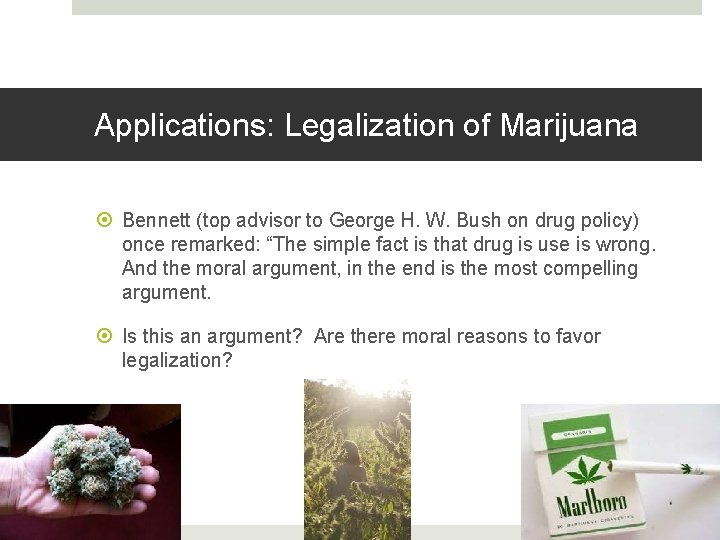
Applications: Legalization of Marijuana Bennett (top advisor to George H. W. Bush on drug policy) once remarked: “The simple fact is that drug is use is wrong. And the moral argument, in the end is the most compelling argument. Is this an argument? Are there moral reasons to favor legalization?
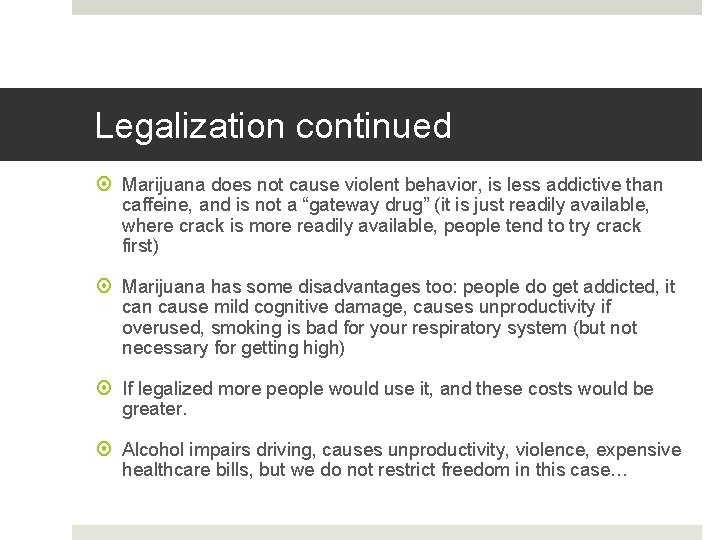
Legalization continued Marijuana does not cause violent behavior, is less addictive than caffeine, and is not a “gateway drug” (it is just readily available, where crack is more readily available, people tend to try crack first) Marijuana has some disadvantages too: people do get addicted, it can cause mild cognitive damage, causes unproductivity if overused, smoking is bad for your respiratory system (but not necessary for getting high) If legalized more people would use it, and these costs would be greater. Alcohol impairs driving, causes unproductivity, violence, expensive healthcare bills, but we do not restrict freedom in this case…
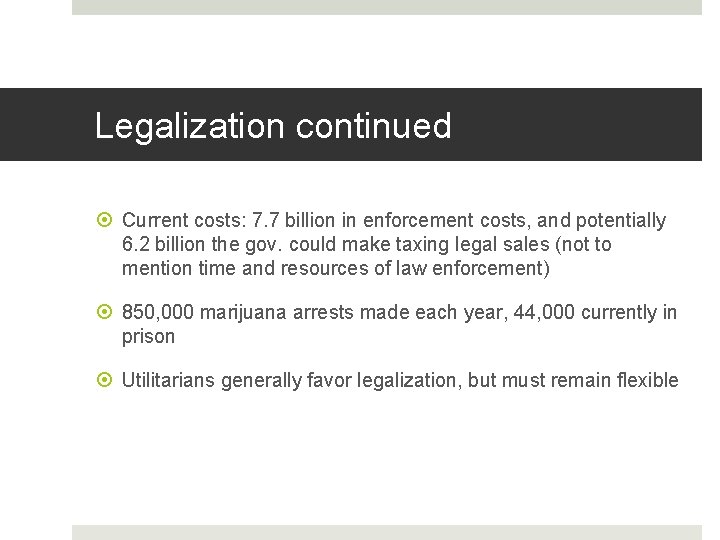
Legalization continued Current costs: 7. 7 billion in enforcement costs, and potentially 6. 2 billion the gov. could make taxing legal sales (not to mention time and resources of law enforcement) 850, 000 marijuana arrests made each year, 44, 000 currently in prison Utilitarians generally favor legalization, but must remain flexible
Application: Nonhuman animals “The question is not, Can they reason? Nor Can the talk? but, Can they suffer? ” (Bentham) What makes it wrong when a human is tormented is that they suffer. Animals too can suffer. Our duty to humans and animals will vary depending on their cognitive capacities. Humans can enjoy things animals cannot, and suffer frustrations animals cannot. Our duties to humans involve the promotion of these more complex pleasures and pains, but when it is the same kind of suffering the suffering of an animal counts equally with the suffering of a human.
The Methods of Factory Farming
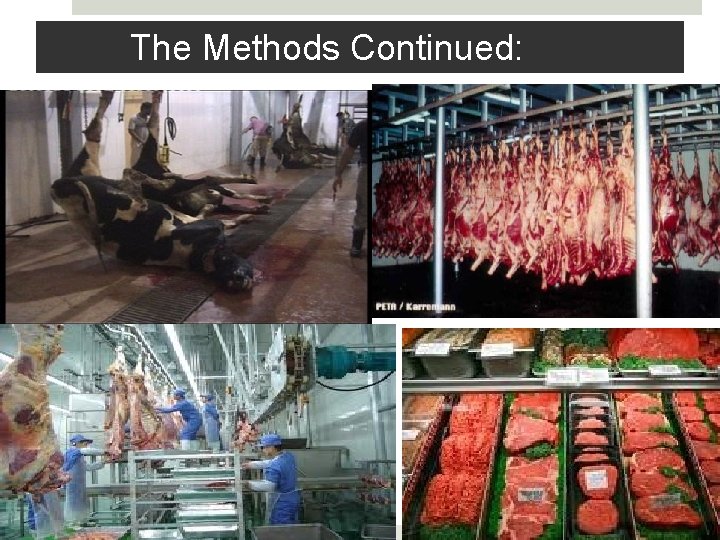
The Methods Continued:
Nonhuman animals continued Eating meat is giving an economic vote to the extreme suffering of animals. Animals in slaughter houses are kept in abhorrent conditions, they cannot move freely, they are perpetually in states of fear, frustration, boredom, and pain, they sustain sever sometimes intentional injuries that are not treated, they are killed prematurely, etc. Eating meat affords an amount of “lower” pleasures, but the suffering and death of millions animals outweighs that small amount of pleasure. And of course, it’s healthy for all stages of life: http: //www. choosemyplate. gov/healthy-eating-tips/tips-forvegetarian. html and evidence based systematic reveiw: http: //www. vrg. org/nutrition/2009_ADA_position_paper. pdf
Peter Singer’s Animal Liberation Mary Wollstonecraft’s Vindication of the Rights of Woman in 1792 was anonymously criticized by Thomas Taylor who attempted to show that her arguments for equal consideration for the interests of woman despite differences between woman and men could be applied to dogs, cats, and horses. Women and different races should receive equal consideration, and restricting consideration on the basis of irrelevant differences in sex and gender is arbitrary and unfair. There should be no difference in consideration of the interests of some being without a morally relevant difference in the capacities of that being.
Peter Singer’s Animal Liberation The principle of equality does not require equal or identical treatment, only equal consideration (dogs should not be given the right to vote, since they can’t vote). Why is racism or sexism wrong? Arbitrary discrimination so that only the interests of members of a certain group are considered important. Intelligencism, or strengthism, would also be unjustified discrimination even though it targets an ability rather than a race or gender.
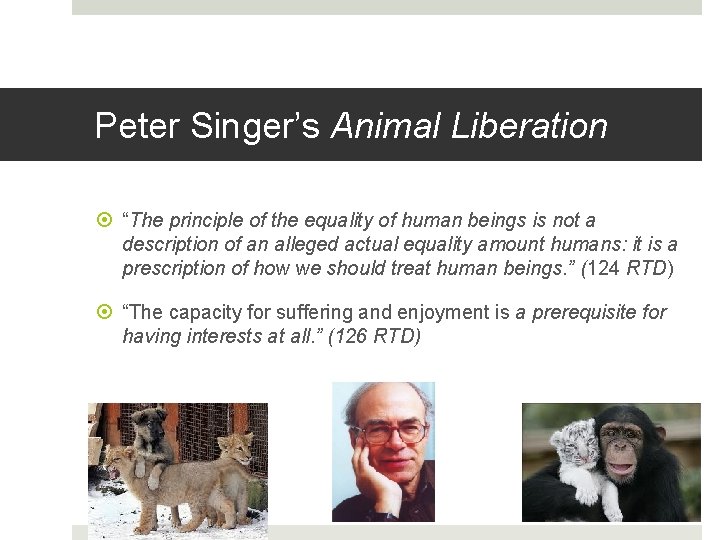
Peter Singer’s Animal Liberation “The principle of the equality of human beings is not a description of an alleged actual equality amount humans: it is a prescription of how we should treat human beings. ” (124 RTD) “The capacity for suffering and enjoyment is a prerequisite for having interests at all. ” (126 RTD)
In Class Peer Based Learning Exercise In 5 minutes, answer the following question on a sheet of paper or your computer. Then, in the next 5 minutes, explain your answer and your reason for that answer to a peer and have them explain their answer, and their reason for that answer to you. Then in the final 5 minutes I will call on one of you to explain both your answer and your peers answer for class participation credit. If we are morally obligated on utilitarian grounds to care for animals because they can suffer, are we also morally obligated to prevent third trimester abortions because fully developed fetuses can feel pain? Or are there important differences between these two cases? Try to use either social contract theory or utilitarianism to support your answer.
Readings for next time: Chapter 4 and 5 of RTD: “Utilitarianism and Integrity” (Williams) and “The Experience Machine” (Nozick) Chapter 8 of Elements: “The Debate Over Utilitarianism” (
Structure of this section Consider some theoretical problems for utilitarianism as a complete account of morality Understand some well known moral dilemmas and various factors that make these dilemmas hard to explain for utilitarianism Consider utilitarianism and its application to the moral issue of economic, social, and medical disparity between the people of underdeveloped and developed countries. More problems for utilitarianism: Backwards-looking reasons In class peer based learning exercise: The ethics of televised gladiator matches
Problems for the view Robert Nozick and the Experience Machine A machine that simulates any experiences you might want to have that you can plug into. If utilitarianism is correct, we ought all plug in to such a machine.
Reasons why we wouldn’t plug in: We want to do certain things, and not just have the experience of doing them We want to be a certain sort of person (courageous, kind, witty, etc. ) There is no actual contact with reality (it is not like taking drugs to get actually be in contact with a deeper reality, it is like taking drugs to surrender to a simulation of reality)
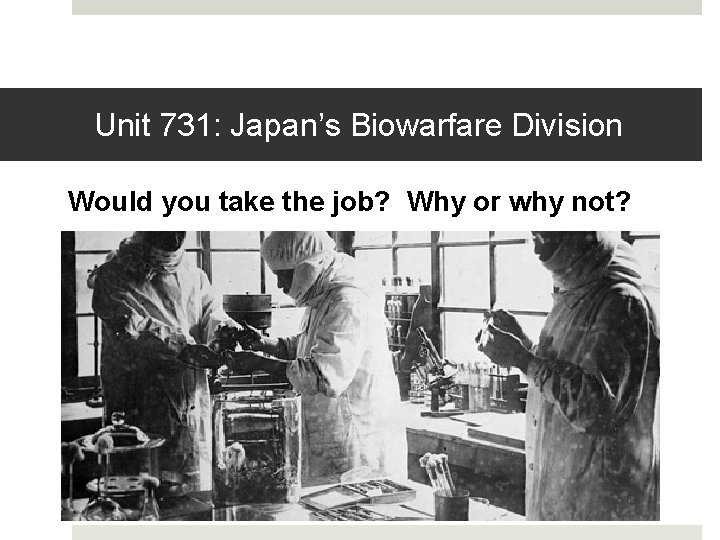
Problems for the view Bernard Williams’ 2 examples showing why utilitarianism cannot account for integrity (knowing and deciding your actions according to your moral identity and the emotions that proceed from such an identity): George is offered a job doing research into chemical and biological warfare that will go to his dangerously enthusiastic peer if he turns it down. His family really needs the job, and it seems taking it would decrease overall suffering…
Unit 731: Japan’s Biowarfare Division Would you take the job? Why or why not?
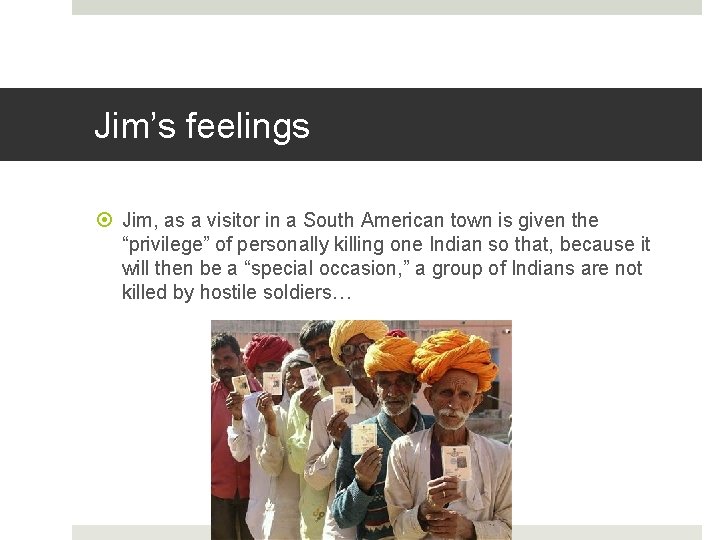
Jim’s feelings Jim, as a visitor in a South American town is given the “privilege” of personally killing one Indian so that, because it will then be a “special occasion, ” a group of Indians are not killed by hostile soldiers…
Self-indulgent squeamishness? Utilitarianism cannot explain why these feelings that you would be doing something wrong should even be felt. From a utilitarian perspective, they are merely unpleasant experiences you should try to eradicate. But this would mean that these feelings are irrational rather than true expressions of what we think would be doing something wrong, even though we did not create the situation participating in the situation is doing something wrong. If these feelings are more than just self-indulgent squeamishness, if they are a recognition of our moral sense of right and wrong and not wanting to go against that moral sense even if doing so would have better consequences, then utilitarianism cannot explain all of morality.
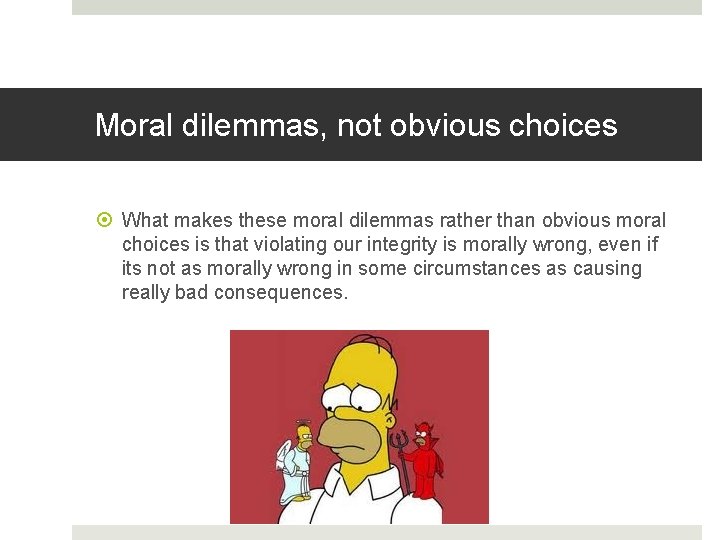
Moral dilemmas, not obvious choices What makes these moral dilemmas rather than obvious moral choices is that violating our integrity is morally wrong, even if its not as morally wrong in some circumstances as causing really bad consequences.
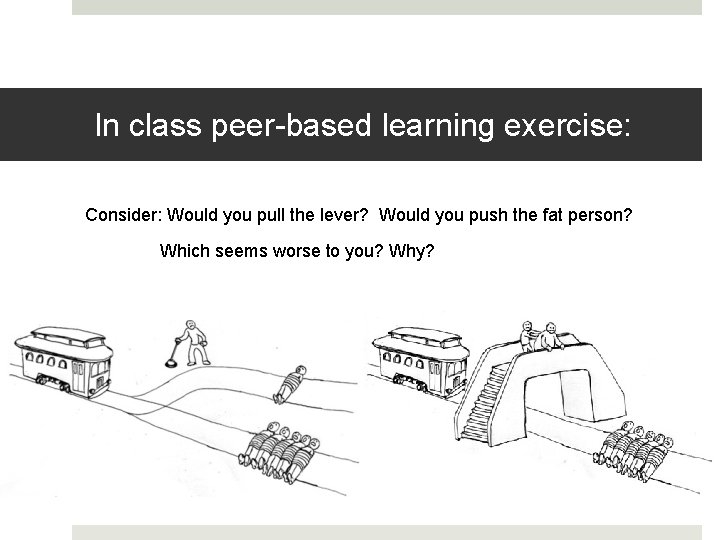
In class peer-based learning exercise: Consider: Would you pull the lever? Would you push the fat person? Which seems worse to you? Why?
9/11 and Starvation 2, 987 innocent people died after the 9/11 terrorist attacks The US government, the Red Cross, together donated 5 billion and 143. 4 million dollars in aid to the emergency and the families of the victims On the same day 33, 000 children died senseless, needless deaths. They could have been easily prevented Rehydration salts (15 cents), antibiotics (25 cents) and vitamin A therapy (10 cents) could have prevented virtually all of these deaths. The same amount of children died on 9/12, 9/13, and so on until today.
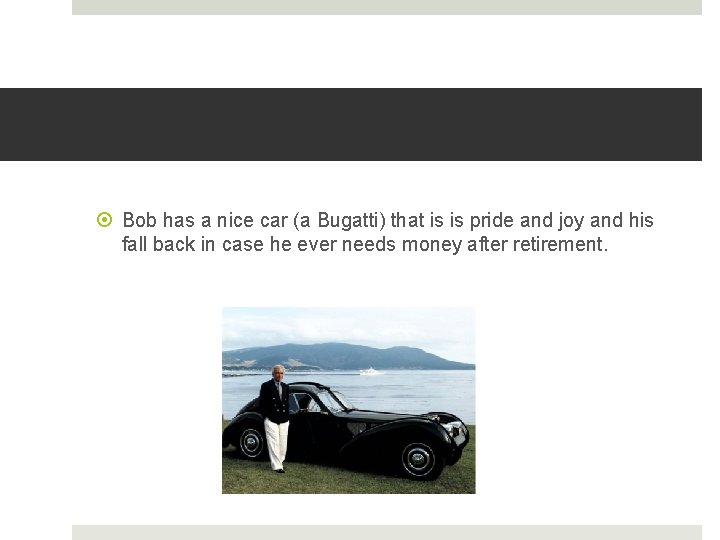
Bob has a nice car (a Bugatti) that is is pride and joy and his fall back in case he ever needs money after retirement.
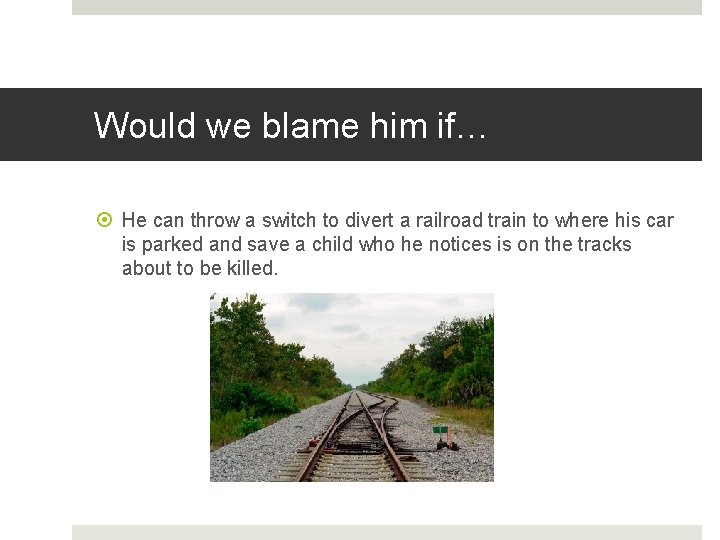
Would we blame him if… He can throw a switch to divert a railroad train to where his car is parked and save a child who he notices is on the tracks about to be killed.
According to a team of experts and Peter Unger… 200. 00 dollars in donation would be enough to offer safe passage to a child who would otherwise die from ages 2 to 6, the most dangerous years. UNICEF or Oxfam America Why do we not do this? Luxury and entertainment are nothing compared to saving the life of an innocent child.
Some Standard Objections The government should give the money, not individuals (it does not give enough, and so that does not relieve you personally of the responsibility of a potential alive or dead child) Others don’t give there fair share, why should I give more to make up for them (but you are aware that a child will die if you do not give, especially since other will not). Louis CK: http: //www. youtube. com/watch? v=l. C 4 Fnf. NKw. Uo
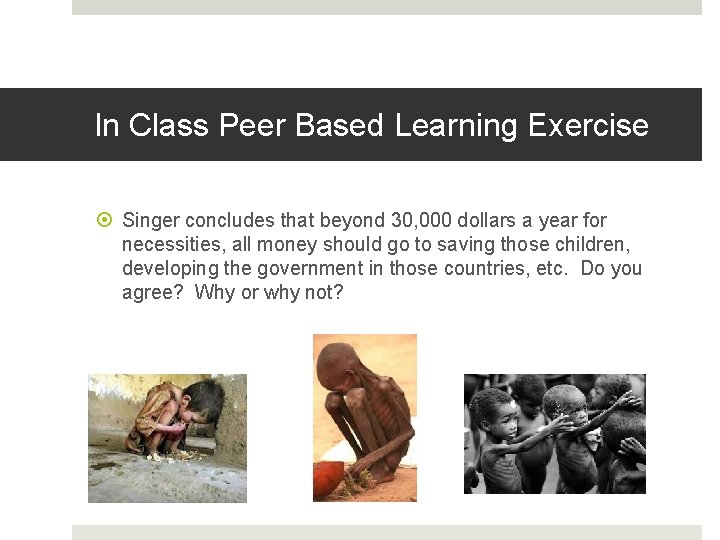
In Class Peer Based Learning Exercise Singer concludes that beyond 30, 000 dollars a year for necessities, all money should go to saving those children, developing the government in those countries, etc. Do you agree? Why or why not?
Problems for theory Acts of promising seem to generate obligations that utilitarianism cannot easily account for: If I promise to buy a house, but then realize that I would rather spend the money taking my friends to Mexico, then even if backing out of the deal will result in one person suffering and many people having a great time (net happiness is up), it still seems wrong to break my promise.
Motivation The motivation for an act is largely irrelevant for utilitarianism. As long as the act promotes greater happiness, the act is a moral one. A person then who is malicious but incredibly bad at predicting how to make people suffer might give poor people money (the root of all evil) in order that they come to harm. Such a person would be acting to promote happiness, but with the motive of promoting suffering. His action would, nevertheless, on utilitarian grounds be moral. Or suppose that a doctor acts with the best of intentions to cure a persons disease, but winds up causing them immense suffering and eventually death…
Hedonism Pleasure is the one and ultimate good, pain the one and ultimate evil. Yet utilitarianism does not need to rely on this notion of happiness. Yet isn’t it bad if your significant other cheats on you and you never find out? Isn’t it a tragedy to loose your interest in creative expression and simply watch TV all the time, even if you enjoy the latter just as much? Possible replies: Mill’s higher and lower pleasures, G. E. Moore’s intrinsic goods that you can increase the amount of (pleasure, friendship, aesthetics pleasure, etc. , ), preference satisfaction.
Consequences Because we often think that justice is more or as important as acting to produce good consequences, utilitarianism cannot possibly be a complete explanation of morality. For example, suppose that to prevent a race riot, an innocent man could be convicted of a rape they did not commit. For example, consider a Peeping Tom who takes pictures of a woman who does not realize it, and circulates those photos to others, all of whom are silent about it, do not interact with the woman, and receive pleasure from the photos.
Backward-Looking Reasons Promises are things you did in the past that impose an obligation on you now. But even if fulfilling your promise causes you more suffering than the suffering of a person whom you break your promise to, you still have a moral reason to keep that promise. Harming someone in the past is a moral reason to be kind to them now, someone doing you a favor in the past is a reason to do them a favor in the future, and so on. But backward-looking reasons are irrelevant to morality from a utilitarian perspective, which looks only to the future consequences of actions There may be a way around this, however, since not taking account of such reasons might lead to a society that on a whole suffers…
Utilitarianism is too demanding All luxuries and personal projects should be forgone in order to save children in third world counties, help the homeless, help animals, etc. This seems supererogatory, not morally required. Utilitarianism also requires that we treat our family and friends impartially, as potential pleasure or pain sources, but loving relationships involve special responsibilities and obligations.
Possible responses: Acts of promise-breaking, lying, etc. , actually do not have good consequences for happiness, and when they do they are moral. Rule utilitarianism: a right action is one that accords with a system of rules that, if adopted by a society, would result in optimal happiness for that society. However, when those rules have exceptions, then either the view collapses back into act utilitarianism, or else it is not aggregate happiness that makes something moral…
Utilitarianism can still be defended… The reason that lying, promise breaking, ignoring integrity, justice, and rights are wrong is that they cause suffering. When people find out about lies, they are hurt and betrayed, when you break a promise you irritate and alienate your friends, when people don’t care about there children, the children feel unloved. In all these cases happiness is reduced. In special cases, like the riot example, or the Williams example, our gut reactions are mistaken and instinctual. Normally lying and killing create suffering rather than reduce it, hence our initial reaction which is actually mistaken. They are mistaken additionally because we do not think about all of the consequences (the others that will die or be beaten by the mob, the people that will be shot in the Williams example, the children that will literally starve, etc. )
Readings: “The Categorical Imperative” Immanuel Kant (RTD Chap. 7) “A Defense of the Death Penalty” Louis Pojman (RTD Chap. 24)
In Class Peer Based Learning Exercise: If something that gives many people pleasure makes a few people suffer, then as long as the overall consequences are more net happiness over suffering it is something that we ought to do, according to Utilitarianism. Consider if we televised real gladiator fights to the death. This would possibly entertain millions of people, but it would mean the suffering of a few. Do you think it would moral to coerce people into participating in such matches? Why or why not?