
Utilitarianism Act Utilitarianism Jeremy Bentham Bentham came from
Utilitarianism

• Act Utilitarianism (Jeremy Bentham) • Bentham came from a family of lawyers working in the city of London, but became disgusted with the law as then practiced since he felt that it was more about making money than helping those in need. • He was a practical man concerned with the social conditions of his day and particularly with the conditions of prisions and hospitals. He wanted to find a moral basis for law that could serve to benefit the whole of society. • Whilst reading Priestley’s Essay on Government Bentham came across the expression ‘the greatest good of the greatest number’ and cried out, like Archimedes, ‘Eureka’ • He applied this principle of utility to reforming areas of criminal law, the jury system, prisons, abolition of transportation and imprisonment for debt, development of savings banks, cheap postage, registration of births and deaths • In 1789 he wrote 'The priniciples of moral and Legislation' in which he put foward his ethical theory and divided his book into 3 sections: • His view on what drove humans and what goodness and badness is all about • The Hedonic Calculus • The prinicple of Utlilty his moral rule
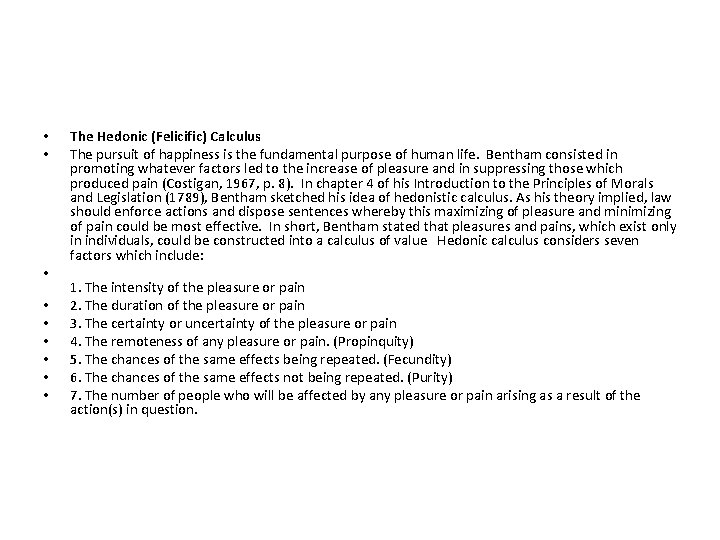
• • • The Hedonic (Felicific) Calculus The pursuit of happiness is the fundamental purpose of human life. Bentham consisted in promoting whatever factors led to the increase of pleasure and in suppressing those which produced pain (Costigan, 1967, p. 8). In chapter 4 of his Introduction to the Principles of Morals and Legislation (1789), Bentham sketched his idea of hedonistic calculus. As his theory implied, law should enforce actions and dispose sentences whereby this maximizing of pleasure and minimizing of pain could be most effective. In short, Bentham stated that pleasures and pains, which exist only in individuals, could be constructed into a calculus of value Hedonic calculus considers seven factors which include: 1. The intensity of the pleasure or pain 2. The duration of the pleasure or pain 3. The certainty or uncertainty of the pleasure or pain 4. The remoteness of any pleasure or pain. (Propinquity) 5. The chances of the same effects being repeated. (Fecundity) 6. The chances of the same effects not being repeated. (Purity) 7. The number of people who will be affected by any pleasure or pain arising as a result of the action(s) in question.

• The Principle of Utility is the very basis of Utilitarianism. It states that something is morally right if it produces pleasure, and morally wrong if it produces pain. As you can see this is the basis of both Act and Rule Utilitarianism: the maximisation of pleasure and the minimisation of pain; The difference is the way in which they go about achieving this.
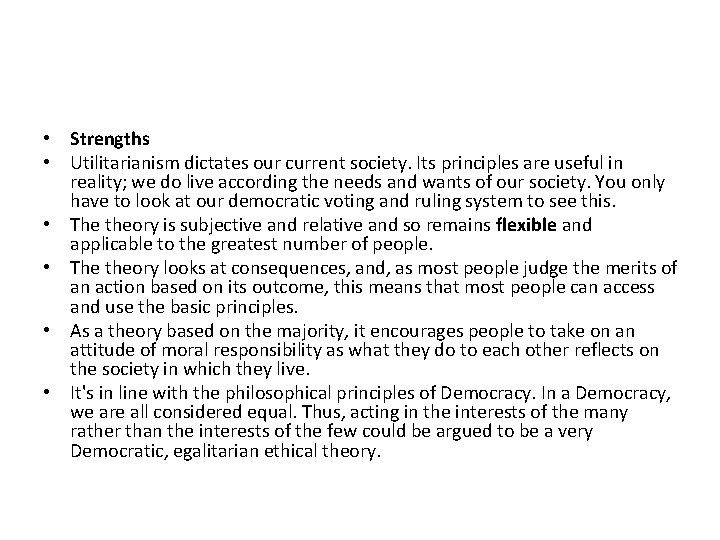
• Strengths • Utilitarianism dictates our current society. Its principles are useful in reality; we do live according the needs and wants of our society. You only have to look at our democratic voting and ruling system to see this. • The theory is subjective and relative and so remains flexible and applicable to the greatest number of people. • The theory looks at consequences, and, as most people judge the merits of an action based on its outcome, this means that most people can access and use the basic principles. • As a theory based on the majority, it encourages people to take on an attitude of moral responsibility as what they do to each other reflects on the society in which they live. • It's in line with the philosophical principles of Democracy. In a Democracy, we are all considered equal. Thus, acting in the interests of the many rather than the interests of the few could be argued to be a very Democratic, egalitarian ethical theory.
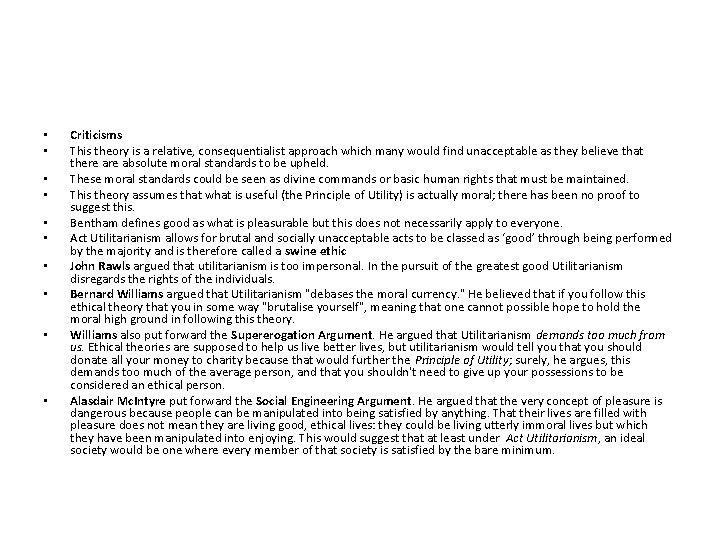
• • • Criticisms This theory is a relative, consequentialist approach which many would find unacceptable as they believe that there absolute moral standards to be upheld. These moral standards could be seen as divine commands or basic human rights that must be maintained. This theory assumes that what is useful (the Principle of Utility) is actually moral; there has been no proof to suggest this. Bentham defines good as what is pleasurable but this does not necessarily apply to everyone. Act Utilitarianism allows for brutal and socially unacceptable acts to be classed as ‘good’ through being performed by the majority and is therefore called a swine ethic John Rawls argued that utilitarianism is too impersonal. In the pursuit of the greatest good Utilitarianism disregards the rights of the individuals. Bernard Williams argued that Utilitarianism "debases the moral currency. " He believed that if you follow this ethical theory that you in some way "brutalise yourself", meaning that one cannot possible hope to hold the moral high ground in following this theory. Williams also put forward the Supererogation Argument. He argued that Utilitarianism demands too much from us. Ethical theories are supposed to help us live better lives, but utilitarianism would tell you that you should donate all your money to charity because that would further the Principle of Utility; surely, he argues, this demands too much of the average person, and that you shouldn't need to give up your possessions to be considered an ethical person. Alasdair Mc. Intyre put forward the Social Engineering Argument. He argued that the very concept of pleasure is dangerous because people can be manipulated into being satisfied by anything. That their lives are filled with pleasure does not mean they are living good, ethical lives: they could be living utterly immoral lives but which they have been manipulated into enjoying. This would suggest that at least under Act Utilitarianism, an ideal society would be one where every member of that society is satisfied by the bare minimum.
Rule Utilitarianism (John Stuart Mill) • • • The main problem that Mill raised with Bentham was that it was purely quantitative, in other words it was based purely on the amount of pleasure an action generated. He wanted to reformulate the Utilitarian theory to reflect the fact that pleasures are not all of equal value. He wanted to take human nature into account Thus he decided to introduce a theory of utility for the common person, which replaced pleasure for happiness. He defined happiness as something which is cultural and spiritual rather than just physical and distinguished between lower and higher pleasures. The pleasures of the mind are far better than that of the body. Mill identifies pleasures of the mind or intellectual pleasures as higher pleasures and pleasures of the body or physical pleasures as lower pleasures. He said that "It is better to be a human dissatisfied than a pig satisfied: better to be a Socrates dissatisfied than a fool satisfied" Although he believed that the well-being of the individual was of a primary concern, happiness is best achieved when it is subject to the rules that protect the common good. Strong Utilitarianism believe that these rules should never be disobeyed Weak Utilitarianism say that although there should be generally accepted rules or guidelines, they should not always be adhered to indefinitely
• Strengths • Supports the notion that human wellbeing is generally good • Solves many of the problems with Act Utilitarianism • Encourages Democracy
• • Sidgewick: "In practice it is hard to distinguish between higher and lower pleasures" This is due to the subjectivity of the word 'pleasure' There's a general epistemological issue with Rule Utilitarianism in that there does not appear to be an objective, accurate way of measuring pleasure and thus the amount of pleasure is subjective. WD Ross: 'Single factor' moral theories don't work because life is too complex Bernard Williams put forward a criticism of Rule Utilitarianism in the form of an example in which a person who is sheltering Jews in his cellar from the Nazis is questioned by the Nazis. In this example the Nazi asks the man if he has any Jews in his cellar. Because he is a Rule Utilitarian and he follows the rule ‘never lie’, he must tell the Nazi the truth and condemn the Jews to a horrible death. Thus, he argues, Rule Utilitarianism is not so different to absolutist morality, and the whole point of utilitarianism is its flexibility which is lost. Not to mention, if he decides to make an exception here and lie, where does he draw the line? The whole ethical theory risks collapse if exceptions can be made wherever and whenever it is convenient. Difficult to predict consequences

Preference Utilitarianism • Preference Utilitarian's consider whether a decision is right or wrong by asking whether it fits in with what people would rationally prefer. • Singer was concerned about minorities and felt all minorities and individuals should be taken into account when considering what is best for everyone. • You should do what is the best interests of the greatest number, rather than calculating pleasure against pain. • Singers approach concentrates on minimising suffering, rather than maximising pleasure. He thinks there is more agreement about what causes pain than what gives you pleasure – is pleasure more down to pleasure than pain?
• Peter Singer & Utilitarianism on animal rights • Let us suppose that animals can feel pleasure and pain and thus can be factored into Utilitarian decisions • Pushing ones thumb into a small frog would cause as much pain as whacking a large plank across a baby • But we shouldn’t feel that the baby’s pain is more important, they’re the same amounts of pain! This would be being speciesist! • Singer concludes that “all animals needs are equal”. We humans are included in the notion “animals”. We are equal to, say, koalas
• Practical implications of Singer’s argument • Many animals are kept in battery farms to satisfy our pleasures. All things being equal, in Utilitarian terms however; the animals pain overrides our pleasure and thus we should not eat meat from battery farms. • What of free-range farms then? Singer refers to previous notions… that some animals are self-conscious “persons” and thus should not be killed. Chickens, however, can be killed and eaten so long as our pleasure in eating them is greater than the pleasure they lose. He doubts the Utilitarian calculus will come down in our favour. However, he grants that chickens are replaceable. • Utilitarianism is therefore against eating most meats. Singer is also against vivisection for cosmetic purposes, but perhaps not for medical purposes as it might be argued the pleasure gained would be greater overall. However, it is unlikely since we can never tell in advance the results of such a test.
• • Criticisms of Singer’s argument The deepest criticisms of Singer’s position are those given by Cora Diamond and implicitly by Raimond Gaita: Singer fails to recognise the fundamental reason we don’t each other is because we respect human fellowship and think that a human being is not something to be eaten, not that it is not in the other person’s interests! Yet, Singer argues its not in the animals’ interests to be eaten and thus we should not. Contradiction! Hurrah! Diamond argues that, if we are to treat animals better than we do – we should seek to extend a sense of fellowship to other animals. Yet Singer’s arguments involve absolutely no sense of this, either amongst human beings or between humans and animals Diamond argues that he fails to completely engage with the reality before us when we think about the treatment of animals Singer provides us with simply a “solution” – leaving out the deeper understanding of what the difficulties are! Tut tut, you have no emotions Singer
- Slides: 13