
Utilising liquidity stress tests as a risk management
- Slides: 20
Utilising liquidity stress tests as a risk management tool Understanding key drivers and scenario considerations Unless explicitly stated, the qualitative and quantitative information included in the presentation are illustrative and are not representative of Uni. Credit Balance Sheet, Economic or Financial position Rocco Fanciullo, Group Liquidity And Interest Rate Risk Management London, June 15 th, 2017
Agenda § Evaluating the essential drivers to consider in a stress test 1 § Scenario analysis 2 § Usages of the stress test and linkage between stress testing and financial planning both in ordinary and in contingent situation 3 2
Agenda § Evaluating the essential drivers to consider in a stress test 1 § Scenario analysis 2 § Usages of the stress test and linkage between stress testing and financial planning both in ordinary and in contingent situation 3 3
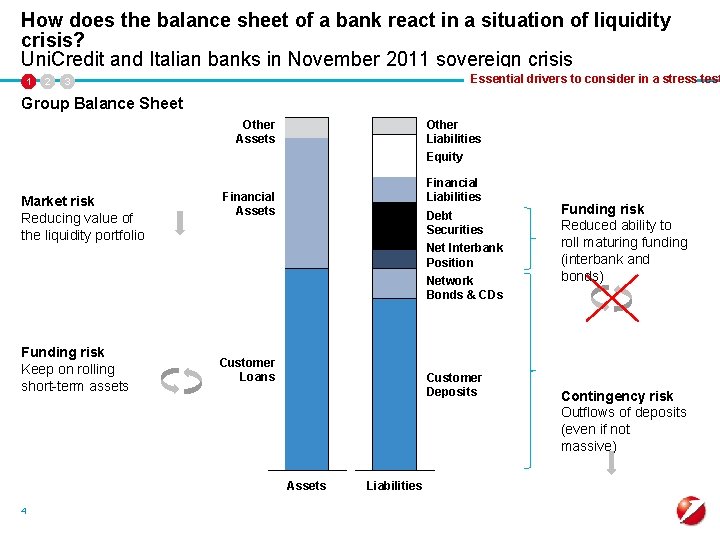
How does the balance sheet of a bank react in a situation of liquidity crisis? Uni. Credit and Italian banks in November 2011 sovereign crisis 1 2 Essential drivers to consider in a stress test 3 Group Balance Sheet Other Assets Other Liabilities Equity Market risk Reducing value of the liquidity portfolio Financial Liabilities Financial Assets Debt Securities Net Interbank Position Network Bonds & CDs Funding risk Keep on rolling short-term assets Customer Loans Customer Deposits Assets 4 Liabilities Funding risk Reduced ability to roll maturing funding (interbank and bonds) Contingency risk Outflows of deposits (even if not massive)
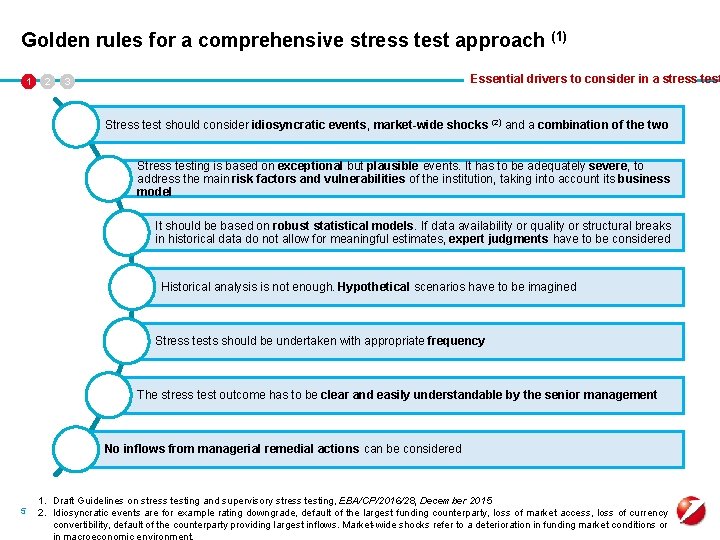
Golden rules for a comprehensive stress test approach 1 2 (1) Essential drivers to consider in a stress test 3 Stress test should consider idiosyncratic events, market-wide shocks (2) and a combination of the two Stress testing is based on exceptional but plausible events. It has to be adequately severe, to address the main risk factors and vulnerabilities of the institution, taking into account its business model It should be based on robust statistical models. If data availability or quality or structural breaks in historical data do not allow for meaningful estimates, expert judgments have to be considered Historical analysis is not enough. Hypothetical scenarios have to be imagined Stress tests should be undertaken with appropriate frequency The stress test outcome has to be clear and easily understandable by the senior management No inflows from managerial remedial actions can be considered 5 1. Draft Guidelines on stress testing and supervisory stress testing, EBA/CP/2016/28, December 2015 2. Idiosyncratic events are for example rating downgrade, default of the largest funding counterparty, loss of market access, loss of currency convertibility, default of the counterparty providing largest inflows. Market-wide shocks refer to a deterioration in funding market conditions or
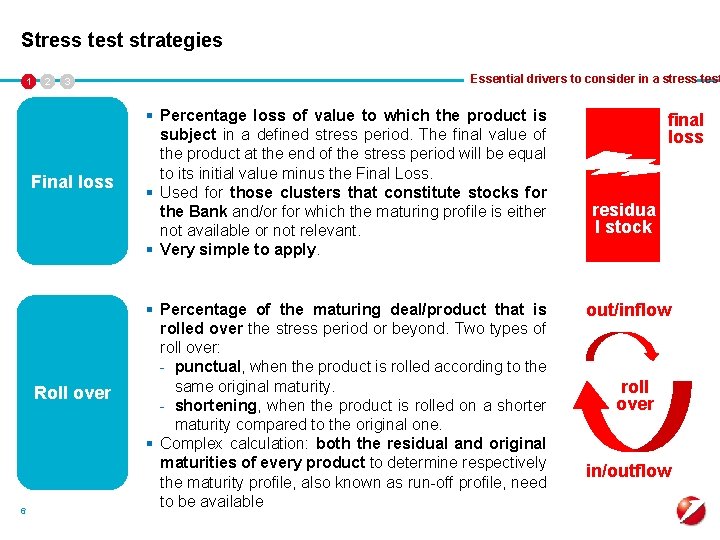
Stress test strategies 1 2 3 Final loss Roll over 6 Essential drivers to consider in a stress test § Percentage loss of value to which the product is subject in a defined stress period. The final value of the product at the end of the stress period will be equal to its initial value minus the Final Loss. § Used for those clusters that constitute stocks for the Bank and/or for which the maturing profile is either not available or not relevant. § Very simple to apply. § Percentage of the maturing deal/product that is rolled over the stress period or beyond. Two types of roll over: - punctual, when the product is rolled according to the same original maturity. - shortening, when the product is rolled on a shorter maturity compared to the original one. § Complex calculation: both the residual and original maturities of every product to determine respectively the maturity profile, also known as run-off profile, need to be available final loss residua l stock out/inflow roll over in/outflow
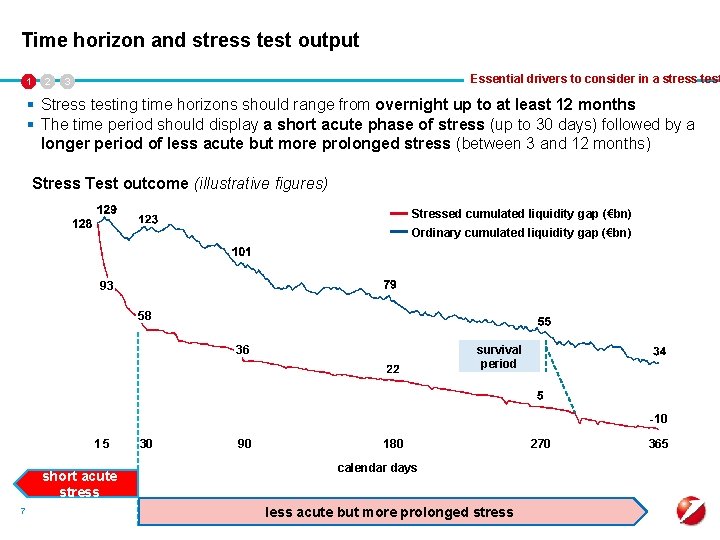
Time horizon and stress test output 1 2 Essential drivers to consider in a stress test 3 § Stress testing time horizons should range from overnight up to at least 12 months § The time period should display a short acute phase of stress (up to 30 days) followed by a longer period of less acute but more prolonged stress (between 3 and 12 months) Stress Test outcome (illustrative figures) Stressed cumulated liquidity gap (€bn) Ordinary cumulated liquidity gap (€bn) 93 58 36 survival period -10 15 short acute stress 7 30 90 180 calendar days less acute but more prolonged stress 270 365
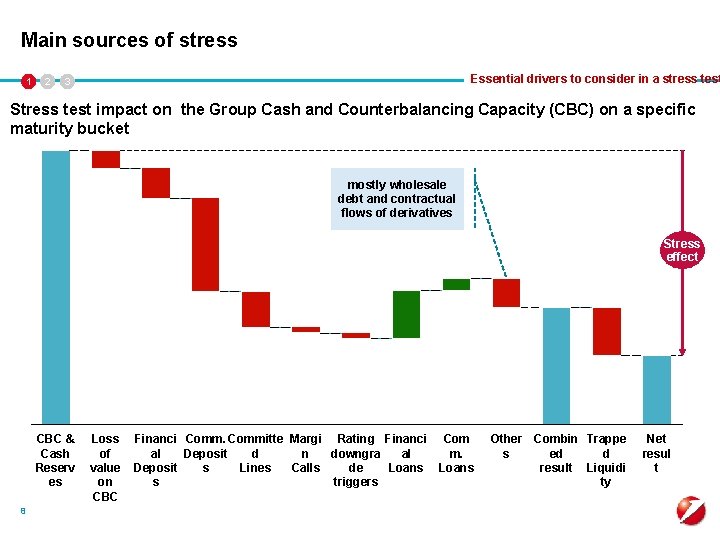
Main sources of stress 1 2 Essential drivers to consider in a stress test 3 Stress test impact on the Group Cash and Counterbalancing Capacity (CBC) on a specific maturity bucket mostly wholesale debt and contractual flows of derivatives Stress effect CBC & Cash Reserv es 8 Loss of value on CBC Financi Committe Margi Rating Financi Com al Deposit d n downgra al m. Deposit s Lines Calls de Loans s triggers Other Combin Trappe s ed d result Liquidi ty Net resul t
Agenda § Evaluating the essential drivers to consider in a stress test 1 § Scenario analysis 2 § Usages of the stress test and linkage between stress testing and financial planning both in ordinary and in contingent situation 3 9
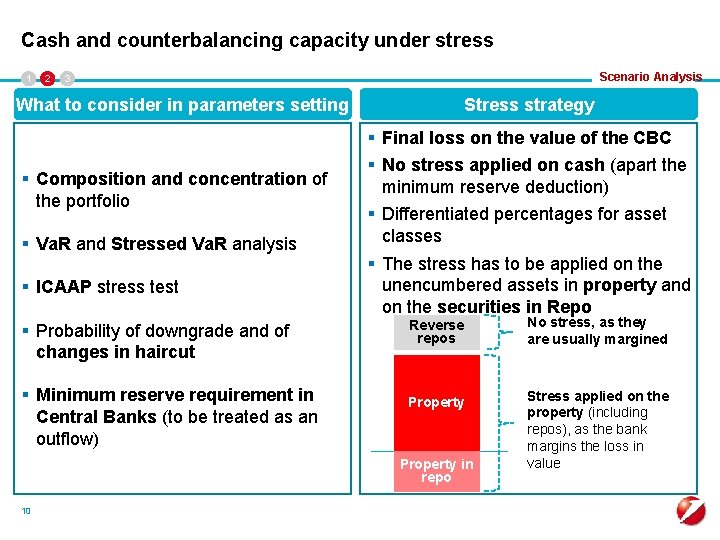
Cash and counterbalancing capacity under stress 1 2 Scenario Analysis 3 What to consider in parameters setting § Composition and concentration of the portfolio § Va. R and Stressed Va. R analysis § ICAAP stress test § Probability of downgrade and of changes in haircut § Minimum reserve requirement in Central Banks (to be treated as an outflow) Stress strategy § Final loss on the value of the CBC § No stress applied on cash (apart the minimum reserve deduction) § Differentiated percentages for asset classes § The stress has to be applied on the unencumbered assets in property and on the securities in Repo Reverse repos No stress, as they are usually margined Property Stress applied on the property (including repos), as the bank margins the loss in value Property in repo 10
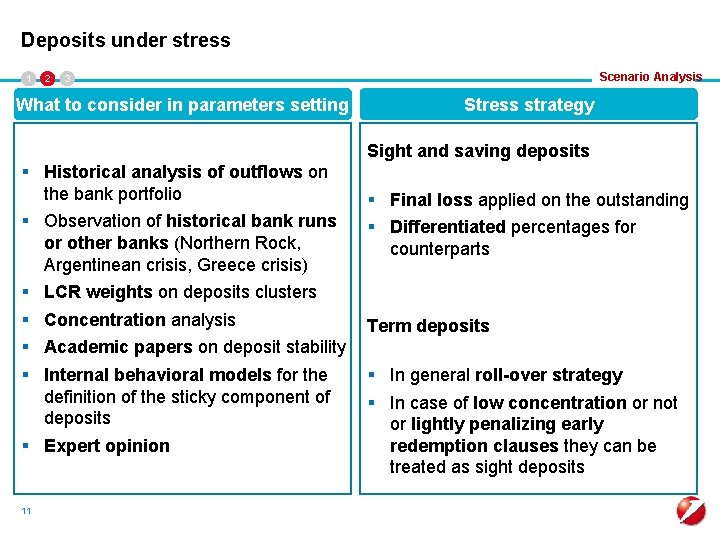
Deposits under stress 1 2 Scenario Analysis 3 What to consider in parameters setting Stress strategy Sight and saving deposits § Historical analysis of outflows on the bank portfolio § Observation of historical bank runs or other banks (Northern Rock, Argentinean crisis, Greece crisis) § LCR weights on deposits clusters § Concentration analysis § Academic papers on deposit stability § Internal behavioral models for the definition of the sticky component of deposits § Expert opinion 11 § Final loss applied on the outstanding § Differentiated percentages for counterparts Term deposits § In general roll-over strategy § In case of low concentration or not or lightly penalizing early redemption clauses they can be treated as sight deposits
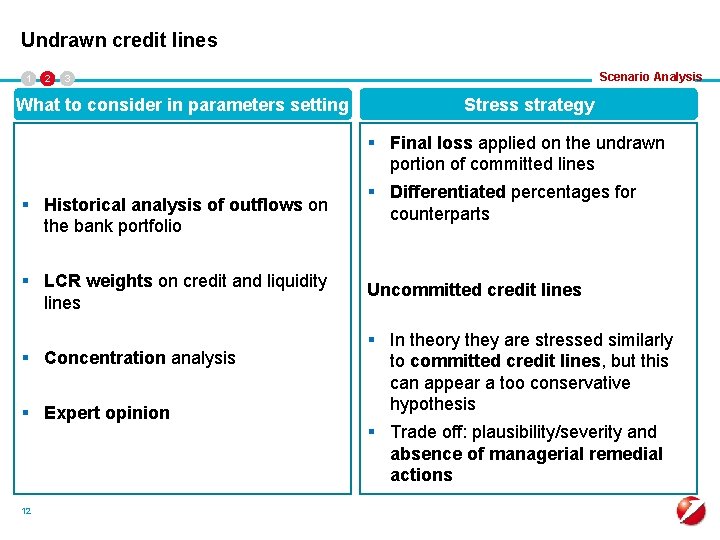
Undrawn credit lines 1 2 What to consider in parameters setting § Historical analysis of outflows on the bank portfolio § LCR weights on credit and liquidity lines § Concentration analysis § Expert opinion 12 Scenario Analysis 3 Stress strategy § Final loss applied on the undrawn portion of committed lines § Differentiated percentages for counterparts Uncommitted credit lines § In theory they are stressed similarly to committed credit lines, but this can appear a too conservative hypothesis § Trade off: plausibility/severity and absence of managerial remedial actions
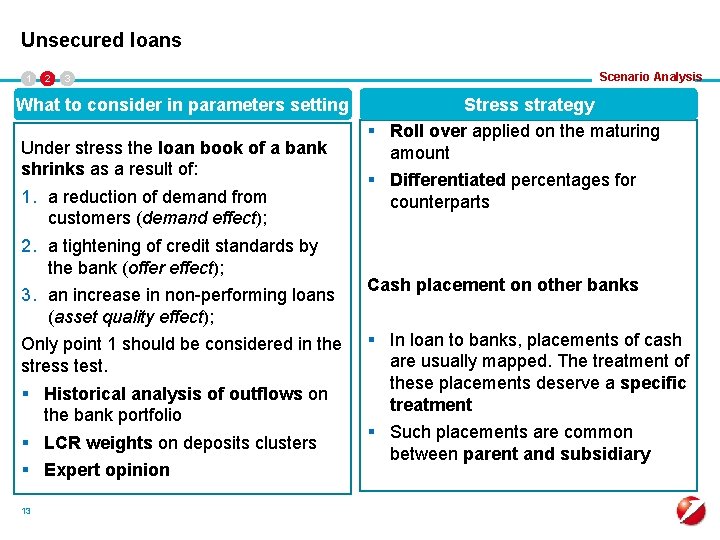
Unsecured loans 1 2 3 What to consider in parameters setting Under stress the loan book of a bank shrinks as a result of: 1. a reduction of demand from customers (demand effect); 2. a tightening of credit standards by the bank (offer effect); 3. an increase in non-performing loans (asset quality effect); Only point 1 should be considered in the stress test. § Historical analysis of outflows on the bank portfolio § LCR weights on deposits clusters § Expert opinion 13 Scenario Analysis Stress strategy § Roll over applied on the maturing amount § Differentiated percentages for counterparts Cash placement on other banks § In loan to banks, placements of cash are usually mapped. The treatment of these placements deserve a specific treatment § Such placements are common between parent and subsidiary
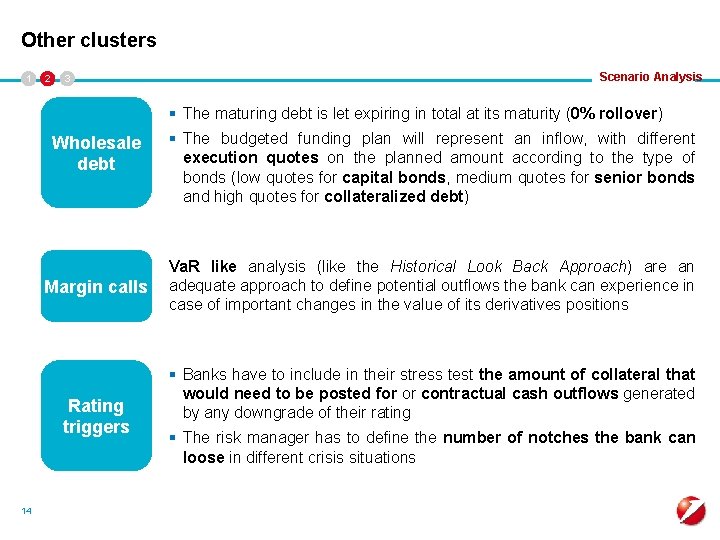
Other clusters 1 2 3 Scenario Analysis § The maturing debt is let expiring in total at its maturity (0% rollover) Wholesale debt Margin calls Rating triggers 14 § The budgeted funding plan will represent an inflow, with different execution quotes on the planned amount according to the type of bonds (low quotes for capital bonds, medium quotes for senior bonds and high quotes for collateralized debt) Va. R like analysis (like the Historical Look Back Approach) are an adequate approach to define potential outflows the bank can experience in case of important changes in the value of its derivatives positions § Banks have to include in their stress test the amount of collateral that would need to be posted for or contractual cash outflows generated by any downgrade of their rating § The risk manager has to define the number of notches the bank can loose in different crisis situations
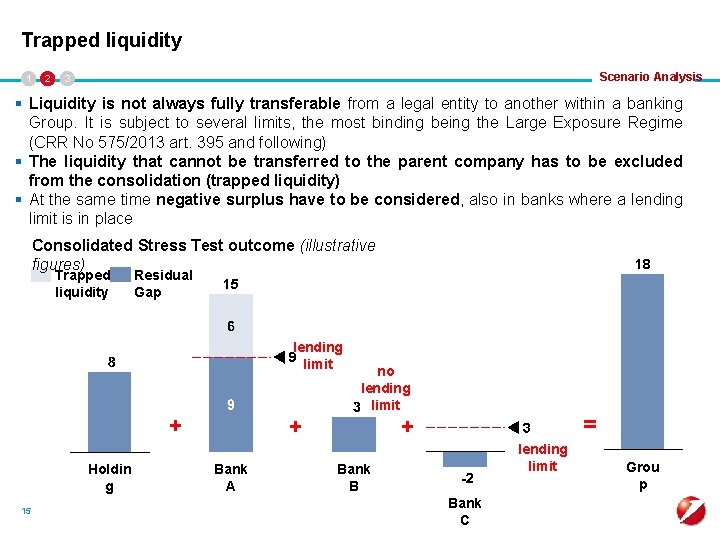
Trapped liquidity 1 2 Scenario Analysis 3 § Liquidity is not always fully transferable from a legal entity to another within a banking Group. It is subject to several limits, the most binding being the Large Exposure Regime (CRR No 575/2013 art. 395 and following) § The liquidity that cannot be transferred to the parent company has to be excluded from the consolidation (trapped liquidity) § At the same time negative surplus have to be considered, also in banks where a lending limit is in place Consolidated Stress Test outcome (illustrative figures) Trapped liquidity Residual Gap 15 lending 9 limit + Holdin g 15 18 + Bank A no lending limit + 3 lending limit Bank B Bank C = Grou p
Agenda § Evaluating the essential drivers to consider in a stress test 1 § Scenario analysis 2 § Usages of the stress test and linkage between stress testing and financial planning both in ordinary and in contingent situation 3 16
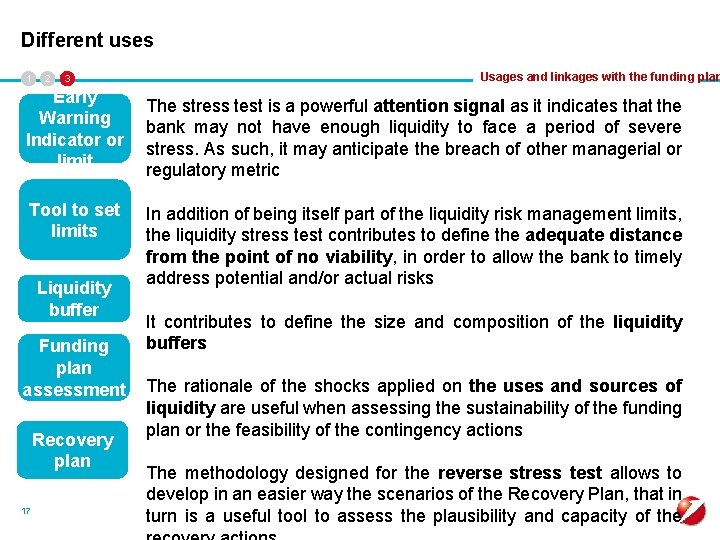
Different uses 1 2 3 Early Warning Indicator or limit Tool to set limits Liquidity buffer Funding plan assessment Recovery plan 17 Usages and linkages with the funding plan The stress test is a powerful attention signal as it indicates that the bank may not have enough liquidity to face a period of severe stress. As such, it may anticipate the breach of other managerial or regulatory metric In addition of being itself part of the liquidity risk management limits, the liquidity stress test contributes to define the adequate distance from the point of no viability, in order to allow the bank to timely address potential and/or actual risks It contributes to define the size and composition of the liquidity buffers The rationale of the shocks applied on the uses and sources of liquidity are useful when assessing the sustainability of the funding plan or the feasibility of the contingency actions The methodology designed for the reverse stress test allows to develop in an easier way the scenarios of the Recovery Plan, that in turn is a useful tool to assess the plausibility and capacity of the
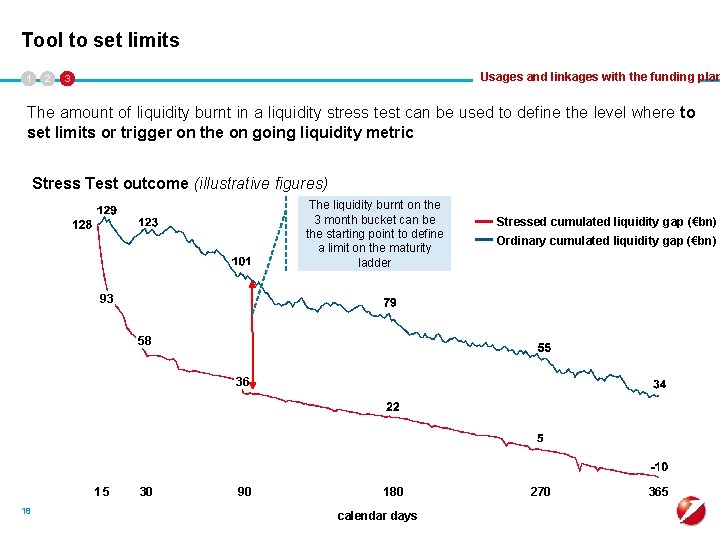
Tool to set limits 1 2 Usages and linkages with the funding plan 3 The amount of liquidity burnt in a liquidity stress test can be used to define the level where to set limits or trigger on the on going liquidity metric Stress Test outcome (illustrative figures) The liquidity burnt on the 3 month bucket can be the starting point to define a limit on the maturity ladder Stressed cumulated liquidity gap (€bn) Ordinary cumulated liquidity gap (€bn) 93 58 36 15 18 30 90 180 calendar days 270 365
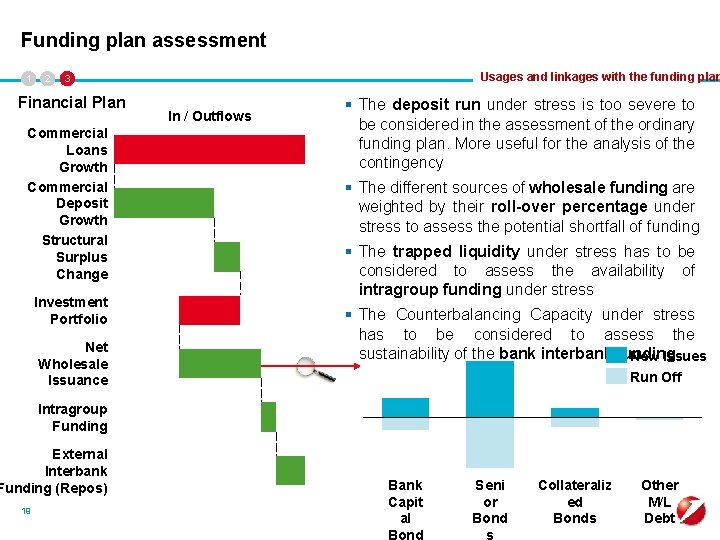
Funding plan assessment 1 2 Usages and linkages with the funding plan 3 Financial Plan Commercial Loans Growth Commercial Deposit Growth Structural Surplus Change Investment Portfolio Net Wholesale Issuance In / Outflows § The deposit run under stress is too severe to be considered in the assessment of the ordinary funding plan. More useful for the analysis of the contingency § The different sources of wholesale funding are weighted by their roll-over percentage under stress to assess the potential shortfall of funding § The trapped liquidity under stress has to be considered to assess the availability of intragroup funding under stress § The Counterbalancing Capacity under stress has to be considered to assess the sustainability of the bank interbank funding New Issues Run Off Intragroup Funding External Interbank Funding (Repos) 19 Bank Capit al Seni or Bond Collateraliz ed Bonds Other M/L Debt
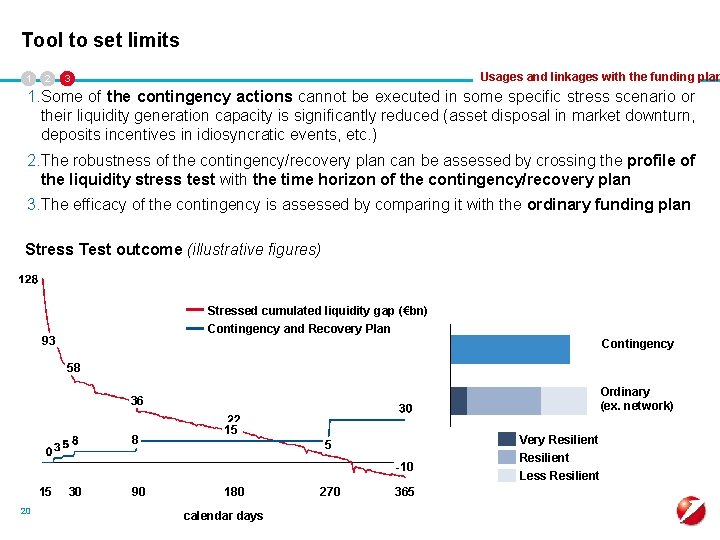
Tool to set limits 1 2 Usages and linkages with the funding plan 3 1. Some of the contingency actions cannot be executed in some specific stress scenario or their liquidity generation capacity is significantly reduced (asset disposal in market downturn, deposits incentives in idiosyncratic events, etc. ) 2. The robustness of the contingency/recovery plan can be assessed by crossing the profile of the liquidity stress test with the time horizon of the contingency/recovery plan 3. The efficacy of the contingency is assessed by comparing it with the ordinary funding plan Stress Test outcome (illustrative figures) Stressed cumulated liquidity gap (€bn) Contingency and Recovery Plan 93 Contingency 58 Ordinary (ex. network) 36 8 15 15 15 Very Resilient 5 -10 15 20 30 90 180 calendar days 270 365 Resilient Less Resilient