
Uterine Fibroids Quiz 1 To start with all
Uterine Fibroids
Quiz 1 • To start with all fibroids are: a) Interstitial b) Submucous c) Subserous d) Ovarian
Quiz 2 • Uterine fibromyoma is associated with: a) Endometriosis b) Pelvic inflammatory ds c) Ovarian carcinoma d) Tamoxifen
Quiz 3 • In fibroids which of the following is not seen: a) Amenorrhoea b) Pelvic mass c) Menstrual abnormality d) Infertility
Quiz 4 • What is a St. Paul’s lantern? a) Submucous fibroid polyp b) Pseudocervical fibroid c) Wandering fibroid d) Cervical fibroid
Quiz 5 • Treatment of red degeneration of fibroid is a) Analgesics b) Laparotomy c) Termination of pregnancy d) Removal at cesarean section
Fibroids • Synonyms : Myoma, Leiomyoma, Fibromyoma • Most common benign neoplasm in uterus and female pelvis • Incidence : 20 to 40% of reproductive age women
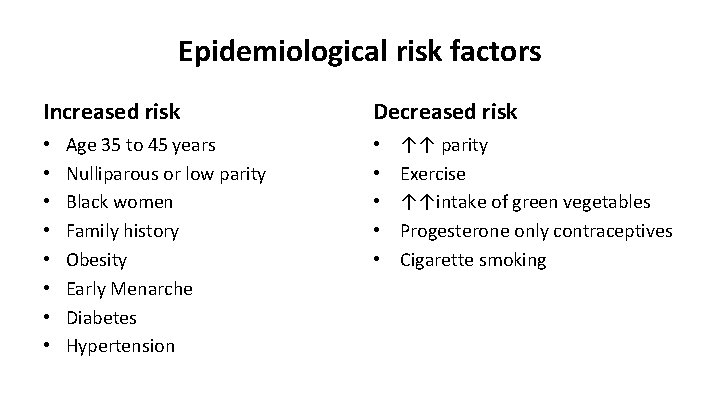
Epidemiological risk factors Increased risk • • Age 35 to 45 years Nulliparous or low parity Black women Family history Obesity Early Menarche Diabetes Hypertension Decreased risk • • • ↑↑ parity Exercise ↑↑intake of green vegetables Progesterone only contraceptives Cigarette smoking
Etiology It arises from smooth muscle cells of myometrium. Suggested causes include: • Monoclonal origin ( arising from single cell) confirmed by G 6 PD studies • Genetic basis confirmed by family studies • Various growth factors like TGFβ , EGF, IGF-1, IGF-2, BFGF are recently implicated
Role of Estrogen in development of Fibroids? • • • Estrogen although not proved for causing myoma, is definitely implicated in its growth Uncommon before puberty & regress after menopause Higher incidence in nulliparous women Common in obese women May increase during pregnancy Studies show high concentrations of estrogen receptors in leiomyoma than myometrium Common in fifth decade due to anovulatory cycles with high or unopposed estrogen
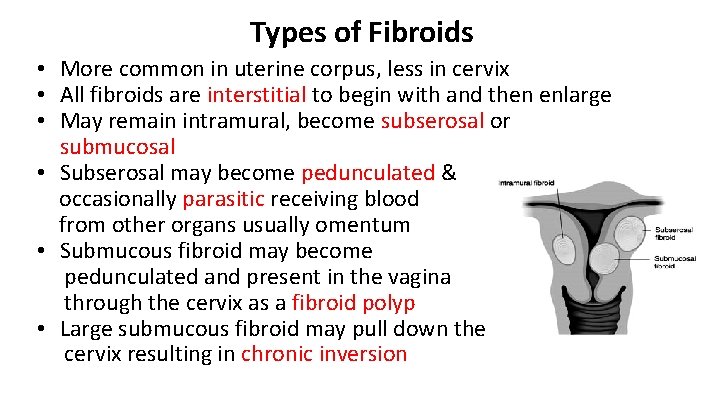
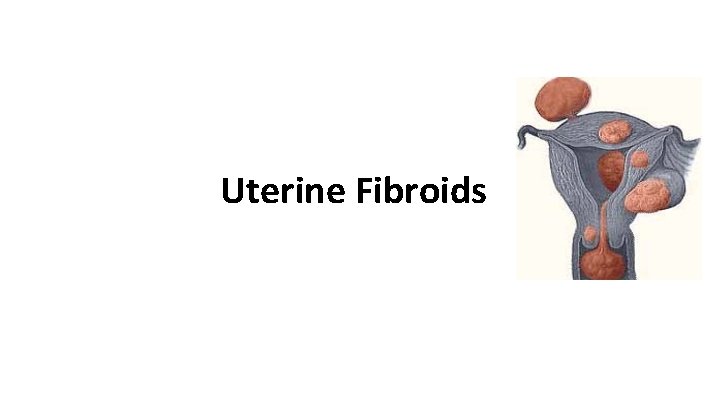
Types of Fibroids • More common in uterine corpus, less in cervix • All fibroids are interstitial to begin with and then enlarge • May remain intramural, become subserosal or submucosal • Subserosal may become pedunculated & occasionally parasitic receiving blood from other organs usually omentum • Submucous fibroid may become pedunculated and present in the vagina through the cervix as a fibroid polyp • Large submucous fibroid may pull down the cervix resulting in chronic inversion
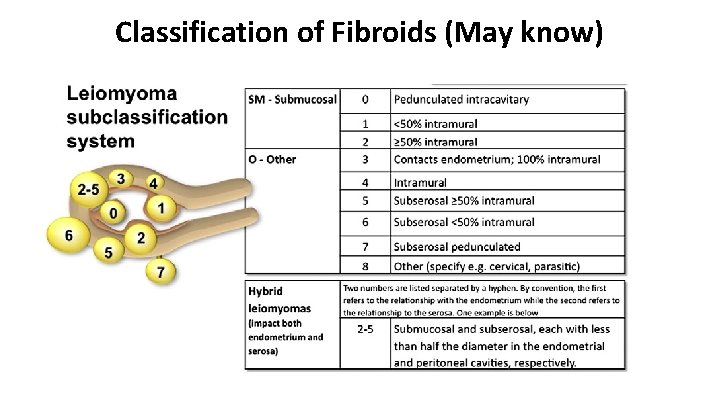
Classification of Fibroids (May know)
Fibroid Pathology • Gross appearance- Multiple, discrete, spherical, pinkish white, firm capsulated masses protruding from surrounding myometrium. Pseudo capsule is made up of compressed myometrium giving it a distinct outline • Microscopy- non-striated muscle fibres are arranged in interlacing bundles of varying size arranged in whorled pattern. Varying amount of connective tissue is intermixed with smooth muscle fibres
Fibroid Pathological variants • Intravenous leiomyomatosis • LPD – leiomyomatosis peritonealis dissemination • Secondary changes- Hyaline, calcific, necrosis, red degeneration during pregnancy, fatty degeneration • Leiomyosarcoma- 0. 49 -0. 79%, more common in the 5 th decade, diagnosed with presence of mitotic figures
Clinical presentation - Commonly asymptomatic - Abnormal uterine bleeding – 30 -50% , more common with submucous fibrouids but may occur with all types due to - ↑↑ surface area - ↑↑vascularity, thinning and ulceration of overlying endometrium - endometrial hyperplasia - venous obstruction - interference with contractions
Clinical presentation (contd. ) • Anemia due to excessive blood loss • Pelvic pain - 1/3 rd patients - backache - Acute pain due to torsion, infection, expulsion, red degeneration, vascular complication - Dysmenorrhoea – Spasmodic as well as congestive
Clinical presentation (contd. ) - Pressure symptoms * - Lump in abdomen - Urinary symptoms- urgency, frequency, incontinence, rarely urethral obstruction - Bowel symptoms- constipation, intermittent intestinal obstruction Abdominal distention- large fibroids Rapid growth- pregnancy and malignancy Infertility – 2 to 10 % cases- due to irregular cavity interfering with sperm transport, endometrial changes Rare symptoms : Ascites, polycythemia
Effects of fibroid on pregnancy/ labor/ puerperium • Pregnancy : Abortion Pressure symptoms Malpresentation Retrodisplacement of uterus • Labour : Preterm labour Uterine inertia Dystocia MRP • Puerperium : Subinvolution Sec. PPH Puerperal sepsis Inversion PPH
Effects of pregnancy on fibroid • Increase in size & softening • Red degeneration - Commonly in 2 nd trimester - due to rapid growth there is congestion with interstitial hemorrhage & venous thrombosis • Impaction in pelvis • Torsion • Infection • Injury- Pressure necrosis during delivery • Rupture of subserous vein Internal hemorrhage
Fibroid – Examination findings General examination– Anemia due to prolonged heavy bleeding P/A – If > 12 weeks size , firm, nodular, arising from pelvis, lower limit can’t be reached, relatively well defined, mobile from side to side, nontender, dull on percussion, no free fluid in abdomen P/S – Cervix pulled higher up P/V – Uterus enlarged, nodular D/D from ovarian tumour Uterus not separately felt , transmitted movement present, notch not felt P/R – May help in difficult cases
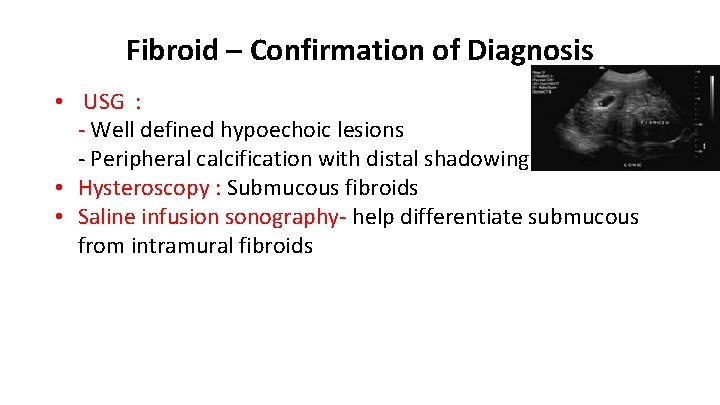
Fibroid – Confirmation of Diagnosis • USG : - Well defined hypoechoic lesions - Peripheral calcification with distal shadowing • Hysteroscopy : Submucous fibroids • Saline infusion sonography- help differentiate submucous from intramural fibroids
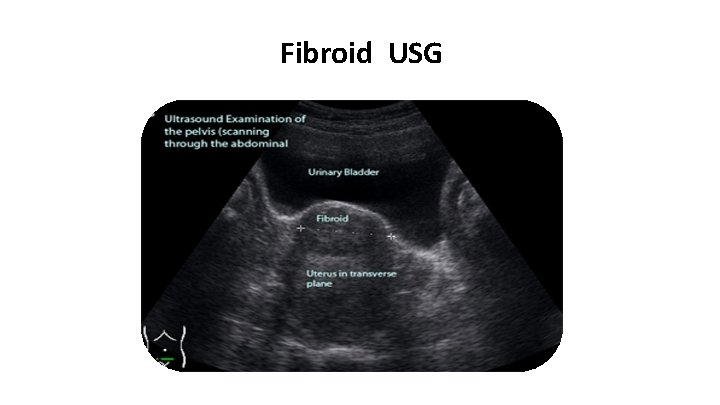
Fibroid USG
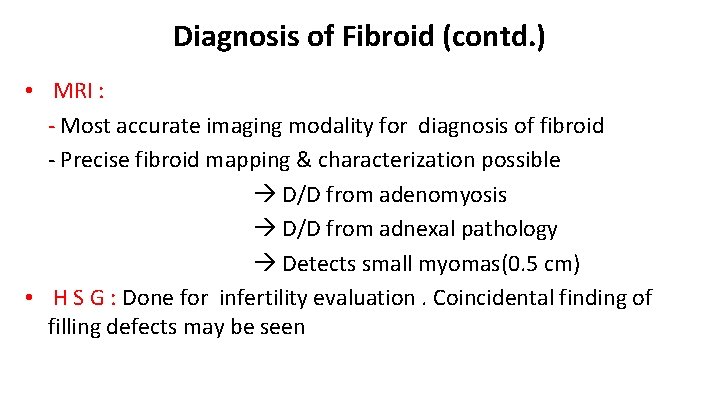
Diagnosis of Fibroid (contd. ) • MRI : - Most accurate imaging modality for diagnosis of fibroid - Precise fibroid mapping & characterization possible D/D from adenomyosis D/D from adnexal pathology Detects small myomas(0. 5 cm) • H S G : Done for infertility evaluation. Coincidental finding of filling defects may be seen
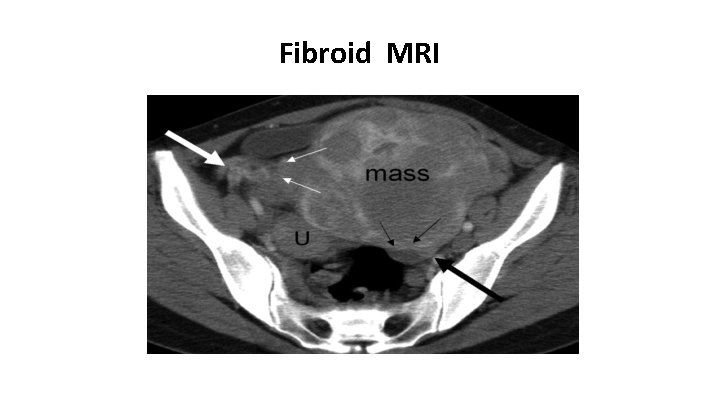
Fibroid MRI
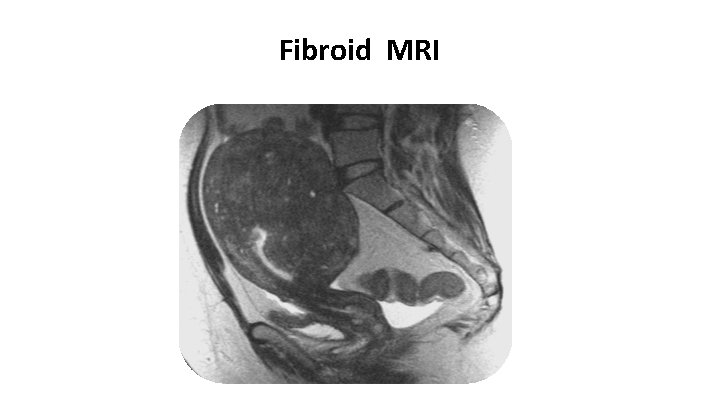
Fibroid MRI
Differential Diagnosis of Fibroid • • • Pregnancy Adenomyosis Ovarian tumour Ectopic pregnancy Endometriosis T O mass
Case study • A 26 yr old P 0+0 presents with menorrhagia. P/V examination shows a bulky uterus. The patient is worried about her bleeding & also wishes to conceive. a) What could be the differential diagnosis? b) How will you confirm the diagnosis?
Expectant management of Fibroid • • Indications : asymptomatic incidental fibroids Size < 12 weeks nearing menopause Prerequisites: - Regular follow up every 6 months - Routine pelvic examination - Baseline imaging to compare regression
Medical Management • • • Not a definitive treatment For symptomatic relief from pain- NSAIDs Decrease menstrual blood loss Preoperatively to decrease the size of fibroid Drugs used: - Progestogens : Oral/ IUCD - Antiprogestogens (Mifepristone) - Androgens ( Danazol, Gestrinone) - Gn. RH analogues - SERMS & SPRM - Aromatase inhibitors
Progesterone • • Medroxy progesterone acetate Norethisterone acetate D 5 X 21 days X 3 -6 cycles Indication: To delay surgery
Progesterone releasing IUD- LNG-IUD Fibroids with uterus <12 weeks size with menorrhagia Expulsion rates higher in presence of fibroids Contains Progesteron LNG 60 mg releasing 20 ug /day Fibroids decreases in size 6 – 12 mths of use May have variable effects on uterine myomas depending upon balance of growth factors • Few studies have shown beneficial results • • •
Mifepristone • • • 5 – 10 mg is tried No loss of bone density Promising results Decrease in myoma volume by 26 -74 %. No effect on bone density Endometrial hyperplasia may limit its longterm use.
Gn. RH analogues • • Gn. RH Agonists: Triptorelin (Decapeptyl) 3. 75 mg I/M once a month X 3 months Leuprolide depot 3. 75 mg I/M once a month X 3 months Goseraline (Zoladex) 3. 6 mg SC once a month X 3 months Advantages : Decrease in size of myoma by 20 to 50 % Decrease in bleeding increases Hb level Decreases blood loss during surgery Helps to convert hysterectomy into myomectomy Helps to converts Abd. hyst into vag. hysterectomy
Gn. RH analogues • Disadvantages : High cost Hypoestrogenic side effects- medical menopause Effect is reversible Rarely ↑↑ bleeding due to degeneration Occasionally difficulty in enucleation during myomectomy • Gn. RH Antagonist Cetrorelix is used 60 mg I/M repeated after 3 -4 months if necessary Initial flare up does not occur Decrease volume of fibroid
SERM – Raloxifen • 60 mg /day is tried for 6 to 12 mths • Higher doses ( 180 mg) are required for effective decrease in size • Better if combined with Gn. RH analogs
SPRM (Selective Progesterone Receptor Modulator) – Asoprisnil • 5 to 25 mg/day is used • Mechanism of inhibitory action is not known • Possible risk of endometrial hyperplasia is not studied
Aromatase inhibitors • Directly inhibit estrogen synthesis & rapidly produce hypoestrogenic state Fadrozole/ Letrozole is tried in couple of studies • 71 % reduction occurred in 8 weeks • Appears to be promising therapy
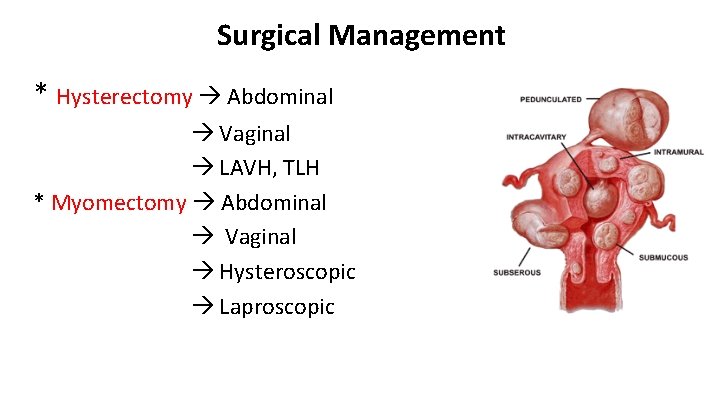
Surgical Management * Hysterectomy Abdominal Vaginal LAVH, TLH * Myomectomy Abdominal Vaginal Hysteroscopic Laproscopic
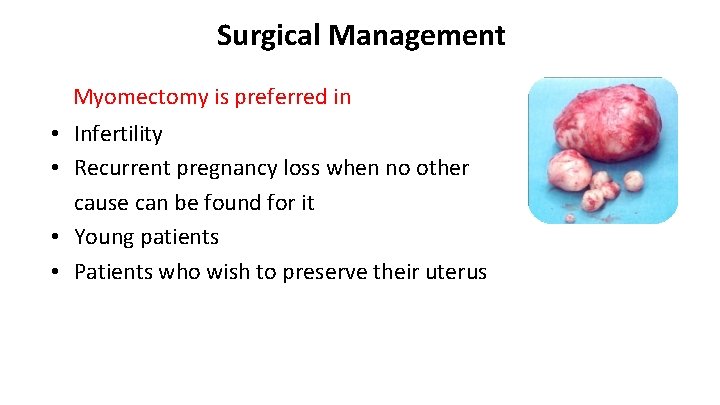
Surgical Management Myomectomy is preferred in • Infertility • Recurrent pregnancy loss when no other cause can be found for it • Young patients • Patients who wish to preserve their uterus
Abdominal myomectomy - Other factors for infertility should be ruled out Consent for hysterectomy Blood matched & handy Pap’s smear & endometrial sampling to rule out malignancy Medical or mechanical means to control blood loss - Bonney’s Myomectomy clamp - Rubber tourniquet - Manual ( finger compression) pressure at isthmic region - Vasopressin 10 – 20 units diluted in 100 ml saline infiltrated before putting the incision
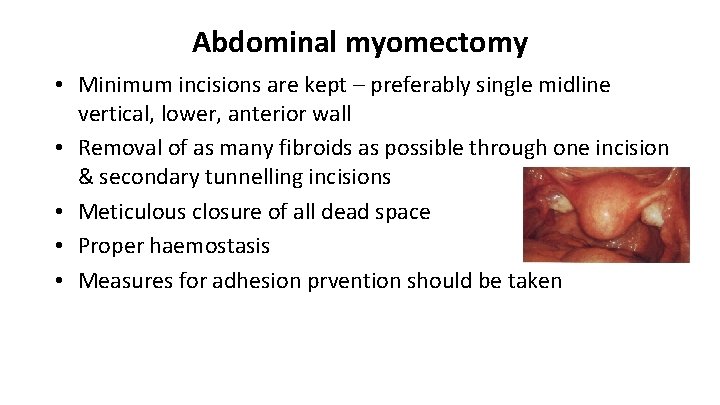
Abdominal myomectomy • Minimum incisions are kept – preferably single midline vertical, lower, anterior wall • Removal of as many fibroids as possible through one incision & secondary tunnelling incisions • Meticulous closure of all dead space • Proper haemostasis • Measures for adhesion prvention should be taken
Bonney’s Hood Operation • For large posterior fundal fibroid • Transverse fundal incision made posterior to tubal insertion • After enucleation uterine wall is sutured anteriorly covering the fundus as a hood
Laproscopic myomectomy • Includes: - In 3 phases excision of myoma, repair of myometrium & extraction of myoma • Suitable for subserous & intramural fibroids upto 10 cm size • Fibroid excised are remoyed by electronic morcellators or through posterior colpotomy incision vaginally.
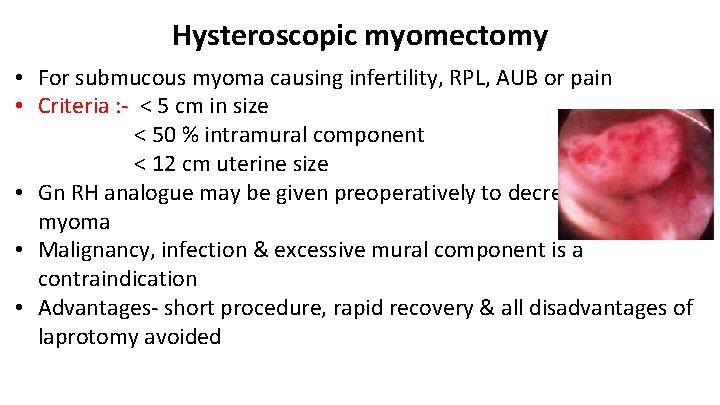
Hysteroscopic myomectomy • For submucous myoma causing infertility, RPL, AUB or pain • Criteria : - < 5 cm in size < 50 % intramural component < 12 cm uterine size • Gn RH analogue may be given preoperatively to decrease size of myoma • Malignancy, infection & excessive mural component is a contraindication • Advantages- short procedure, rapid recovery & all disadvantages of laprotomy avoided
Vaginal myomectomy • Submucous pedunculated or small sessile cervical fibroids are removed vaginally • Ligation of pedicle if accessible • Twisting off the fibroids if pedicle not accessible in case of small & medium size fibroids • To gain access to pedicle of higher & big fibroid incision on the cervix can be made
Factors favouring vaginal hysterectomy • • Uterus < 16 wks, preferably < 14 wks No associated pathology like endometriosis , PID, adhesions Uterus mobile & adequate lateral space in pelvis Experienced vaginal surgeon
Newer modalities of treatment • Laparoscopic myolysis • Uterine artery embolization • MRGFUS
Laproscopic myolysis • By ND-YAG laser or long bipolar needle electrode blood supply of myoma coagulated • Results in atrophy of myoma • Applicable if myoma 3 -10 cm size & < 4 in number
Uterine artery embolization • By interventional radiologist • Catheter is passed retrograde through Right femoral artery to bifurcation of aorta & then negotiated down to opposite uterine artery first • Polyvinyl alcohol ( PVA ) particles ( 500 -700 um) or gelfoam are used for embolization • 60 – 65 % reduction in size of fibroid • 80 – 90 % have improvements in menorrhagia & pressure symptoms
Uterine artery embolization • High vascularity & solitary fibroid are associated with greater chance of longterm success • Pregnancy, active infection, desire for fertility & suspicion of malignancy are absolute contraindications • Risk of ovarian failure must be counselled • Post embolization syndrome ( fever , vomiting, pain) can occur
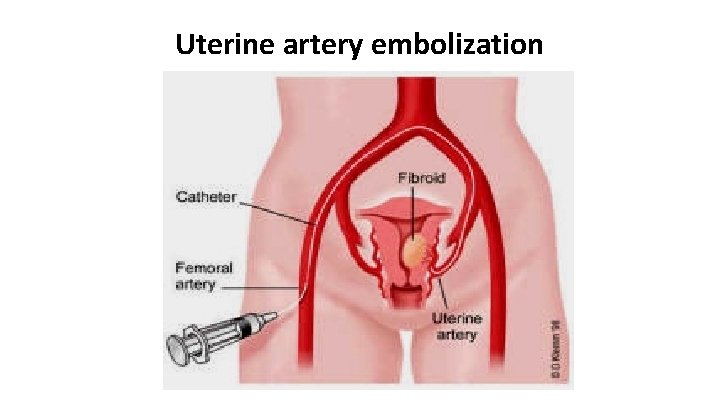
Uterine artery embolization
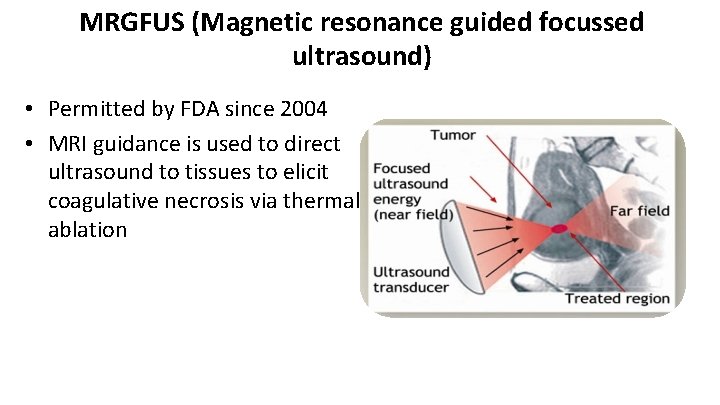
MRGFUS (Magnetic resonance guided focussed ultrasound) • Permitted by FDA since 2004 • MRI guidance is used to direct ultrasound to tissues to elicit coagulative necrosis via thermal ablation
Case study • A 26 yr old P 0+0 presents with menorrhagia. P/V examination shows a bulky uterus. The patient is worried about her bleeding & also wishes to conceive. a) How will you manage this patient?
MCQs • 1. A pregnant woman with fibroid uterus develops acute pain in abdomen with low grade fever & mild leucocytosis at 28 week. The most likely diagnosis is a) Preterm labor b) Torsion of fibroid c) Red degeneration of fibroid d) Infection in fibroid
• 2. Least common complication in fibroid is a) Menstrual disorder b) Malignancy c) Urinary retention d) Degeneration
• 3. Submucosal fibroid is diagnosed by all except a) Hysteroscopy b) Hysterosalpingography c) Transabdominal USG d) Laparoscopy
• 4. The drug which has no effect on the size of fibroids is a) Gn. RH agonist b) Danazol c) Progesterone d) Mifepristone
• 5. all of the following are indications for myomectomy except a) Associated infertility b) Recurrent pregnancy loss c) Pressure symptoms d) Red degeneration
• 6. A 29 yr old nulliparous woman complains of severe menorrhagia & lower abdominal pain since 3 months. On examination there was a 14 weeks size uterus with fundal fibroid. The treatment of choice is a) Wait & watch b) Gn. RH analogue c) Myomectomy d) Hysterectomy
• 7. pressure symptom is usually seen in which type of fibroid? a) Submucous b) Subserous c) Intramural d) All
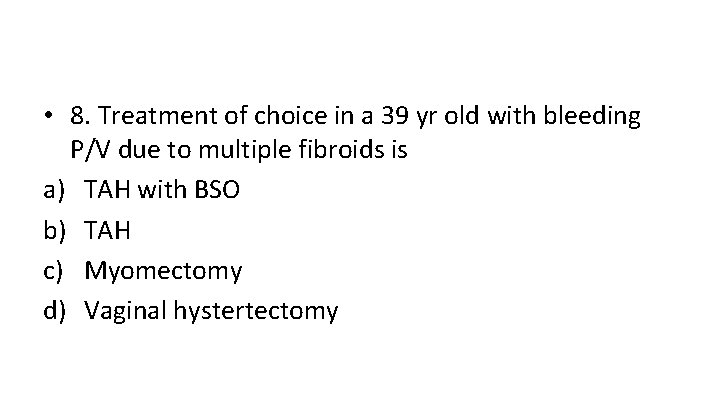
• 8. Treatment of choice in a 39 yr old with bleeding P/V due to multiple fibroids is a) TAH with BSO b) TAH c) Myomectomy d) Vaginal hystertectomy
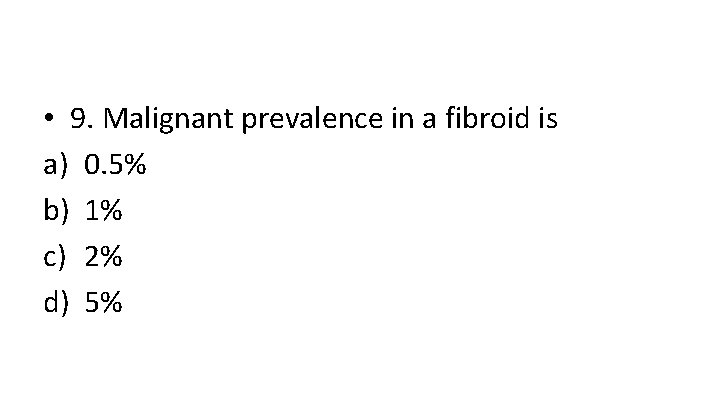
• 9. Malignant prevalence in a fibroid is a) 0. 5% b) 1% c) 2% d) 5%
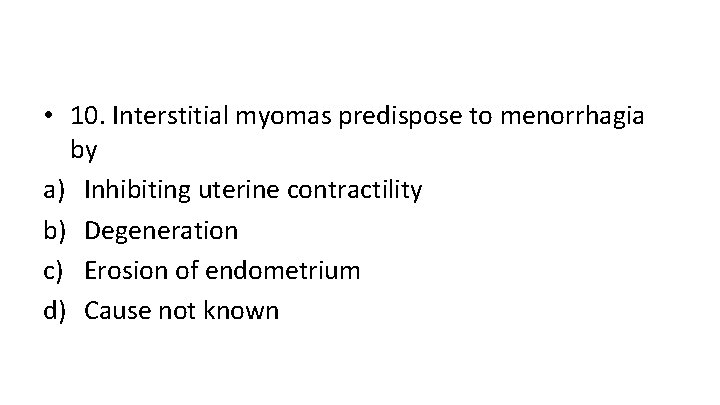
• 10. Interstitial myomas predispose to menorrhagia by a) Inhibiting uterine contractility b) Degeneration c) Erosion of endometrium d) Cause not known
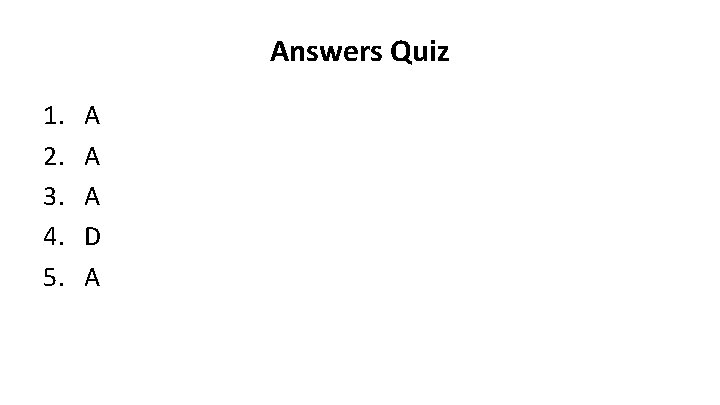
Answers Quiz 1. 2. 3. 4. 5. A A A D A
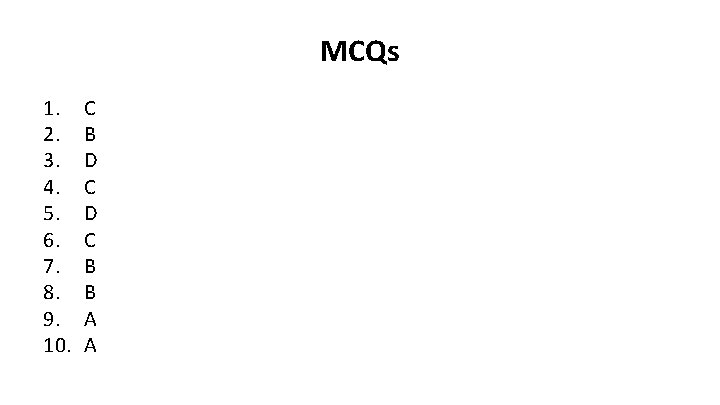
MCQs 1. 2. 3. 4. 5. 6. 7. 8. 9. 10. C B D C B B A A
- Slides: 65