
UTAS Awards Workshop 2017 Presented by Andrea Adam
UTAS Awards Workshop 2017 Presented by Andrea Adam and Tracy Douglas AWARDS & GRANTS TEAM Steve Drew, Andrea Adam, Tamzen Jeanneret Tasmanian Institute of Learning and Teaching (TILT) Awards. Grants@utas. edu. au
Aims Today’s session will: provide information about the awards § help you begin writing your award application § Our aim is to help you: identify a relevant award category § think about a focus for your award application § consider forms of evidence you may need § prepare a ‘strongly supported’ application §
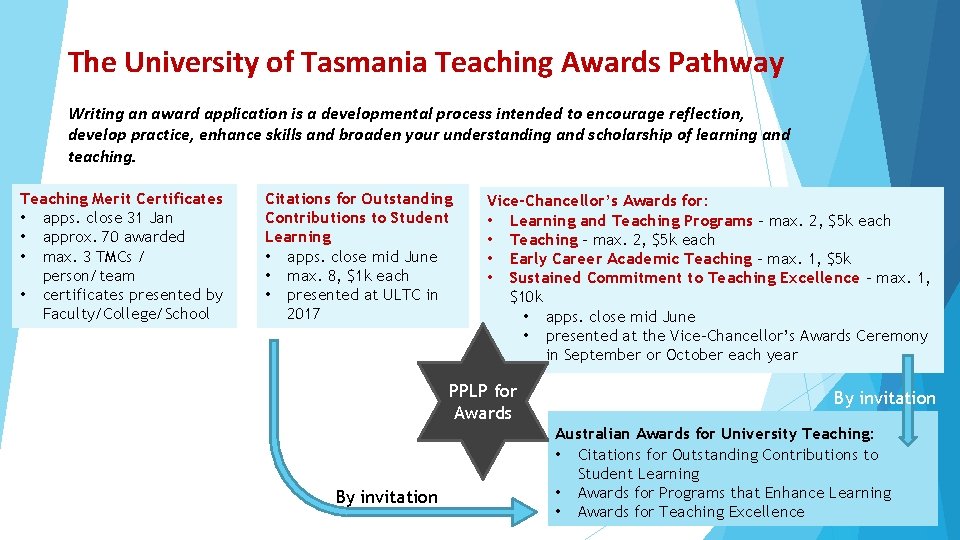
The University of Tasmania Teaching Awards Pathway Writing an award application is a developmental process intended to encourage reflection, develop practice, enhance skills and broaden your understanding and scholarship of learning and teaching. Teaching Merit Certificates • apps. close 31 Jan • approx. 70 awarded • max. 3 TMCs / person/team • certificates presented by Faculty/College/School Citations for Outstanding Contributions to Student Learning • apps. close mid June • max. 8, $1 k each • presented at ULTC in 2017 Vice-Chancellor’s Awards for: • Learning and Teaching Programs – max. 2, $5 k each • Teaching – max. 2, $5 k each • Early Career Academic Teaching – max. 1, $5 k • Sustained Commitment to Teaching Excellence – max. 1, $10 k • apps. close mid June • presented at the Vice-Chancellor’s Awards Ceremony in September or October each year PPLP for Awards By invitation Australian Awards for University Teaching: • Citations for Outstanding Contributions to Student Learning • Awards for Programs that Enhance Learning • Awards for Teaching Excellence
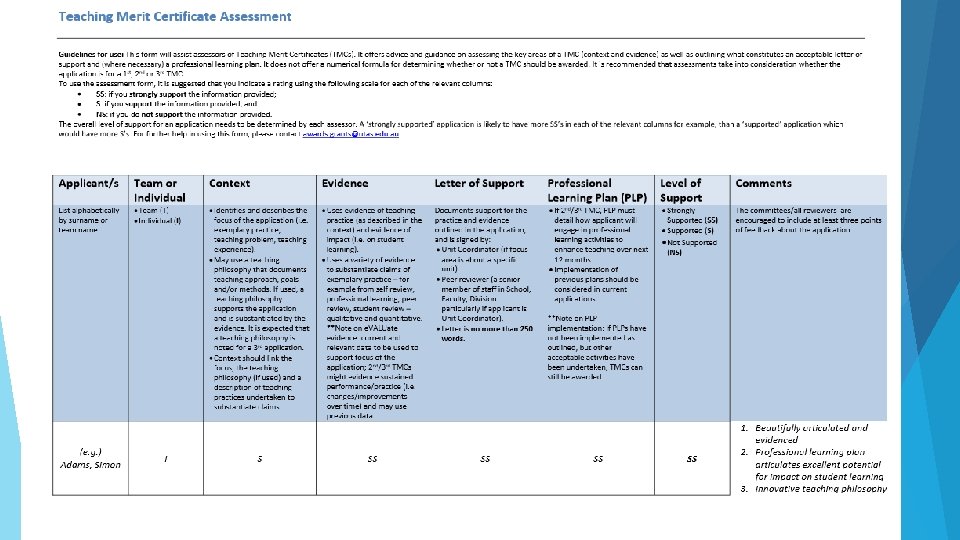
Teaching Merit Certificates Aimed at a range of levels from new and sessional to more experienced staff Maximum of 3 awarded person (including team awards) Complete the TMC application form Nominate a focus area (i. e. assessment, student support, scholarship) Support statement from unit coordinator or peer – validating claims and evidence provided in your application If applying for 2 nd/3 rd TMC, include professional learning plan. Up to one page, documenting activities and evidence to be carried out/collected before next TMC (or VC’s Citation). Two assessors + whole-of-institution moderation http: //www. teaching-learning. utas. edu. au/awards-and-grants/awards/utas-awards/teaching-merit-certificate
Teaching Merit Certificates Recent changes: New application forms: 1 st TMC application 2 nd or 3 rd TMC application Higher word counts New template for the supporting statement Approval of your line manager For 2 nd or 3 rd TMC, include previous successful applications (since 2011), and Show evidence of progression
Teaching Merit Certificates Applications due to Awards. Grants@utas. edu. au by 5. 00 pm, 31 January 2017
Citations for Outstanding Contributions to Student Learning Up to 8 awarded; $1, 000 each Available to academic and professional staff VC’s Award – Program Maximum of 2 VC’s Program Awards; $5, 000 each Available to academic and professional staff VC’s Award - Teaching/Early Career Academic Up to 2 awarded; $10, 000 team/$5, 000 individuals. Available to academic staff only VC’s Award - Medal for Sustained Commitment to Teaching Excellence Only 1 awarded; $10, 000, for individuals only Available to academic staff only Eligible 5 years post award of a VC’s Teaching Award http: //www. teaching-learning. utas. edu. au/awards-and-grants/awards/utas-awards/-vice-chancellors-citations-for-outstandingcontributions-to-student-learning

Vice-Chancellor’s Awards Subject to change in 2018 Check the website for updates Register for PPLP for Awards Contact Awards. Grants@utas. edu. au
Where can I go for extra help? UTAS Awards Website support (all guidelines, eligibility criteria and forms are online PLUS resources such as: What makes a good TMC? For UTAS Citations and Awards Peer Professional Learning Program for Awards (Feb – June each year – see our website for details; register early!) https: //secure. utas. edu. au/teaching-learning/awards-and-grants/awards/pplp-forawards Peer Review Panel – applicants can have their draft application blind reviewed with feedback provided (email draft applications to TILT – see key dates on A&G site).
Key Dates Teaching Merit Certificates due 31 January 2018 Citations and VC’s Awards due mid June 2018 http: //www. teaching-learning. utas. edu. au/awardsand-grants/key-dates-and-events

Writing your Award Application
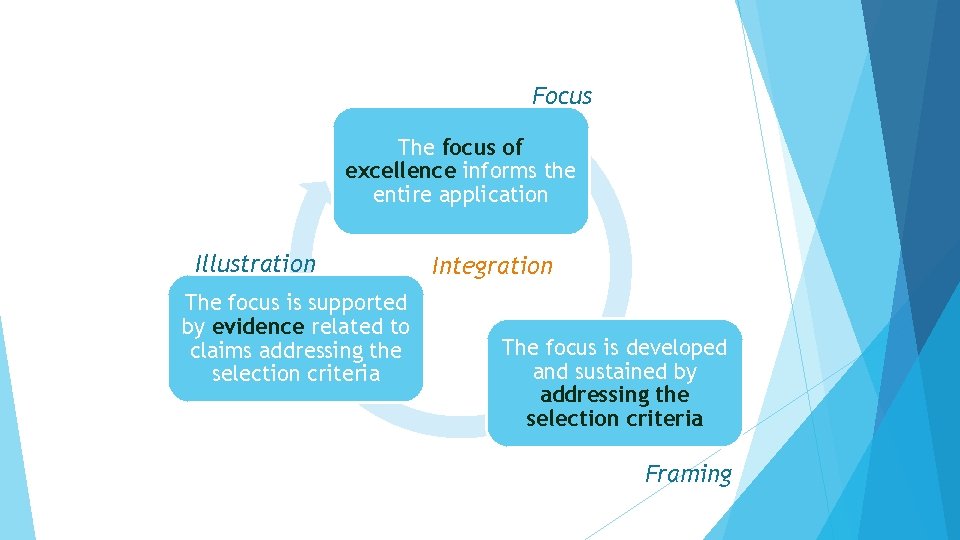
Focus The focus of excellence. ALTC informs the Awards entire application Illustration The focus is supported by evidence related to claims addressing the selection criteria Integration The focus is developed and sustained by addressing the selection criteria Framing
Focus FOCUS Developing a focus for your application helps you to tell ‘your story’. What it is about your teaching approach, strategy or other practice that has the greatest impact on students and their learning? Two minute reflection: What is it you do really well? (write down some notes)
Writing an award application: Focus Some questions to help you determine your focus What are you most proud of in your teaching? How do you teach? Why do you do it that way? What skills do you teach? How do you motivate students? How do you inspire them to learn? How do you know that they are learning? How do you assess your students? What do you assess? In what ways do you encourage them to become independent learners? In what ways do you respect students as individuals? How do you encourage students individually to develop to their full potential? Have you ever written/presented/shared about learning/teaching? Have you made any contributions to learning/teaching in your field/discipline/school/faculty/the University? What are some/one key challenge(s) you have faced as a tertiary teacher and how have you attempted to overcome it/them? What legacy has/will your style of teaching leave for your students? Do you have any educational 'heroes', if so, who are they and why? How do you use their approach or philosophy to inform your own teaching?
Framing Selection Criteria Framing your focus : Addressing selection criteria or providing a context Selection criteria need to be interrogated – what are they asking of you? (For Citations: Select the one(s) that best matches your chosen focus. ) Write to the criterion you choose, but don’t write for it – retain your own voice. Use key examples and ensure they directly relate to the selected criterion. Keep focused – about excellence or excellent practice – not core business.
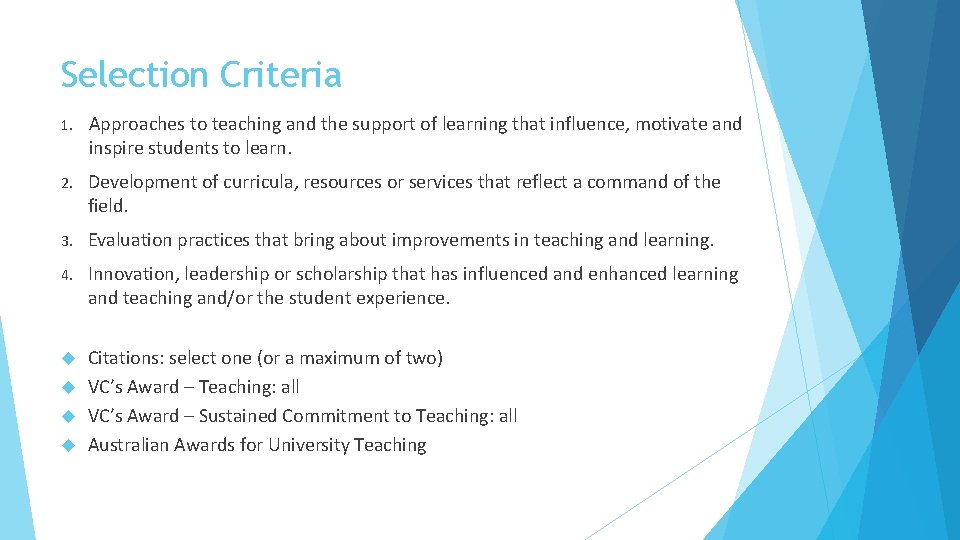
Selection Criteria 1. Approaches to teaching and the support of learning that influence, motivate and inspire students to learn. 2. Development of curricula, resources or services that reflect a command of the field. 3. Evaluation practices that bring about improvements in teaching and learning. 4. Innovation, leadership or scholarship that has influenced and enhanced learning and teaching and/or the student experience. Citations: select one (or a maximum of two) VC’s Award – Teaching: all VC’s Award – Sustained Commitment to Teaching: all Australian Awards for University Teaching
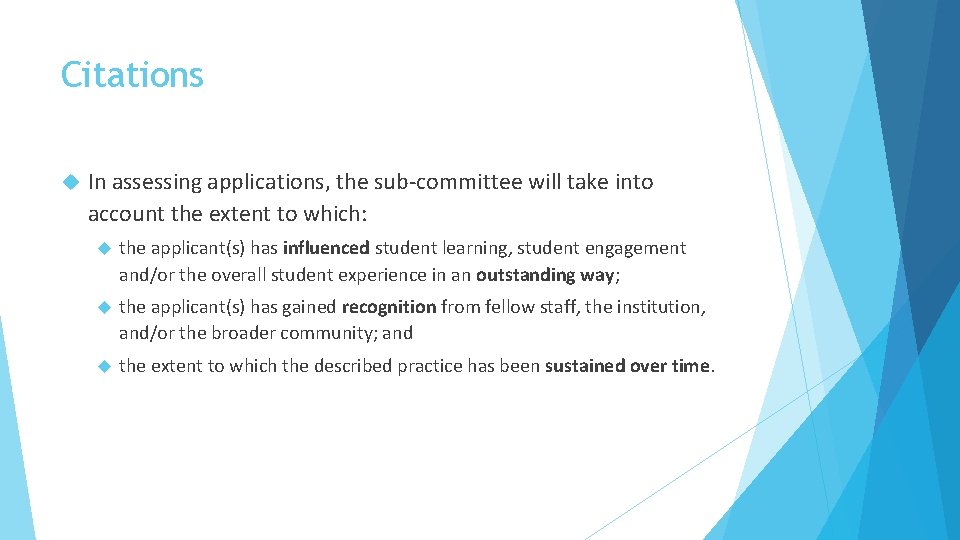
Citations In assessing applications, the sub-committee will take into account the extent to which: the applicant(s) has influenced student learning, student engagement and/or the overall student experience in an outstanding way; the applicant(s) has gained recognition from fellow staff, the institution, and/or the broader community; and the extent to which the described practice has been sustained over time.
VC’s Award - Teaching the assessment panel will consider the relative levels of achievement against each selection criteria, according to the academic level an applicant holds. The panel will also consider the extent: to which the claims for excellence are supported by formal and informal evaluation; of creativity, imagination or innovation, irrespective of whether the approach involves traditional learning environments or technology-based developments; and to which the application demonstrates evidence of sustained effectiveness over time. VC’s Award – Sustained Commitment to Teaching Claims and evidence provided for this application must show distinct growth in teaching practice and impact on student learning from the time the applicant's last award was received.
VC’s Awards – Program Category - select one: Widening participation Educational partnerships and collaborations with other organisations Innovation and flexibility in curricula, learning and teaching Postgraduate education Student experiences and services supporting learning, development and growth in higher education Global citizenship and internationalisation
VC’s Award – Program Address all four selection criteria Distinctiveness, coherence and clarity of purpose Influence on student learning and student engagement Breadth of impact Concern for equity and diversity In assessing applications, the assessment panel will take into account: the extent to which the application gives clear evidence of the effectiveness of the program in formal and informal evaluation the degree of creativity, imagination or innovation of the application the extent to which the application demonstrates evidence of the sustained effectiveness of the program over time.
ILLUSTRATION Illustration Substantiating your claims for commendable practice. What evidence do I have which demonstrates the quality of my teaching and can substantiate the claims I am making? Two minute reflection: How do you know that what you do works?
ILLUSTRATION Illustration Substantiating your claims for commendable practice. What evidence do I have which demonstrates the quality of my teaching and can substantiate the claims I am making? Then ask yourself: Is the evidence appropriate for the award category? Is the evidence appropriate for the chosen selection criteria? Does the evidence substantiate the claims made? How should the evidence be presented (i. e. e. VALUate data)? Successful applications use a combination of evidence - showing breadth and depth.
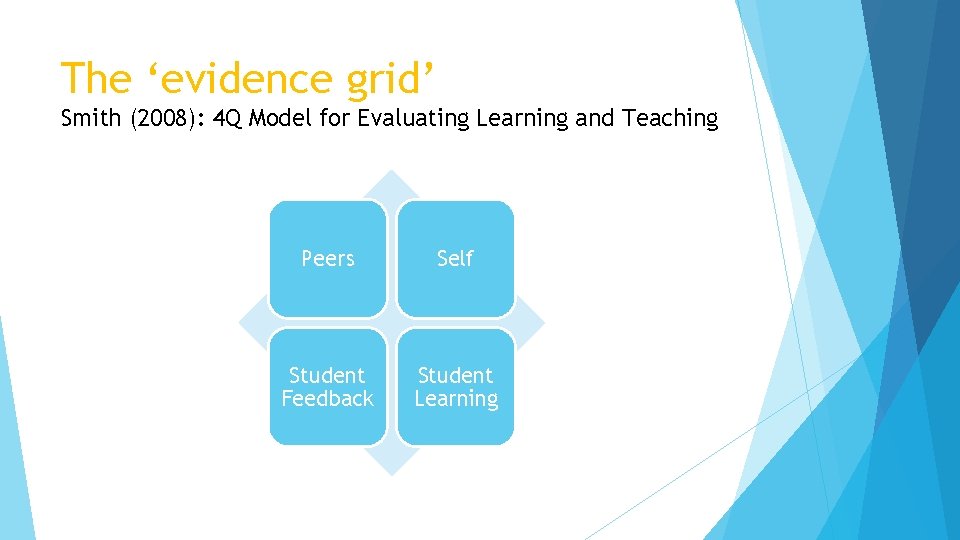
The ‘evidence grid’ Smith (2008): 4 Q Model for Evaluating Learning and Teaching ALTC Awards Peers Self Student Feedback Student Learning
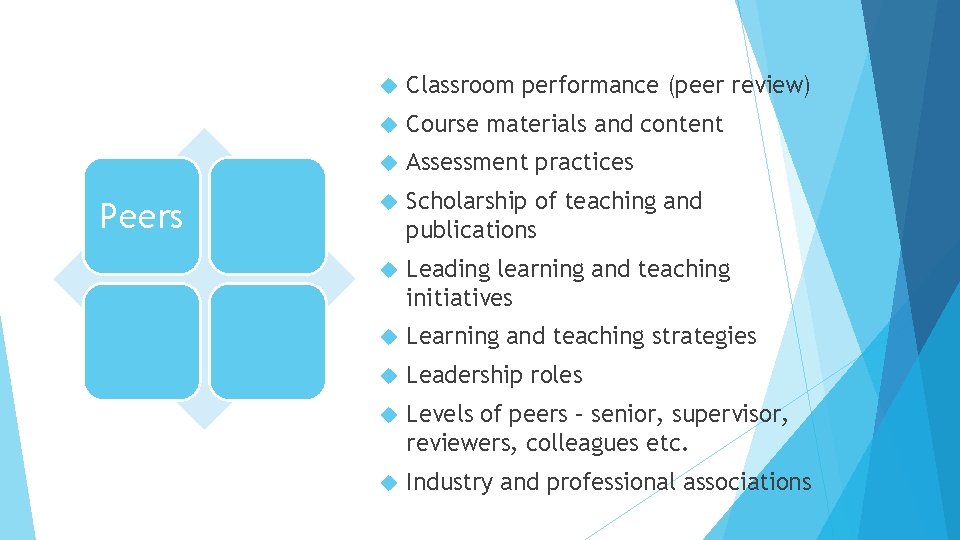
The ‘evidence grid’: Peers Classroom performance (peer review) Course materials and content Assessment practices Scholarship of teaching and publications Leading learning and teaching initiatives Learning and teaching strategies Leadership roles Levels of peers – senior, supervisor, reviewers, colleagues etc. Industry and professional associations
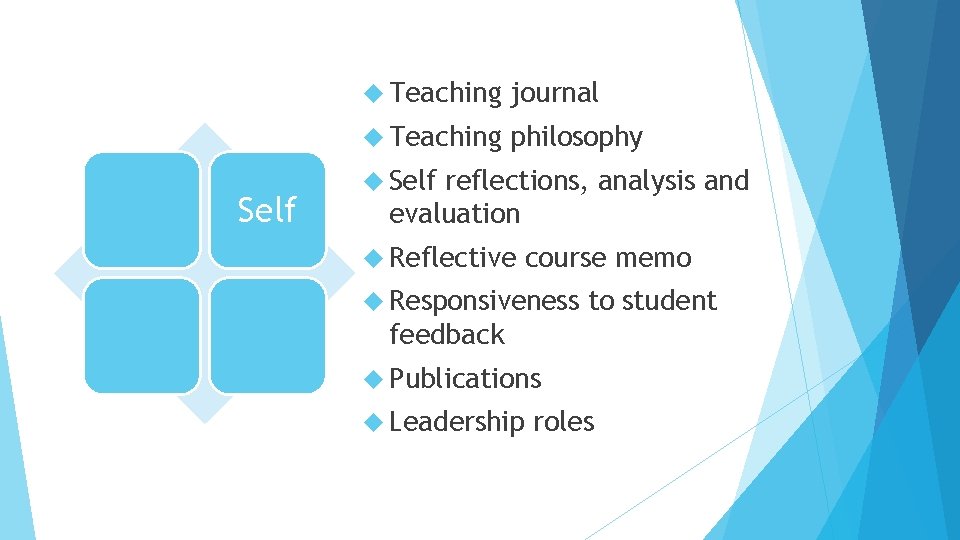
The ‘evidence grid’: Self Teaching journal Teaching philosophy Self reflections, analysis and evaluation Reflective course memo Responsiveness to student feedback Publications Leadership roles
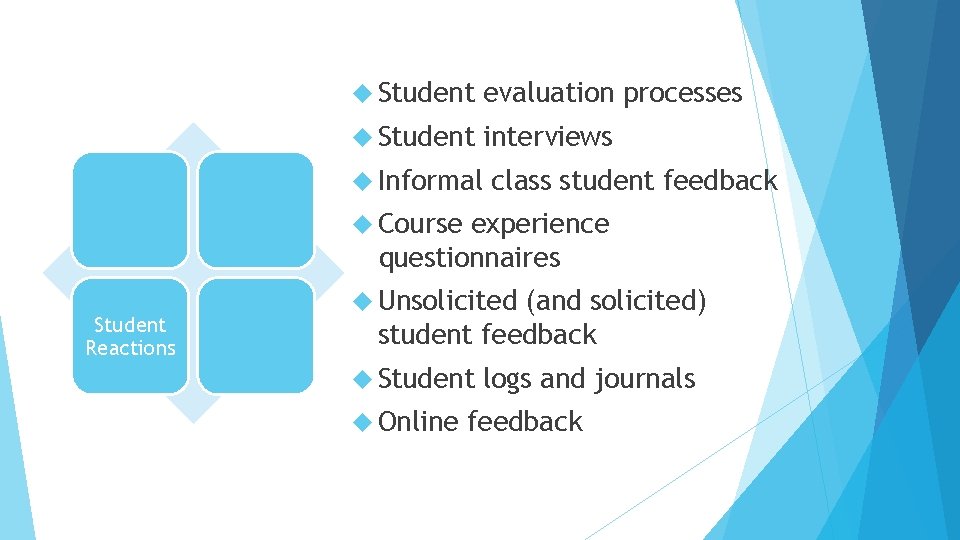
The ‘evidence grid’: Student Reactions Student evaluation processes Student interviews Informal class student feedback Course experience questionnaires Student Reactions Unsolicited (and solicited) student feedback Student Online logs and journals feedback
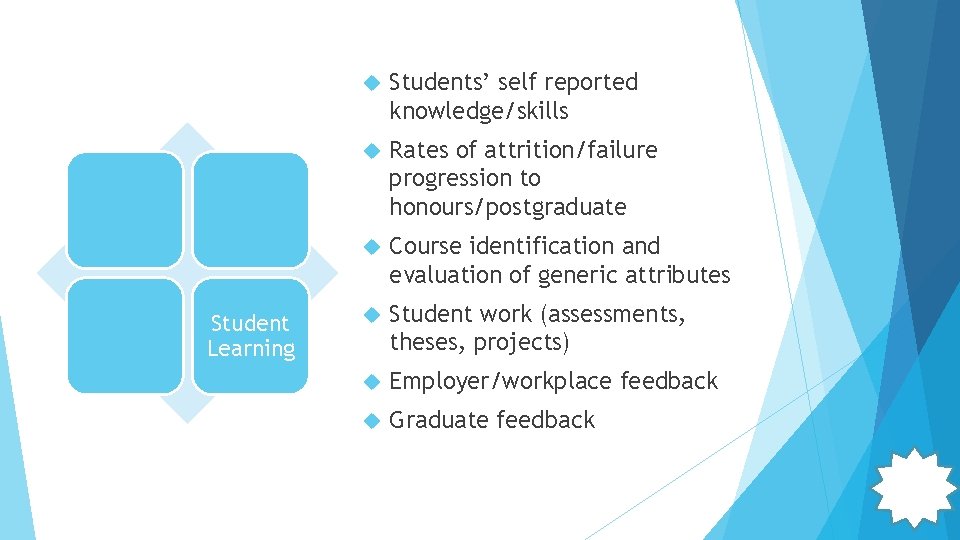
The ‘evidence grid’: Student Learning Students’ self reported knowledge/skills Rates of attrition/failure progression to honours/postgraduate Course identification and evaluation of generic attributes Student work (assessments, theses, projects) Employer/workplace feedback Graduate feedback
FRAMING Bringing it all together For example: You are inspired to be an inclusive practitioner because you believe that all student abilities should be catered for (teaching philosophy) and have implemented inclusive practice principles (teaching practice) to address ‘first in family’ student cohort characteristics of your unit (teaching challenge). You have examples (evidence) of your own professional learning in this area/student feedback/feedback from relevant staff in the student centre and a publication in the area of ‘alternative assessment’.
A quick word about So. TL is the ‘methodology’ through which you justify your good practice. Grounds your practice in theory Establishes and validates your teaching philosophy Establishes and validates your teaching pedagogy Some key readings for you to consider: Boyer, E. (1990) Scholarship Reconsidered: Priorities of the Professoriate, Special Report, Carnegie Foundation for the Advancement of Teaching, New York: Jossey-Bass Brookfield, S. (1995) Becoming a Critically Reflective Teacher, New York: Jossey-Bass Skelton, A. (Ed. ) (2007) International Perspectives on Teaching Excellence in Higher Education: Improving Knowledge and Practice, Oxon: Routledge Useful So. TL Websites http: //www. issotl. org/SOTL. html International Society for the Scholarship of Teaching and Learning http: //www. heacademy. ac. uk/home The Higher Education Academy. See resources section http: //www. sotl. ilstu. edu/ Carnegie academy for the scholarship of teaching and learning
A think/write activity: Identify a focus for your application (i. e. what is excellent about your practice and why is it excellent? ) What is the context of your teaching? / How will you frame your story? i. e. tell your ‘teaching’ story and keep it relevant to the focus area of your application. What is your teaching philosophy and how does it relate to your focus area? (why and how you do what you do)? What evidence do you have which tells your practice is excellent? How do you know that your practice is excellent? What different types of evidence do you have to substantiate your claims? These must also relate to the focus of your application.
- Slides: 31