
Utah Valley University Virtual Reality Implementation for a
- Slides: 8
Utah Valley University Virtual Reality Implementation for a Scanning Electron Microscope Matthew Meyers Dr. Rezal Kamali-Sarvestani, Dr. Paul Weber, Scott Kaiser, Cody Anderson, UVU ECE and Physics Departments
The course: This Fall UVU is introducing a nanotechnology course: - Lectures once a week - Labs once a week - VR simulations Introduces elements of nanotechnology fabrication (photolithography, EBL, sputtering, etching) and characterization (microscopy, and SEM)
VR Simulations’ Goals 1) Train students in the exact equipment they will be using for labs 2) Students won’t be intimidated by new equipment on first encounter 3) Students will have a stronger sense of how it works beforehand 4) Students will avoid costly mistakes that lose time and/or damage equipment
VR Strengths Visualize things that cannot be seen in the real-world Cost friendly - institutions that cannot afford nanotechnology machinery can afford VR Low risk - no worry about students being exposed dangerous chemicals or damaging costly equipment
VR Weaknesses Restricted by currently available technology - Lack of true realism due to processing time/power It can be difficult to read Lack of dexterity due to need to use controllers Some forms of movement can cause motion sickness Loss of real-world awareness carries risks of injury - Walking into wall, etc.
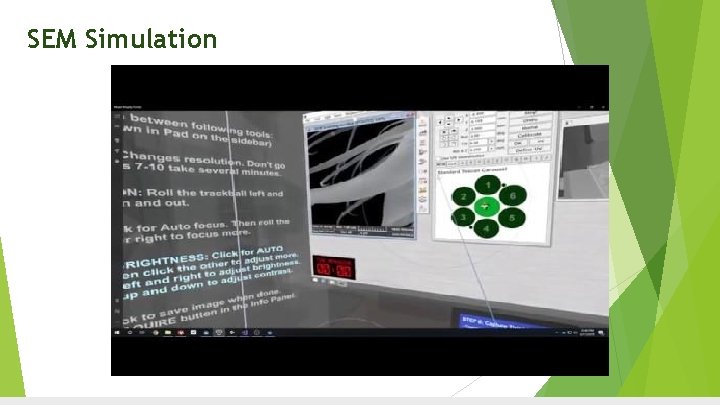
Types of Simulations 1) Photolithography - use of spin coater, photoresist, preparation of wafer sample, exposing pattern, developing 2) SEM - use of scanning electron microscope 3) Plasma Etching - use of plasma etching machine to remove material from sample 4) Sputter Deposition - operation of two-stage vacuum system, diffusion pump, creating a thin layer sample coating by sputtering 5) Nanomanufacturing Facility Interior - tour of facility based on I. M. Flash in Lehi, UT
SEM Simulation
Conclusion UVU is using virtual reality in its nanotechnology education in order to help more students prepare for using the real world machines while reducing risks, increasing lab safety, and providing relevant experience that will help them further their goals. Than Grant 1700695 Dr. Reza Kamali-Sarvestani THANK and Dr. Paul Weber YOU!