
UTAH ASSOCIATION OF FAMILY AND CONCILIATION COURTS Salt







- Slides: 51
UTAH ASSOCIATION OF FAMILY AND CONCILIATION COURTS Salt Lake City, Utah February 21, 2020
Child Custody Relocation Dilemmas: Social Science Integrated Analytical Model: Best Interests or Least Detrimental Alternative? February 21, 2020
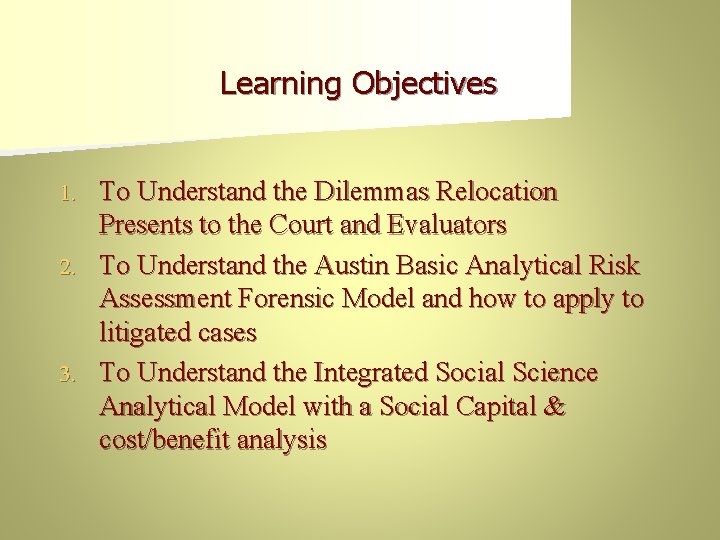
Learning Objectives To Understand the Dilemmas Relocation Presents to the Court and Evaluators 2. To Understand the Austin Basic Analytical Risk Assessment Forensic Model and how to apply to litigated cases 3. To Understand the Integrated Social Science Analytical Model with a Social Capital & cost/benefit analysis 1.
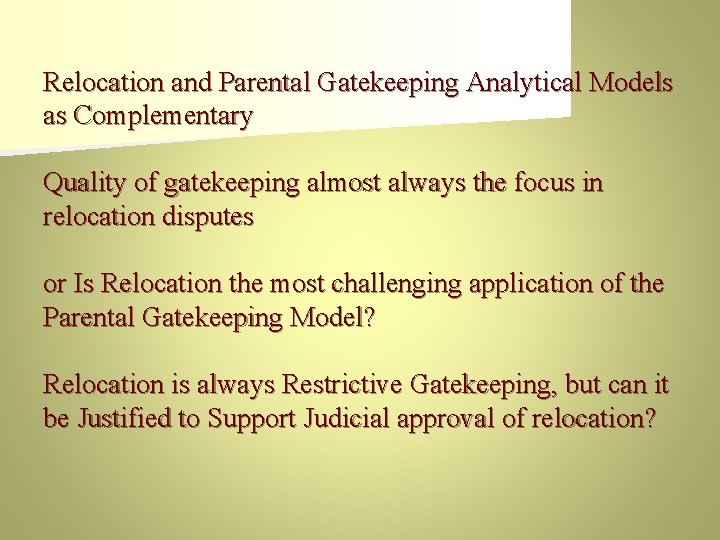
Relocation and Parental Gatekeeping Analytical Models as Complementary Quality of gatekeeping almost always the focus in relocation disputes or Is Relocation the most challenging application of the Parental Gatekeeping Model? Relocation is always Restrictive Gatekeeping, but can it be Justified to Support Judicial approval of relocation?
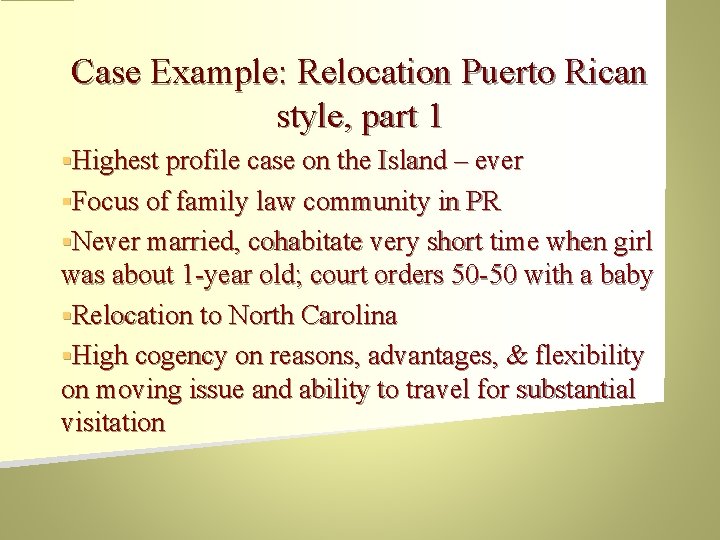
Case Example: Relocation Puerto Rican style, part 1 §Highest profile case on the Island – ever §Focus of family law community in PR §Never married, cohabitate very short time when girl was about 1 -year old; court orders 50 -50 with a baby §Relocation to North Carolina §High cogency on reasons, advantages, & flexibility on moving issue and ability to travel for substantial visitation
Case example, part 2 n n n n Social Work family study a` la PR system Two high profile experts for “case review & analysis” and instructional testimony on the issues History of coercive control IPV by father; personality issues Zero psychological, personal liabilities for mother Gatekeeping Extended family & social capital ; both sides highly involved Litigation drags on and on; both sides expect appeal to PR Supreme Court; it is a given Child is ready to enter kindergarten at time of trial
Case example, part 3 n n n Very undeveloped PR family law-custody; no relocation law; Focus on case with pending legislation in PR Senate Austin report circulated New relocation law passed & released before end of 4 -weeks of trial History of dad traveling to NC for 8 -months, every other week when mother & baby are there
Divorce & Unpartnering Rates n Hovers around 50% on divorce for many years in most Western countries n Unpartnering: % of nonmarried parents n Data on the rates? n Nonmarrieds in litigation – commonplace n None of the stats are good for an aspirational goal of long-term family stability
Residential Mobility versus Legal Relocation cases n n n Professor Sarah Ramsey position Of course the family dynamics are entirely different Longitudinal research in Australia & New Zealand (Parkinson, Cashmore, Taylor) on litigating families Highest quality qualitative research Hypothesis generation Emphasis on practical solutions and risk management in the context of relocation and long distance parenting
Mobility: Separated and Divorced n n n U. S. Census Data 2010 How different will 2020 be? Historically very mobile society; part of the reality in the social policy on relocation 2010 showed a slight drop in overall rate to 34% Separated & Divorced the highest rates; mostly likely to have young children (see Parkinson et al. , 2016) at www. child-custody-services. com.
Meta Issues in Relocation: Outside thinking on issues in the Forest n n n Psycho-Legal Dilemmas (Austin, 2000 b); Competing Constitutional Rights, social policy interests Legal Parameters: statutory and case law factors (factorial analysis) Parkinson & Cashmore (2015); Austin (2016) Ambiguities in the Law? 4 Decisional Alternatives; which comparisons for court to consider? Least Restrictive Alternative (LDA) vs. Best Interests
Ambiguities in Relocation Law n n n Variation between State Laws Can the court consider if the parent would move without the child? Can Court just deny relocation without changing custodial parent? California: Court must assume each parent will be living where they state they intend to live So it it becomes designating the custodial parent and risk management in every analysis
Help the Court Visualize n Based on careful investigation and fact gathering n What life would be like for the child and parent in the alternative living arrangements n What will life be like in Orlando vs. Salt Lake? n Practical considerations if long distance
Cogency Test n Court wants to know if the proposed relocation makes sense and will be in the child’s best interest n Reasons for the move n Degree of Realistic Flexibility on moving issue n Relative Advantages and Disadvanges of moving vs. not moving
Anti-Relocation Bias • • • Example of Confirmatory Bias By Judges, Evaluators, Mediators A Common Cognitive Bias Defined: (Mis)Interpreting facts/data to support a preferred hypothesis; preconceived mindset Not considering alternative hypotheses
Even Playing Field? n Case Law: Put Parties on an even playing field or “equal footing” n Relocation as Incongruent with Social Policy of continuing contact with both parents? n Juxtapose countervailing parental rights n Open-mindedness vs. Bias
Austin Relocation Risk Assessment Forensic Model (2000) n Factorial Analysis n Extrapolated from Divorce effects literature and child development theory n Violence Risk Assessment literature as the scientific paradigm by analogy on risk assessment n Risk & Resilience General Framework (Hetherington; Rutter; Garmesky, others
Another Relocation case example: Vindictive Motives? n n n Mother propose move Roaring Fork valley, CO to Tallahassee, FL Older children, 9 & 11 years Native South Africa; U. S. citizens Stay-at-home mom; legally separated by a “War of the Roses” continue to live together Dad finally gets own place; high conflict New girlfriend; mom immediately proposes relocation
“I got to get out of this place, ” slide 2 n Father a “solid breadwinner” n Father very involved in activities with kids: ski, fly fish, other; kids very athletic n A CFI investigation for court by lawyer n Big issue of allege dad putting kids in the middle on the relocation issue n Child preference in relocation cases?
Moving to warmer climate, slide 3 n n n n 11 -year old girl strongly opposed to move Tells CFI Florida has sharks & tsunamis Mother in other ways a restrictive gatekeeper Court temporary orders of close to 50 -50 Dad can work from home Dad not an easy person or co-parent; he gives CFI a list of 20 -things the mother needs to change Mother asserts reason of family support in Florida CFI views dad as restrictive gatekeeper
Additional Factors n Number & Type of Past Moves n Is the child introverted? n Loss/Gain in Social Capital n Ability of moving parent to cultivate new sources of social capital n Is nonmoving parent a viable candidate to be the custodial parent? n History of ACEs?
Case Law incorporating the Austin Relocation Risk Factors n Estopina v. O’Brian, 60 A. 3 d 790 (D. C. 2013). [high court] n Samuel v. Person, 2010 WL 2627858 (D. C. Super) [trial court]
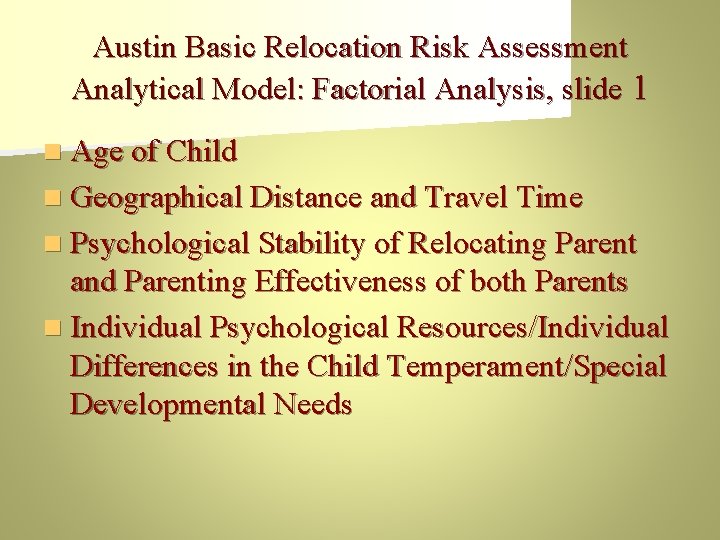
Austin Basic Relocation Risk Assessment Analytical Model: Factorial Analysis, slide 1 n Age of Child n Geographical Distance and Travel Time n Psychological Stability of Relocating Parent and Parenting Effectiveness of both Parents n Individual Psychological Resources/Individual Differences in the Child Temperament/Special Developmental Needs
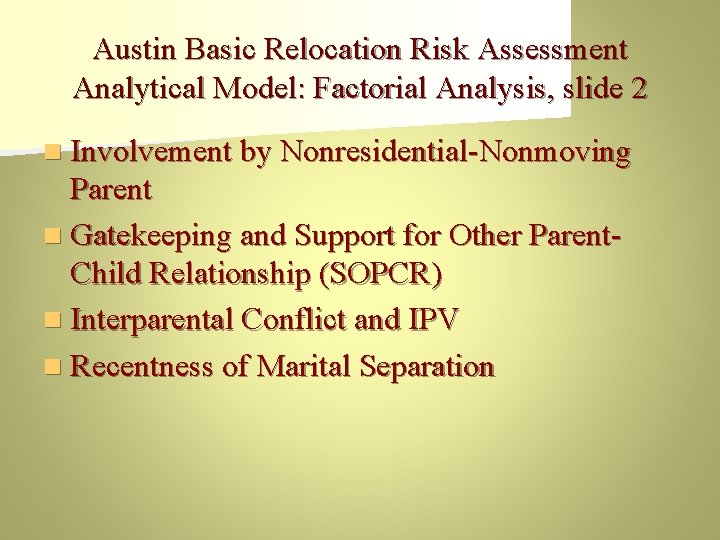
Austin Basic Relocation Risk Assessment Analytical Model: Factorial Analysis, slide 2 n Involvement by Nonresidential-Nonmoving Parent n Gatekeeping and Support for Other Parent. Child Relationship (SOPCR) n Interparental Conflict and IPV n Recentness of Marital Separation
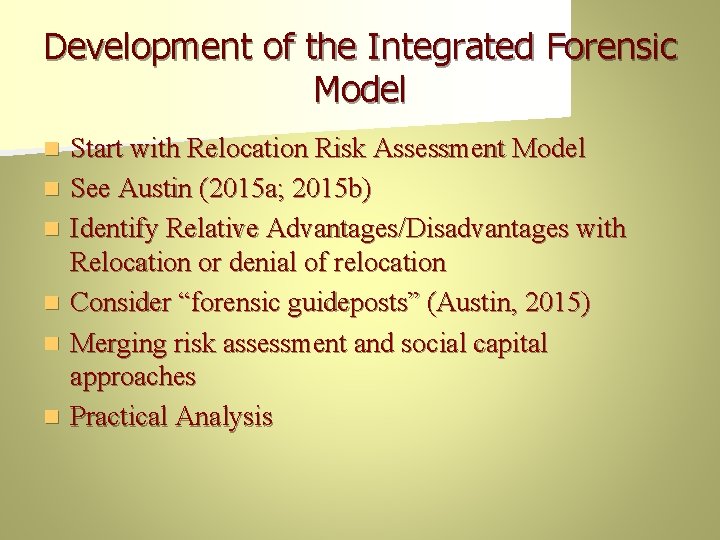
Development of the Integrated Forensic Model n n n Start with Relocation Risk Assessment Model See Austin (2015 a; 2015 b) Identify Relative Advantages/Disadvantages with Relocation or denial of relocation Consider “forensic guideposts” (Austin, 2015) Merging risk assessment and social capital approaches Practical Analysis
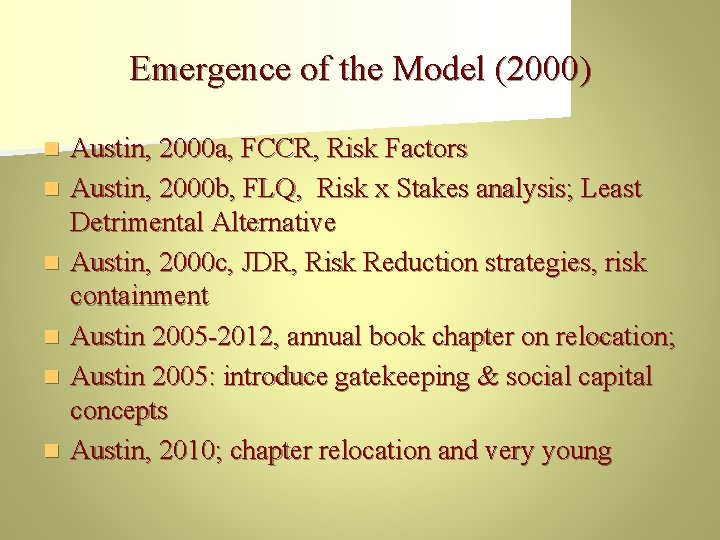
Emergence of the Model (2000) n n n Austin, 2000 a, FCCR, Risk Factors Austin, 2000 b, FLQ, Risk x Stakes analysis; Least Detrimental Alternative Austin, 2000 c, JDR, Risk Reduction strategies, risk containment Austin 2005 -2012, annual book chapter on relocation; Austin 2005: introduce gatekeeping & social capital concepts Austin, 2010; chapter relocation and very young
Social Science Analytical Model Development n n n Cogency Test Cost/benefit analysis Austin (2008 a): review of literature on residential mobility on children of divorce Austin (2008 b): revision of risk assessment factorial model with supporting research Austin (2015 a): introduce combination of risk assessment and social capital approach to the Integrated Analytical Model
Applying Scientific Research n Applying Research to the Individual Case n Between Group & Within Group Variance n Qualitative vs. Quantitative Research n Relocation cases “Ripe” for opportunities to apply research n Admissibility Issues n Instructional Testimony
Applying Social Science Information Comment-Corrections to AFCC Guidelines (2016/2017) n Expect non-psychologists to be competent consumers of SS research? n Evaluators just don’t do this much n Applying Social Science terms, language, concepts, heuristics, guides, frameworks, informal models, theories, and empirical generalizations n
Research Relevant to Relocation Dilemmas, slide 1 n n n Residential Mobility research (Sociology. Demography) Is relocation a general risk factor? (Austin, 2008 a) Parkinson, Cashmore, Taylor (Parkinson et al. , 2016) Joint Parental Involvement Mc. Lanahan; Amato Divorce effects: concepts and diverse variables
Research Relevant to Relocation Dilemmas, slide 2 n Research in support of relocation risk assessment model – factorial analysis n Joint Parental Involvement; importance of fathers on children’s adjustment & wellbeing; n Attachment Theory n Resource Availability Theory n Benefits from Social Capital, positive & negative?
FORENSIC INVESTIGATION n n n Careful Investigation needed in all litigated cases Especially True for Relocation Cases Helping Court Visualize Potential Alternative Residential Living Arrangements Austin & Kirkpatrick (2004) Always about the Facts & Context at the end of the day Forensic Analytical Model is just a first step. Important nuance in the model. DC case law noted this point in the model.
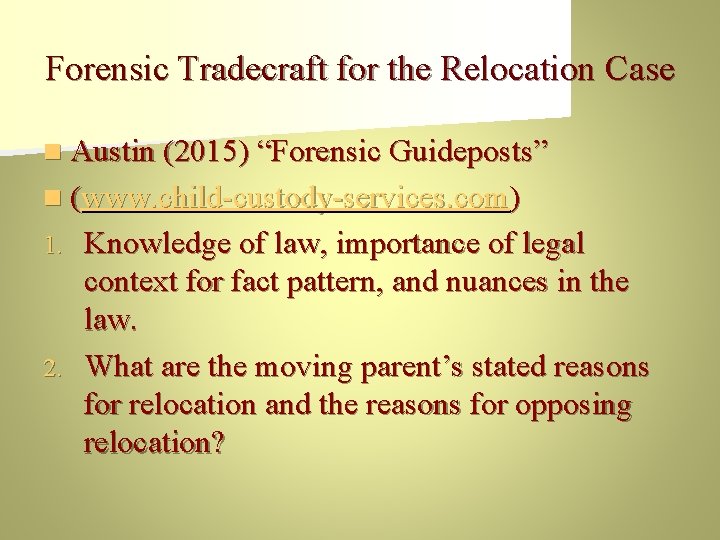
Forensic Tradecraft for the Relocation Case n Austin (2015) “Forensic Guideposts” n (www. child-custody-services. com) Knowledge of law, importance of legal context for fact pattern, and nuances in the law. 2. What are the moving parent’s stated reasons for relocation and the reasons for opposing relocation? 1.
Forensic Guideposts, slide 2 3. Fundamental comparison and importance of investigation of the facts and issues. 4. Evaluators should utilize a systematic approach to the case and fact pattern to guide the design and implementation of the forensic evaluation. 5. Assess the factors from the statute and case law, and other relevant information.
Forensic Guideposts, slide 3 6. Past and projected pattern of parental gatekeeping by both parents. 7. What is the degree of realistic flexibility on the moving issue for the moving parent, and if allowed by law, for the nonmoving parent on the option of also moving and following the child? 8. Based on the investigation and forensic assessment, is the nonmoving parent a viable candidate to be the residential parent?
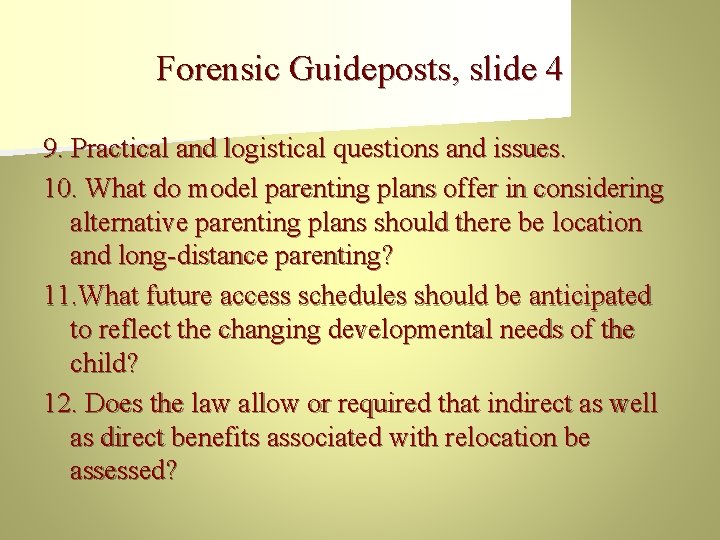
Forensic Guideposts, slide 4 9. Practical and logistical questions and issues. 10. What do model parenting plans offer in considering alternative parenting plans should there be location and long-distance parenting? 11. What future access schedules should be anticipated to reflect the changing developmental needs of the child? 12. Does the law allow or required that indirect as well as direct benefits associated with relocation be assessed?
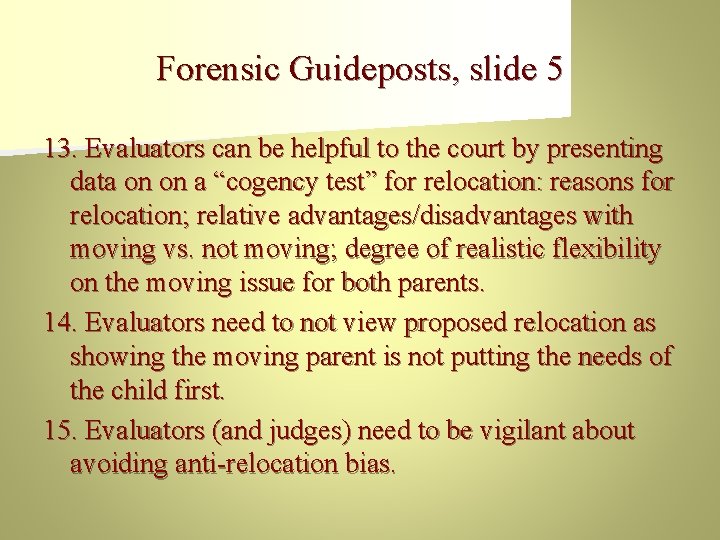
Forensic Guideposts, slide 5 13. Evaluators can be helpful to the court by presenting data on on a “cogency test” for relocation: reasons for relocation; relative advantages/disadvantages with moving vs. not moving; degree of realistic flexibility on the moving issue for both parents. 14. Evaluators need to not view proposed relocation as showing the moving parent is not putting the needs of the child first. 15. Evaluators (and judges) need to be vigilant about avoiding anti-relocation bias.
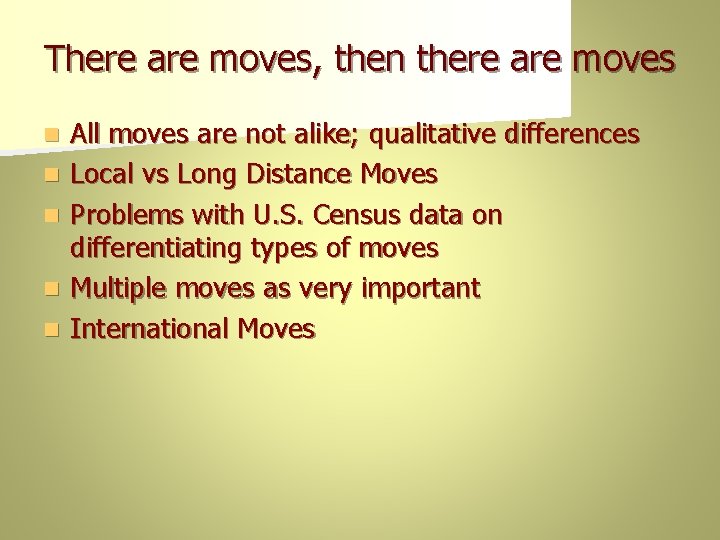
There are moves, then there are moves n n n All moves are not alike; qualitative differences Local vs Long Distance Moves Problems with U. S. Census data on differentiating types of moves Multiple moves as very important International Moves
Effects of Relocation on Children of Divorce • Austin (2008 b) • Residential Mobility • Relocation as Adverse Childhood Event (ACE) • Austin change in view on the relocation effect • Hyper-mobile at highest risk • Social Capital analysis; extended family? • Most children will do okay after relocation but is it best or better than what the other paths represented?
Real World Research: Families who Litigate n n n n Patrick Parkinson, JD & Judith Cashmore, Ph. D. 80 families involved in relocation litigation 50% of relocations approved by court Very long distance moves Longitudinal: followed over 3 -years Qualitative research; most kids did fine Can new partner move to home community? Parkinson, Cashmore, Taylor & Austin (2016)
Research on Shared Parenting Children of Divorce show best long-term adjustment with quality relationships with both parents § Also a Legislative Declaration to promote continuing contact with both parents § Controversy on frequency/amount of contact by fathers vs quality issue §
Constructing Local & Long Distance Parenting Plans n Shared = Substantial = Meaningful Opportunity for Involvement n Shared Definition: 35% Timeshare; 5/14 overnights n Plus other times; holidays; summers n Long Distance & Developmental Stage n Arizona Supreme Court Model Parenting Plans
Child Custody Evaluation Perspective • Forensic • • Method Usually court-appointed Answering the court’s questions Investigative rather than therapeutic Multiple sources of information Credibility of information is assessed Evaluation of hypotheses Expert opinions & recommendations
Relocation & Risk Management n n n How to manage risk of harm to the nonmoving parent-child relationship? Relocation as Depriving Child of the other parent’s social capital Indirect Harm to the Child Long distance parenting plan is key to the risk management; Access plan Quality of Gatekeeping is the 2 nd key
Social Capital & Ecological Comparison n In both local & long distance parenting plans n Richness & Opportunities for the child’s development & Adjustment in the two residential environments and communities n Presence of extended family; educational opportunities; differences in parenting styles
Social Capital: Explaining the “Gatekeeping Effect” Social Capital refers to the psychosocial resources that a child derives from the important relationships and experiences in his or her life associated with an identified social environment. Sources include Parents, siblings, extended family, teachers, peers, coaches. n Positive & Negative Social Capital n Part of the Fundamental Comparison made in custody determinations n
Gatekeeping as Social Capital n n n Quality of Gatekeeping is part of the social capital available to the child FG as Positive Social Capital Unjustified RG as Negative Social Capital Nonmoving parents/fathers assert Proposed Relocation is “alienation. ” This is common. FG in long distance creates risk management for harm to nonmoving-child relationship
Gatekeeping & Proposed Long Distance Parenting Plan The “gatekeeping track record” of the moving parent? n Is it expected that moving parent will be proactive in supporting the other parent-child relationship? n What is the moving parent’s proposed long distance parenting plan? n – The “proposed maximum access plan” as FG – A “minimum access plan” represents RG
Facilitative Gatekeeping and Risk Management Importance of Skype or Virtual Parenting Time (VPT) n Can the moving parent feel comfortable with a consistent presence of the other (distant) parent in her residence, electronically? n Case vignette: 7 -year old; mother move to TN; dad in Raleigh, NC; proposed plan is 1 -week in summer; half of Christmas; half of spring break; history of high degree of RG n
What if IPV & proposed Relocation? n If past substantial/severe IPV and relocation co-occurring? n Cannot expect the victim-parent to be the facilitative gatekeeper or “friendly parent” n IPV as justifying relocation?
Austin Publications on Child Custody, Relocation, Parental Gatekeeping, Intimate Partner Violence available at: www. child-custody-services. com www. parentalgatekeeping. com