
UTA GEM DHCAL SIM J Yu Univ of
- Slides: 25
UTA GEM DHCAL SIM J. Yu* Univ. of Texas at Arlington Nov. 7 - 9, 2002 NIU/NICADD • Introduction • Digital Hadron Calorimeter Requirements • GEM in the sensitive gap • UTA GEM DHCAL Prototype Status • Simulation Status • Summary (*On A. Brandt, De, DHCAL S. Habib, V. Kaushik, J. Li, M. Nov. behalf 7, 2002 of the UTA team; Jae Yu: GEM K. Based Sosebee, A. White)
Introduction • LC physics topics – Distinguish W from Z in two jet final states Good jet mass resolution – Higher Jet energy resolution; – Excellent jet angular resolution • Energy flow algorithm is one of the solutions – Replace charged track energy with momentum measured in the tracking system • Requires efficient removal of associated energy cluster Good position resolution • Higher calorimeter granularity – Use calorimeter only for neutral particle energies – Best known method for jet energy resolution improvement • Large number of readout channel will drive up the cost for analogue style energy measurement Digital HCAL Nov. 7, 2002 Jae Yu: GEM high Based DHCAL 2 • Tracking calorimeter with gain sensitive gap
Goals for UTA DHCAL Development • Develop digital hadron calorimetry for use with EFA – Aim for cost effectiveness and high granularity – Look for a good tracking device for the sensitive gap • • • Develop GEM cell(s) and prototype Develop module/stack design for EFA optimization Simulate GEM behavior in calorimeter Implement GEM readout structure into simulation Develop EF and calorimeter tracking algorithms Cost effective, large scale GEM DHCAL Nov. 7, 2002 Jae Yu: GEM Based DHCAL 3
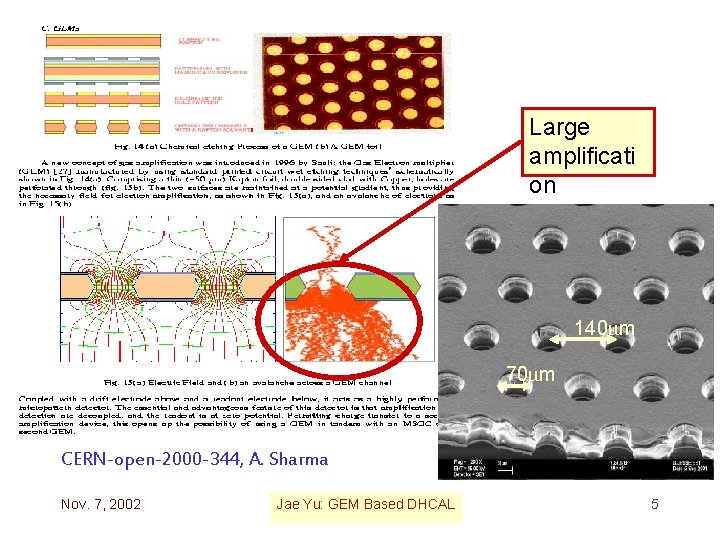
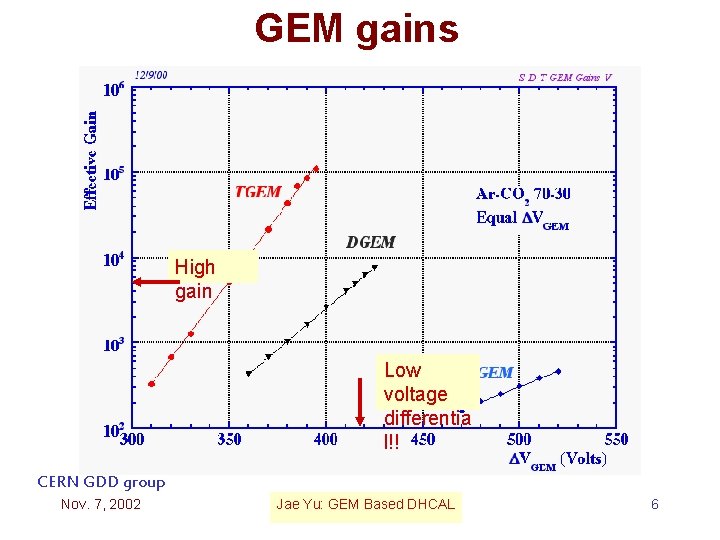
Why GEM? • GEM developed by F. Sauli (CERN) for use as preamplification stage for MSGC’s • Allow flexible and geometrical design, using printed circuit readout Can be as fine a readout as GEM tracking chamber!! • High gains, above 104, with spark probabilities per incident less than 10 -10 • Fast response – 40 ns drift time for 3 mm gap with Ar. CO 2 • Relatively low HV – A few 100 V per each GEM gap compared to 10 -16 k. V for RPC • Rather reasonable cost – Foils are basically copper-clad kapton – ~$400 for a specially prepared and framed 10 cmx 10 cm foil Nov. 7, 2002 Jae Yu: GEM Based DHCAL 4
Large amplificati on 140 mm 70 mm CERN-open-2000 -344, A. Sharma Nov. 7, 2002 Jae Yu: GEM Based DHCAL 5
GEM gains High gain Low voltage differentia l!! CERN GDD group Nov. 7, 2002 Jae Yu: GEM Based DHCAL 6
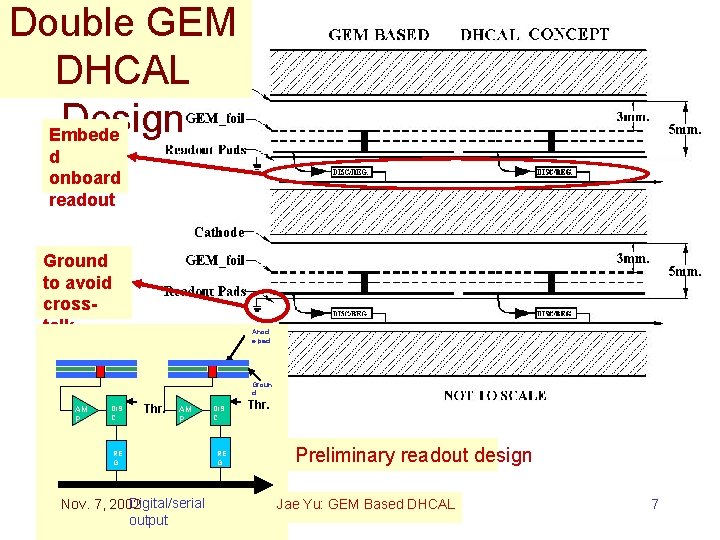
Double GEM DHCAL Design Embede d onboard readout Ground to avoid crosstalk Anod e pad Groun d AM P DIS C Thr. AM P RE G Digital/serial Nov. 7, 2002 output DIS C RE G Thr. Preliminary readout design Jae Yu: GEM Based DHCAL 7
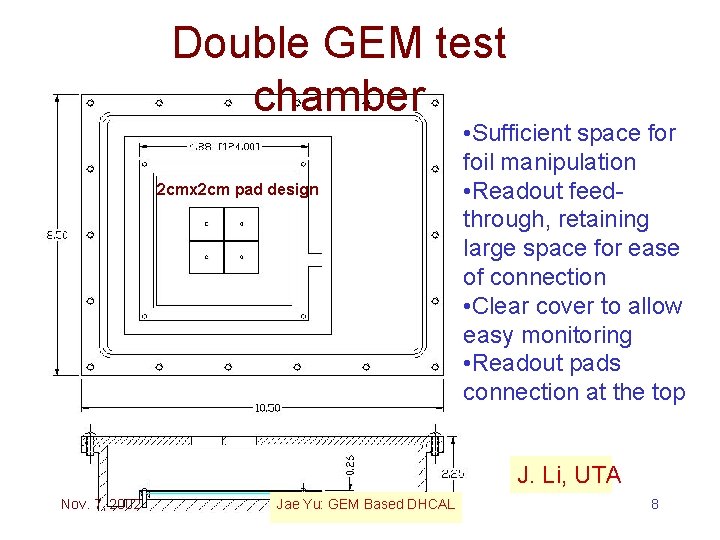
Double GEM test chamber 2 cmx 2 cm pad design • Sufficient space for foil manipulation • Readout feedthrough, retaining large space for ease of connection • Clear cover to allow easy monitoring • Readout pads connection at the top J. Li, UTA Nov. 7, 2002 Jae Yu: GEM Based DHCAL 8
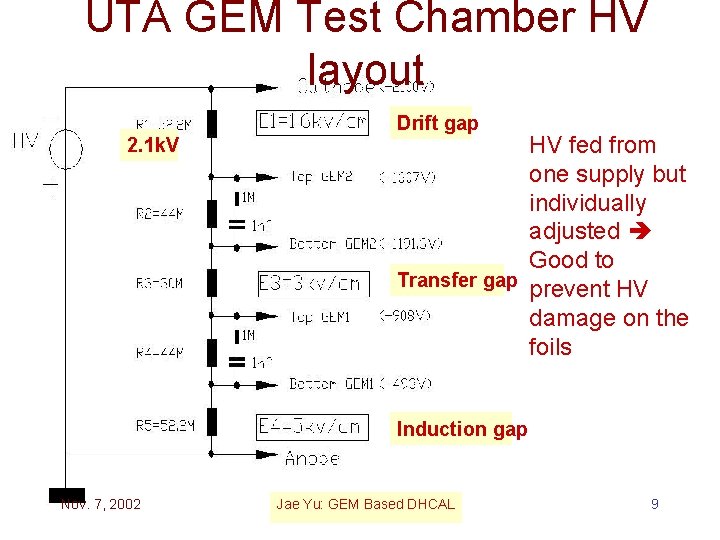
UTA GEM Test Chamber HV layout 2. 1 k. V Drift gap HV fed from one supply but individually adjusted Good to Transfer gap prevent HV damage on the foils Induction gap Nov. 7, 2002 Jae Yu: GEM Based DHCAL 9
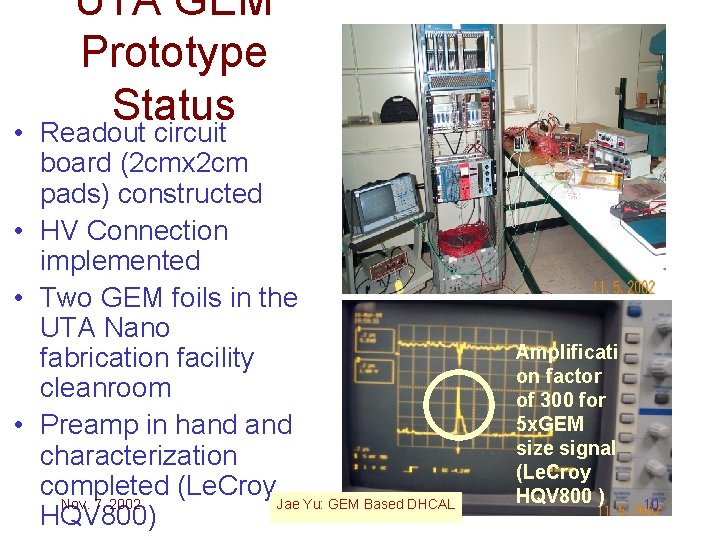
• UTA GEM Prototype Status Readout circuit board (2 cmx 2 cm pads) constructed • HV Connection implemented • Two GEM foils in the UTA Nano fabrication facility cleanroom • Preamp in hand characterization completed (Le. Croy Nov. 7, 2002 Jae Yu: GEM Based DHCAL HQV 800) Amplificati on factor of 300 for 5 x. GEM size signal (Le. Croy HQV 800 ) 10
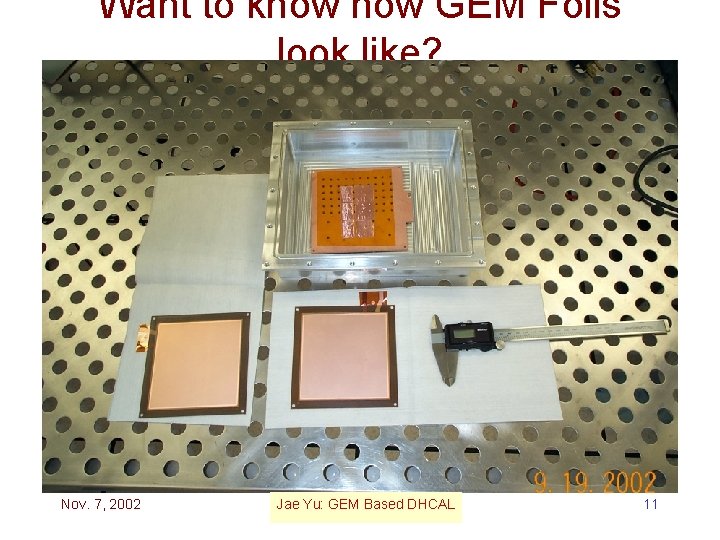
Want to know how GEM Foils look like? Nov. 7, 2002 Jae Yu: GEM Based DHCAL 11
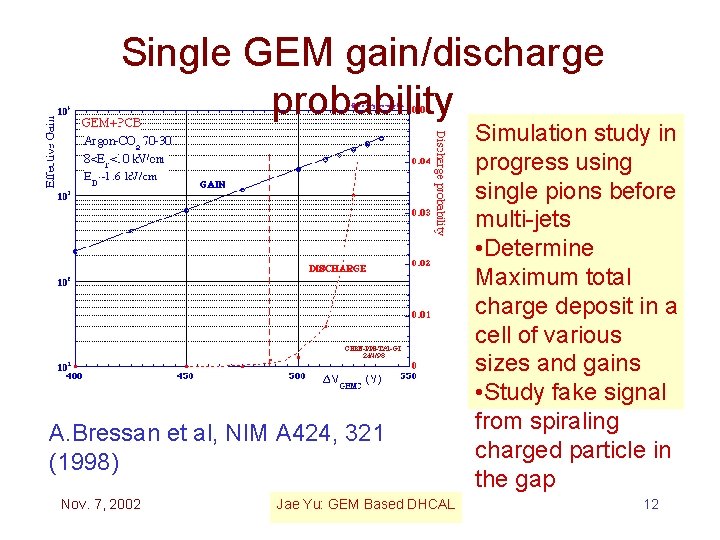
Single GEM gain/discharge probability A. Bressan et al, NIM A 424, 321 (1998) Nov. 7, 2002 Jae Yu: GEM Based DHCAL Simulation study in progress usingle pions before multi-jets • Determine Maximum total charge deposit in a cell of various sizes and gains • Study fake signal from spiraling charged particle in the gap 12
UTA Simulation Status • Two masters students have been working on this project – Pandora-Phythia implementation and HEPEvt ASCII output in place – Mokka successfully installed – Mokka Geometry database downloaded and installed at UTA – Completed single pion studies using default geometry • Reproduced expected response • Energy resolution seems to be reasonable also – Preliminary mixture GEM geometry implemented – Single pion study with mixture GEM begun • Root macro and JAS based analysis packages developed Nov. 7, 2002 Jae Yu: GEM Based DHCAL 13 • Proceed with more detailed GEM geometry
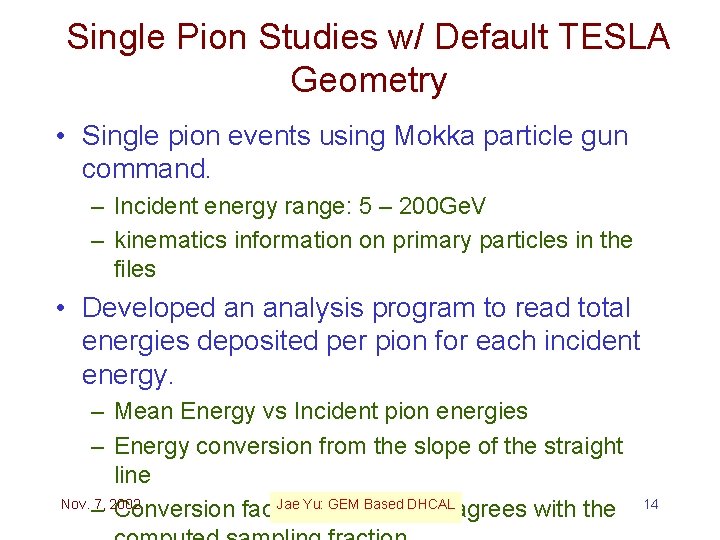
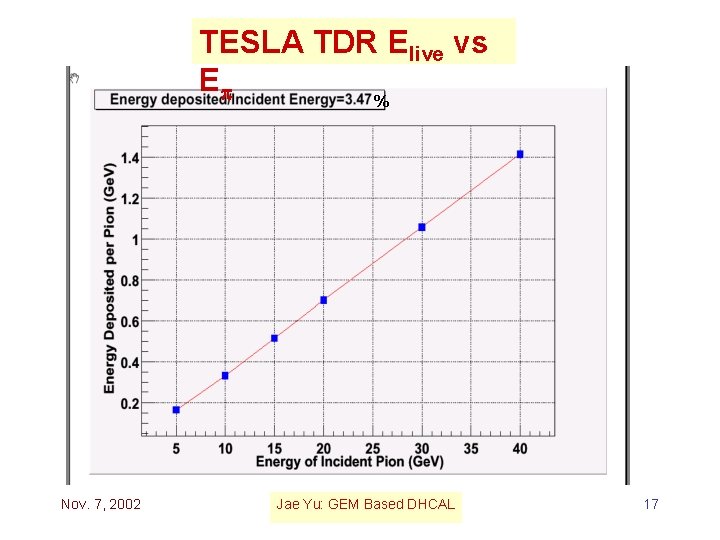
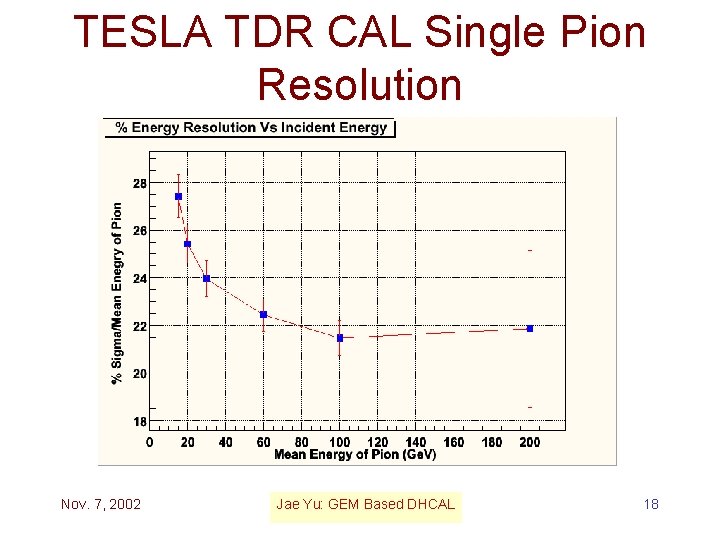
Single Pion Studies w/ Default TESLA Geometry • Single pion events using Mokka particle gun command. – Incident energy range: 5 – 200 Ge. V – kinematics information on primary particles in the files • Developed an analysis program to read total energies deposited per pion for each incident energy. – Mean Energy vs Incident pion energies – Energy conversion from the slope of the straight line Nov. 7, 2002 Jae Yu: GEM Based DHCAL – Conversion factor is 3. 47% and agrees with the 14
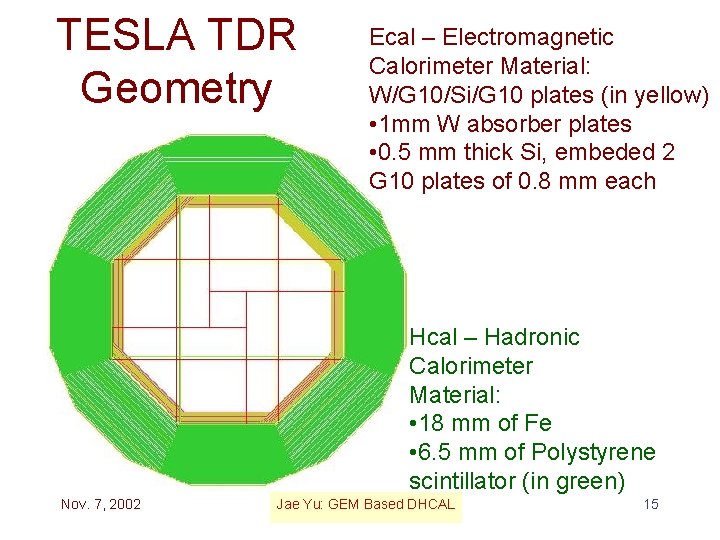
TESLA TDR Geometry Ecal – Electromagnetic Calorimeter Material: W/G 10/Si/G 10 plates (in yellow) • 1 mm W absorber plates • 0. 5 mm thick Si, embeded 2 G 10 plates of 0. 8 mm each Hcal – Hadronic Calorimeter Material: • 18 mm of Fe • 6. 5 mm of Polystyrene scintillator (in green) Nov. 7, 2002 Jae Yu: GEM Based DHCAL 15
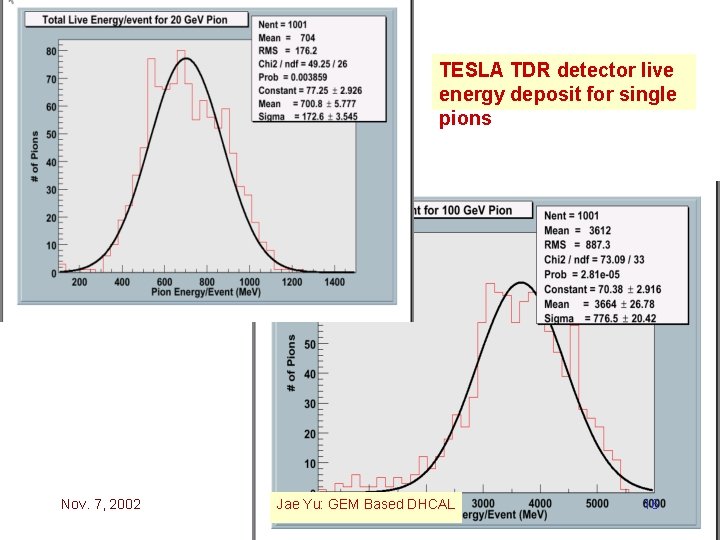
TESLA TDR detector live energy deposit for single pions Nov. 7, 2002 Jae Yu: GEM Based DHCAL 16
TESLA TDR Elive vs Ep % Nov. 7, 2002 Jae Yu: GEM Based DHCAL 17
TESLA TDR CAL Single Pion Resolution Nov. 7, 2002 Jae Yu: GEM Based DHCAL 18
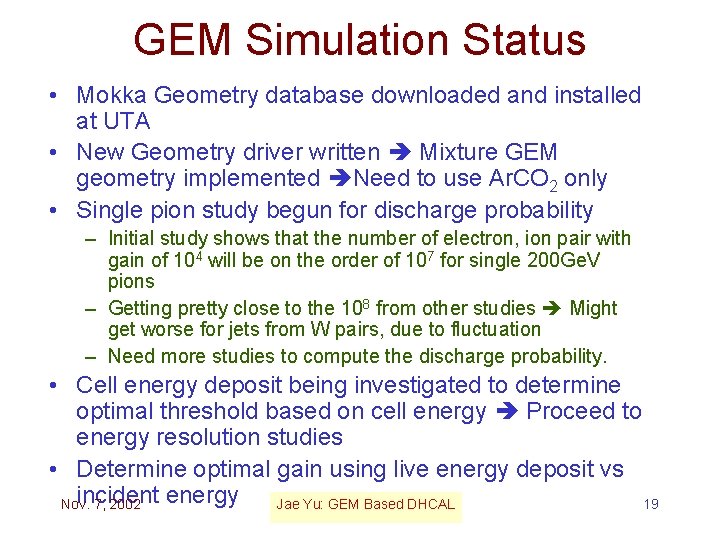
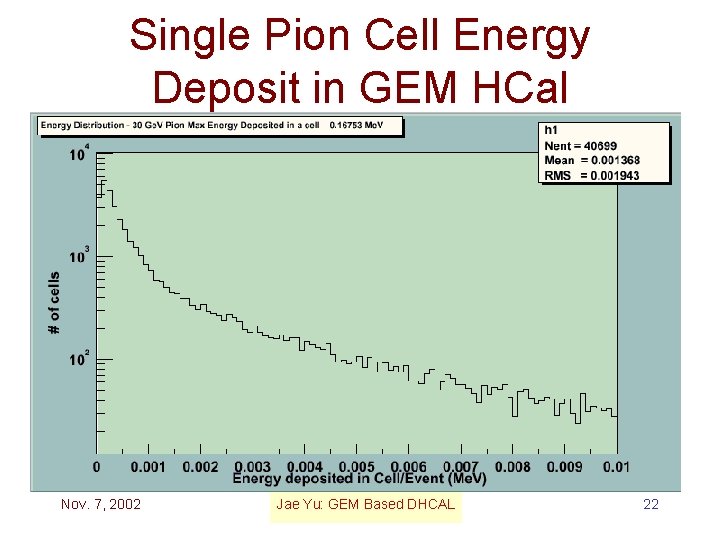
GEM Simulation Status • Mokka Geometry database downloaded and installed at UTA • New Geometry driver written Mixture GEM geometry implemented Need to use Ar. CO 2 only • Single pion study begun for discharge probability – Initial study shows that the number of electron, ion pair with gain of 104 will be on the order of 107 for single 200 Ge. V pions – Getting pretty close to the 108 from other studies Might get worse for jets from W pairs, due to fluctuation – Need more studies to compute the discharge probability. • Cell energy deposit being investigated to determine optimal threshold based on cell energy Proceed to energy resolution studies • Determine optimal gain using live energy deposit vs incident energy Nov. 7, 2002 Jae Yu: GEM Based DHCAL 19
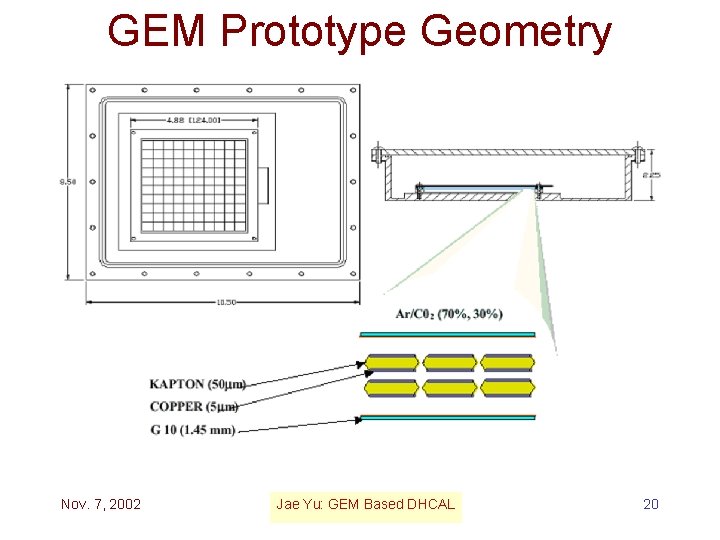
GEM Prototype Geometry Nov. 7, 2002 Jae Yu: GEM Based DHCAL 20
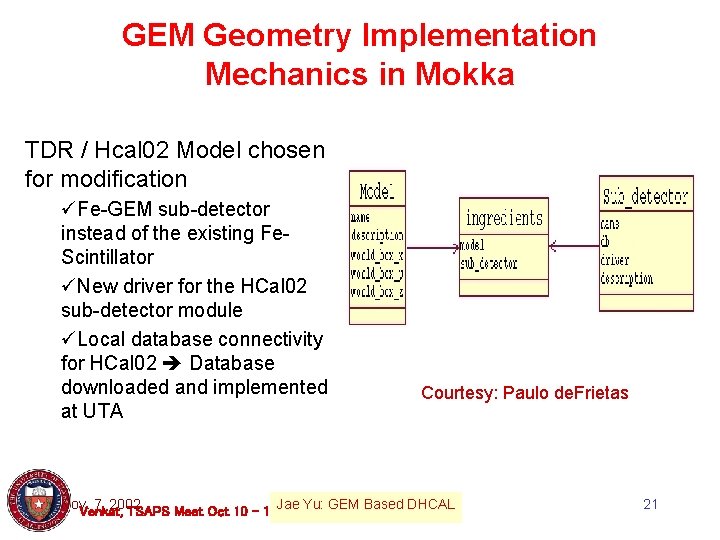
GEM Geometry Implementation Mechanics in Mokka TDR / Hcal 02 Model chosen for modification üFe-GEM sub-detector instead of the existing Fe. Scintillator üNew driver for the HCal 02 sub-detector module üLocal database connectivity for HCal 02 Database downloaded and implemented at UTA Courtesy: Paulo de. Frietas Nov. 7, 2002 Yu: GEM Based DHCAL Venkat, TSAPS Meet Oct 10 - 12, Jae 2002 21
Single Pion Cell Energy Deposit in GEM HCal Nov. 7, 2002 Jae Yu: GEM Based DHCAL 22
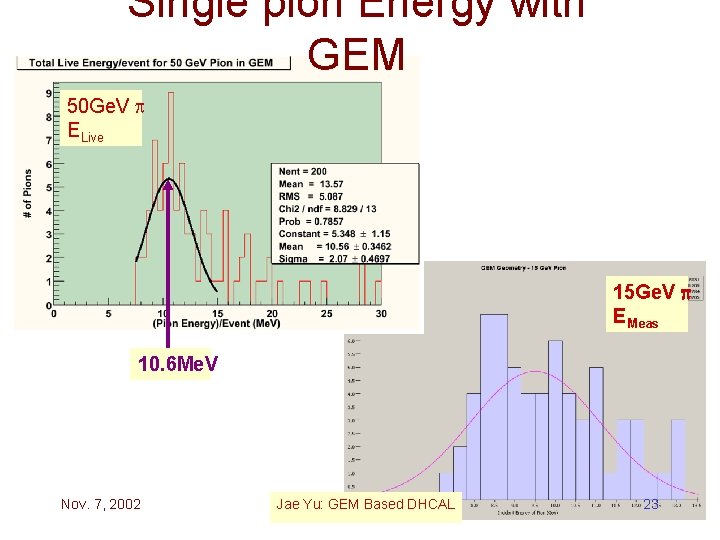
Single pion Energy with GEM 50 Ge. V ELive 15 Ge. V p EMeas 10. 6 Me. V Nov. 7, 2002 Jae Yu: GEM Based DHCAL 23
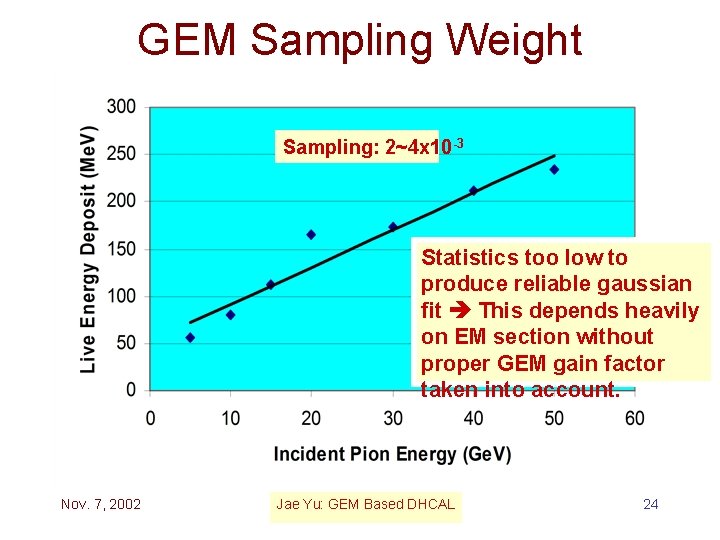
GEM Sampling Weight Sampling: 2~4 x 10 -3 Statistics too low to produce reliable gaussian fit This depends heavily on EM section without proper GEM gain factor taken into account. Nov. 7, 2002 Jae Yu: GEM Based DHCAL 24
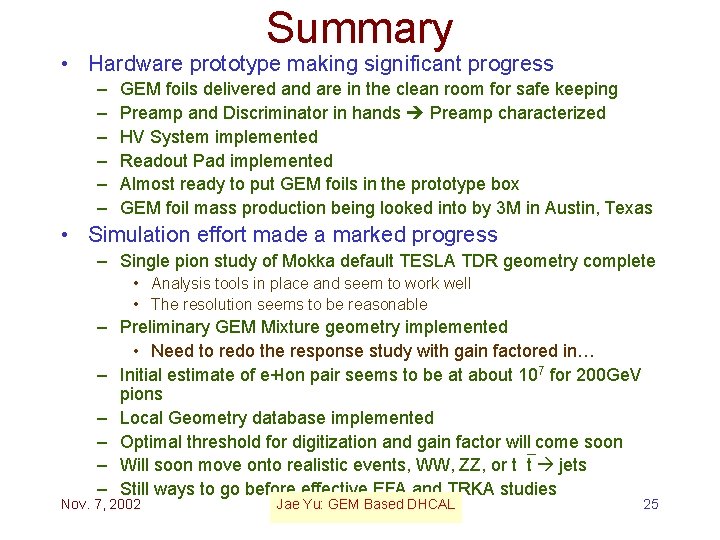
Summary • Hardware prototype making significant progress – – – GEM foils delivered and are in the clean room for safe keeping Preamp and Discriminator in hands Preamp characterized HV System implemented Readout Pad implemented Almost ready to put GEM foils in the prototype box GEM foil mass production being looked into by 3 M in Austin, Texas • Simulation effort made a marked progress – Single pion study of Mokka default TESLA TDR geometry complete • Analysis tools in place and seem to work well • The resolution seems to be reasonable – Preliminary GEM Mixture geometry implemented • Need to redo the response study with gain factored in… – Initial estimate of e+Ion pair seems to be at about 107 for 200 Ge. V pions – Local Geometry database implemented – Optimal threshold for digitization and gain factor will come soon – Will soon move onto realistic events, WW, ZZ, or t`t jets – Still ways to go before effective EFA and TRKA studies Nov. 7, 2002 Jae Yu: GEM Based DHCAL 25