
USPHS Office of Force Readiness and Deployment Response

- Slides: 29
USPHS Office of Force Readiness and Deployment Response Readiness Training Lifecycle “A continuous continuum” 1 JUN 2007
Force Readiness Training Life Cycle • Based on the National Response Plan, National Incident Management System • Meets S 3678 Pandemic and All Hazards Preparedness ACT objectives, DHHS Secretary’s goals • Provides successive training building blocks for readiness competencies
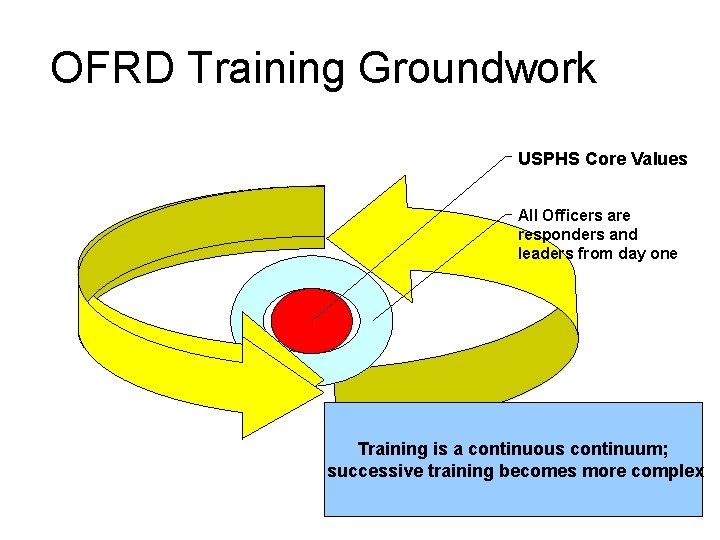
OFRD Training Groundwork USPHS Core Values All Officers are responders and leaders from day one Training is a continuous continuum; successive training becomes more complex
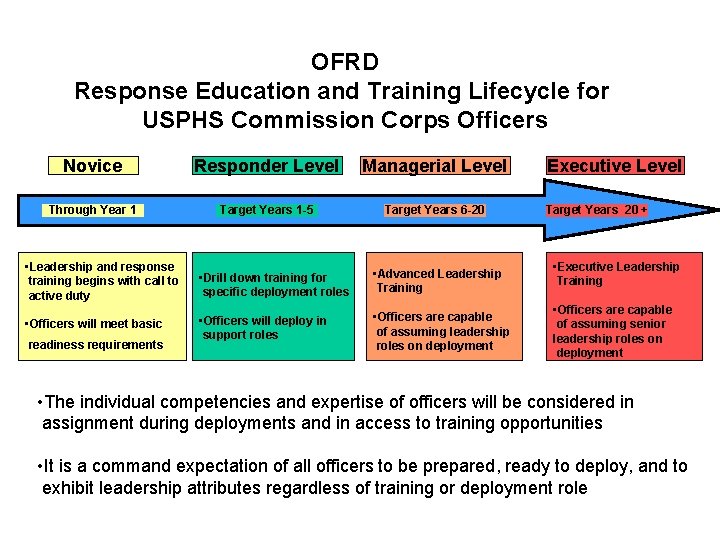
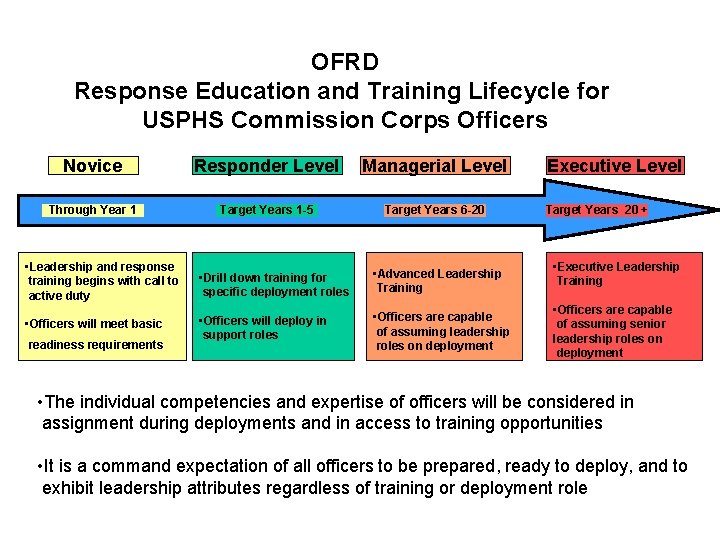
OFRD Response Education and Training Lifecycle for USPHS Commission Corps Officers Novice Responder Level Managerial Level Through Year 1 Target Years 1 -5 Target Years 6 -20 • Leadership and response training begins with call to active duty • Drill down training for specific deployment roles • Advanced Leadership Training • Officers will meet basic • Officers will deploy in support roles • Officers are capable of assuming leadership roles on deployment readiness requirements Executive Level Target Years 20 + • Executive Leadership Training • Officers are capable of assuming senior leadership roles on deployment • The individual competencies and expertise of officers will be considered in assignment during deployments and in access to training opportunities • It is a command expectation of all officers to be prepared, ready to deploy, and to exhibit leadership attributes regardless of training or deployment role
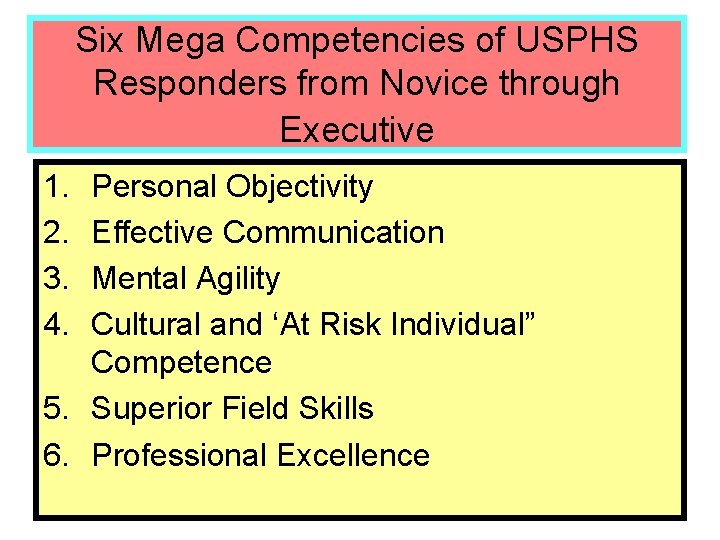
Six Mega Competencies of USPHS Responders from Novice through Executive 1. 2. 3. 4. Personal Objectivity Effective Communication Mental Agility Cultural and ‘At Risk Individual” Competence 5. Superior Field Skills 6. Professional Excellence
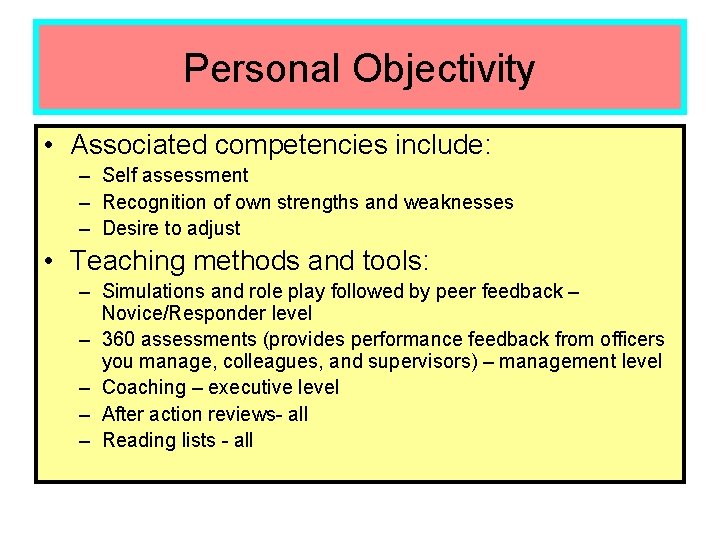
Personal Objectivity • Associated competencies include: – Self assessment – Recognition of own strengths and weaknesses – Desire to adjust • Teaching methods and tools: – Simulations and role play followed by peer feedback – Novice/Responder level – 360 assessments (provides performance feedback from officers you manage, colleagues, and supervisors) – management level – Coaching – executive level – After action reviews- all – Reading lists - all
Effective Communication
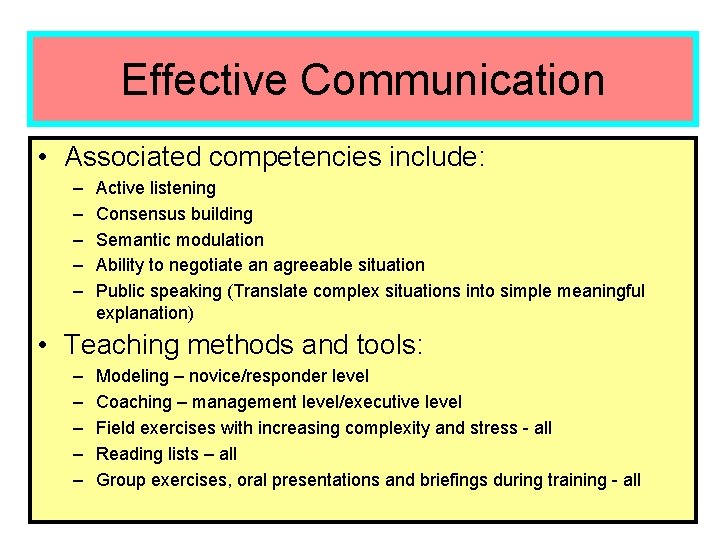
Effective Communication • Associated competencies include: – – – Active listening Consensus building Semantic modulation Ability to negotiate an agreeable situation Public speaking (Translate complex situations into simple meaningful explanation) • Teaching methods and tools: – – – Modeling – novice/responder level Coaching – management level/executive level Field exercises with increasing complexity and stress - all Reading lists – all Group exercises, oral presentations and briefings during training - all
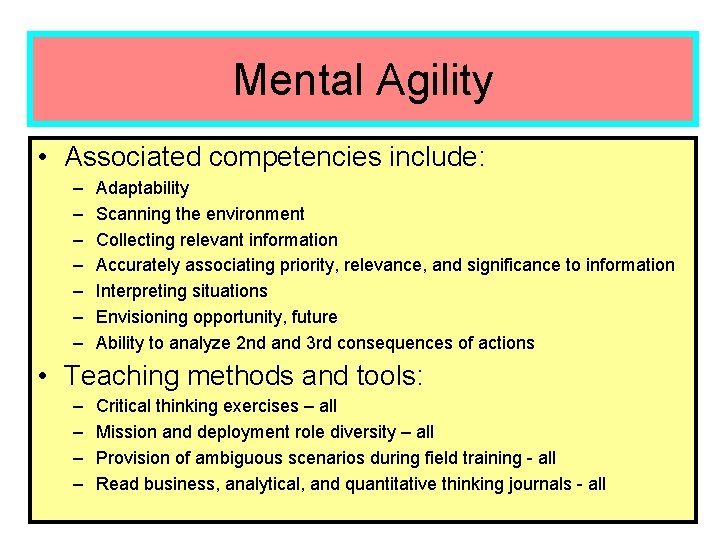
Mental Agility • Associated competencies include: – – – – Adaptability Scanning the environment Collecting relevant information Accurately associating priority, relevance, and significance to information Interpreting situations Envisioning opportunity, future Ability to analyze 2 nd and 3 rd consequences of actions • Teaching methods and tools: – – Critical thinking exercises – all Mission and deployment role diversity – all Provision of ambiguous scenarios during field training - all Read business, analytical, and quantitative thinking journals - all
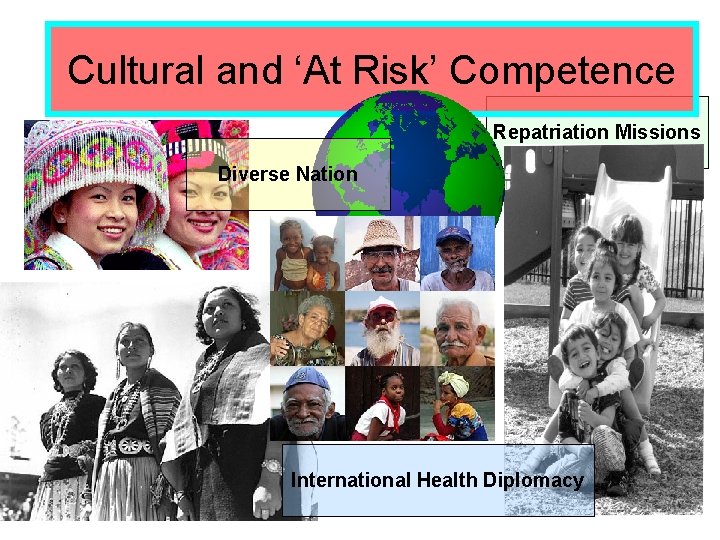
Cultural and ‘At Risk’ Competence Repatriation Missions Diverse Nation International Health Diplomacy
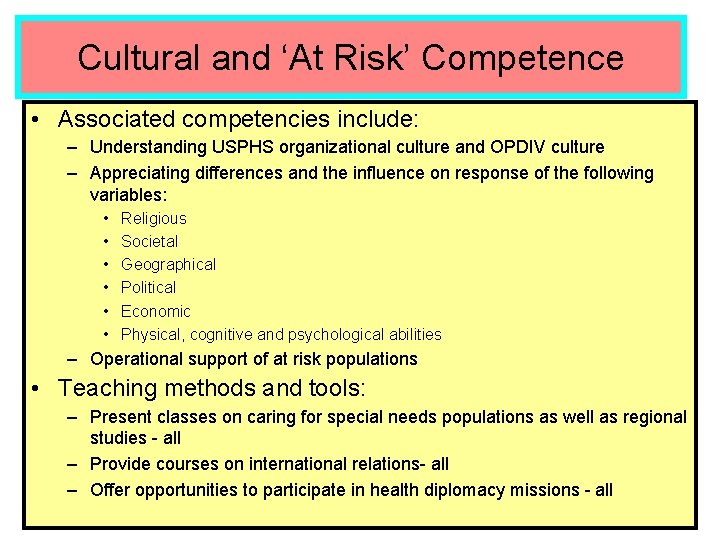
Cultural and ‘At Risk’ Competence • Associated competencies include: – Understanding USPHS organizational culture and OPDIV culture – Appreciating differences and the influence on response of the following variables: • • • Religious Societal Geographical Political Economic Physical, cognitive and psychological abilities – Operational support of at risk populations • Teaching methods and tools: – Present classes on caring for special needs populations as well as regional studies - all – Provide courses on international relations- all – Offer opportunities to participate in health diplomacy missions - all
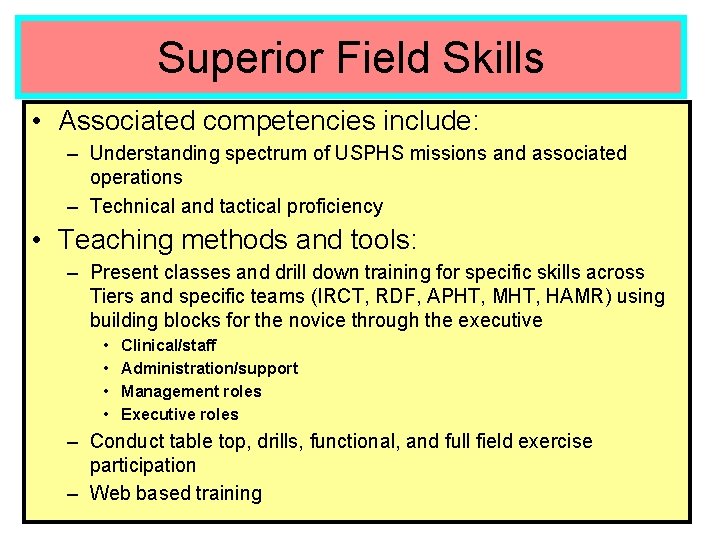
Superior Field Skills • Associated competencies include: – Understanding spectrum of USPHS missions and associated operations – Technical and tactical proficiency • Teaching methods and tools: – Present classes and drill down training for specific skills across Tiers and specific teams (IRCT, RDF, APHT, MHT, HAMR) using building blocks for the novice through the executive • • Clinical/staff Administration/support Management roles Executive roles – Conduct table top, drills, functional, and full field exercise participation – Web based training
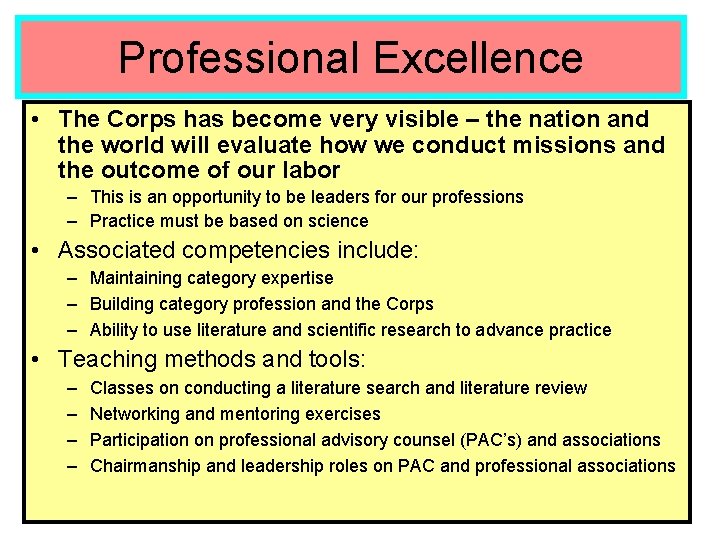
Professional Excellence • The Corps has become very visible – the nation and the world will evaluate how we conduct missions and the outcome of our labor – This is an opportunity to be leaders for our professions – Practice must be based on science • Associated competencies include: – Maintaining category expertise – Building category profession and the Corps – Ability to use literature and scientific research to advance practice • Teaching methods and tools: – – Classes on conducting a literature search and literature review Networking and mentoring exercises Participation on professional advisory counsel (PAC’s) and associations Chairmanship and leadership roles on PAC and professional associations
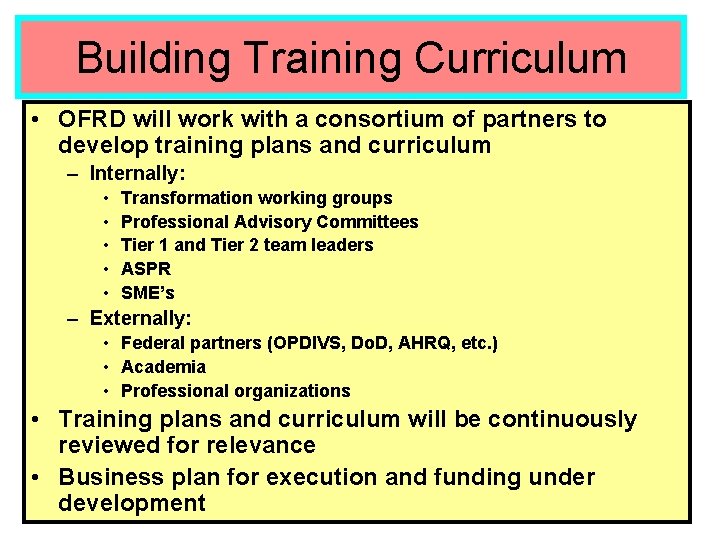
Building Training Curriculum • OFRD will work with a consortium of partners to develop training plans and curriculum – Internally: • • • Transformation working groups Professional Advisory Committees Tier 1 and Tier 2 team leaders ASPR SME’s – Externally: • Federal partners (OPDIVS, Do. D, AHRQ, etc. ) • Academia • Professional organizations • Training plans and curriculum will be continuously reviewed for relevance • Business plan for execution and funding under development
OFRD Response Education and Training Lifecycle for USPHS Commission Corps Officers Novice Responder Level Managerial Level Through Year 1 Target Years 1 -5 Target Years 6 -20 • Leadership and response training begins with call to active duty • Drill down training for specific deployment roles • Advanced Leadership Training • Officers will meet basic • Officers will deploy in support roles • Officers are capable of assuming leadership roles on deployment readiness requirements Executive Level Target Years 20 + • Executive Leadership Training • Officers are capable of assuming senior leadership roles on deployment • The individual competencies and expertise of officers will be considered in assignment during deployments and in access to training opportunities • It is a command expectation of all officers to be prepared, ready to deploy, and to exhibit leadership attributes regardless of training or deployment role
Novice Call to Active Duty – 1 Year • Leadership and Response Training begins with call to active duty • Officers will meet basic readiness requirements
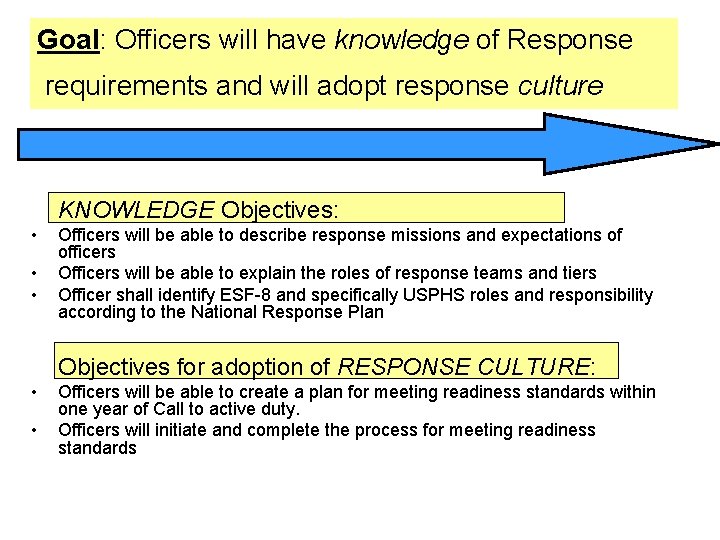
Goal: Officers will have knowledge of Response requirements and will adopt response culture KNOWLEDGE Objectives: • • • Officers will be able to describe response missions and expectations of officers Officers will be able to explain the roles of response teams and tiers Officer shall identify ESF-8 and specifically USPHS roles and responsibility according to the National Response Plan Objectives for adoption of RESPONSE CULTURE: • • Officers will be able to create a plan for meeting readiness standards within one year of Call to active duty. Officers will initiate and complete the process for meeting readiness standards
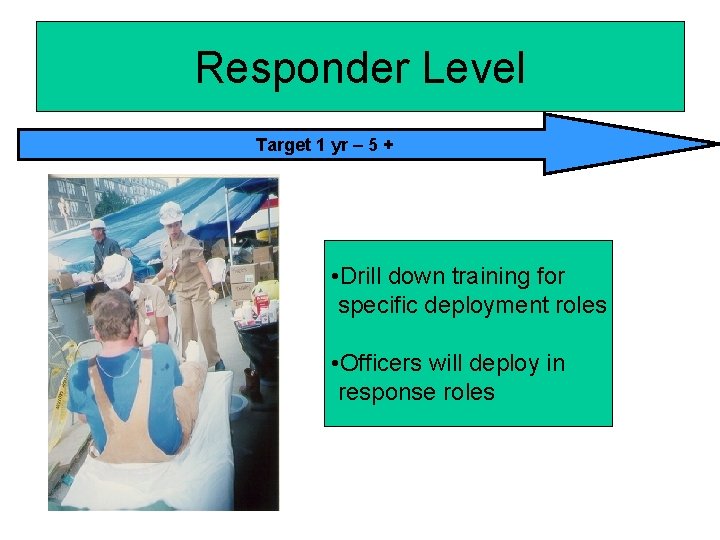
Responder Level Target 1 yr – 5 + • Drill down training for specific deployment roles • Officers will deploy in response roles
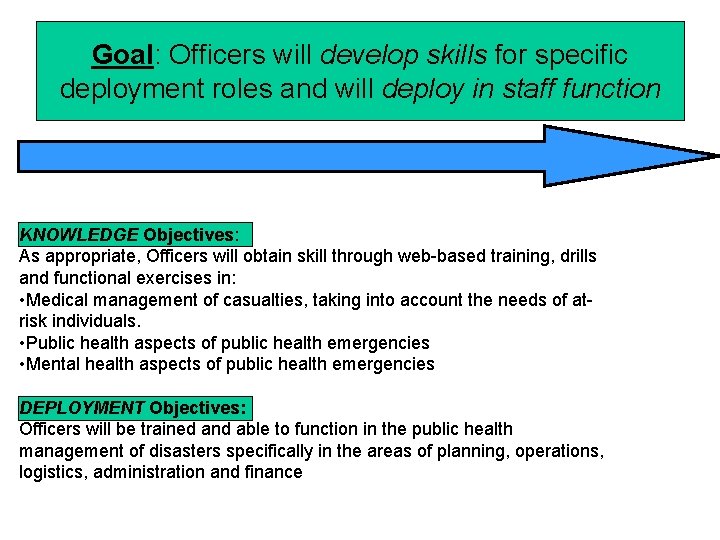
Goal: Officers will develop skills for specific deployment roles and will deploy in staff function KNOWLEDGE Objectives: As appropriate, Officers will obtain skill through web-based training, drills and functional exercises in: • Medical management of casualties, taking into account the needs of atrisk individuals. • Public health aspects of public health emergencies • Mental health aspects of public health emergencies DEPLOYMENT Objectives: Officers will be trained and able to function in the public health management of disasters specifically in the areas of planning, operations, logistics, administration and finance
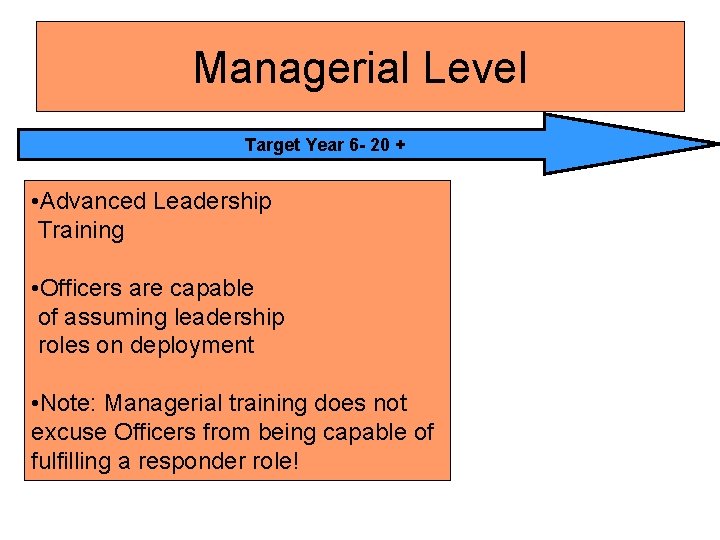
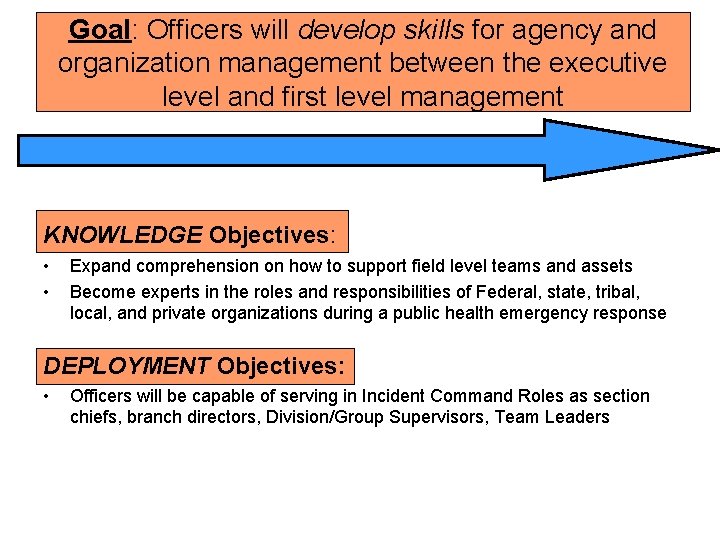
Managerial Level Target Year 6 - 20 + • Advanced Leadership Training • Officers are capable of assuming leadership roles on deployment • Note: Managerial training does not excuse Officers from being capable of fulfilling a responder role!
Goal: Officers will develop skills for agency and organization management between the executive level and first level management KNOWLEDGE Objectives: • • Expand comprehension on how to support field level teams and assets Become experts in the roles and responsibilities of Federal, state, tribal, local, and private organizations during a public health emergency response DEPLOYMENT Objectives: • Officers will be capable of serving in Incident Command Roles as section chiefs, branch directors, Division/Group Supervisors, Team Leaders
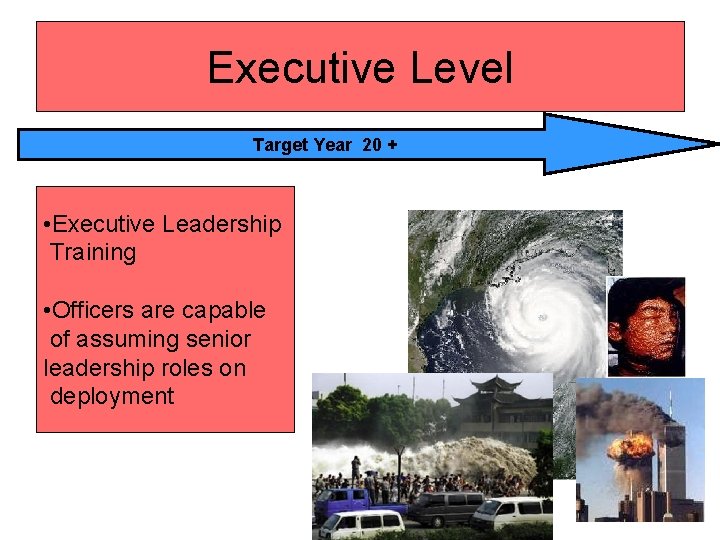
Executive Level Target Year 20 + • Executive Leadership Training • Officers are capable of assuming senior leadership roles on deployment
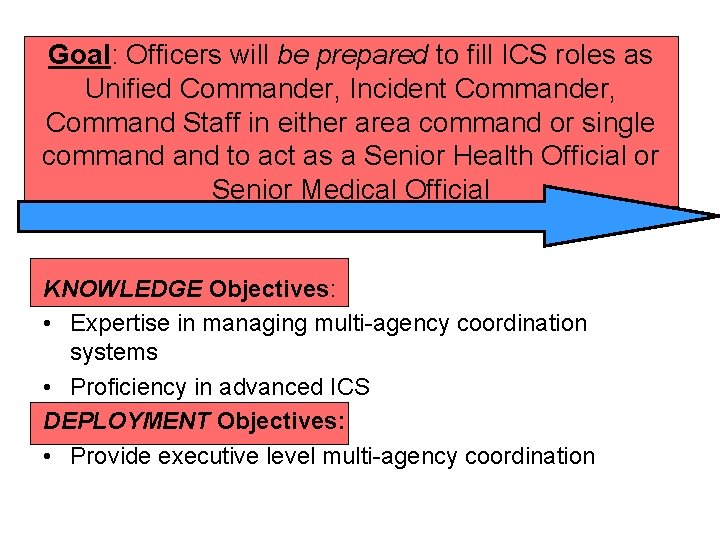
Goal: Officers will be prepared to fill ICS roles as Unified Commander, Incident Commander, Command Staff in either area command or single command to act as a Senior Health Official or Senior Medical Official KNOWLEDGE Objectives: • Expertise in managing multi-agency coordination systems • Proficiency in advanced ICS DEPLOYMENT Objectives: • Provide executive level multi-agency coordination
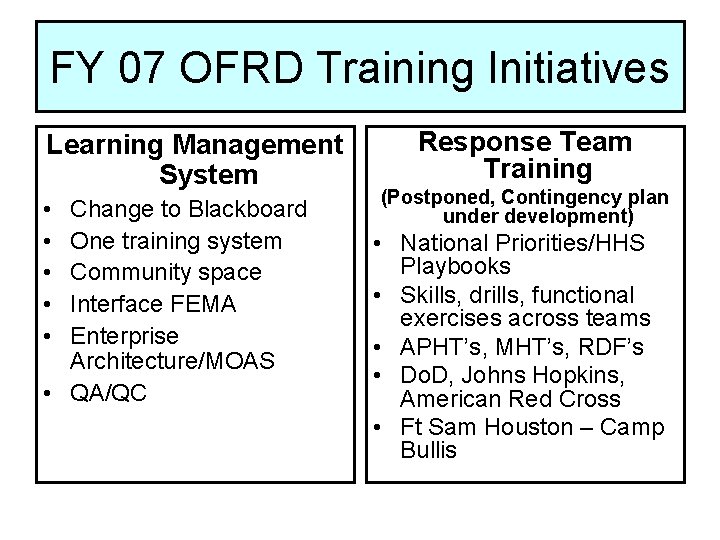
FY 07 OFRD Training Initiatives Learning Management System • • • Change to Blackboard One training system Community space Interface FEMA Enterprise Architecture/MOAS • QA/QC Response Team Training (Postponed, Contingency plan under development) • National Priorities/HHS Playbooks • Skills, drills, functional exercises across teams • APHT’s, MHT’s, RDF’s • Do. D, Johns Hopkins, American Red Cross • Ft Sam Houston – Camp Bullis
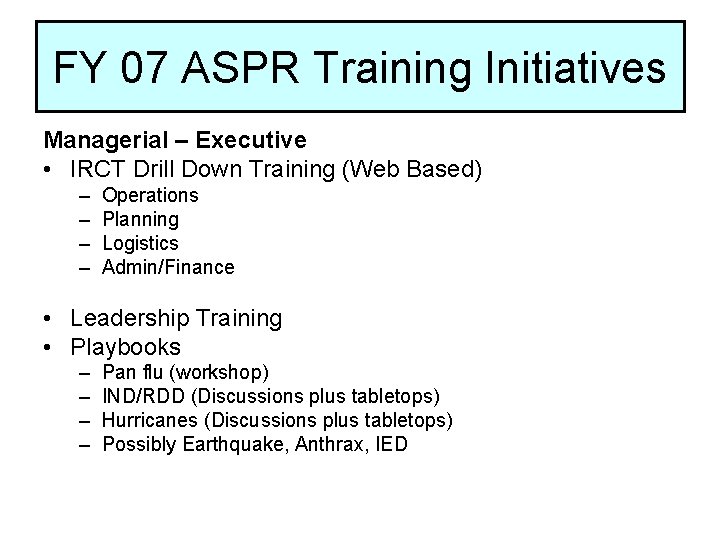
FY 07 ASPR Training Initiatives Managerial – Executive • IRCT Drill Down Training (Web Based) – – Operations Planning Logistics Admin/Finance • Leadership Training • Playbooks – – Pan flu (workshop) IND/RDD (Discussions plus tabletops) Hurricanes (Discussions plus tabletops) Possibly Earthquake, Anthrax, IED
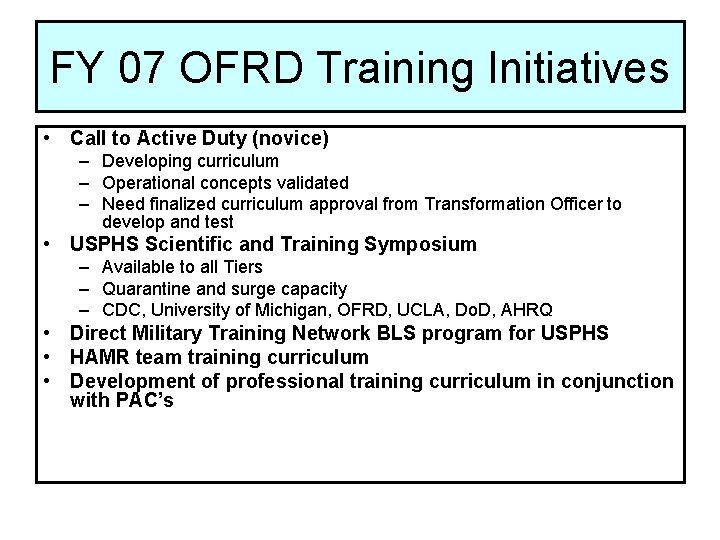
FY 07 OFRD Training Initiatives • Call to Active Duty (novice) – Developing curriculum – Operational concepts validated – Need finalized curriculum approval from Transformation Officer to develop and test • USPHS Scientific and Training Symposium – Available to all Tiers – Quarantine and surge capacity – CDC, University of Michigan, OFRD, UCLA, Do. D, AHRQ • Direct Military Training Network BLS program for USPHS • HAMR team training curriculum • Development of professional training curriculum in conjunction with PAC’s
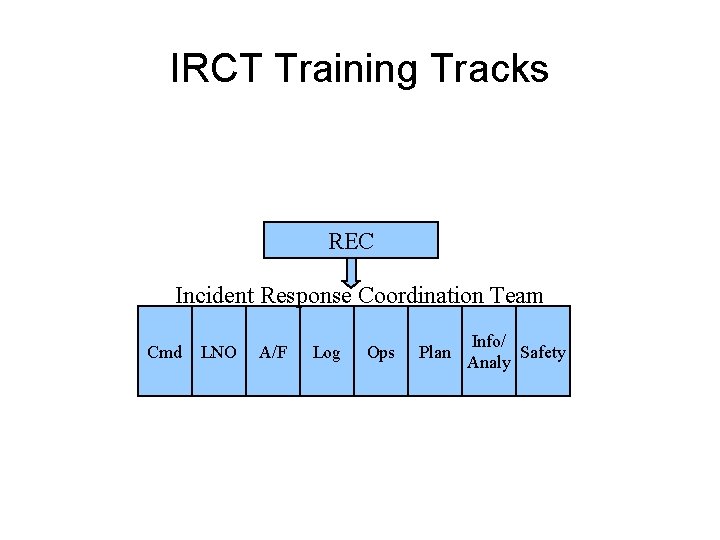
IRCT Training Tracks REC Incident Response Coordination Team Cmd LNO A/F Log Ops Plan Info/ Safety Analy
Questions? CDR Kimberly Elenberg Medical Readiness Training Director 301 -443 -1476 LCDR Patrick Denis Training Program Management Officer 301 -443 -1475