
USP 800 Hazardous Drugs Handling in Healthcare Setting
- Slides: 23
USP <800> Hazardous Drugs. Handling in Healthcare Setting WILLIAM MARANO PHARMD CANDIDATE 2016|MCPHS UNIVERSITY HTTP: //MEDCRED. COM/P/1352979159 3/30/16
Objectives Gain a better understanding of what USP <800> is and who it affects Learn about the requirements of USP <800> and changes from USP <797> Discuss the potential impact USP <800> will have on pharmacy practice
What is USP <800>? Outlines guidelines for hazardous drug (HD) handling Created to identify receiving, storage, mixing, preparing, compounding, dispensing, and administration of HD requirements GENERAL CHAPTER <800> HAZARDOUS DRUGS-HANDLING IN HEALTHCARE SETTINGS. AVAILABLE AT: HTTP: //WWW. USP. ORG/USP-NF/NOTICES/GENERALCHAPTER-HAZARDOUS-DRUGS-HANDLING-HEALTHCARE-SETTINGS. ACCESSED MARCH 29, 2016.
Why do we need USP <800>? Previously no chapter for HD Protects patient, healthcare personnel, and environment There is no acceptable level of personnel exposure to HDs GENERAL CHAPTER <800> HAZARDOUS DRUGS-HANDLING IN HEALTHCARE SETTINGS. AVAILABLE AT: HTTP: //WWW. USP. ORG/USP-NF/NOTICES/GENERALCHAPTER-HAZARDOUS-DRUGS-HANDLING-HEALTHCARE-SETTINGS. ACCESSED MARCH 29, 2016.
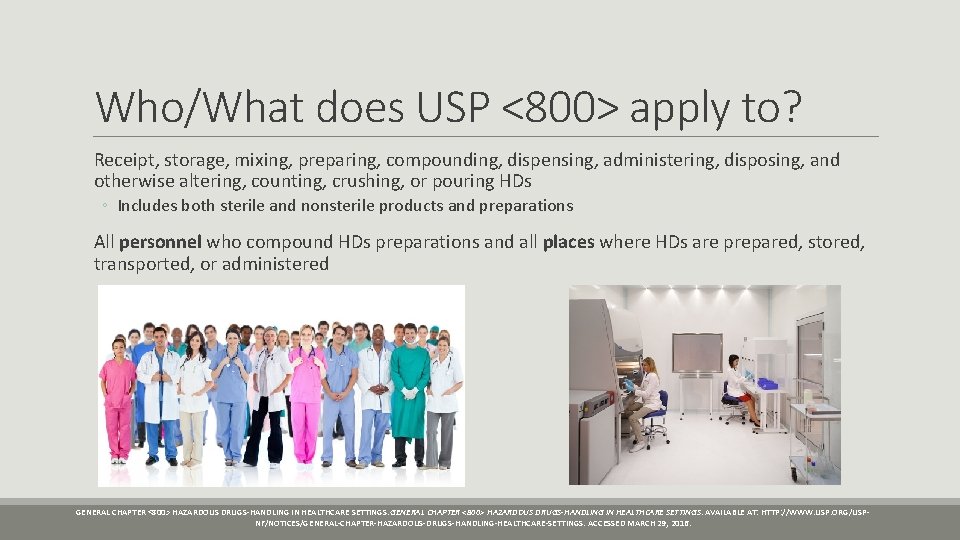
Who/What does USP <800> apply to? Receipt, storage, mixing, preparing, compounding, dispensing, administering, disposing, and otherwise altering, counting, crushing, or pouring HDs ◦ Includes both sterile and nonsterile products and preparations All personnel who compound HDs preparations and all places where HDs are prepared, stored, transported, or administered GENERAL CHAPTER <800> HAZARDOUS DRUGS-HANDLING IN HEALTHCARE SETTINGS. AVAILABLE AT: HTTP: //WWW. USP. ORG/USPNF/NOTICES/GENERAL-CHAPTER-HAZARDOUS-DRUGS-HANDLING-HEALTHCARE-SETTINGS. ACCESSED MARCH 29, 2016.
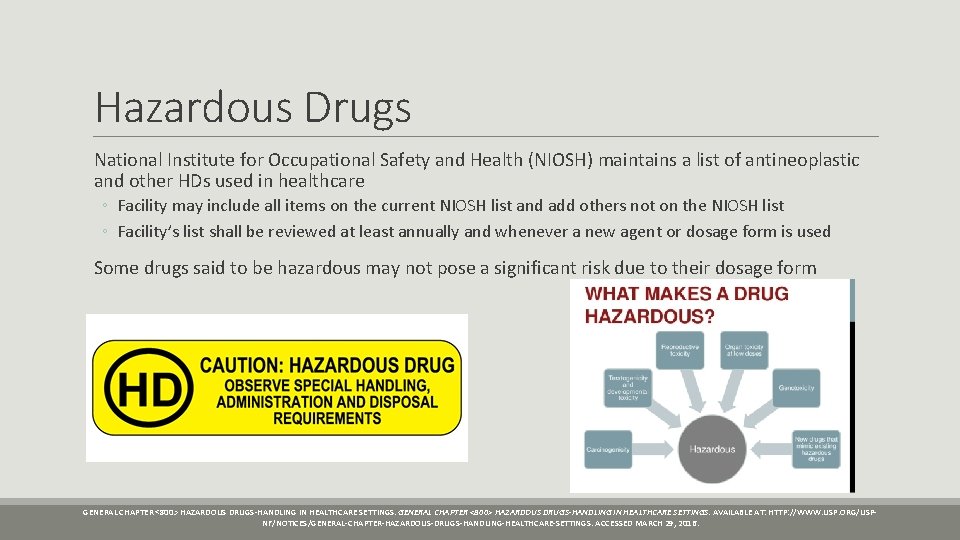
Hazardous Drugs National Institute for Occupational Safety and Health (NIOSH) maintains a list of antineoplastic and other HDs used in healthcare ◦ Facility may include all items on the current NIOSH list and add others not on the NIOSH list ◦ Facility’s list shall be reviewed at least annually and whenever a new agent or dosage form is used Some drugs said to be hazardous may not pose a significant risk due to their dosage form GENERAL CHAPTER <800> HAZARDOUS DRUGS-HANDLING IN HEALTHCARE SETTINGS. AVAILABLE AT: HTTP: //WWW. USP. ORG/USPNF/NOTICES/GENERAL-CHAPTER-HAZARDOUS-DRUGS-HANDLING-HEALTHCARE-SETTINGS. ACCESSED MARCH 29, 2016.
Facility Requirements Engineering controls (including primary, secondary, and supplemental) Competent personnel Robust work practices Availability of appropriate Personnel Protection Equipment (PPE) Policies for the use of PPE and employee compliance with PPE use and policies Medical surveillance program Policies for HD waste segregation and disposal GENERAL CHAPTER <800> HAZARDOUS DRUGS-HANDLING IN HEALTHCARE SETTINGS. AVAILABLE AT: HTTP: //WWW. USP. ORG/USP-NF/NOTICES/GENERALCHAPTER-HAZARDOUS-DRUGS-HANDLING-HEALTHCARE-SETTINGS. ACCESSED MARCH 29, 2016.
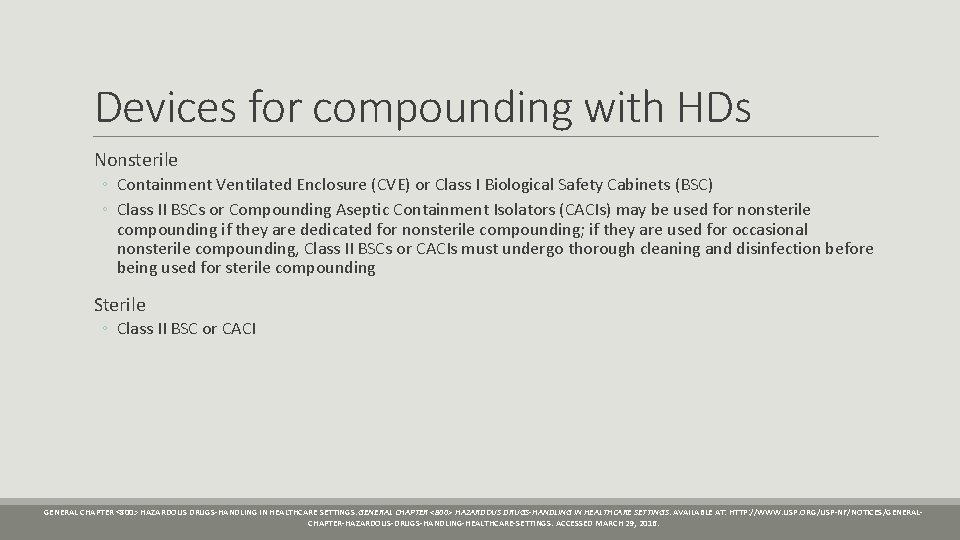
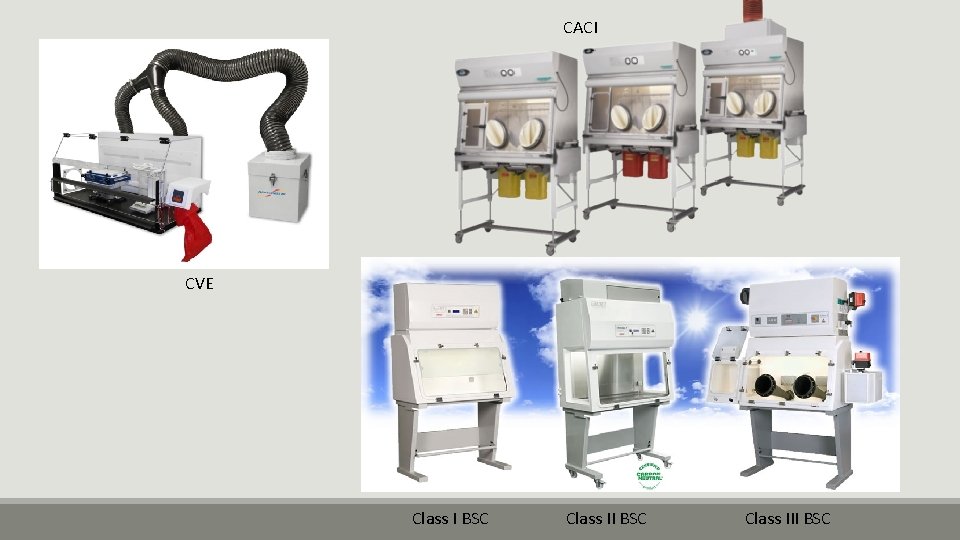
Devices for compounding with HDs Nonsterile ◦ Containment Ventilated Enclosure (CVE) or Class I Biological Safety Cabinets (BSC) ◦ Class II BSCs or Compounding Aseptic Containment Isolators (CACIs) may be used for nonsterile compounding if they are dedicated for nonsterile compounding; if they are used for occasional nonsterile compounding, Class II BSCs or CACIs must undergo thorough cleaning and disinfection before being used for sterile compounding Sterile ◦ Class II BSC or CACI GENERAL CHAPTER <800> HAZARDOUS DRUGS-HANDLING IN HEALTHCARE SETTINGS. AVAILABLE AT: HTTP: //WWW. USP. ORG/USP-NF/NOTICES/GENERALCHAPTER-HAZARDOUS-DRUGS-HANDLING-HEALTHCARE-SETTINGS. ACCESSED MARCH 29, 2016.
CACI CVE Class I BSC Class III BSC
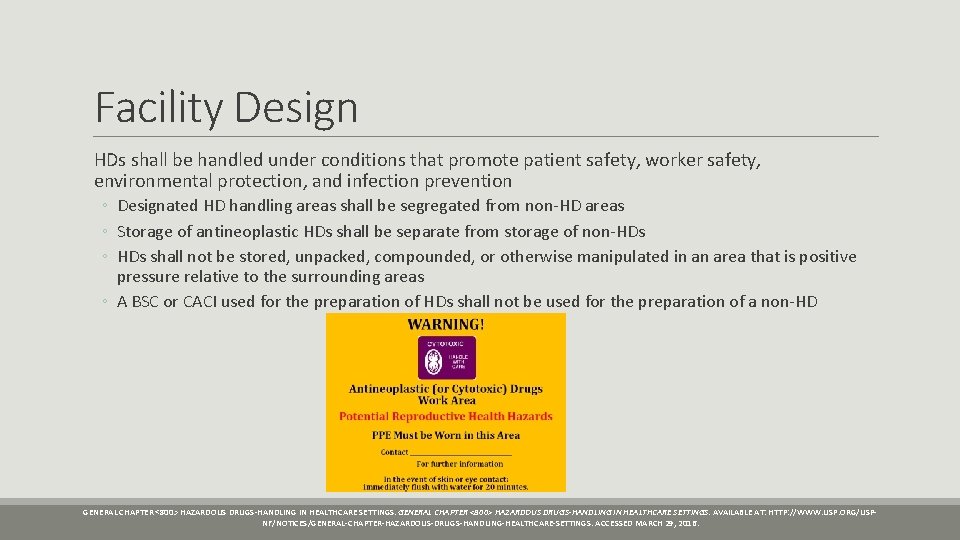
Facility Design HDs shall be handled under conditions that promote patient safety, worker safety, environmental protection, and infection prevention ◦ Designated HD handling areas shall be segregated from non-HD areas ◦ Storage of antineoplastic HDs shall be separate from storage of non-HDs ◦ HDs shall not be stored, unpacked, compounded, or otherwise manipulated in an area that is positive pressure relative to the surrounding areas ◦ A BSC or CACI used for the preparation of HDs shall not be used for the preparation of a non-HD GENERAL CHAPTER <800> HAZARDOUS DRUGS-HANDLING IN HEALTHCARE SETTINGS. AVAILABLE AT: HTTP: //WWW. USP. ORG/USPNF/NOTICES/GENERAL-CHAPTER-HAZARDOUS-DRUGS-HANDLING-HEALTHCARE-SETTINGS. ACCESSED MARCH 29, 2016.
Storage of HDs All HD storage areas and containers, regardless of the formulation, shall be labeled as such to prevent improper handling HDs shall be stored separately from other inventory to prevent contamination and personnel exposure ◦ Negative pressure room with at least 12 air changes per hour (ACPH) Refrigerated HDs shall be stored in a dedicated refrigerator in the HD storage room, buffer room, or containment segregated compounding area (C-SCA) GENERAL CHAPTER <800> HAZARDOUS DRUGS-HANDLING IN HEALTHCARE SETTINGS. AVAILABLE AT: HTTP: //WWW. USP. ORG/USP-NF/NOTICES/GENERAL -CHAPTER-HAZARDOUS-DRUGS-HANDLING-HEALTHCARE-SETTINGS. ACCESSED MARCH 29, 2016.
Containment Primary Engineering Controls (C-PECs) ◦ Externally vented ◦ Restricted access segregated room with minimum negative pressure of 0. 01 inches of water column Containment Secondary Engineering Controls (C-SECs) ◦ HD compounding activities must occur within a C-SEC ◦ C-PEC shall be vented to the outside air through high efficiency particle air (HEPA) filtration GENERAL CHAPTER <800> HAZARDOUS DRUGS-HANDLING IN HEALTHCARE SETTINGS. AVAILABLE AT: HTTP: //WWW. USP. ORG/USP-NF/NOTICES/GENERALCHAPTER-HAZARDOUS-DRUGS-HANDLING-HEALTHCARE-SETTINGS. ACCESSED MARCH 29, 2016.
Changes to USP <797> Elimination of the current allowance in 797 for facilities that prepare a low volume of hazardous drugs that permits placement of a BSC or CACI in a nonnegative pressure room. ◦ All hazardous drug compounding shall be done in a separate area designated for hazardous drug compounding. Allowance for a C-SCA, a separate, negative pressure room with at least 12 air changes per hour (ACPH) for use with compounding hazardous drugs. Low- and medium-risk hazardous drug CSP may be prepared in a BSC located in a C-SCA, provided the beyond use date of the CSP does not exceed 12 hours. ◦ A CACI that meets the requirements in 797 may be used for hazardous drug compounding if it is placed in a C-SCA GENERAL CHAPTER <800> HAZARDOUS DRUGS-HANDLING IN HEALTHCARE SETTINGS. AVAILABLE AT: HTTP: //WWW. USP. ORG/USP-NF/NOTICES/GENERALCHAPTER-HAZARDOUS-DRUGS-HANDLING-HEALTHCARE-SETTINGS. ACCESSED MARCH 29, 2016.
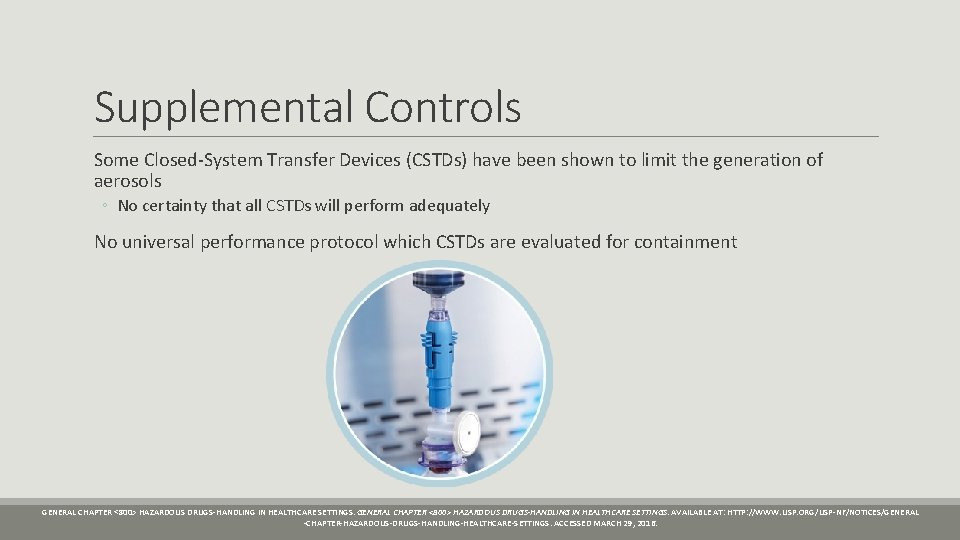
Supplemental Controls Some Closed-System Transfer Devices (CSTDs) have been shown to limit the generation of aerosols ◦ No certainty that all CSTDs will perform adequately No universal performance protocol which CSTDs are evaluated for containment GENERAL CHAPTER <800> HAZARDOUS DRUGS-HANDLING IN HEALTHCARE SETTINGS. AVAILABLE AT: HTTP: //WWW. USP. ORG/USP-NF/NOTICES/GENERAL -CHAPTER-HAZARDOUS-DRUGS-HANDLING-HEALTHCARE-SETTINGS. ACCESSED MARCH 29, 2016.
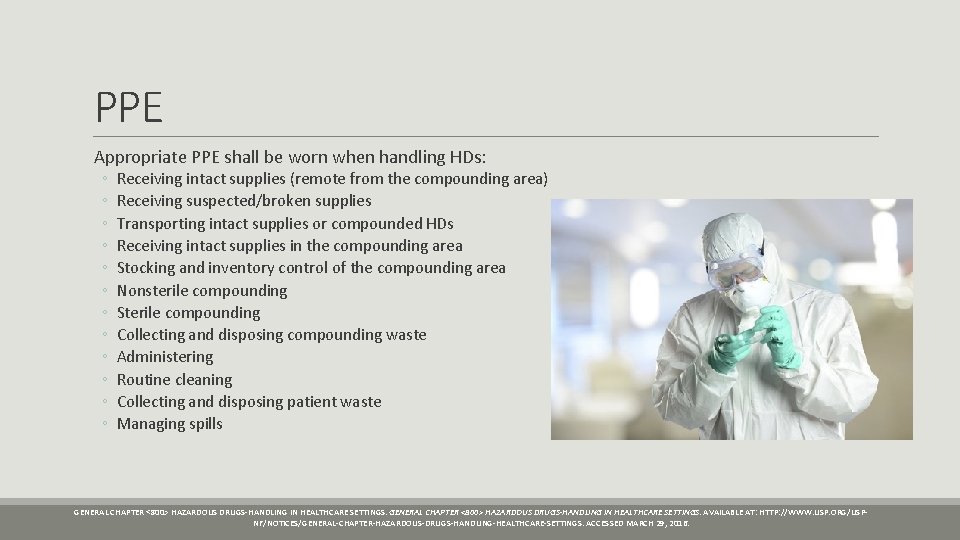
PPE Appropriate PPE shall be worn when handling HDs: ◦ ◦ ◦ Receiving intact supplies (remote from the compounding area) Receiving suspected/broken supplies Transporting intact supplies or compounded HDs Receiving intact supplies in the compounding area Stocking and inventory control of the compounding area Nonsterile compounding Sterile compounding Collecting and disposing compounding waste Administering Routine cleaning Collecting and disposing patient waste Managing spills GENERAL CHAPTER <800> HAZARDOUS DRUGS-HANDLING IN HEALTHCARE SETTINGS. AVAILABLE AT: HTTP: //WWW. USP. ORG/USPNF/NOTICES/GENERAL-CHAPTER-HAZARDOUS-DRUGS-HANDLING-HEALTHCARE-SETTINGS. ACCESSED MARCH 29, 2016.
Personnel Each facility is required to have a compounding supervisor ◦ ◦ ◦ Designated individual Responsible for developing and implementing appropriate procedures Oversees facility compliance with USP <800> and other applicable laws, regulations, and standards Ensures competency of personnel Assures environmental control of the compounding areas GENERAL CHAPTER <800> HAZARDOUS DRUGS-HANDLING IN HEALTHCARE SETTINGS. AVAILABLE AT: HTTP: //WWW. USP. ORG/USP-NF/NOTICES/GENERAL -CHAPTER-HAZARDOUS-DRUGS-HANDLING-HEALTHCARE-SETTINGS. ACCESSED MARCH 29, 2016.
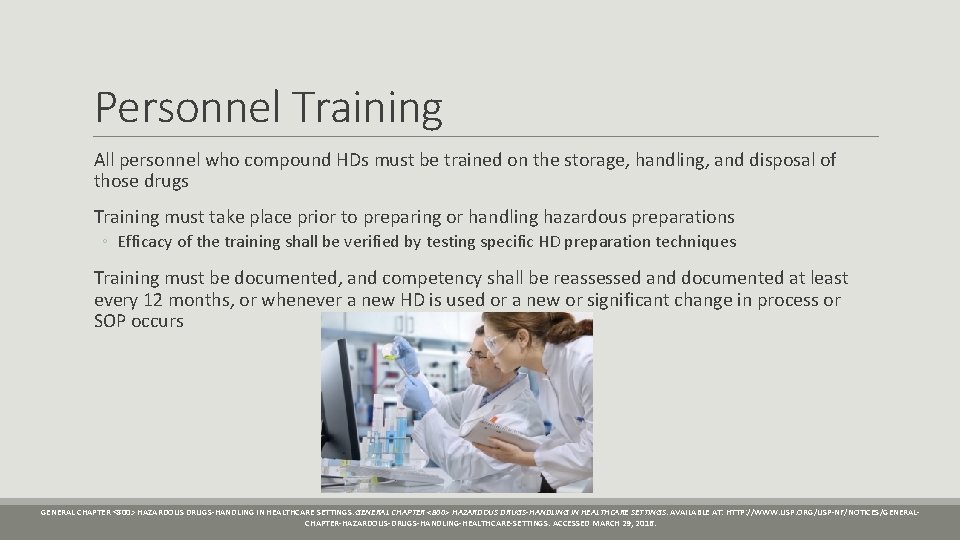
Personnel Training All personnel who compound HDs must be trained on the storage, handling, and disposal of those drugs Training must take place prior to preparing or handling hazardous preparations ◦ Efficacy of the training shall be verified by testing specific HD preparation techniques Training must be documented, and competency shall be reassessed and documented at least every 12 months, or whenever a new HD is used or a new or significant change in process or SOP occurs GENERAL CHAPTER <800> HAZARDOUS DRUGS-HANDLING IN HEALTHCARE SETTINGS. AVAILABLE AT: HTTP: //WWW. USP. ORG/USP-NF/NOTICES/GENERALCHAPTER-HAZARDOUS-DRUGS-HANDLING-HEALTHCARE-SETTINGS. ACCESSED MARCH 29, 2016.
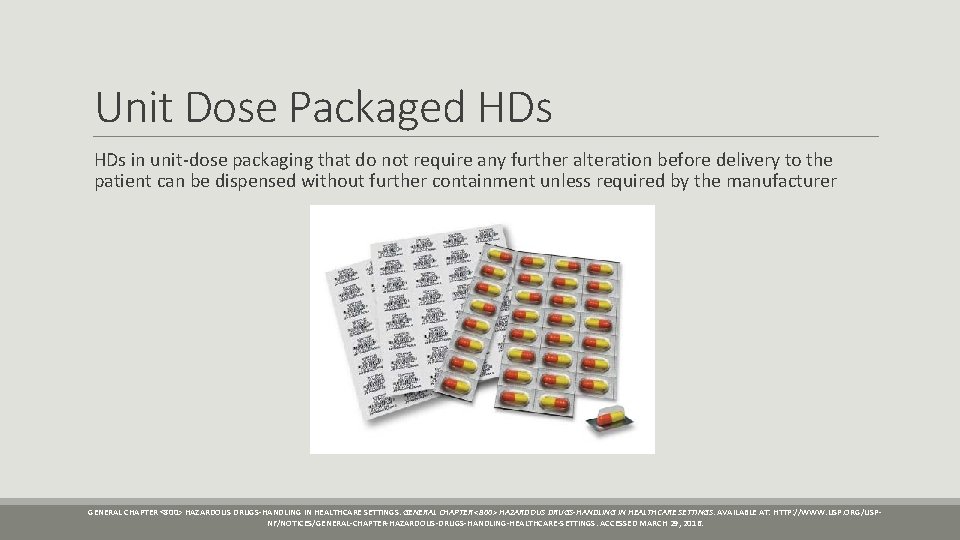
Unit Dose Packaged HDs in unit-dose packaging that do not require any further alteration before delivery to the patient can be dispensed without further containment unless required by the manufacturer GENERAL CHAPTER <800> HAZARDOUS DRUGS-HANDLING IN HEALTHCARE SETTINGS. AVAILABLE AT: HTTP: //WWW. USP. ORG/USPNF/NOTICES/GENERAL-CHAPTER-HAZARDOUS-DRUGS-HANDLING-HEALTHCARE-SETTINGS. ACCESSED MARCH 29, 2016.
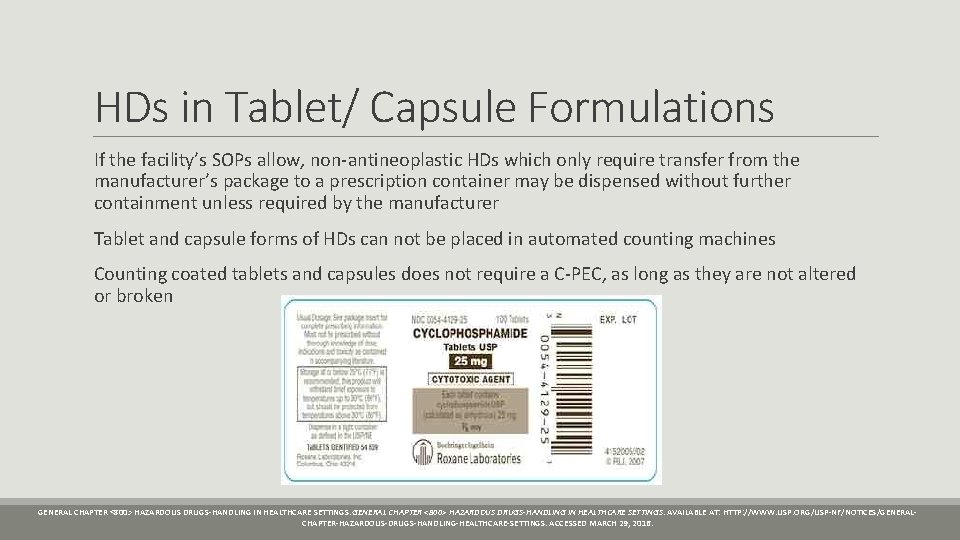
HDs in Tablet/ Capsule Formulations If the facility’s SOPs allow, non-antineoplastic HDs which only require transfer from the manufacturer’s package to a prescription container may be dispensed without further containment unless required by the manufacturer Tablet and capsule forms of HDs can not be placed in automated counting machines Counting coated tablets and capsules does not require a C-PEC, as long as they are not altered or broken GENERAL CHAPTER <800> HAZARDOUS DRUGS-HANDLING IN HEALTHCARE SETTINGS. AVAILABLE AT: HTTP: //WWW. USP. ORG/USP-NF/NOTICES/GENERALCHAPTER-HAZARDOUS-DRUGS-HANDLING-HEALTHCARE-SETTINGS. ACCESSED MARCH 29, 2016.
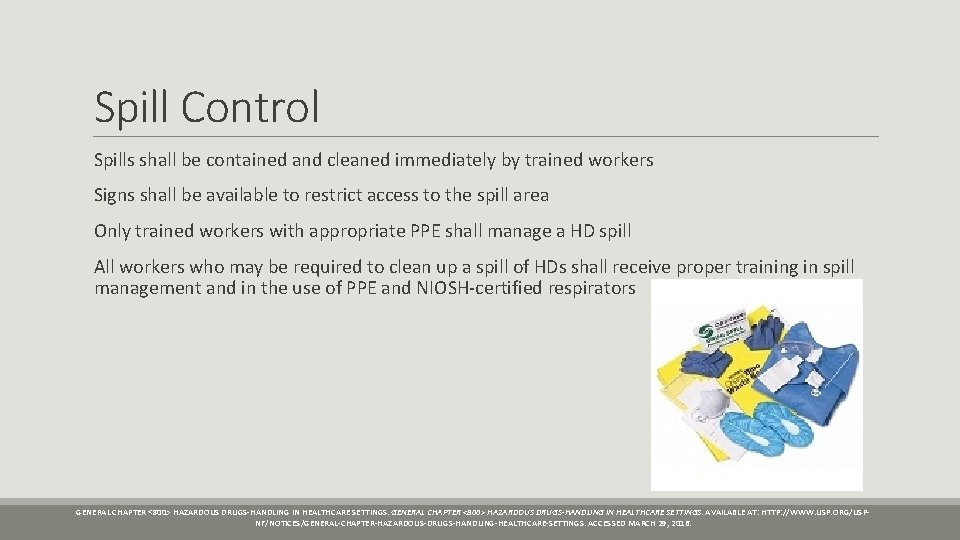
Spill Control Spills shall be contained and cleaned immediately by trained workers Signs shall be available to restrict access to the spill area Only trained workers with appropriate PPE shall manage a HD spill All workers who may be required to clean up a spill of HDs shall receive proper training in spill management and in the use of PPE and NIOSH-certified respirators GENERAL CHAPTER <800> HAZARDOUS DRUGS-HANDLING IN HEALTHCARE SETTINGS. AVAILABLE AT: HTTP: //WWW. USP. ORG/USPNF/NOTICES/GENERAL-CHAPTER-HAZARDOUS-DRUGS-HANDLING-HEALTHCARE-SETTINGS. ACCESSED MARCH 29, 2016.
Monitoring Environmental wipe sampling to detect uncontained HDs Workers monitored in a systematic program of medical surveillance ◦ Purpose of surveillance is to identify the earliest reversible biologic effects ◦ Medical surveillance acts as a check on the appropriateness of controls already in use GENERAL CHAPTER <800> HAZARDOUS DRUGS-HANDLING IN HEALTHCARE SETTINGS. AVAILABLE AT: HTTP: //WWW. USP. ORG/USPNF/NOTICES/GENERAL-CHAPTER-HAZARDOUS-DRUGS-HANDLING-HEALTHCARE-SETTINGS. ACCESSED MARCH 29, 2016.
How Does USP <800> Effect Pharmacy Practice Facility design: Hazardous drugs must be stored in negative or normal/neutral pressure, and compounding must be completed in certified biological safety cabinets or compounding aseptic containment isolators in a separate room with negative pressure ◦ Outsourcing ◦ Partnering with larger facilities ◦ Retail, outpatient, and private practice Garb: Details for personal protective equipment are based on the function being performed Cleaning: Deactivation and disinfection with an oxidizer, cleaning with a germicidal detergent, and disinfection with sterile alcohol ◦ Time ◦ Expense Administering: Closed-system drug-transfer devices should be used when compounding and shall be used when administering ◦ Hiring ◦ Training EDER K. WHAT PHARMACISTS NEED TO KNOW AHEAD OF USP <800>. PHARMACY TIMES 2014. AVAILABLE AT: HTTP: //WWW. PHARMACYTIMES. COM/NEWS/WHAT-PHARMACISTS-NEED-TO-KNOW-AHEAD-OF-USP-800. ACCESSED MARCH 30, 2016.
Summary USP <800> states guidelines for HD handling No acceptable level of personnel exposure to HDs Affects all people and places who come in contact with HDs Chapter outlines engineering changes as well as devices which must be used for storing and handling HDs Can no longer prepare small amounts of HDs in non-negative pressure rooms Must now used a separate room with negative pressure for HD compounding Health of staff will be monitored to ensure safety regulations are effective New safety regulations may limit smaller pharmacies, private practices, and outpatient facility’s ability to provide HDs to their patients