
USP 800 Avoiding the Hazards of Non Compliance



- Slides: 42
<USP 800> Avoiding the Hazards of Non. Compliance Dustin Ezell, Pharm. D, BCPS Baptist Health – North Little Rock
Learning Objectives • Compare <USP 800> requirements to current guidelines and practices • Identify NIOSH risk categories and corresponding safe handling guidelines • Review strategies for implementing a successful compliance program • Effectively perform hazardous drug risk assessments
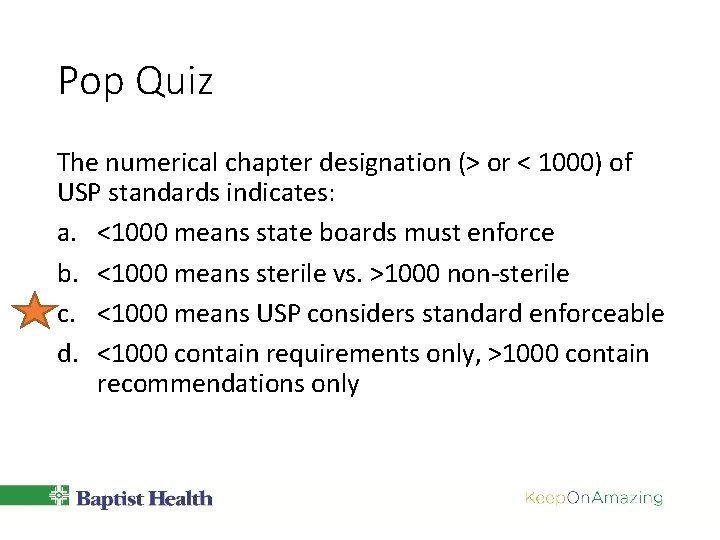
What is 800? • USP (United States Pharmacopeia) is an independent standard setting body • No inherent regulatory or enforcement authority • Considers standards <1000 “enforceable” • Standards set by Expert Committee • USP <800> defines processes intended to minimize exposure to hazardous drugs in healthcare settings.
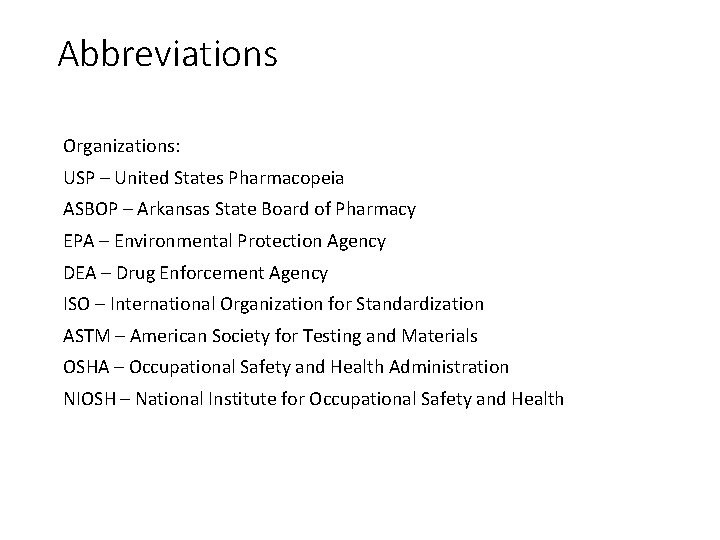
Abbreviations Organizations: USP – United States Pharmacopeia ASBOP – Arkansas State Board of Pharmacy EPA – Environmental Protection Agency DEA – Drug Enforcement Agency ISO – International Organization for Standardization ASTM – American Society for Testing and Materials OSHA – Occupational Safety and Health Administration NIOSH – National Institute for Occupational Safety and Health
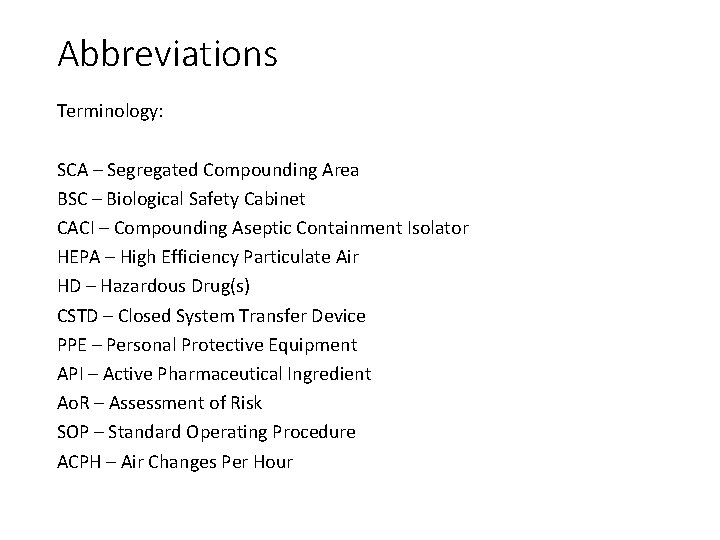
Abbreviations Terminology: SCA – Segregated Compounding Area BSC – Biological Safety Cabinet CACI – Compounding Aseptic Containment Isolator HEPA – High Efficiency Particulate Air HD – Hazardous Drug(s) CSTD – Closed System Transfer Device PPE – Personal Protective Equipment API – Active Pharmaceutical Ingredient Ao. R – Assessment of Risk SOP – Standard Operating Procedure ACPH – Air Changes Per Hour
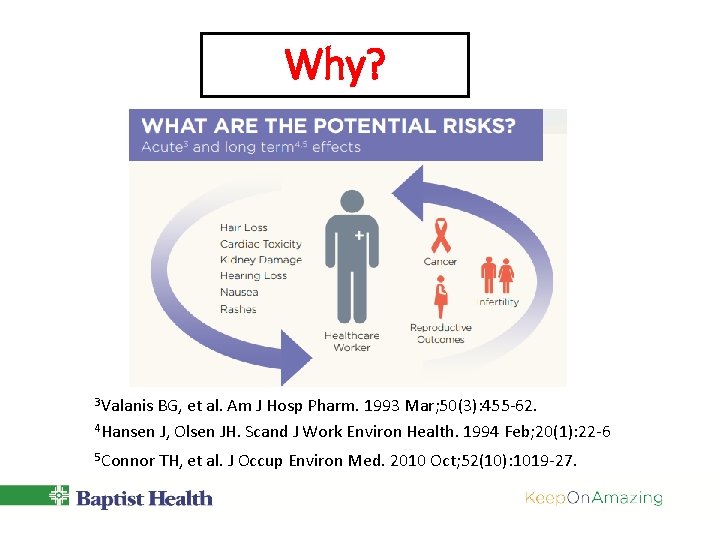
Why? 3 Valanis BG, et al. Am J Hosp Pharm. 1993 Mar; 50(3): 455 -62. 4 Hansen J, Olsen JH. Scand J Work Environ Health. 1994 Feb; 20(1): 22 -6 5 Connor TH, et al. J Occup Environ Med. 2010 Oct; 52(10): 1019 -27.
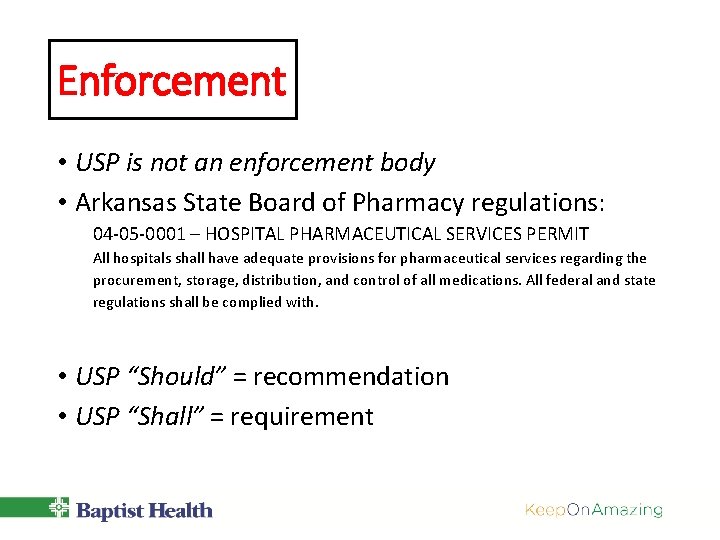
Enforcement • USP is not an enforcement body • Arkansas State Board of Pharmacy regulations: 04 -05 -0001 – HOSPITAL PHARMACEUTICAL SERVICES PERMIT All hospitals shall have adequate provisions for pharmaceutical services regarding the procurement, storage, distribution, and control of all medications. All federal and state regulations shall be complied with. • USP “Should” = recommendation • USP “Shall” = requirement
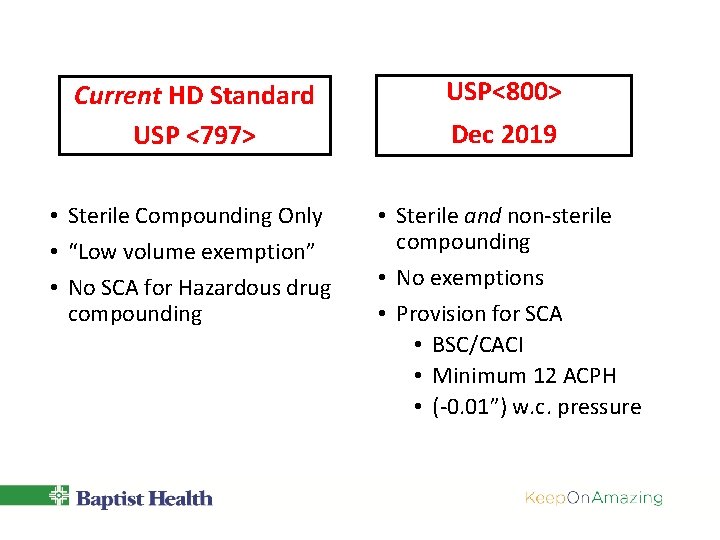
Current HD Standard USP <797> USP<800> • Sterile Compounding Only • “Low volume exemption” • No SCA for Hazardous drug compounding • Sterile and non-sterile compounding • No exemptions • Provision for SCA • BSC/CACI • Minimum 12 ACPH • (-0. 01”) w. c. pressure Dec 2019
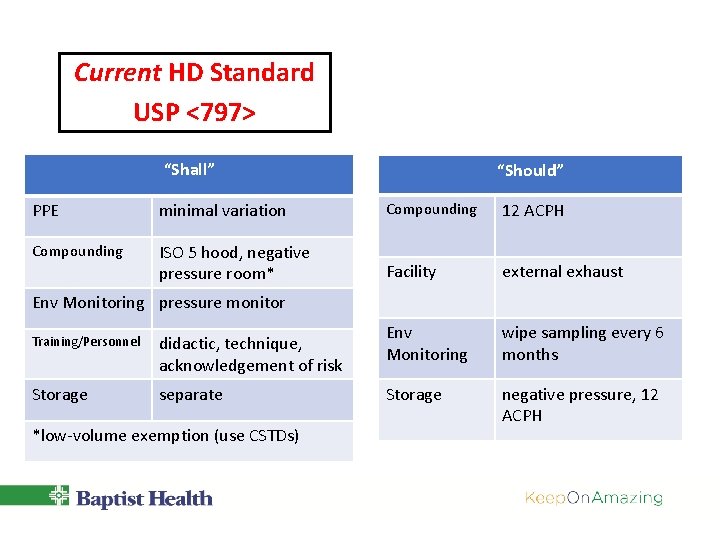
Current HD Standard USP <797> “Shall” “Should” PPE minimal variation Compounding 12 ACPH Compounding ISO 5 hood, negative pressure room* Facility external exhaust Env Monitoring wipe sampling every 6 months Storage negative pressure, 12 ACPH Env Monitoring pressure monitor Training/Personnel didactic, technique, acknowledgement of risk Storage separate *low-volume exemption (use CSTDs)
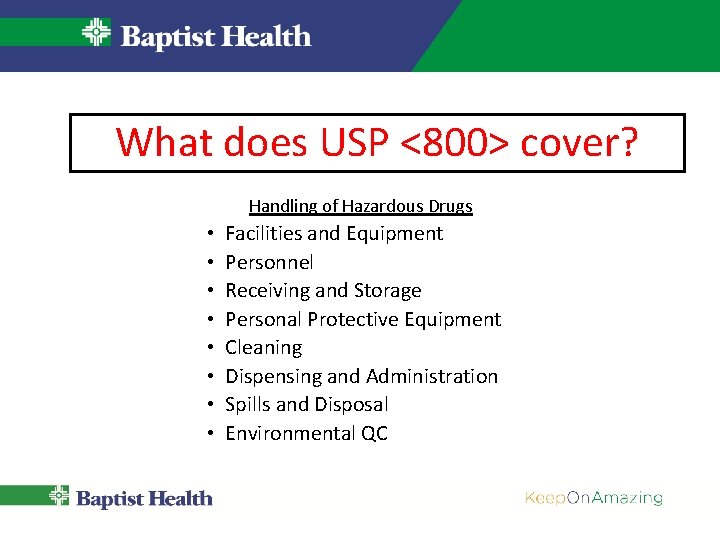
What does USP <800> cover? Handling of Hazardous Drugs • • Facilities and Equipment Personnel Receiving and Storage Personal Protective Equipment Cleaning Dispensing and Administration Spills and Disposal Environmental QC
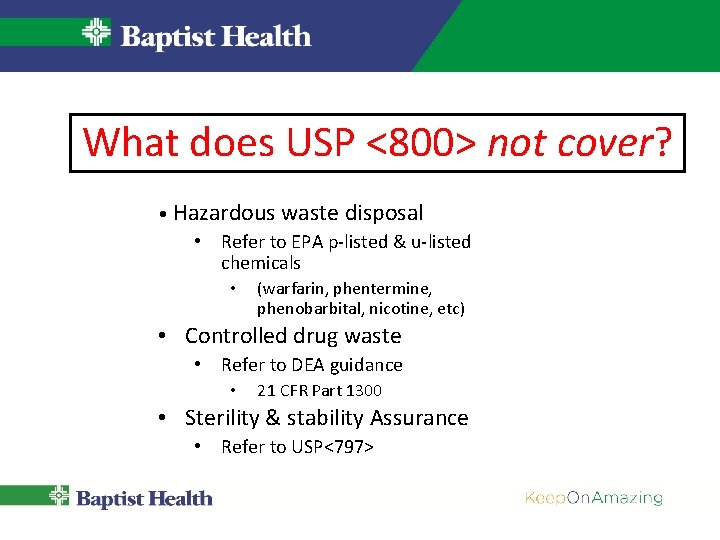
What does USP <800> not cover? • Hazardous waste disposal • Refer to EPA p-listed & u-listed chemicals • (warfarin, phentermine, phenobarbital, nicotine, etc) • Controlled drug waste • Refer to DEA guidance • 21 CFR Part 1300 • Sterility & stability Assurance • Refer to USP<797>
Pop Quiz The numerical chapter designation (> or < 1000) of USP standards indicates: a. <1000 means state boards must enforce b. <1000 means sterile vs. >1000 non-sterile c. <1000 means USP considers standard enforceable d. <1000 contain requirements only, >1000 contain recommendations only
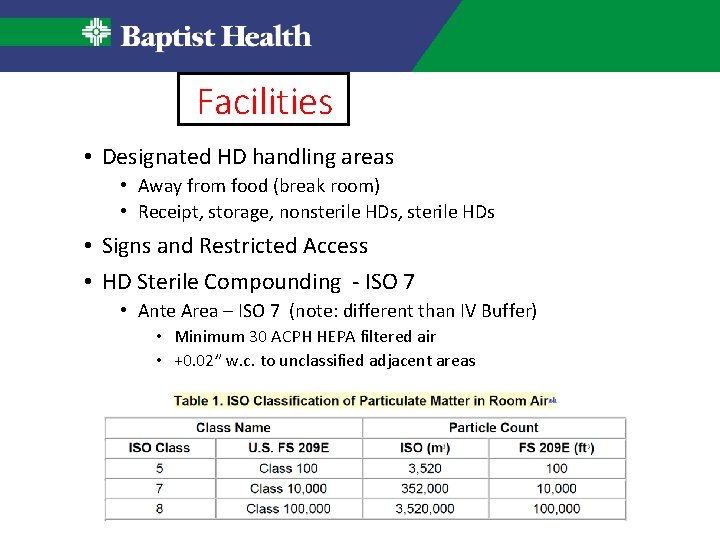
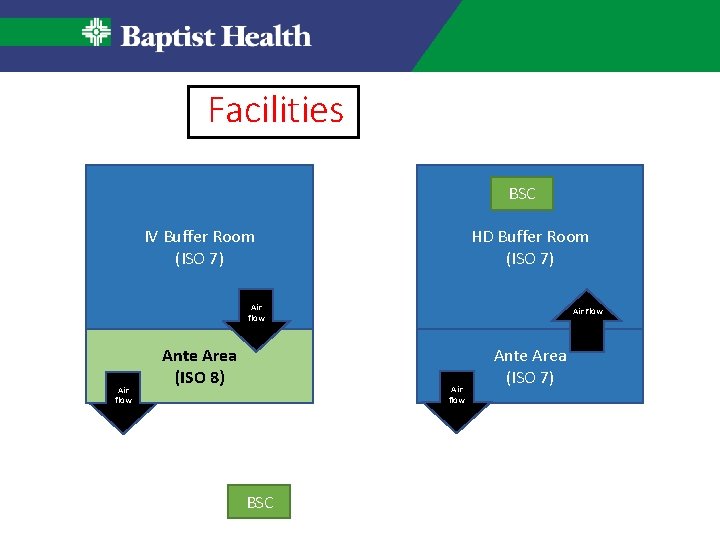
Facilities • Designated HD handling areas • Away from food (break room) • Receipt, storage, nonsterile HDs, sterile HDs • Signs and Restricted Access • HD Sterile Compounding - ISO 7 • Ante Area – ISO 7 (note: different than IV Buffer) • Minimum 30 ACPH HEPA filtered air • +0. 02” w. c. to unclassified adjacent areas
Facilities BSC IV Buffer Room (ISO 7) HD Buffer Room (ISO 7) Air flow Ante Area (ISO 8) Air Flow Air flow BSC Ante Area (ISO 7)
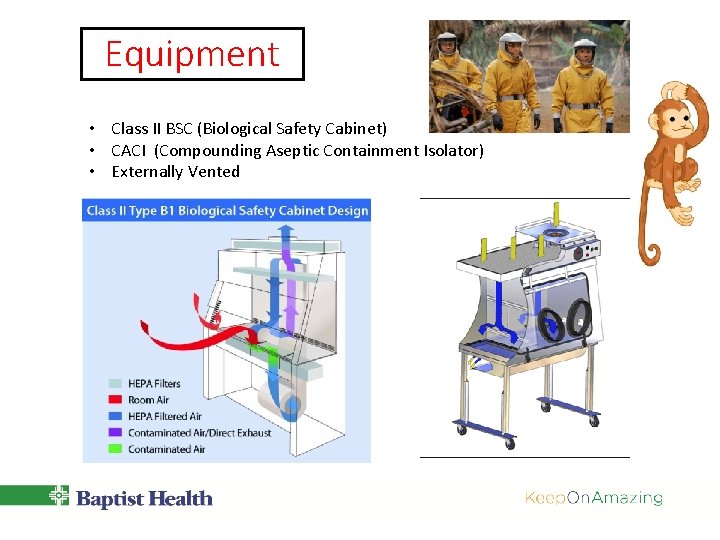
Equipment • Class II BSC (Biological Safety Cabinet) • CACI (Compounding Aseptic Containment Isolator) • Externally Vented
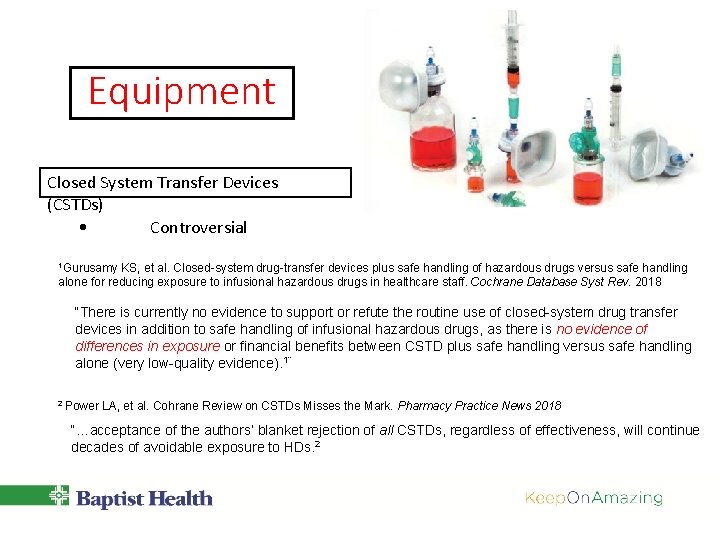
Equipment Closed System Transfer Devices (CSTDs) • Controversial 1 Gurusamy KS, et al. Closed-system drug-transfer devices plus safe handling of hazardous drugs versus safe handling alone for reducing exposure to infusional hazardous drugs in healthcare staff. Cochrane Database Syst Rev. 2018 “There is currently no evidence to support or refute the routine use of closed-system drug transfer devices in addition to safe handling of infusional hazardous drugs, as there is no evidence of differences in exposure or financial benefits between CSTD plus safe handling versus safe handling alone (very low-quality evidence). 1” 2 Power LA, et al. Cohrane Review on CSTDs Misses the Mark. Pharmacy Practice News 2018 “…acceptance of the authors’ blanket rejection of all CSTDs, regardless of effectiveness, will continue decades of avoidable exposure to HDs. 2
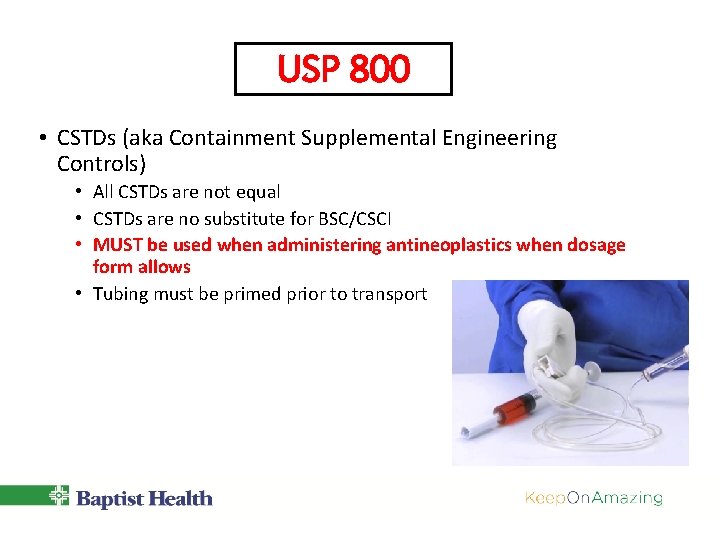
USP 800 • CSTDs (aka Containment Supplemental Engineering Controls) • All CSTDs are not equal • CSTDs are no substitute for BSC/CSCI • MUST be used when administering antineoplastics when dosage form allows • Tubing must be primed prior to transport
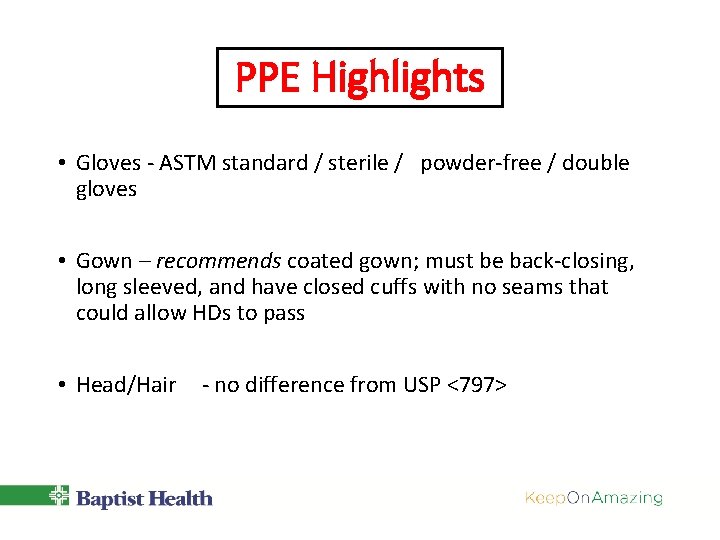
PPE Highlights • Gloves - ASTM standard / sterile / powder-free / double gloves • Gown – recommends coated gown; must be back-closing, long sleeved, and have closed cuffs with no seams that could allow HDs to pass • Head/Hair - no difference from USP <797>
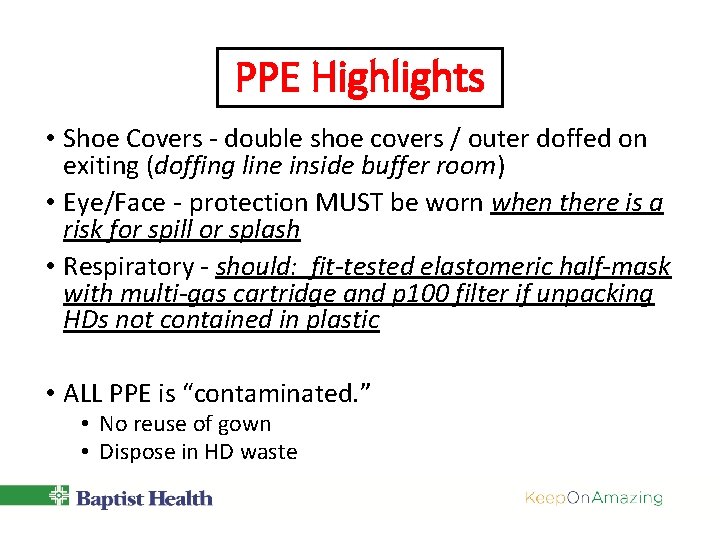
PPE Highlights • Shoe Covers - double shoe covers / outer doffed on exiting (doffing line inside buffer room) • Eye/Face - protection MUST be worn when there is a risk for spill or splash • Respiratory - should: fit-tested elastomeric half-mask with multi-gas cartridge and p 100 filter if unpacking HDs not contained in plastic • ALL PPE is “contaminated. ” • No reuse of gown • Dispose in HD waste
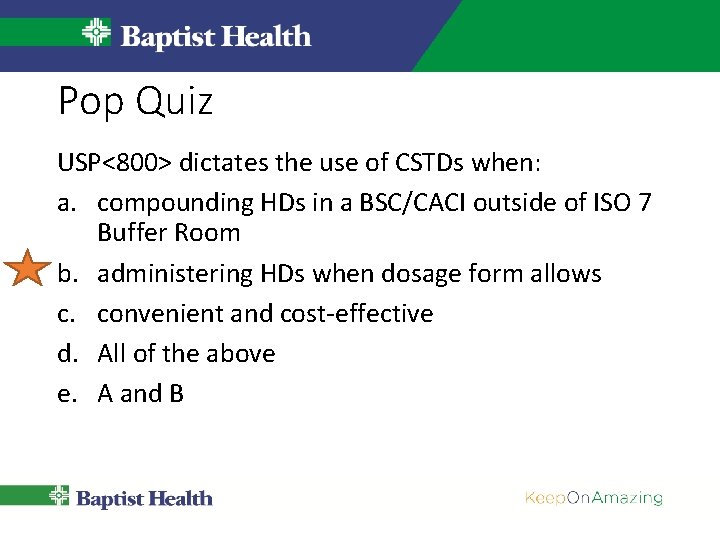
Pop Quiz USP<800> dictates the use of CSTDs when: a. compounding HDs in a BSC/CACI outside of ISO 7 Buffer Room b. administering HDs when dosage form allows c. convenient and cost-effective d. All of the above e. A and B
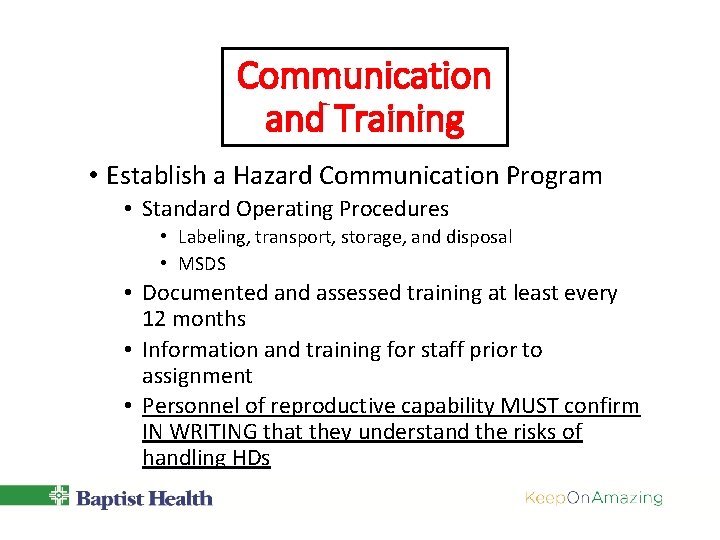
Communication and Training • Establish a Hazard Communication Program • Standard Operating Procedures • Labeling, transport, storage, and disposal • MSDS • Documented and assessed training at least every 12 months • Information and training for staff prior to assignment • Personnel of reproductive capability MUST confirm IN WRITING that they understand the risks of handling HDs
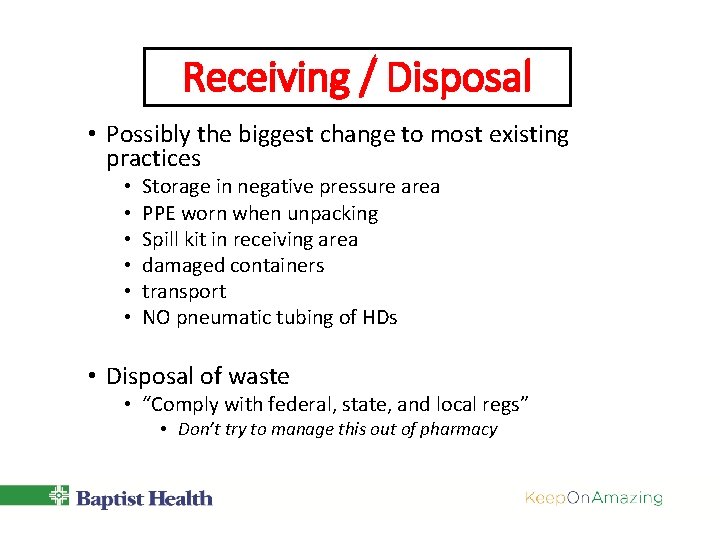
Receiving / Disposal • Possibly the biggest change to most existing practices • • • Storage in negative pressure area PPE worn when unpacking Spill kit in receiving area damaged containers transport NO pneumatic tubing of HDs • Disposal of waste • “Comply with federal, state, and local regs” • Don’t try to manage this out of pharmacy
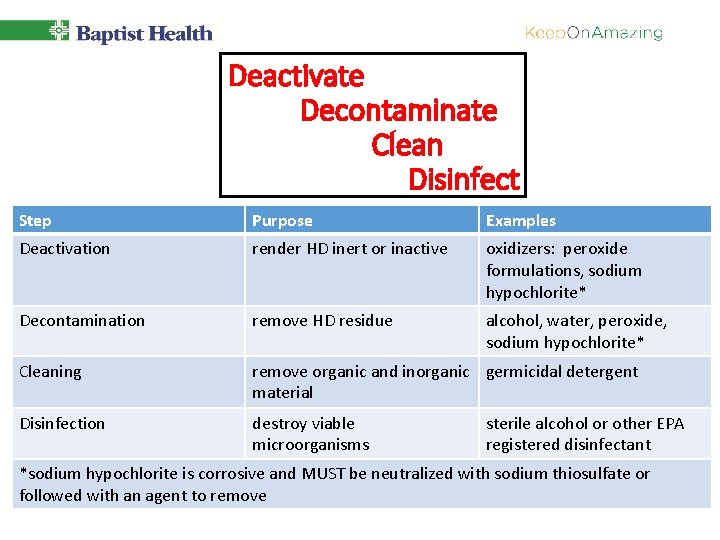
Deactivate Decontaminate Clean Disinfect Step Purpose Examples Deactivation render HD inert or inactive oxidizers: peroxide formulations, sodium hypochlorite* Decontamination remove HD residue alcohol, water, peroxide, sodium hypochlorite* Cleaning remove organic and inorganic germicidal detergent material Disinfection destroy viable microorganisms sterile alcohol or other EPA registered disinfectant *sodium hypochlorite is corrosive and MUST be neutralized with sodium thiosulfate or followed with an agent to remove
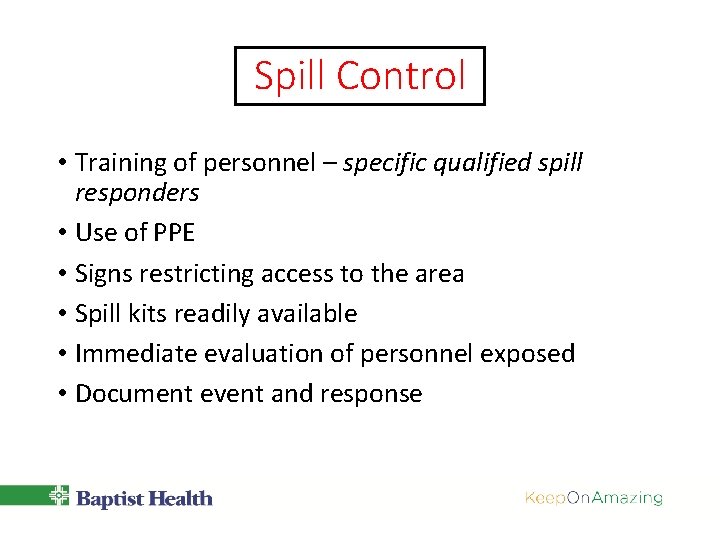
Spill Control • Training of personnel – specific qualified spill responders • Use of PPE • Signs restricting access to the area • Spill kits readily available • Immediate evaluation of personnel exposed • Document event and response
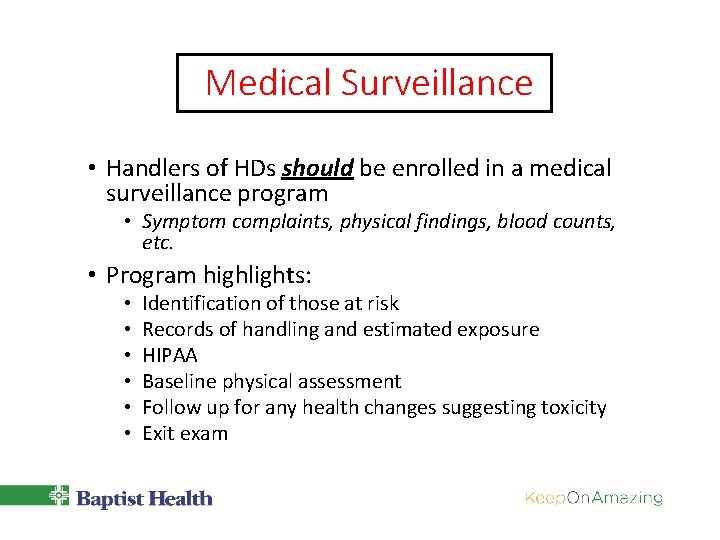
Medical Surveillance • Handlers of HDs should be enrolled in a medical surveillance program • Symptom complaints, physical findings, blood counts, etc. • Program highlights: • • • Identification of those at risk Records of handling and estimated exposure HIPAA Baseline physical assessment Follow up for any health changes suggesting toxicity Exit exam
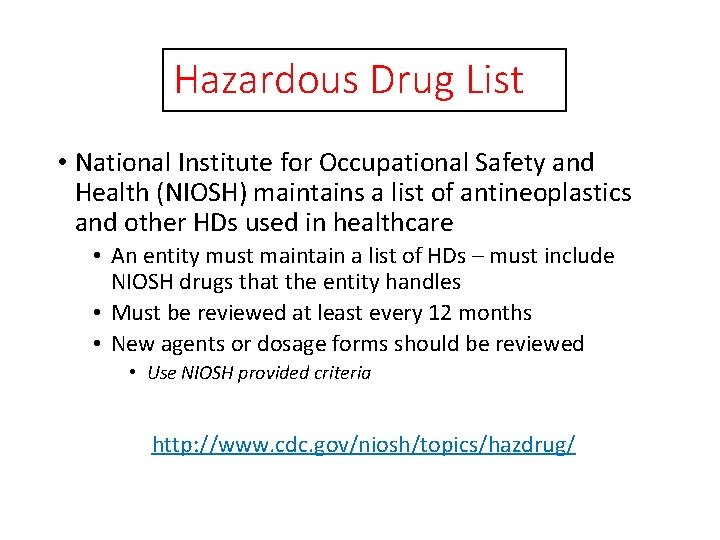
Hazardous Drug List • National Institute for Occupational Safety and Health (NIOSH) maintains a list of antineoplastics and other HDs used in healthcare • An entity must maintain a list of HDs – must include NIOSH drugs that the entity handles • Must be reviewed at least every 12 months • New agents or dosage forms should be reviewed • Use NIOSH provided criteria http: //www. cdc. gov/niosh/topics/hazdrug/
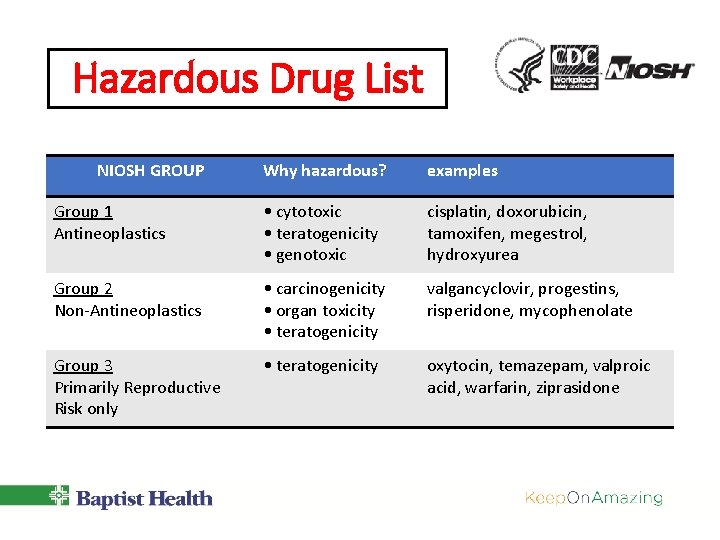
Hazardous Drug List NIOSH GROUP Why hazardous? examples Group 1 Antineoplastics • cytotoxic • teratogenicity • genotoxic cisplatin, doxorubicin, tamoxifen, megestrol, hydroxyurea Group 2 Non-Antineoplastics • carcinogenicity • organ toxicity • teratogenicity valgancyclovir, progestins, risperidone, mycophenolate Group 3 Primarily Reproductive Risk only • teratogenicity oxytocin, temazepam, valproic acid, warfarin, ziprasidone
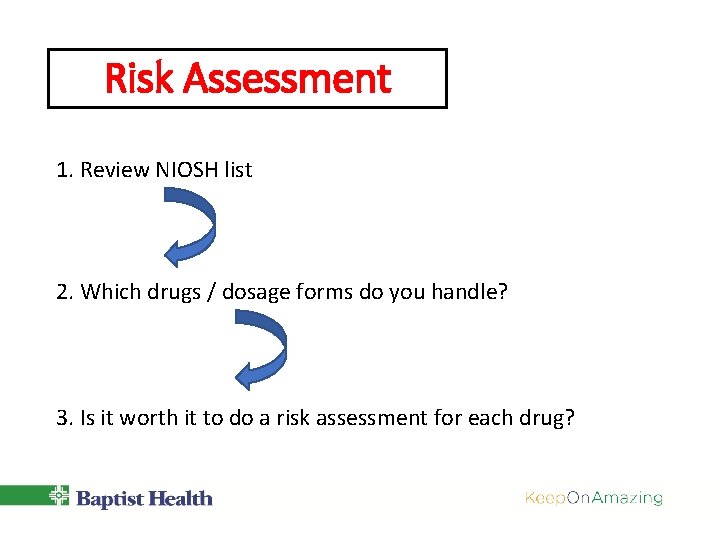
Risk Assessment 1. Review NIOSH list 2. Which drugs / dosage forms do you handle? 3. Is it worth it to do a risk assessment for each drug?
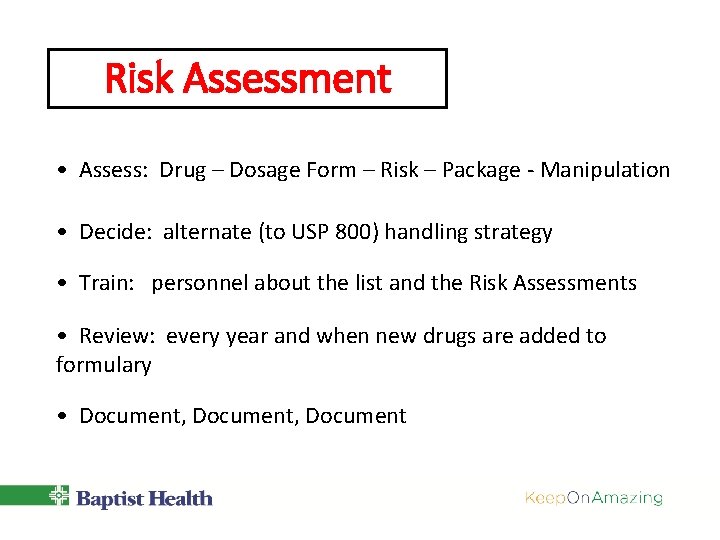
Risk Assessment • Assess: Drug – Dosage Form – Risk – Package - Manipulation • Decide: alternate (to USP 800) handling strategy • Train: personnel about the list and the Risk Assessments • Review: every year and when new drugs are added to formulary • Document, Document
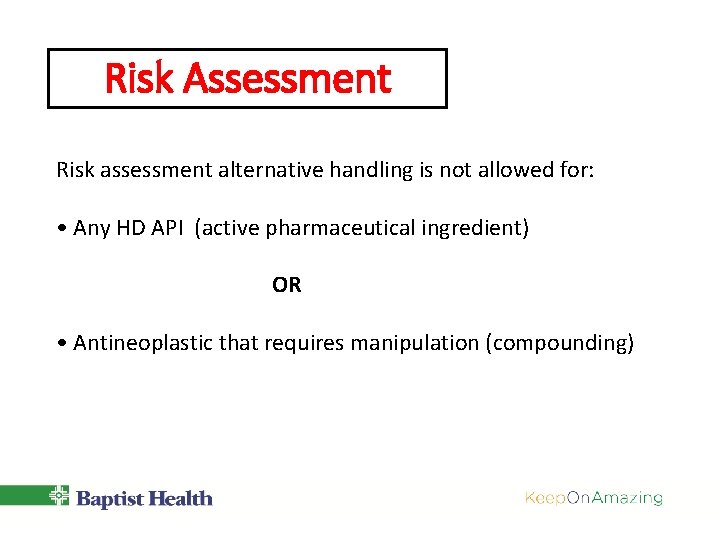
Risk Assessment Risk assessment alternative handling is not allowed for: • Any HD API (active pharmaceutical ingredient) OR • Antineoplastic that requires manipulation (compounding)
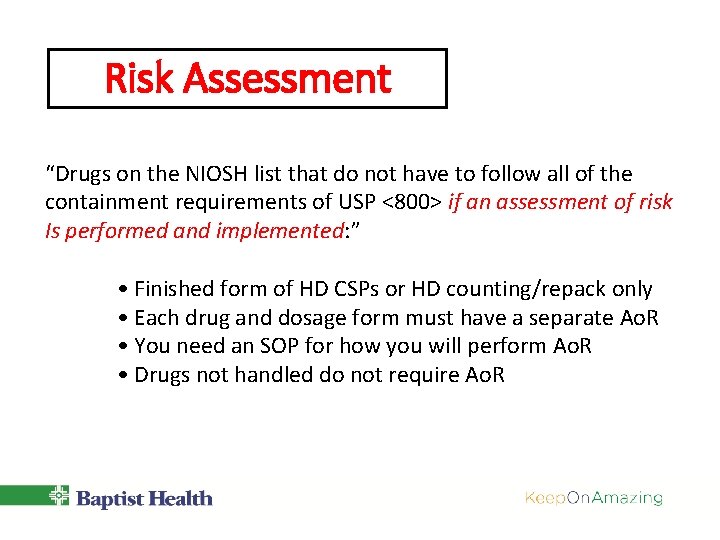
Risk Assessment “Drugs on the NIOSH list that do not have to follow all of the containment requirements of USP <800> if an assessment of risk Is performed and implemented: ” • Finished form of HD CSPs or HD counting/repack only • Each drug and dosage form must have a separate Ao. R • You need an SOP for how you will perform Ao. R • Drugs not handled do not require Ao. R
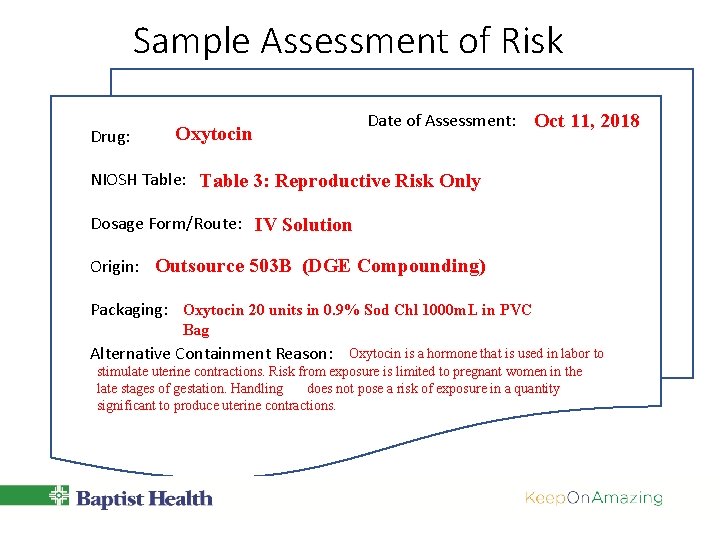
Sample Assessment of Risk Drug: Oxytocin Date of Assessment: Oct 11, 2018 NIOSH Table: Table 3: Reproductive Risk Only Dosage Form/Route: IV Solution Origin: Outsource 503 B (DGE Compounding) Packaging: Oxytocin 20 units in 0. 9% Sod Chl 1000 m. L in PVC Bag Oxytocin is a hormone that is used in labor to Alternative Containment Reason: stimulate uterine contractions. Risk from exposure is limited to pregnant women in the late stages of gestation. Handling does not pose a risk of exposure in a quantity significant to produce uterine contractions.
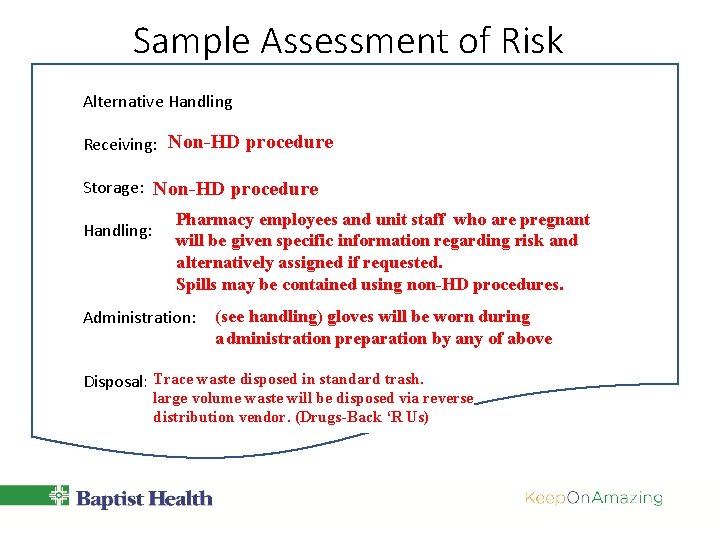
Sample Assessment of Risk Alternative Handling Receiving: Non-HD procedure Storage: Non-HD procedure Handling: Pharmacy employees and unit staff who are pregnant will be given specific information regarding risk and alternatively assigned if requested. Spills may be contained using non-HD procedures. Administration: (see handling) gloves will be worn during administration preparation by any of above Disposal: Trace waste disposed in standard trash. large volume waste will be disposed via reverse distribution vendor. (Drugs-Back ‘R Us)
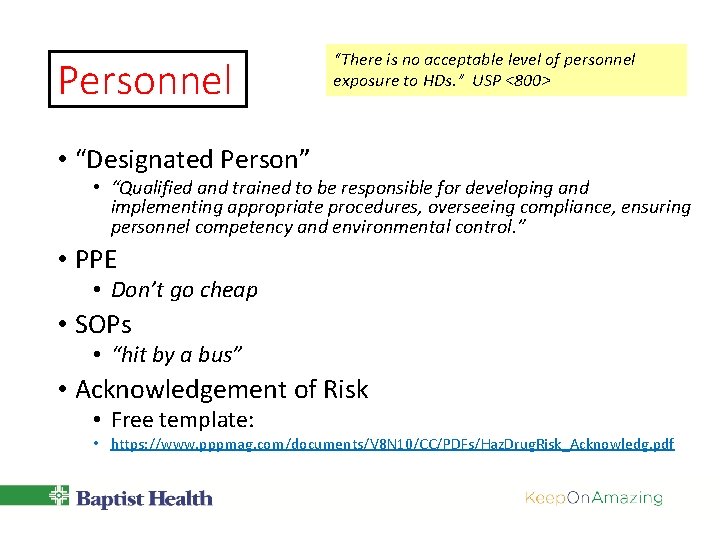
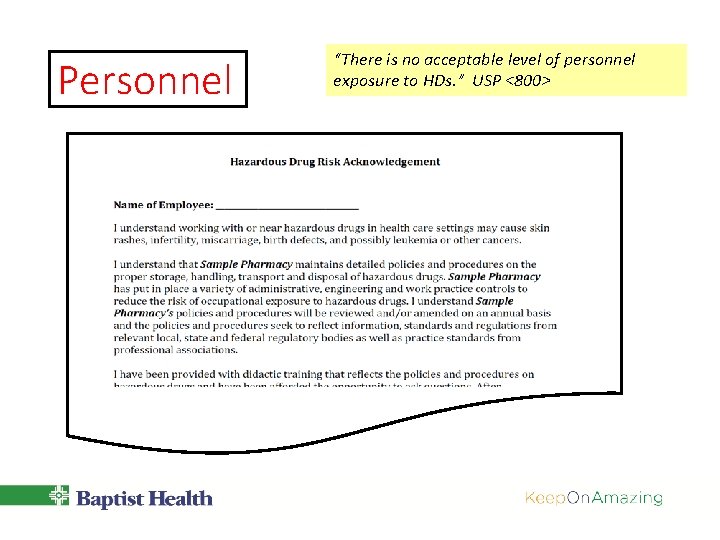
Personnel “There is no acceptable level of personnel exposure to HDs. ” USP <800> • “Designated Person” • “Qualified and trained to be responsible for developing and implementing appropriate procedures, overseeing compliance, ensuring personnel competency and environmental control. ” • PPE • Don’t go cheap • SOPs • “hit by a bus” • Acknowledgement of Risk • Free template: • https: //www. pppmag. com/documents/V 8 N 10/CC/PDFs/Haz. Drug. Risk_Acknowledg. pdf
Personnel “There is no acceptable level of personnel exposure to HDs. ” USP <800>
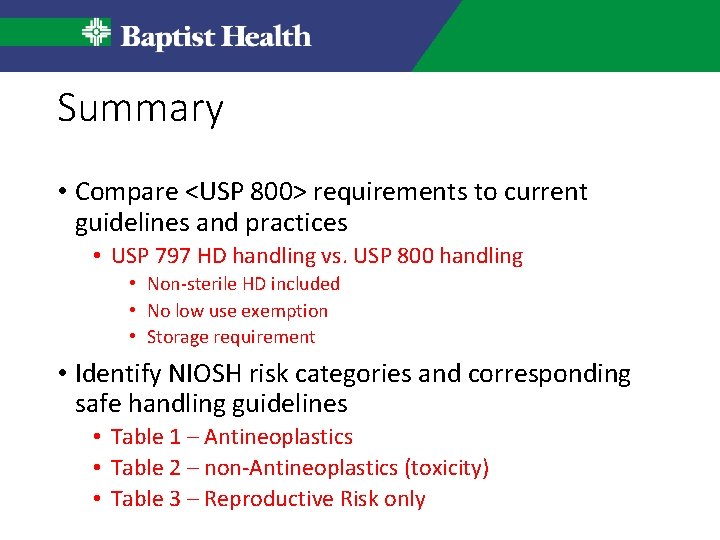
Summary • Compare <USP 800> requirements to current guidelines and practices • USP 797 HD handling vs. USP 800 handling • Non-sterile HD included • No low use exemption • Storage requirement • Identify NIOSH risk categories and corresponding safe handling guidelines • Table 1 – Antineoplastics • Table 2 – non-Antineoplastics (toxicity) • Table 3 – Reproductive Risk only
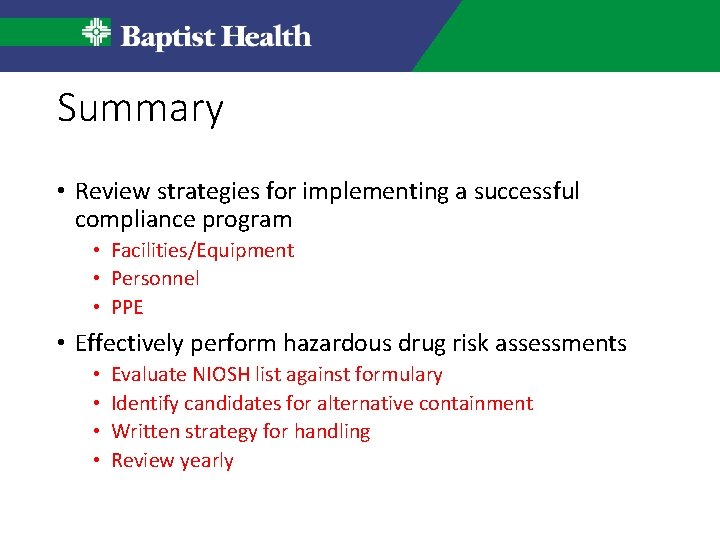
Summary • Review strategies for implementing a successful compliance program • Facilities/Equipment • Personnel • PPE • Effectively perform hazardous drug risk assessments • • Evaluate NIOSH list against formulary Identify candidates for alternative containment Written strategy for handling Review yearly
Special Thanks • Baptist Health Medical Center – North Little Rock • Grace Marable, Pharm. D, BCPS • Don Garner, PD • Clinical Pharmacy Staff reviewed and provided feedback and edits • Patricia C. Kienle, RPh, MPA, FASHP – USP <800> Expert Committee • Provided reference supplements
references • American Society of Health-System Pharmacists. ASHP guidelines on compounding sterile preparations. Am J Health-Syst Pharm. 2014; 71(2): 145– 166. • Connor TH, Mackenzie BA, De. Bord DG. Clarification about hazardous drugs. Am J Health-Syst Pharm. 2012; 69(22): 1949– 1950. • NIOSH list of antineoplastic and other hazardous drugs in healthcare settings, 2016 Cincinnati, OH: Department of Health and Human Services, CDC; 2016. • University Health. System Consortium. UHC consensus statement: model hazardous drug safety plan for institutions. Chica-go, IL: UHC; October 2009, revised January 2011. • https: //www. pppmag. com/documents/V 8 N 10/CC/PDFs/Haz. Drug. Risk_Acknowle dg. pdf (accessed Sept 24, 2018)
references • USP Convention, Inc. <800> Hazardous Drugs-Handling in Health care Settings. USP 40 -National Formulary 35. 1 st supp. Rockville, MD: USP Convention, Inc , 2017. • https: //www. epa. gov/hw/defining-hazardous-waste-listed-characteristic-andmixed-radiological-wastes. Accessed Sept 24, 2018 • Perform an Assessment Of Risk To Comply with Usp : March 2017 - Pharmacy Purchasing & Products Magazine. https: //www. pppmag. com/article/2012