
USJAPAN New RCS Design Roadmap Budget Table RCS
US-JAPAN New RCS Design Road-map

Budget Table RCS meeting to discuss issues and plan. . assign work Foreign Travel Costs $ $ Total Travel (D) Name Project Role CY Tan 10, 000. 00 Month s Requested Salary ($) Fringe Benefits Funds Requested Principle Investigator 2. 00 $- $- $- Kiyomi Seiya Co-Investigator 2. 00 $- $- $- Chandra Bhat Co-Investigator 2. 00 $- $- $- William Pellico Co-Investigator 2. 00 $26, 654. 88 $7, 929. 83 $34, 584. 71 RCS 2 nd meeting to discuss results/progress – re-evaluate work and set remaining work Foreign Travel Costs Total Travel (D) Name Project Role CY Tan $ $ 10, 000. 00 Months Requested Salary ($) Principle Investigator 0. 00 $- $- $- Kiyomi Seiya Co-Investigator 0. 00 $- $- $- Chandra Bhat Co-Investigator 0. 00 $- $- $- William Pellico Co-Investigator 1. 75 $27, 507. 83 $8, 183. 58 $35, 691. 41 Task complete - Fringe Benefits Funds Requested
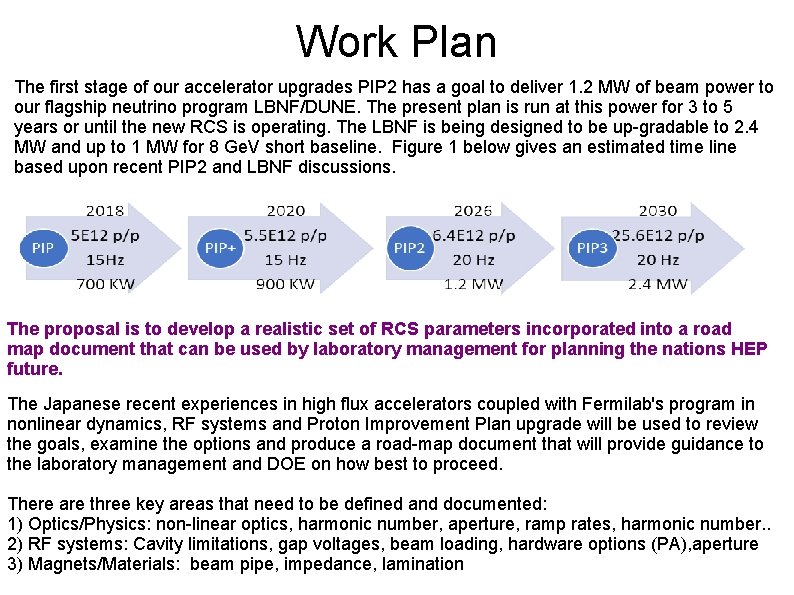
Work Plan The first stage of our accelerator upgrades PIP 2 has a goal to deliver 1. 2 MW of beam power to our flagship neutrino program LBNF/DUNE. The present plan is run at this power for 3 to 5 years or until the new RCS is operating. The LBNF is being designed to be up-gradable to 2. 4 MW and up to 1 MW for 8 Ge. V short baseline. Figure 1 below gives an estimated time line based upon recent PIP 2 and LBNF discussions. The proposal is to develop a realistic set of RCS parameters incorporated into a road map document that can be used by laboratory management for planning the nations HEP future. The Japanese recent experiences in high flux accelerators coupled with Fermilab's program in nonlinear dynamics, RF systems and Proton Improvement Plan upgrade will be used to review the goals, examine the options and produce a road-map document that will provide guidance to the laboratory management and DOE on how best to proceed. There are three key areas that need to be defined and documented: 1) Optics/Physics: non-linear optics, harmonic number, aperture, ramp rates, harmonic number. . 2) RF systems: Cavity limitations, gap voltages, beam loading, hardware options (PA), aperture 3) Magnets/Materials: beam pipe, impedance, lamination
- Slides: 3