
USING YOUR ASSESSMENT RESULTS FOR IMPROVEMENT ASSESSMENT PROCESS
- Slides: 14
USING YOUR ASSESSMENT RESULTS FOR IMPROVEMENT
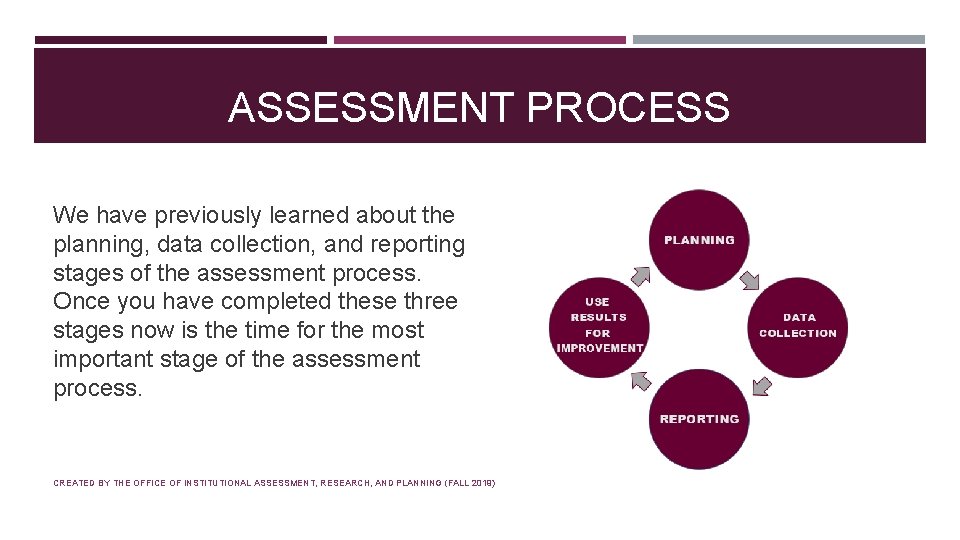
ASSESSMENT PROCESS We have previously learned about the planning, data collection, and reporting stages of the assessment process. Once you have completed these three stages now is the time for the most important stage of the assessment process. CREATED BY THE OFFICE OF INSTITUTIONAL ASSESSMENT, RESEARCH, AND PLANNING (FALL 2019)
USE OF RESULTS FOR IMPROVEMENT STAGE FOUR CREATED BY THE OFFICE OF INSTITUTIONAL ASSESSMENT, RESEARCH, AND PLANNING (FALL 2019)
WHAT DOES USING RESULTS FOR IMPROVEMENT MEAN? It involves program faculty working together in closely examining the results to improve the quality of students’ experiences and learning. It is important to learn from the assessment results to “close the loop” rather than simply maintaining the benchmark or criterion. CREATED BY THE OFFICE OF INSTITUTIONAL ASSESSMENT, RESEARCH, AND PLANNING (FALL 2019)
ACTION PLANS An action plan is the follow-up to the assessment just conducted. Actions must be identified for each measure, even if that action is to replace the measure with another one. Actions should also be as specific as possible, and should show that the team has thought through the results CREATED BY THE OFFICE OF INSTITUTIONAL ASSESSMENT, RESEARCH, AND PLANNING (FALL 2019)
GUIDELINES TO ACTION PLANS 1. Action plans flow directly from the analysis of the data. 2. Some actions plans will immediately solve a problem in the next cycle, but others are long term and will put you on the path to improvement. 3. Action plans are specific. 4. Action plans may or may not require additional resources. 5. Action plans must be tracked over one or more subsequent cycles. CREATED BY THE OFFICE OF INSTITUTIONAL ASSESSMENT, RESEARCH, AND PLANNING (FALL 2019)
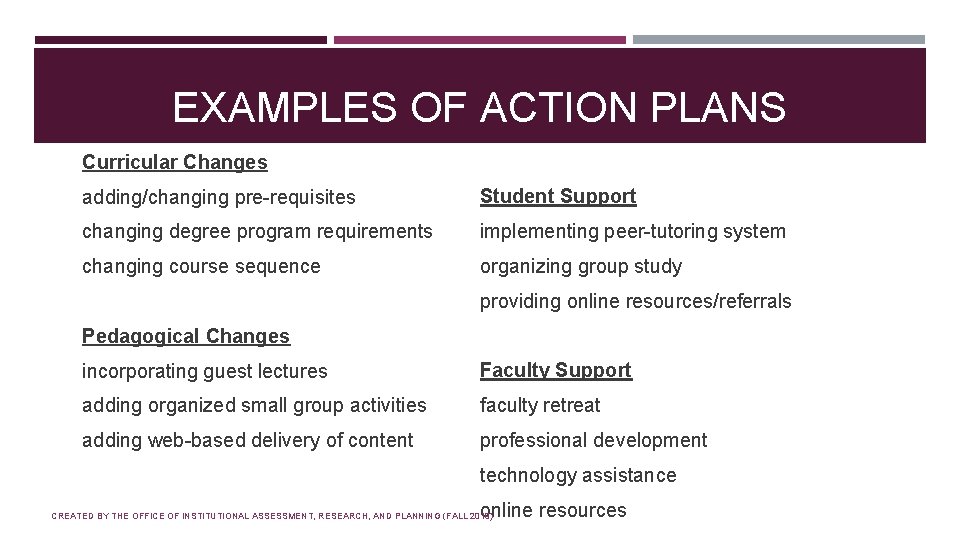
EXAMPLES OF ACTION PLANS Curricular Changes adding/changing pre-requisites Student Support changing degree program requirements implementing peer-tutoring system changing course sequence organizing group study providing online resources/referrals Pedagogical Changes incorporating guest lectures Faculty Support adding organized small group activities faculty retreat adding web-based delivery of content professional development technology assistance online resources CREATED BY THE OFFICE OF INSTITUTIONAL ASSESSMENT, RESEARCH, AND PLANNING (FALL 2019)
EXAMPLES WHEN MEASURE IS MET Performance is consistent and no significant program changes occurred, you may conclude that no changes are necessary. Now is the time to consider if you still want to include this outcome, or if you would like to raise your target levels. If performance is consistent and significant program changes occurred, you may conclude that changes were not effective. Lack of immediate improvement in the next assessment cycle is not seen as a failure. Continue monitoring and reporting. If performance levels improved as a result of previous changes, you may decide if you want to continue with recent changes with no modification. Consider how to sustain what has been working, and how to improve upon it. CREATED BY THE OFFICE OF INSTITUTIONAL ASSESSMENT, RESEARCH, AND PLANNING (FALL 2019)
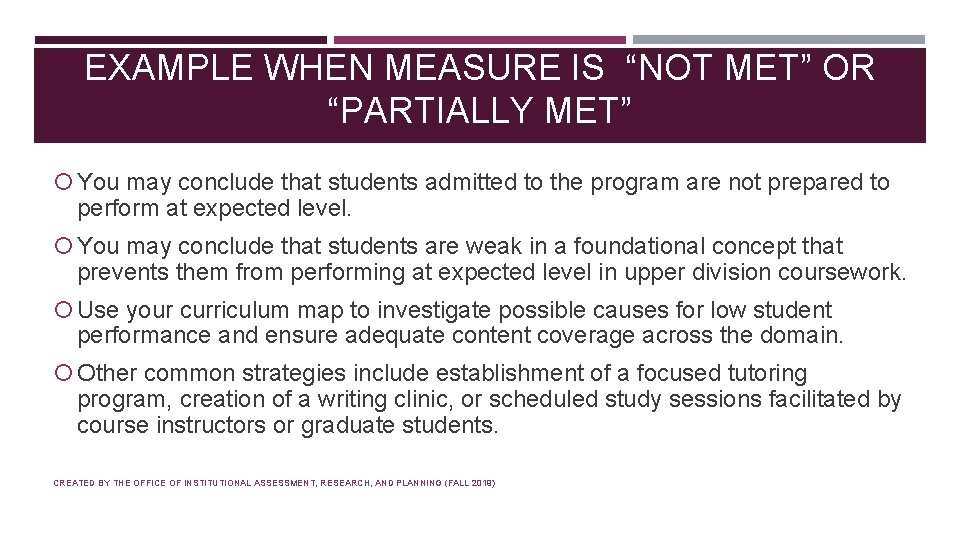
EXAMPLE WHEN MEASURE IS “NOT MET” OR “PARTIALLY MET” You may conclude that students admitted to the program are not prepared to perform at expected level. You may conclude that students are weak in a foundational concept that prevents them from performing at expected level in upper division coursework. Use your curriculum map to investigate possible causes for low student performance and ensure adequate content coverage across the domain. Other common strategies include establishment of a focused tutoring program, creation of a writing clinic, or scheduled study sessions facilitated by course instructors or graduate students. CREATED BY THE OFFICE OF INSTITUTIONAL ASSESSMENT, RESEARCH, AND PLANNING (FALL 2019)
DOCUMENTATION If our activities/data/decisions/strategies and resulting changes for improvement are not documented… …then SACSCOC will think they don’t exist! CREATED BY THE OFFICE OF INSTITUTIONAL ASSESSMENT, RESEARCH, AND PLANNING (FALL 2019)
HOW TO DOCUMENT We focus on the program only Anonymity of all participants in our measures has to be maintained - never identify anyone Clearly state how findings were reviewed Clearly state the changes implemented as a result of the findings and who or whom will be implementing these changes CREATED BY THE OFFICE OF INSTITUTIONAL ASSESSMENT, RESEARCH, AND PLANNING (FALL 2019)
MOST IMPORTANTLY We need to use our findings to: Plan, Strategize, and Improve. All of this finishes our current cycle while simultaneously laying the foundation and groundwork for the next assessment cycle. CREATED BY THE OFFICE OF INSTITUTIONAL ASSESSMENT, RESEARCH, AND PLANNING (FALL 2019)
Assessment, when done well, occurs within the normal course of the academic cycle. It is not meaningless and time consuming work done solely to satisfy administrative requirements. CREATED BY THE OFFICE OF INSTITUTIONAL ASSESSMENT, RESEARCH, AND PLANNING (FALL 2019)
REFERENCES Baker, W. (2012). Assessment 101: Academic Assessment Five Steps to Continuous Improvement of Student Learning. http: //www. counciloakassessment. com/ Resources, https: //elpaso. ttuhsc. edu/oire/Resources. aspx. CREATED BY THE OFFICE OF INSTITUTIONAL ASSESSMENT, RESEARCH, AND PLANNING (FALL 2019)