
Using Whole Genome Sequencing Analysis in Genotype Cluster




- Slides: 20
Using Whole Genome Sequencing Analysis in Genotype Cluster Investigation Perspectives from Los Angeles County Tuberculosis Control Program Wendy Noboa, MS Shameer Poonja, MPH Public Health Advisor The Centers for Disease Control and Prevention 1
Conflict of Interest Statement I have no conflicts of interest to declare. 2
Objectives • Los Angeles County’s (LAC) process of integrating Whole Genome Sequencing (WGS) data into genotype cluster investigation practices • Case studies using WGS analysis • Identify outbreaks and outbreak cases with greater precision • Refute outbreaks • Intervene to interrupt recent TB transmission • Explore added value, advantages, and challenges of using WGS analysis 3
Integrating WGS into Genotype Cluster Investigations 4
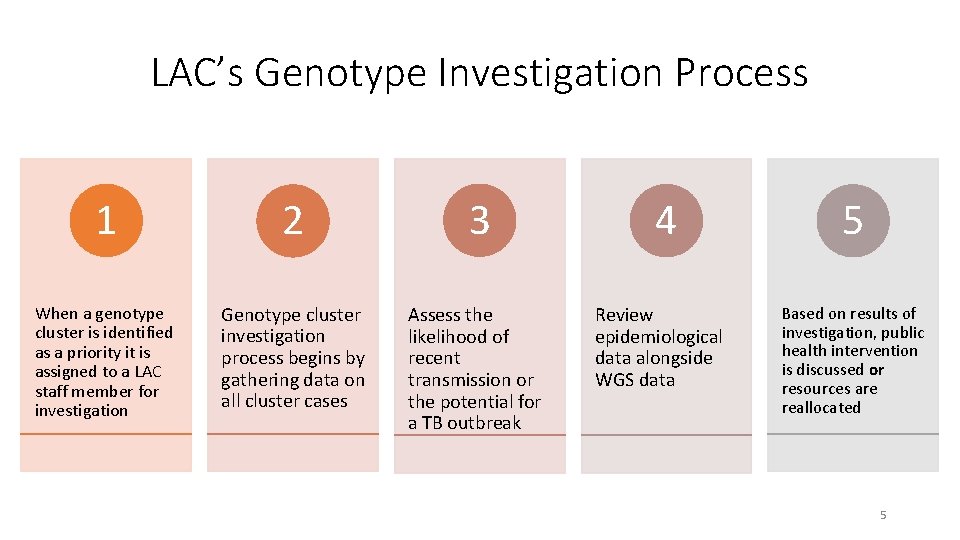
LAC’s Genotype Investigation Process 1 2 3 When a genotype cluster is identified as a priority it is assigned to a LAC staff member for investigation Genotype cluster investigation process begins by gathering data on all cluster cases Assess the likelihood of recent transmission or the potential for a TB outbreak 4 Review epidemiological data alongside WGS data 5 Based on results of investigation, public health intervention is discussed or resources are reallocated 5
Requesting WGS Analysis • Criteria for requesting WGS phylogenetic analysis: • Cluster is of high suspicion for ongoing recent transmission • Cluster is a potential TB outbreak • (Outbreak = 4 cases with definite epi-links within 3 year period) • Cluster is rare or unique to LAC • What can WGS analysis help answer: • Confirm or refute the presence of a TB outbreak • Exclude cases that are genetically distant and not associated with recent transmission • Identify and focus interventions 6
Real-world Case Studies 7
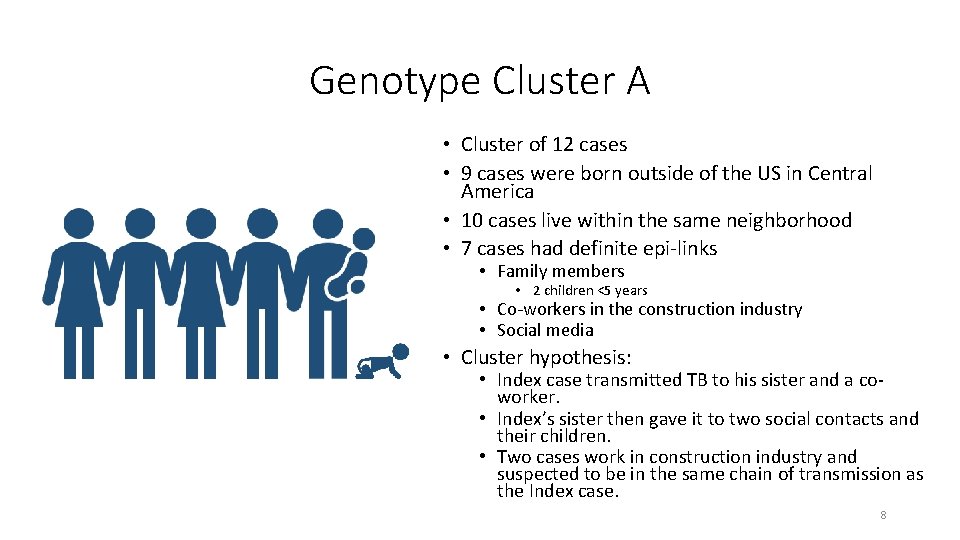
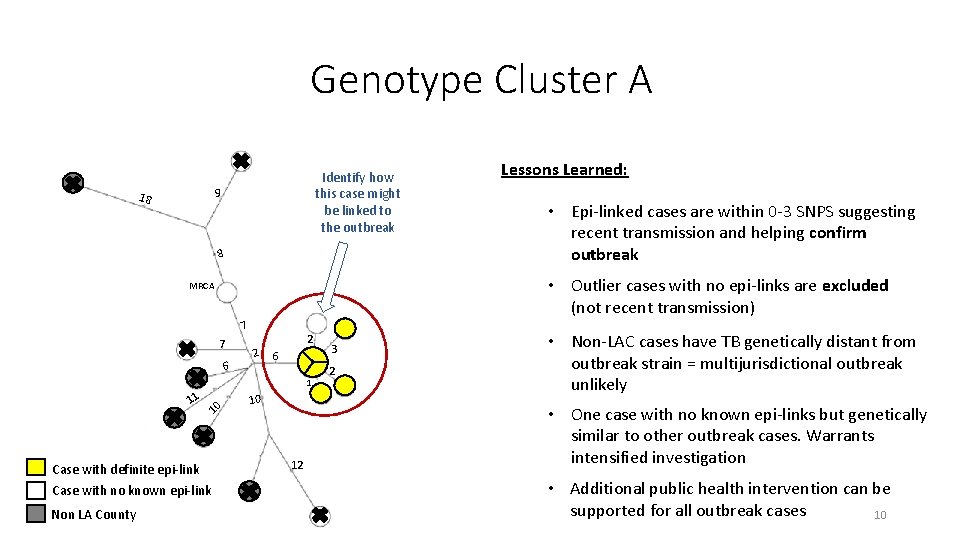
Genotype Cluster A • Cluster of 12 cases • 9 cases were born outside of the US in Central America • 10 cases live within the same neighborhood • 7 cases had definite epi-links • Family members • 2 children <5 years • Co-workers in the construction industry • Social media • Cluster hypothesis: • Index case transmitted TB to his sister and a coworker. • Index’s sister then gave it to two social contacts and their children. • Two cases work in construction industry and suspected to be in the same chain of transmission as the Index case. 8
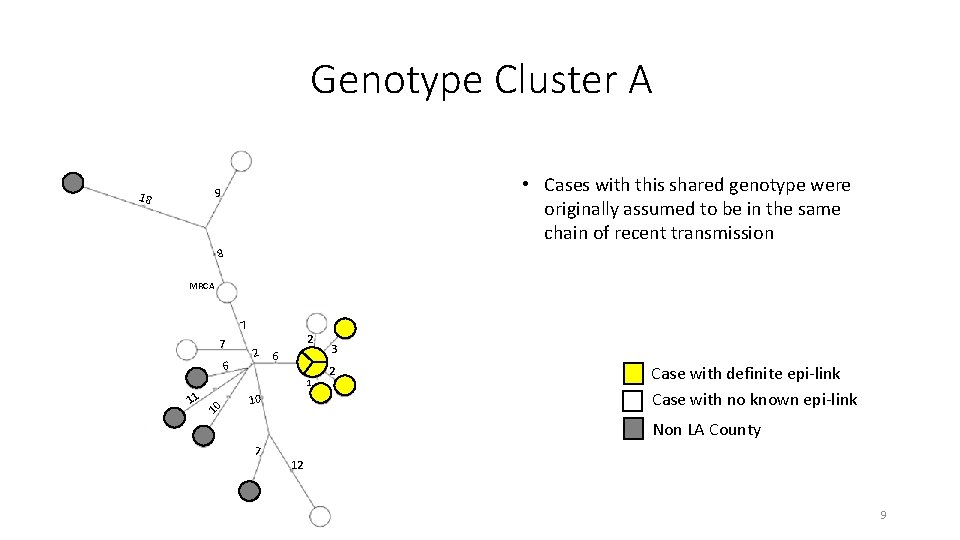
Genotype Cluster A • Cases with this shared genotype were originally assumed to be in the same chain of recent transmission 9 18 8 MRCA 7 7 6 2 2 6 11 10 3 2 Case with definite epi-link Case with no known epi-link Non LA County 7 12 9
Genotype Cluster A Identify how this case might be linked to the outbreak 9 18 8 7 7 6 2 2 6 10 1 Case with definite epi-link Case with no known epi-link Non LA County • Epi-linked cases are within 0 -3 SNPS suggesting recent transmission and helping confirm outbreak • Outlier cases with no epi-links are excluded (not recent transmission) MRCA 11 Lessons Learned: 10 12 3 2 • Non-LAC cases have TB genetically distant from outbreak strain = multijurisdictional outbreak unlikely • One case with no known epi-links but genetically similar to other outbreak cases. Warrants intensified investigation • Additional public health intervention can be supported for all outbreak cases 10
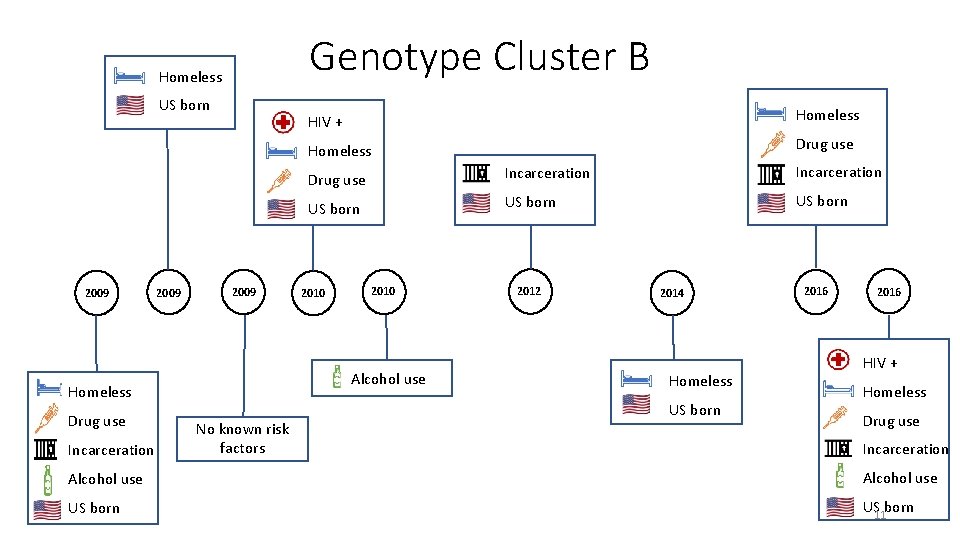
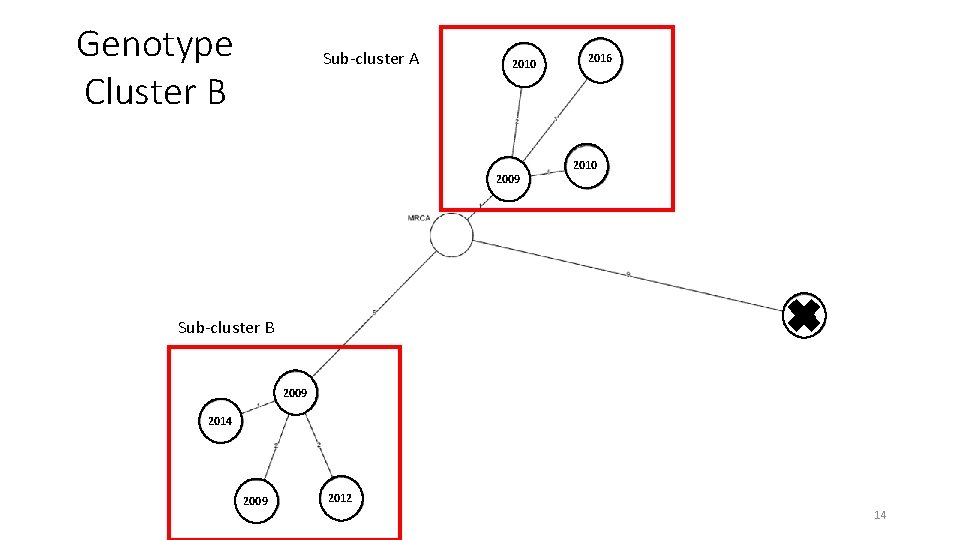
Genotype Cluster B Homeless US born 2009 Incarceration Homeless Drug use Incarceration US born 2010 Alcohol use Homeless Drug use HIV + 2012 2014 Homeless US born No known risk factors 2016 HIV + Homeless Drug use Incarceration Alcohol use US born US 11 born
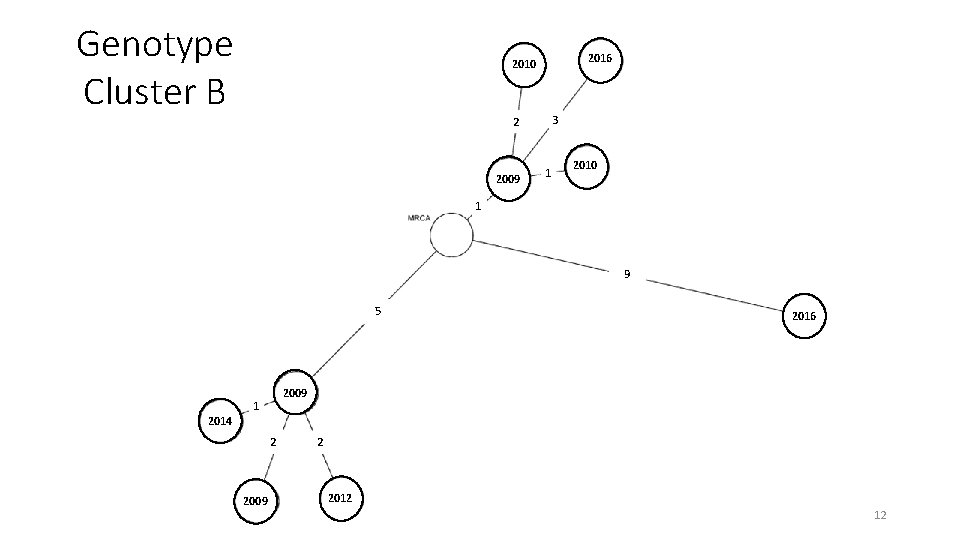
Genotype Cluster B 2016 2010 3 2 2009 1 2010 1 9 5 2014 2009 11 2 2009 2016 2 2012 12
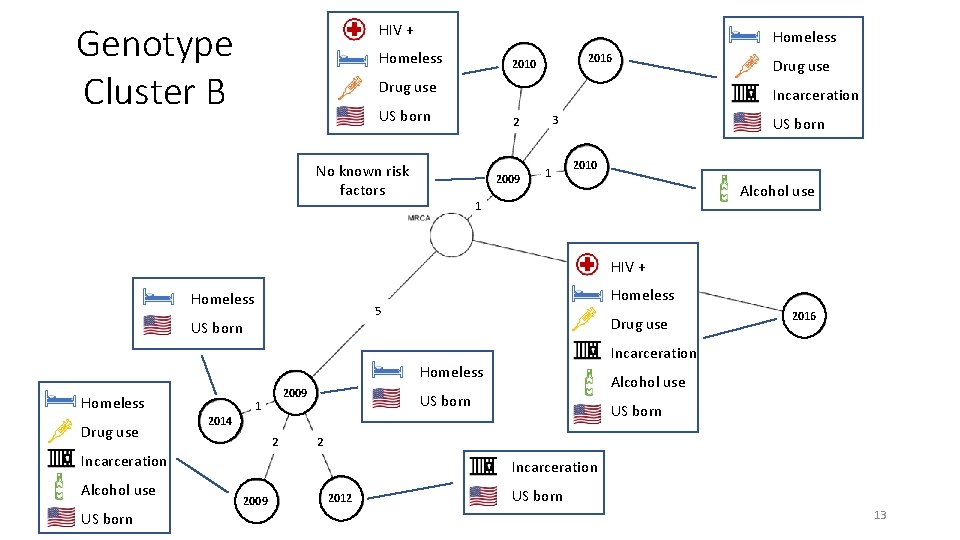
Genotype Cluster B HIV + Homeless 2016 2010 Drug use Incarceration US born No known risk factors Drug use 3 2 2009 1 US born 2010 Alcohol use 1 HIV + Homeless 5 US born Drug use Incarceration Homeless Drug use 2014 2009 1 2 US born Alcohol use US born 2 Incarceration Alcohol use 2016 Incarceration 2009 2012 US born 13
Genotype Cluster B Sub-cluster A 2010 2009 2016 2010 2016 Sub-cluster B 2009 2014 2009 2012 14
Advantages and challenges of using WGS data 15
Advantages of Using WGS Data • Helps confirm or refute TB outbreaks • Identify cases in the same chain of recent transmission • Exclude cases not in the same chain of recent transmission • Helps to focus genotype cluster investigations • Phylogenetic trees are a visual tool to share evidence of recent transmission and influence the use of public health resources 16
Challenges of Using WGS Data • WGS data can be intimidating • Technical terms and concepts • WGS data alone cannot be used to determine directionality of transmission • Detailed and complete epidemiologic and clinical data is needed • If WGS does not support hypothesis • Back to the drawing board to reassess transmission event • To get the full picture, WGS analysis may require special requests • Retrospective WGS • Requests for isolates outside the local jurisdiction • Requests for isolates from closely related genotypes 17
Conclusions • WGS is a tool that can be used in conjunction with traditional epidemiologic investigation methods • Documentation of clinical and epidemiological data is necessary for WGS analysis • Request WGS analysis • Work closely with the State TB Control Branch to determine which isolates are most appropriate to request for WGS analysis • Do not be intimidated • Incorporating WGS analysis does not require a team of investigators • The State TB Control Branch can help with interpreting results and training and the Centers for Disease Control and Prevention has a number of scientific resources • We are all learning together 18
Acknowledgements • Los Angeles County Tuberculosis Control Program • California State TB Control Branch • CDC Division of TB Elimination - Surveillance, Epidemiology and Outbreak Investigations Branch • CDC Center for State, Tribal, Local, and Territorial Support – Public Health Associate Program Contact Information: Wendy Noboa, PHA, (213) 745 -0825, wpernal@ph. lacounty. gov Shameer Poonja, PHA, (213) 745 -0834, spoonja@ph. lacounty. gov 19
BACK UP SLIDES 20