
USING WELLBEING CONCEPT TO MEASURE ECONOMIC AND SOCIAL
USING WELLBEING CONCEPT TO MEASURE ECONOMIC AND SOCIAL IMPACTS: A case study of the seaweed processing women’s groups in Indonesian villages Silva Larson 1, Natalie Stoeckl 1, Mardiana Fachri 2, Mustafa Dalvi 2, Mike Rimmer 1 , Libby Swanepoel 1 and Nicholas Paul 1 1 The University of Sunshine Coast, Maroochydore, QLD Australia 2 Hasanuddin University, Makassar, Indonesia Seeds of Change Conference, Canberra April 2019, Acknowledging FIS/2015/038
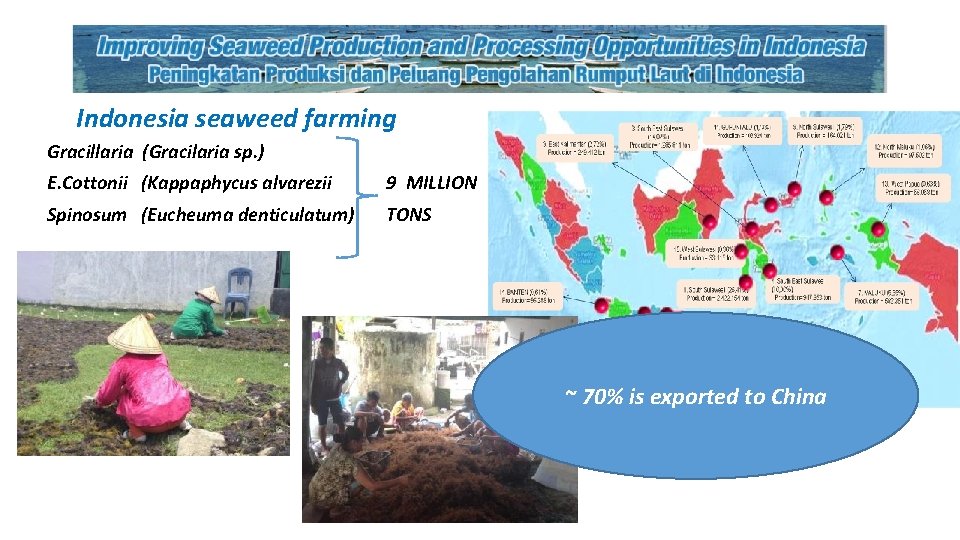
Indonesia seaweed farming Gracillaria (Gracilaria sp. ) E. Cottonii (Kappaphycus alvarezii 9 MILLION Spinosum (Eucheuma denticulatum) TONS ~ 70% is exported to China
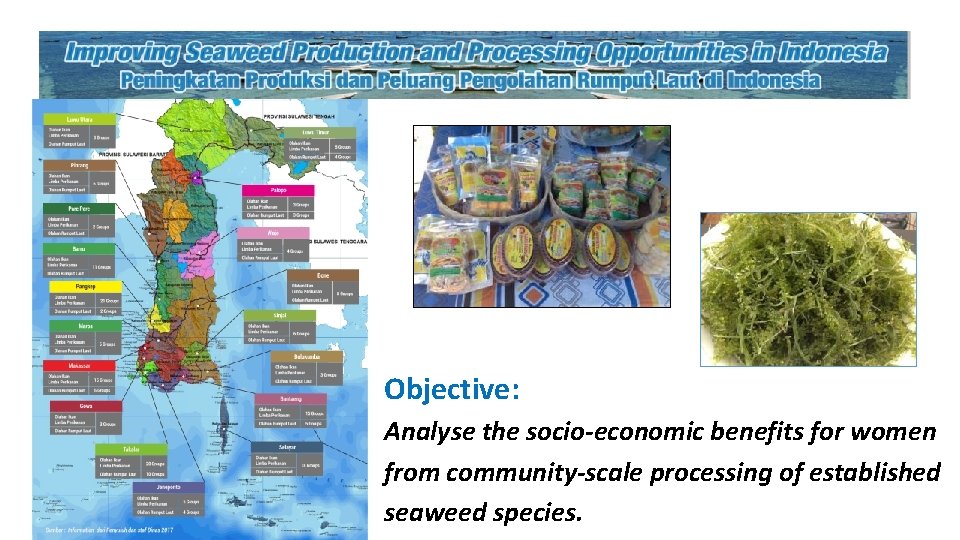
Objective: Analyse the socio-economic benefits for women from community-scale processing of established seaweed species.
A very common objective: “Analyse the socio-economic benefits (of an intervention) for women” And a very common proxy: money $$$$ -As ∆ in income on individual or household level -As ∆ in GDP or sectoral value on national or industry level

A very common objective: “Analyse the socio-economic benefits (of an intervention) for women” And a very common proxy: money $$$$ -As ∆ in income on individual or household level -As ∆ in GDP or sectoral value on national or industry level But – a concept of benefit goes well beyond $$$$ We might be significantly underreporting the total value
Problems with commonly used evaluation methods: (a) measurement of both monetary and non-monetary impacts on equal footing; (b) delimitation, (c) attribution and causality, (d) capturing of both positive and negative changes, and (e) capturing of unintended impacts.
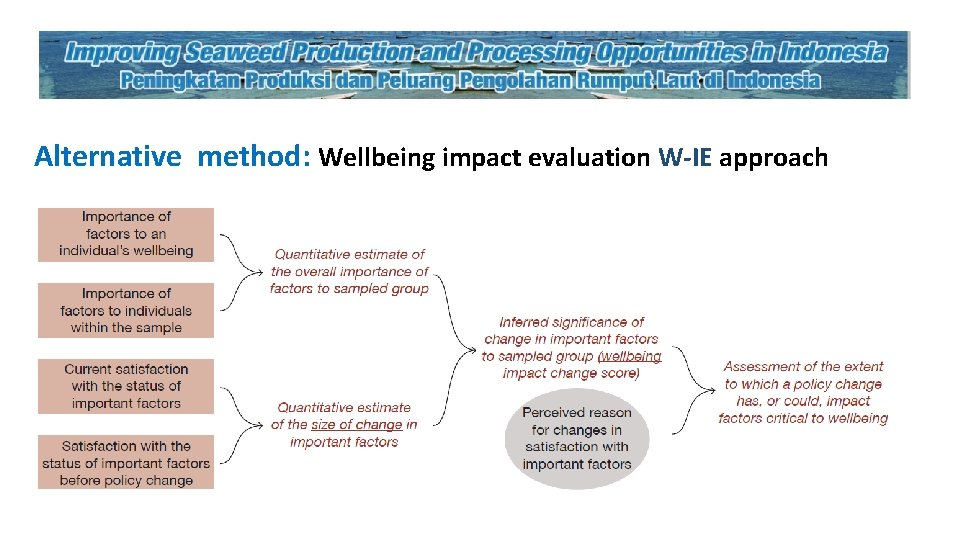
Alternative method: Wellbeing impact evaluation W-IE approach
Quantitative data collected for each wellbeing factor (WBF): W-IE = (%selecting*Imp)*(Sat now-Sat before) = Imp OA * ∆ Sat -Where, Imp: How important is WBF to women’s wellbeing (Likart scale, 0 -10) % selecting: % of total sample selecting that factor Imp OA: Importance overall, multiplying importance score with % selecting Sat now and Sat before: satisfaction with the WBFnnow and before intervention started (Likart scale 0 -10) ∆ Sat: Size of change in satisfaction (Sat now – Sat before) WBI: Wellbeing impact change score
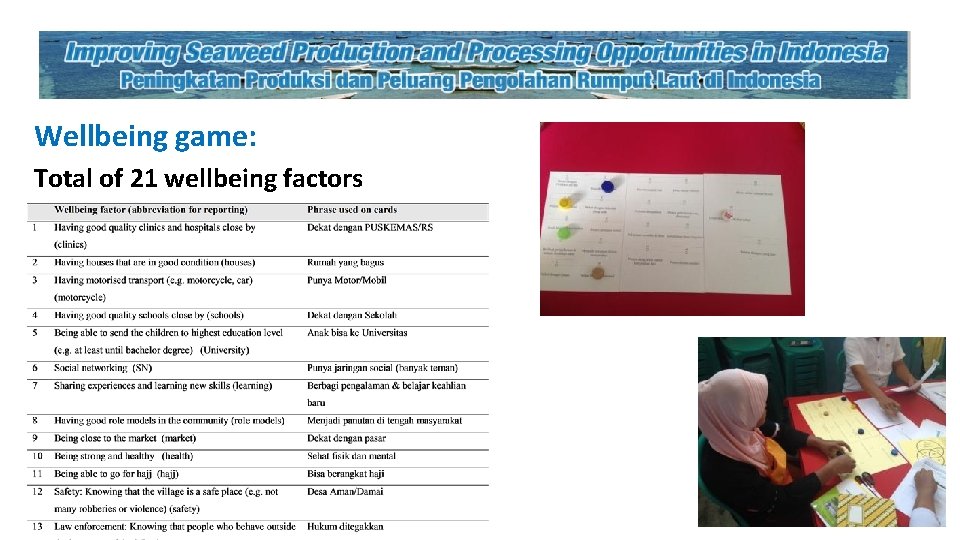
Wellbeing game: Total of 21 wellbeing factors
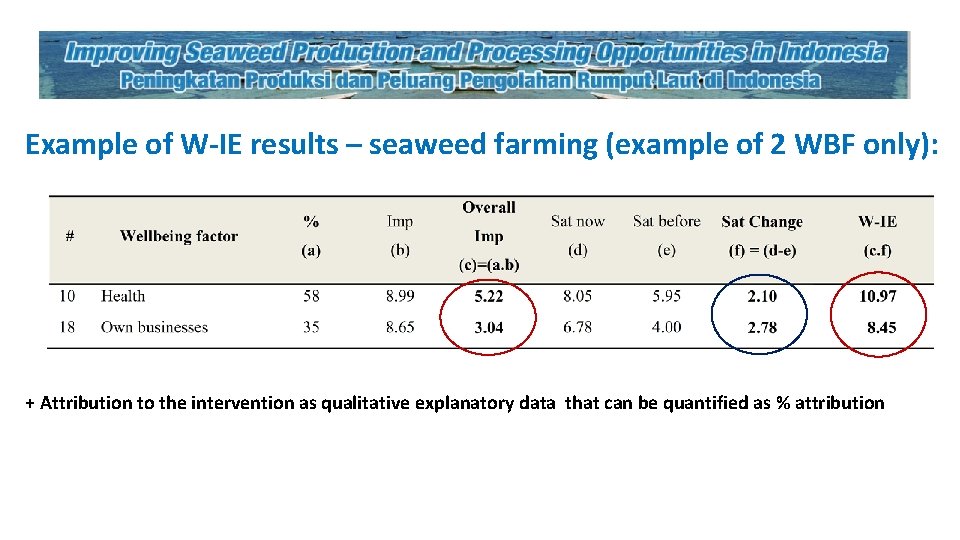
Example of W-IE results – seaweed farming (example of 2 WBF only): + Attribution to the intervention as qualitative explanatory data that can be quantified as % attribution
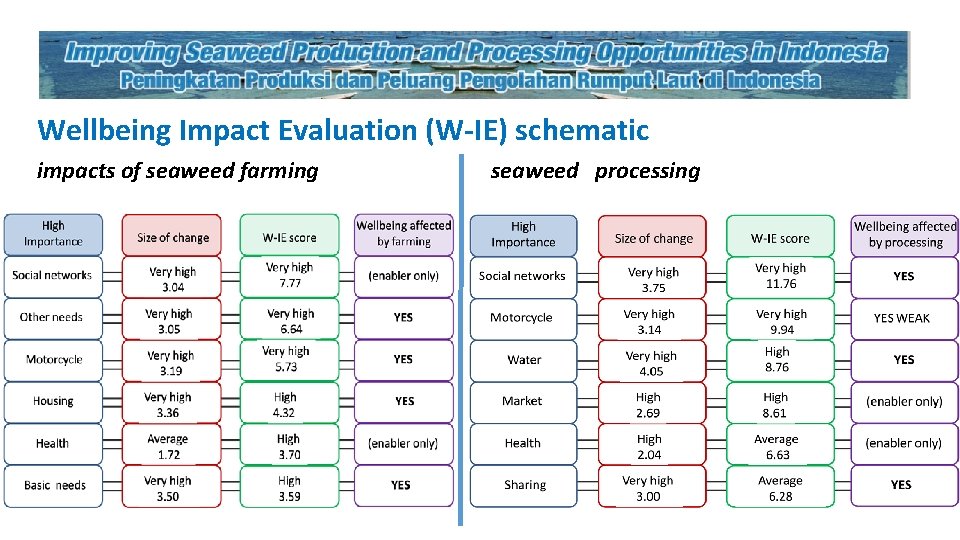
Wellbeing Impact Evaluation (W-IE) schematic impacts of seaweed farming seaweed processing
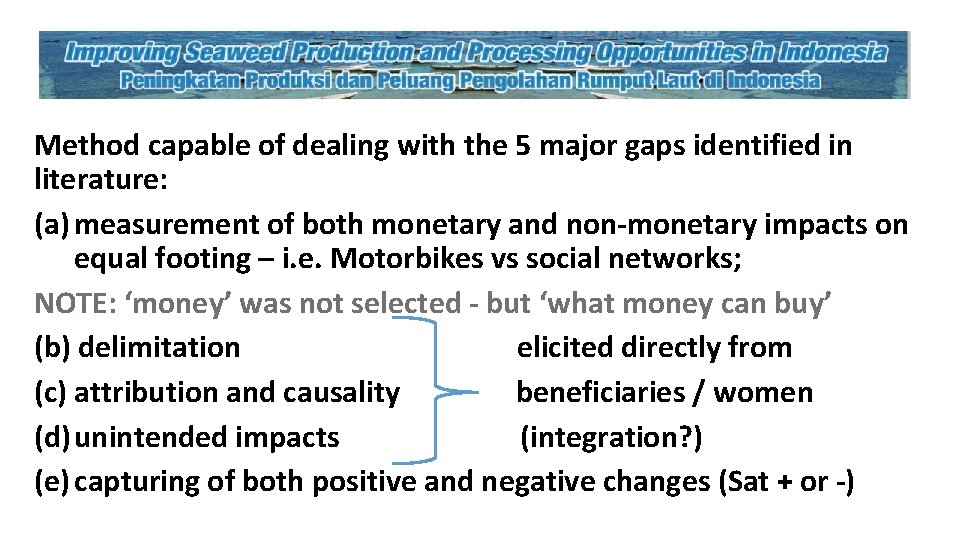
Method capable of dealing with the 5 major gaps identified in literature: (a) measurement of both monetary and non-monetary impacts on equal footing – i. e. Motorbikes vs social networks; NOTE: ‘money’ was not selected - but ‘what money can buy’ (b) delimitation elicited directly from (c) attribution and causality beneficiaries / women (d) unintended impacts (integration? ) (e) capturing of both positive and negative changes (Sat + or -)
Utility: - Already tested and working well in wide range of projects/ programs/ interventions Way forward: - Further methodological and theoretical ‘tweaking’ ‘Shortcoming’: not a generic ‘method of mass destruction’ - It is a context specific method, no ‘copy and paste’, hence, - It can not be applied by untrained or poorly trained people
Thank you! Base reference: Larson S, Stoeckl N, Jarvis D, Addison J, Prior S and Esparon M (2018) Using measures of wellbeing for impact evaluation: Proof of concept developed with an Indigenous community undertaking land management programs in northern Australia, AMBIO doi: https: //doi. org/10. 1007/s 13280 -018 -1058 -3
- Slides: 14