
Using VSM for Understanding Affective Work Environment Diagnosing

- Slides: 28
Using VSM for Understanding Affective Work Environment & Diagnosing Causes of Workforce Emotions Holistically Dr. Iffat S. Chaudhry Dr. Angela Espinosa Prof. Richard Vidgen A’Sharqiyah University, Oman University of Hull, UK Workshop: Managing Complexity with VSM: Theory, Application & Innovative Research, 11 -13 Nov, 2015 10/24/2020 VSM Diagnosing Workforce Emotions 1
Overview n n n n Abstract Problem Statement Study Objectives Development of (VSM based) Holistic Emotions Measurement Model (HEMM) Field Testing of (VSM based) Holistic Emotions Measurement Model (HEMM) Results Conclusion Future Directions 10/24/2020 VSM Diagnosing Workforce Emotions 2
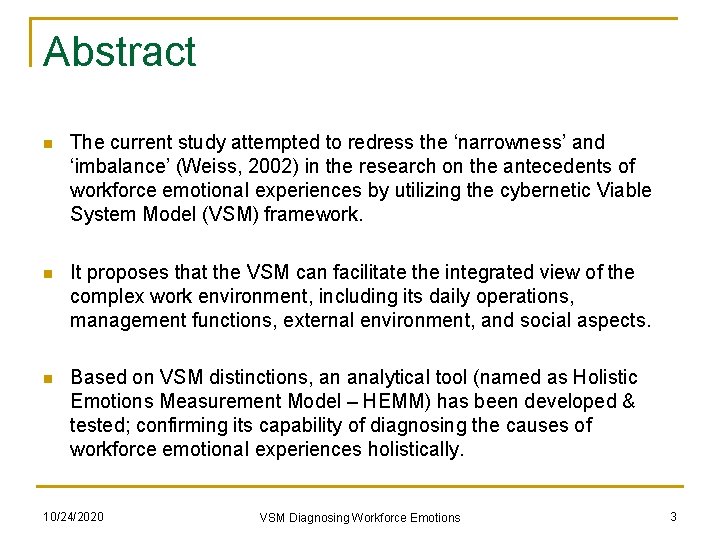
Abstract n The current study attempted to redress the ‘narrowness’ and ‘imbalance’ (Weiss, 2002) in the research on the antecedents of workforce emotional experiences by utilizing the cybernetic Viable System Model (VSM) framework. n It proposes that the VSM can facilitate the integrated view of the complex work environment, including its daily operations, management functions, external environment, and social aspects. n Based on VSM distinctions, an analytical tool (named as Holistic Emotions Measurement Model – HEMM) has been developed & tested; confirming its capability of diagnosing the causes of workforce emotional experiences holistically. 10/24/2020 VSM Diagnosing Workforce Emotions 3
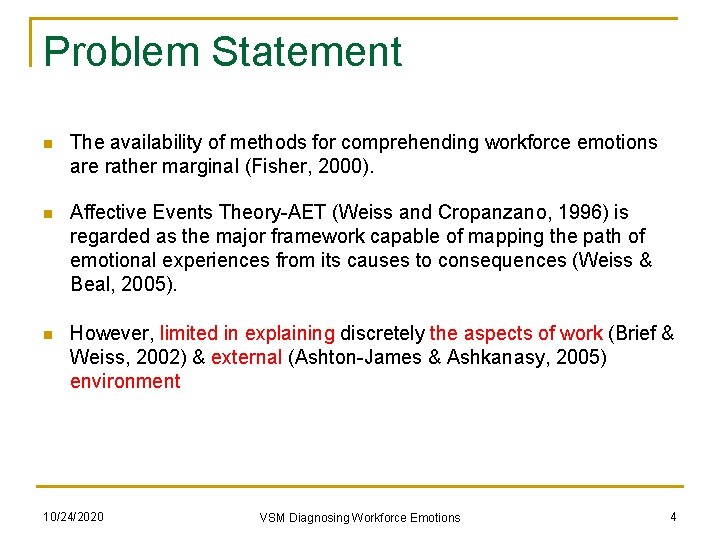
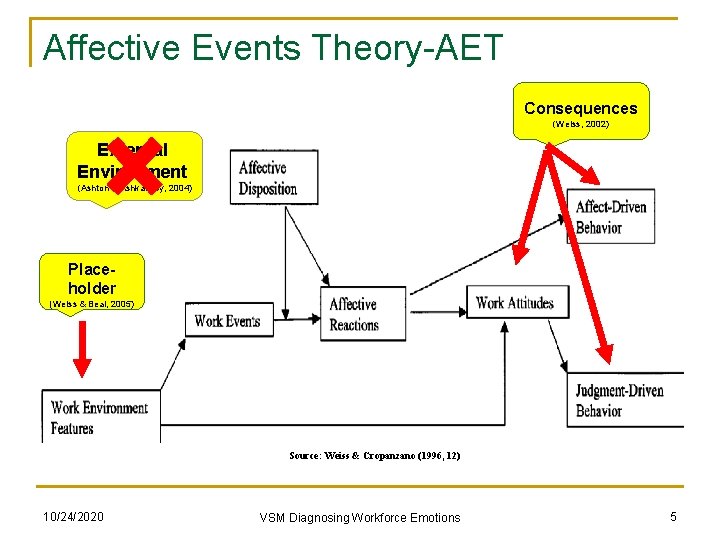
Problem Statement n The availability of methods for comprehending workforce emotions are rather marginal (Fisher, 2000). n Affective Events Theory-AET (Weiss and Cropanzano, 1996) is regarded as the major framework capable of mapping the path of emotional experiences from its causes to consequences (Weiss & Beal, 2005). n However, limited in explaining discretely the aspects of work (Brief & Weiss, 2002) & external (Ashton-James & Ashkanasy, 2005) environment 10/24/2020 VSM Diagnosing Workforce Emotions 4
Affective Events Theory-AET Consequences (Weiss, 2002) External Environment (Ashton & Ashkanasy, 2004) Placeholder (Weiss & Beal, 2005) Source: Weiss & Cropanzano (1996, 12) 10/24/2020 VSM Diagnosing Workforce Emotions 5
Fragmented View – Work Environment & its Related Aspects n Wegge (2006) q n Basch and Fisher (1998) q n Autonomy, Participation, Supervisor Support, Employee Welfare & Work Overload Acts of Colleagues, Management, Customers; Company Policies & its Reputation; Workload, Influence, External Environment. Erol-Korkmaz (2010) q Task-Related, Relations with Supervisor, Relation with Co-workers, Relation with Subordinates, & Organizational Policies. 10/24/2020 VSM Diagnosing Workforce Emotions 6
Objectives n Step 1: Development of (VSM based) Holistic Emotions Measurement Model (HEMM) q n As a conceptual device for producing a holistic understanding of the work environment triggering workforce emotions. Step 2: Field Testing of (VSM based) Holistic Emotions Measurement Model (HEMM) q To test the explanatory power of the suggested model in understanding the affective work environment and its related features. 10/24/2020 VSM Diagnosing Workforce Emotions 7
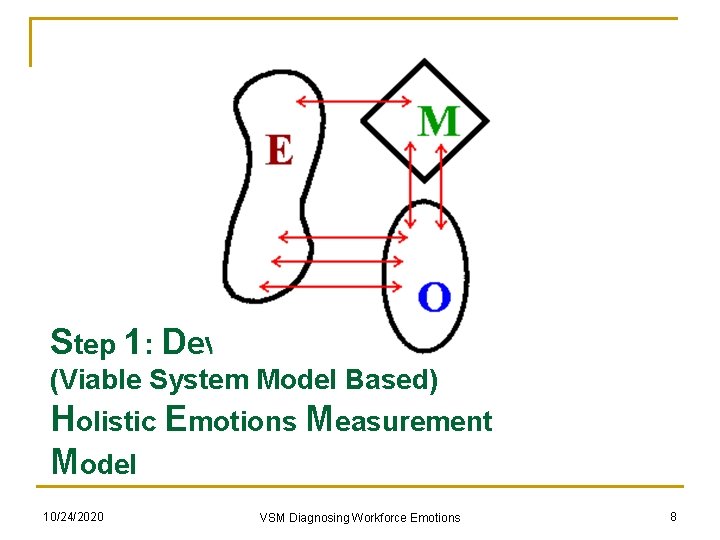
Step 1: Development of (Viable System Model Based) Holistic Emotions Measurement Model 10/24/2020 VSM Diagnosing Workforce Emotions 8
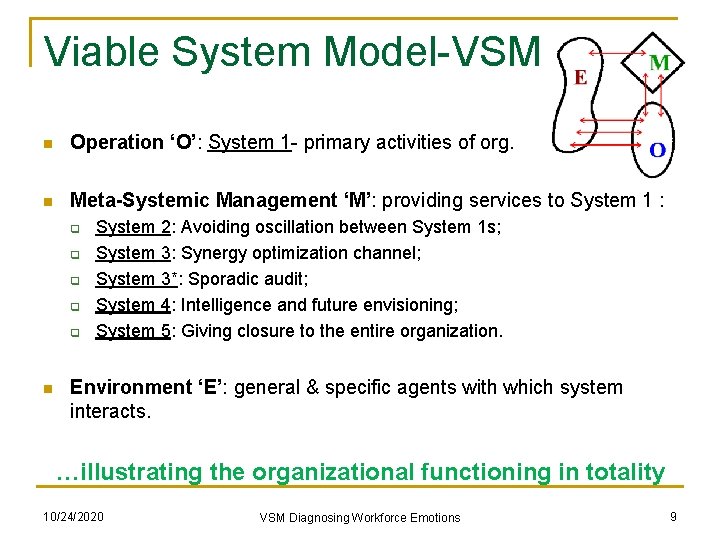
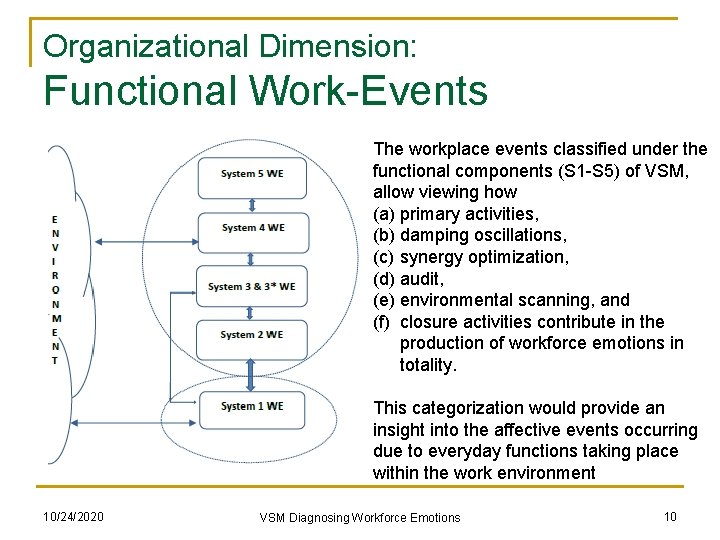
Viable System Model-VSM n Operation ‘O’: System 1 - primary activities of org. n Meta-Systemic Management ‘M’: providing services to System 1 : q q q n System 2: Avoiding oscillation between System 1 s; System 3: Synergy optimization channel; System 3*: Sporadic audit; System 4: Intelligence and future envisioning; System 5: Giving closure to the entire organization. Environment ‘E’: general & specific agents with which system interacts. …illustrating the organizational functioning in totality 10/24/2020 VSM Diagnosing Workforce Emotions 9
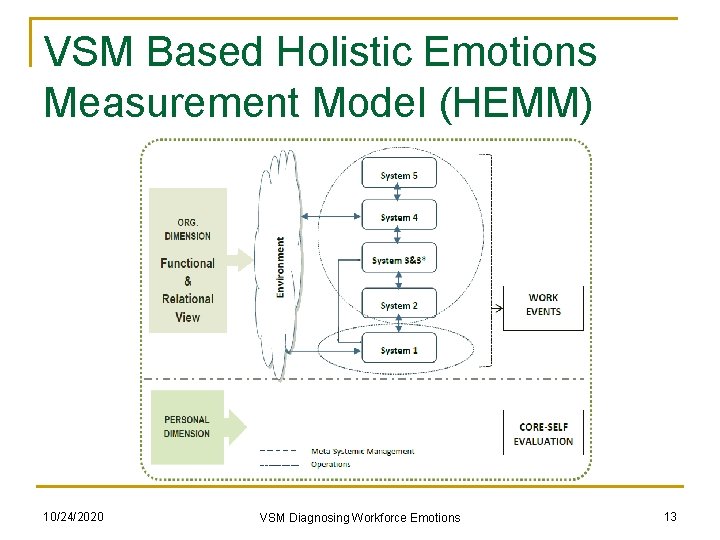
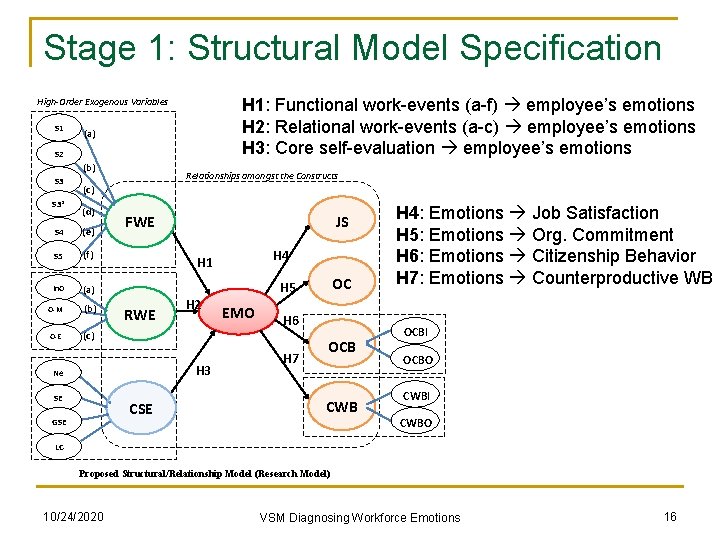
Organizational Dimension: Functional Work-Events The workplace events classified under the functional components (S 1 -S 5) of VSM, allow viewing how (a) primary activities, (b) damping oscillations, (c) synergy optimization, (d) audit, (e) environmental scanning, and (f) closure activities contribute in the production of workforce emotions in totality. This categorization would provide an insight into the affective events occurring due to everyday functions taking place within the work environment 10/24/2020 VSM Diagnosing Workforce Emotions 10
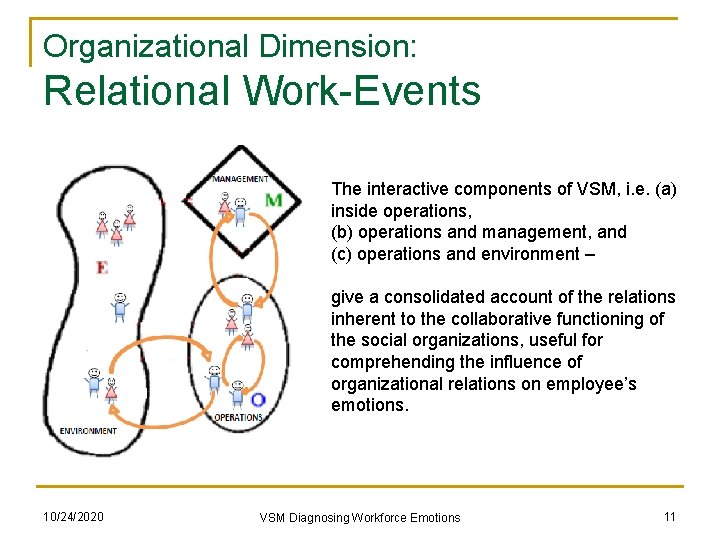
Organizational Dimension: Relational Work-Events The interactive components of VSM, i. e. (a) inside operations, (b) operations and management, and (c) operations and environment – give a consolidated account of the relations inherent to the collaborative functioning of the social organizations, useful for comprehending the influence of organizational relations on employee’s emotions. 10/24/2020 VSM Diagnosing Workforce Emotions 11
Personality Dim. : Core Self. Evaluation n CSE is a higher-order trait constituted of four personality traits (Judge et al. , 1998): q Self-esteem, ‘the overall value that one places on oneself as a person’ q Generalized self-efficacy, ‘an evaluation of how well one can perform across a variety of situations’ q Neuroticism, ‘the tendency to have a negativistic cognitive/explanatory style and to focus on negative aspects of the self’ q Locus of control, ‘beliefs about the causes of events in one’s life – internal or external’ 10/24/2020 VSM Diagnosing Workforce Emotions 12
VSM Based Holistic Emotions Measurement Model (HEMM) 10/24/2020 VSM Diagnosing Workforce Emotions 13
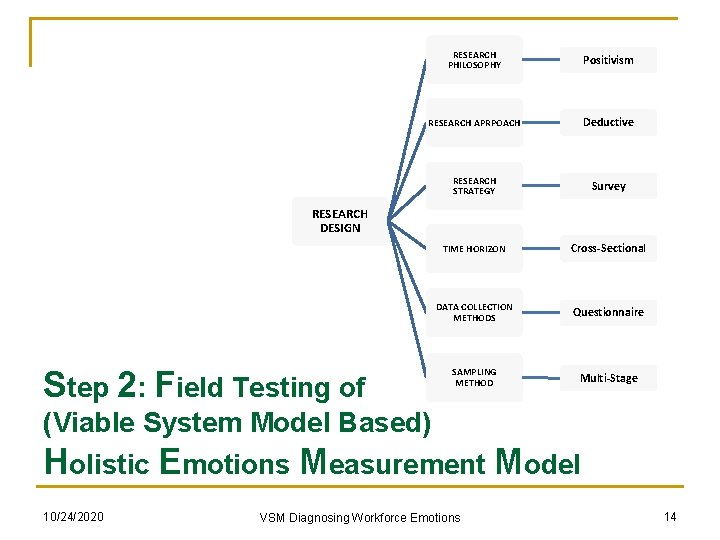
RESEARCH PHILOSOPHY Positivism RESEARCH APRPOACH Deductive RESEARCH STRATEGY Survey RESEARCH DESIGN Step 2: Field Testing of TIME HORIZON Cross-Sectional DATA COLLECTION METHODS Questionnaire SAMPLING METHOD Multi-Stage (Viable System Model Based) Holistic Emotions Measurement Model 10/24/2020 VSM Diagnosing Workforce Emotions 14
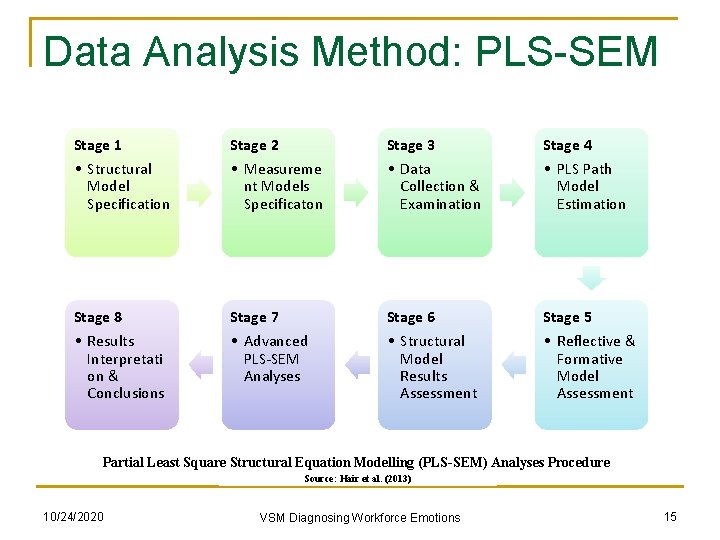
Data Analysis Method: PLS-SEM Stage 1 • Structural Model Specification Stage 2 • Measureme nt Models Specificaton Stage 3 • Data Collection & Examination Stage 4 • PLS Path Model Estimation Stage 8 • Results Interpretati on & Conclusions Stage 7 • Advanced PLS-SEM Analyses Stage 6 • Structural Model Results Assessment Stage 5 • Reflective & Formative Model Assessment Partial Least Square Structural Equation Modelling (PLS-SEM) Analyses Procedure Source: Hair et al. (2013) 10/24/2020 VSM Diagnosing Workforce Emotions 15
Stage 1: Structural Model Specification H 1: Functional work-events (a-f) employee’s emotions H 2: Relational work-events (a-c) employee’s emotions H 3: Core self-evaluation employee’s emotions High-Order Exogenous Variables S 1 (a) S 2 (b) S 3* Relationships amongst the Constructs (c) (d) S 4 (e) S 5 (f) In. O (a) O-M (b) O-E (c) JS FWE RWE H 2 H 3 CSE GSE OC H 5 Ne SE H 4 H 1 EMO H 6 H 7 OCB CWB H 4: Emotions Job Satisfaction H 5: Emotions Org. Commitment H 6: Emotions Citizenship Behavior H 7: Emotions Counterproductive WB OCBI OCBO CWBI CWBO LC Proposed Structural/Relationship Model (Research Model) 10/24/2020 VSM Diagnosing Workforce Emotions 16
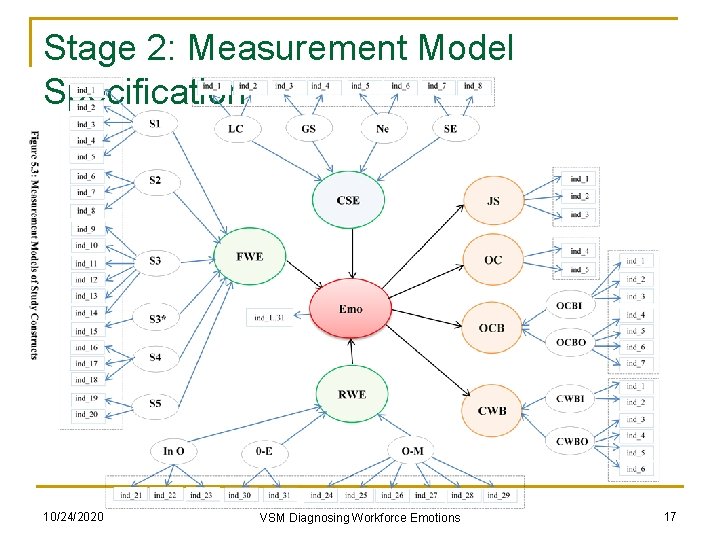
Stage 2: Measurement Model Specification 10/24/2020 VSM Diagnosing Workforce Emotions 17
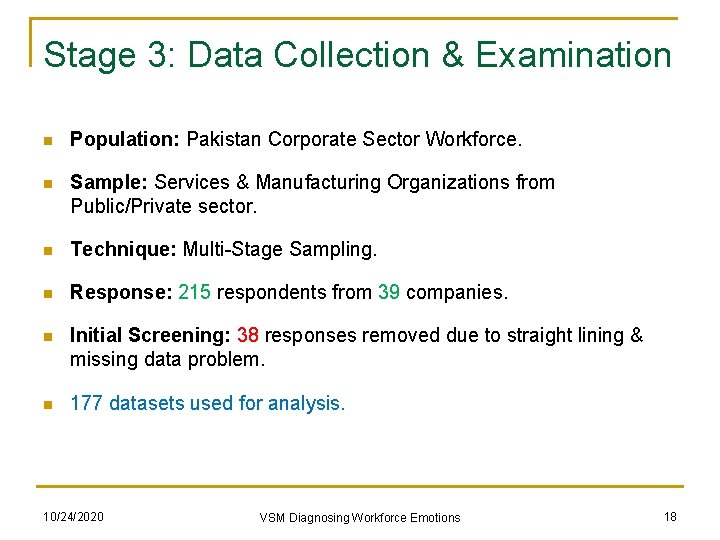
Stage 3: Data Collection & Examination n Population: Pakistan Corporate Sector Workforce. n Sample: Services & Manufacturing Organizations from Public/Private sector. n Technique: Multi-Stage Sampling. n Response: 215 respondents from 39 companies. n Initial Screening: 38 responses removed due to straight lining & missing data problem. n 177 datasets used for analysis. 10/24/2020 VSM Diagnosing Workforce Emotions 18
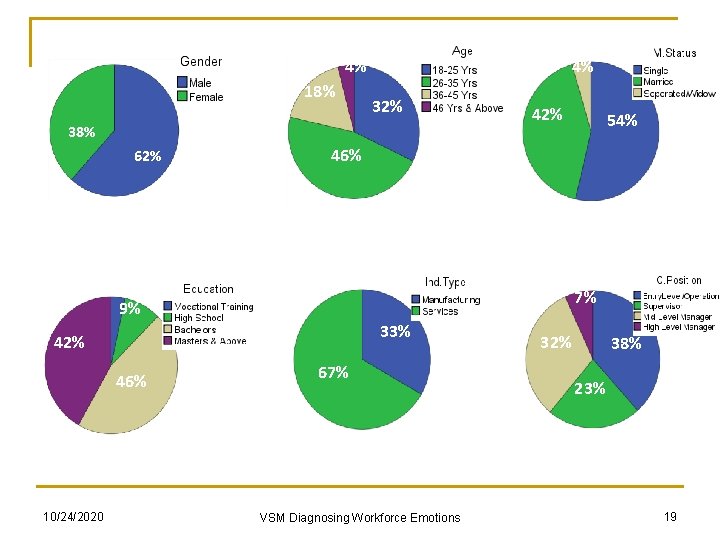
4% 4% 18% 32% 38% 62% 46% 3. 39% 7% 9% 33% 42% 46% 45. 76% 10/24/2020 54% 67% VSM Diagnosing Workforce Emotions 32% 38% 23% 19
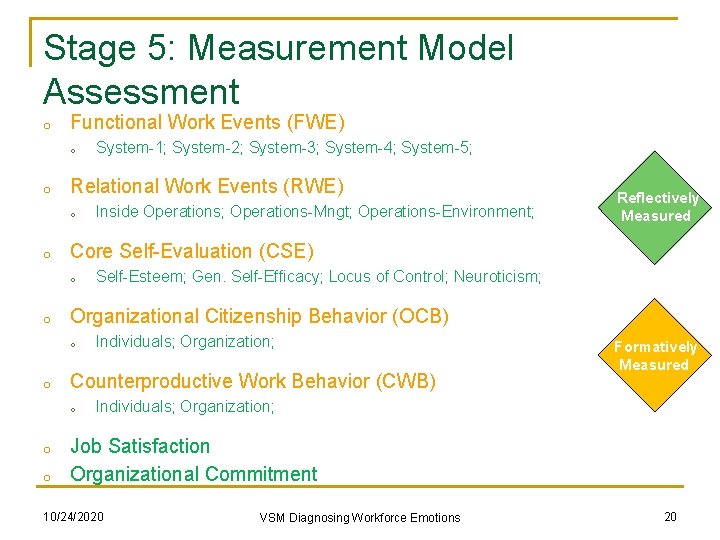
Stage 5: Measurement Model Assessment o Functional Work Events (FWE) o o Relational Work Events (RWE) o o o Individuals; Organization; Counterproductive Work Behavior (CWB) o o Self-Esteem; Gen. Self-Efficacy; Locus of Control; Neuroticism; Organizational Citizenship Behavior (OCB) o o Inside Operations; Operations-Mngt; Operations-Environment; Reflectively Measured Core Self-Evaluation (CSE) o o System-1; System-2; System-3; System-4; System-5; Formatively Measured Individuals; Organization; Job Satisfaction Organizational Commitment 10/24/2020 VSM Diagnosing Workforce Emotions 20
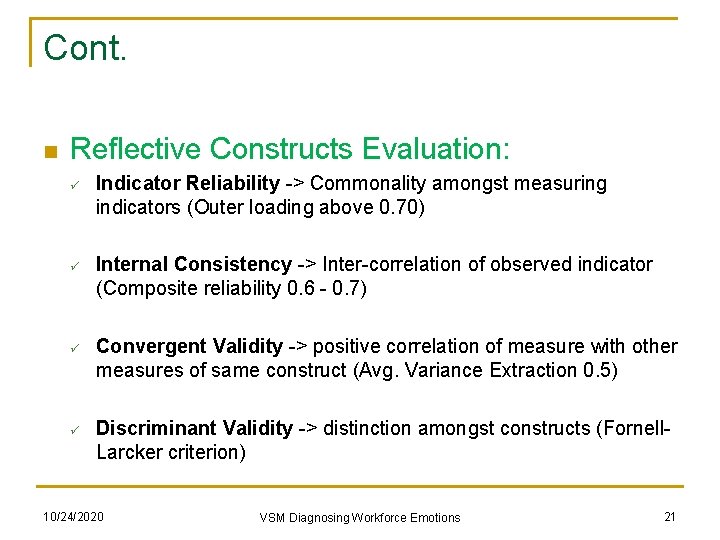
Cont. n Reflective Constructs Evaluation: ü ü Indicator Reliability -> Commonality amongst measuring indicators (Outer loading above 0. 70) Internal Consistency -> Inter-correlation of observed indicator (Composite reliability 0. 6 - 0. 7) Convergent Validity -> positive correlation of measure with other measures of same construct (Avg. Variance Extraction 0. 5) Discriminant Validity -> distinction amongst constructs (Fornell. Larcker criterion) 10/24/2020 VSM Diagnosing Workforce Emotions 21
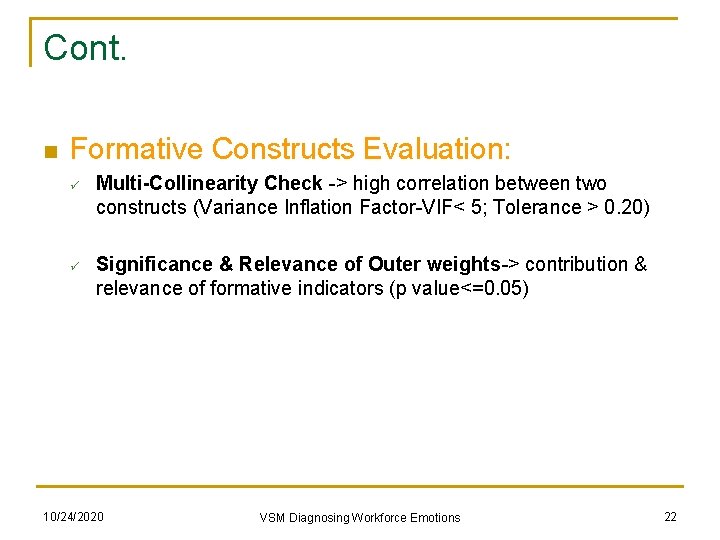
Cont. n Formative Constructs Evaluation: ü ü Multi-Collinearity Check -> high correlation between two constructs (Variance Inflation Factor-VIF< 5; Tolerance > 0. 20) Significance & Relevance of Outer weights-> contribution & relevance of formative indicators (p value<=0. 05) 10/24/2020 VSM Diagnosing Workforce Emotions 22
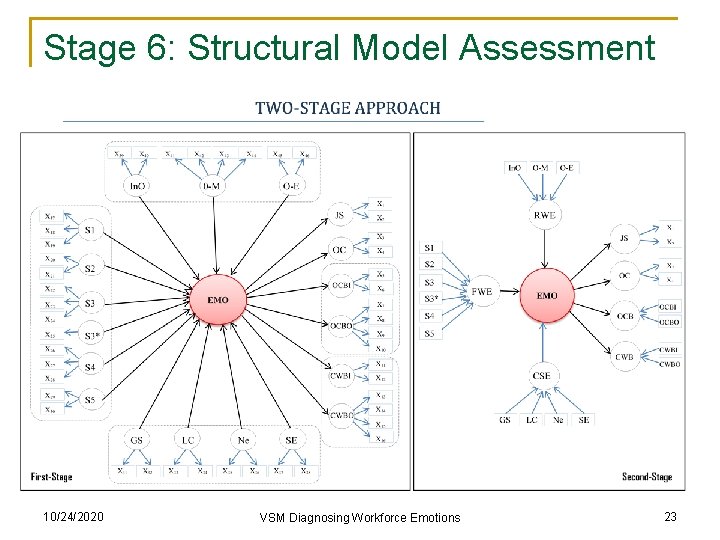
Stage 6: Structural Model Assessment 10/24/2020 VSM Diagnosing Workforce Emotions 23
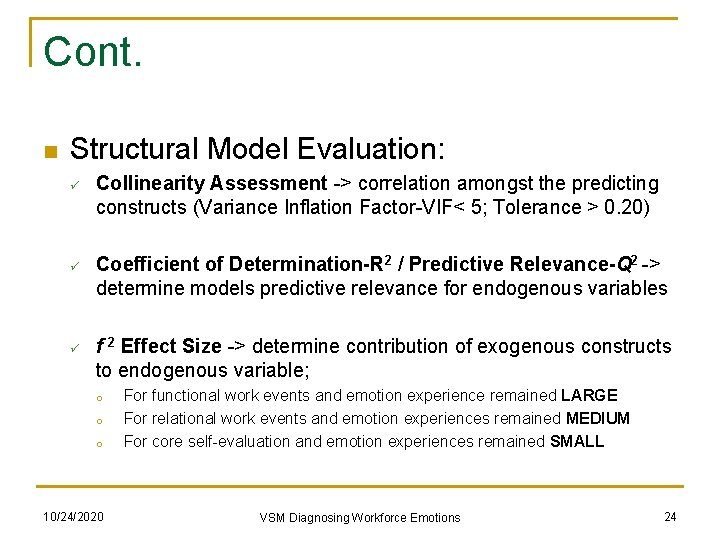
Cont. n Structural Model Evaluation: ü ü ü Collinearity Assessment -> correlation amongst the predicting constructs (Variance Inflation Factor-VIF< 5; Tolerance > 0. 20) Coefficient of Determination-R 2 / Predictive Relevance-Q 2 -> determine models predictive relevance for endogenous variables f 2 Effect Size -> determine contribution of exogenous constructs to endogenous variable; o o o 10/24/2020 For functional work events and emotion experience remained LARGE For relational work events and emotion experiences remained MEDIUM For core self-evaluation and emotion experiences remained SMALL VSM Diagnosing Workforce Emotions 24
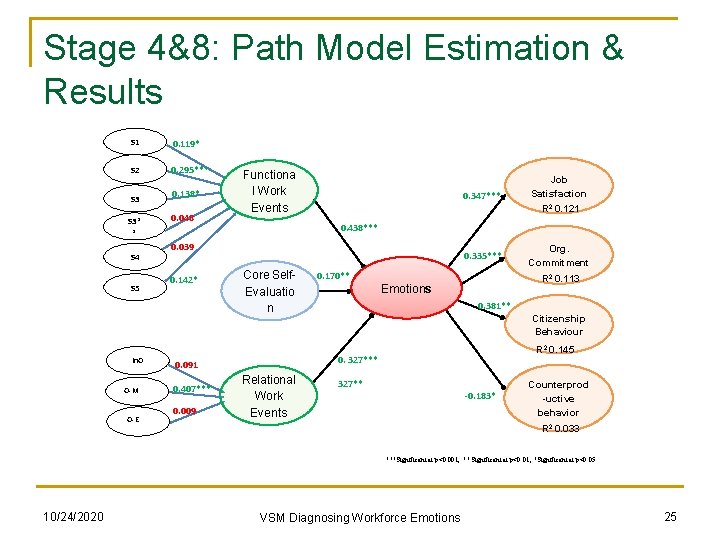
Stage 4&8: Path Model Estimation & Results S 1 0. 119* S 2 0. 295*** S 3* * S 4 S 5 In. O O-M O-E 0. 138* 0. 048 Functiona l Work Events 0. 347*** R 2 0. 121 0. 438*** 0. 039 0. 142* 0. 335*** Core Self. Evaluatio n 0. 009 0. 170** Relational Work Events Org. Commitment R 2 0. 113 Emotions 0. 381** Citizenship Behaviour R 2 0. 145 0. 327*** 0. 091 0. 407*** Job Satisfaction 327** -0. 183* Counterprod -uctive behavior R 2 0. 033 ***Significant at p<0. 001; ** Significant at p<0. 01; *Significant at p<0. 05 10/24/2020 VSM Diagnosing Workforce Emotions 25
Conclusion n The findings determined ü ü ü Validity of HEMM for diagnosing holistically the affective work environment triggering employee’s emotions. Helpful in evaluating the aggregate impact of employee’s felt emotions on his/her subsequent reactions (work attitudes and behaviors). Complementing state-of-art theories on emotions management by offering a better depiction of work environment and its related aspects useful for comprehending workforce emotions. 10/24/2020 VSM Diagnosing Workforce Emotions 26
Future Directions n Utilize the recursivity principle of VSM to explore the implications of workforce emotions at different levels (individual, dyad, group and system level) within the organization. n Utilize laws of requisite variety to investigate how emotions act as attenuators or amplifiers of the desired behaviors - useful for job design conducive of better performance and overall positive climate. 10/24/2020 VSM Diagnosing Workforce Emotions 27
Thank You Dr. Iffat Sabir Chaudhry Email: iffat. sabir@asu. edu. om Assistant Professor, College of Business Admin. , A’Sharqiyah University, Ibra 400, Oman 10/24/2020 VSM Diagnosing Workforce Emotions 28