
Using visual sources to develop analyticalthinking a 3




- Slides: 30
Using visual sources to develop analyticalthinking: a 3 -stage method with an image
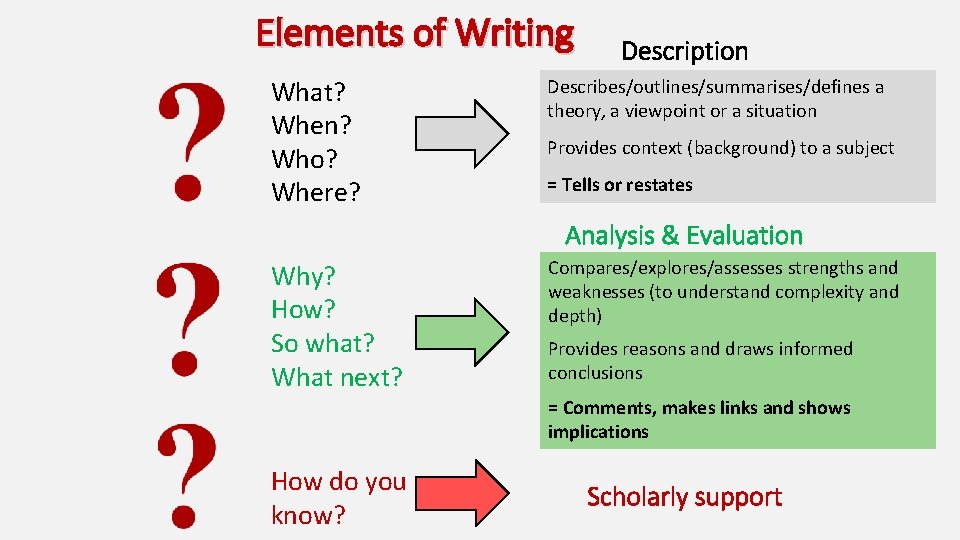
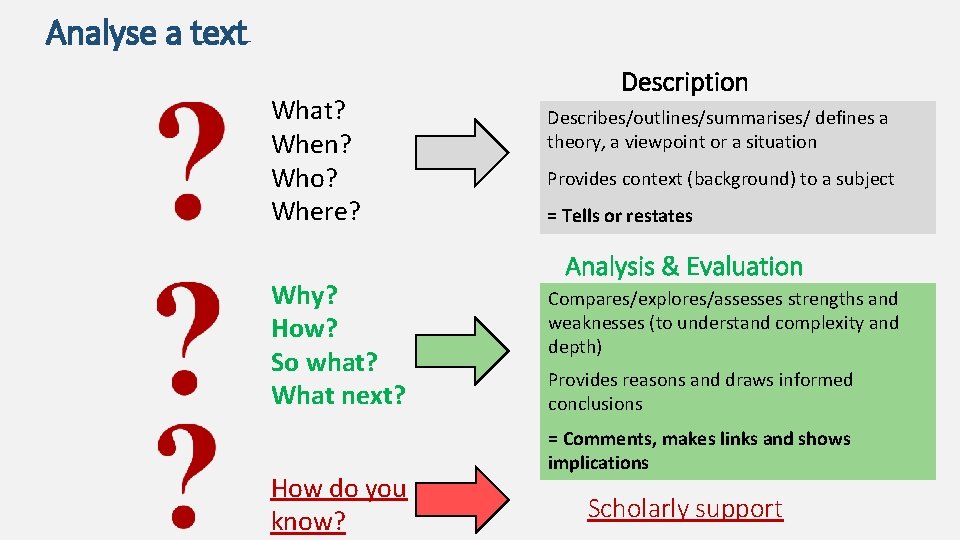
Elements of Writing What? When? Who? Where? Description Describes/outlines/summarises/defines a theory, a viewpoint or a situation Provides context (background) to a subject = Tells or restates Analysis & Evaluation Why? How? So what? What next? Compares/explores/assesses strengths and weaknesses (to understand complexity and depth) Provides reasons and draws informed conclusions = Comments, makes links and shows implications How do you know? Scholarly support
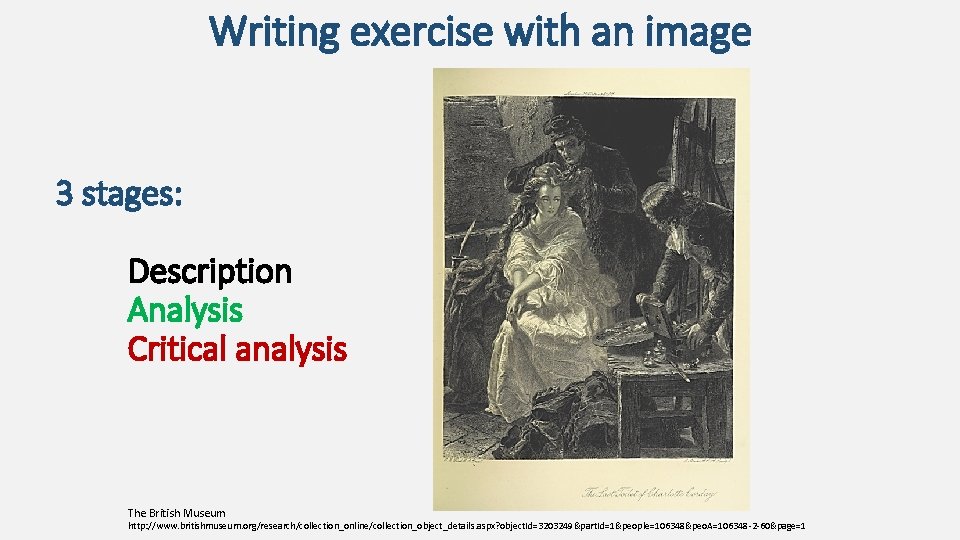
Writing exercise with an image 3 stages: Description Analysis Critical analysis The British Museum http: //www. britishmuseum. org/research/collection_online/collection_object_details. aspx? object. Id=3203249&part. Id=1&people=106348&peo. A=106348 -2 -60&page=1
Writing exercise with an image 1. Work in pairs or small groups. 2. Brainstorm ideas and jot them down (sentences, bullet points, key words). Stage 1 Stage 2 Stage 3
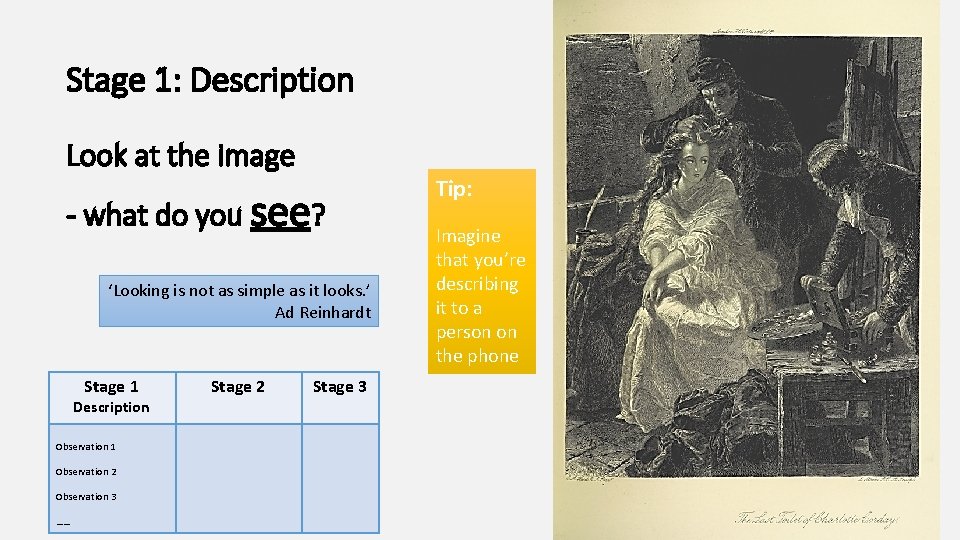
Stage 1: Description Look at the image - what do you see? ‘Looking is not as simple as it looks. ’ Ad Reinhardt Stage 1 Description Observation 1 Observation 2 Observation 3 …… Stage 2 Stage 3 Tip: Imagine that you’re describing it to a person on the phone
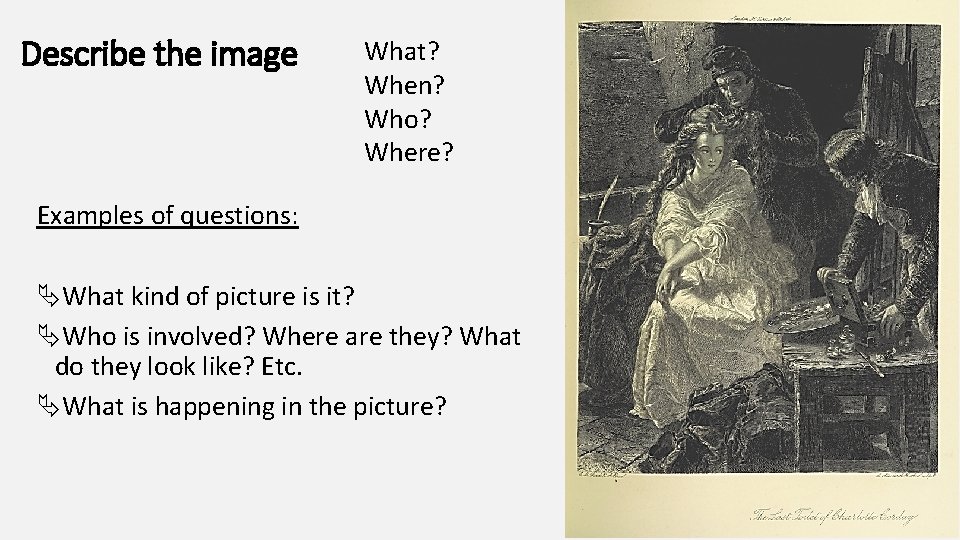
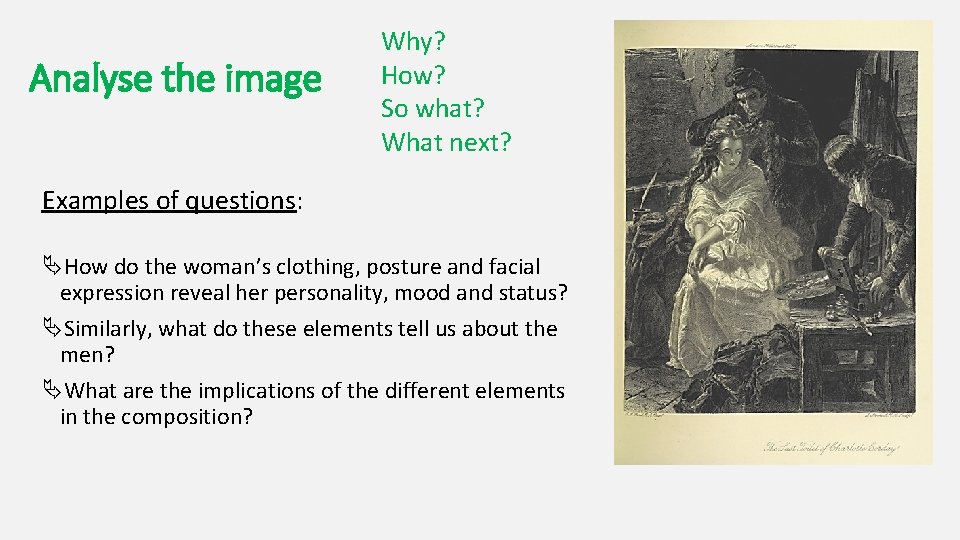
Describe the image What? When? Who? Where? Examples of questions: ÄWhat kind of picture is it? ÄWho is involved? Where are they? What do they look like? Etc. ÄWhat is happening in the picture?
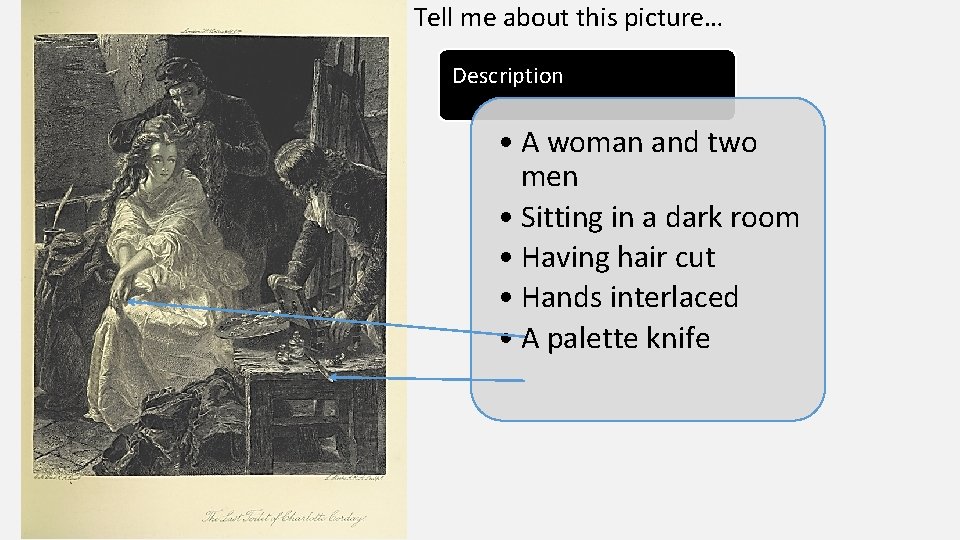
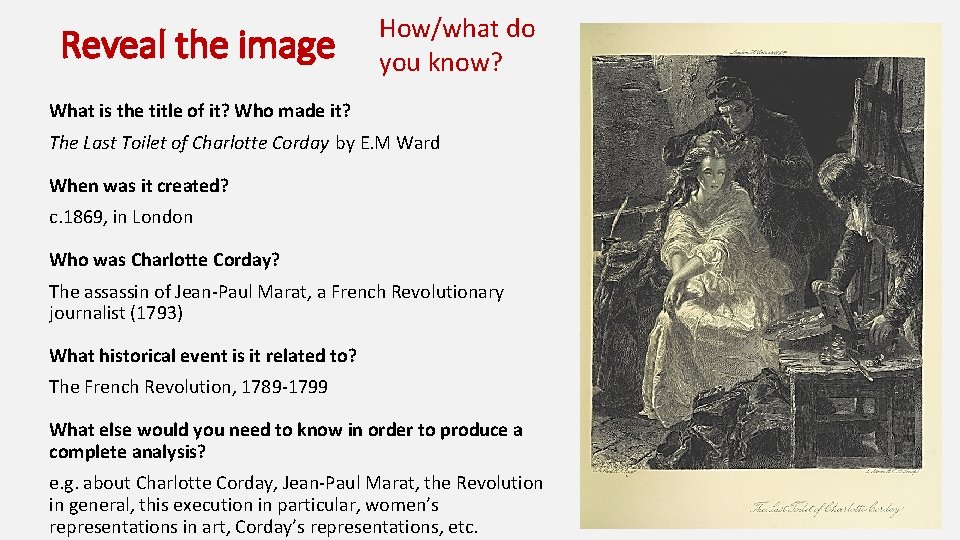
Tell me about this picture… Description • A woman and two men • Sitting in a dark room • Having hair cut • Hands interlaced • A palette knife
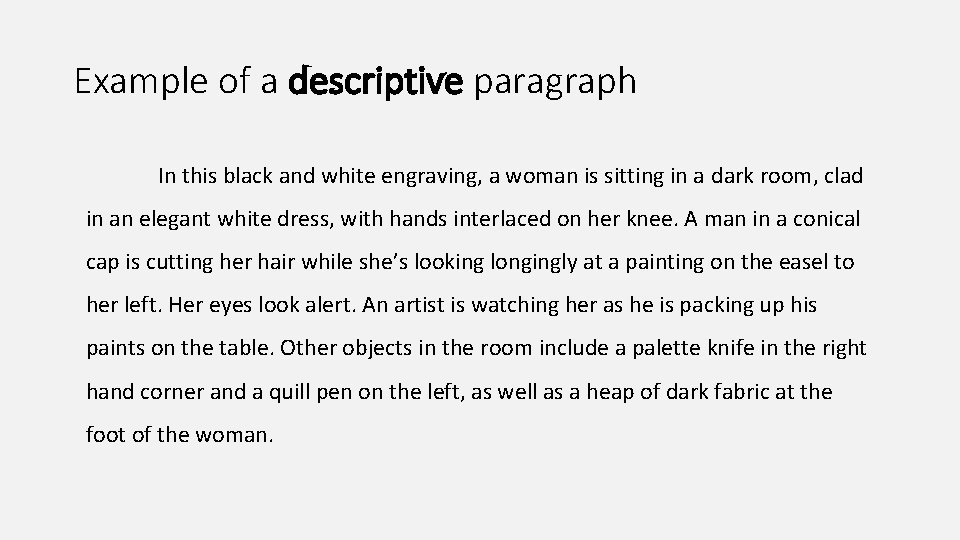
Example of a descriptive paragraph In this black and white engraving, a woman is sitting in a dark room, clad in an elegant white dress, with hands interlaced on her knee. A man in a conical cap is cutting her hair while she’s looking longingly at a painting on the easel to her left. Her eyes look alert. An artist is watching her as he is packing up his paints on the table. Other objects in the room include a palette knife in the right hand corner and a quill pen on the left, as well as a heap of dark fabric at the foot of the woman.
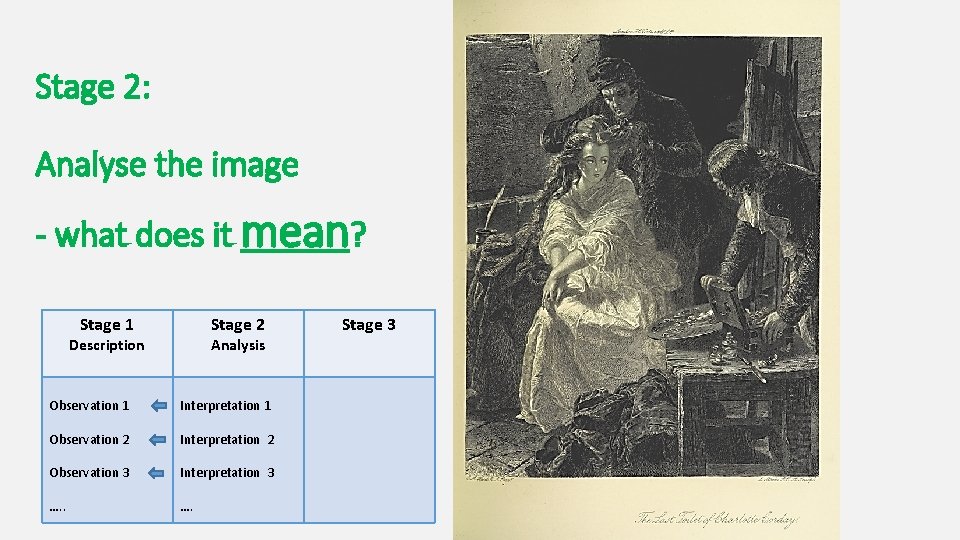
Stage 2: Analyse the image - what does it mean? Stage 1 Stage 2 Description Analysis Observation 1 Interpretation 1 Observation 2 Interpretation 2 Observation 3 Interpretation 3 …. Stage 3
Analyse the image Why? How? So what? What next? Examples of questions: ÄHow do the woman’s clothing, posture and facial expression reveal her personality, mood and status? ÄSimilarly, what do these elements tell us about the men? ÄWhat are the implications of the different elements in the composition?
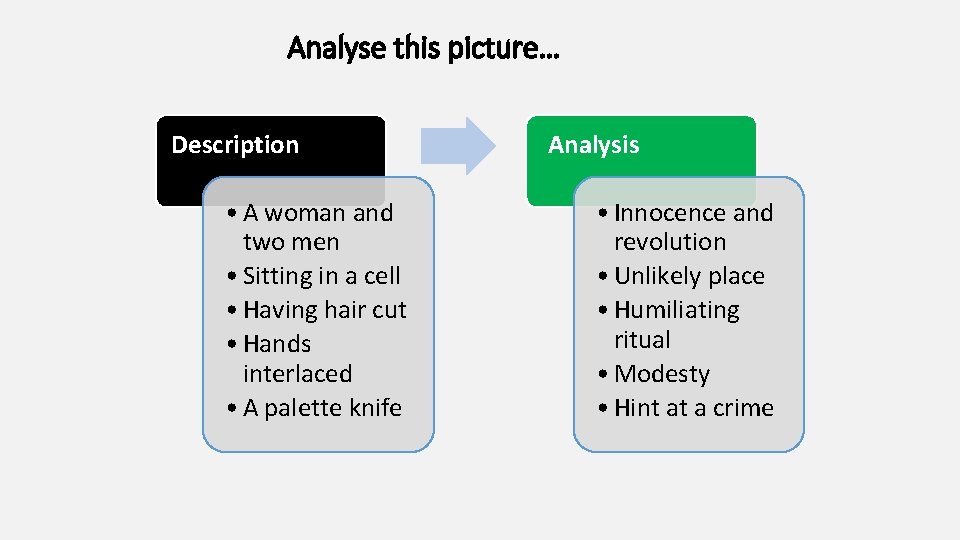
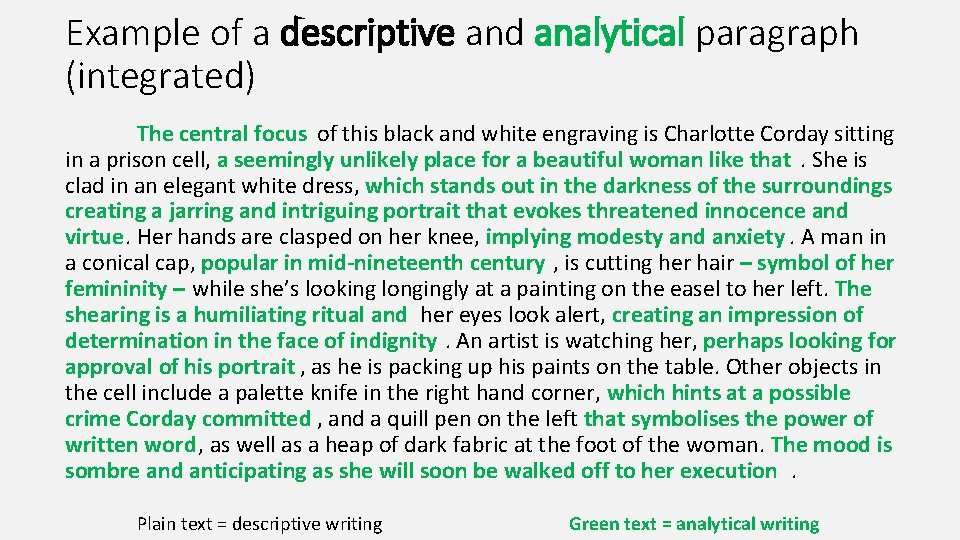
Analyse this picture… Description • A woman and two men • Sitting in a cell • Having hair cut • Hands interlaced • A palette knife Analysis • Innocence and revolution • Unlikely place • Humiliating ritual • Modesty • Hint at a crime
Example of a descriptive and analytical paragraph (integrated) The central focus of this black and white engraving is Charlotte Corday sitting in a prison cell, a seemingly unlikely place for a beautiful woman like that. She is clad in an elegant white dress, which stands out in the darkness of the surroundings creating a jarring and intriguing portrait that evokes threatened innocence and virtue. Her hands are clasped on her knee, implying modesty and anxiety. A man in a conical cap, popular in mid-nineteenth century , is cutting her hair – symbol of her femininity – while she’s looking longingly at a painting on the easel to her left. The shearing is a humiliating ritual and her eyes look alert, creating an impression of determination in the face of indignity. An artist is watching her, perhaps looking for approval of his portrait , as he is packing up his paints on the table. Other objects in the cell include a palette knife in the right hand corner, which hints at a possible crime Corday committed , and a quill pen on the left that symbolises the power of written word, as well as a heap of dark fabric at the foot of the woman. The mood is sombre and anticipating as she will soon be walked off to her execution. Plain text = descriptive writing Green text = analytical writing
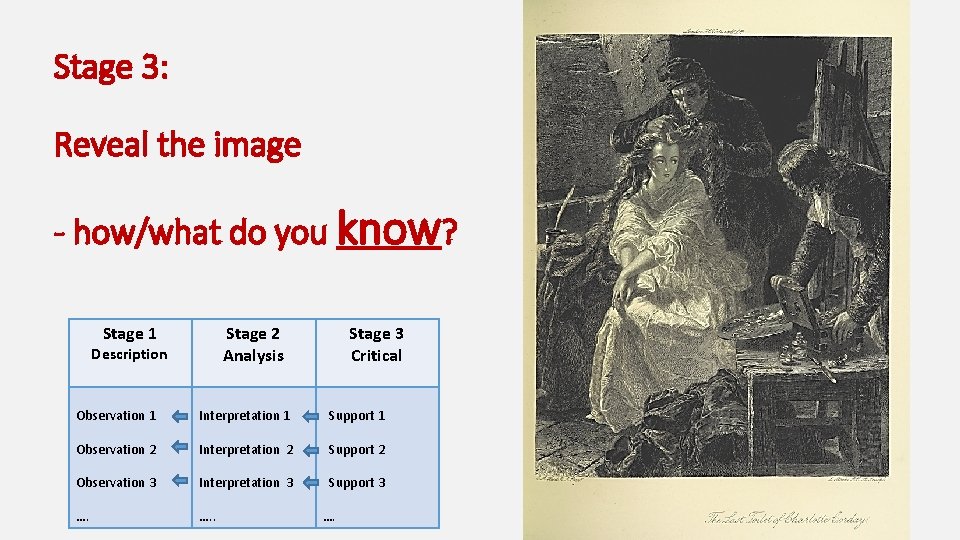
Stage 3: Reveal the image - how/what do you know? Stage 1 Stage 2 Analysis Description Stage 3 Critical Observation 1 Interpretation 1 Support 1 Observation 2 Interpretation 2 Support 2 Observation 3 Interpretation 3 Support 3 ….
Reveal the image How/what do you know? What is the title of it? Who made it? The Last Toilet of Charlotte Corday by E. M Ward When was it created? c. 1869, in London Who was Charlotte Corday? The assassin of Jean-Paul Marat, a French Revolutionary journalist (1793) What historical event is it related to? The French Revolution, 1789 -1799 What else would you need to know in order to produce a complete analysis? e. g. about Charlotte Corday, Jean-Paul Marat, the Revolution in general, this execution in particular, women’s representations in art, Corday’s representations, etc.
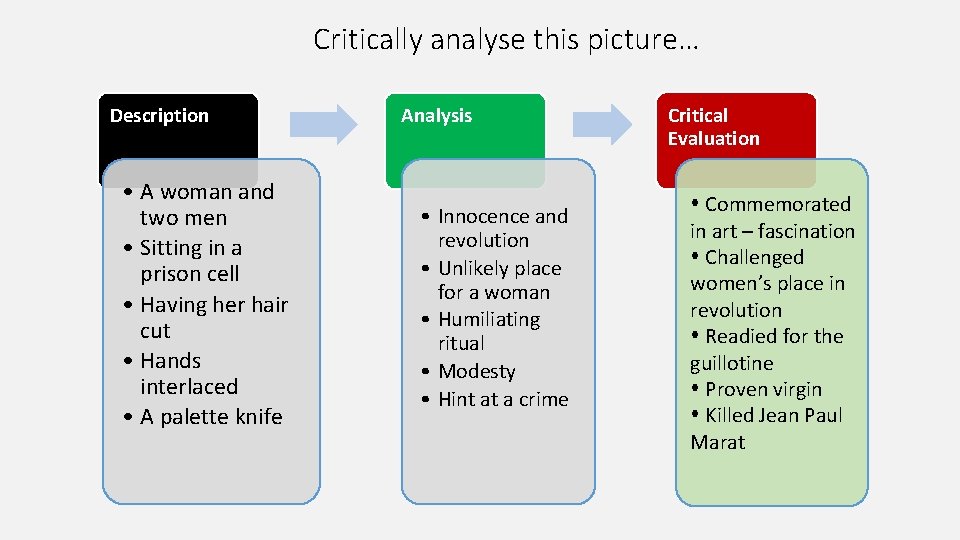
Critically analyse this picture… Description • A woman and two men • Sitting in a prison cell • Having her hair cut • Hands interlaced • A palette knife Analysis • Innocence and revolution • Unlikely place for a woman • Humiliating ritual • Modesty • Hint at a crime Critical Evaluation Commemorated in art – fascination Challenged women’s place in revolution Readied for the guillotine Proven virgin Killed Jean Paul Marat
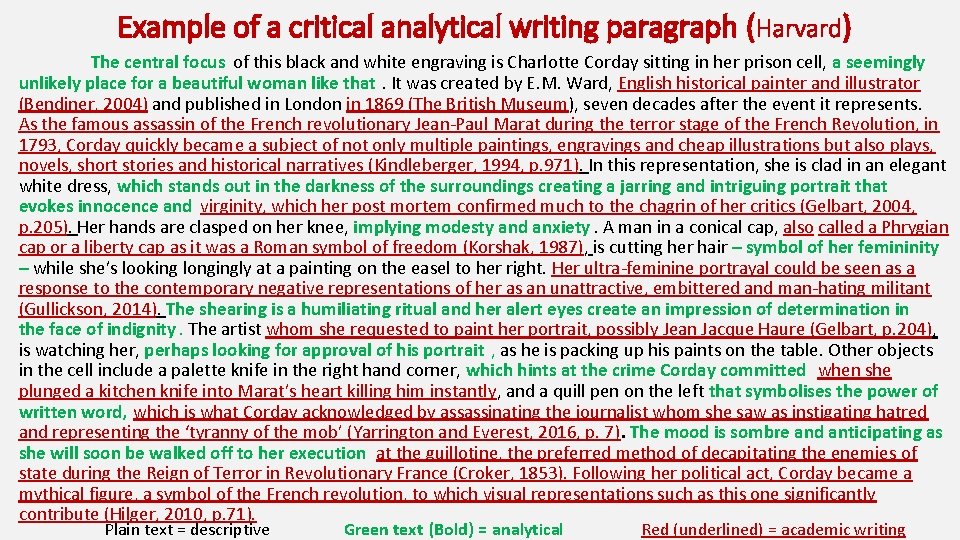
Example of a critical analytical writing paragraph (Harvard) The central focus of this black and white engraving is Charlotte Corday sitting in her prison cell, a seemingly unlikely place for a beautiful woman like that. It was created by E. M. Ward, English historical painter and illustrator (Bendiner, 2004) and published in London in 1869 (The British Museum), seven decades after the event it represents. As the famous assassin of the French revolutionary Jean-Paul Marat during the terror stage of the French Revolution, in 1793, Corday quickly became a subject of not only multiple paintings, engravings and cheap illustrations but also plays, novels, short stories and historical narratives (Kindleberger, 1994, p. 971). In this representation, she is clad in an elegant white dress, which stands out in the darkness of the surroundings creating a jarring and intriguing portrait that evokes innocence and virginity, which her post mortem confirmed much to the chagrin of her critics (Gelbart, 2004, p. 205). Her hands are clasped on her knee, implying modesty and anxiety. A man in a conical cap, also called a Phrygian cap or a liberty cap as it was a Roman symbol of freedom (Korshak, 1987), is cutting her hair – symbol of her femininity – while she’s looking longingly at a painting on the easel to her right. Her ultra-feminine portrayal could be seen as a response to the contemporary negative representations of her as an unattractive, embittered and man-hating militant (Gullickson, 2014). The shearing is a humiliating ritual and her alert eyes create an impression of determination in the face of indignity. The artist whom she requested to paint her portrait, possibly Jean Jacque Haure (Gelbart, p. 204), is watching her, perhaps looking for approval of his portrait , as he is packing up his paints on the table. Other objects in the cell include a palette knife in the right hand corner, which hints at the crime Corday committed when she plunged a kitchen knife into Marat’s heart killing him instantly, and a quill pen on the left that symbolises the power of written word, which is what Corday acknowledged by assassinating the journalist whom she saw as instigating hatred and representing the ‘tyranny of the mob’ (Yarrington and Everest, 2016, p. 7). The mood is sombre and anticipating as she will soon be walked off to her execution at the guillotine, the preferred method of decapitating the enemies of state during the Reign of Terror in Revolutionary France (Croker, 1853). Following her political act, Corday became a mythical figure, a symbol of the French revolution, to which visual representations such as this one significantly contribute (Hilger, 2010, p. 71). Plain text = descriptive Green text (Bold) = analytical Red (underlined) = academic writing
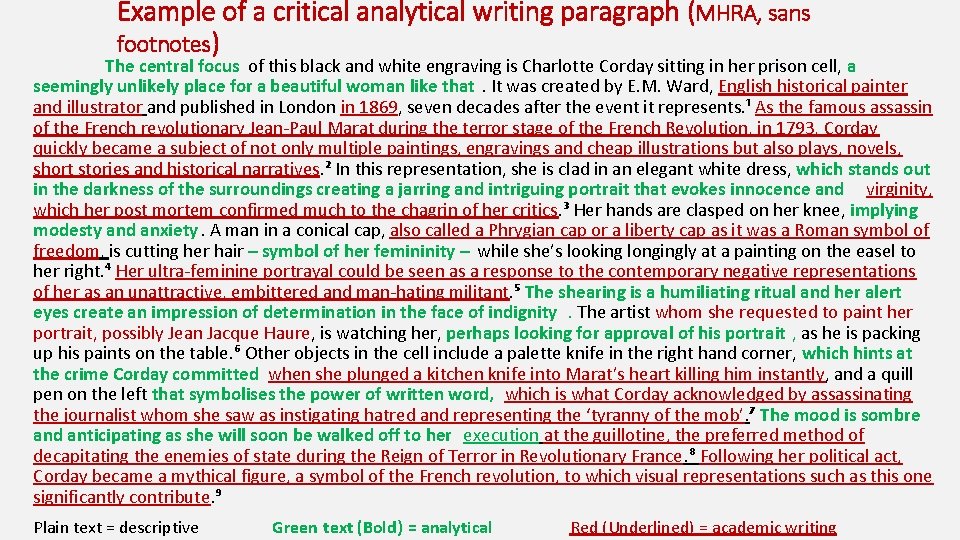
Example of a critical analytical writing paragraph (MHRA, sans footnotes) The central focus of this black and white engraving is Charlotte Corday sitting in her prison cell, a seemingly unlikely place for a beautiful woman like that. It was created by E. M. Ward, English historical painter and illustrator and published in London in 1869, seven decades after the event it represents. ¹ As the famous assassin of the French revolutionary Jean-Paul Marat during the terror stage of the French Revolution, in 1793, Corday quickly became a subject of not only multiple paintings, engravings and cheap illustrations but also plays, novels, short stories and historical narratives. ² In this representation, she is clad in an elegant white dress, which stands out in the darkness of the surroundings creating a jarring and intriguing portrait that evokes innocence and virginity, which her post mortem confirmed much to the chagrin of her critics. ³ Her hands are clasped on her knee, implying modesty and anxiety. A man in a conical cap, also called a Phrygian cap or a liberty cap as it was a Roman symbol of freedom, is cutting her hair – symbol of her femininity – while she’s looking longingly at a painting on the easel to her right. ⁴ Her ultra-feminine portrayal could be seen as a response to the contemporary negative representations of her as an unattractive, embittered and man-hating militant. ⁵ The shearing is a humiliating ritual and her alert eyes create an impression of determination in the face of indignity. The artist whom she requested to paint her portrait, possibly Jean Jacque Haure, is watching her, perhaps looking for approval of his portrait , as he is packing up his paints on the table. ⁶ Other objects in the cell include a palette knife in the right hand corner, which hints at the crime Corday committed when she plunged a kitchen knife into Marat’s heart killing him instantly, and a quill pen on the left that symbolises the power of written word, which is what Corday acknowledged by assassinating the journalist whom she saw as instigating hatred and representing the ‘tyranny of the mob’. ⁷ The mood is sombre and anticipating as she will soon be walked off to her execution at the guillotine, the preferred method of decapitating the enemies of state during the Reign of Terror in Revolutionary France. ⁸ Following her political act, Corday became a mythical figure, a symbol of the French revolution, to which visual representations such as this one significantly contribute. ⁹ Plain text = descriptive Green text (Bold) = analytical Red (Underlined) = academic writing
Reference List (Harvard) Bendiner, K. (2004) ‘Ward, Edward Matthew (1816– 1879)’. Oxford Dictionary of National Biography. Oxford University Press. Available at http: //www. oxforddnb. com/view/article/28683 (Accessed: 1 June 2016). Croker, J. W. (1853) History of the Guillotine. London: J. Murray. Gelbart, N. R. (2004) ‘The Blonding of Charlotte Corday’. Eighteenth-century studies 38. 1, pp. 201 -221. Gullickson, G. L. (2014) ‘Militant Women: representations of Charlotte Corday, Louise Michel and Emmeline Pankhurst’. Women’s History Review 23. 6, pp. 837 -852. Hilger, S. (2010) ‘The Murderess on Stage: Christine Westphalen’s Charlotte Corday (1804)’. In: Bielby, C. and Richards, A. , eds. , Women and Death 3: Women's Representations of Death in German Culture Since 1500. New York: Camden House. Kindleberger, E. R. (1994) ‘Charlotte Corday in text and image: A case study in the French Revolution and women's history’. French Historical Studies , pp. 969 -999. Korshak, Y. (1987) ‘The Liberty cap as a revolutionary symbol in America and France’. Smithsonian Studies in American Art 1. 2, pp. 53 -69. Ward, E. M. (1869) ‘The Last Toilet of Charlotte Corday’ [engraving]. London. British Museum Collection Online. Available at http: //www. britishmuseum. org/research/collection_online/collection_object_details. aspx (Accessed: 1 June 2016). Yarrington, A. and Everest, K. eds. (1993) Reflections of Revolution: Images of Romanticism. London and New York: Routledge.
Bibliography (MHRA) Bendiner, K. , ‘Ward, Edward Matthew (1816– 1879)’, Oxford Dictionary of National Biography (Oxford University Press: 2004), available at http: //www. oxforddnb. com/view/article/28683 (Accessed: 1 June 2016) Croker, J. W. , History of the Guillotine (London: J. Murray, 1853) Gelbart, N. R. , ‘The Blonding of Charlotte Corday’, Eighteenth-century studies 38. 1 (2004), pp. 201 -221 Gullickson, G. L. , ‘Militant Women: representations of Charlotte Corday, Louise Michel and Emmeline Pankhurst’, Women’s History Review 23. 6 (2014), pp. 837 -852 Hilger, S. , ‘The Murderess on Stage: Christine Westphalen’s Charlotte Corday (1804)’, in: Bielby, C. and Richards, A. , (eds. ), Women and Death 3: Women's Representations of Death in German Culture Since 1500 (New York: Camden House, 2010) Kindleberger, E. R. , ‘Charlotte Corday in text and image: A case study in the French Revolution and women's history’, French Historical Studies (1994), pp. 969 -999 Korshak, Y. , ‘The Liberty cap as a revolutionary symbol in America and France’, Smithsonian Studies in American Art 1. 2 (1987), pp. 53 -69 Ward, E. M. , ‘The Last Toilet of Charlotte Corday’ (1869), London, British Museum Collection Online, available at http: //www. britishmuseum. org/research/collection_online/collection_object_details. aspx (Accessed: 1 June 2016) Yarrington, A. , and K. Everest, (eds. ) Reflections of Revolution: Images of Romanticism (London and New York: Routledge, 1993)
The central focus of this black and white engraving is Charlotte Corday sitting in her prison cell, a seemingly unlikely place for a beautiful woman like that. It was created by E. M. Ward, English historical painter and illustrator (Bendiner, 2004) and published in London in 1869 (The British Museum ), seven decades after the event it represents. As the famous assassin of the French revolutionary Jean-Paul Marat during the terror stage of the French Revolution, in 1793, Corday quickly became a subject of not only multiple paintings, engravings and cheap illustrations but also plays, novels, short stories and historical narratives (Kindleberger, 1994, p. 971). In this representation, she is clad in an elegant white dress, which stands out in the darkness of the surroundings creating a jarring and intriguing portrait that evokes innocence and virginity, which her post mortem confirmed much to the chagrin of her critics (Gelbart, 2004, p. 205). Her hands are clasped on her knee, implying modesty and anxiety. A man in a conical cap, also called a Phrygian cap or a liberty cap as it was a Roman symbol of freedom (Korshak, 1987), is cutting her hair – symbol of her femininity – while she’s looking longingly at a painting on the easel to her right. Her ultra-feminine portrayal could be seen as a response to the contemporary negative representations of her as an unattractive, embittered and man-hating militant (Gullickson, 2014). The shearing is a humiliating ritual and her alert eyes create an impression of determination in the face of indignity. The artist whom she requested to paint her portrait, possibly Jean Jacque Haure (Gelbart, p. 204) , is watching her, perhaps looking for approval of his portrait, as he is packing up his paints on the table. Other objects in the cell include a palette knife in the right hand corner, which hints at the crime Corday committed when she plunged a kitchen knife into Marat’s heart killing him instantly, and a quill pen on the left that symbolises the power of written word, which is what Corday acknowledged by assassinating the journalist whom she saw as instigating hatred and representing the ‘tyranny of the mob’ (Yarrington and Everest, 2016, p. 7). The mood is sombre and anticipating as she will soon be walked off to her execution at the guillotine, the preferred method of decapitating the enemies of state during the Reign of Terror in Revolutionary France (Croker, 1853). Following her political act, Corday became a mythical figure, a symbol of the French revolution, to which visual representations such as this one significantly contribute (Hilger, 2010, p. 71). Th i is O s. N u t c u r t Ts ! d re
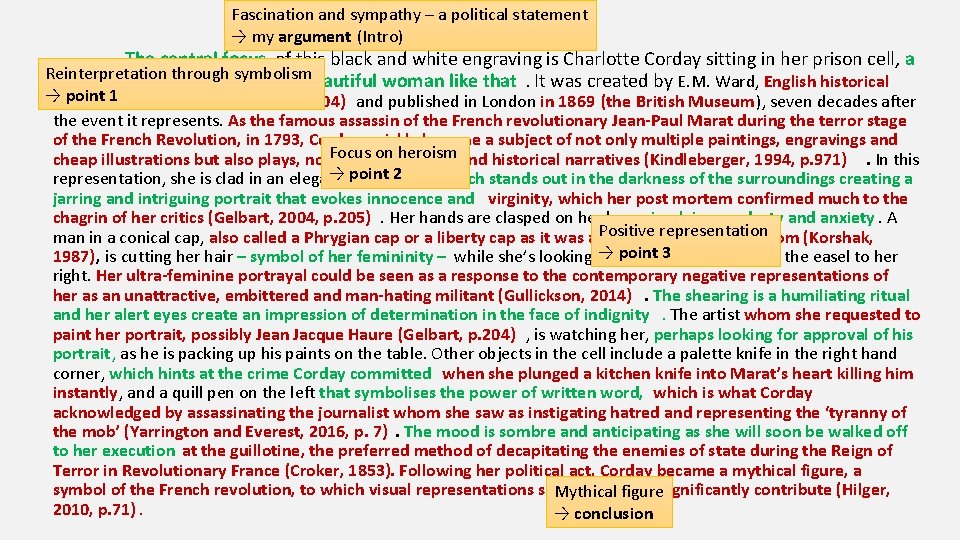
Fascination and sympathy – a political statement → my argument (Intro) The central focus of this black and white engraving is Charlotte Corday sitting in her prison cell, a Reinterpretation through symbolism seemingly unlikely place for a beautiful woman like that. It was created by E. M. Ward, English historical → point 1 and illustrator (Bendiner, 2004) and published in London in 1869 (the British Museum ), seven decades after painter the event it represents. As the famous assassin of the French revolutionary Jean-Paul Marat during the terror stage of the French Revolution, in 1793, Corday quickly became a subject of not only multiple paintings, engravings and Focusshort on heroism cheap illustrations but also plays, novels, stories and historical narratives (Kindleberger, 1994, p. 971). In this → point 2 representation, she is clad in an elegant white dress, which stands out in the darkness of the surroundings creating a jarring and intriguing portrait that evokes innocence and virginity, which her post mortem confirmed much to the chagrin of her critics (Gelbart, 2004, p. 205). Her hands are clasped on her knee, implying modesty and anxiety. A representation man in a conical cap, also called a Phrygian cap or a liberty cap as it was a Positive Roman symbol of freedom (Korshak, → point 3 at a painting on the easel to her 1987), is cutting her hair – symbol of her femininity – while she’s looking longingly right. Her ultra-feminine portrayal could be seen as a response to the contemporary negative representations of her as an unattractive, embittered and man-hating militant (Gullickson, 2014). The shearing is a humiliating ritual and her alert eyes create an impression of determination in the face of indignity. The artist whom she requested to paint her portrait, possibly Jean Jacque Haure (Gelbart, p. 204) , is watching her, perhaps looking for approval of his portrait, as he is packing up his paints on the table. Other objects in the cell include a palette knife in the right hand corner, which hints at the crime Corday committed when she plunged a kitchen knife into Marat’s heart killing him instantly, and a quill pen on the left that symbolises the power of written word, which is what Corday acknowledged by assassinating the journalist whom she saw as instigating hatred and representing the ‘tyranny of the mob’ (Yarrington and Everest, 2016, p. 7). The mood is sombre and anticipating as she will soon be walked off to her execution at the guillotine, the preferred method of decapitating the enemies of state during the Reign of Terror in Revolutionary France (Croker, 1853). Following her political act, Corday became a mythical figure, a symbol of the French revolution, to which visual representations such as thisfigure one significantly contribute (Hilger, Mythical 2010, p. 71). → conclusion
Paragraphs 4. Implications State significance and perhaps link to next paragraph 3. Support Theory and references: Evidence Case study Scholarly support 1. Claim/point N E S First sentence. PIC TOrest of ‘controls’ the paragraph 2. Justification Unpack the controlling statement: Explain Analyse E C N TE
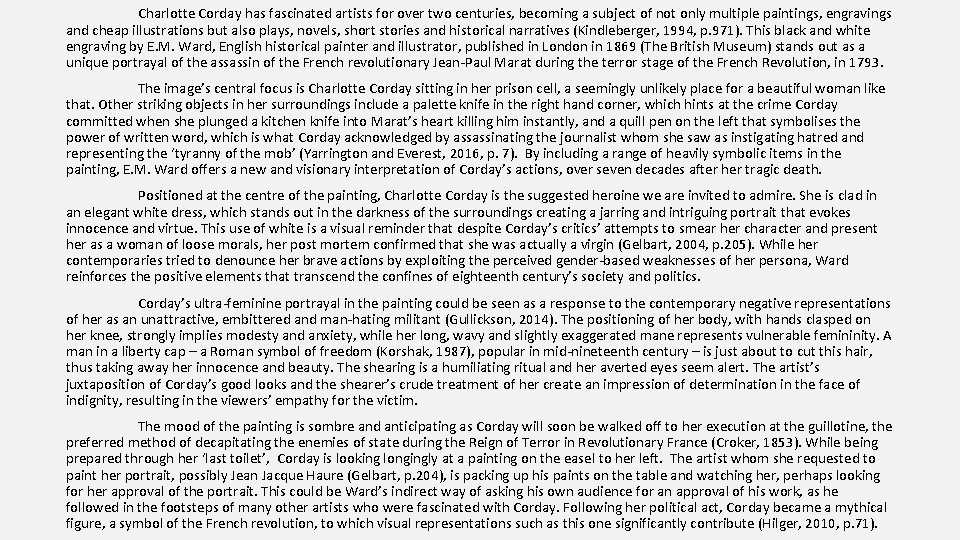
Charlotte Corday has fascinated artists for over two centuries, becoming a subject of not only multiple paintings, engravings and cheap illustrations but also plays, novels, short stories and historical narratives (Kindleberger, 1994, p. 971). This black and white engraving by E. M. Ward, English historical painter and illustrator, published in London in 1869 (The British Museum) stands out as a unique portrayal of the assassin of the French revolutionary Jean-Paul Marat during the terror stage of the French Revolution, in 1793. The image’s central focus is Charlotte Corday sitting in her prison cell, a seemingly unlikely place for a beautiful woman like that. Other striking objects in her surroundings include a palette knife in the right hand corner, which hints at the crime Corday committed when she plunged a kitchen knife into Marat’s heart killing him instantly, and a quill pen on the left that symbolises the power of written word, which is what Corday acknowledged by assassinating the journalist whom she saw as instigating hatred and representing the ‘tyranny of the mob’ (Yarrington and Everest, 2016, p. 7). By including a range of heavily symbolic items in the painting, E. M. Ward offers a new and visionary interpretation of Corday’s actions, over seven decades after her tragic death. Positioned at the centre of the painting, Charlotte Corday is the suggested heroine we are invited to admire. She is clad in an elegant white dress, which stands out in the darkness of the surroundings creating a jarring and intriguing portrait that evokes innocence and virtue. This use of white is a visual reminder that despite Corday’s critics’ attempts to smear her character and present her as a woman of loose morals, her post mortem confirmed that she was actually a virgin (Gelbart, 2004, p. 205). While her contemporaries tried to denounce her brave actions by exploiting the perceived gender-based weaknesses of her persona, Ward reinforces the positive elements that transcend the confines of eighteenth century’s society and politics. Corday’s ultra-feminine portrayal in the painting could be seen as a response to the contemporary negative representations of her as an unattractive, embittered and man-hating militant (Gullickson, 2014). The positioning of her body, with hands clasped on her knee, strongly implies modesty and anxiety, while her long, wavy and slightly exaggerated mane represents vulnerable femininity. A man in a liberty cap – a Roman symbol of freedom (Korshak, 1987), popular in mid-nineteenth century – is just about to cut this hair, thus taking away her innocence and beauty. The shearing is a humiliating ritual and her averted eyes seem alert. The artist’s juxtaposition of Corday’s good looks and the shearer’s crude treatment of her create an impression of determination in the face of indignity, resulting in the viewers’ empathy for the victim. The mood of the painting is sombre and anticipating as Corday will soon be walked off to her execution at the guillotine, the preferred method of decapitating the enemies of state during the Reign of Terror in Revolutionary France (Croker, 1853). While being prepared through her ‘last toilet’, Corday is looking longingly at a painting on the easel to her left. The artist whom she requested to paint her portrait, possibly Jean Jacque Haure (Gelbart, p. 204), is packing up his paints on the table and watching her, perhaps looking for her approval of the portrait. This could be Ward’s indirect way of asking his own audience for an approval of his work, as he followed in the footsteps of many other artists who were fascinated with Corday. Following her political act, Corday became a mythical figure, a symbol of the French revolution, to which visual representations such as this one significantly contribute (Hilger, 2010, p. 71).
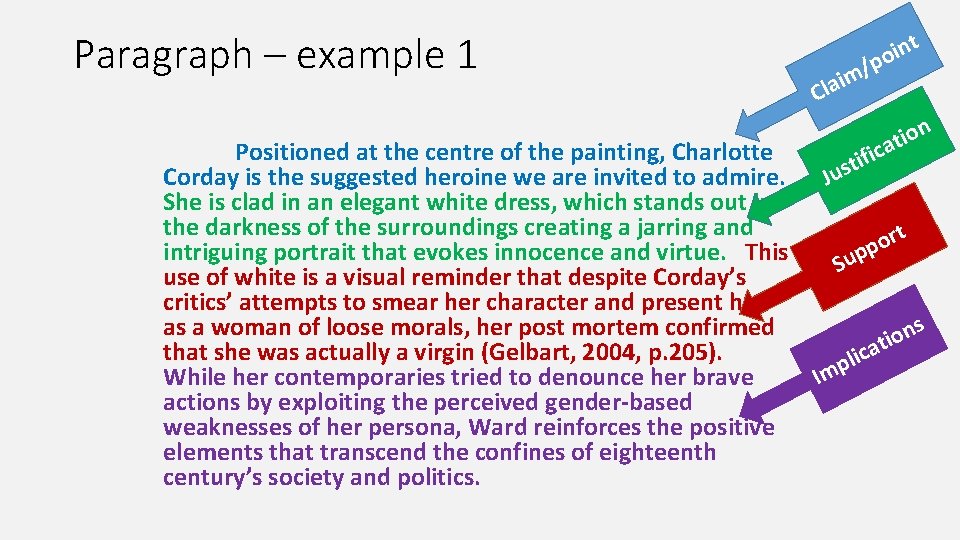
Paragraph – example 1 Positioned at the centre of the painting, Charlotte Corday is the suggested heroine we are invited to admire. She is clad in an elegant white dress, which stands out in the darkness of the surroundings creating a jarring and intriguing portrait that evokes innocence and virtue. This use of white is a visual reminder that despite Corday’s critics’ attempts to smear her character and present her as a woman of loose morals, her post mortem confirmed that she was actually a virgin (Gelbart, 2004, p. 205). While her contemporaries tried to denounce her brave actions by exploiting the perceived gender-based weaknesses of her persona, Ward reinforces the positive elements that transcend the confines of eighteenth century’s society and politics. t n i po / m i Cla i f i t us J n io t a c t r o upp S lic p Im ns o i at
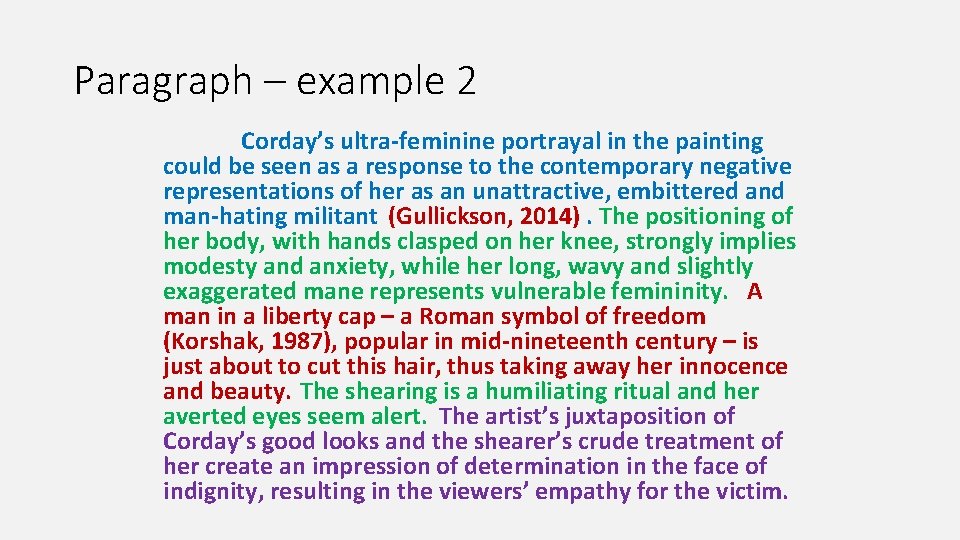
Paragraph – example 2 Corday’s ultra-feminine portrayal in the painting could be seen as a response to the contemporary negative representations of her as an unattractive, embittered and man-hating militant (Gullickson, 2014). The positioning of her body, with hands clasped on her knee, strongly implies modesty and anxiety, while her long, wavy and slightly exaggerated mane represents vulnerable femininity. A man in a liberty cap – a Roman symbol of freedom (Korshak, 1987), popular in mid-nineteenth century – is just about to cut this hair, thus taking away her innocence and beauty. The shearing is a humiliating ritual and her averted eyes seem alert. The artist’s juxtaposition of Corday’s good looks and the shearer’s crude treatment of her create an impression of determination in the face of indignity, resulting in the viewers’ empathy for the victim.
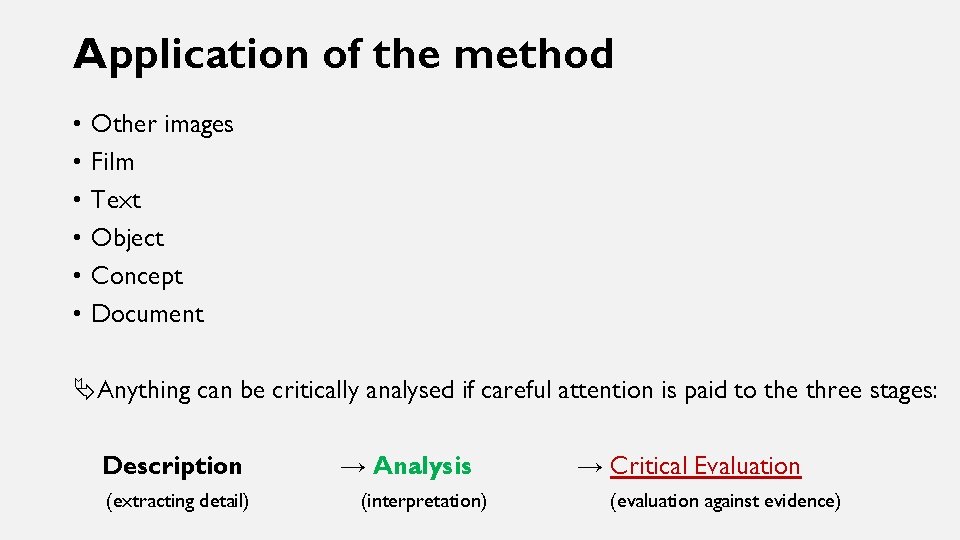
Application of the method • • • Other images Film Text Object Concept Document ÄAnything can be critically analysed if careful attention is paid to the three stages: Description (extracting detail) → Analysis (interpretation) → Critical Evaluation (evaluation against evidence)
Analyse this! Use the 3 stages of critical analysis: What can you see? What does it mean? How does it link to knowledge?
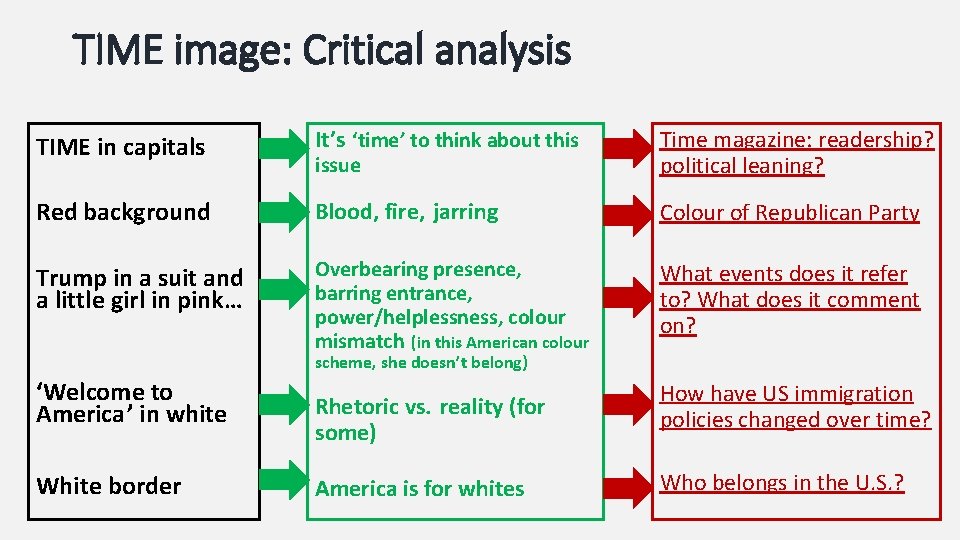
TIME image: Critical analysis TIME in capitals It’s ‘time’ to think about this issue Time magazine: readership? political leaning? Red background Blood, fire, jarring Colour of Republican Party Trump in a suit and a little girl in pink… Overbearing presence, barring entrance, power/helplessness, colour mismatch (in this American colour What events does it refer to? What does it comment on? scheme, she doesn’t belong) ‘Welcome to America’ in white White border Rhetoric vs. reality (for some) America is for whites How have US immigration policies changed over time? Who belongs in the U. S. ?
Analyse a text What? When? Who? Where? Why? How? So what? What next? How do you know? Description Describes/outlines/summarises/ defines a theory, a viewpoint or a situation Provides context (background) to a subject = Tells or restates Analysis & Evaluation Compares/explores/assesses strengths and weaknesses (to understand complexity and depth) Provides reasons and draws informed conclusions = Comments, makes links and shows implications Scholarly support
Thank you