
Using Visual Discovery in the Social Studies Classroom
![Other Questions to Explore O Who took this picture [if known]? O Where was](https://slidetodoc.com/presentation_image/3fc2ca32897903fe0e9bbf68ef7be27d/image-17.jpg "Other Questions to Explore O Who took this picture [if known]? O Where was")
- Slides: 27
Using Visual Discovery in the Social Studies Classroom
The Average U. S. Teenager… O Spends 50 hours a week utilizing media (Kaiser Family Foundation, 2005) O Spends 1. 5 to 4 hours watching TV daily (UNICEF, 2004) O Students of lower socioeconomic status watch the most TV (UNICEF, 2004).
O What positive and negative effects does this massive use of media have on our students? O What implications do these statistics have for social studies teachers?
Social Studies Teachers…. O 92% report that they show all or part of a film at least once a week (Stoddard & Marcus, 2010). O 100% report using film/video at least once a month.
Effective Use of Media Can… O O O O O be used to expose and examine social justice issues (Aitken, Jokisch, & Boone, 2003; Brown, 2011; James, Marin, & Kasssam, 2011; Pimintel, 2010; Russell, 2009; Russell & Waters, 2009; Stoddard & Marcus, 2010) enhance student enjoyment of and feeling of personal connection to the course content (Matz & Pingatore, 2005; Roberts, Dean, & Nienhuis, 2009, Woelders, 2007) help develop historical empathy (Metzger, 2007; Neuhaus, 2010; Stoddard & Marcus, 2010) be a primary source for examining the country or time period in which the film was made (Matz & Pingatore, 2005; Parameswaran, 2010; Stoddard & Marcus, 2010) motivate young people to become more civically active (James et al. , 2011) be particularly helpful when teaching special populations, including lower-level and English language learners (Study of School Uses of Television and Video, 1997) promote cultural understanding between diverse groups (Briam, 2010; Fontaine, 2010 a; White, 2009) help students comprehend the ways in which diverse people view the world (Giroux, 2001) encourage the critical thinking and media literacy skills that are necessary for citizens in a democracy (Brown, 2011; Fontaine, 2010 b; Pimintel, 2010; Russell & Waters, 2009; Stoddard & Marcus, 2010; White, 2009).
O However, to what extent are social studies teachers using visuals effectively? O What positive and/or negative practices have you observed in your own teachers’ use of visuals in the classroom?
Ineffective Use of Media Can… O Be used a rewards for good behavior, as time- fillers, or as an easy activity when substitute teachers are present (Hobbs, 2006) O Teach students to view media as a neutral source of information (Marcus, 2005) O perpetuate negative stereotypes of diverse cultural groups (James et al. , 2011; White, 2009) O “filmic account [can] ‘colonize’ their thinking about the past—taking up residence in the mind as a kind of literal truth” (Metzger, 2007, p. 68).
What is Media Literacy? • Understanding the intentions and motives implanted within the media • Having the skills to access, analyze, evaluate, and create media in a variety of forms • Widespread use of software to manipulate and alter digital images, blurring the lines of reality • Teaching students to think critically and learn to ask the right questions about what they are reading, watching, or hearing in the media. • A crucial skill for effective citizens in a democratic nation
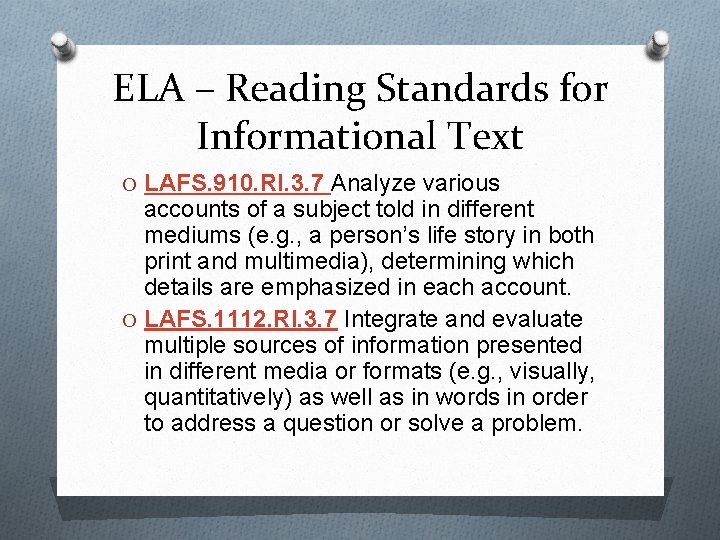
ELA – Reading Standards for Informational Text O LAFS. 910. RI. 3. 7 Analyze various accounts of a subject told in different mediums (e. g. , a person’s life story in both print and multimedia), determining which details are emphasized in each account. O LAFS. 1112. RI. 3. 7 Integrate and evaluate multiple sources of information presented in different media or formats (e. g. , visually, quantitatively) as well as in words in order to address a question or solve a problem.
Using Still Images
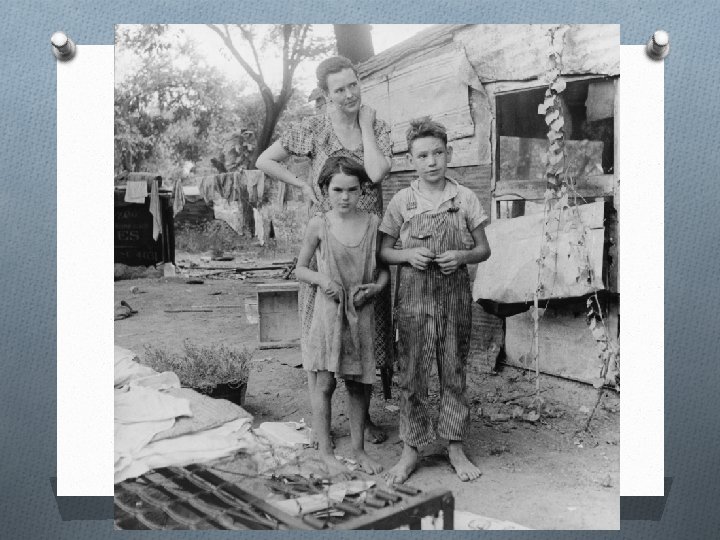
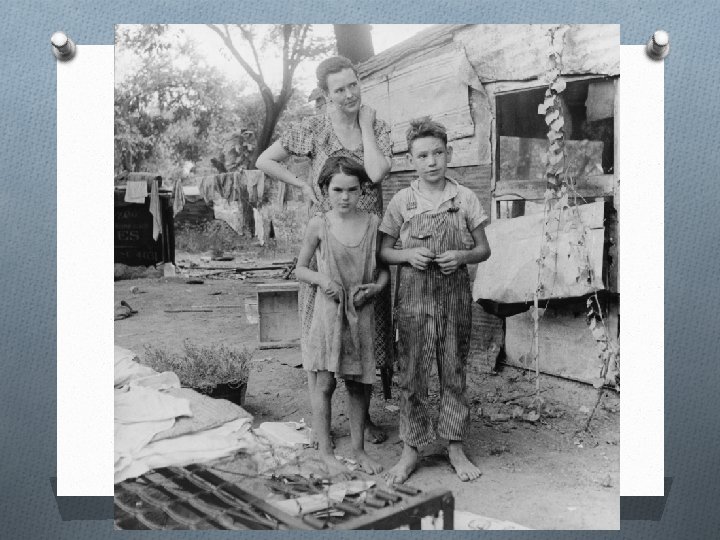
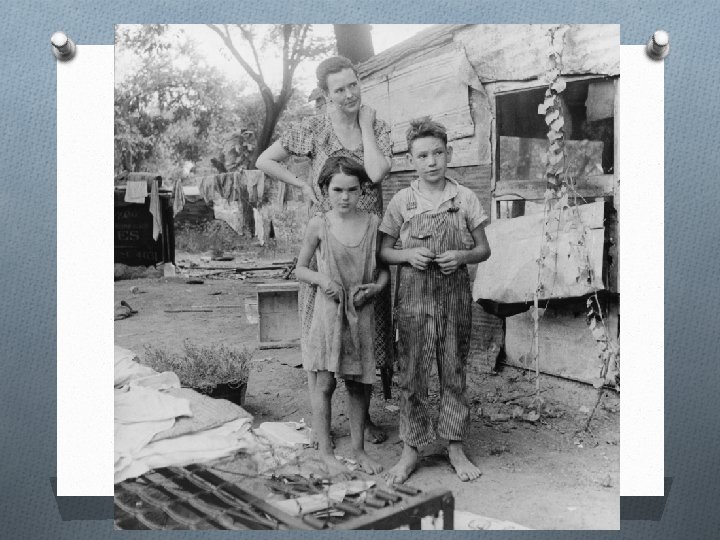
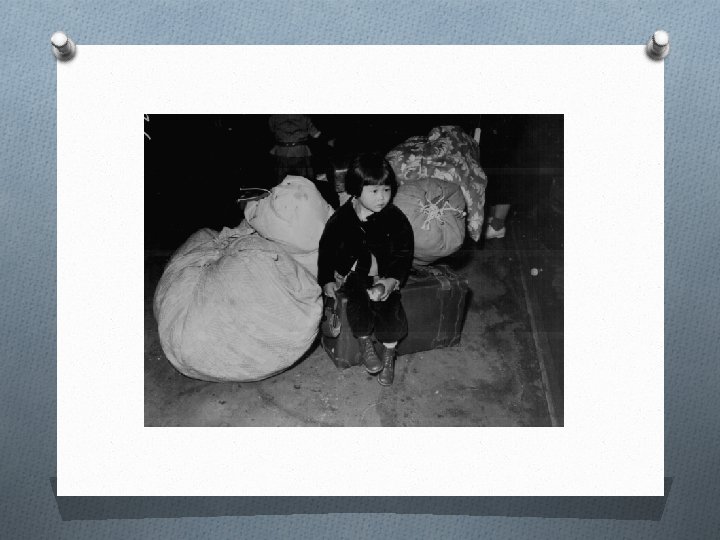
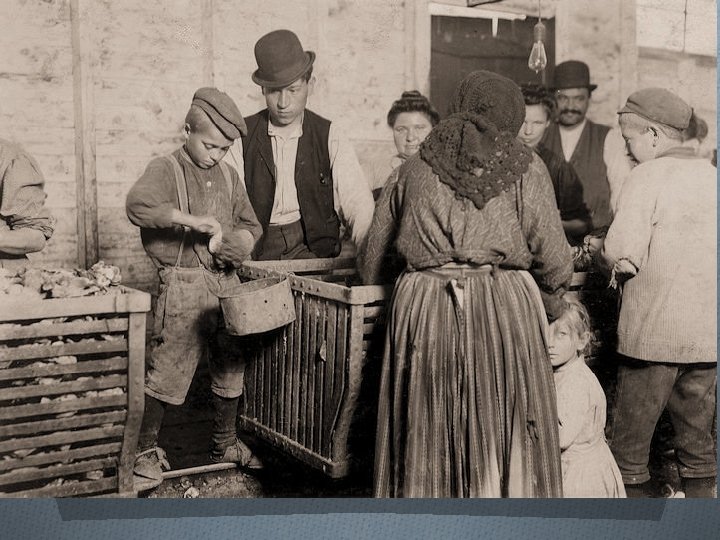
Level I: Gathering Evidence O What do you see in this image? O What are some key details, or pieces of evidence you see? O How would you describe the scene and people? O What do you hear or smell?
Level II: Interpreting Evidence O What do you think is the approximate date of this scene? Give one piece of evidence to support your answer. O Where might this scene have taken place? Give two pieces of evidence to support your answer. O What do you think is happening in this scene? Be prepared to support you opinion with two pieces of evidence.
Level III: Making Hypotheses O How do you think these people were feeling at this time and place? O Why do you think these people are ____ (ex-immigrating to America)?
Other Questions to Explore O Who took this picture [if known]? O Where was it originally used/printed [if known]? O What was the photographers purpose? O What is NOT shown in the photo? O If a similar picture were taken today what would be different?
Using Film
The Russell Model for Using Film: Stage One: The Preparation Stage Required Activities • Develop a lesson plan that incorporates the film while meeting instructional goals and state standards • Adhere to all legal requirements • Preview the film before showing in the classroom • Create specific activities needed for each stage of the model • Obtain permission from administration to show the film • Obtain permission from students’ parents/guardians to show the film • Arrange for any necessary equipment (e. g. DVD player, TV, LCD projector) • Organize the classroom for effective film viewing
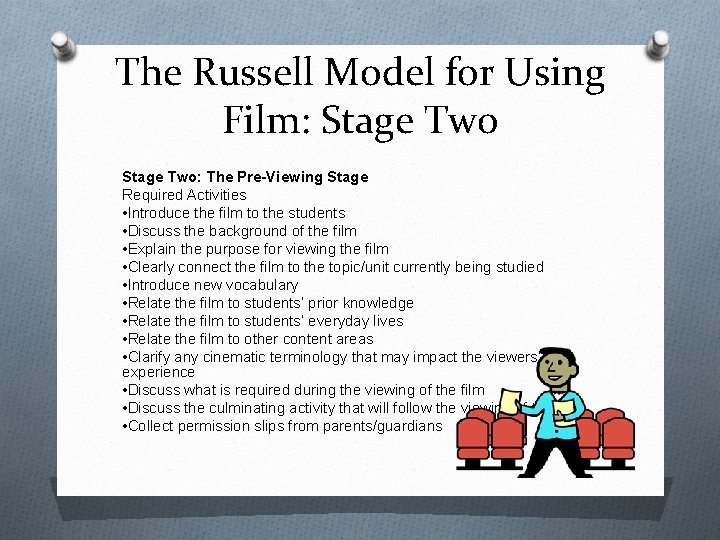
The Russell Model for Using Film: Stage Two: The Pre-Viewing Stage Required Activities • Introduce the film to the students • Discuss the background of the film • Explain the purpose for viewing the film • Clearly connect the film to the topic/unit currently being studied • Introduce new vocabulary • Relate the film to students’ prior knowledge • Relate the film to students’ everyday lives • Relate the film to other content areas • Clarify any cinematic terminology that may impact the viewers’ experience • Discuss what is required during the viewing of the film • Discuss the culminating activity that will follow the viewing of the film • Collect permission slips from parents/guardians
The Russell Model for Using Film: Stage 3 Stage Three: Watching the Film Required Activity • Watch the film Optional Activities • Have students take notes • Complete a guided activity • Answer questions created by the teacher
The Russell Model for Using Film: Stage 4 Stage Four: The Culminating Activity Stage Required Activities • Stop the film • Review, clarify, and/or discuss major points, concepts, issues, scenes, and/or inaccuracies • Assess student learning Optional Assessment Strategies • Class discussion • Class debate • Rewrite the ending of the film • Write a review of the film • Take a test/quiz • Complete a written assignment aligned with the film and topic/unit • Have students reenact a scene from the film • Have students conduct a mock interview with the star, director, and/or producer of the film • Have students analyze and evaluate the film
Movie time! Tōkyō Sonata (2008) O Drama, Rated PG-13, 120 minutes, Color, Language: Japanese with English subtitles O Director: Kiyoshi Kurosawa; Producers: Produced by Wouter Barendrecht, Yuki'e Kitô , Yasushi Kotani, Raymond Phathanavirangoon, and Michael J. Werner; Writers: Kiyoshi Kurosawa, Max Mannix, and Sachiko Tanaka O Cast: Teruyuki Kagawa and Kyōko Koizumi O Tōkyō Sonata tells the story of a Japanese family that disintegrates due to the pressures of the Japanese economic recession of the 1990 s-2000 s. When the father loses his job, he feels he must hide it from his family.
Film Activity O While watching selected film clips… O Look for interactions that exemplify Japanese culture O Consider whether you believe most Americans would handle the situation in the same way O Consider how the use of these clips can inform us of our own or others’ culture.
O Please take out a piece of paper, write your name, and then comment on each of the following points. You will not be graded on your opinion, so feel free to be honest. O 1. What I learned in class today O 2. What I need more clarification on O 3. High point O 4. Low point Please leave your paper on your table. You may leave when you are done. See you next week!