
Using Variable Precision DSP Block and Designing with
Using Variable Precision DSP Block and Designing with Floating Point Technology Roadshow 2011 © 2011 Altera Corporation - Public 1. 1
Agenda n n Variable Precision DSP Architecture in Altera 28 nm FPGA Floating-point Processing with 28 -nm Variable Precision DSP © 2011 Altera Corporation - Public 2
Variable-Precision DSP Architecture © 2011 Altera Corporation - Public
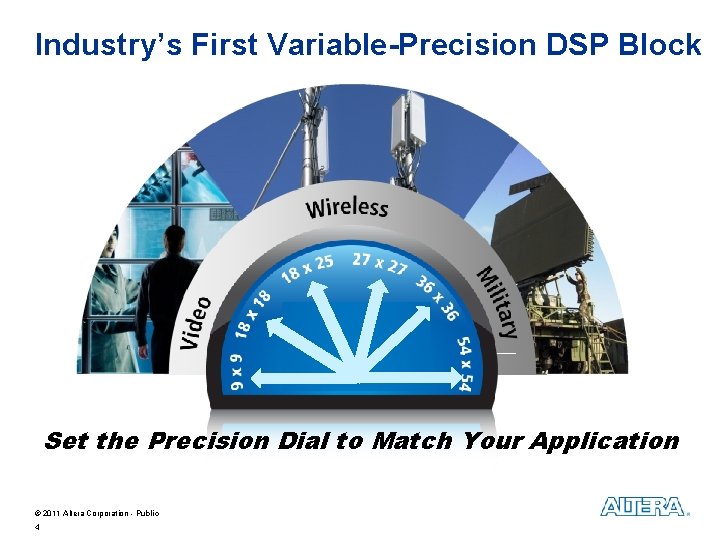
Industry’s First Variable-Precision DSP Block Set the Precision Dial to Match Your Application © 2011 Altera Corporation - Public 4
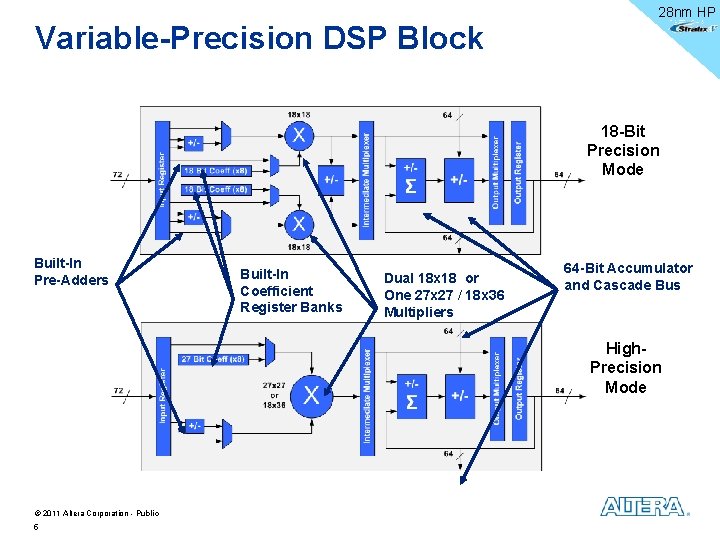
Variable-Precision DSP Block 28 nm HP 18 -Bit Precision Mode Built-In Pre-Adders Built-In Coefficient Register Banks Dual 18 x 18 or One 27 x 27 / 18 x 36 Multipliers 64 -Bit Accumulator and Cascade Bus High. Precision Mode © 2011 Altera Corporation - Public 5
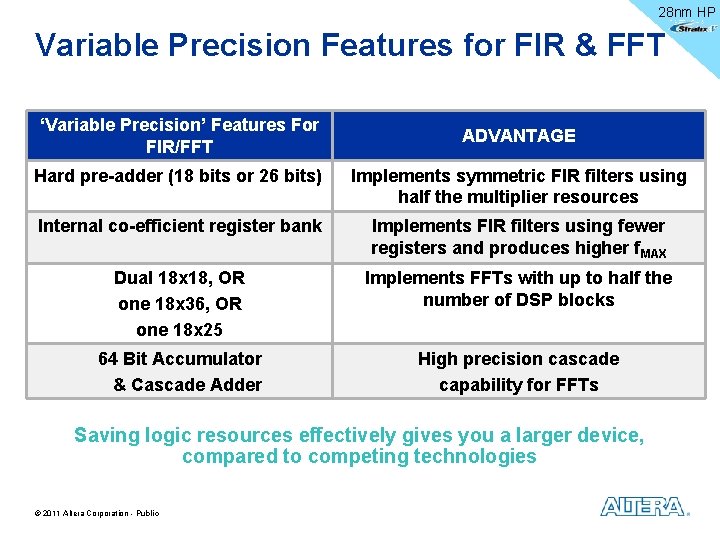
28 nm HP Variable Precision Features for FIR & FFT ‘Variable Precision’ Features For FIR/FFT ADVANTAGE Hard pre-adder (18 bits or 26 bits) Implements symmetric FIR filters using half the multiplier resources Internal co-efficient register bank Implements FIR filters using fewer registers and produces higher f. MAX Dual 18 x 18, OR one 18 x 36, OR one 18 x 25 Implements FFTs with up to half the number of DSP blocks 64 Bit Accumulator & Cascade Adder High precision cascade capability for FFTs Saving logic resources effectively gives you a larger device, compared to competing technologies © 2011 Altera Corporation - Public

28 nm LP Arria-V/Cyclone-V: Variable-Precision DSP Block Enhanced for FIR Implementation 64 -Bit Cascade Path n. Supports systolic finite impulse response (FIR) n. Performs sum-of-products operations Multiplier Modes for Flexibility n. Three 9 x 9 multipliers, or n. Two 18 x 18 multipliers, or n. One 27 x 27 multiplier per block Up to 64 -Bit Adder/ Subtractor/Accumulator n 1, 024 -tap filters n 2, 048 -tap symmetric filters Integrated Coefficient Registers n. Save memory and routing resources n. Provide built-in timing closure Feedback Register and Multiplexer n. Implement two independent filter channels per DSP block Hard Pre-Adders n. Reduce multiplier usage n. Save routing resources New for Arria V/Cyclone V FPGAs Systolic FIR Direct FIR Serial FIR High-Efficiency FIR Filter Implementation © 2011 Altera Corporation - Public 7
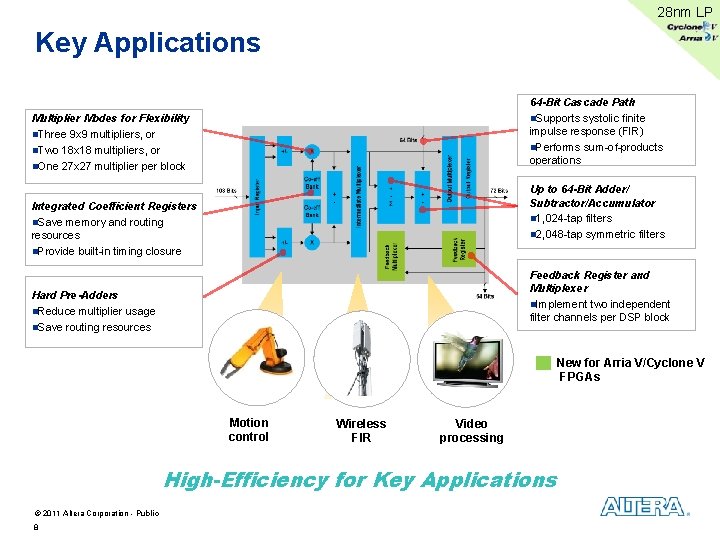
28 nm LP Key Applications 64 -Bit Cascade Path n. Supports systolic finite impulse response (FIR) n. Performs sum-of-products operations Multiplier Modes for Flexibility n. Three 9 x 9 multipliers, or n. Two 18 x 18 multipliers, or n. One 27 x 27 multiplier per block Up to 64 -Bit Adder/ Subtractor/Accumulator n 1, 024 -tap filters n 2, 048 -tap symmetric filters Integrated Coefficient Registers n. Save memory and routing resources n. Provide built-in timing closure Feedback Register and Multiplexer n. Implement two independent filter channels per DSP block Hard Pre-Adders n. Reduce multiplier usage n. Save routing resources New for Arria V/Cyclone V FPGAs Motion control Wireless FIR Video processing High-Efficiency for Key Applications © 2011 Altera Corporation - Public 8
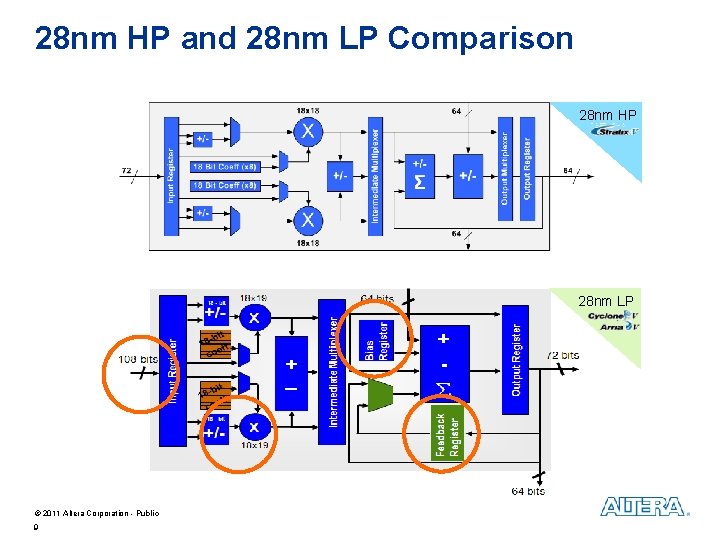
28 nm HP and 28 nm LP Comparison 28 nm HP 28 nm LP © 2011 Altera Corporation - Public 9
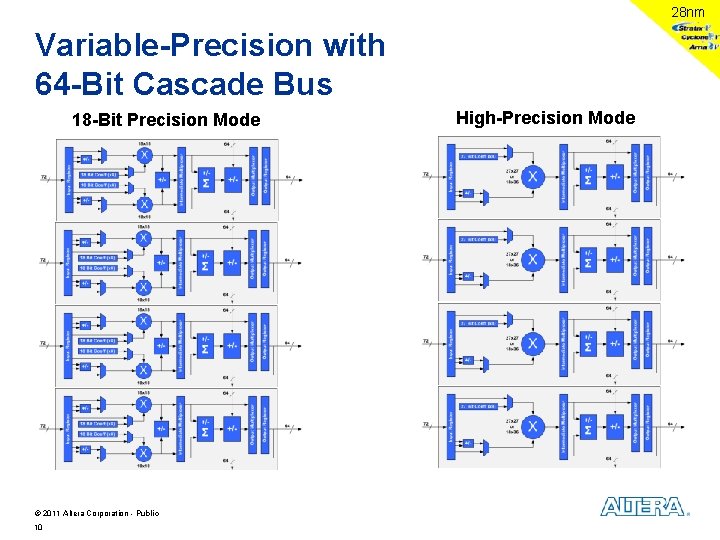
28 nm Variable-Precision with 64 -Bit Cascade Bus 18 -Bit Precision Mode © 2011 Altera Corporation - Public 10 High-Precision Mode
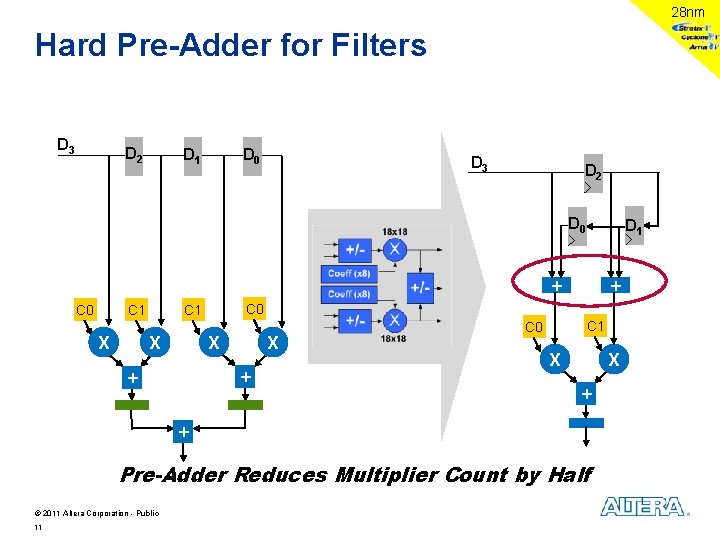
28 nm Hard Pre-Adder for Filters D 3 D 2 D 1 D 0 D 3 D 2 D 0 D 1 + C 0 C 1 X X X + + + C 1 C 0 X X + + Pre-Adder Reduces Multiplier Count by Half © 2011 Altera Corporation - Public 11
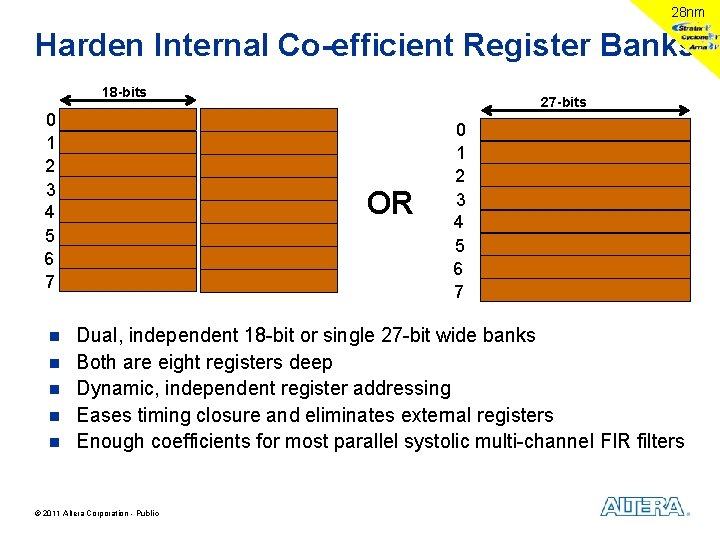
28 nm Harden Internal Co-efficient Register Banks 18 -bits 0 1 2 3 4 5 6 7 n n n 27 -bits OR 0 1 2 3 4 5 6 7 Dual, independent 18 -bit or single 27 -bit wide banks Both are eight registers deep Dynamic, independent register addressing Eases timing closure and eliminates external registers Enough coefficients for most parallel systolic multi-channel FIR filters © 2011 Altera Corporation - Public
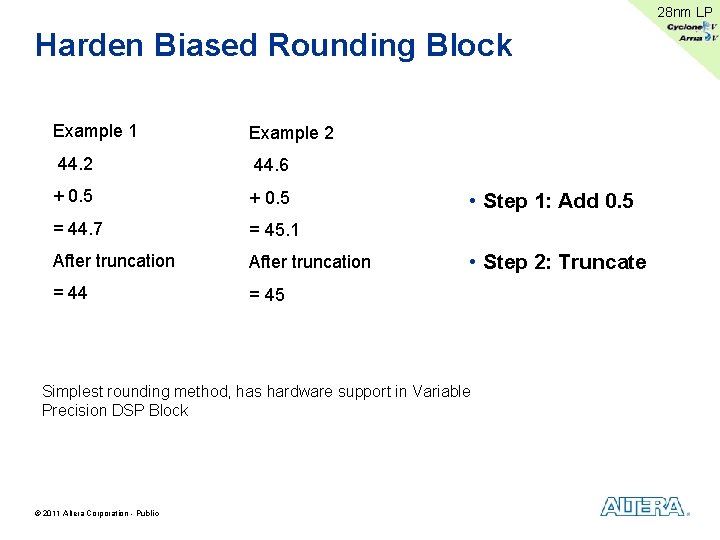
28 nm LP Harden Biased Rounding Block Example 1 Example 2 44. 6 + 0. 5 = 44. 7 = 45. 1 After truncation = 44 = 45 • Step 1: Add 0. 5 • Step 2: Truncate Simplest rounding method, has hardware support in Variable Precision DSP Block © 2011 Altera Corporation - Public
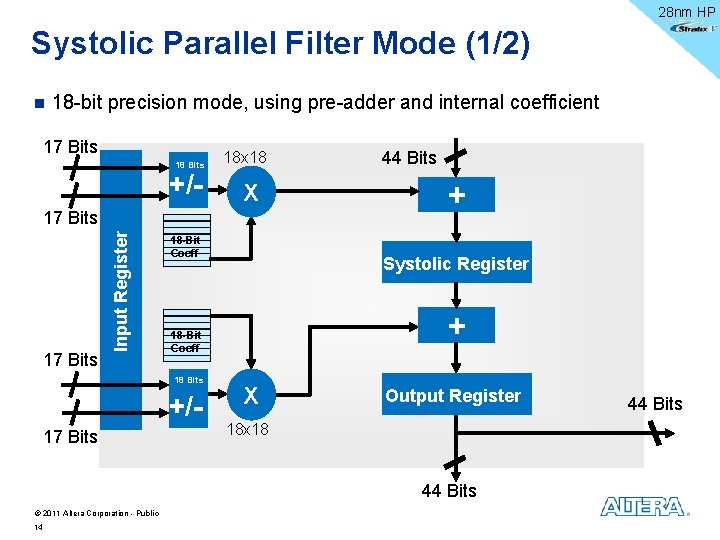
28 nm HP Systolic Parallel Filter Mode (1/2) n 18 -bit precision mode, using pre-adder and internal coefficient 17 Bits 18 Bits +/- 18 x 18 X 17 Bits Input Register 17 Bits 18 -Bit Coeff +/17 Bits + Systolic Register + 18 -Bit Coeff 18 Bits 44 Bits X Output Register 18 x 18 44 Bits © 2011 Altera Corporation - Public 14 44 Bits

28 nm HP Systolic Parallel Filter Mode (2/2) n High-precision mode, using pre-adder and internal coefficient 22 Bits Input Register 25 Bits 64 Bits 27 -Bit Coeff X + 27 x 27 25 Bits +/- Output Register 25 Bits 64 Bits © 2011 Altera Corporation - Public 15 64 Bits
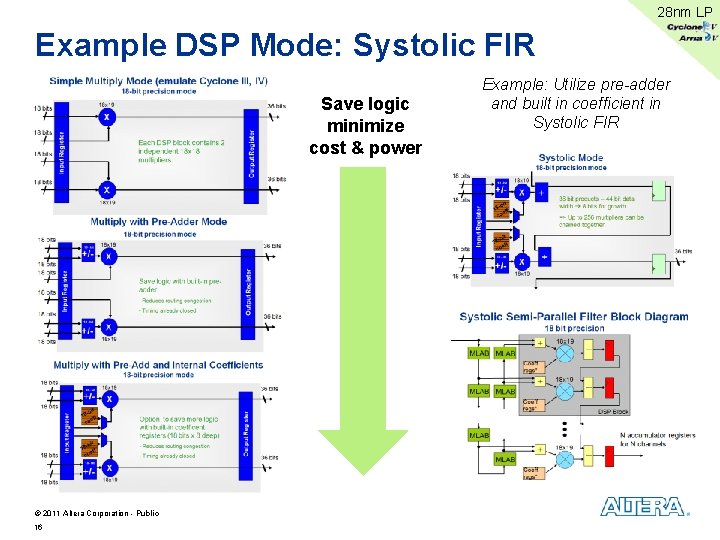
28 nm LP Example DSP Mode: Systolic FIR Save logic minimize cost & power © 2011 Altera Corporation - Public 16 Example: Utilize pre-adder and built in coefficient in Systolic FIR
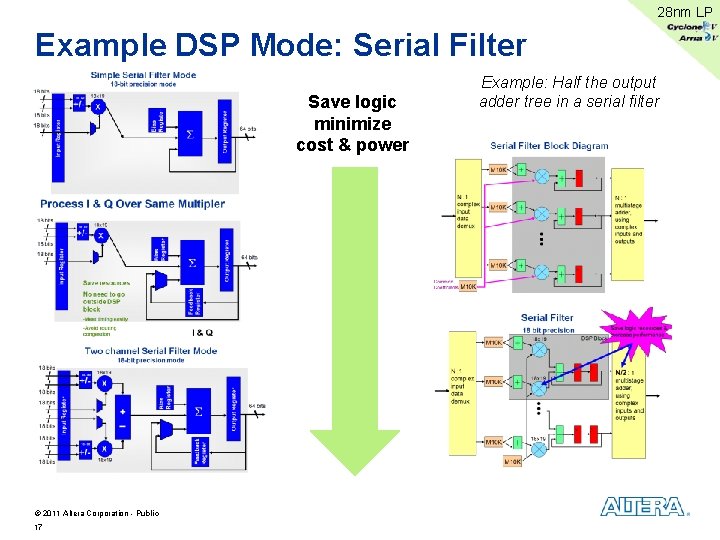
28 nm LP Example DSP Mode: Serial Filter Save logic minimize cost & power © 2011 Altera Corporation - Public 17 Example: Half the output adder tree in a serial filter
Floating Point DSP Architecture © 2011 Altera Corporation - Public
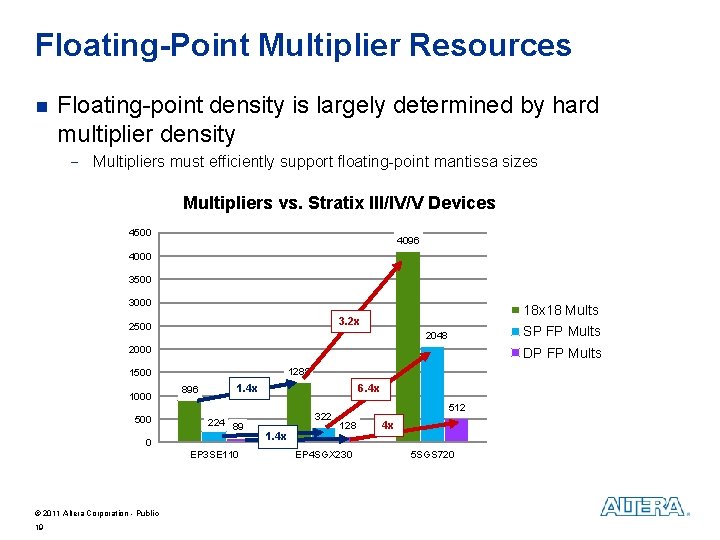
Floating-Point Multiplier Resources n Floating-point density is largely determined by hard multiplier density - Multipliers must efficiently support floating-point mantissa sizes Multipliers vs. Stratix III/IV/V Devices 4500 4096 4000 3500 3000 18 x 18 Mults 3. 2 x 2500 SP FP Mults 2048 2000 DP FP Mults 1288 1500 1000 500 896 1. 4 x 224 89 0 EP 3 SE 110 © 2011 Altera Corporation - Public 19 6. 4 x 322 1. 4 x 512 128 EP 4 SGX 230 4 x 5 SGS 720
New Floating-Point Methodology n Processors – each FP operation in standardized IEEE 754 format n This can be done but not optimized in FPGAs - Excessive logic usage - Unsustainable routing requirements - Sub 100 -MHz performance - This penalty discourages use of FP compared to fixed n Altera has novel approach: fused datapath - IEEE 754 interface only at algorithm boundaries - Large reduction in logic and routing - Optimize algorithms to use hard multipliers - Single and double-precision floating- point support - Based upon internal C to datapath tool © 2011 Altera Corporation - Public 20
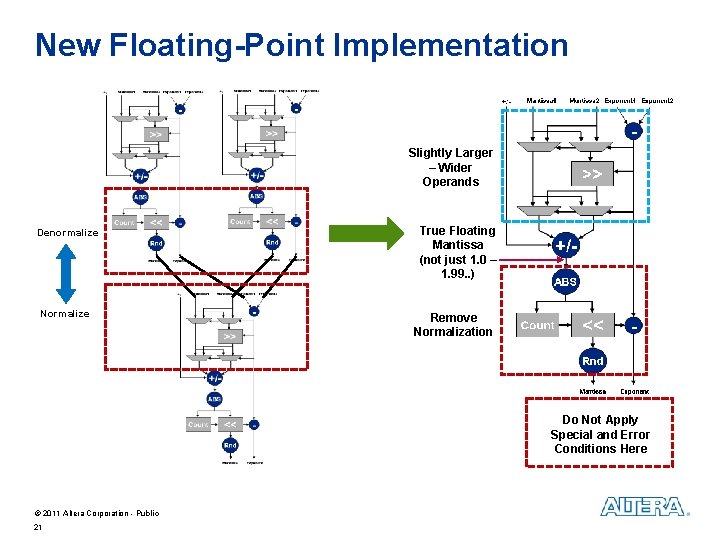
New Floating-Point Implementation Slightly Larger – Wider Operands Denormalize Normalize True Floating Mantissa (not just 1. 0 – 1. 99. . ) Remove Normalization Do Not Apply Special and Error Conditions Here © 2011 Altera Corporation - Public 21
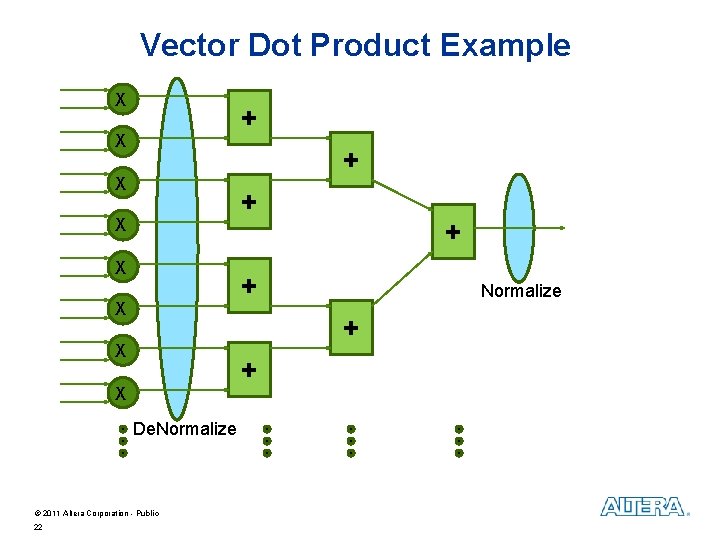
Vector Dot Product Example X + X + X Normalize + X De. Normalize © 2011 Altera Corporation - Public 22 +
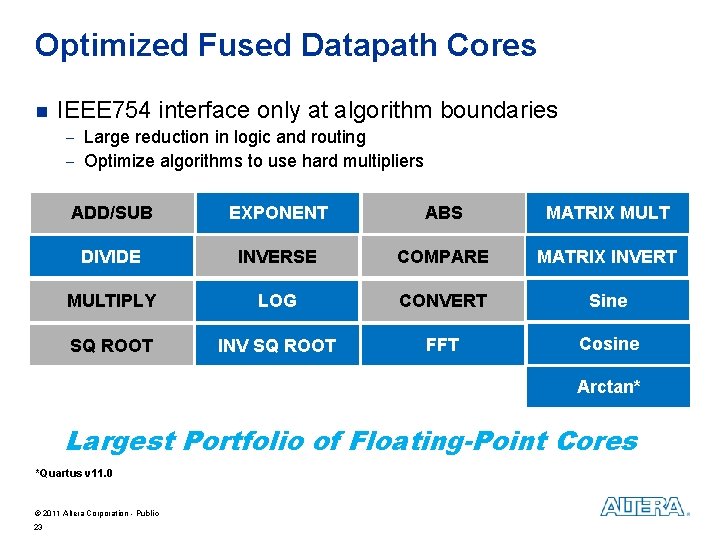
Optimized Fused Datapath Cores n IEEE 754 interface only at algorithm boundaries - Large reduction in logic and routing - Optimize algorithms to use hard multipliers ADD/SUB EXPONENT ABS MATRIX MULT DIVIDE INVERSE COMPARE MATRIX INVERT MULTIPLY LOG CONVERT Sine SQ ROOT INV SQ ROOT FFT* FFT Cosine Arctan* Largest Portfolio of Floating-Point Cores *Quartus v 11. 0 © 2011 Altera Corporation - Public 23
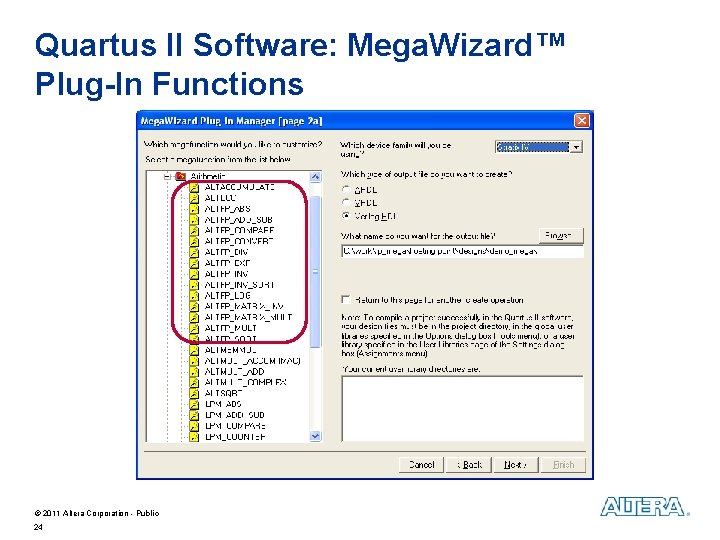
Quartus II Software: Mega. Wizard™ Plug-In Functions © 2011 Altera Corporation - Public 24
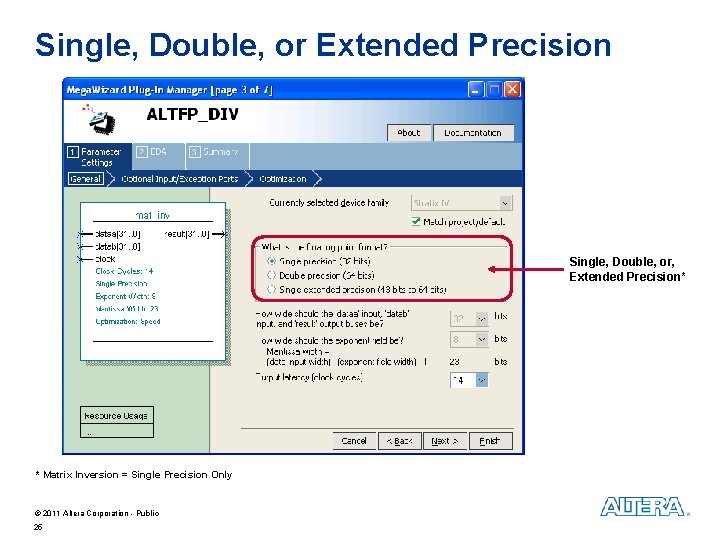
Single, Double, or Extended Precision Single, Double, or, Extended Precision* * Matrix Inversion = Single Precision Only © 2011 Altera Corporation - Public 25
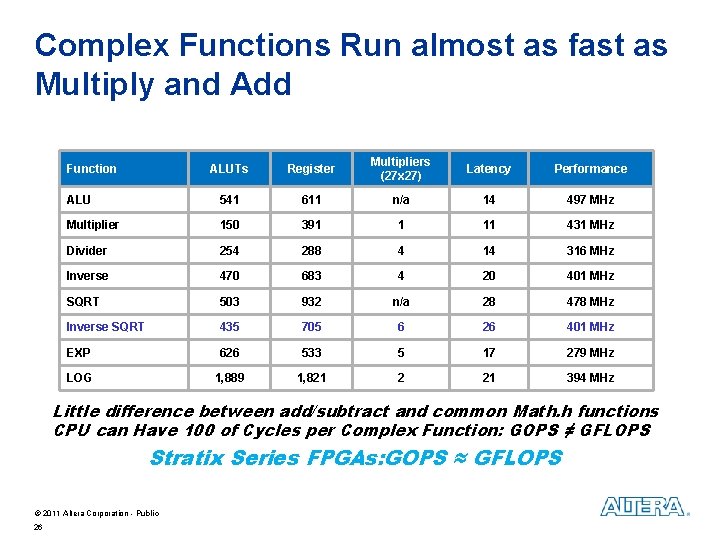
Complex Functions Run almost as fast as Multiply and Add ALUTs Register Multipliers (27 x 27) Latency Performance ALU 541 611 n/a 14 497 MHz Multiplier 150 391 1 11 431 MHz Divider 254 288 4 14 316 MHz Inverse 470 683 4 20 401 MHz SQRT 503 932 n/a 28 478 MHz Inverse SQRT 435 705 6 26 401 MHz EXP 626 533 5 17 279 MHz LOG 1, 889 1, 821 2 21 394 MHz Function Little difference between add/subtract and common Math. h functions CPU can Have 100 of Cycles per Complex Function: GOPS ≠ GFLOPS Stratix Series FPGAs: GOPS ≈ GFLOPS © 2011 Altera Corporation - Public 26
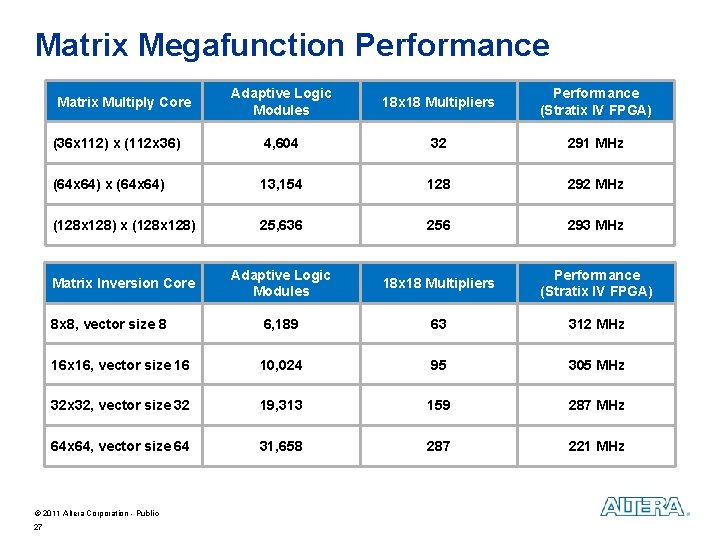
Matrix Megafunction Performance Adaptive Logic Modules 18 x 18 Multipliers Performance (Stratix IV FPGA) (36 x 112) x (112 x 36) 4, 604 32 291 MHz (64 x 64) x (64 x 64) 13, 154 128 292 MHz (128 x 128) x (128 x 128) 25, 636 256 293 MHz Matrix Inversion Core Adaptive Logic Modules 18 x 18 Multipliers Performance (Stratix IV FPGA) 8 x 8, vector size 8 6, 189 63 312 MHz 16 x 16, vector size 16 10, 024 95 305 MHz 32 x 32, vector size 32 19, 313 159 287 MHz 64 x 64, vector size 64 31, 658 287 221 MHz Matrix Multiply Core © 2011 Altera Corporation - Public 27
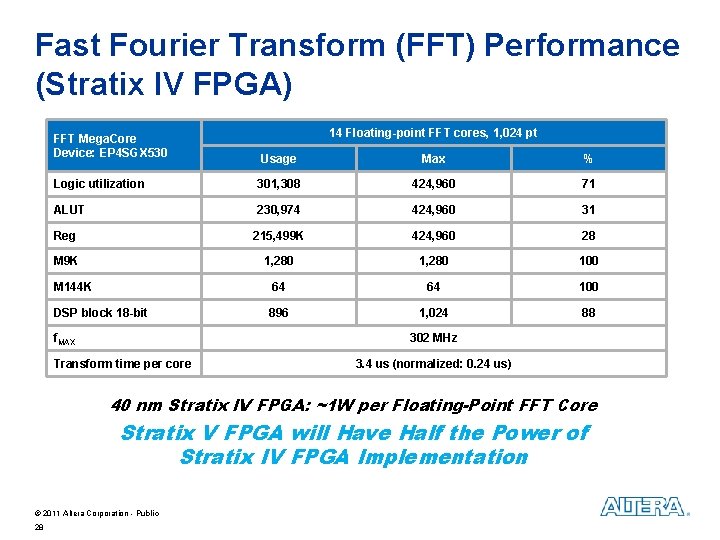
Fast Fourier Transform (FFT) Performance (Stratix IV FPGA) FFT Mega. Core Device: EP 4 SGX 530 14 Floating-point FFT cores, 1, 024 pt Usage Max % Logic utilization 301, 308 424, 960 71 ALUT 230, 974 424, 960 31 Reg 215, 499 K 424, 960 28 M 9 K 1, 280 100 M 144 K 64 64 100 DSP block 18 -bit 896 1, 024 88 f. MAX 302 MHz Transform time per core 3. 4 us (normalized: 0. 24 us) 40 nm Stratix IV FPGA: ~1 W per Floating-Point FFT Core Stratix V FPGA will Have Half the Power of Stratix IV FPGA Implementation © 2011 Altera Corporation - Public 28

Thank You © 2011 Altera Corporation - Public ALTERA, ARRIA, CYCLONE, HARDCOPY, MAX, MEGACORE, NIOS, QUARTUS and STRATIX words and logos are trademarks of Altera Corporation and registered in the United States and are trademarks or registered trademarks in other countries.
- Slides: 29