
Using UML Patterns and Java ObjectOriented Software Engineering
Using UML, Patterns, and Java Object-Oriented Software Engineering Chapter 16, Methodologies
Outline • A mountaineering example • Project context • Goals, client types • Environment, methods, tools, methodology • Methodology spectrum • Planning, design reuse, modeling, process, control&monitoring, redefinition • Different types of planning • Different ways to use models • Use of processes in software development Bernd Bruegge & Allen H. Dutoit Object-Oriented Software Engineering: Using UML, Patterns, and Java 2
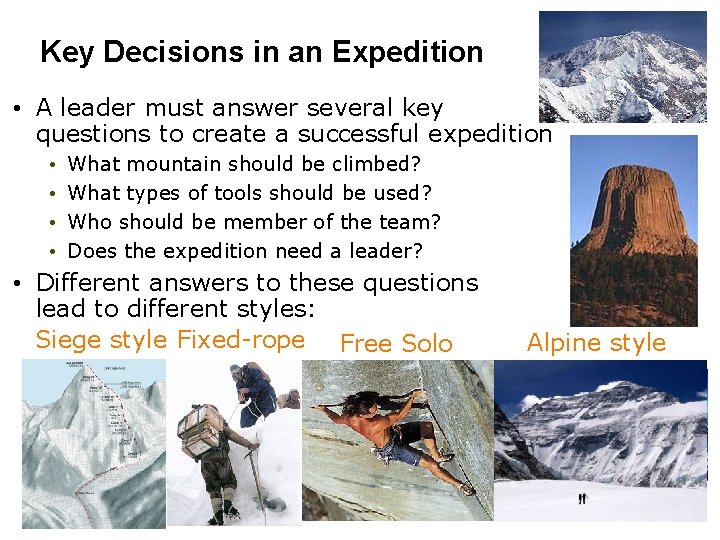
Key Decisions in an Expedition • A leader must answer several key questions to create a successful expedition • • What mountain should be climbed? What types of tools should be used? Who should be member of the team? Does the expedition need a leader? • Different answers to these questions lead to different styles: Siege style Fixed-rope Free Solo Alpine style
Key Decisions in a Software Project • • Project goals Schedule Cost Project organization Software life cycle model Tools Methods Team members and organization Influenced by Methodology Bernd Bruegge & Allen H. Dutoit Object-Oriented Software Engineering: Using UML, Patterns, and Java 4
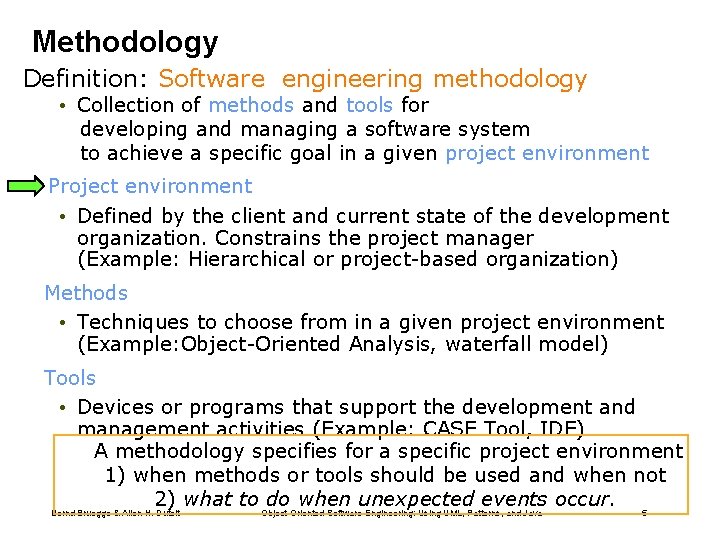
Methodology Definition: Software engineering methodology • Collection of methods and tools for developing and managing a software system to achieve a specific goal in a given project environment Project environment • Defined by the client and current state of the development organization. Constrains the project manager (Example: Hierarchical or project-based organization) Methods • Techniques to choose from in a given project environment (Example: Object-Oriented Analysis, waterfall model) Tools • Devices or programs that support the development and management activities (Example: CASE Tool, IDE) A methodology specifies for a specific project environment 1) when methods or tools should be used and when not 2) what to Object-Oriented do when unexpected events occur. 5 Bernd Bruegge & Allen H. Dutoit Software Engineering: Using UML, Patterns, and Java
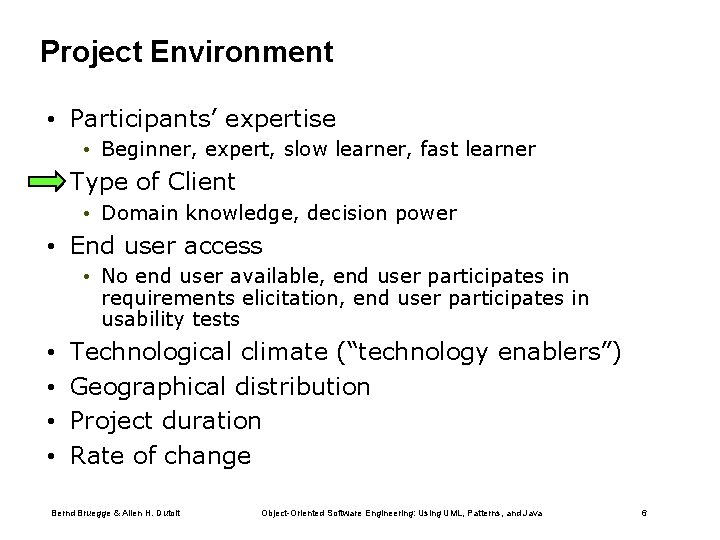
Project Environment • Participants’ expertise • Beginner, expert, slow learner, fast learner • Type of Client • Domain knowledge, decision power • End user access • No end user available, end user participates in requirements elicitation, end user participates in usability tests • • Technological climate (“technology enablers”) Geographical distribution Project duration Rate of change Bernd Bruegge & Allen H. Dutoit Object-Oriented Software Engineering: Using UML, Patterns, and Java 6
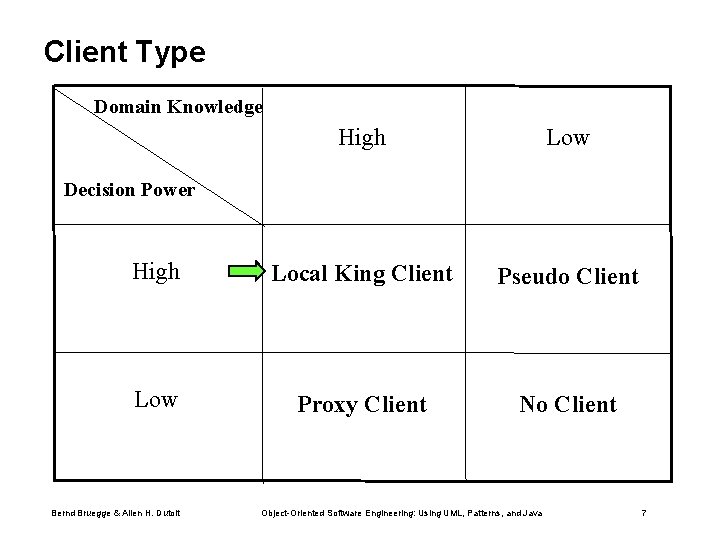
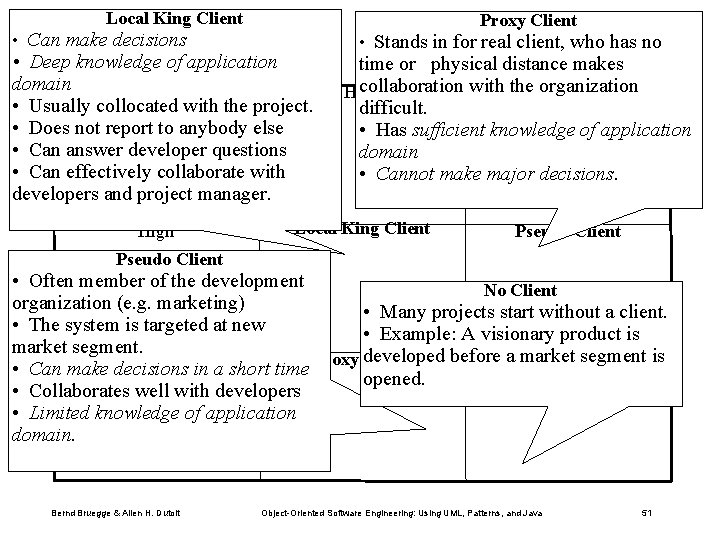
Client Type Domain Knowledge High Low High Local King Client Pseudo Client Low Proxy Client No Client Decision Power Bernd Bruegge & Allen H. Dutoit Object-Oriented Software Engineering: Using UML, Patterns, and Java 7
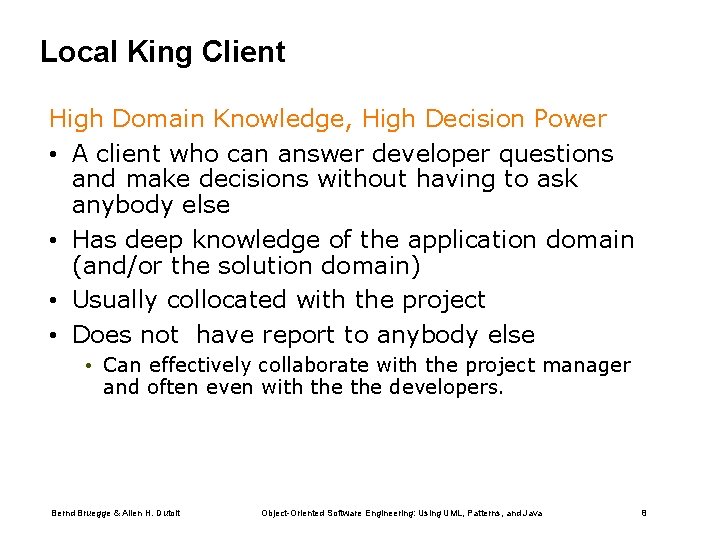
Local King Client High Domain Knowledge, High Decision Power • A client who can answer developer questions and make decisions without having to ask anybody else • Has deep knowledge of the application domain (and/or the solution domain) • Usually collocated with the project • Does not have report to anybody else • Can effectively collaborate with the project manager and often even with the developers. Bernd Bruegge & Allen H. Dutoit Object-Oriented Software Engineering: Using UML, Patterns, and Java 8
Proxy Client High Domain Knowledge, Low Decision Power • Proxy clients are sent for the “real client” Reasons: • Real client has no time • Physical distance would make collaboration of the real client with the project organization difficult • Proxy clients have sufficient knowledge of the application domain • They can answer clarification questions from the developers • Proxy clients do not have sufficient power • They cannot make major decisions, they have to ask somebody else => time delay! Bernd Bruegge & Allen H. Dutoit Object-Oriented Software Engineering: Using UML, Patterns, and Java 9
Pseudo Client Low Domain Knowledge, High Decision Power • The pseudo client is a member of the development organization • Often even developers act as pseudo clients • If the system is targeted at a new market segment, the pseudo client often comes from marketing • Pseudo clients can make decisions within a short time • Pseudo clients have a limited knowledge of the application domain. Bernd Bruegge & Allen H. Dutoit Object-Oriented Software Engineering: Using UML, Patterns, and Java 10
“No Client” • A project can start without a client • Example: A visionary product is developed before a market segment is opened • In these cases the project manager should still select a client, usually a pseudo client who acts as an end user • The stakes of the developers can be balanced against the stakes of the future user. Bernd Bruegge & Allen H. Dutoit Object-Oriented Software Engineering: Using UML, Patterns, and Java 11
End User Access • Clients and end users usually do not have the same interests • Clients are interested in • an early delivery date • as much functionality as possible • low cost • End users are interested in • a familiar user interface • an easy to learn user interface • a system that supports their specific task well • If the project success depends on the usability of the product, then • end users should be included in the project • usability tests should be conducted with the end users. Bernd Bruegge & Allen H. Dutoit Object-Oriented Software Engineering: Using UML, Patterns, and Java 12
Project Environment • Participants’ expertise • Beginner, expert, slow learner, fast learner • Type of Client • Domain knowledge, decision power • End user access • No end user available, end user participates in requirements elicitation, end user participates in usability tests • • Technological climate (“technology enablers”) Geographical distribution Project duration Rate of change Bernd Bruegge & Allen H. Dutoit Object-Oriented Software Engineering: Using UML, Patterns, and Java 13
Technological climate • Depending on the requirements expressed by the client, a project may be constrained in the technological components it has to use. Examples: • A project needs to improve a legacy system • It deals with well-known and mature technology but the technology might be out of date • A project develops a first-of-a-kind prototype • based on a new technology enabler • Examples: RFID, GPS • Usually has to deal with preliminary versions of components and immature technology • GPS in a mobile phone Bernd Bruegge & Allen H. Dutoit Object-Oriented Software Engineering: Using UML, Patterns, and Java 14
Geographical Distribution • “Single room” projects: Participants in a single room • Reasons for distributed projects: • Organization may have resulted from the merger • Organization is a consortium, located in different geographical locations • Part of the organization must be collocated with client • Geographical distribution has pros and cons: Promise of low cost labor Increases the availability of skill May take advantage of different time zones Slows down communication and decision making Lowers awareness among teams Leads to loss of information between sites High communication cost. Bernd Bruegge & Allen H. Dutoit Object-Oriented Software Engineering: Using UML, Patterns, and Java 15
Methodology Issues • Methodologies provide general principles and strategies for selecting methods and tools in a given project environment • Key questions for which methodologies provide guidance: • • • How How How much much Bernd Bruegge & Allen H. Dutoit involvement of the customer? planning? reuse? modeling before coding? process? control and monitoring? Object-Oriented Software Engineering: Using UML, Patterns, and Java 16
![How much Planning? • Two styles of navigation [Gladwin 1964] • European navigation: •](http://slidetodoc.com/presentation_image_h/0d13ccb598d915c6895f7c2d588b62cc/image-17.jpg "How much Planning? • Two styles of navigation [Gladwin 1964] • European navigation: •")
How much Planning? • Two styles of navigation [Gladwin 1964] • European navigation: • Current Location and Desired Location • Planned Route • Route Deviation and Route Correction • “Polynesian navigation” Bernd Bruegge & Allen H. Dutoit Object-Oriented Software Engineering: Using UML, Patterns, and Java 17
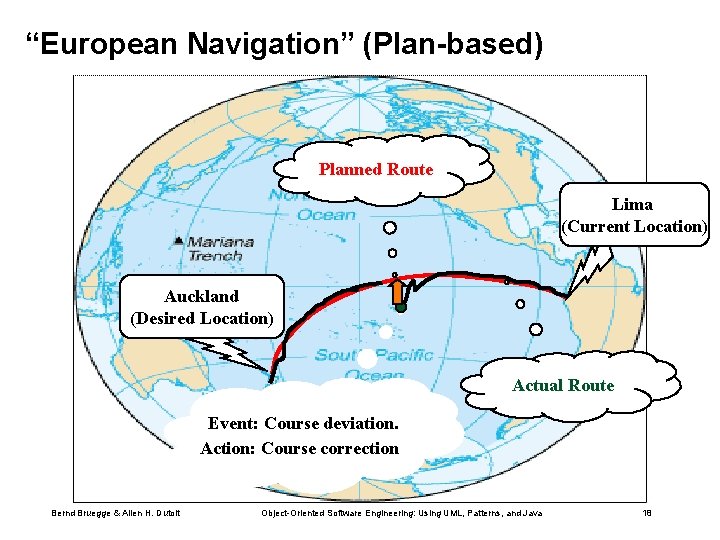
“European Navigation” (Plan-based) Planned Route Lima (Current Location) Auckland (Desired Location) Actual Route Event: Course deviation. Action: Course correction Bernd Bruegge & Allen H. Dutoit Object-Oriented Software Engineering: Using UML, Patterns, and Java 18
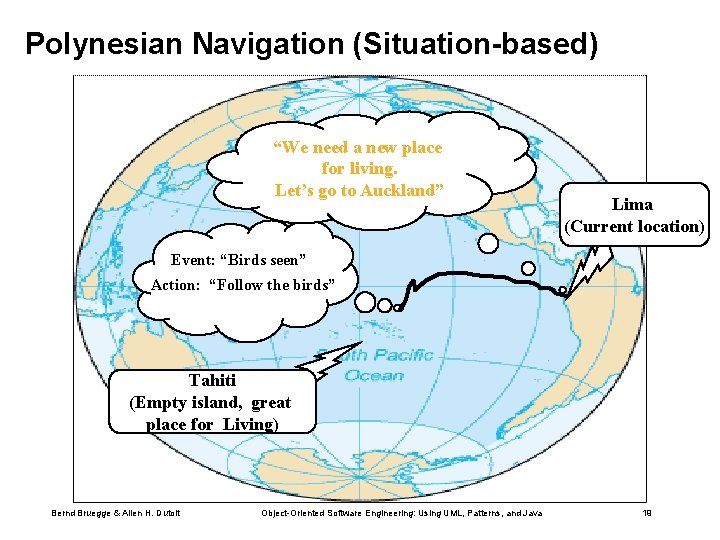
Polynesian Navigation (Situation-based) “We need a new place for living. Let’s go to Auckland” Lima (Current location) Event: “Birds seen” Action: “Follow the birds” Tahiti (Empty island, great place for Living) Bernd Bruegge & Allen H. Dutoit Object-Oriented Software Engineering: Using UML, Patterns, and Java 19
![Situated action • Context-dependent action [Suchman 1990] • Selection of action depends on the](http://slidetodoc.com/presentation_image_h/0d13ccb598d915c6895f7c2d588b62cc/image-20.jpg "Situated action • Context-dependent action [Suchman 1990] • Selection of action depends on the")
Situated action • Context-dependent action [Suchman 1990] • Selection of action depends on the type of event, the situation and the skill of the developer • European Navigation is context independent • Event: “Course deviation in the morning” • Action: “Course correction towards planned route” • Event: “Course deviation in the evening” • Action: “Course correction towards planned route” • Polynesian Navigation is context dependent • Event: “Birds seen”, Context: Morning • Action: “Sail opposite to the direction of the birds • Event: “Birds seen”, Context: Evening • Action: “Sail in the direction of the birds”. Bernd Bruegge & Allen H. Dutoit Object-Oriented Software Engineering: Using UML, Patterns, and Java 20
Pros and Cons of Software Project Plans • Plus • Very useful to kick off a software project • Useful also if the outcome is predictable or if no major change occurs • Con: • Of limited value to control the project when • the outcome is unpredictable • when unexpected events occur that change the project environment, tools or methods • Examples of unexpected events: • Appearance of new technology unknown at project start • A visionary scenario turns out to be unimplementable • Company is merged with another one during the project. Bernd Bruegge & Allen H. Dutoit Object-Oriented Software Engineering: Using UML, Patterns, and Java 21
How much Modeling? • Advantages of modeling: • Modeling enables developers to deal with complexity • Modeling makes implicit knowledge about the system explicit • Modeling formalizes knowledge so that a number of participants can share it • Problem with modeling: • If one is not careful, models can become as complex as the system being modeled. Bernd Bruegge & Allen H. Dutoit Object-Oriented Software Engineering: Using UML, Patterns, and Java 22
Managerial Challenges of Modeling • Formalizing knowledge is expensive • Takes time and effort from developers • Requires validation and consensus • Models introduce redundancy • If the system is changed, the models must be changed • If several models depict the same aspects of the system, all of them must be updated • If one model becomes out of sync, it loses its value • Models become complex • As the model complexity becomes similar to the complexity of the system, the benefit of having a model is reduced significantly. Bernd Bruegge & Allen H. Dutoit Object-Oriented Software Engineering: Using UML, Patterns, and Java 23
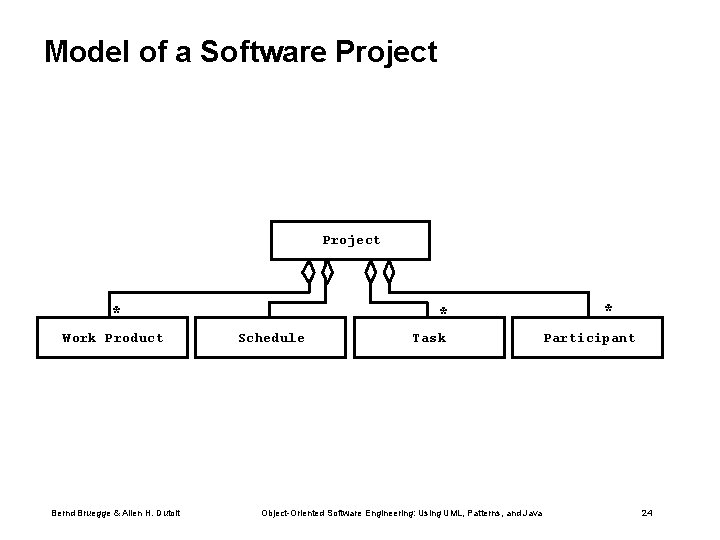
Model of a Software Project * Work Product Bernd Bruegge & Allen H. Dutoit * Schedule Task Object-Oriented Software Engineering: Using UML, Patterns, and Java * Participant 24
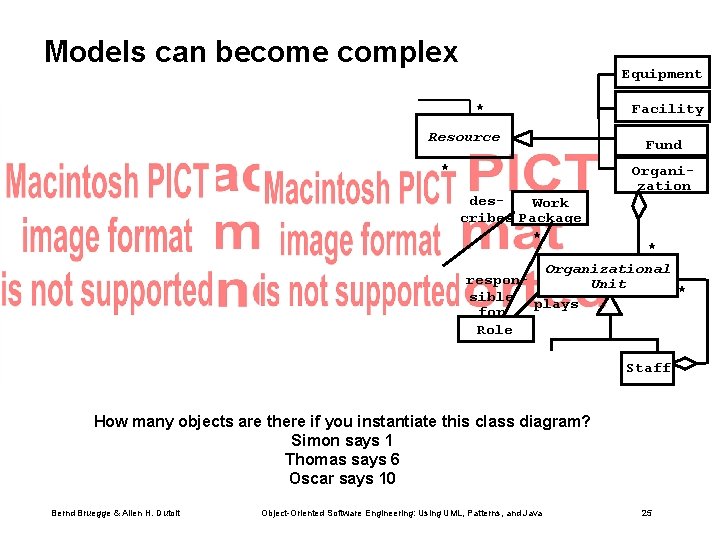
Models can become complex Equipment * Resource * des. Work cribes Package * Facility Fund Organization * Organizational respon. Unit * sible plays for Role Staff How many objects are there if you instantiate this class diagram? Simon says 1 Thomas says 6 Oscar says 10 Bernd Bruegge & Allen H. Dutoit Object-Oriented Software Engineering: Using UML, Patterns, and Java 25
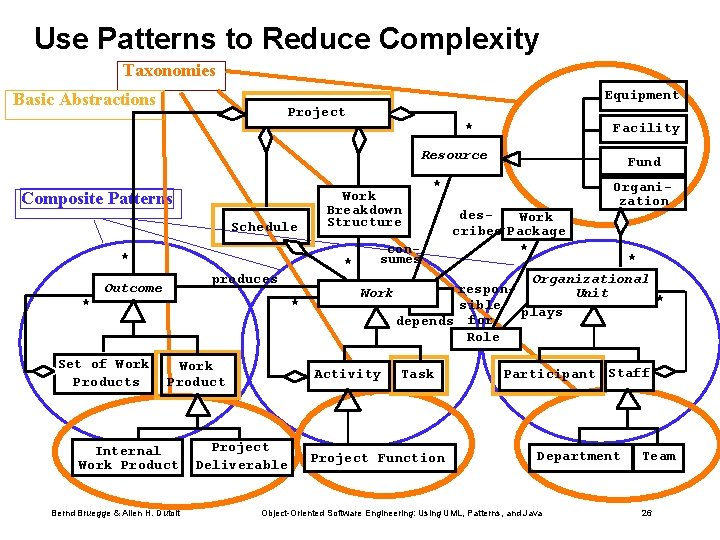
Use Patterns to Reduce Complexity Taxonomies Equipment Basic Abstractions Project * Facility Resource Composite Patterns Schedule * * produces Outcome * Set of Work Products Work Breakdown Structure * Work Product Internal Work Product Bernd Bruegge & Allen H. Dutoit * consumes des. Work cribes Package * Organizational respon. Work Unit * sible plays depends for Role Activity Project Deliverable Fund Task Project Function Participant Staff Department Object-Oriented Software Engineering: Using UML, Patterns, and Java Team 26
Reducing the Complexity of Models • To reduce the complexity of large model we use navigation and abstraction • Start with a simplified model and then decorate it incrementally • Start with key abstractions (use animation) • Then decorate the model with the additional classes • To reduce the complexity of the model even further • Use inheritance (taxonomies, design patterns) • If the model is still too complex, show the subclasses on a separate page Bernd Bruegge & Allen H. Dutoit Object-Oriented Software Engineering: Using UML, Patterns, and Java 27
Where do we need Models? • Models support three different types of activities: • Communication: The model provides a common vocabulary. An informal model is often used to communicate an idea • Analysis/Design: Models enable developers to reason about the future system • Archival: Compact representation for storing the design and rationale of an existing system. Bernd Bruegge & Allen H. Dutoit Object-Oriented Software Engineering: Using UML, Patterns, and Java 28
Models to support Communication • Also called conceptual models • Most often used in the early phases of a project and during informal communications. • The model does not have to be consistent or complete • The notation does not even have to be correct • The model is used only to communicate an idea to a person • If the idea is understood, the model has served its purpose • UML is our preferred notation for models to support communication • Communication Media: • A Whiteboard, a slide or even a napkin. Bernd Bruegge & Allen H. Dutoit Object-Oriented Software Engineering: Using UML, Patterns, and Java 29
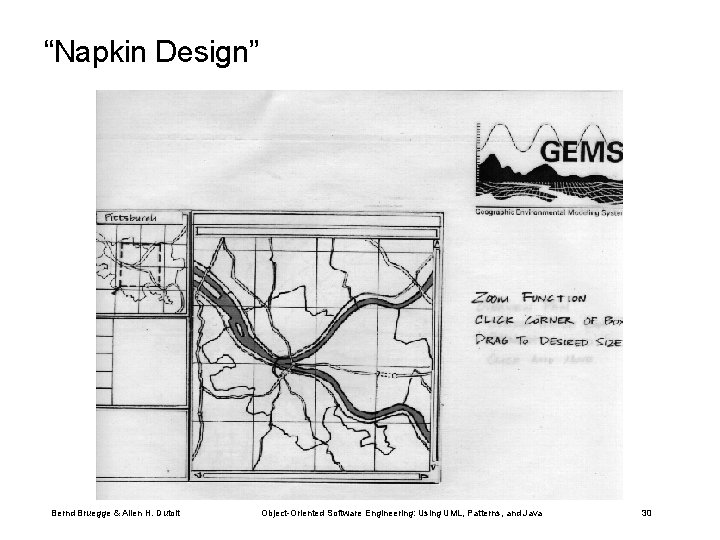
“Napkin Design” Bernd Bruegge & Allen H. Dutoit Object-Oriented Software Engineering: Using UML, Patterns, and Java 30
Models to support Analysis and Design • Also called specification models • The model provides a representation that enables developers to reason about the system • The model is used to communicate the idea to a computer • The model needs to be made consistent and complete • The notation must be correct so the model can be entered into a CASE tool • UML is our preferred notation for models to models that support analysis and design. Bernd Bruegge & Allen H. Dutoit Object-Oriented Software Engineering: Using UML, Patterns, and Java 31
Methodology Issues • Methodologies provide guidance, general principles and strategies for selecting methods and tools in a given project environment. • Key questions for which methodologies provide guidance: • How ü How • How much much Bernd Bruegge & Allen H. Dutoit involvement of the customer planning? reuse? modeling? process? control and monitoring? Object-Oriented Software Engineering: Using UML, Patterns, and Java 32
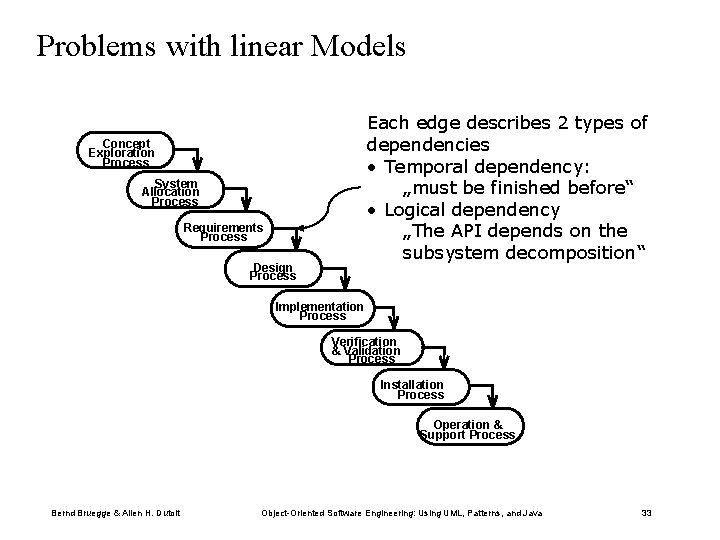
Problems with linear Models Each edge describes 2 types of dependencies • Temporal dependency: „must be finished before“ • Logical dependency „The API depends on the subsystem decomposition“ Concept Exploration Process System Allocation Process Requirements Process Design Process Implementation Process Verification & Validation Process Installation Process Operation & Support Process Bernd Bruegge & Allen H. Dutoit Object-Oriented Software Engineering: Using UML, Patterns, and Java 33
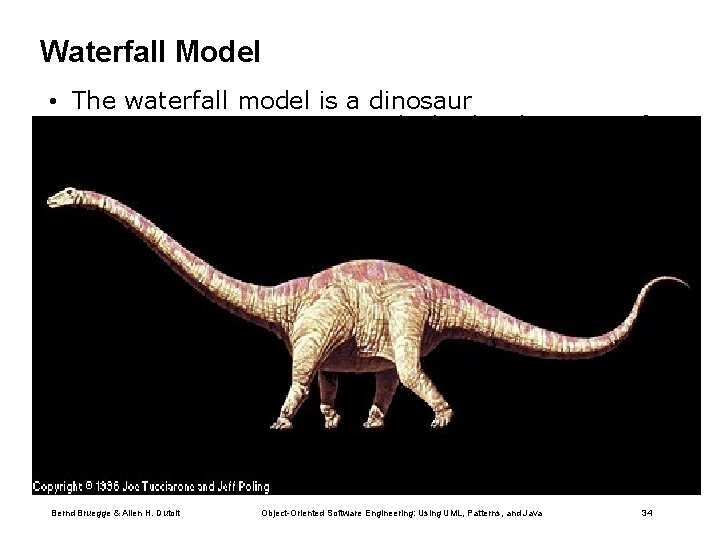
Waterfall Model • The waterfall model is a dinosaur Each edge describes 2 types of dependencies • Temporal dependency: „must be finished before“ • Logical dependency „The API depends on the subsystem decomposition“ Concept Exploration Process System Allocation Process Requirements Process Design Process Implementation Process Verification & Validation Process Installation Process Operation & Support Process Bernd Bruegge & Allen H. Dutoit Object-Oriented Software Engineering: Using UML, Patterns, and Java 34
The Problem is how to Deal with Change Bernd Bruegge & Allen H. Dutoit Object-Oriented Software Engineering: Using UML, Patterns, and Java 35
red yellow green blue red blue yellow green blue Bernd Bruegge & Allen H. Dutoit Object-Oriented Software Engineering: Using UML, Patterns, and Java 36
red yellow green blue red blue yellow green blue Bernd Bruegge & Allen H. Dutoit Object-Oriented Software Engineering: Using UML, Patterns, and Java 37
Controlling Software Development with a Process How do we control software development? Two opinions: • Through organizational maturity (Humphrey) • Repeatable process, Capability Maturity Model (CMM) • Through agility (Schwaber): • Large parts of software development is empirical in nature; they cannot be modeled with a defined process • There is a difference between defined and empirical process • How can software development better be described? • with a defined process control model • with an empirical process control model. Bernd Bruegge & Allen H. Dutoit Object-Oriented Software Engineering: Using UML, Patterns, and Java 38
Defined Process Control Model • Requires that every piece of work is completely understood • Deviations are seen as errors that need to be corrected • Given a well-defined set of inputs, the same outputs are generated every time • Precondition to apply this model: • All the activities and tasks are well defined to provide repeatability and predictability • If the preconditions are not satisfied: • Lot of surprises, loss of control, incomplete or wrong work products. Bernd Bruegge & Allen H. Dutoit Object-Oriented Software Engineering: Using UML, Patterns, and Java 39
Empirical Process Control Model • The process is imperfectly defined, not all pieces of work are completely understood • Deviations are seen as opportunities that need to be investigated • The empirical process “expects the unexpected” • Control is exercised through frequent inspection • Conditions when to apply this model: • Frequent change, unpredictable and unrepeatable outputs. Bernd Bruegge & Allen H. Dutoit Object-Oriented Software Engineering: Using UML, Patterns, and Java 40
Summary • A project has many contexts • Goals, client types • Environment, methods, tools, methodology • Methodology issues • Planning, design reuse, modeling, process, control&monitoring, redefinition • Different types of planning • European vs. Polynesian navigation • Different types of models • For communication, specification and archival • Different ways to control processes • Defined vs empirical process control models. Bernd Bruegge & Allen H. Dutoit Object-Oriented Software Engineering: Using UML, Patterns, and Java 41
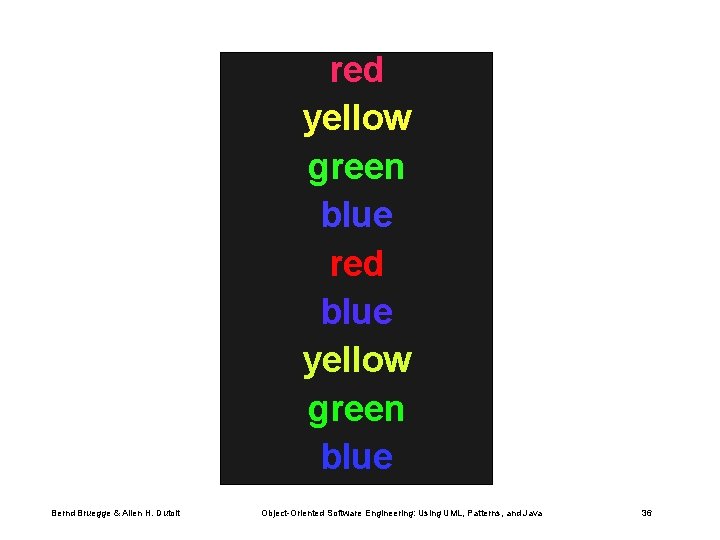
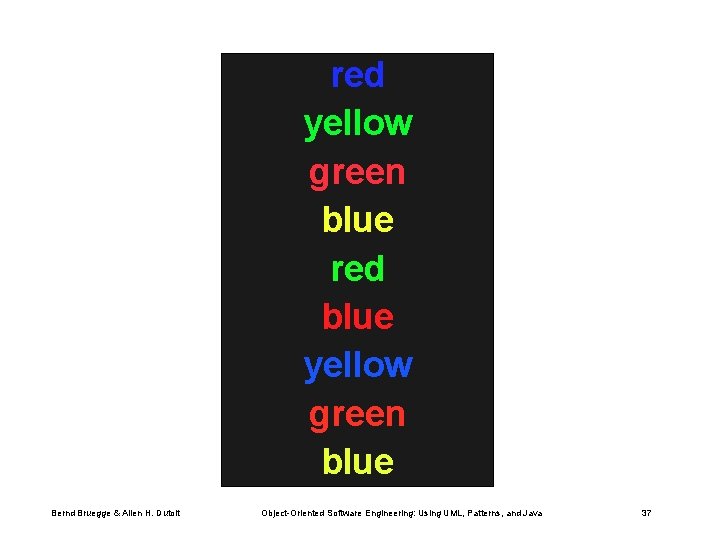
Additional References • W. Humphrey • Managing the Software Process, Addison-Wesley, Reading MA, 1989 • K. Schwaber, M. Beedle, R. C. Martin • Agile Software Development with Scrum, Prentice Hall, Upper Saddle River, NJ, 2001. • http: //en. wikipedia. org/wiki/Stroop_effect Bernd Bruegge & Allen H. Dutoit Object-Oriented Software Engineering: Using UML, Patterns, and Java 42
Backup and Additional Slides Bernd Bruegge & Allen H. Dutoit Object-Oriented Software Engineering: Using UML, Patterns, and Java 43
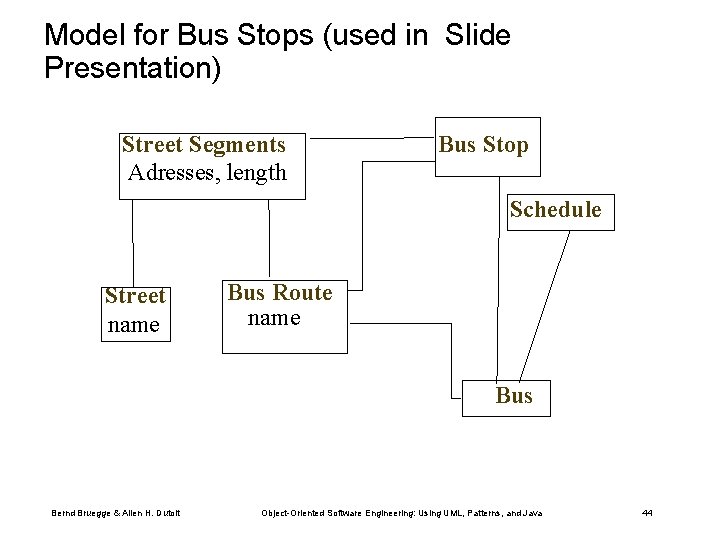
Model for Bus Stops (used in Slide Presentation) Street Segments Adresses, length Bus Stop Schedule Street name Bus Route name Bus Bernd Bruegge & Allen H. Dutoit Object-Oriented Software Engineering: Using UML, Patterns, and Java 44
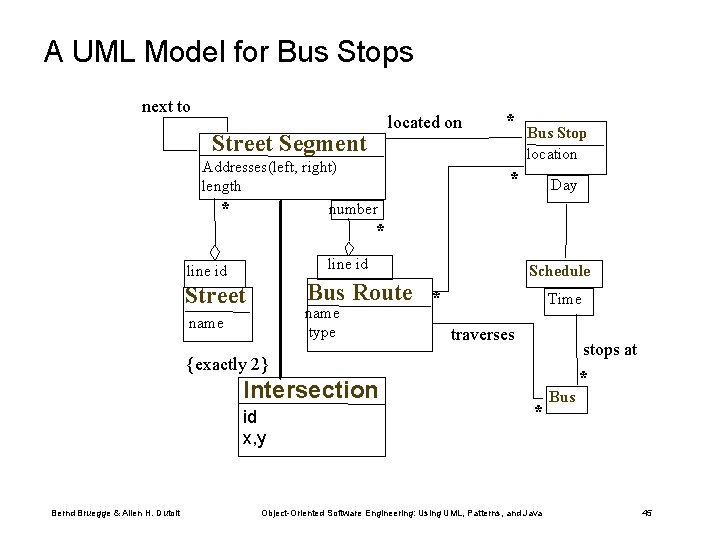
A UML Model for Bus Stops next to located on Street Segment Addresses(left, right) length number * * Bus Stop location * Day * line id Bus Route Street name type name Schedule * Time traverses stops at {exactly 2} Intersection id x, y Bernd Bruegge & Allen H. Dutoit * * Object-Oriented Software Engineering: Using UML, Patterns, and Java Bus 45
For many people, moving away from defined processes means descending into chaos. However, a process can be controlled even if it cannot be defined Bernd Bruegge & Allen H. Dutoit Object-Oriented Software Engineering: Using UML, Patterns, and Java 46
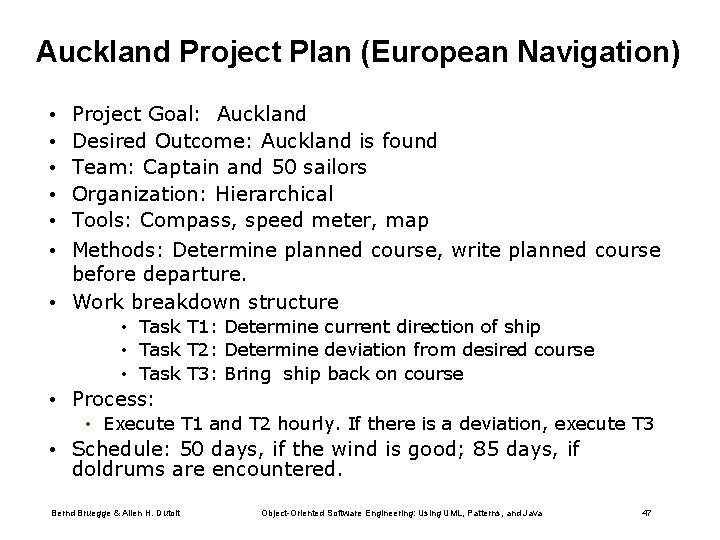
Auckland Project Plan (European Navigation) • • • Project Goal: Auckland Desired Outcome: Auckland is found Team: Captain and 50 sailors Organization: Hierarchical Tools: Compass, speed meter, map Methods: Determine planned course, write planned course before departure. • Work breakdown structure • Task T 1: Determine current direction of ship • Task T 2: Determine deviation from desired course • Task T 3: Bring ship back on course • Process: • Execute T 1 and T 2 hourly. If there is a deviation, execute T 3 • Schedule: 50 days, if the wind is good; 85 days, if doldrums are encountered. Bernd Bruegge & Allen H. Dutoit Object-Oriented Software Engineering: Using UML, Patterns, and Java 47
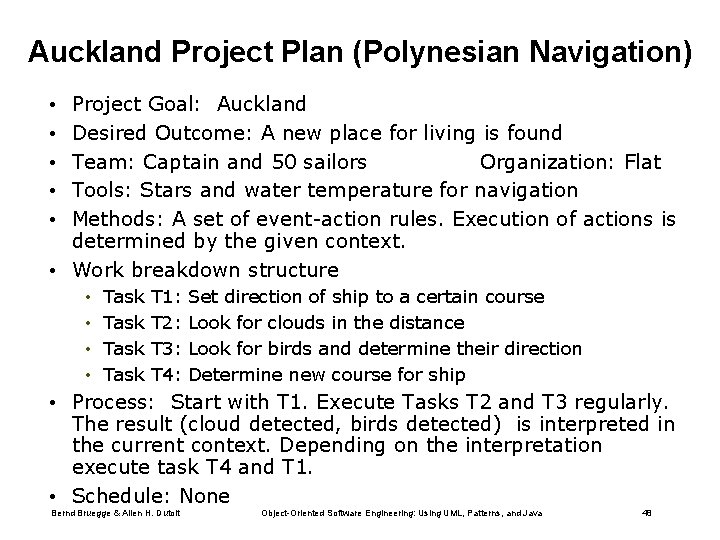
Auckland Project Plan (Polynesian Navigation) Project Goal: Auckland Desired Outcome: A new place for living is found Team: Captain and 50 sailors Organization: Flat Tools: Stars and water temperature for navigation Methods: A set of event-action rules. Execution of actions is determined by the given context. • Work breakdown structure • • • Task T 1: T 2: T 3: T 4: Set direction of ship to a certain course Look for clouds in the distance Look for birds and determine their direction Determine new course for ship • Process: Start with T 1. Execute Tasks T 2 and T 3 regularly. The result (cloud detected, birds detected) is interpreted in the current context. Depending on the interpretation execute task T 4 and T 1. • Schedule: None Bernd Bruegge & Allen H. Dutoit Object-Oriented Software Engineering: Using UML, Patterns, and Java 48
Enabling Technologies for Light-Weight Processes • • • Internet Self-Organizing Teams Peer-to-Peer Communication Ability to Change Plans Situated Actions Bernd Bruegge & Allen H. Dutoit Object-Oriented Software Engineering: Using UML, Patterns, and Java 49
What type of process do we need? • Big vs Small Systems • Space-Shuttle, fly-by-wire • OS kernels, searching, sendmail • Embedded Systems • Airbag controllers • Brake systems “Blue Collar” Applications Mobile Systems Mobile Maintenance, Mobile Health care Augmented Reality Systems Overlay of virtual information on real objects in real time Flying Bridges Bernd Bruegge & Allen H. Dutoit Object-Oriented Software Engineering: Using UML, Patterns, and Java 50
Local King Client • Can make decisions Proxy Client Type • Deep knowledge of application domain • Usually collocated with the project. • Does not report to anybody else • Can answer developer questions • Can effectively collaborate with developers and project manager. High • Stands in for real client, who has no time or physical distance makes collaboration with the organization High Low difficult. • Has sufficient knowledge of application domain • Cannot make major decisions. Local King Client Pseudo Client • Often member of the development No Client organization (e. g. marketing) • Many projects start without a client. • The system is targeted at new • Example: A visionary product is market segment. before a market segment is Low Proxy developed Client No Client • Can make decisions in a short time opened. • Collaborates well with developers • Limited knowledge of application domain. Bernd Bruegge & Allen H. Dutoit Object-Oriented Software Engineering: Using UML, Patterns, and Java 51
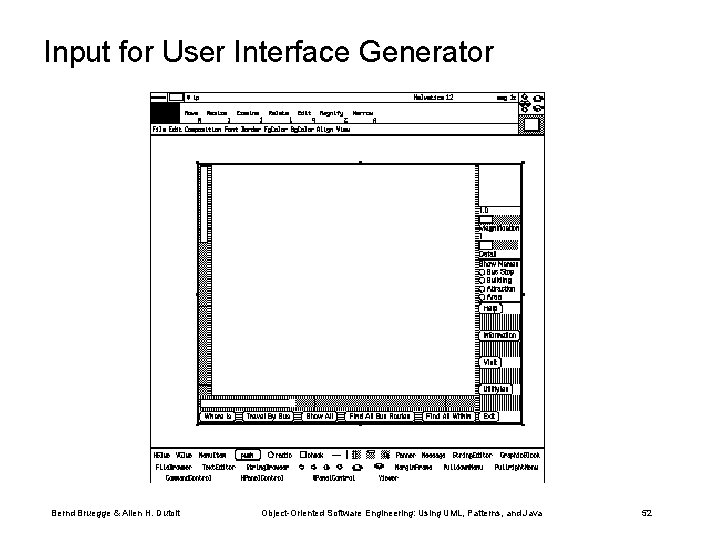
Input for User Interface Generator Bernd Bruegge & Allen H. Dutoit Object-Oriented Software Engineering: Using UML, Patterns, and Java 52
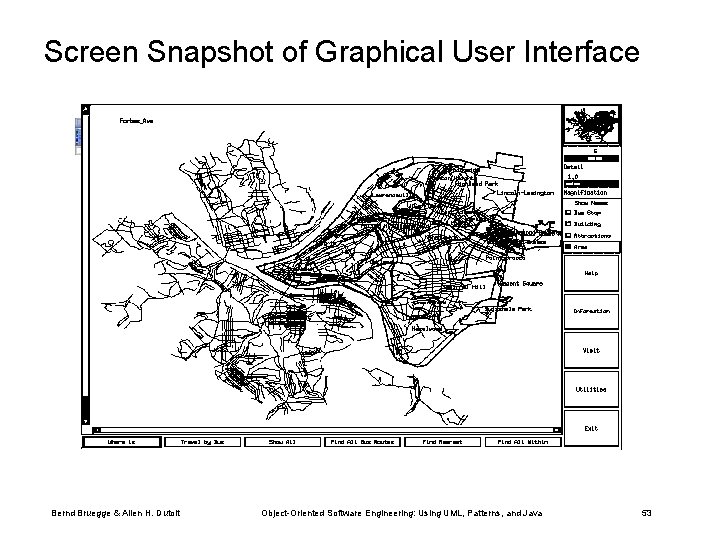
Screen Snapshot of Graphical User Interface Bernd Bruegge & Allen H. Dutoit Object-Oriented Software Engineering: Using UML, Patterns, and Java 53
UML can model more than Software Systems • UML has been designed to model software artifacts. • However, UML is a modeling language that can be used to model a variety of phenomena • projects and processes, even philosophical systems. • The models for projects and processes used in the book are models intended for communication. Bernd Bruegge & Allen H. Dutoit Object-Oriented Software Engineering: Using UML, Patterns, and Java 54
- Slides: 54