
Using UML Patterns and Java ObjectOriented Software Engineering
Using UML, Patterns, and Java Object-Oriented Software Engineering Chapter 8, Object Design Introduction to Design Patterns
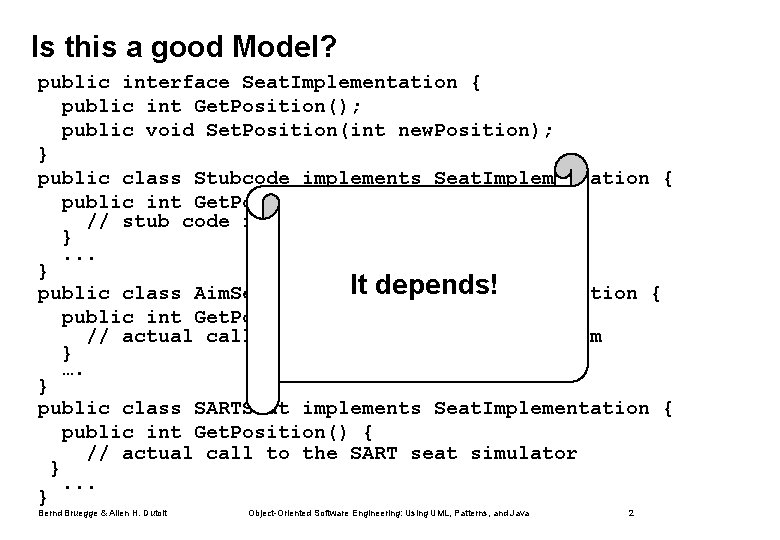
Is this a good Model? public interface Seat. Implementation { public int Get. Position(); public void Set. Position(int new. Position); } public class Stubcode implements Seat. Implementation { public int Get. Position() { // stub code for Get. Position }. . . } It depends! public class Aim. Seat implements Seat. Implementation { public int Get. Position() { // actual call to the AIM simulation system } …. } public class SARTSeat implements Seat. Implementation { public int Get. Position() { // actual call to the SART seat simulator }. . . } Bernd Bruegge & Allen H. Dutoit Object-Oriented Software Engineering: Using UML, Patterns, and Java 2
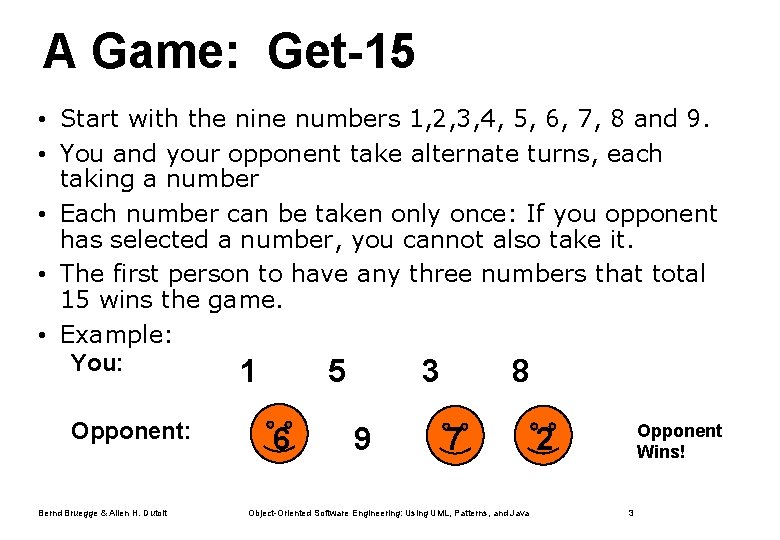
A Game: Get-15 • Start with the nine numbers 1, 2, 3, 4, 5, 6, 7, 8 and 9. • You and your opponent take alternate turns, each taking a number • Each number can be taken only once: If you opponent has selected a number, you cannot also take it. • The first person to have any three numbers that total 15 wins the game. • Example: You: 1 5 3 8 Opponent: Bernd Bruegge & Allen H. Dutoit 6 9 7 Object-Oriented Software Engineering: Using UML, Patterns, and Java Opponent Wins! 2 3
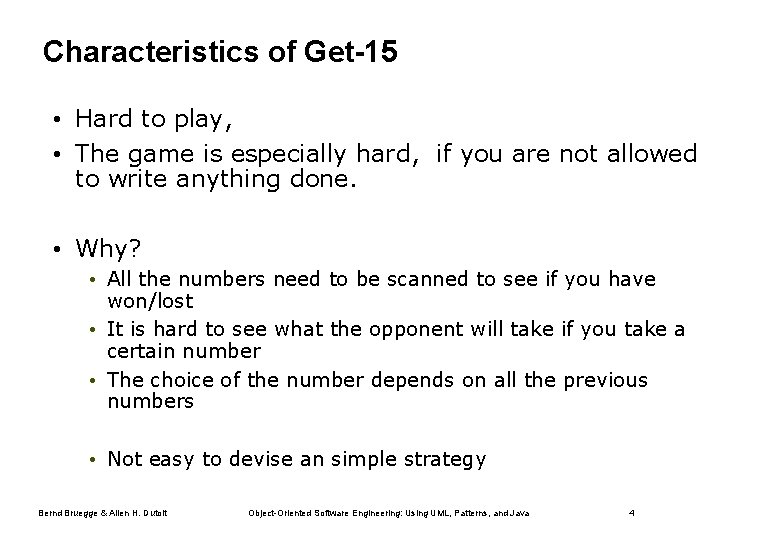
Characteristics of Get-15 • Hard to play, • The game is especially hard, if you are not allowed to write anything done. • Why? • All the numbers need to be scanned to see if you have won/lost • It is hard to see what the opponent will take if you take a certain number • The choice of the number depends on all the previous numbers • Not easy to devise an simple strategy Bernd Bruegge & Allen H. Dutoit Object-Oriented Software Engineering: Using UML, Patterns, and Java 4

Another Game: Tic-Tac-Toe Source: http: //boulter. com/ttt/index. cgi Bernd Bruegge & Allen H. Dutoit Object-Oriented Software Engineering: Using UML, Patterns, and Java 5
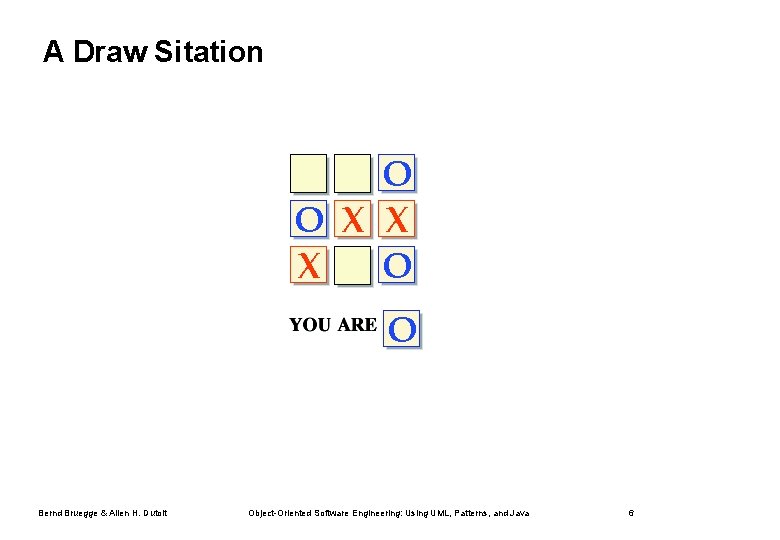
A Draw Sitation Bernd Bruegge & Allen H. Dutoit Object-Oriented Software Engineering: Using UML, Patterns, and Java 6
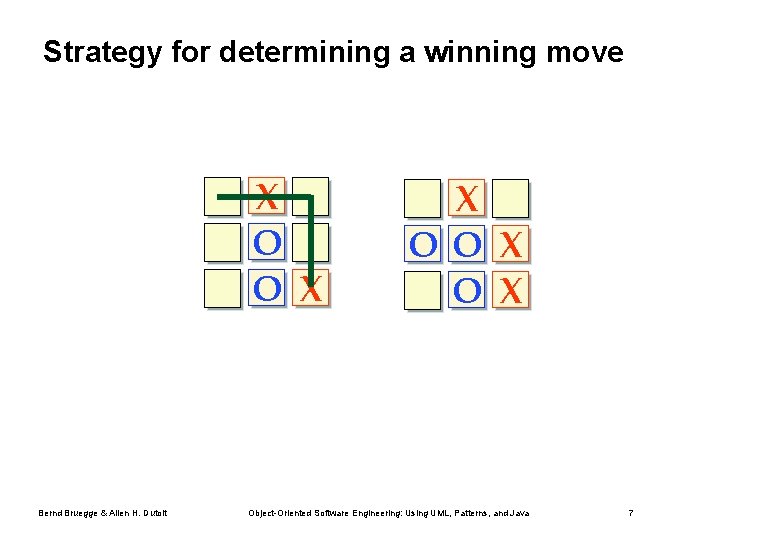
Strategy for determining a winning move Bernd Bruegge & Allen H. Dutoit Object-Oriented Software Engineering: Using UML, Patterns, and Java 7
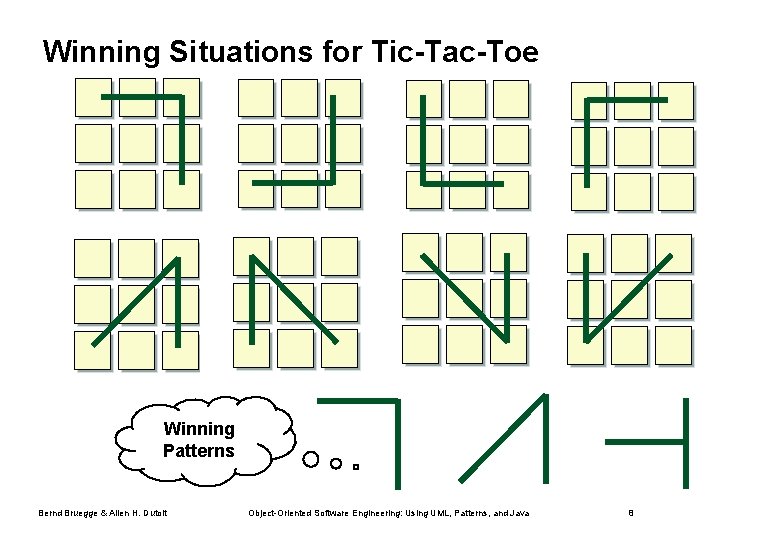
Winning Situations for Tic-Tac-Toe Winning Patterns Bernd Bruegge & Allen H. Dutoit Object-Oriented Software Engineering: Using UML, Patterns, and Java 8
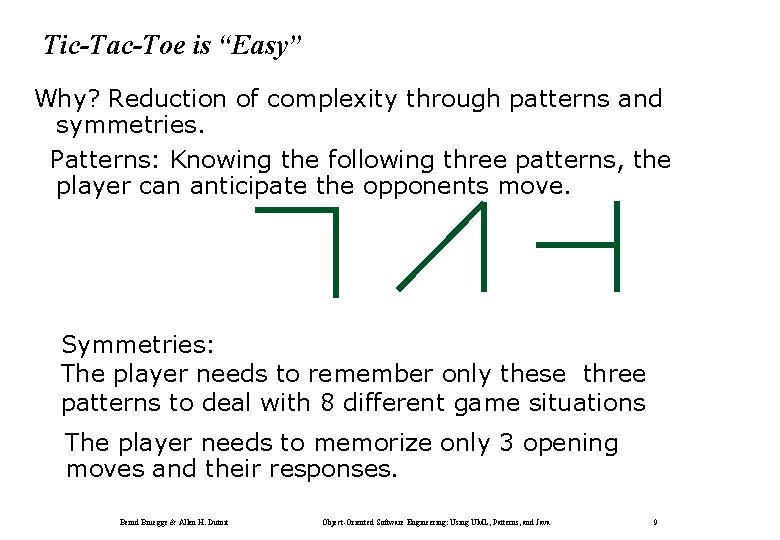
Tic-Tac-Toe is “Easy” Why? Reduction of complexity through patterns and symmetries. Patterns: Knowing the following three patterns, the player can anticipate the opponents move. Symmetries: The player needs to remember only these three patterns to deal with 8 different game situations The player needs to memorize only 3 opening moves and their responses. Bernd Bruegge & Allen H. Dutoit Object-Oriented Software Engineering: Using UML, Patterns, and Java 9
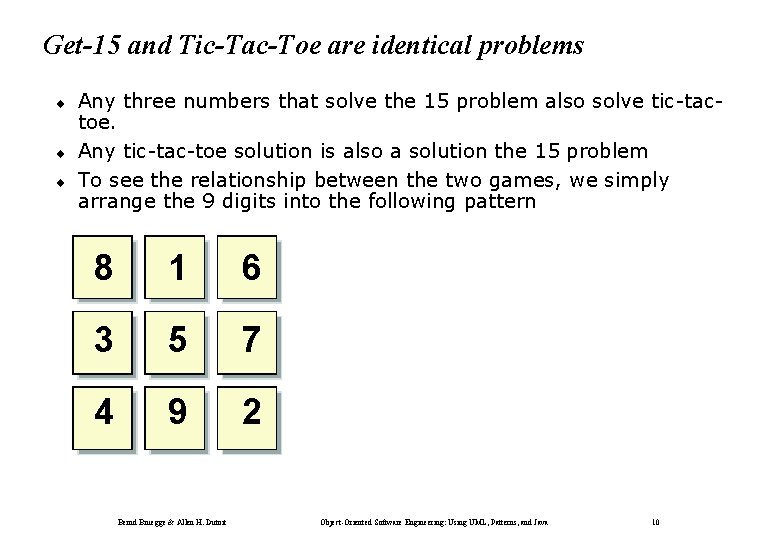
Get-15 and Tic-Tac-Toe are identical problems ¨ ¨ ¨ Any three numbers that solve the 15 problem also solve tic-tactoe. Any tic-tac-toe solution is also a solution the 15 problem To see the relationship between the two games, we simply arrange the 9 digits into the following pattern 8 1 6 3 5 7 4 9 2 Bernd Bruegge & Allen H. Dutoit Object-Oriented Software Engineering: Using UML, Patterns, and Java 10
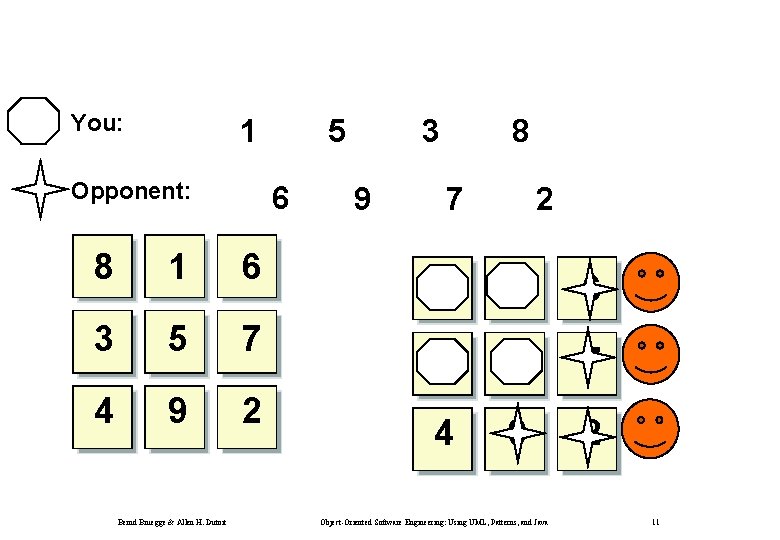
You: 1 Opponent: 6 8 1 6 3 5 7 4 9 2 Bernd Bruegge & Allen H. Dutoit 5 3 9 8 7 2 8 1 6 3 5 7 4 9 2 Object-Oriented Software Engineering: Using UML, Patterns, and Java 11
• During Object Modeling we do many transformations and changes to the object model • It is important to make sure the object design model stays simple! • In the next two lectures we show to use design patterns to keep system models simple. Bernd Bruegge & Allen H. Dutoit Object-Oriented Software Engineering: Using UML, Patterns, and Java 12
Modeling Heuristics • Modeling must address our mental limitations: • Our short-term memory has only limited capacity (7+-2) • Good models deal with this limitation, because they… • … do not tax the mind • A good model requires only a minimal mental effort to understand • … reduce complexity • Turn complex tasks into easy ones (by good choice of representation) • Use of symmetries • … use abstractions • taxonomies • … have organizational structure: • Memory limitations are overcome with an appropriate representation (“natural model”). Bernd Bruegge & Allen H. Dutoit Object-Oriented Software Engineering: Using UML, Patterns, and Java 13
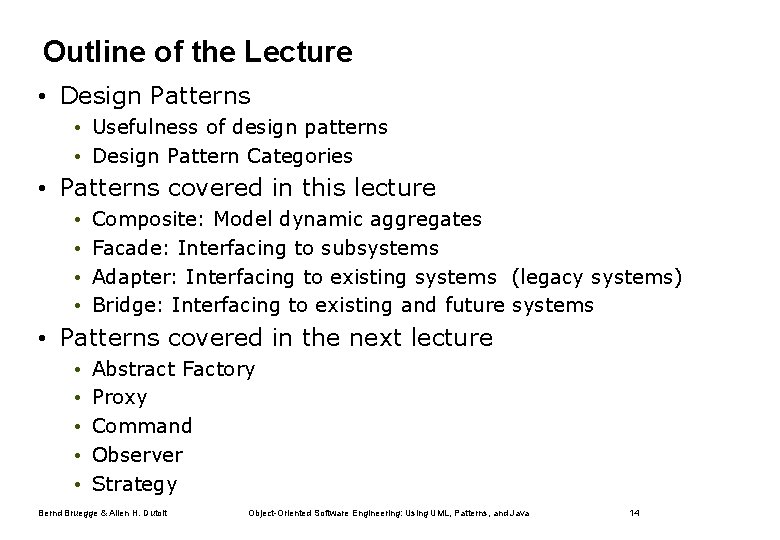
Outline of the Lecture • Design Patterns • Usefulness of design patterns • Design Pattern Categories • Patterns covered in this lecture • • Composite: Model dynamic aggregates Facade: Interfacing to subsystems Adapter: Interfacing to existing systems (legacy systems) Bridge: Interfacing to existing and future systems • Patterns covered in the next lecture • • • Abstract Factory Proxy Command Observer Strategy Bernd Bruegge & Allen H. Dutoit Object-Oriented Software Engineering: Using UML, Patterns, and Java 14
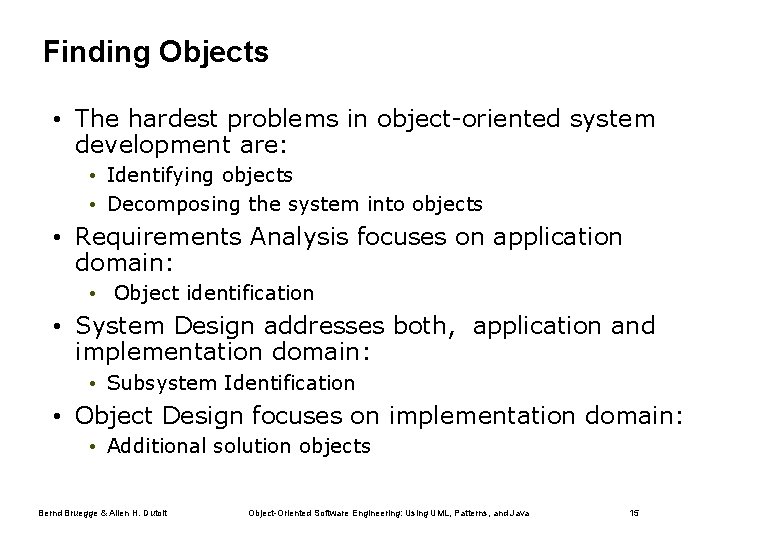
Finding Objects • The hardest problems in object-oriented system development are: • Identifying objects • Decomposing the system into objects • Requirements Analysis focuses on application domain: • Object identification • System Design addresses both, application and implementation domain: • Subsystem Identification • Object Design focuses on implementation domain: • Additional solution objects Bernd Bruegge & Allen H. Dutoit Object-Oriented Software Engineering: Using UML, Patterns, and Java 15
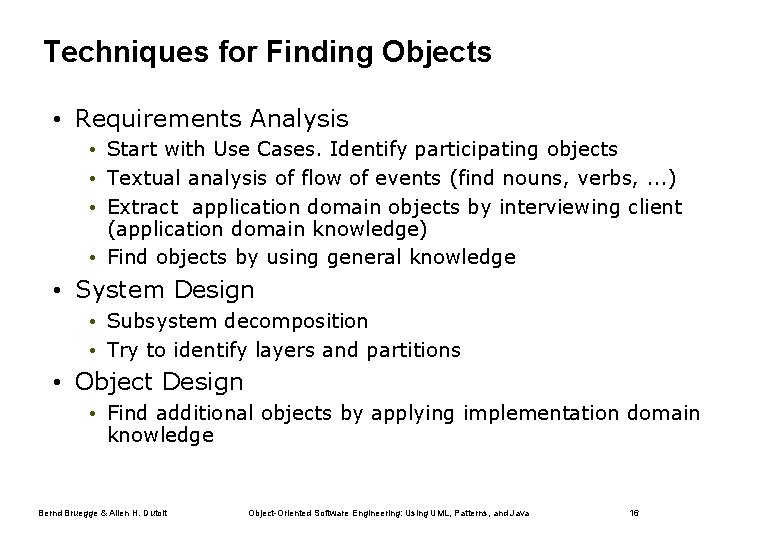
Techniques for Finding Objects • Requirements Analysis • Start with Use Cases. Identify participating objects • Textual analysis of flow of events (find nouns, verbs, . . . ) • Extract application domain objects by interviewing client (application domain knowledge) • Find objects by using general knowledge • System Design • Subsystem decomposition • Try to identify layers and partitions • Object Design • Find additional objects by applying implementation domain knowledge Bernd Bruegge & Allen H. Dutoit Object-Oriented Software Engineering: Using UML, Patterns, and Java 16
Another Source for Finding Objects : Design Patterns • What are Design Patterns? • A design pattern describes a problem which occurs over and over again in our environment • Then it describes the core of the solution to that problem, in such a way that you can use this solution a million times over, without ever doing it the same twice Bernd Bruegge & Allen H. Dutoit Object-Oriented Software Engineering: Using UML, Patterns, and Java 17
What is common between these definitions? • Definition Software System • A software system consists of subsystems which are either other subsystems or collection of classes • Definition Software Lifecycle: • The software lifecycle consists of a set of development activities which are either other actitivies or collection of tasks Bernd Bruegge & Allen H. Dutoit Object-Oriented Software Engineering: Using UML, Patterns, and Java 18
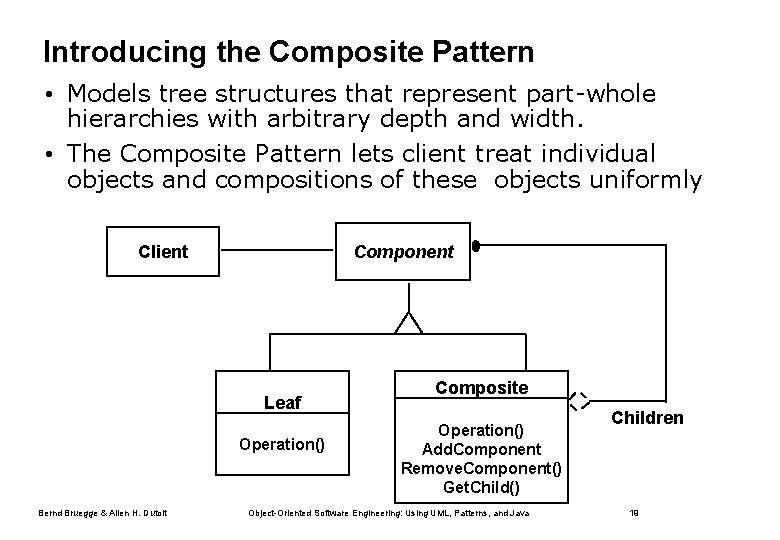
Introducing the Composite Pattern • Models tree structures that represent part-whole hierarchies with arbitrary depth and width. • The Composite Pattern lets client treat individual objects and compositions of these objects uniformly Client Component Leaf Operation() Bernd Bruegge & Allen H. Dutoit Composite Operation() Add. Component Remove. Component() Get. Child() Object-Oriented Software Engineering: Using UML, Patterns, and Java Children 19
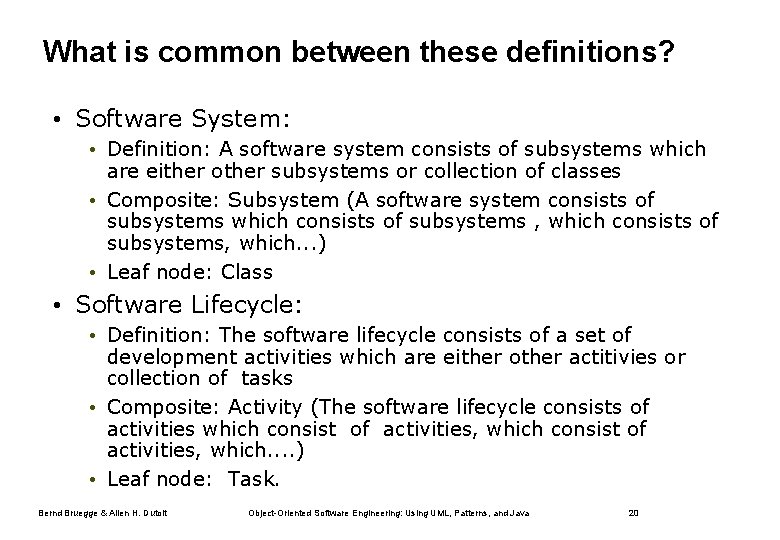
What is common between these definitions? • Software System: • Definition: A software system consists of subsystems which are either other subsystems or collection of classes • Composite: Subsystem (A software system consists of subsystems which consists of subsystems , which consists of subsystems, which. . . ) • Leaf node: Class • Software Lifecycle: • Definition: The software lifecycle consists of a set of development activities which are either other actitivies or collection of tasks • Composite: Activity (The software lifecycle consists of activities which consist of activities, which. . ) • Leaf node: Task. Bernd Bruegge & Allen H. Dutoit Object-Oriented Software Engineering: Using UML, Patterns, and Java 20
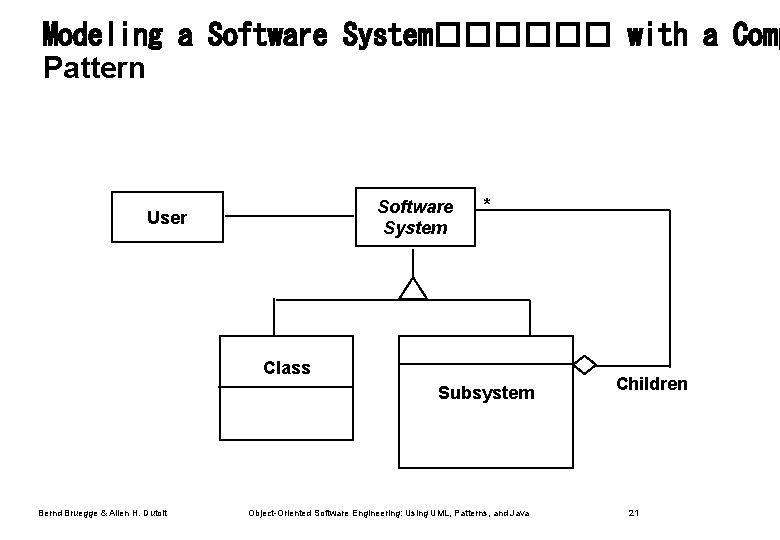
Modeling a Software System������ with a Comp Pattern Software System User * Class Subsystem Bernd Bruegge & Allen H. Dutoit Object-Oriented Software Engineering: Using UML, Patterns, and Java Children 21
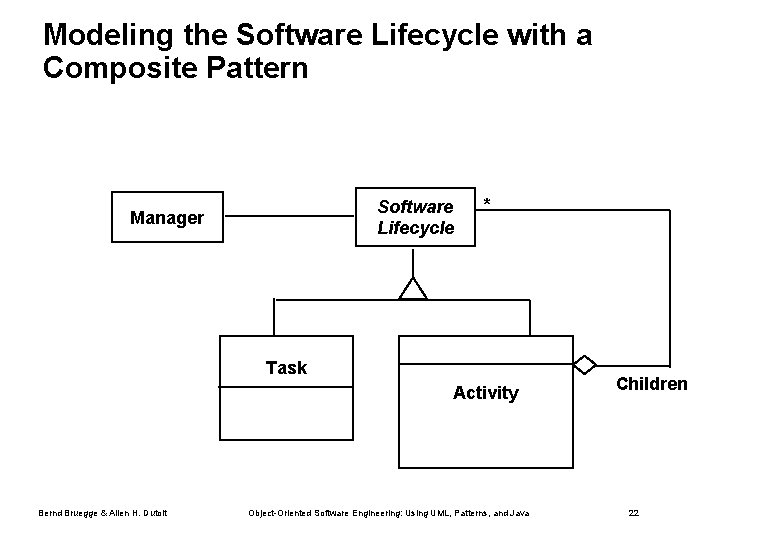
Modeling the Software Lifecycle with a Composite Pattern Software Lifecycle Manager * Task Activity Bernd Bruegge & Allen H. Dutoit Object-Oriented Software Engineering: Using UML, Patterns, and Java Children 22
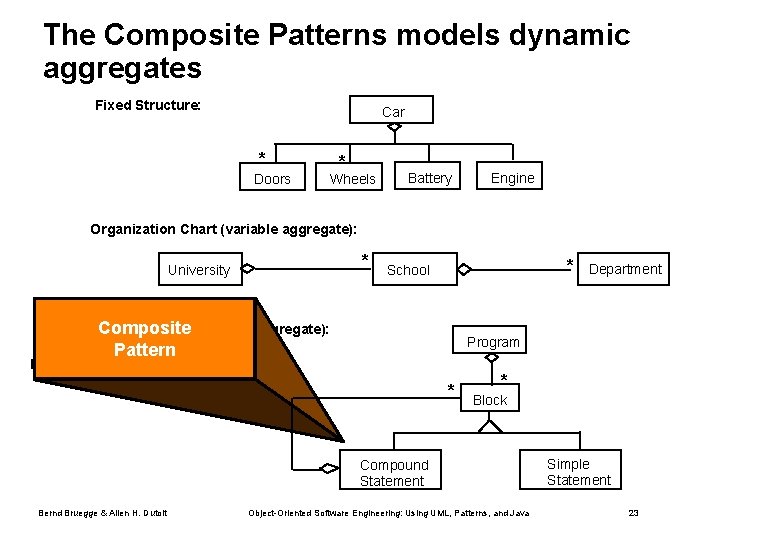
The Composite Patterns models dynamic aggregates Fixed Structure: Car * Doors * Wheels Battery Engine Organization Chart (variable aggregate): * University * School Dynamic tree (recursive aggregate): Composite Program Pattern Dynamic tree (recursive aggregate): * * Block Compound Statement Bernd Bruegge & Allen H. Dutoit Department Object-Oriented Software Engineering: Using UML, Patterns, and Java Simple Statement 23
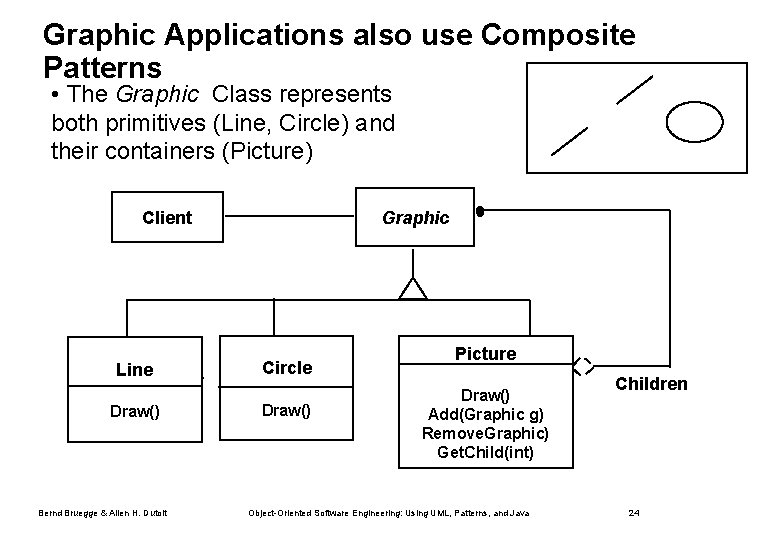
Graphic Applications also use Composite Patterns • The Graphic Class represents both primitives (Line, Circle) and their containers (Picture) Client Line Draw() Bernd Bruegge & Allen H. Dutoit Graphic Circle Draw() Picture Draw() Add(Graphic g) Remove. Graphic) Get. Child(int) Object-Oriented Software Engineering: Using UML, Patterns, and Java Children 24
Bernd Bruegge & Allen H. Dutoit Object-Oriented Software Engineering: Using UML, Patterns, and Java 25
Reducing the Complexity of Models • To communicate a complex model we use navigation and reduction of complexity • We do not simply use a picture from the CASE tool and dump it in front of the user • The key is navigate through the model so the user can follow it • We start with a very simple model • Start with the key abstractions • Then decorate the model with additional classes • To reduce the complexity of the model further, we • Look for inheritance (taxonomies) • If the model is still too complex, we show subclasses on a separate slide • Then we identify or introduce patterns in the model • We make sure to use the name of the patterns. Bernd Bruegge & Allen H. Dutoit Object-Oriented Software Engineering: Using UML, Patterns, and Java 26
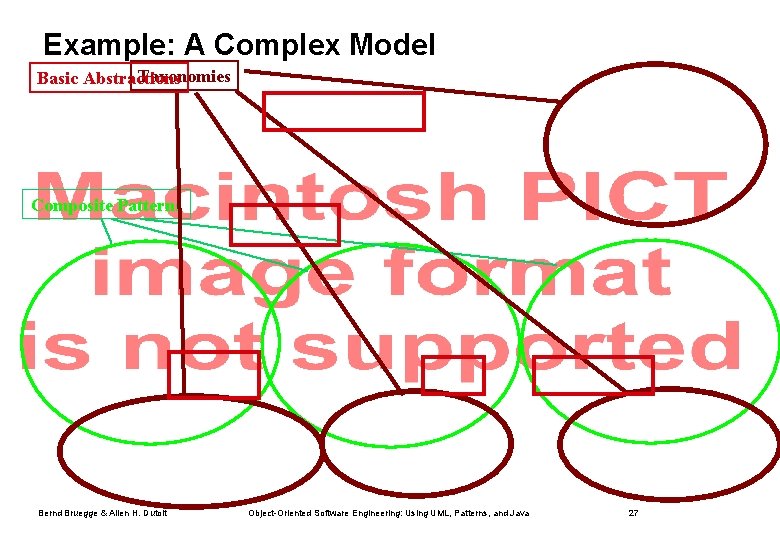
Example: A Complex Model Taxonomies Basic Abstractions Composite Patterns Bernd Bruegge & Allen H. Dutoit Object-Oriented Software Engineering: Using UML, Patterns, and Java 27
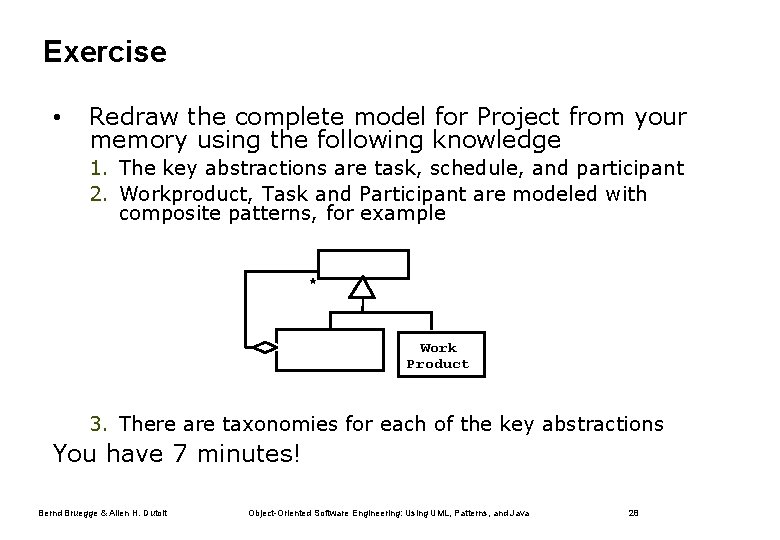
Exercise • Redraw the complete model for Project from your memory using the following knowledge 1. The key abstractions are task, schedule, and participant 2. Workproduct, Task and Participant are modeled with composite patterns, for example * Work Product 3. There are taxonomies for each of the key abstractions You have 7 minutes! Bernd Bruegge & Allen H. Dutoit Object-Oriented Software Engineering: Using UML, Patterns, and Java 28
Many design patterns use a combination of inheritance and delegation Bernd Bruegge & Allen H. Dutoit Object-Oriented Software Engineering: Using UML, Patterns, and Java 29
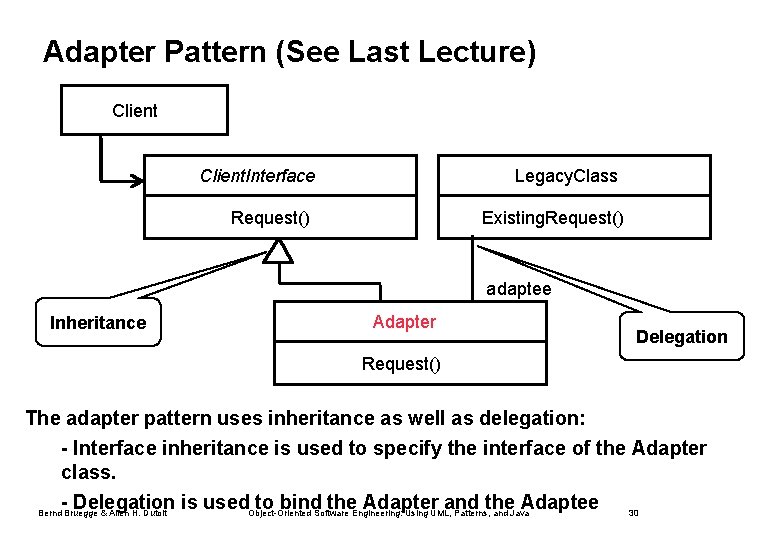
Adapter Pattern (See Last Lecture) Client. Interface Legacy. Class Request() Existing. Request() adaptee Inheritance Adapter Delegation Request() The adapter pattern uses inheritance as well as delegation: - Interface inheritance is used to specify the interface of the Adapter class. - Delegation is used. Object-Oriented to bind. Software the. Engineering: Adapter and the Adaptee 30 Bernd Bruegge & Allen H. Dutoit Using UML, Patterns, and Java
Adapter Pattern • The adapter pattern lets classes work together that couldn’t otherwise because of incompatible interfaces • “Convert the interface of a class into another interface expected by a client class. ” • Used to provide a new interface to existing legacy components (Interface engineering, reengineering). • Two adapter patterns: • Class adapter: • Uses multiple inheritance to adapt one interface to another • Object adapter: • Uses single inheritance and delegation • Object adapters are much more frequent. • We cover only object adapters (and call them adapters). Bernd Bruegge & Allen H. Dutoit Object-Oriented Software Engineering: Using UML, Patterns, and Java 31
More Patterns Bernd Bruegge & Allen H. Dutoit Object-Oriented Software Engineering: Using UML, Patterns, and Java 32
Bridge Pattern • Use a bridge to “decouple an abstraction from its implementation so that the two can vary independently” (From [Gamma et al 1995]) • Also know as a Handle/Body pattern • Allows different implementations of an interface to be decided upon dynamically. Bernd Bruegge & Allen H. Dutoit Object-Oriented Software Engineering: Using UML, Patterns, and Java 33
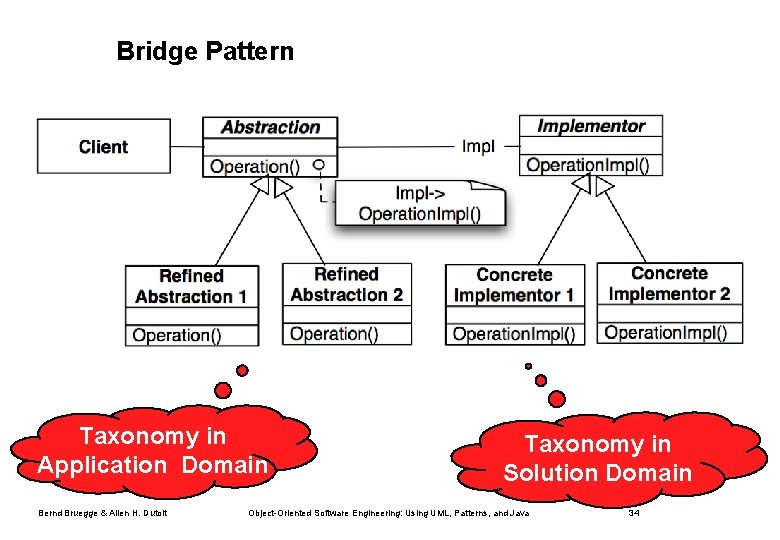
Bridge Pattern Taxonomy in Application Domain Bernd Bruegge & Allen H. Dutoit Taxonomy in Solution Domain Object-Oriented Software Engineering: Using UML, Patterns, and Java 34
Why the Name Bridge Pattern? Taxonomy in Application Domain Bernd Bruegge & Allen H. Dutoit Taxonomy in Solution Domain Object-Oriented Software Engineering: Using UML, Patterns, and Java 35
Motivation for the Bridge Pattern • Decouples an abstraction from its implementation so that the two can vary independently • This allows to bind one from many different implementations of an interface to a client dynamically • Design decision that can be realized any time during the runtime of the system • However, usually the binding occurs at start up time of the system (e. g. in the constructor of the interface class) Bernd Bruegge & Allen H. Dutoit Object-Oriented Software Engineering: Using UML, Patterns, and Java 36
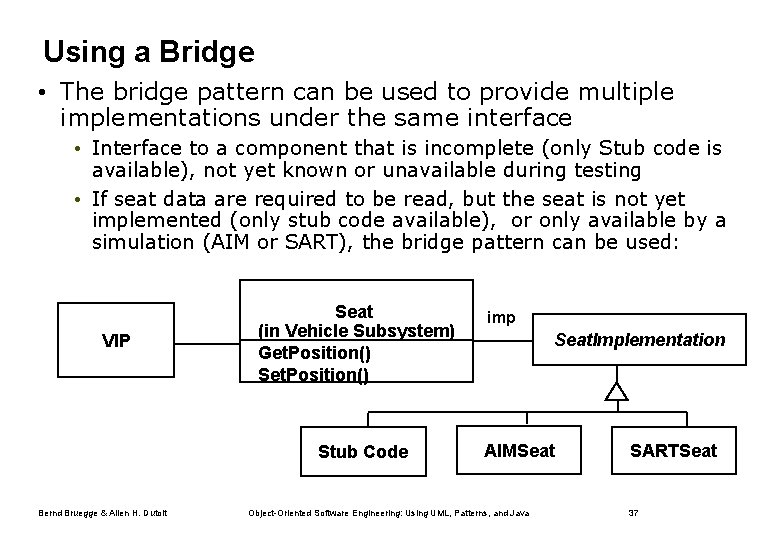
Using a Bridge • The bridge pattern can be used to provide multiple implementations under the same interface • Interface to a component that is incomplete (only Stub code is available), not yet known or unavailable during testing • If seat data are required to be read, but the seat is not yet implemented (only stub code available), or only available by a simulation (AIM or SART), the bridge pattern can be used: VIP Seat (in Vehicle Subsystem) Get. Position() Stub Code Bernd Bruegge & Allen H. Dutoit imp Seat. Implementation AIMSeat Object-Oriented Software Engineering: Using UML, Patterns, and Java SARTSeat 37
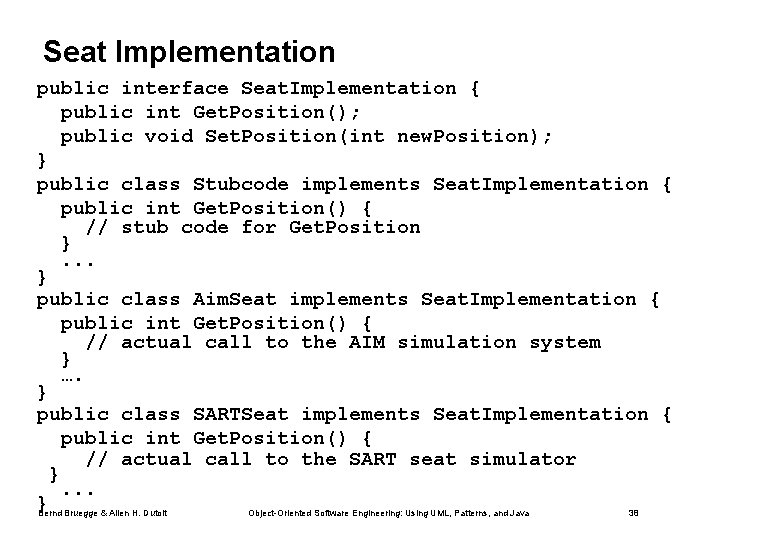
Seat Implementation public interface Seat. Implementation { public int Get. Position(); public void Set. Position(int new. Position); } public class Stubcode implements Seat. Implementation { public int Get. Position() { // stub code for Get. Position }. . . } public class Aim. Seat implements Seat. Implementation { public int Get. Position() { // actual call to the AIM simulation system } …. } public class SARTSeat implements Seat. Implementation { public int Get. Position() { // actual call to the SART seat simulator }. . . } Bernd Bruegge & Allen H. Dutoit Object-Oriented Software Engineering: Using UML, Patterns, and Java 38
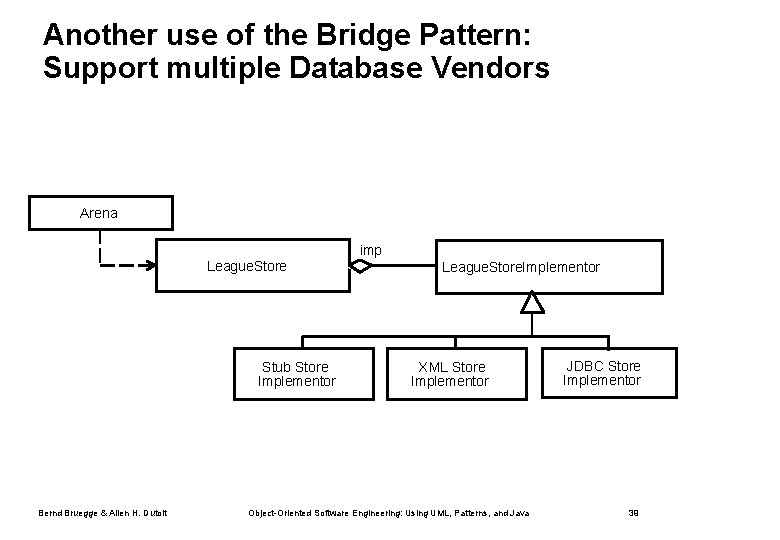
Another use of the Bridge Pattern: Support multiple Database Vendors Arena League. Store Stub Store Implementor Bernd Bruegge & Allen H. Dutoit imp League. Store. Implementor XML Store Implementor Object-Oriented Software Engineering: Using UML, Patterns, and Java JDBC Store Implementor 39
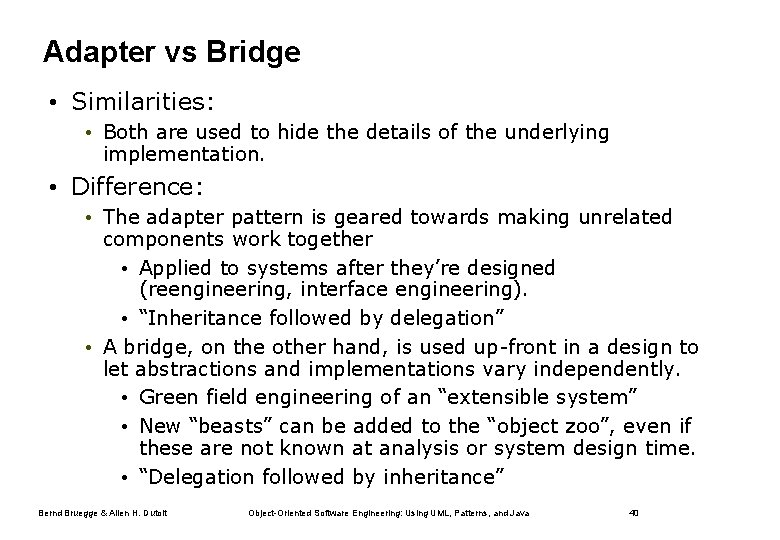
Adapter vs Bridge • Similarities: • Both are used to hide the details of the underlying implementation. • Difference: • The adapter pattern is geared towards making unrelated components work together • Applied to systems after they’re designed (reengineering, interface engineering). • “Inheritance followed by delegation” • A bridge, on the other hand, is used up-front in a design to let abstractions and implementations vary independently. • Green field engineering of an “extensible system” • New “beasts” can be added to the “object zoo”, even if these are not known at analysis or system design time. • “Delegation followed by inheritance” Bernd Bruegge & Allen H. Dutoit Object-Oriented Software Engineering: Using UML, Patterns, and Java 40
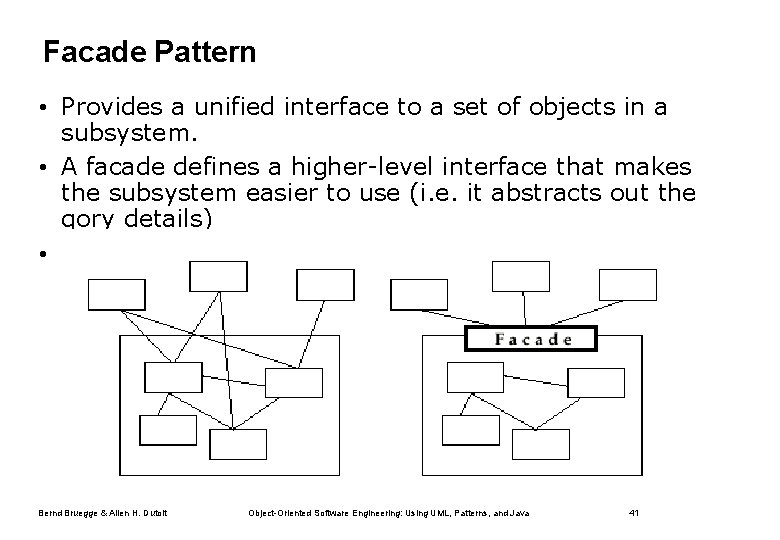
Facade Pattern • Provides a unified interface to a set of objects in a subsystem. • A facade defines a higher-level interface that makes the subsystem easier to use (i. e. it abstracts out the gory details) • Facades allow us to provide a closed architecture Bernd Bruegge & Allen H. Dutoit Object-Oriented Software Engineering: Using UML, Patterns, and Java 41
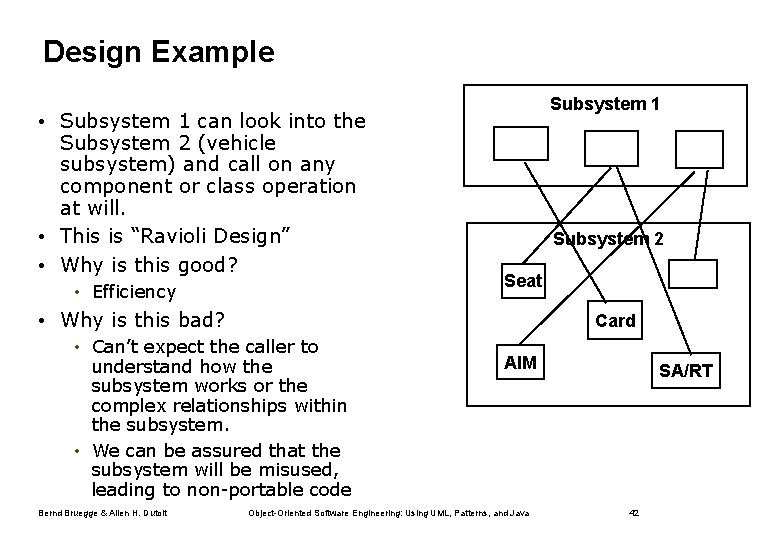
Design Example • Subsystem 1 can look into the Subsystem 2 (vehicle subsystem) and call on any component or class operation at will. • This is “Ravioli Design” • Why is this good? • Efficiency Subsystem 1 Subsystem 2 Seat • Why is this bad? Card • Can’t expect the caller to understand how the subsystem works or the complex relationships within the subsystem. • We can be assured that the subsystem will be misused, leading to non-portable code Bernd Bruegge & Allen H. Dutoit AIM Object-Oriented Software Engineering: Using UML, Patterns, and Java SA/RT 42
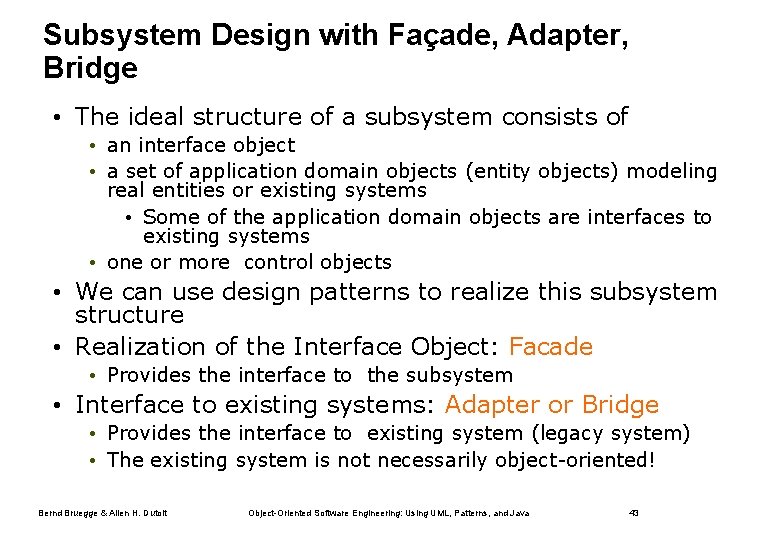
Subsystem Design with Façade, Adapter, Bridge • The ideal structure of a subsystem consists of • an interface object • a set of application domain objects (entity objects) modeling real entities or existing systems • Some of the application domain objects are interfaces to existing systems • one or more control objects • We can use design patterns to realize this subsystem structure • Realization of the Interface Object: Facade • Provides the interface to the subsystem • Interface to existing systems: Adapter or Bridge • Provides the interface to existing system (legacy system) • The existing system is not necessarily object-oriented! Bernd Bruegge & Allen H. Dutoit Object-Oriented Software Engineering: Using UML, Patterns, and Java 43
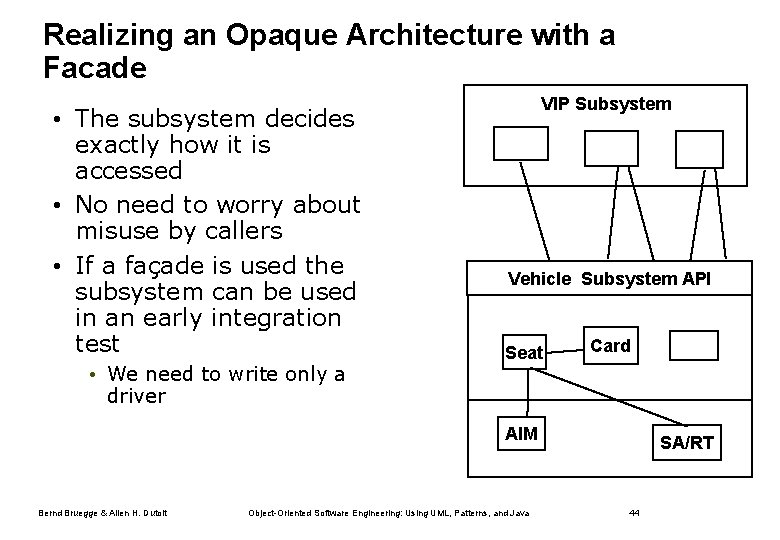
Realizing an Opaque Architecture with a Facade • The subsystem decides exactly how it is accessed • No need to worry about misuse by callers • If a façade is used the subsystem can be used in an early integration test • We need to write only a driver VIP Subsystem Vehicle Subsystem API Seat Card AIM Bernd Bruegge & Allen H. Dutoit Object-Oriented Software Engineering: Using UML, Patterns, and Java SA/RT 44
When should you use these Design Patterns? • A façade should be offered by all subsystems in a software system who a services • The façade delegates requests to the appropriate components within the subsystem. The façade usually does not have to be changed, when the components are changed • The adapter design pattern should be used to interface to existing components • Example: A smart card software system should use an adapter for a smart card reader from a specific manufacturer • The bridge design pattern should be used to interface to a set of objects • where the full set of objects is not completely known at analysis or design time. • when a subsystem or component must be replaced later after the system has been deployed and client programs use it in the field. Bernd Bruegge & Allen H. Dutoit Object-Oriented Software Engineering: Using UML, Patterns, and Java 45
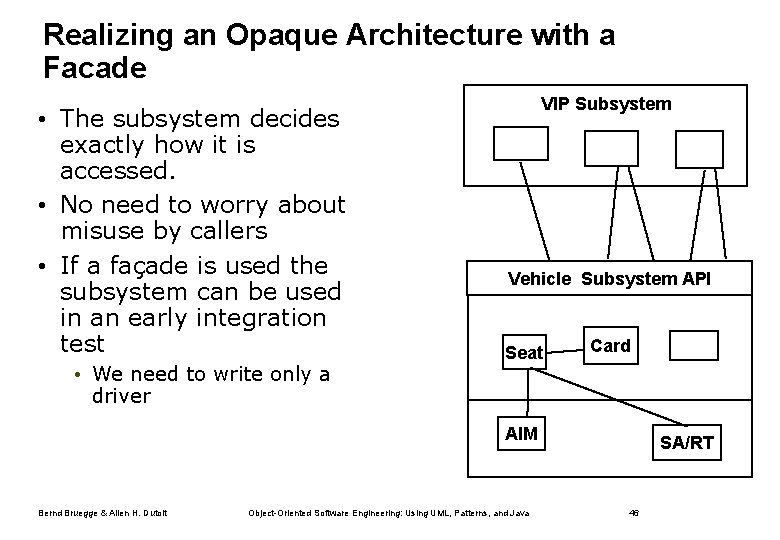
Realizing an Opaque Architecture with a Facade • The subsystem decides exactly how it is accessed. • No need to worry about misuse by callers • If a façade is used the subsystem can be used in an early integration test • We need to write only a driver VIP Subsystem Vehicle Subsystem API Seat Card AIM Bernd Bruegge & Allen H. Dutoit Object-Oriented Software Engineering: Using UML, Patterns, and Java SA/RT 46
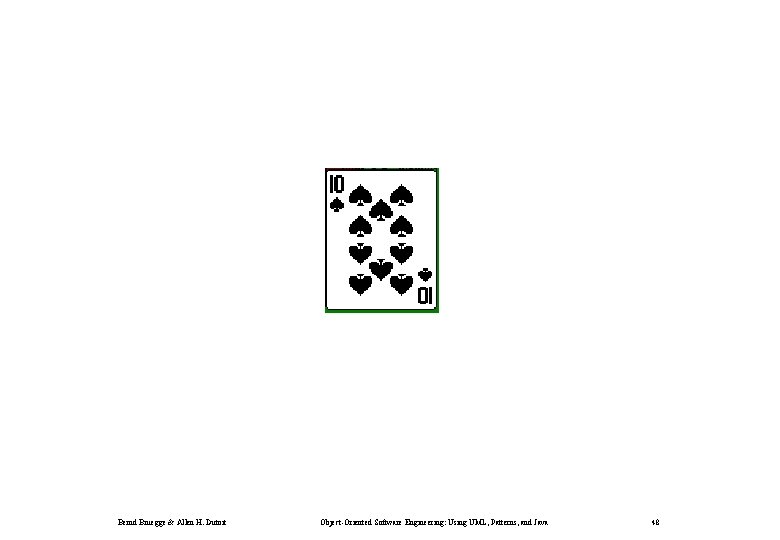
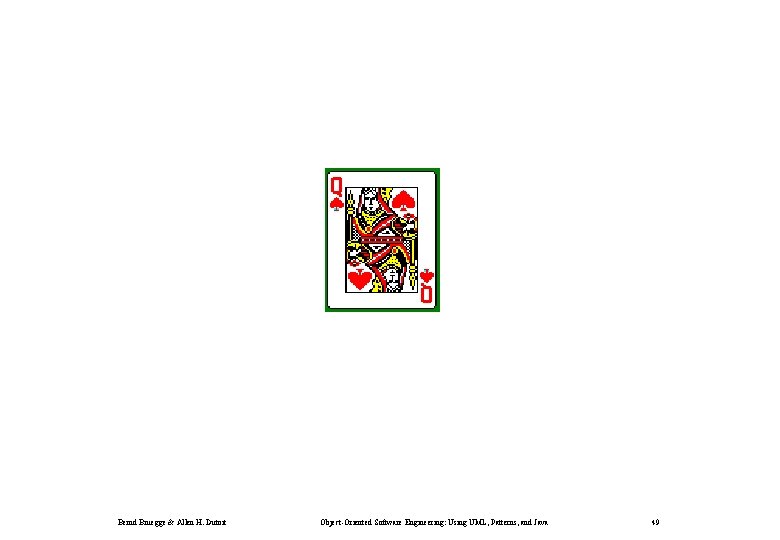
Patterns are not the cure for everything • What is wrong in the following pictures? Bernd Bruegge & Allen H. Dutoit Object-Oriented Software Engineering: Using UML, Patterns, and Java 47
Bernd Bruegge & Allen H. Dutoit Object-Oriented Software Engineering: Using UML, Patterns, and Java 48
Bernd Bruegge & Allen H. Dutoit Object-Oriented Software Engineering: Using UML, Patterns, and Java 49
Bernd Bruegge & Allen H. Dutoit Object-Oriented Software Engineering: Using UML, Patterns, and Java 50
Bernd Bruegge & Allen H. Dutoit Object-Oriented Software Engineering: Using UML, Patterns, and Java 51
Bernd Bruegge & Allen H. Dutoit Object-Oriented Software Engineering: Using UML, Patterns, and Java 52
Summary • Design patterns are partial solutions to common problems such as • such as separating an interface from a number of alternate implementations • wrapping around a set of legacy classes • protecting a caller from changes associated with specific platforms • A design pattern consists of a small number of classes • uses delegation and inheritance • provides a modifiable design solution • These classes can be adapted and refined for the specific system under construction • Customization of the system • Reuse of existing solutions. Bernd Bruegge & Allen H. Dutoit Object-Oriented Software Engineering: Using UML, Patterns, and Java 54
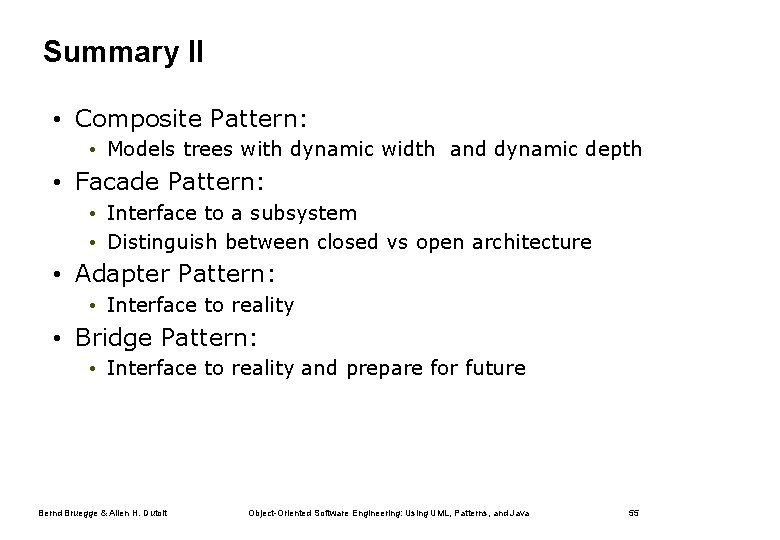
Summary II • Composite Pattern: • Models trees with dynamic width and dynamic depth • Facade Pattern: • Interface to a subsystem • Distinguish between closed vs open architecture • Adapter Pattern: • Interface to reality • Bridge Pattern: • Interface to reality and prepare for future Bernd Bruegge & Allen H. Dutoit Object-Oriented Software Engineering: Using UML, Patterns, and Java 55
Additional Slides Bernd Bruegge & Allen H. Dutoit Object-Oriented Software Engineering: Using UML, Patterns, and Java 56
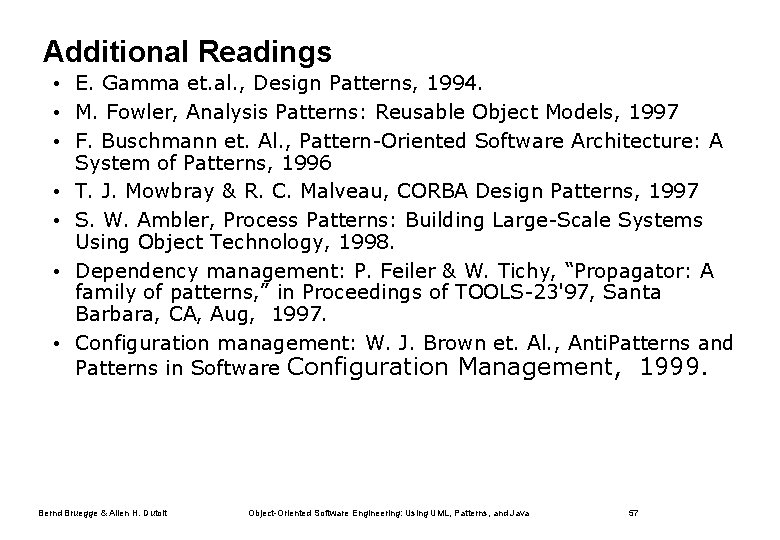
Additional Readings • E. Gamma et. al. , Design Patterns, 1994. • M. Fowler, Analysis Patterns: Reusable Object Models, 1997 • F. Buschmann et. Al. , Pattern-Oriented Software Architecture: A System of Patterns, 1996 • T. J. Mowbray & R. C. Malveau, CORBA Design Patterns, 1997 • S. W. Ambler, Process Patterns: Building Large-Scale Systems Using Object Technology, 1998. • Dependency management: P. Feiler & W. Tichy, “Propagator: A family of patterns, ” in Proceedings of TOOLS-23'97, Santa Barbara, CA, Aug, 1997. • Configuration management: W. J. Brown et. Al. , Anti. Patterns and Patterns in Software Configuration Management, 1999. Bernd Bruegge & Allen H. Dutoit Object-Oriented Software Engineering: Using UML, Patterns, and Java 57
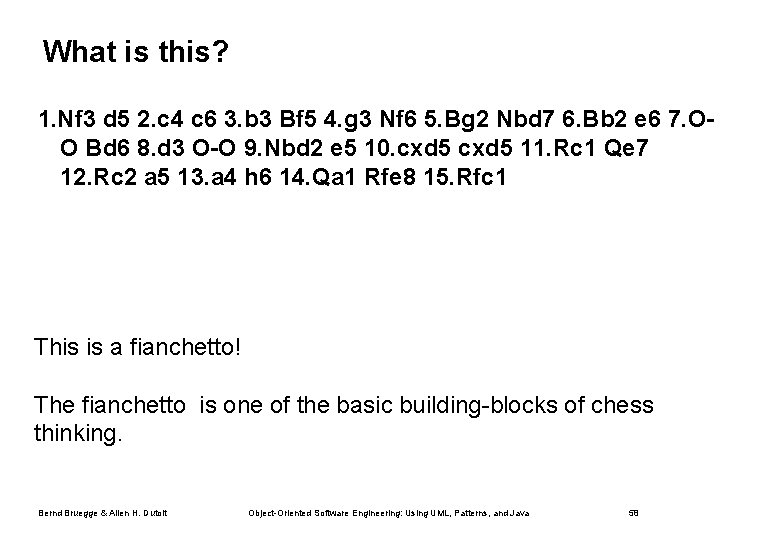
What is this? 1. Nf 3 d 5 2. c 4 c 6 3. b 3 Bf 5 4. g 3 Nf 6 5. Bg 2 Nbd 7 6. Bb 2 e 6 7. OO Bd 6 8. d 3 O-O 9. Nbd 2 e 5 10. cxd 5 11. Rc 1 Qe 7 12. Rc 2 a 5 13. a 4 h 6 14. Qa 1 Rfe 8 15. Rfc 1 This is a fianchetto! The fianchetto is one of the basic building-blocks of chess thinking. Bernd Bruegge & Allen H. Dutoit Object-Oriented Software Engineering: Using UML, Patterns, and Java 58
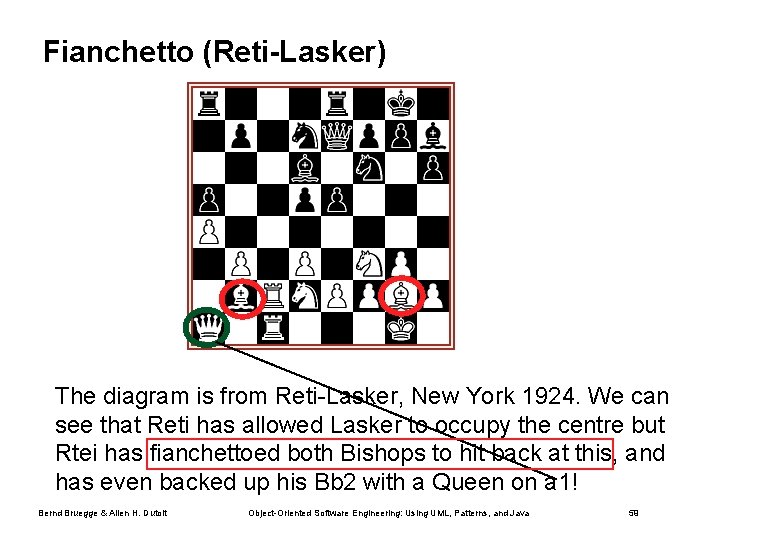
Fianchetto (Reti-Lasker) The diagram is from Reti-Lasker, New York 1924. We can see that Reti has allowed Lasker to occupy the centre but Rtei has fianchettoed both Bishops to hit back at this, and has even backed up his Bb 2 with a Queen on a 1! Bernd Bruegge & Allen H. Dutoit Object-Oriented Software Engineering: Using UML, Patterns, and Java 59
Additional Design Heuristics • Never use implementation inheritance, always use interface inheritance • A subclass should never hide operations implemented in a superclass • If you are tempted to use implementation inheritance, use delegation instead Bernd Bruegge & Allen H. Dutoit Object-Oriented Software Engineering: Using UML, Patterns, and Java 60
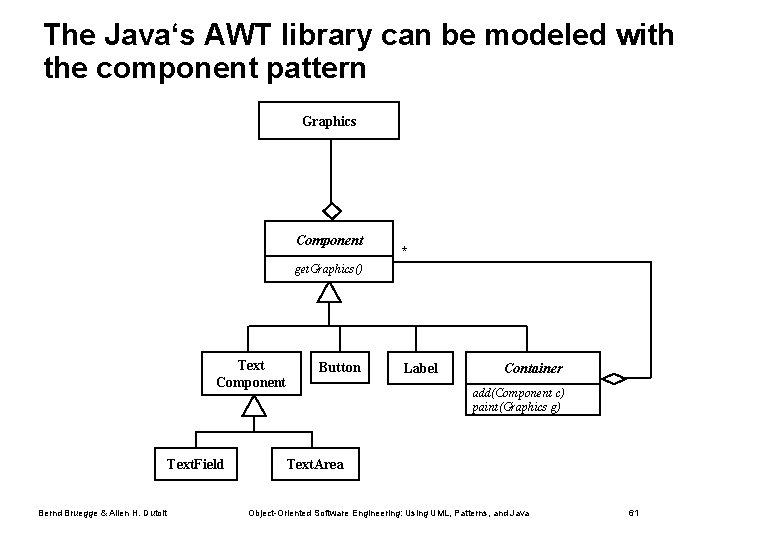
The Java‘s AWT library can be modeled with the component pattern Graphics Component * get. Graphics() Text Component Text. Field Bernd Bruegge & Allen H. Dutoit Button Label Container add(Component c) paint(Graphics g) Text. Area Object-Oriented Software Engineering: Using UML, Patterns, and Java 61
Notation used in the Design Patterns Book • Erich Gamma, Richard Helm, Ralph Johnson, John Vlissides, Design Patterns: Elements of Reusable Object-Oriented Software, Addison Wesley, 1995 • Based on OMT (a precursor to UML). Notational differences between the OMT notation and UML: Attributes come after the Operations Associations are called acquaintances Multiplicities are shown as solid circles Dashed line: Instantiation Assocation (Class can instantiate objects of associated class) (In UML it denotes a dependency) • UML Note is called Dogear box (connected by dashed line to class operation): Pseudo-code implementation of operation. • • Bernd Bruegge & Allen H. Dutoit Object-Oriented Software Engineering: Using UML, Patterns, and Java 62
Paradigms • Paradigms are like rules • They structure the environment and make them understandable • Information that does not fit into the paradigm is invisible. • Patterns are a special case of paradigms. Bernd Bruegge & Allen H. Dutoit Object-Oriented Software Engineering: Using UML, Patterns, and Java 63
- Slides: 62