
Using UML Patterns and Java ObjectOriented Software Engineering
Using UML, Patterns, and Java Object-Oriented Software Engineering Chapter 3, Project Organization and Communication
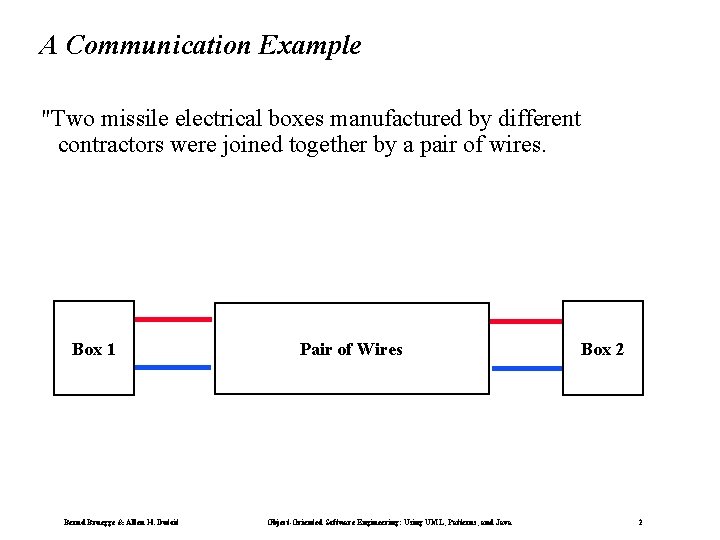
A Communication Example "Two missile electrical boxes manufactured by different contractors were joined together by a pair of wires. Box 1 Bernd Bruegge & Allen H. Dutoit Pair of Wires Object-Oriented Software Engineering: Using UML, Patterns, and Java Box 2 2

A Communication Example (continued) Thanks to a particular thorough preflight check, it was discovered that the wires had been reversed. " Box 1 Bernd Bruegge & Allen H. Dutoit Box 2 Object-Oriented Software Engineering: Using UML, Patterns, and Java 3
After the Crash. . . "The postflight analysis revealed that the contractors had indeed corrected the reversed wires as instructed. " Bernd Bruegge & Allen H. Dutoit Object-Oriented Software Engineering: Using UML, Patterns, and Java 4
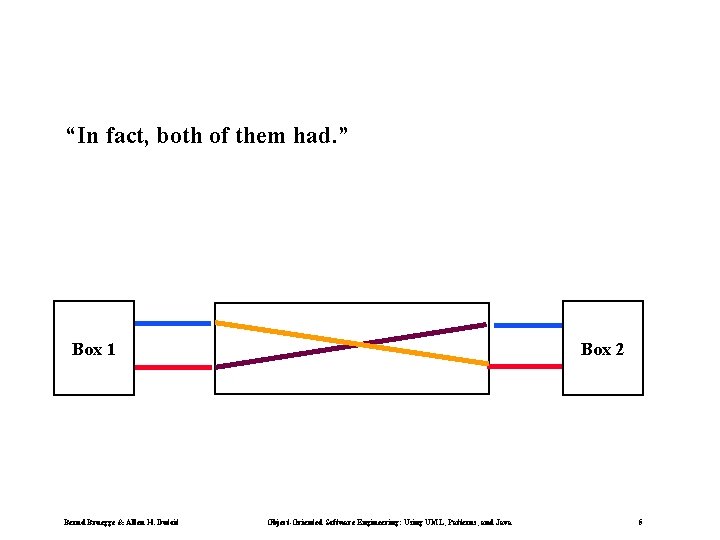
“In fact, both of them had. ” Box 1 Bernd Bruegge & Allen H. Dutoit Box 2 Object-Oriented Software Engineering: Using UML, Patterns, and Java 5
Communication is important In large system development efforts, you will spend more time communicating than coding A software engineer needs to learn the so-called soft skills: technical writing, reading documentation, communication, collaboration, management, presentations. In this course, we ask each of you to (acquire and) demonstrate the following skills: ¨ Management: Run a team meeting ¨ Presentation: Present an major aspect of STARS during its development phase. ¨ Collaboration: Negotiate requirements with the client and with members from your team and other teams. ¨ Technical writing: Write part of the documentation of STARS Bernd Bruegge & Allen H. Dutoit Object-Oriented Software Engineering: Using UML, Patterns, and Java 6
Definitions Communication event ¨ Type of information exchange that has defined objectives and scope ¨ Scheduled: Planned communication (e. g. , review, meeting) ¨ Unscheduled: Event-driven communication (e. g. , request for change, issue clarification, problem report) Communication mechanism ¨ Tool or procedure that can be used to transmit information ¨ Synchronous: Sender and receiver are available at the same time ¨ Asynchronous: Sender and Receiver are not communicating at the same time. Bernd Bruegge & Allen H. Dutoit Object-Oriented Software Engineering: Using UML, Patterns, and Java 7
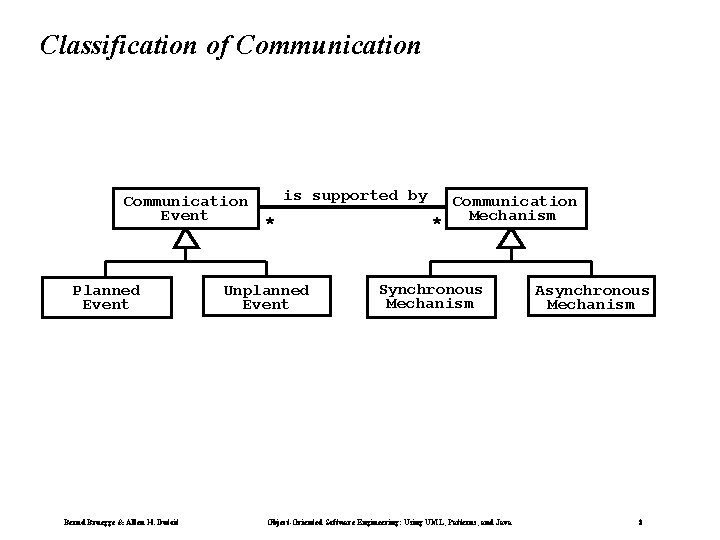
Classification of Communication Event Planned Event Bernd Bruegge & Allen H. Dutoit is supported by * Unplanned Event Communication Mechanism * Synchronous Mechanism Object-Oriented Software Engineering: Using UML, Patterns, and Java Asynchronous Mechanism 8
Planned Communication Events Problem Definition w Objective: Present goals, requirements and constraints w Example: Client Presentation w Usually scheduled at the beginning of a project. Project Review: Focus on system model w Objective: Assess status and review system model, system decomposition, and subsystem interfaces w Examples: Analysis Review, System Design Review w Scheduled around project milestones and deliverables Client Review: Focus on requirements w Objective: Brief client, agree on requirements changes w Client Review w Usually scheduled after analysis phase Bernd Bruegge & Allen H. Dutoit Object-Oriented Software Engineering: Using UML, Patterns, and Java 9
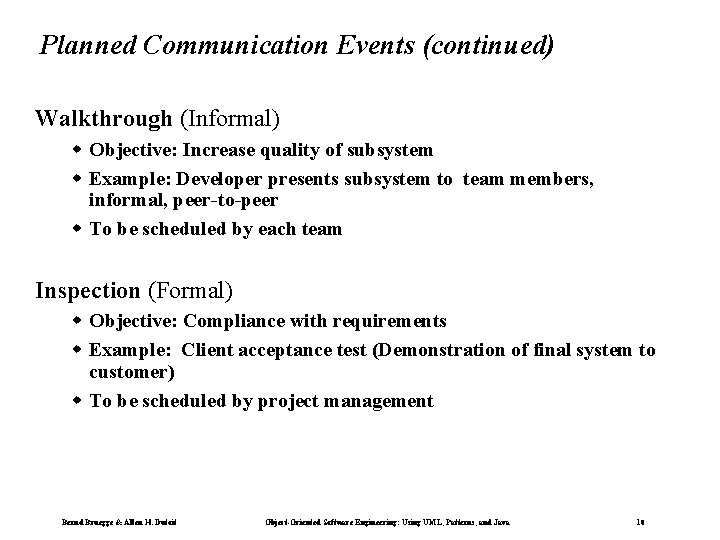
Planned Communication Events (continued) Walkthrough (Informal) w Objective: Increase quality of subsystem w Example: Developer presents subsystem to team members, informal, peer-to-peer w To be scheduled by each team Inspection (Formal) w Objective: Compliance with requirements w Example: Client acceptance test (Demonstration of final system to customer) w To be scheduled by project management Bernd Bruegge & Allen H. Dutoit Object-Oriented Software Engineering: Using UML, Patterns, and Java 10
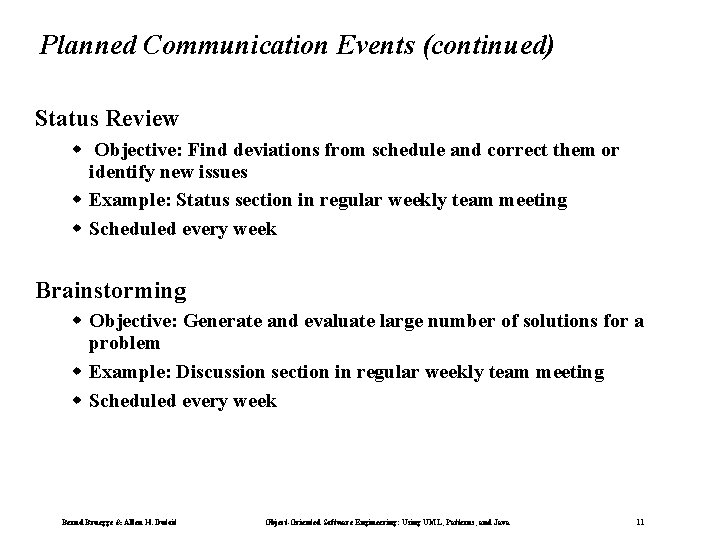
Planned Communication Events (continued) Status Review w Objective: Find deviations from schedule and correct them or identify new issues w Example: Status section in regular weekly team meeting w Scheduled every week Brainstorming w Objective: Generate and evaluate large number of solutions for a problem w Example: Discussion section in regular weekly team meeting w Scheduled every week Bernd Bruegge & Allen H. Dutoit Object-Oriented Software Engineering: Using UML, Patterns, and Java 11
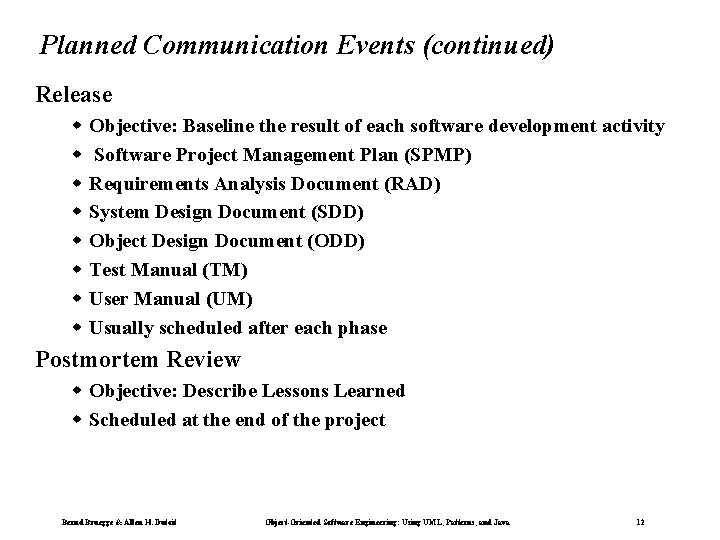
Planned Communication Events (continued) Release w w w w Objective: Baseline the result of each software development activity Software Project Management Plan (SPMP) Requirements Analysis Document (RAD) System Design Document (SDD) Object Design Document (ODD) Test Manual (TM) User Manual (UM) Usually scheduled after each phase Postmortem Review w Objective: Describe Lessons Learned w Scheduled at the end of the project Bernd Bruegge & Allen H. Dutoit Object-Oriented Software Engineering: Using UML, Patterns, and Java 12
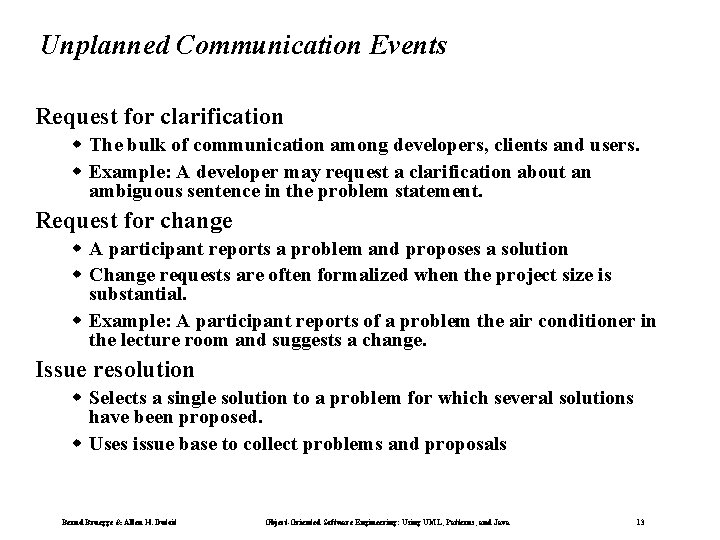
Unplanned Communication Events Request for clarification w The bulk of communication among developers, clients and users. w Example: A developer may request a clarification about an ambiguous sentence in the problem statement. Request for change w A participant reports a problem and proposes a solution w Change requests are often formalized when the project size is substantial. w Example: A participant reports of a problem the air conditioner in the lecture room and suggests a change. Issue resolution w Selects a single solution to a problem for which several solutions have been proposed. w Uses issue base to collect problems and proposals Bernd Bruegge & Allen H. Dutoit Object-Oriented Software Engineering: Using UML, Patterns, and Java 13
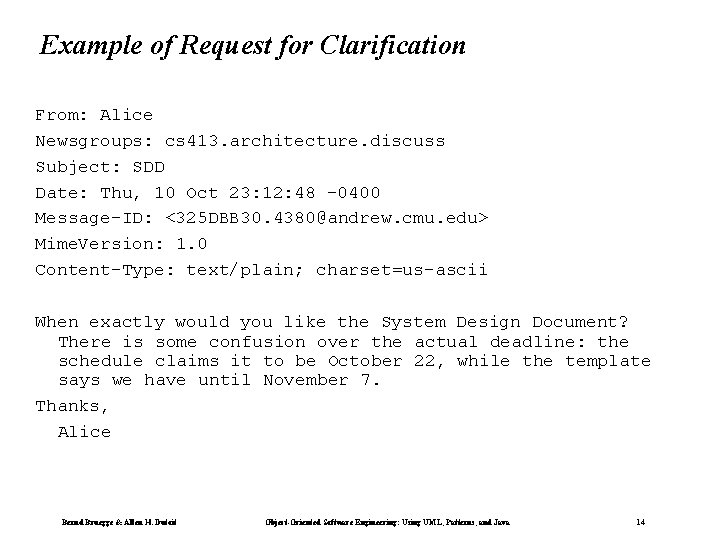
Example of Request for Clarification From: Alice Newsgroups: cs 413. architecture. discuss Subject: SDD Date: Thu, 10 Oct 23: 12: 48 -0400 Message-ID: <325 DBB 30. 4380@andrew. cmu. edu> Mime. Version: 1. 0 Content-Type: text/plain; charset=us-ascii When exactly would you like the System Design Document? There is some confusion over the actual deadline: the schedule claims it to be October 22, while the template says we have until November 7. Thanks, Alice Bernd Bruegge & Allen H. Dutoit Object-Oriented Software Engineering: Using UML, Patterns, and Java 14
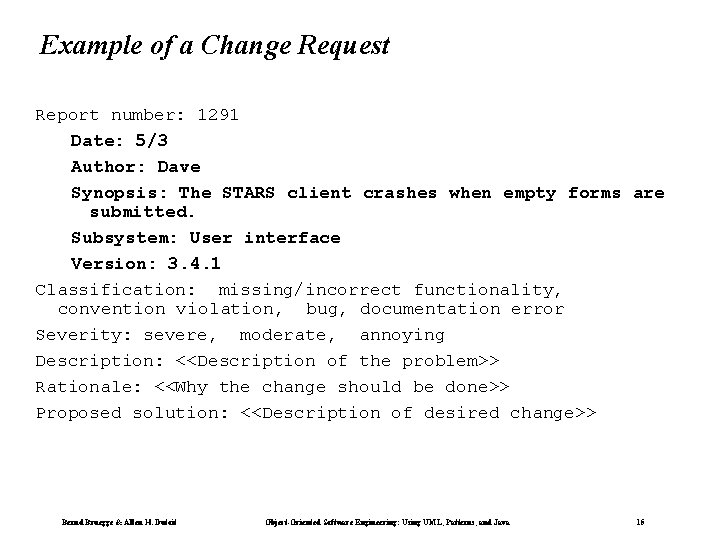
Example of a Change Request Report number: 1291 Date: 5/3 Author: Dave Synopsis: The STARS client crashes when empty forms are submitted. Subsystem: User interface Version: 3. 4. 1 Classification: missing/incorrect functionality, convention violation, bug, documentation error Severity: severe, moderate, annoying Description: <<Description of the problem>> Rationale: <<Why the change should be done>> Proposed solution: <<Description of desired change>> Bernd Bruegge & Allen H. Dutoit Object-Oriented Software Engineering: Using UML, Patterns, and Java 15
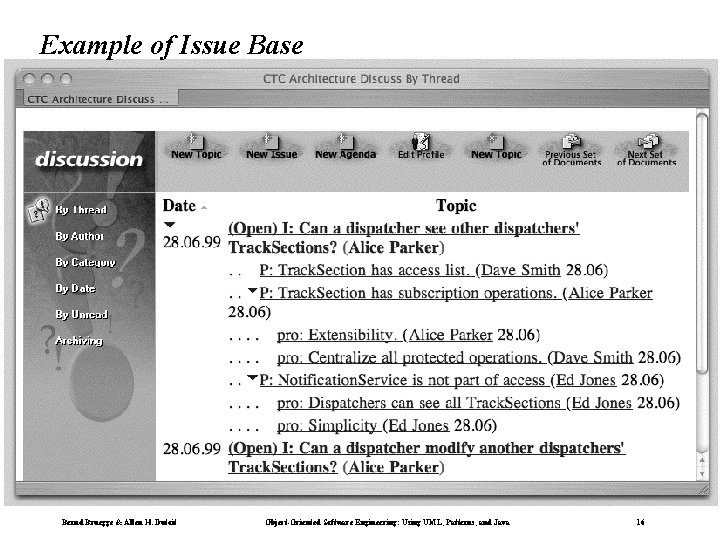
Example of Issue Base Bernd Bruegge & Allen H. Dutoit Object-Oriented Software Engineering: Using UML, Patterns, and Java 16
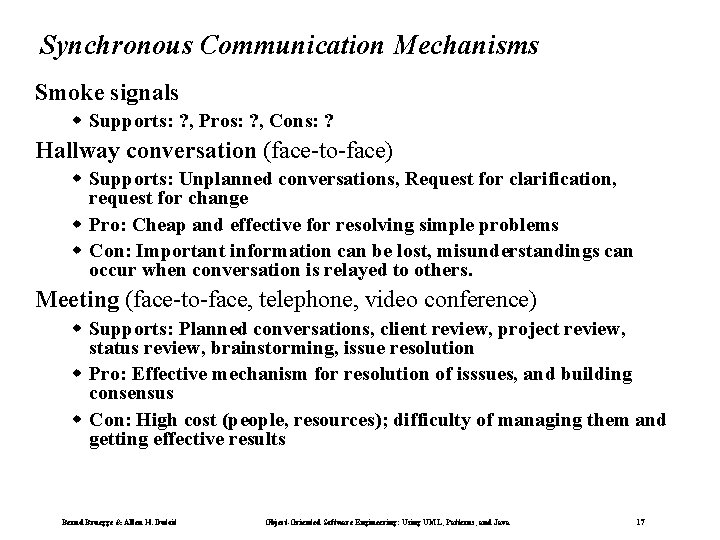
Synchronous Communication Mechanisms Smoke signals w Supports: ? , Pros: ? , Cons: ? Hallway conversation (face-to-face) w Supports: Unplanned conversations, Request for clarification, request for change w Pro: Cheap and effective for resolving simple problems w Con: Important information can be lost, misunderstandings can occur when conversation is relayed to others. Meeting (face-to-face, telephone, video conference) w Supports: Planned conversations, client review, project review, status review, brainstorming, issue resolution w Pro: Effective mechanism for resolution of isssues, and building consensus w Con: High cost (people, resources); difficulty of managing them and getting effective results Bernd Bruegge & Allen H. Dutoit Object-Oriented Software Engineering: Using UML, Patterns, and Java 17
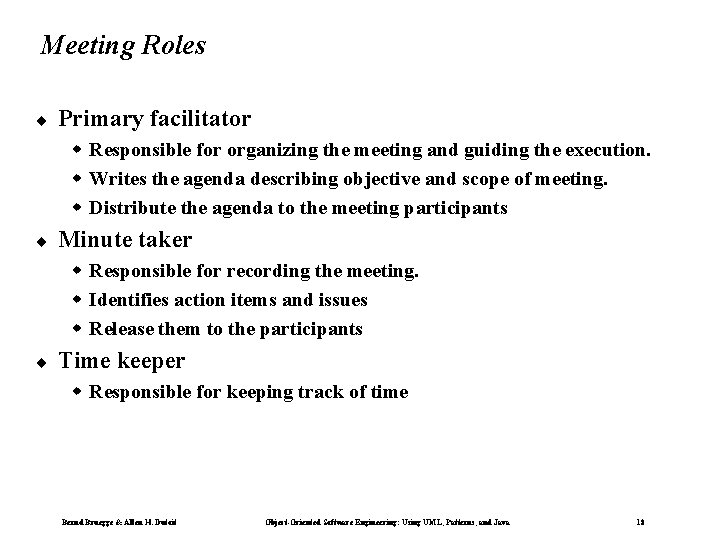
Meeting Roles ¨ Primary facilitator w Responsible for organizing the meeting and guiding the execution. w Writes the agenda describing objective and scope of meeting. w Distribute the agenda to the meeting participants ¨ Minute taker w Responsible for recording the meeting. w Identifies action items and issues w Release them to the participants ¨ Time keeper w Responsible for keeping track of time Bernd Bruegge & Allen H. Dutoit Object-Oriented Software Engineering: Using UML, Patterns, and Java 18
Structure of a Meeting Agenda Bernd Bruegge & Allen H. Dutoit Object-Oriented Software Engineering: Using UML, Patterns, and Java 19
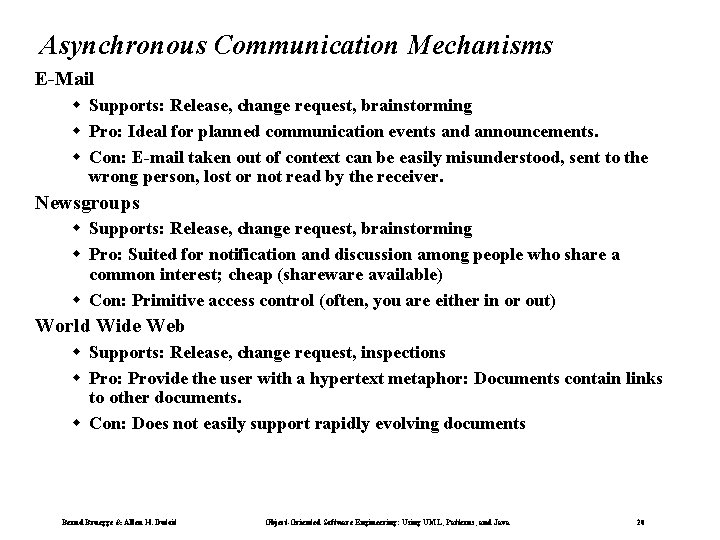
Asynchronous Communication Mechanisms E-Mail w Supports: Release, change request, brainstorming w Pro: Ideal for planned communication events and announcements. w Con: E-mail taken out of context can be easily misunderstood, sent to the wrong person, lost or not read by the receiver. Newsgroups w Supports: Release, change request, brainstorming w Pro: Suited for notification and discussion among people who share a common interest; cheap (shareware available) w Con: Primitive access control (often, you are either in or out) World Wide Web w Supports: Release, change request, inspections w Pro: Provide the user with a hypertext metaphor: Documents contain links to other documents. w Con: Does not easily support rapidly evolving documents Bernd Bruegge & Allen H. Dutoit Object-Oriented Software Engineering: Using UML, Patterns, and Java 20
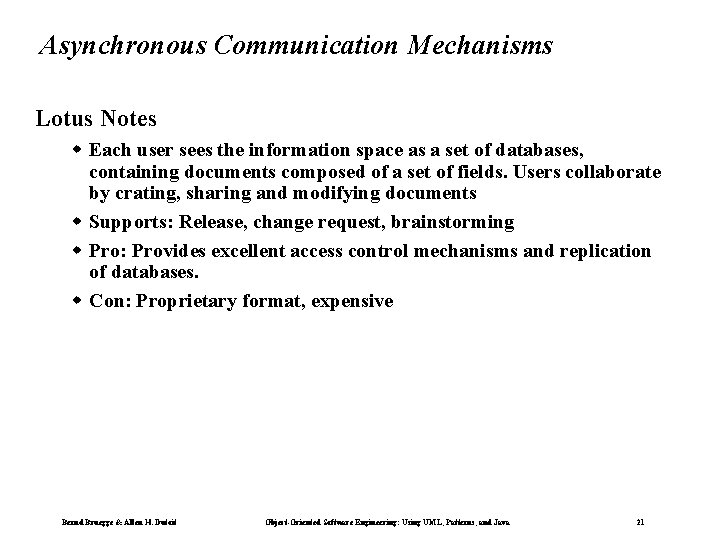
Asynchronous Communication Mechanisms Lotus Notes w Each user sees the information space as a set of databases, containing documents composed of a set of fields. Users collaborate by crating, sharing and modifying documents w Supports: Release, change request, brainstorming w Pro: Provides excellent access control mechanisms and replication of databases. w Con: Proprietary format, expensive Bernd Bruegge & Allen H. Dutoit Object-Oriented Software Engineering: Using UML, Patterns, and Java 21
Example: Document Review with Lotus Notes ¨ Use cases: w w w w ¨ Fill out a review form Attach document to be reviewed Distribute the review form to reviewers Wait for comments from reviewers Review comments Create action items from selected comments Revise document and post the revised version Iterate the review cycle The following example demonstrates a document review database from JAMES project. Bernd Bruegge & Allen H. Dutoit Object-Oriented Software Engineering: Using UML, Patterns, and Java 22
Review of Documents Database Bernd Bruegge & Allen H. Dutoit Object-Oriented Software Engineering: Using UML, Patterns, and Java 23

Bernd Bruegge & Allen H. Dutoit Object-Oriented Software Engineering: Using UML, Patterns, and Java 24
Fill out the Review Form ¨ ¨ Select reviewers Select the document to be reviewed Add comments to reviewers Determine deadline Bernd Bruegge & Allen H. Dutoit Object-Oriented Software Engineering: Using UML, Patterns, and Java 25
Reviewer Notification ¨ Selected reviewers get e-mail Bernd Bruegge & Allen H. Dutoit Object-Oriented Software Engineering: Using UML, Patterns, and Java 26

Bernd Bruegge & Allen H. Dutoit Object-Oriented Software Engineering: Using UML, Patterns, and Java 27
Reviewers add their Comments Bernd Bruegge & Allen H. Dutoit Object-Oriented Software Engineering: Using UML, Patterns, and Java 28
Originator Notification Bernd Bruegge & Allen H. Dutoit Object-Oriented Software Engineering: Using UML, Patterns, and Java 29
Final Recipient Notification Bernd Bruegge & Allen H. Dutoit Object-Oriented Software Engineering: Using UML, Patterns, and Java 30
Review Tasks ¨ ¨ ¨ Editor reviews comments Editor selects reviewed comments Web Master posts reviewed document and action items Team members complete their action items Editor integrates changes Editor posts changed document on the review database for the next review cycle Bernd Bruegge & Allen H. Dutoit Object-Oriented Software Engineering: Using UML, Patterns, and Java 31
Accepted Document w/ Action Items Bernd Bruegge & Allen H. Dutoit Object-Oriented Software Engineering: Using UML, Patterns, and Java 32
SPMP Action Items Bernd Bruegge & Allen H. Dutoit Object-Oriented Software Engineering: Using UML, Patterns, and Java 33
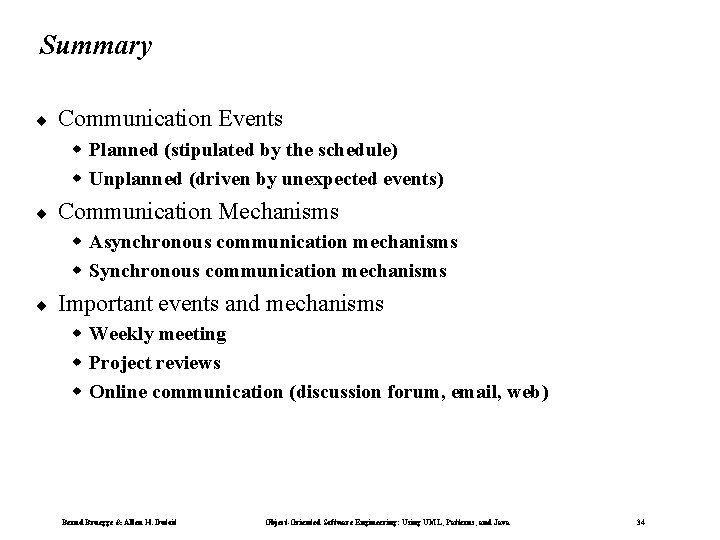
Summary ¨ Communication Events w Planned (stipulated by the schedule) w Unplanned (driven by unexpected events) ¨ Communication Mechanisms w Asynchronous communication mechanisms w Synchronous communication mechanisms ¨ Important events and mechanisms w Weekly meeting w Project reviews w Online communication (discussion forum, email, web) Bernd Bruegge & Allen H. Dutoit Object-Oriented Software Engineering: Using UML, Patterns, and Java 34
- Slides: 34