
Using UML Patterns and Java ObjectOriented Software Engineering
Using UML, Patterns, and Java Object-Oriented Software Engineering Chapter 8, Object Design: Object Constraint Language
Outline of the Lecture • • • OCL Simple predicates Preconditions Postconditions Contracts Sets, Bags, and Sequences Bernd Bruegge & Allen Dutoit Object-Oriented Software Engineering: Conquering Complex and Changing Systems 2
OCL: Object Constraint Language • Formal language for expressing constraints over a set of objects and their attributes • Part of the UML standard • Used to write constraints that cannot otherwise be expressed in a diagram • Declarative • No side effects • No control flow • Based on Sets and Multi Sets Bernd Bruegge & Allen Dutoit Object-Oriented Software Engineering: Conquering Complex and Changing Systems 3
OCL Basic Concepts • OCL expressions • Return True or False • Are evaluated in a specified context, either a class or an operation • All constraints apply to all instances Bernd Bruegge & Allen Dutoit Object-Oriented Software Engineering: Conquering Complex and Changing Systems 4
OCL Simple Predicates Example: context Tournament inv: self. get. Max. Num. Players() > 0 In English: “The maximum number of players in any tournament should be a postive number. ” Notes: • “self” denotes all instances of “Tournament” • OCL uses the same dot notation as Java. Bernd Bruegge & Allen Dutoit Object-Oriented Software Engineering: Conquering Complex and Changing Systems 5
OCL Preconditions Example: context Tournament: : accept. Player(p) pre: not self. is. Player. Accepted(p) In English: “The accept. Player(p) operation can only be invoked if player p has not yet been accepted in the tournament. ” Notes: • The context of a precondtion is an operation • is. Player. Accepted(p) is an operation defined by the class Tournament Bernd Bruegge & Allen Dutoit Object-Oriented Software Engineering: Conquering Complex and Changing Systems 6
OCL Postconditions Example: context Tournament: : accept. Player(p) post: self. get. Num. Players() = self@pre. get. Num. Players() + 1 In English: “The number of accepted player in a tournament increases by one after the completion of accept. Player()” Notes: • self@pre denotes the state of the tournament before the invocation of the operation. • Self denotes the state of the tournament after the completion of the operation. Bernd Bruegge & Allen Dutoit Object-Oriented Software Engineering: Conquering Complex and Changing Systems 7
OCL Contract for accept. Player() in Tournament context Tournament: : accept. Player(p) pre: not is. Player. Accepted(p) context Tournament: : accept. Player(p) pre: get. Num. Players() < get. Max. Num. Players() context Tournament: : accept. Player(p) post: is. Player. Accepted(p) context Tournament: : accept. Player(p) post: get. Num. Players() = @pre. get. Num. Players() + 1 Bernd Bruegge & Allen Dutoit Object-Oriented Software Engineering: Conquering Complex and Changing Systems 8
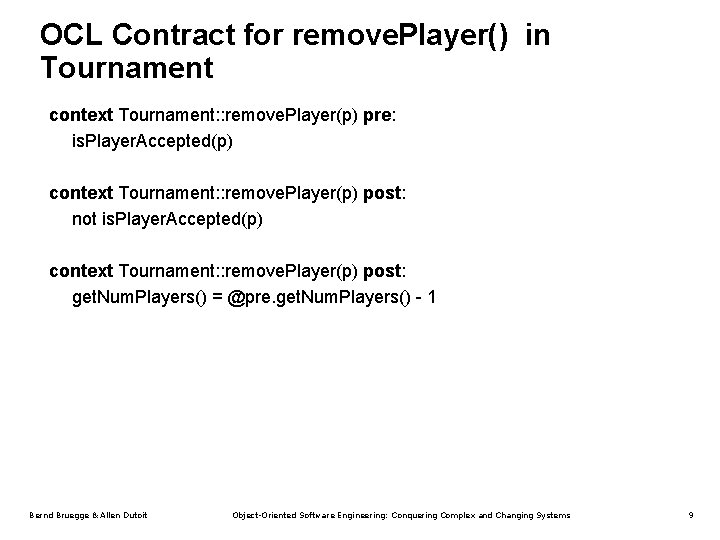
OCL Contract for remove. Player() in Tournament context Tournament: : remove. Player(p) pre: is. Player. Accepted(p) context Tournament: : remove. Player(p) post: not is. Player. Accepted(p) context Tournament: : remove. Player(p) post: get. Num. Players() = @pre. get. Num. Players() - 1 Bernd Bruegge & Allen Dutoit Object-Oriented Software Engineering: Conquering Complex and Changing Systems 9
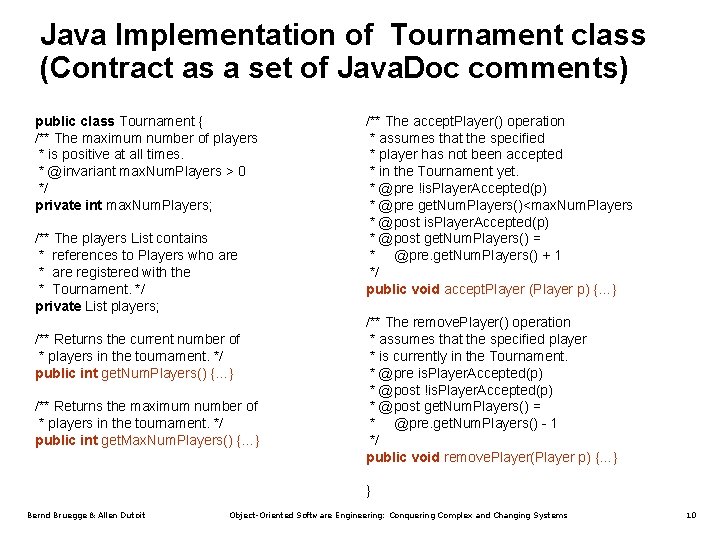
Java Implementation of Tournament class (Contract as a set of Java. Doc comments) public class Tournament { /** The maximum number of players * is positive at all times. * @invariant max. Num. Players > 0 */ private int max. Num. Players; /** The players List contains * references to Players who are * are registered with the * Tournament. */ private List players; /** Returns the current number of * players in the tournament. */ public int get. Num. Players() {…} /** Returns the maximum number of * players in the tournament. */ public int get. Max. Num. Players() {…} /** The accept. Player() operation * assumes that the specified * player has not been accepted * in the Tournament yet. * @pre !is. Player. Accepted(p) * @pre get. Num. Players()<max. Num. Players * @post is. Player. Accepted(p) * @post get. Num. Players() = * @pre. get. Num. Players() + 1 */ public void accept. Player (Player p) {…} /** The remove. Player() operation * assumes that the specified player * is currently in the Tournament. * @pre is. Player. Accepted(p) * @post !is. Player. Accepted(p) * @post get. Num. Players() = * @pre. get. Num. Players() - 1 */ public void remove. Player(Player p) {…} } Bernd Bruegge & Allen Dutoit Object-Oriented Software Engineering: Conquering Complex and Changing Systems 10
Constraints can involve more than one class How do we specify constraints on on a group of classes? Starting from a specific class in the UML class diagram, we navigate the associations in the class diagram to refer to the other classes and their properties (attributes and Operations). Bernd Bruegge & Allen Dutoit Object-Oriented Software Engineering: Conquering Complex and Changing Systems 11
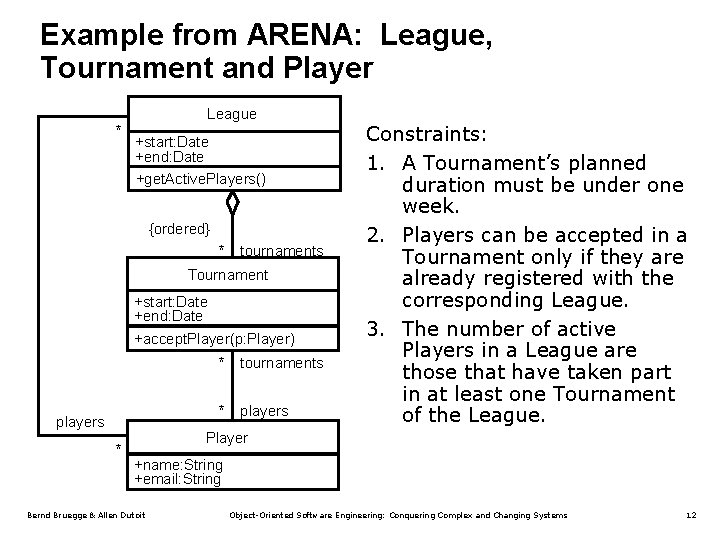
Example from ARENA: League, Tournament and Player * League +start: Date +end: Date +get. Active. Players() {ordered} * tournaments Tournament +start: Date +end: Date +accept. Player(p: Player) players * * tournaments * players Constraints: 1. A Tournament’s planned duration must be under one week. 2. Players can be accepted in a Tournament only if they are already registered with the corresponding League. 3. The number of active Players in a League are those that have taken part in at least one Tournament of the League. Player +name: String +email: String Bernd Bruegge & Allen Dutoit Object-Oriented Software Engineering: Conquering Complex and Changing Systems 12
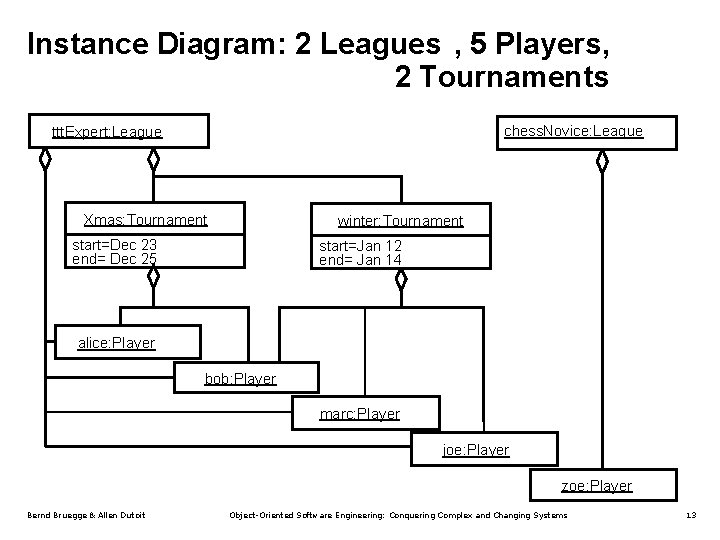
Instance Diagram: 2 Leagues , 5 Players, 2 Tournaments chess. Novice: League ttt. Expert: League Xmas: Tournament winter: Tournament start=Dec 23 end= Dec 25 start=Jan 12 end= Jan 14 alice: Player bob: Player marc: Player joe: Player zoe: Player Bernd Bruegge & Allen Dutoit Object-Oriented Software Engineering: Conquering Complex and Changing Systems 13
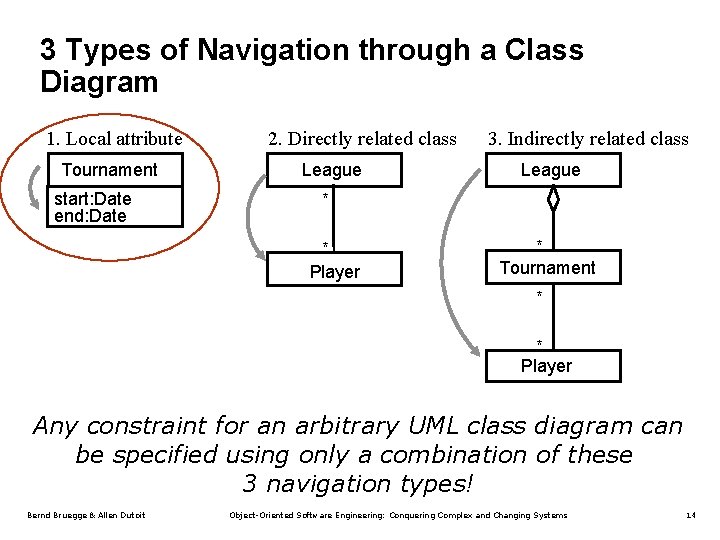
3 Types of Navigation through a Class Diagram 1. Local attribute Tournament start: Date end: Date 2. Directly related class League 3. Indirectly related class League * * Player * Tournament * * Player Any constraint for an arbitrary UML class diagram can be specified using only a combination of these 3 navigation types! Bernd Bruegge & Allen Dutoit Object-Oriented Software Engineering: Conquering Complex and Changing Systems 14
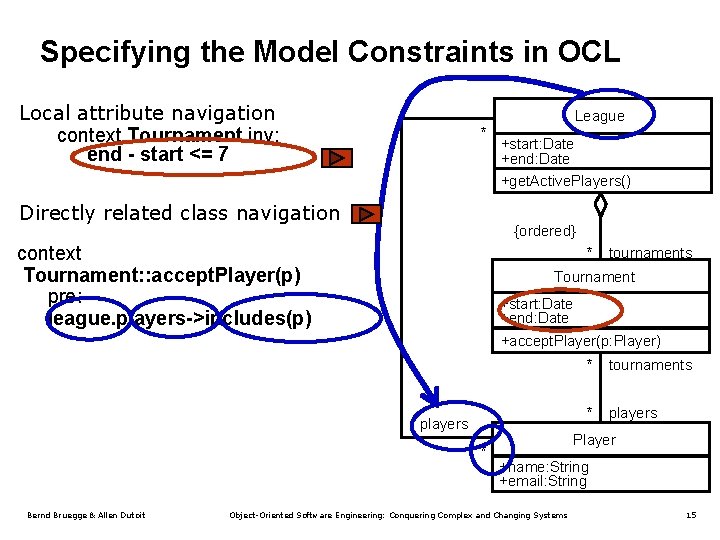
Specifying the Model Constraints in OCL Local attribute navigation context Tournament inv: end - start <= 7 * Directly related class navigation League +start: Date +end: Date +get. Active. Players() {ordered} context Tournament: : accept. Player(p) pre: league. players->includes(p) * Tournament +start: Date +end: Date +accept. Player(p: Player) players * Bernd Bruegge & Allen Dutoit tournaments * players Player +name: String +email: String Object-Oriented Software Engineering: Conquering Complex and Changing Systems 15
OCL Sets, Bags and Sequences • Sets, Bags and Sequences are predefined in OCL and subtypes of Collection. OCL offers a large number of predefined operations on collections. They are all of the form: collection->operation(arguments) Bernd Bruegge & Allen Dutoit Object-Oriented Software Engineering: Conquering Complex and Changing Systems 16
OCL-Collection • The OCL-Type Collection is the generic superclass of a collection of objects of Type T • Subclasses of Collection are • Set: Set in the mathematical sense. Every element � can appear only once • Bag: A collection, in which elements can appear more than once (also called multiset) • Sequence: A multiset, in which the elements are ordered • Example for Collections: • Set(Integer): a set of integer numbers • Bag(Person): a multiset of persons • Sequence(Customer): a sequence of customers Bernd Bruegge & Allen Dutoit Object-Oriented Software Engineering: Conquering Complex and Changing Systems 17
OCL-Operations for OCL-Collections (1) size: Integer Number of elements in the collection includes(o: Ocl. Any): Boolean True, if the element o is in the collection count(o: Ocl. Any): Integer Counts how many times an element is contained in the collection is. Empty: Boolean True, if the collection is empty not. Empty: Boolean True, if the collection is not empty The OCL-Type Ocl. Any is the most general OCL-Type Bernd Bruegge & Allen Dutoit Object-Oriented Software Engineering: Conquering Complex and Changing Systems 18
OCL-Operations for OCL-Collections(2) union(c 1: Collection) Union with collection c 1 intersection(c 2: Collection) Intersection with Collection c 2 (contains only elements, which appear in the collection as well as in collection c 2 auftreten) including(o: Ocl. Any) Collection containing all elements of the Collection and element o select(expr: Ocl. Expression) Subset of all elements of the collection, for which the OCLexpression expr is true Bernd Bruegge & Allen Dutoit Object-Oriented Software Engineering: Conquering Complex and Changing Systems 19
How do we get OCL-Collections? • A collection can be generated by explicitly enumerating the elements • A collection can be generated by navigating along one or more 1 -N associations • Navigation along a single 1: n association yields a Set • Navigation along a couple of 1: n associations yields a Bag (Multiset) • Navigation along a single 1: n association labeled with the constraint {ordered } yields a Sequence Bernd Bruegge & Allen Dutoit Object-Oriented Software Engineering: Conquering Complex and Changing Systems 20
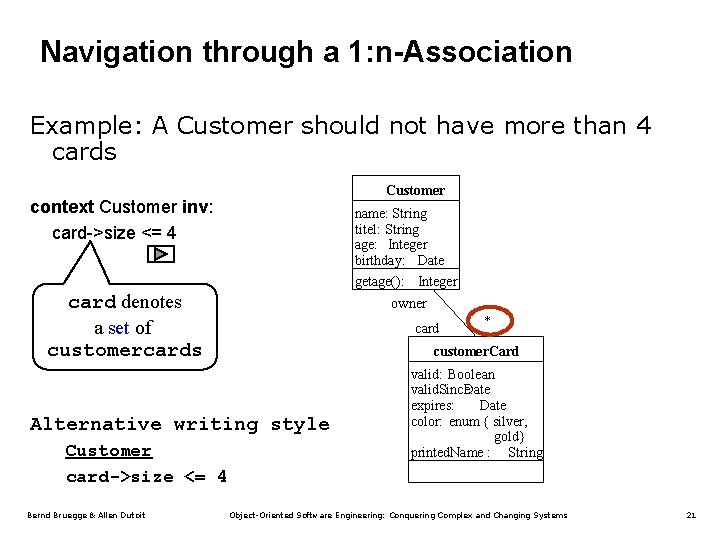
Navigation through a 1: n-Association Example: A Customer should not have more than 4 cards Customer context Customer inv: card->size <= 4 name: String titel: String age: Integer birthday: Date getage(): Integer card denotes a set of customercards owner card customer. Card Alternative writing style Customer card->size <= 4 Bernd Bruegge & Allen Dutoit * valid: Boolean valid. Since: Date expires: Date color: enum { silver, gold} printed. Name : String Object-Oriented Software Engineering: Conquering Complex and Changing Systems 21
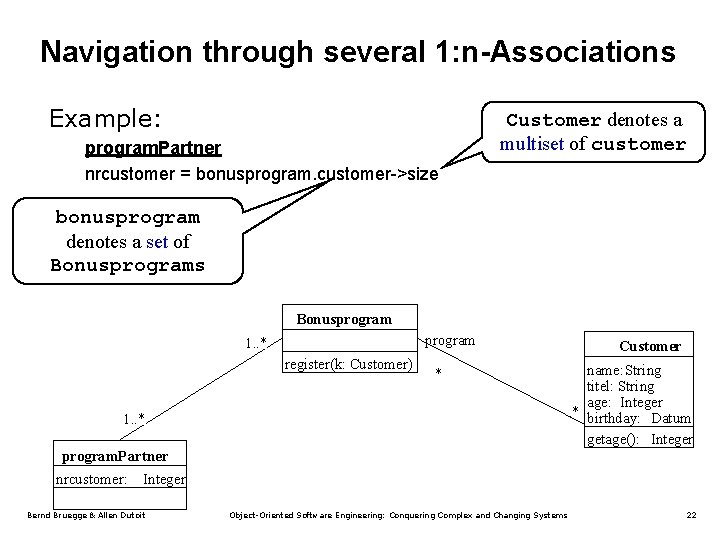
Navigation through several 1: n-Associations Example: program. Partner nrcustomer = bonusprogram. customer->size Customer denotes a multiset of customer bonusprogram denotes a set of Bonusprograms Bonusprogram 1. . * register(k: Customer) * 1. . * Customer name: String titel: String age: Integer. * birthday: Datum getage(): Integer program. Partner nrcustomer: Integer Bernd Bruegge & Allen Dutoit Object-Oriented Software Engineering: Conquering Complex and Changing Systems 22
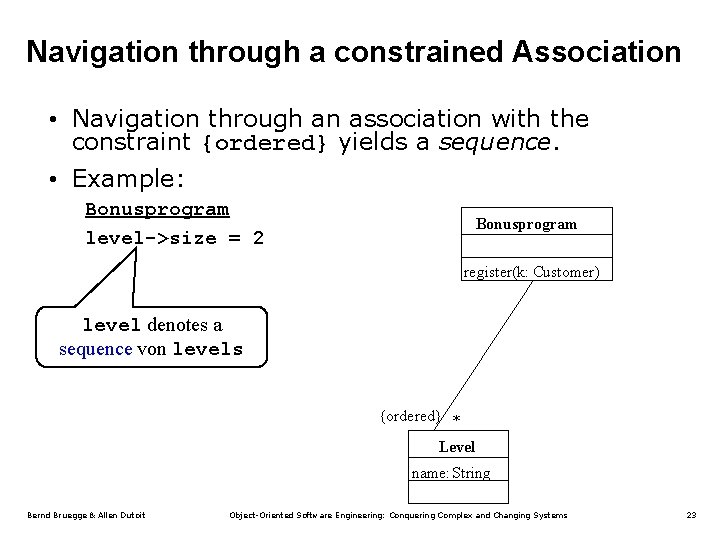
Navigation through a constrained Association • Navigation through an association with the constraint {ordered} yields a sequence. • Example: Bonusprogram level->size = 2 Bonusprogram register(k: Customer) level denotes a sequence von levels {ordered} * Level name: String Bernd Bruegge & Allen Dutoit Object-Oriented Software Engineering: Conquering Complex and Changing Systems 23
Conversion between OCL-Collections • OCL offers operations to convert OCL-Collections: as. Set Transforms a multiset or sequence into a set as. Bag transforms a set or sequence into a multiset as. Sequence transforms a set or multiset into a sequence. Bernd Bruegge & Allen Dutoit Object-Oriented Software Engineering: Conquering Complex and Changing Systems 24
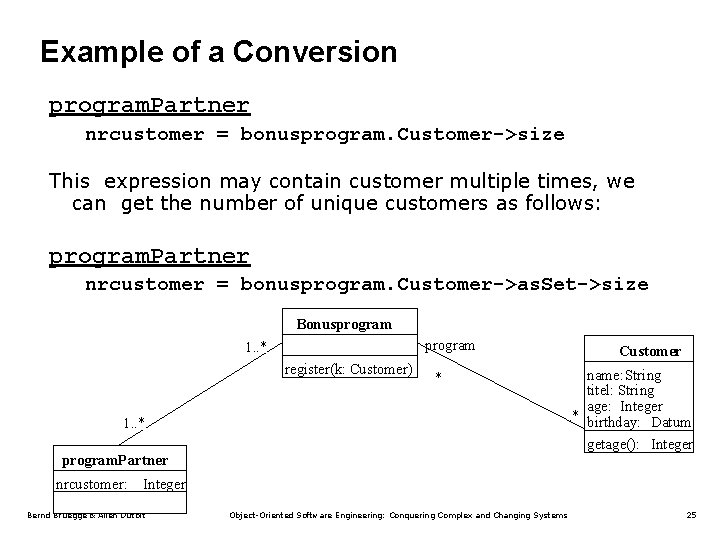
Example of a Conversion program. Partner nrcustomer = bonusprogram. Customer->size This expression may contain customer multiple times, we can get the number of unique customers as follows: program. Partner nrcustomer = bonusprogram. Customer->as. Set->size Bonusprogram 1. . * register(k: Customer) * 1. . * Customer name: String titel: String age: Integer. * birthday: Datum getage(): Integer program. Partner nrcustomer: Integer Bernd Bruegge & Allen Dutoit Object-Oriented Software Engineering: Conquering Complex and Changing Systems 25
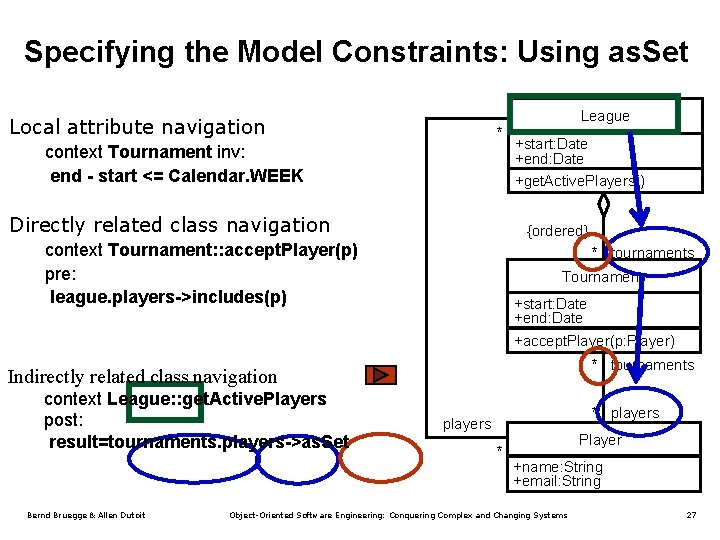
Specifying the Model Constraints: Using as. Set Local attribute navigation * context Tournament inv: end - start <= Calendar. WEEK Directly related class navigation League +start: Date +end: Date +get. Active. Players() {ordered} context Tournament: : accept. Player(p) pre: league. players->includes(p) * tournaments Tournament +start: Date +end: Date +accept. Player(p: Player) * tournaments Indirectly related class navigation context League: : get. Active. Players post: result=tournaments. players->as. Set Bernd Bruegge & Allen Dutoit * players * Player +name: String +email: String Object-Oriented Software Engineering: Conquering Complex and Changing Systems 27
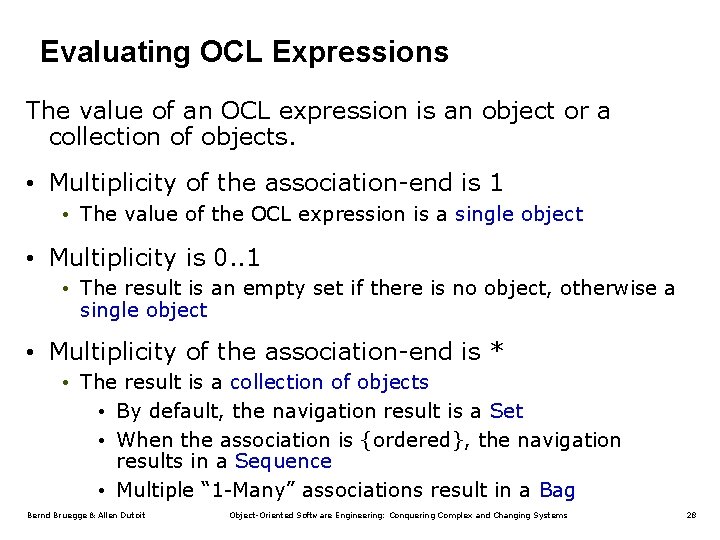
Evaluating OCL Expressions The value of an OCL expression is an object or a collection of objects. • Multiplicity of the association-end is 1 • The value of the OCL expression is a single object • Multiplicity is 0. . 1 • The result is an empty set if there is no object, otherwise a single object • Multiplicity of the association-end is * • The result is a collection of objects • By default, the navigation result is a Set • When the association is {ordered}, the navigation results in a Sequence • Multiple “ 1 -Many” associations result in a Bag Bernd Bruegge & Allen Dutoit Object-Oriented Software Engineering: Conquering Complex and Changing Systems 28
Additional Readings • J. B. Warmer, A. G. Kleppe The Object Constraint Language: Getting your Models ready for MDA, Addison-Wesley, 2 nd edition, 2003 • B. Meyer Object-Oriented Software Construction, 2 nd edition, Prentice Hall, 1997. • B. Meyer, Design by Contract: The Lesson of Ariane, Computer, IEEE, Vol. 30, No. 2, pp. 129 -130, January 1997. http: //archive. eiffel. com/doc/manuals/technology/contract/arian e/page. html • C. A. R. Hoare, An axiomatic basis for computer programming. Communications of the ACM, 12(10): 576 -585, October 1969. (Good starting point for Hoare logic: http: //en. wikipedia. org/wiki/Hoare_logic) Bernd Bruegge & Allen Dutoit Object-Oriented Software Engineering: Conquering Complex and Changing Systems 29
Summary • Constraints are predicates (often boolean expressions) on UML model elements • Contracts are constraints on a class that enable class users, implementors and extenders to share the same assumption about the class (“Design by contract”) • OCL is the example of a formal language that allows us to express constraints on UML models • Complicated constrains involving more than one class, attribute or operation can be expressed with 3 basic navigation types. Bernd Bruegge & Allen Dutoit Object-Oriented Software Engineering: Conquering Complex and Changing Systems 30
Backup and Additional Slides Bernd Bruegge & Allen Dutoit Object-Oriented Software Engineering: Conquering Complex and Changing Systems 31
Additional Constraints on this Model 1. A Tournament’s planned duration must be under one week. 2. Players can be accepted in a Tournament only if they are already registered with the corresponding League. 3. The number of active Players in a League are those that have taken part in at least one Tournament of the League. Bernd Bruegge & Allen Dutoit Object-Oriented Software Engineering: Conquering Complex and Changing Systems 32
Additional Constraints on this Model 1. A Tournament’s planned duration must be under one week. 2. Players can be accepted in a Tournament only if they are already registered with the corresponding League. 3. The number of active Players in a League are those that have taken part in at least one Tournament of the League. Bernd Bruegge & Allen Dutoit Object-Oriented Software Engineering: Conquering Complex and Changing Systems 33
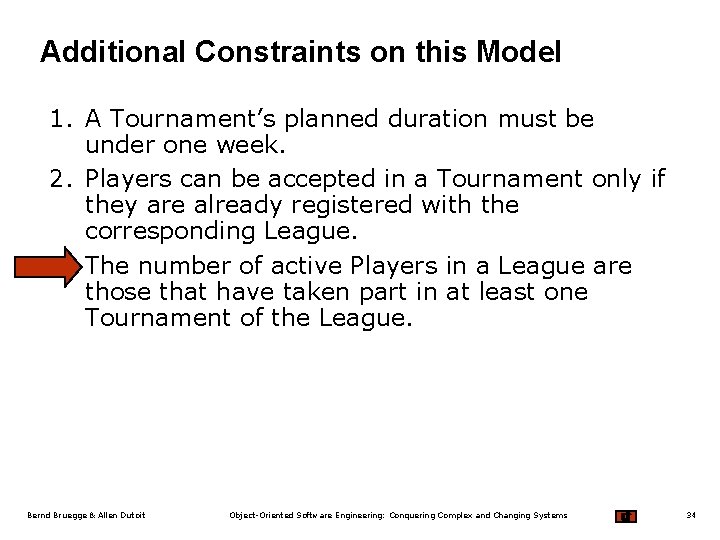
Additional Constraints on this Model 1. A Tournament’s planned duration must be under one week. 2. Players can be accepted in a Tournament only if they are already registered with the corresponding League. 3. The number of active Players in a League are those that have taken part in at least one Tournament of the League. Bernd Bruegge & Allen Dutoit Object-Oriented Software Engineering: Conquering Complex and Changing Systems 34
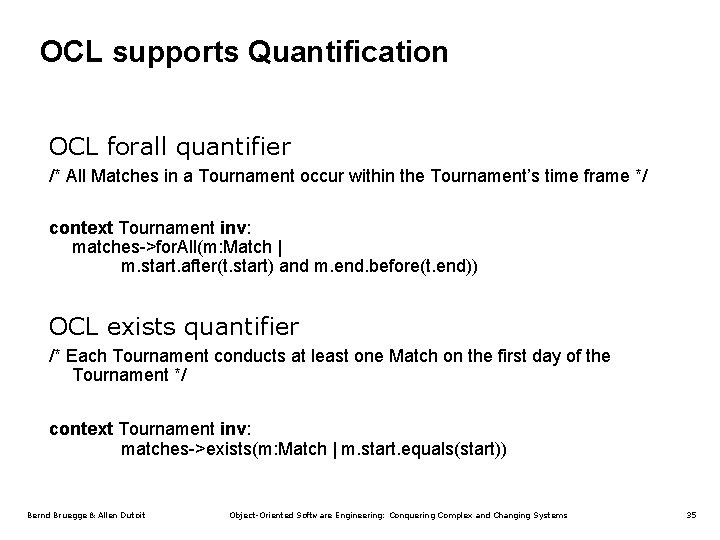
OCL supports Quantification OCL forall quantifier /* All Matches in a Tournament occur within the Tournament’s time frame */ context Tournament inv: matches->for. All(m: Match | m. start. after(t. start) and m. end. before(t. end)) OCL exists quantifier /* Each Tournament conducts at least one Match on the first day of the Tournament */ context Tournament inv: matches->exists(m: Match | m. start. equals(start)) Bernd Bruegge & Allen Dutoit Object-Oriented Software Engineering: Conquering Complex and Changing Systems 35
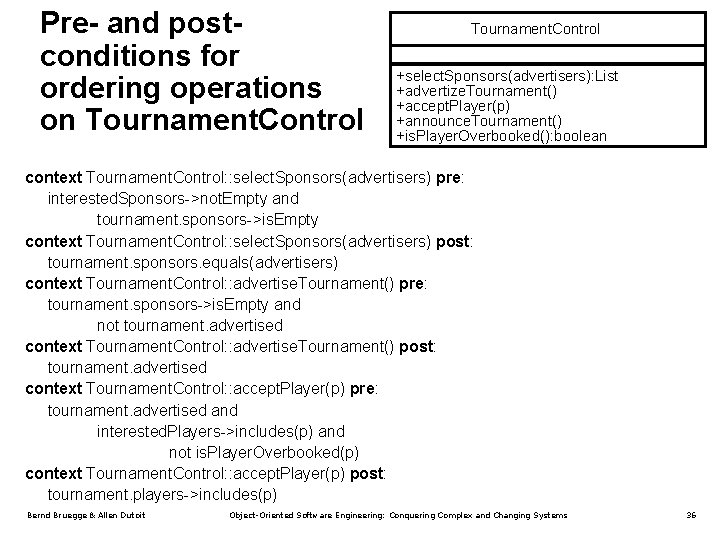
Pre- and postconditions for ordering operations on Tournament. Control +select. Sponsors(advertisers): List +advertize. Tournament() +accept. Player(p) +announce. Tournament() +is. Player. Overbooked(): boolean context Tournament. Control: : select. Sponsors(advertisers) pre: interested. Sponsors->not. Empty and tournament. sponsors->is. Empty context Tournament. Control: : select. Sponsors(advertisers) post: tournament. sponsors. equals(advertisers) context Tournament. Control: : advertise. Tournament() pre: tournament. sponsors->is. Empty and not tournament. advertised context Tournament. Control: : advertise. Tournament() post: tournament. advertised context Tournament. Control: : accept. Player(p) pre: tournament. advertised and interested. Players->includes(p) and not is. Player. Overbooked(p) context Tournament. Control: : accept. Player(p) post: tournament. players->includes(p) Bernd Bruegge & Allen Dutoit Object-Oriented Software Engineering: Conquering Complex and Changing Systems 36
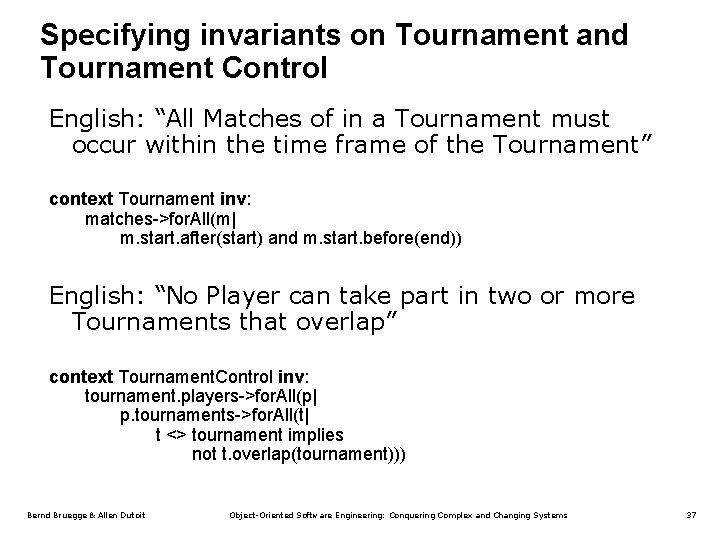
Specifying invariants on Tournament and Tournament Control English: “All Matches of in a Tournament must occur within the time frame of the Tournament” context Tournament inv: matches->for. All(m| m. start. after(start) and m. start. before(end)) English: “No Player can take part in two or more Tournaments that overlap” context Tournament. Control inv: tournament. players->for. All(p| p. tournaments->for. All(t| t <> tournament implies not t. overlap(tournament))) Bernd Bruegge & Allen Dutoit Object-Oriented Software Engineering: Conquering Complex and Changing Systems 37
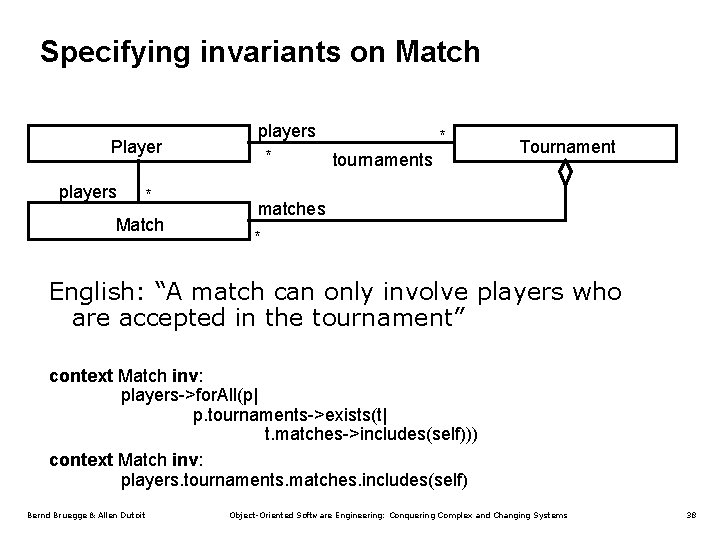
Specifying invariants on Match Player players * Match players * * tournaments Tournament matches * English: “A match can only involve players who are accepted in the tournament” context Match inv: players->for. All(p| p. tournaments->exists(t| t. matches->includes(self))) context Match inv: players. tournaments. matches. includes(self) Bernd Bruegge & Allen Dutoit Object-Oriented Software Engineering: Conquering Complex and Changing Systems 38
- Slides: 37