
Using Transitions Correctly First there are rules Next
- Slides: 7
Using Transitions Correctly First, there are rules. Next, they get boring. Consequently, using the wrong transitions confuses the reader.
Rules • Transitional words or expressions should be used – At the beginning of paragraphs to link big ideas – Within the paragraph to connect explanations Use transitions that indicate the relationship between ideas!
The When and the Where • To show relationships of time: – Afterward, before, meanwhile, later, until, soon, during • To show relationships of place: – Here, there, elsewhere, beyond, opposite, behind **These are used more in narrative writing. **
Making Your Point • To add an idea to your point: – Furthermore, next, besides, in addition, also, moreover • To compare ideas that are similar: – Likewise, similarly, also, too, in a like manner **These are “big idea” transitional words and expressions**
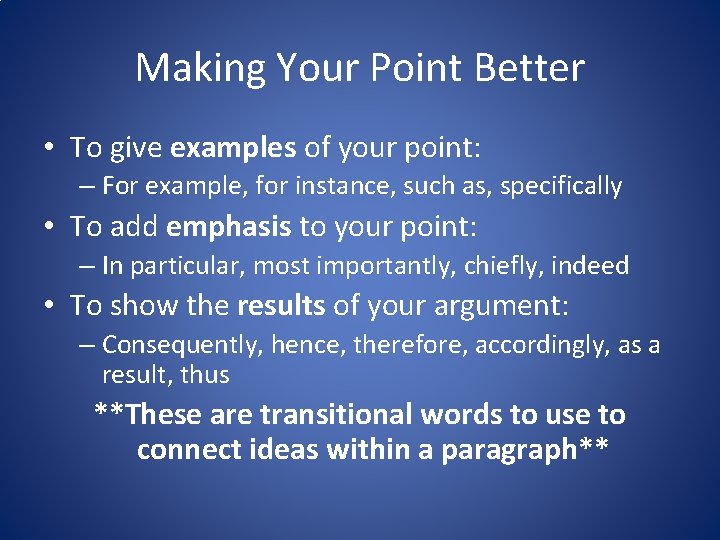
Making Your Point Better • To give examples of your point: – For example, for instance, such as, specifically • To add emphasis to your point: – In particular, most importantly, chiefly, indeed • To show the results of your argument: – Consequently, hence, therefore, accordingly, as a result, thus **These are transitional words to use to connect ideas within a paragraph**
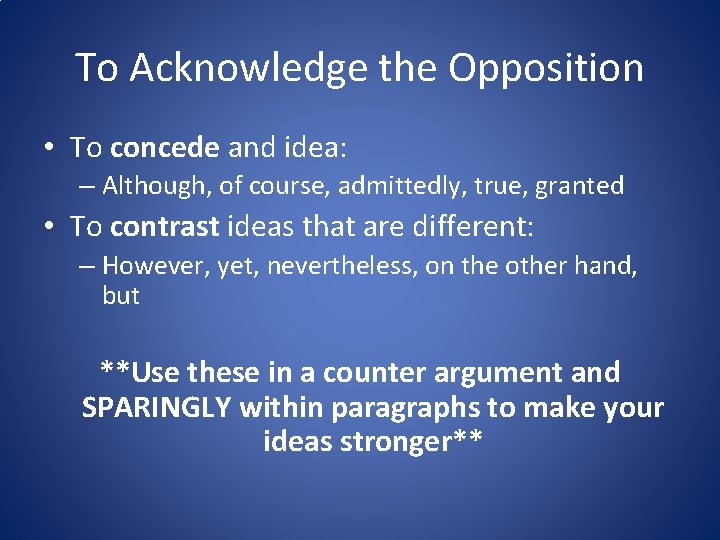
To Acknowledge the Opposition • To concede and idea: – Although, of course, admittedly, true, granted • To contrast ideas that are different: – However, yet, nevertheless, on the other hand, but **Use these in a counter argument and SPARINGLY within paragraphs to make your ideas stronger**
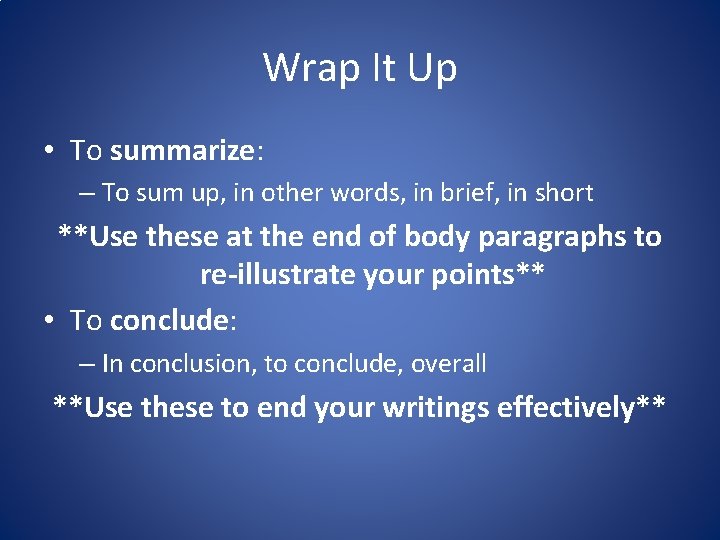
Wrap It Up • To summarize: – To sum up, in other words, in brief, in short **Use these at the end of body paragraphs to re-illustrate your points** • To conclude: – In conclusion, to conclude, overall **Use these to end your writings effectively**