
Using Tolerance Intervals for Setting Process Validation Acceptance
- Slides: 30
Using Tolerance Intervals for Setting Process Validation Acceptance Criteria Richard K. Burdick —Amgen, Inc. (CO) Graybill Conference June, 2008
Using Tolerance Intervals for Setting Process Validation Acceptance Criteria “A worn-out academician’s adventure in the ‘real word’"
Outline § Life at Amgen § Nonclinical statistics § Definitions for Process Characterization and Validation § Statistical Methods for Setting Process Validation Acceptance Criteria § Future Opportunities Operational Excellence 3
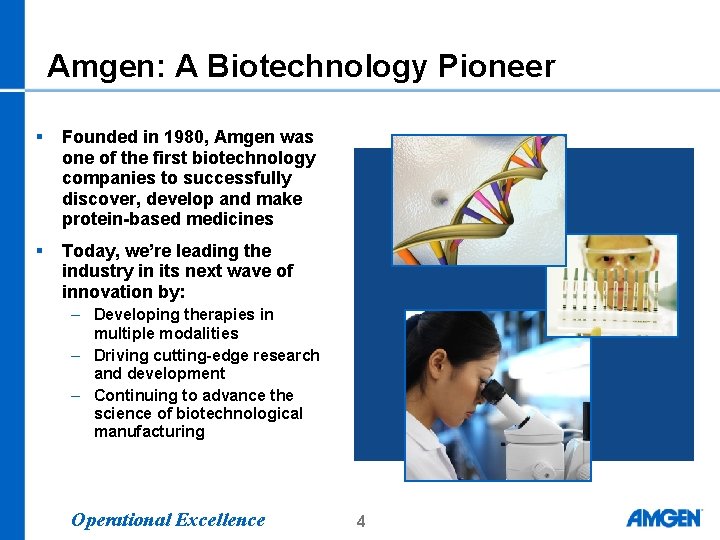
Amgen: A Biotechnology Pioneer § Founded in 1980, Amgen was one of the first biotechnology companies to successfully discover, develop and make protein-based medicines § Today, we’re leading the industry in its next wave of innovation by: – Developing therapies in multiple modalities – Driving cutting-edge research and development – Continuing to advance the science of biotechnological manufacturing Operational Excellence 4
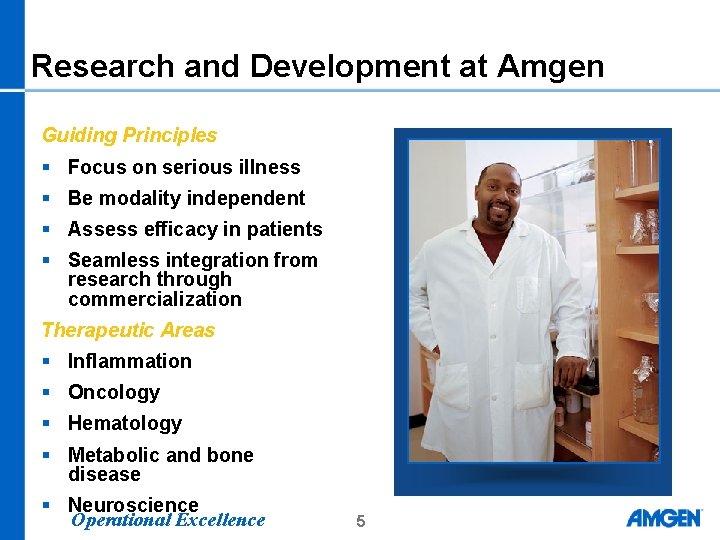
Research and Development at Amgen Guiding Principles § Focus on serious illness § Be modality independent § Assess efficacy in patients § Seamless integration from research through commercialization Therapeutic Areas § Inflammation § Oncology § Hematology § Metabolic and bone disease § Neuroscience Operational Excellence 5
Nonclinical Statistics § Chemistry, Manufacturing, Controls (CMC) development establishes the process of manufacturing drug product to meet clinical requirements. § Work in both research and development and manufacturing. Operational Excellence 6
Nonclinical statisticians involved in… § R&D with – – – Assay validation Process validation Method transfer Stability studies (storage conditions, shelf-life, expiry extensions) DOE for process characterization Establishment of specifications and process validation acceptance limits. § Manufacturing with – Maximization of yields – Control charting – Support in non-conformance reports (identification of assignable causes) – Raw materials inspection Operational Excellence 7
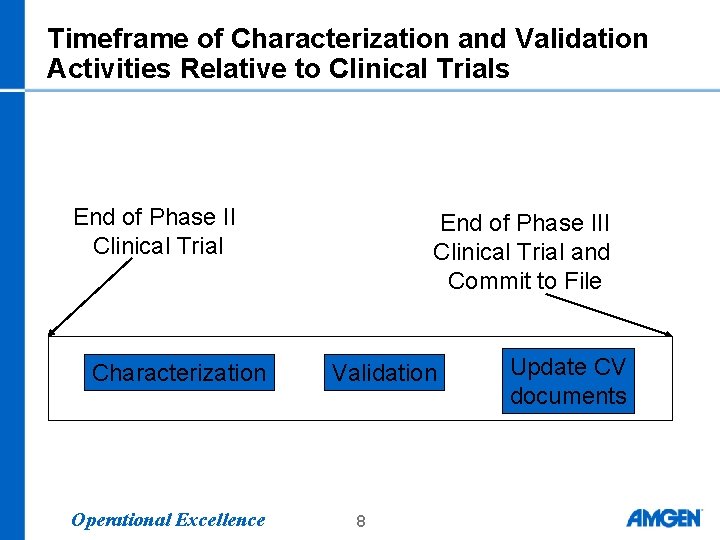
Timeframe of Characterization and Validation Activities Relative to Clinical Trials End of Phase II Clinical Trial Characterization Operational Excellence End of Phase III Clinical Trial and Commit to File Validation 8 Update CV documents
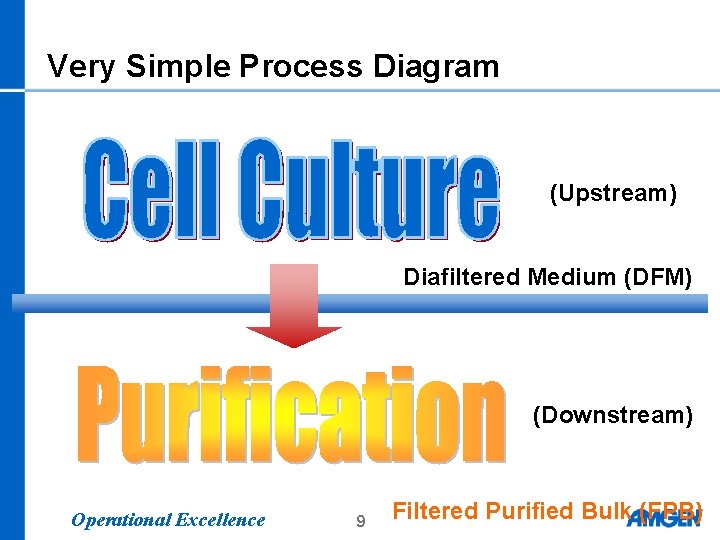
Very Simple Process Diagram (Upstream) Diafiltered Medium (DFM) (Downstream) Operational Excellence 9 Filtered Purified Bulk (FPB)
Process Characterization § Process Characterization is a precursor to process validation and is comprised of a set of documented studies in which operating parameters (inputs) are purposely varied to determine the effect on product quality attributes (outputs) and process performance. § Employs Failure Modes and Effects Analysis (FMEA) and Experimental Design Operational Excellence 10
Process Validation § Process validation provides the documented evidence that the process, when operated within established limits, can perform effectively and reproducibly to produce an intermediate, active pharmaceutical ingredient (API) or drug product meeting predetermined criteria and quality attributes. § Final drug product and API have specifications that must be met based on standards mandated by safety concerns and other factors. § However, intermediate process steps (which do not have mandated standards) have a number of acceptance criteria that must be met to demonstrate process consistency and the ability to meet final specifications. Operational Excellence 11
Process Validation Acceptance Criteria § Process Validation Acceptance Criteria (PVAC) A set of numerical limits that when exceeded, signals a significant departure from operating conditions or product quality. § Set prior to initiation of the validation campaign. § Establishing PVAC is one of the greatest challenges in the development of a commercial biopharmaceutical manufacturing process. Operational Excellence 12
Definitions § Operating Parameter (OP): Parameter that can be directly manipulated (input) § Performance Parameter (PP): In-process parameter or measurement used for process performance evaluation (output) § Normal Operating Range (NOR): A range for an operating parameter that is listed in the Manufacturing Procedure. Frequently based on equipment and/or process capability. Operational Excellence 13
Setting PVAC-A personal history § My involvement with the ACO process development (PD) group began as a discussion concerning analysis of one-off studies conducted at 3 times outside the NOR. § Questions concerned how to determine the operating parameters (OPs) that were most important in the process. § I helped them analyze the data in a manner they were comfortable with, and gained their confidence so that I could work with them on future projects. Operational Excellence 14
Setting PVAC-A personal history § My involvement with the ACO process development (PD) group began as a discussion concerning analysis of one-off studies conducted at 3 times outside the normal operating range (NOR). § Questions concerned how to determine the operating parameters (OPs) that were most important in the process. § I helped them analyze the data in a manner they were comfortable with, and gained their confidence so that I could work with them on future projects. Lesson 1: Sometimes it is best to answer the client’s question instead of telling them what they are doing wrong. Operational Excellence 15
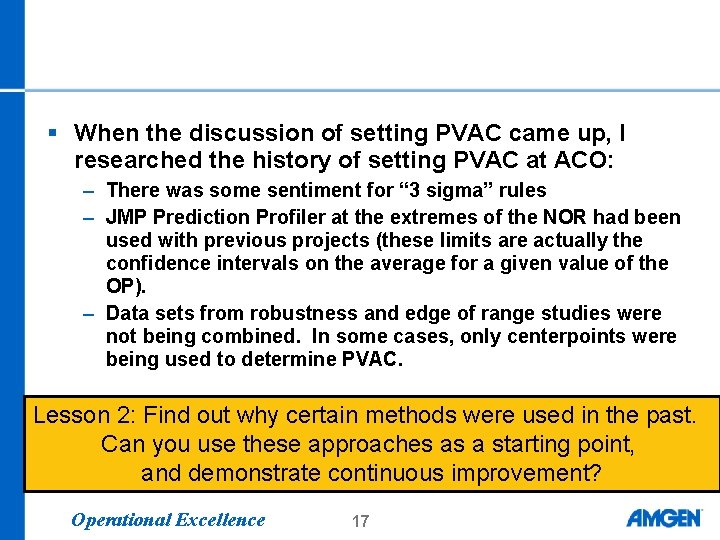
§ When the discussion of setting PVAC came up, I researched the history of setting PVAC at ACO: – There was some sentiment for “ 3 sigma” rules – JMP Prediction Profiler at the extremes of the NOR had been used with previous projects (these limits are actually the confidence intervals on the average for a given value of the OP). – Data sets from robustness and edge of range studies were not being combined. In some cases, only centerpoints were being used to determine PVAC. Operational Excellence 16
§ When the discussion of setting PVAC came up, I researched the history of setting PVAC at ACO: – There was some sentiment for “ 3 sigma” rules – JMP Prediction Profiler at the extremes of the NOR had been used with previous projects (these limits are actually the confidence intervals on the average for a given value of the OP). – Data sets from robustness and edge of range studies were not being combined. In some cases, only centerpoints were being used to determine PVAC. Lesson 2: Find out why certain methods were used in the past. Can you use these approaches as a starting point, and demonstrate continuous improvement? Operational Excellence 17
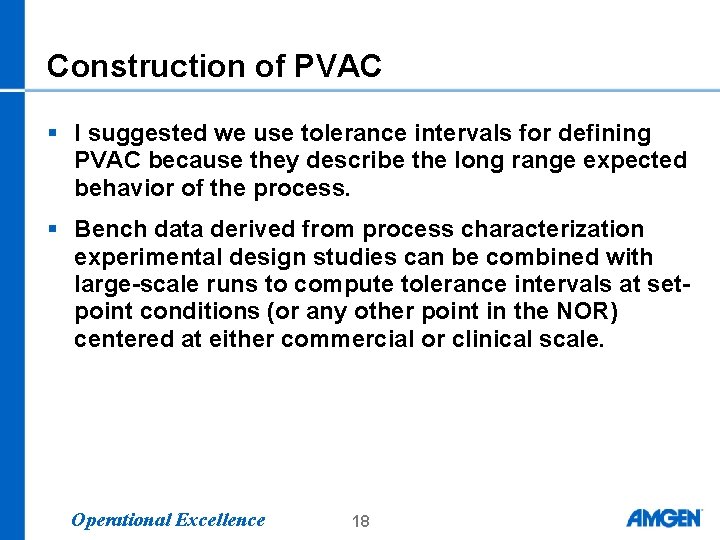
Construction of PVAC § I suggested we use tolerance intervals for defining PVAC because they describe the long range expected behavior of the process. § Bench data derived from process characterization experimental design studies can be combined with large-scale runs to compute tolerance intervals at setpoint conditions (or any other point in the NOR) centered at either commercial or clinical scale. Operational Excellence 18
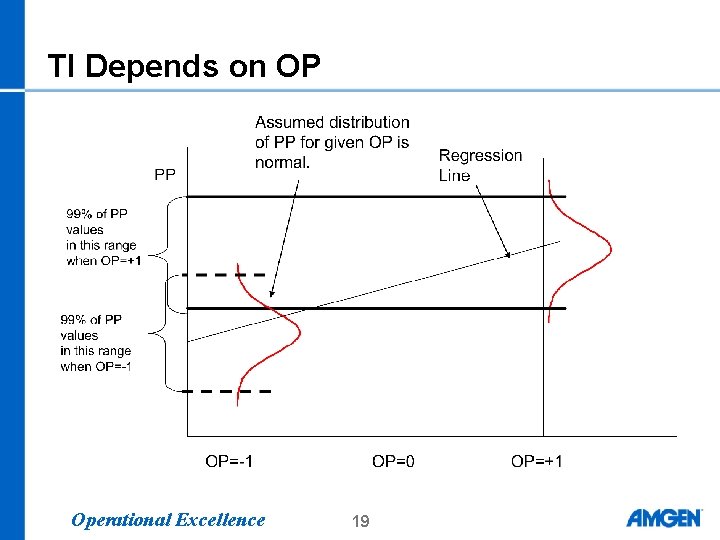
TI Depends on OP Operational Excellence 19
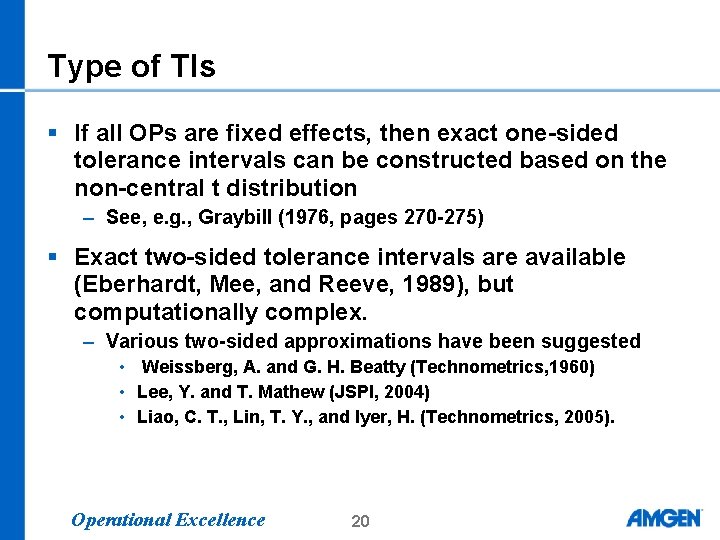
Type of TIs § If all OPs are fixed effects, then exact one-sided tolerance intervals can be constructed based on the non-central t distribution – See, e. g. , Graybill (1976, pages 270 -275) § Exact two-sided tolerance intervals are available (Eberhardt, Mee, and Reeve, 1989), but computationally complex. – Various two-sided approximations have been suggested • Weissberg, A. and G. H. Beatty (Technometrics, 1960) • Lee, Y. and T. Mathew (JSPI, 2004) • Liao, C. T. , Lin, T. Y. , and Iyer, H. (Technometrics, 2005). Operational Excellence 20
One other refinement § Many times, the PC models involve random effects such as the raw materials that feed into a process step. § In this case, the fixed effect methods can not be applied for computing tolerance intervals. § Generalized Inference provides an approach for computing tolerance intervals with a random effect. • Liao, C. T. , Lin, T. Y. , and Iyer, H. (Technometrics, 2005) • Based on generalized fiducial intervals Operational Excellence 21
One other refinement § Many times, the PC models involve random effects such as the raw materials that feed into a process step. § In this case, the fixed effect methods can not be applied for computing tolerance intervals. § Generalized Inference provides an approach for computing tolerance intervals with a random effect. • Liao, C. T. , Lin, T. Y. , and Iyer, H. (Technometrics, 2005) • Based on generalized fiducial intervals Lesson 3: Continue to make improvements and demonstrate you are willing to continually improve your work. Operational Excellence 22
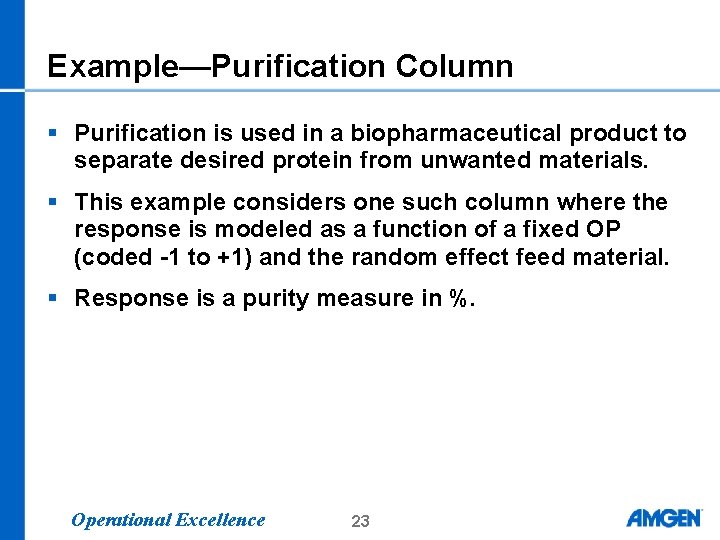
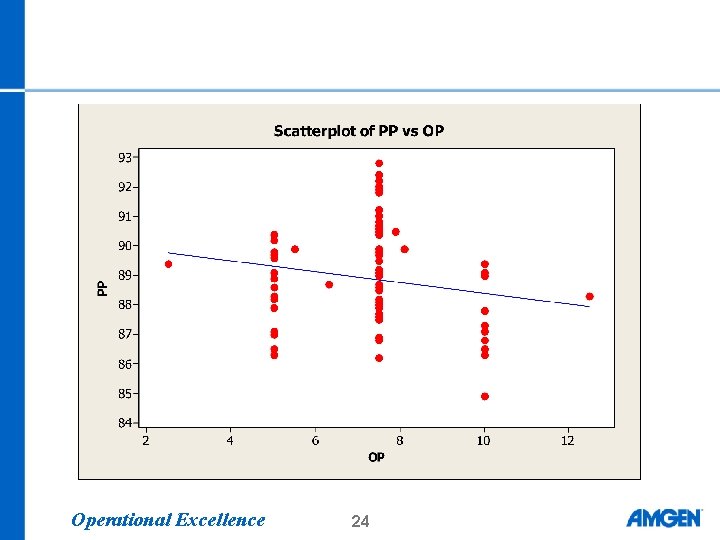
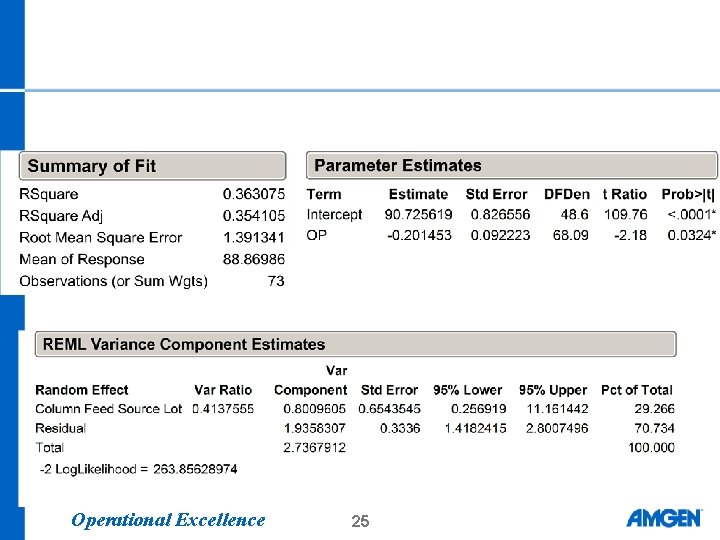
Example—Purification Column § Purification is used in a biopharmaceutical product to separate desired protein from unwanted materials. § This example considers one such column where the response is modeled as a function of a fixed OP (coded -1 to +1) and the random effect feed material. § Response is a purity measure in %. Operational Excellence 23
Operational Excellence 24
Operational Excellence 25
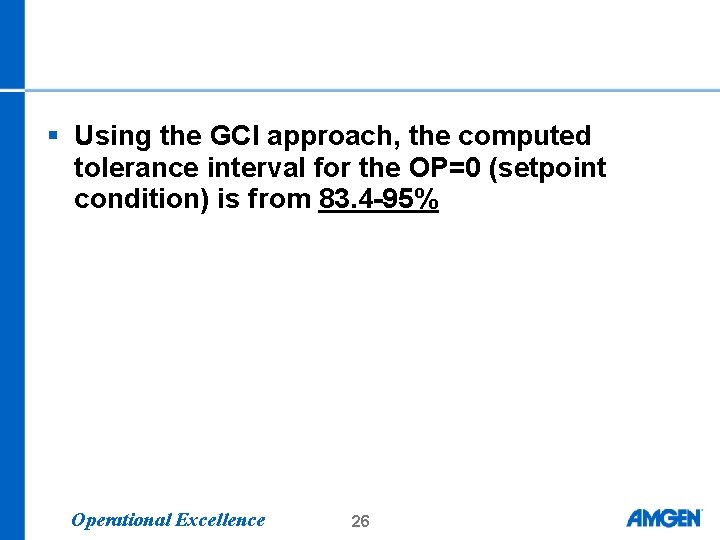
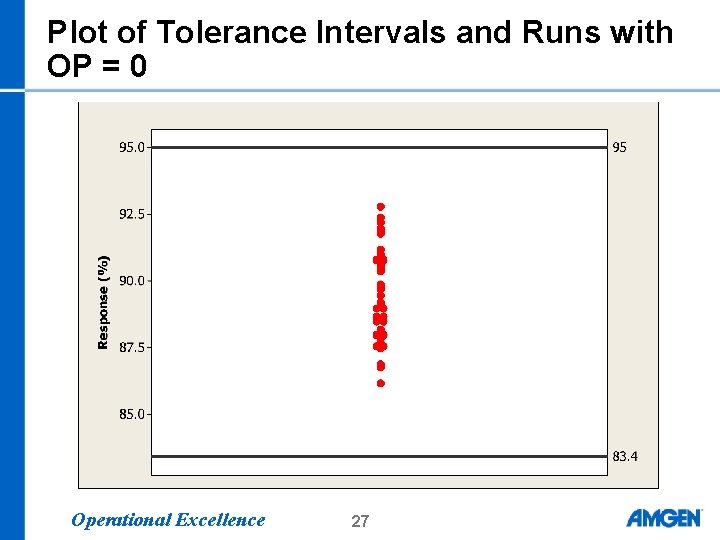
§ Using the GCI approach, the computed tolerance interval for the OP=0 (setpoint condition) is from 83. 4 -95% Operational Excellence 26
Plot of Tolerance Intervals and Runs with OP = 0 Operational Excellence 27
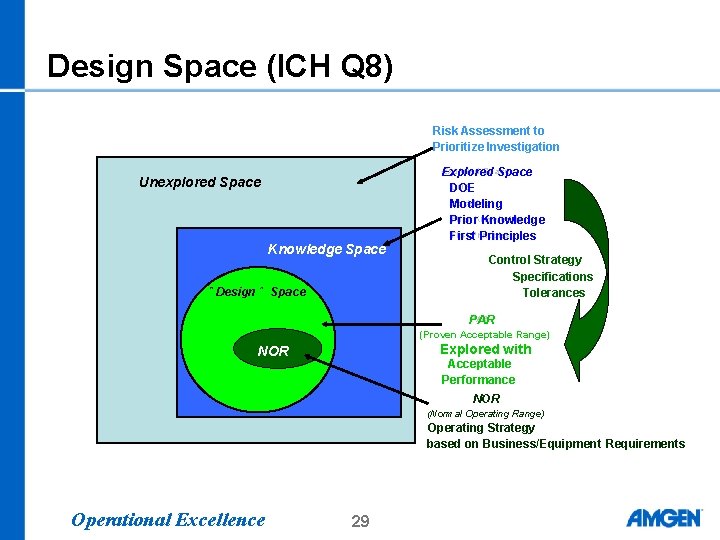
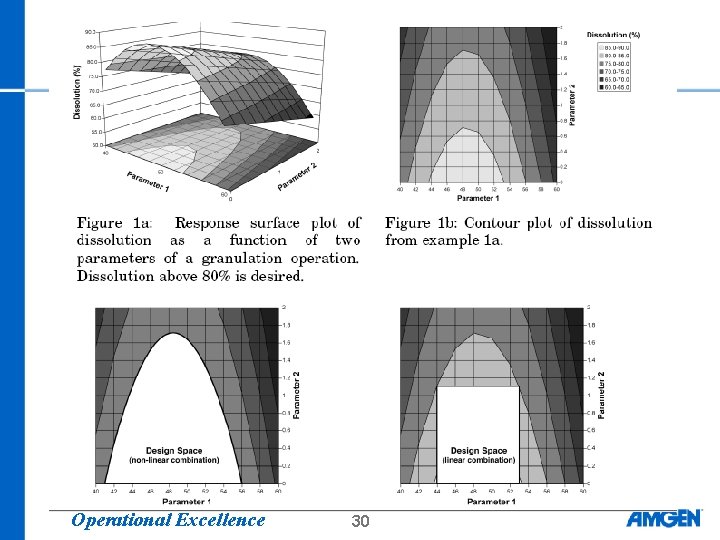
Future Opportunities § FDA initiative for Quality by Design. § ICH Q 8 Appendix on movement within the proven acceptable range (PAR)—also referred to as “Design Space”. Operational Excellence 28
Design Space (ICH Q 8) Risk Assessment to Prioritize Investigation Unexplored Space Knowledge Space “ Design ” Space Explored Space DOE Modeling Prior Knowledge First Principles Control Strategy Specifications Tolerances PAR (Proven Acceptable Range) Explored with NOR Acceptable Performance NOR (Normal Operating Range) Operating Strategy based on Business/Equipment Requirements Operational Excellence 29
Operational Excellence 30