
Using theory to design better tobacco control interventions
Using theory to design better tobacco control interventions Robert West University College London September 2011 1
Statement of competing interests • I undertake research and consultancy for companies that develop and manufacture smoking cessation medications • I have a share of a patent in a novel nicotine delivery device • I am co-director of the NHS Centre for Smoking Cessation and Training • I am a trustee of QUIT and on the scientific advisory board of Free & Clear 2

Topics • • What is tobacco control? The MPOWER approach The COM-B model of behaviour The Behaviour Change Wheel as a system for developing an intervention strategy • Applying COM-B and the BCW to tobacco control 3
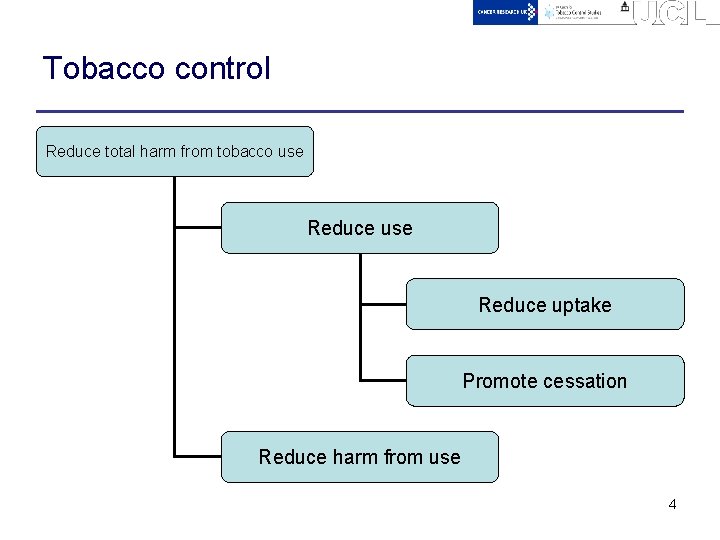
Tobacco control Reduce total harm from tobacco use Reduce uptake Promote cessation Reduce harm from use 4

MPOWER • Monitor tobacco use and prevention policies A us • Protect peopleefrom ful tobacco smoke he • Offer help to quit tobacco use uri sti i m • Warn about the dangers ple cof : n tobacco me ee dg • Enforce bans on tobacco nadvertising, tat u i promotion and sponsorship on ida nc eo • Raise taxes on tobacco n 5
Tobacco control as ‘behaviour change’ • Tobacco use is a form of behaviour • The goal is to achieve sustained ‘behaviour change’ – prevention of tobacco uptake – tobacco cessation – changes in use of tobacco products • Models of behaviour change should provide a scientific basis for developing intervention strategies 6
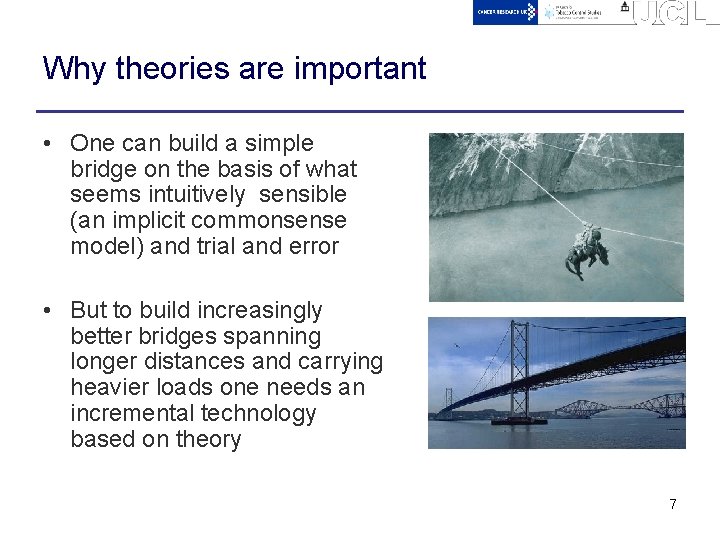
Why theories are important • One can build a simple bridge on the basis of what seems intuitively sensible (an implicit commonsense model) and trial and error • But to build increasingly better bridges spanning longer distances and carrying heavier loads one needs an incremental technology based on theory 7
Theories of behaviour change • There is a rich body of theory in behaviour change. For example. . . Decision theory how people assess risk and make choices Learning theory how experiences of reward and punishment control our behaviour Personality theory How people differ and why Economic theory how changes in price and availability affect behaviour Social theory how members of groups interact Neurobiological theories brain mechanisms underlying change 8
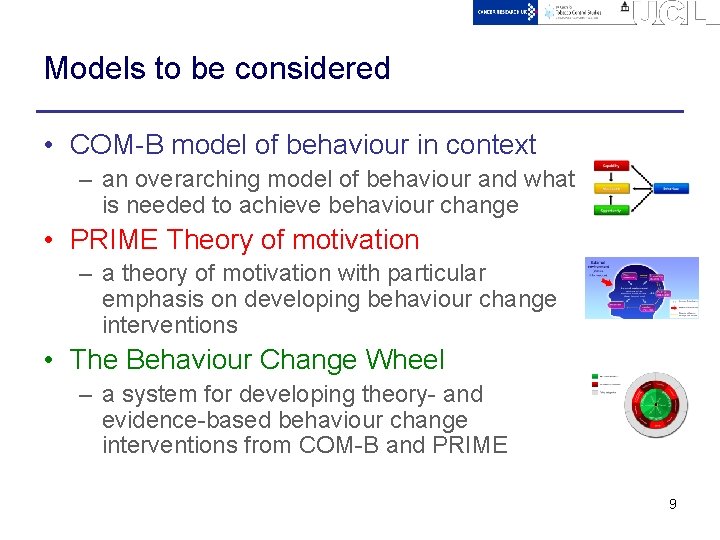
Models to be considered • COM-B model of behaviour in context – an overarching model of behaviour and what is needed to achieve behaviour change • PRIME Theory of motivation – a theory of motivation with particular emphasis on developing behaviour change interventions • The Behaviour Change Wheel – a system for developing theory- and evidence-based behaviour change interventions from COM-B and PRIME 9
Why these models? • They – bring together core components of other theories into a single coherent model – stay as close as possible to everyday language – are specifically aimed at developing behaviour change interventions Key references: Michie S, M van Stralan, West R (2011) The Behaviour Change Wheel: A new method for characterising and designing behaviour change interventions. Implementation Science, 6, 42. West R (2011) Models of Addiction. Lisbon: EMCDDA 10
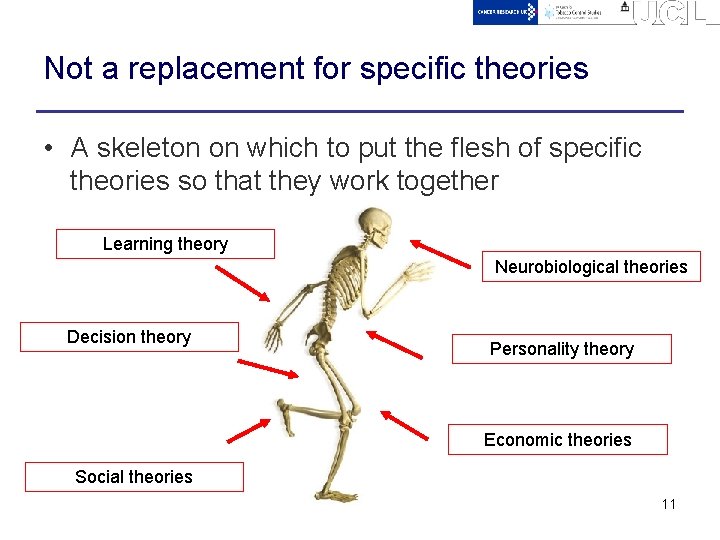
Not a replacement for specific theories • A skeleton on which to put the flesh of specific theories so that they work together Learning theory Neurobiological theories Decision theory Personality theory Economic theories Social theories 11
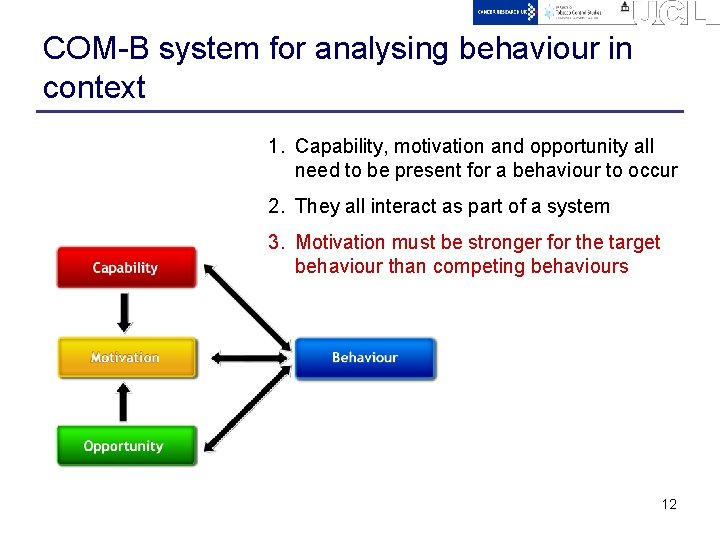
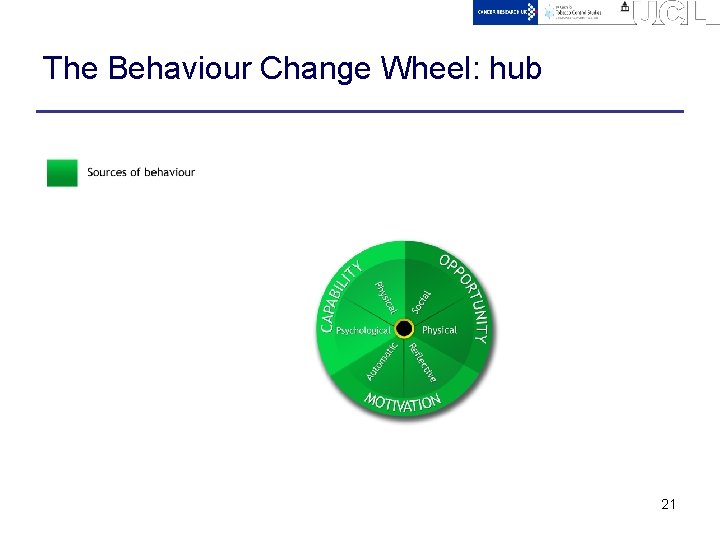
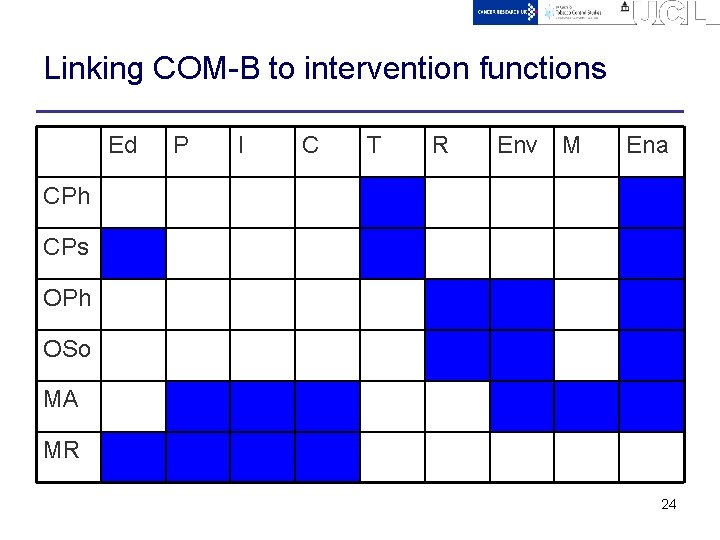
COM-B system for analysing behaviour in context 1. Capability, motivation and opportunity all need to be present for a behaviour to occur 2. They all interact as part of a system 3. Motivation must be stronger for the target behaviour than competing behaviours 12
Capability • The person has to be physically and psychologically able to perform the behaviour • Psychological capability – knowledge and understanding of • why it could be worth doing it • how to do it – capacity and skills for self-regulation • • impulse control mental energy how to make effective plans how to structure the environment 13
Motivation • The person has to want or need to engage in the behaviour at relevant moments more than they want to do something else or not do it • Sources of motivation – Reflective thought • Evaluation of costs and benefits • Self-conscious plans – Feelings and urges • • Wants: anticipated pleasure or satisfaction Needs: anticipated relief from mental or physical discomfort Impulses: Habit and instinct Counter-impulses: inhibitory processes 14
Opportunity • There have to be events and situations in the social and physical environment that enable or prompt the behaviour • Physical environment – enabling factors – cues/prompts • Social environment – modes of thinking/language – models 15
Motivation: reflective and automatic Reflective Beliefs about what is good and bad, conscious intentions, decisions and plans Automatic Emotional responses, desires and habits resulting from associative learning and physiological states 16
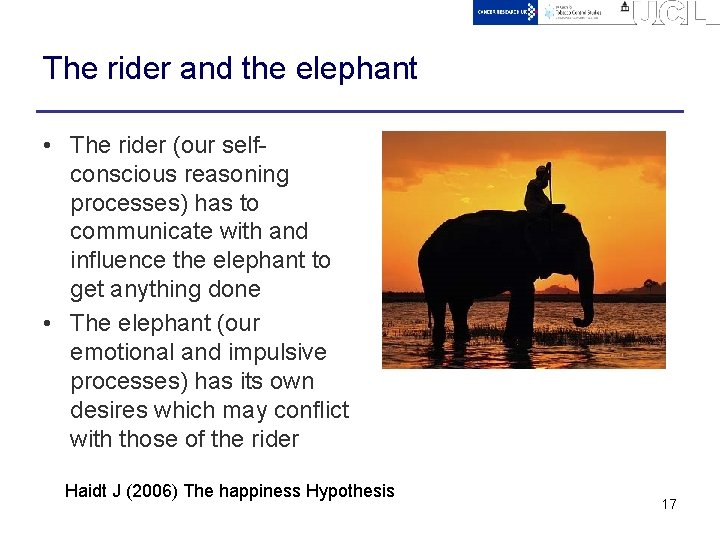
The rider and the elephant • The rider (our selfconscious reasoning processes) has to communicate with and influence the elephant to get anything done • The elephant (our emotional and impulsive processes) has its own desires which may conflict with those of the rider Haidt J (2006) The happiness Hypothesis 17
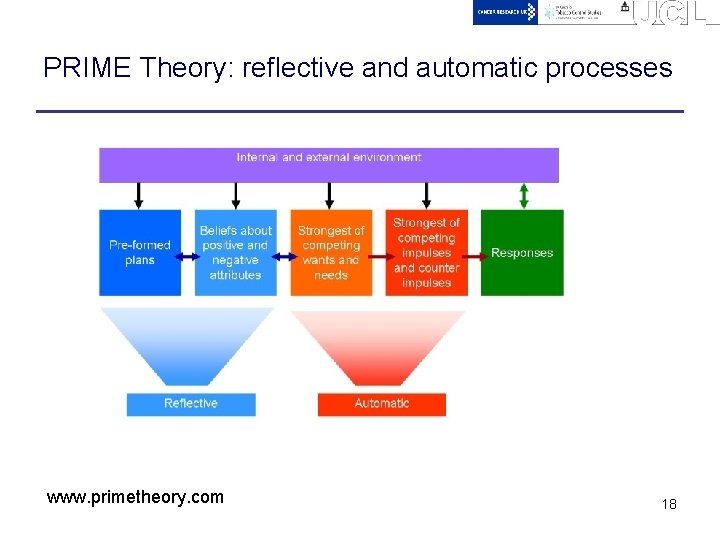
PRIME Theory: reflective and automatic processes www. primetheory. com 18
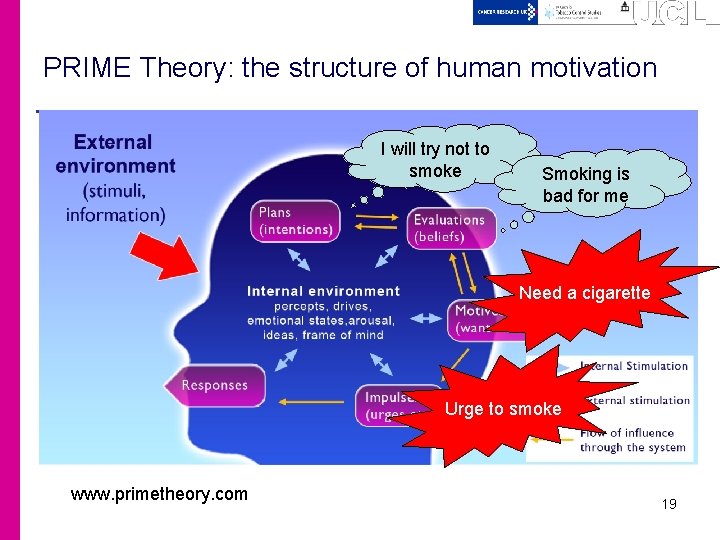
PRIME Theory: the structure of human motivation I will try not to smoke Smoking is bad for me Need a cigarette Urge to smoke www. primetheory. com 19
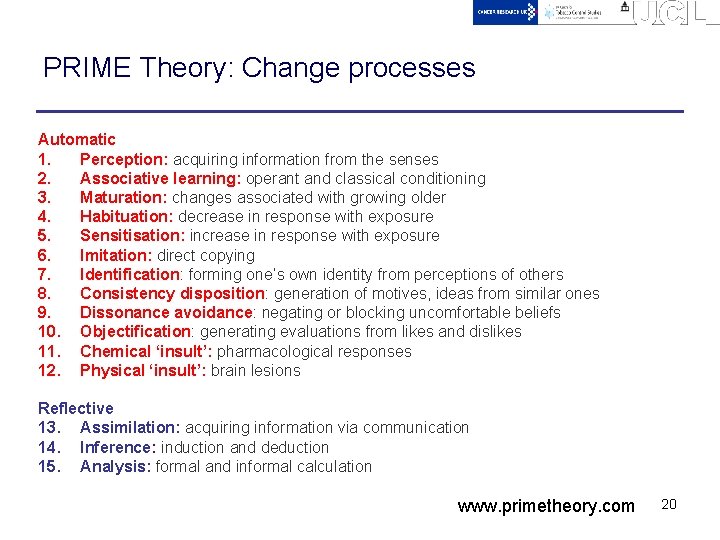
PRIME Theory: Change processes Automatic 1. Perception: acquiring information from the senses 2. Associative learning: operant and classical conditioning 3. Maturation: changes associated with growing older 4. Habituation: decrease in response with exposure 5. Sensitisation: increase in response with exposure 6. Imitation: direct copying 7. Identification: forming one’s own identity from perceptions of others 8. Consistency disposition: generation of motives, ideas from similar ones 9. Dissonance avoidance: negating or blocking uncomfortable beliefs 10. Objectification: generating evaluations from likes and dislikes 11. Chemical ‘insult’: pharmacological responses 12. Physical ‘insult’: brain lesions Reflective 13. Assimilation: acquiring information via communication 14. Inference: induction and deduction 15. Analysis: formal and informal calculation www. primetheory. com 20
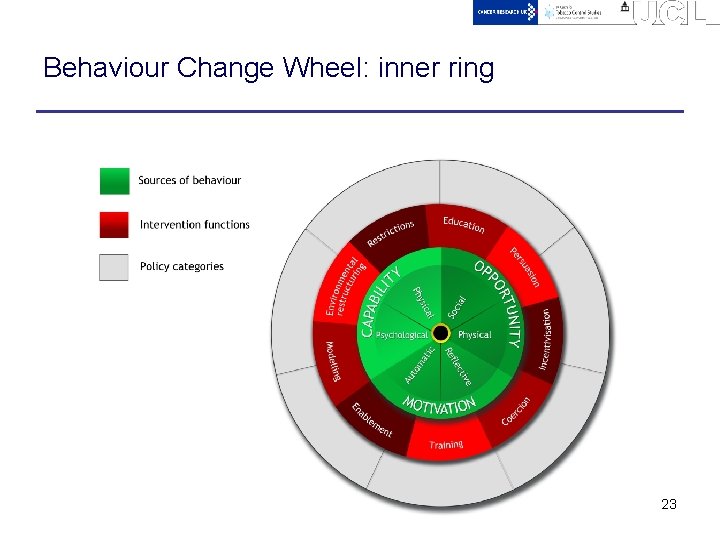
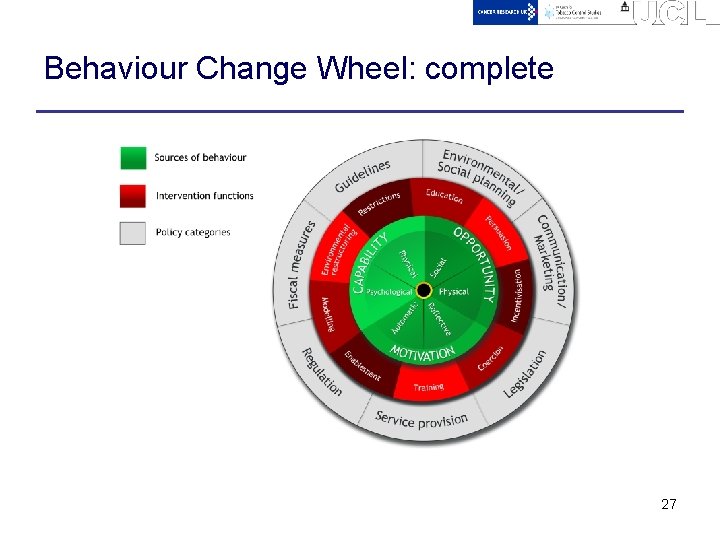
The Behaviour Change Wheel: hub 21
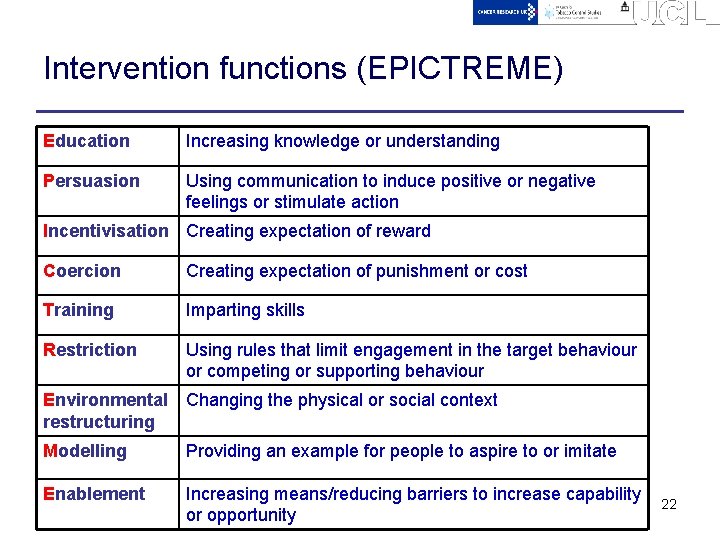
Intervention functions (EPICTREME) Education Increasing knowledge or understanding Persuasion Using communication to induce positive or negative feelings or stimulate action Incentivisation Creating expectation of reward Coercion Creating expectation of punishment or cost Training Imparting skills Restriction Using rules that limit engagement in the target behaviour or competing or supporting behaviour Environmental Changing the physical or social context restructuring Modelling Providing an example for people to aspire to or imitate Enablement Increasing means/reducing barriers to increase capability or opportunity 22
Behaviour Change Wheel: inner ring 23
Linking COM-B to intervention functions Ed P I C T R Env M Ena CPh CPs OPh OSo MA MR 24
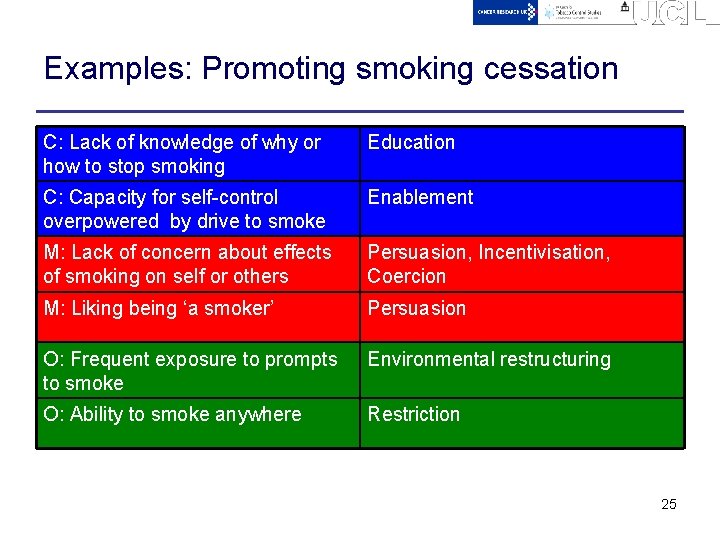
Examples: Promoting smoking cessation C: Lack of knowledge of why or how to stop smoking Education C: Capacity for self-control overpowered by drive to smoke Enablement M: Lack of concern about effects of smoking on self or others Persuasion, Incentivisation, Coercion M: Liking being ‘a smoker’ Persuasion O: Frequent exposure to prompts to smoke Environmental restructuring O: Ability to smoke anywhere Restriction 25
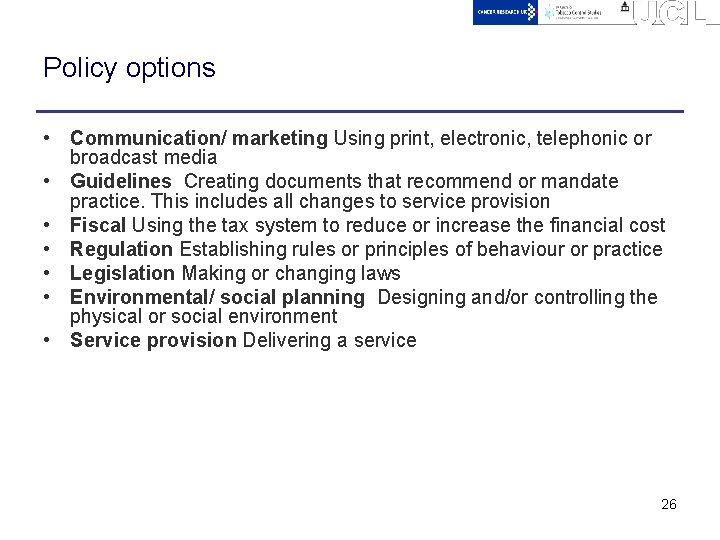
Policy options • Communication/ marketing Using print, electronic, telephonic or broadcast media • Guidelines Creating documents that recommend or mandate practice. This includes all changes to service provision • Fiscal Using the tax system to reduce or increase the financial cost • Regulation Establishing rules or principles of behaviour or practice • Legislation Making or changing laws • Environmental/ social planning Designing and/or controlling the physical or social environment • Service provision Delivering a service 26
Behaviour Change Wheel: complete 27
Education as part of tobacco control • Increasing knowledge and understanding about tobacco use and cessation T – effect on a life-expectancy rge – effect on pain and tin disability ge – effect on mental health v – consequences of use ofaldifferent ua forms of tobacco tio as possible – importance of stopping as young n s – effect on other people – tobacco industry tactics – best ways of stopping 28
Persuasion as part of tobacco control • Changing the way people feel about tobacco use T – – – arg of importance of stopping smoking reminding e tin smoking with negative imagery associating g a ndpositive evimagery around not smoking creating alu im methods making effective pu at of stopping attractive ion promotion ls company countering tobacco e/i s nh , e ibi mo tio n n 29
Incentivisation as part of tobacco control • Giving people rewards for not smoking – rewards for not taking up smoking T em aforrgabstinence – rewards eti of effective methods of achieving otifor use – rewards n o ge abstinencen, im va pu lu lse atio /in ns hib , itio n 30
Coercion as part of tobacco control • Punishing smoking – raising taxes T em arillicit – combating supply g eti oti smoking – stigmatising n o n, ge im va pu lu lse atio /in ns hib , itio n 31
Training as part of tobacco control • Providing people with the skills to avoid or escape from tobacco use T arg – refusal skills training eti – self-control training ng – training in effective use of c cessation methods ap ab ilit y 32
Restriction as part of tobacco control • Making rules about what, when and where people can smoke T arg cigarettes – banning high-tar eti in indoor public areas – banning smoking ng – banning smoking in o cars with children in pp ort un ity 33
Environmental restructuring as part of tobacco control • Restricting availability • – removing vending machines T – reducing a outlet rge density – preventing sales ti to minors ng Reducing smoking prompts op po – Reducing tobacco promotion rtu niint films etc – Reducing exposure to smoking y 34
Modelling as part of tobacco control • Showing people attractive non-smoking models – refusing to smoke T em asmoking – stopping rge – using o effective methods tio ticessation n n, ge im va pu lu lse atio /in ns hib , itio n 35
Enablement as part of tobacco control • Helping people resist or stop smoking – addressing psychological problems that pre-dispose Ta to smoking rge to combat craving and withdrawal – providing medicines t nicotine’s effects and substitute for symptoms, blockin gc positive functions ap ab substitutes for – providing non-pharmacological ilit smoking y – providing behavioural support to aid cessation 36
Other key considerations • Affordability – What can be afforded within the resources that can be devoted to it • Practicability – What is the best implementation that can be achieved • Acceptability – What is ethically and publicly acceptable 37
Understanding the context • Need the best, most specific information possible • Use this in the COM-B analysis to help decide the strategy 38
Relevant evidence from the UK • Education: – quitting younger, better use of NRT bought OTC, and more use of Stop Smoking Services • Persuasion: – more effective use of GP advice • Coercion: – more effective use of cost increases • Restriction: – examine how to make them work better • Enablement – Raise the quality and increase affordability of Stop-Smoking support Arnott D (Ed) All Party Parliamentary Group Report on Tobacco Control in England. London: ASH www. ash. org. uk 39

Education 40
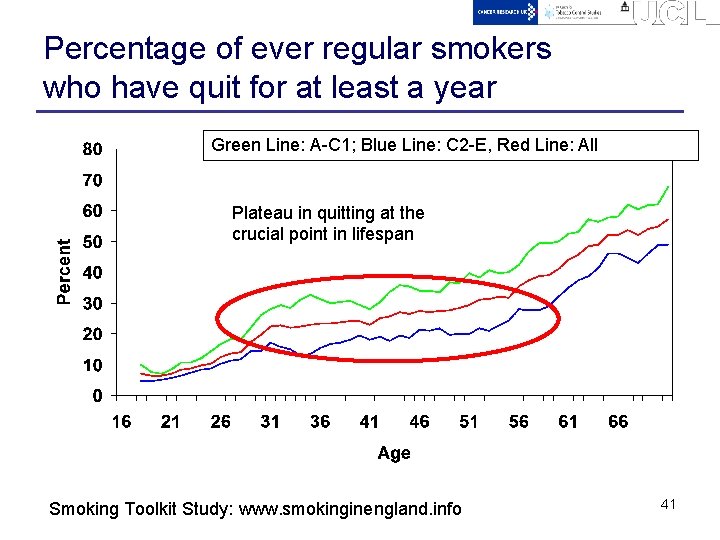
Percentage of ever regular smokers who have quit for at least a year Green Line: A-C 1; Blue Line: C 2 -E, Red Line: All Plateau in quitting at the crucial point in lifespan Smoking Toolkit Study: www. smokinginengland. info 41
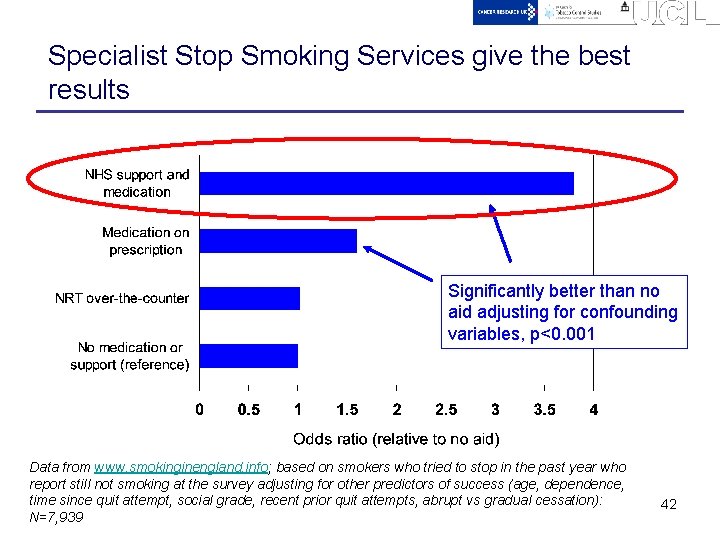
Specialist Stop Smoking Services give the best results Significantly better than no aid adjusting for confounding variables, p<0. 001 Data from www. smokinginengland. info; based on smokers who tried to stop in the past year who report still not smoking at the survey adjusting for other predictors of success (age, dependence, time since quit attempt, social grade, recent prior quit attempts, abrupt vs gradual cessation): N=7, 939 42
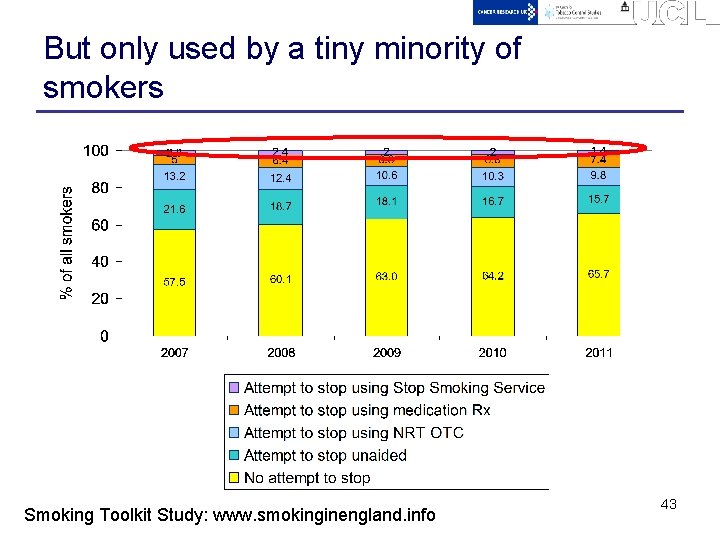
But only used by a tiny minority of smokers Smoking Toolkit Study: www. smokinginengland. info 43
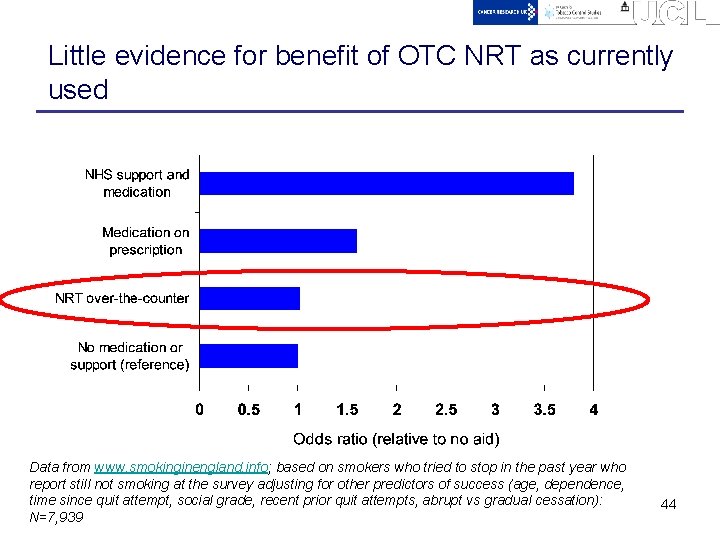
Little evidence for benefit of OTC NRT as currently used Data from www. smokinginengland. info; based on smokers who tried to stop in the past year who report still not smoking at the survey adjusting for other predictors of success (age, dependence, time since quit attempt, social grade, recent prior quit attempts, abrupt vs gradual cessation): N=7, 939 44

Use of aids to cessation Smoking Toolkit Study: www. smokinginengland. info 45
Persuasion 46
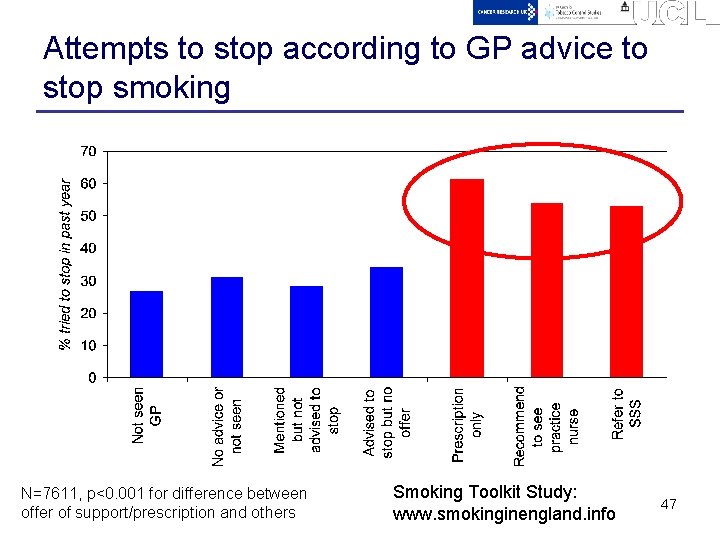
Attempts to stop according to GP advice to stop smoking N=7611, p<0. 001 for difference between offer of support/prescription and others Smoking Toolkit Study: www. smokinginengland. info 47
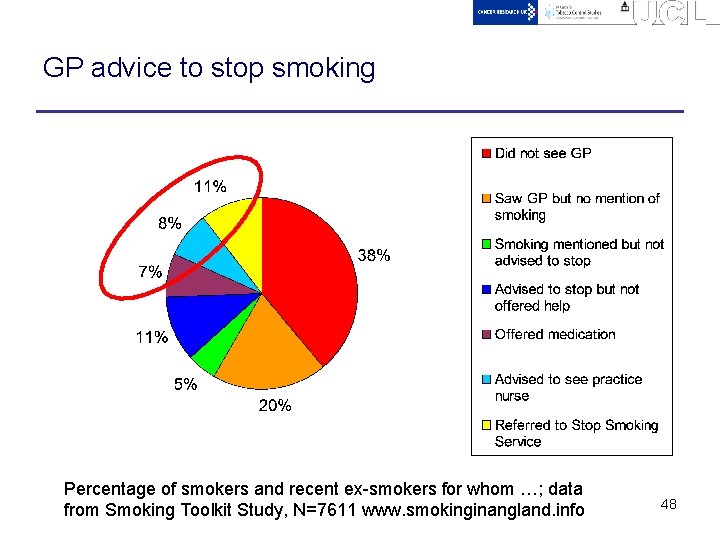
GP advice to stop smoking Percentage of smokers and recent ex-smokers for whom …; data from Smoking Toolkit Study, N=7611 www. smokinginangland. info 48
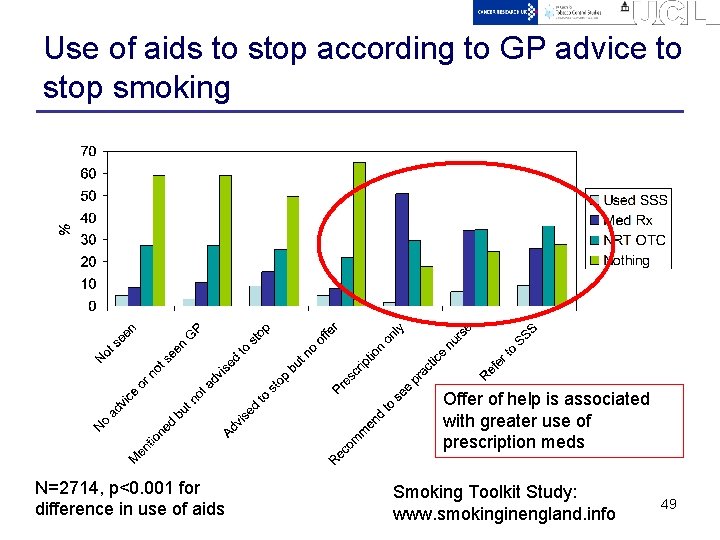
Use of aids to stop according to GP advice to stop smoking Offer of help is associated with greater use of prescription meds N=2714, p<0. 001 for difference in use of aids Smoking Toolkit Study: www. smokinginengland. info 49
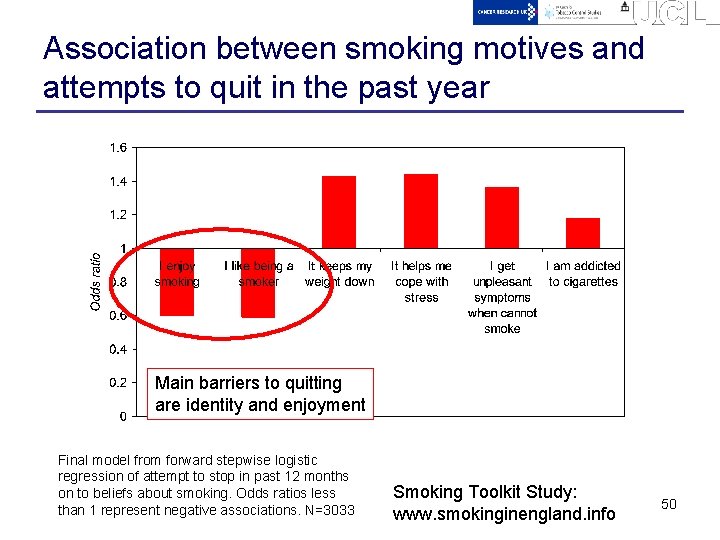
Association between smoking motives and attempts to quit in the past year Main barriers to quitting are identity and enjoyment Final model from forward stepwise logistic regression of attempt to stop in past 12 months on to beliefs about smoking. Odds ratios less than 1 represent negative associations. N=3033 Smoking Toolkit Study: www. smokinginengland. info 50

Coercion 51
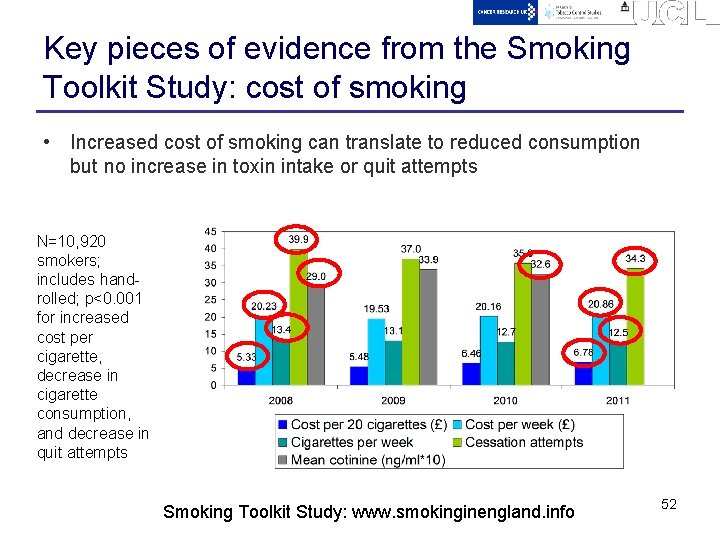
Key pieces of evidence from the Smoking Toolkit Study: cost of smoking • Increased cost of smoking can translate to reduced consumption but no increase in toxin intake or quit attempts N=10, 920 smokers; includes handrolled; p<0. 001 for increased cost per cigarette, decrease in cigarette consumption, and decrease in quit attempts Smoking Toolkit Study: www. smokinginengland. info 52

Restriction 53
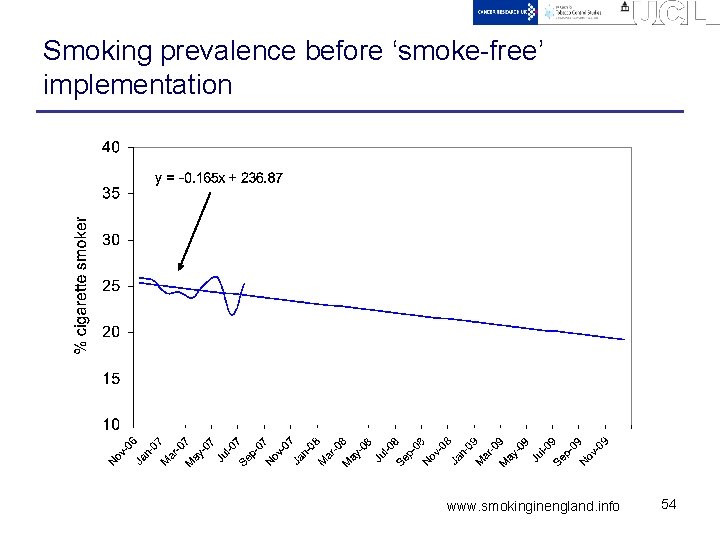
Smoking prevalence before ‘smoke-free’ implementation www. smokinginengland. info 54
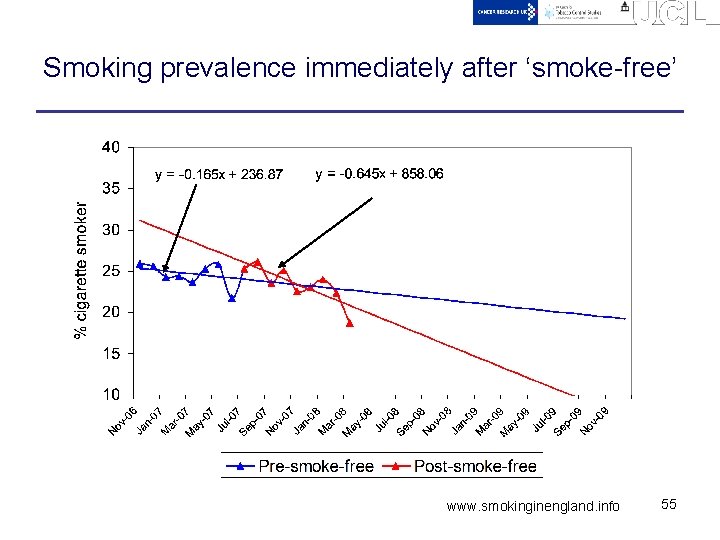
Smoking prevalence immediately after ‘smoke-free’ www. smokinginengland. info 55
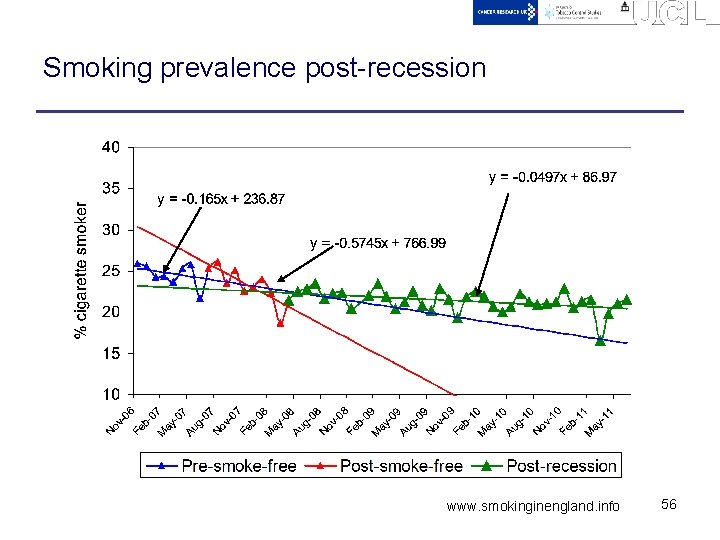
Smoking prevalence post-recession www. smokinginengland. info 56
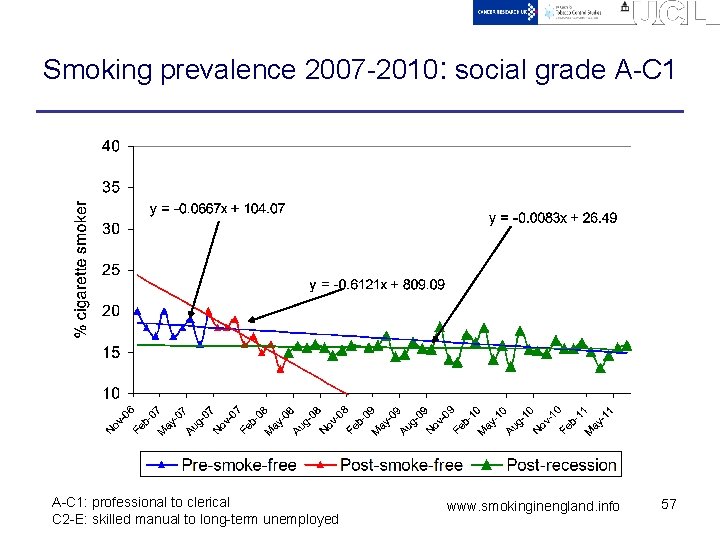
Smoking prevalence 2007 -2010: social grade A-C 1: professional to clerical C 2 -E: skilled manual to long-term unemployed www. smokinginengland. info 57
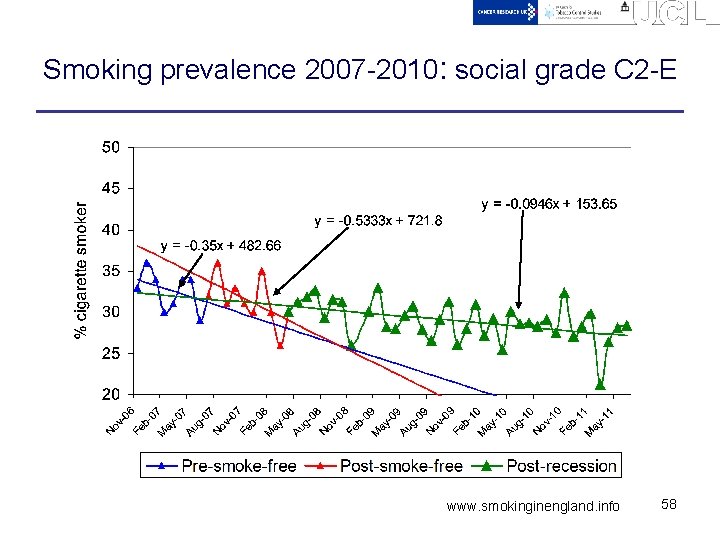
Smoking prevalence 2007 -2010: social grade C 2 -E www. smokinginengland. info 58
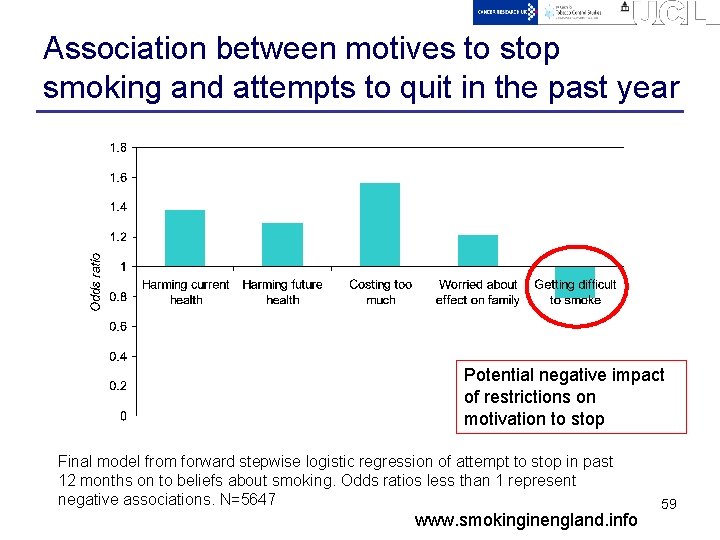
Association between motives to stop smoking and attempts to quit in the past year Potential negative impact of restrictions on motivation to stop Final model from forward stepwise logistic regression of attempt to stop in past 12 months on to beliefs about smoking. Odds ratios less than 1 represent negative associations. N=5647 www. smokinginengland. info 59
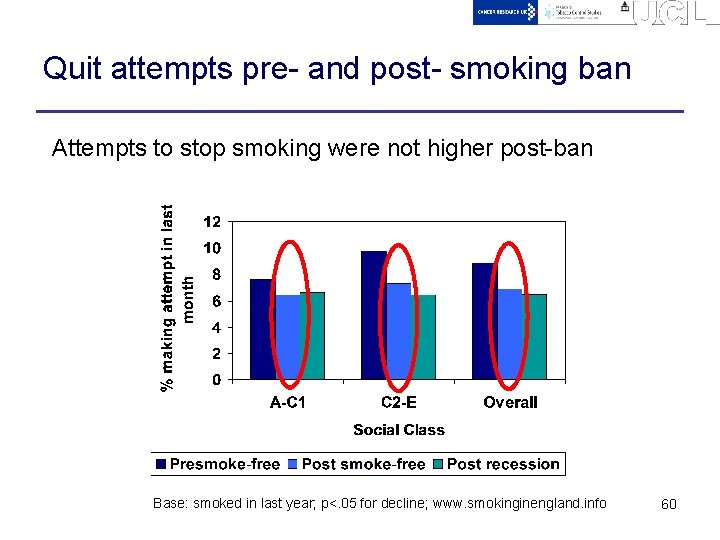
Quit attempts pre- and post- smoking ban Attempts to stop smoking were not higher post-ban Base: smoked in last year; p<. 05 for decline; www. smokinginengland. info 60
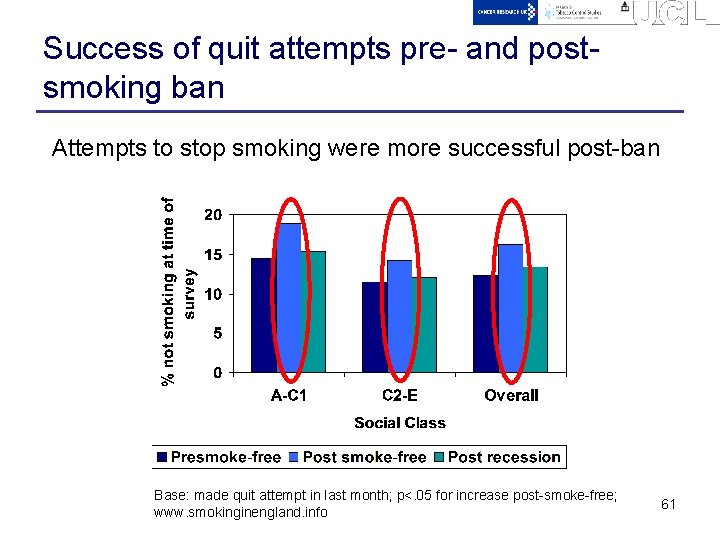
Success of quit attempts pre- and postsmoking ban Attempts to stop smoking were more successful post-ban Base: made quit attempt in last month; p<. 05 for increase post-smoke-free; www. smokinginengland. info 61
Enablement 62
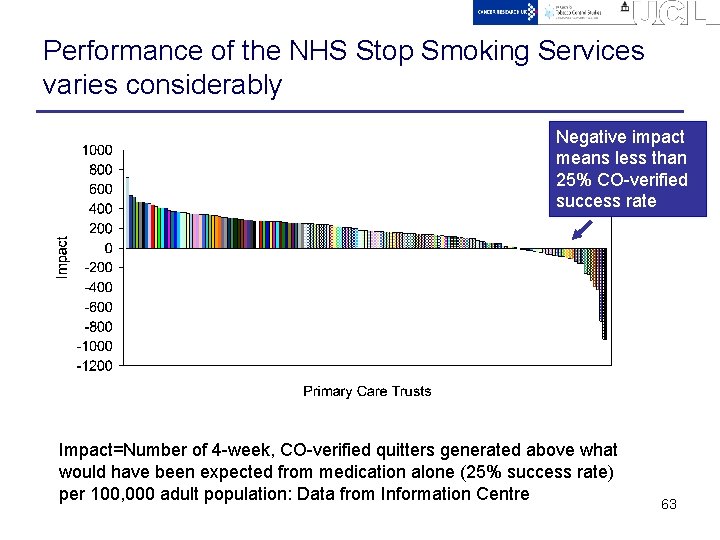
Performance of the NHS Stop Smoking Services varies considerably Negative impact means less than 25% CO-verified success rate Impact=Number of 4 -week, CO-verified quitters generated above what would have been expected from medication alone (25% success rate) per 100, 000 adult population: Data from Information Centre 63
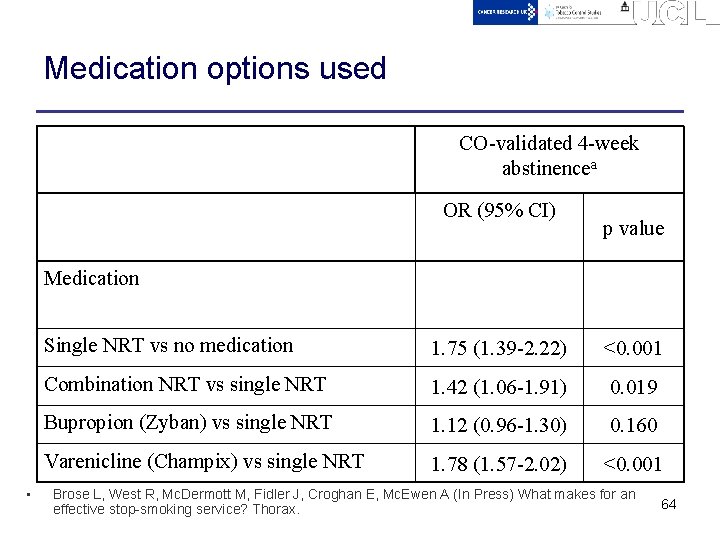
Medication options used CO-validated 4 -week abstinencea OR (95% CI) p value Medication • Single NRT vs no medication 1. 75 (1. 39 -2. 22) <0. 001 Combination NRT vs single NRT 1. 42 (1. 06 -1. 91) 0. 019 Bupropion (Zyban) vs single NRT 1. 12 (0. 96 -1. 30) 0. 160 Varenicline (Champix) vs single NRT 1. 78 (1. 57 -2. 02) <0. 001 Brose L, West R, Mc. Dermott M, Fidler J, Croghan E, Mc. Ewen A (In Press) What makes for an effective stop-smoking service? Thorax. 64
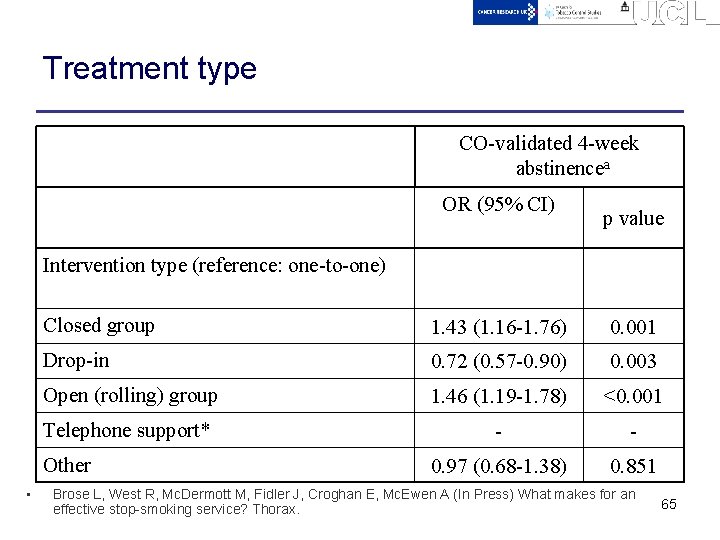
Treatment type CO-validated 4 -week abstinencea OR (95% CI) p value Intervention type (reference: one-to-one) Closed group 1. 43 (1. 16 -1. 76) 0. 001 Drop-in 0. 72 (0. 57 -0. 90) 0. 003 Open (rolling) group 1. 46 (1. 19 -1. 78) <0. 001 Telephone support* - - 0. 97 (0. 68 -1. 38) 0. 851 Other • Brose L, West R, Mc. Dermott M, Fidler J, Croghan E, Mc. Ewen A (In Press) What makes for an effective stop-smoking service? Thorax. 65
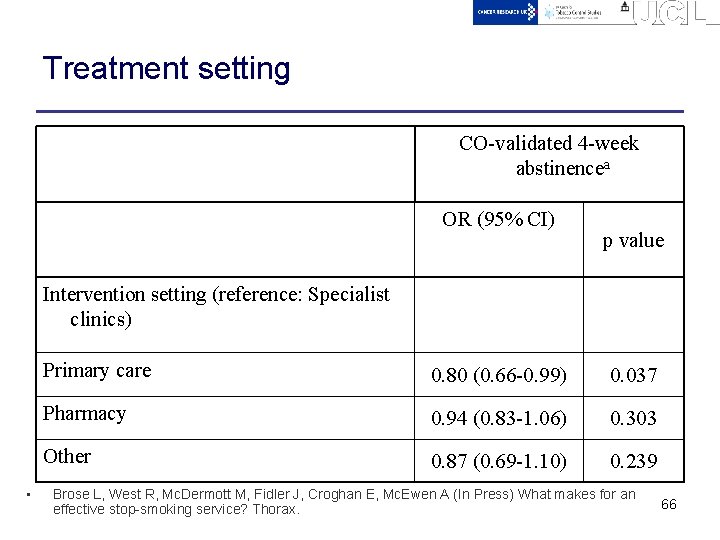
Treatment setting CO-validated 4 -week abstinencea OR (95% CI) p value Intervention setting (reference: Specialist clinics) • Primary care 0. 80 (0. 66 -0. 99) 0. 037 Pharmacy 0. 94 (0. 83 -1. 06) 0. 303 Other 0. 87 (0. 69 -1. 10) 0. 239 Brose L, West R, Mc. Dermott M, Fidler J, Croghan E, Mc. Ewen A (In Press) What makes for an effective stop-smoking service? Thorax. 66
A narrative for England: the back story • Smoking is still killing 80, 000 people each year. • There is strong support for interventions that support smokers to stop and protect children. They also must give value for money. 67
A narrative for England: the plot • We can make better use of existing resources to support smokers in stopping and protect children from starting and from effects of smoking • Communications – how best to stop, better use of NRT, linked to price increases and tighter control on illicit supply – importance of trying to stop at least once a year, starting as young as possible • Health professional advice – very brief advice just on best methods of stopping and offer of support • Tobacco industry – remove all possible methods of promoting their products (point of sale, plain packaging) • Extending restrictions – with consent as a means of supporting quitting and protecting young people • Stop Smoking Services – Get better value by improving quality 68
Conclusions • Need an overarching model of behaviour change to develop an ‘incremental technology’ • COM-B, PRIME and BCW provide a possible approach – but only a small first step • Provides a systematic basis for developing an intervention strategy based on an analysis of what is needed to achieve a behavioural target • Specific evidence of the behaviour in context is then needed to examine priorities and details of the interventions 69
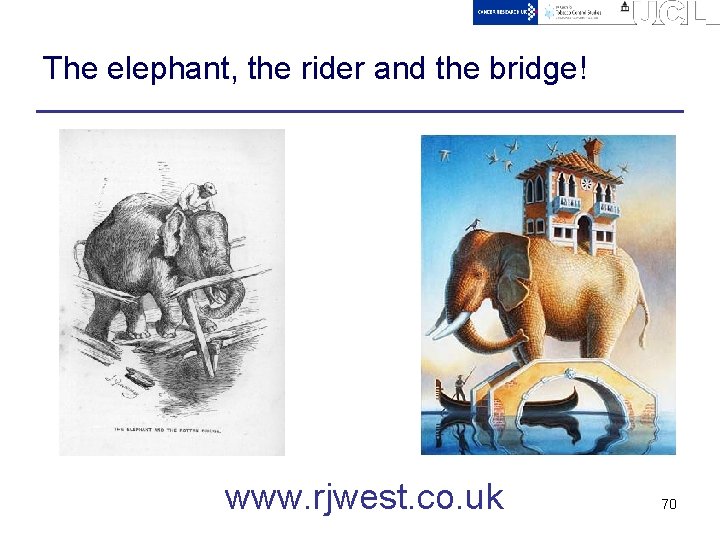
The elephant, the rider and the bridge! www. rjwest. co. uk 70
- Slides: 70