
Using the tools of science to teach science
- Slides: 35
Using the tools of science to teach science Carl Wieman UBC & CU Nobel Prize Data!! Colorado physics & chem education research group: W. Adams, K. Perkins, K. Gray, L. Koch, J. Barbera, S. Mc. Kagan, N. Finkelstein, S. Pollock, R. Lemaster, S. Reid, C. Malley, M. Dubson. . . $$ NSF, Kavli, Hewlett)
Using the tools of science to teach science I) Why should we care about science education? II) What does research tell us about effectiveness of traditional science teaching and how to improve? III) Some technology that can help (if used correctly!) IV) What am I doing at UBC (brief)
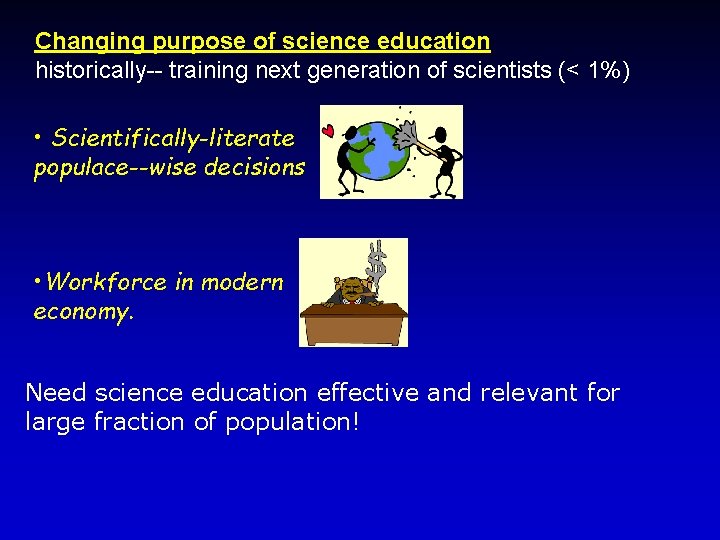
Changing purpose of science education historically-- training next generation of scientists (< 1%) • Scientifically-literate populace--wise decisions • Workforce in modern economy. Need science education effective and relevant for large fraction of population!
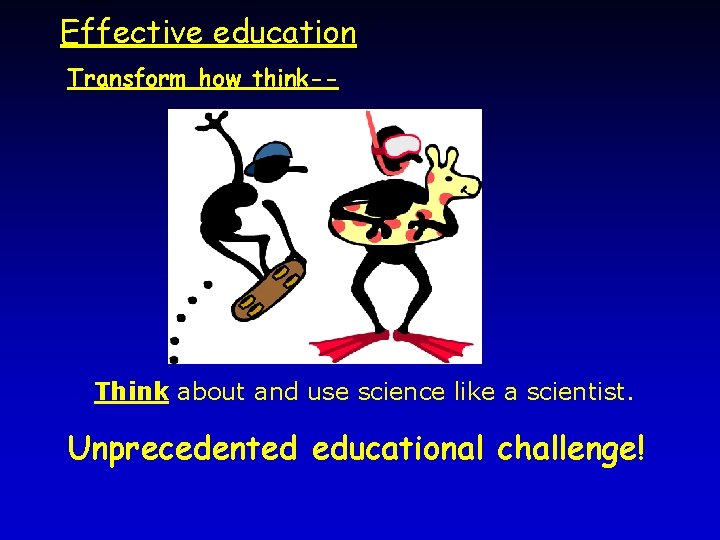
Effective education Transform how think-- Think about and use science like a scientist. Unprecedented educational challenge!
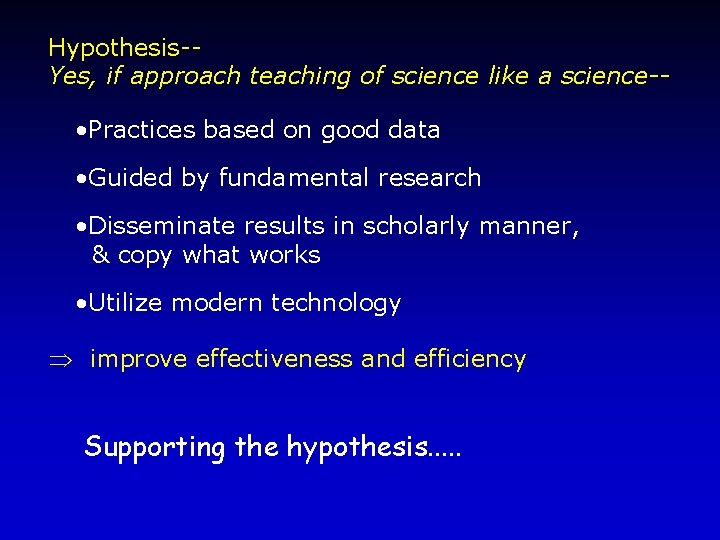
Hypothesis-Yes, if approach teaching of science like a science-- • Practices based on good data • Guided by fundamental research • Disseminate results in scholarly manner, & copy what works • Utilize modern technology improve effectiveness and efficiency Supporting the hypothesis. . .
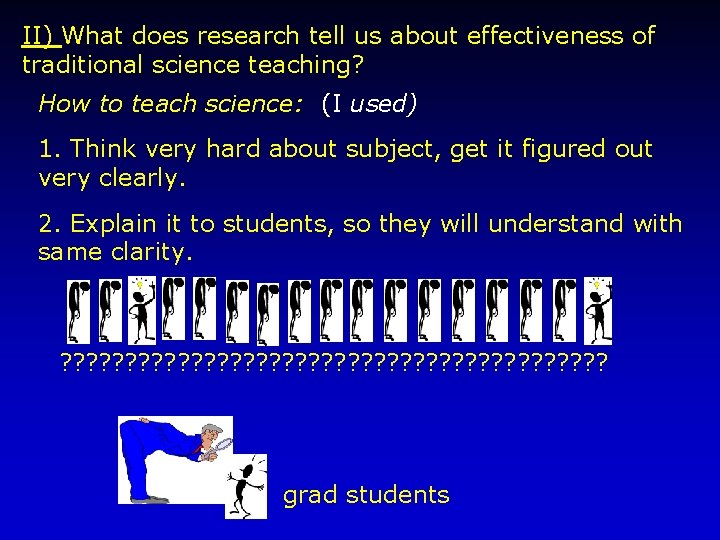
II) What does research tell us about effectiveness of traditional science teaching? How to teach science: (I used) 1. Think very hard about subject, get it figured out very clearly. 2. Explain it to students, so they will understand with same clarity. ? ? ? ? ? ? ? ? ? ? ? grad students
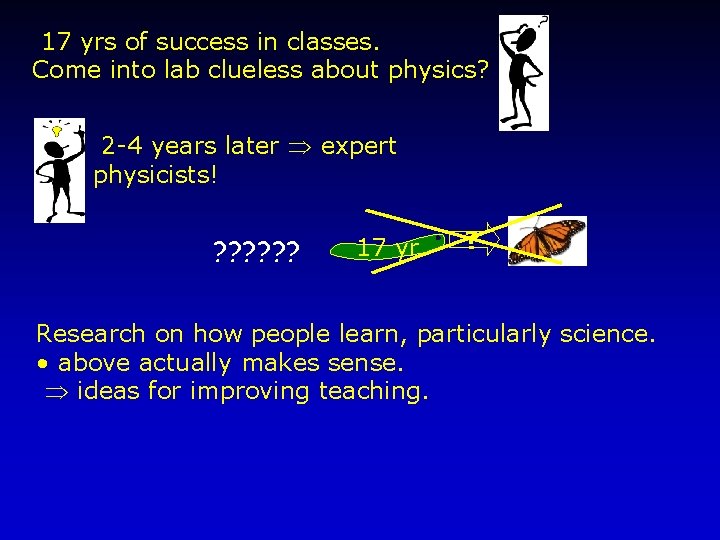
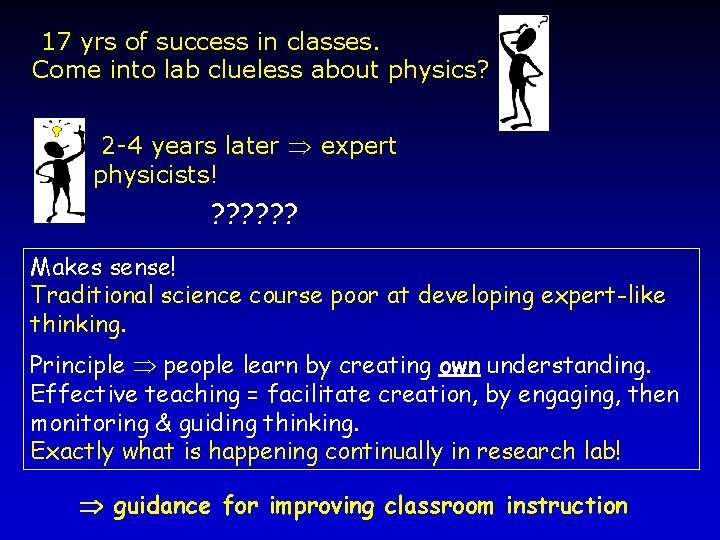
17 yrs of success in classes. Come into lab clueless about physics? 2 -4 years later expert physicists! ? ? ? 17 yr ? Research on how people learn, particularly science. • above actually makes sense. ideas for improving teaching.
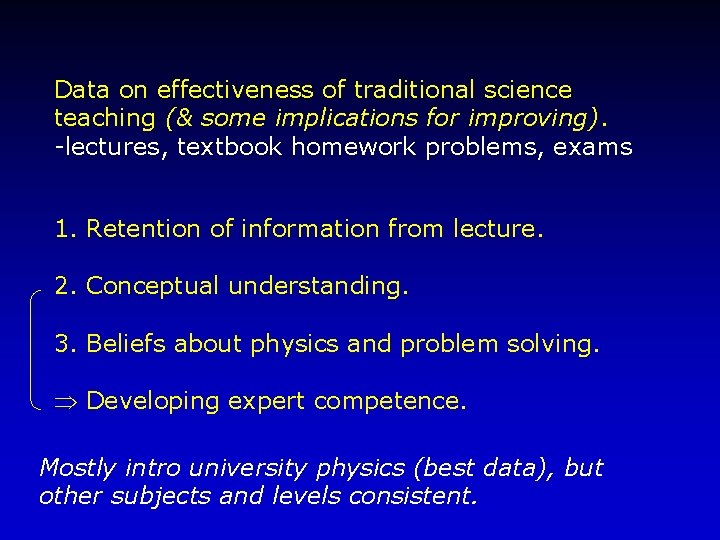
Data on effectiveness of traditional science teaching (& some implications for improving). -lectures, textbook homework problems, exams 1. Retention of information from lecture. 2. Conceptual understanding. 3. Beliefs about physics and problem solving. Developing expert competence. Mostly intro university physics (best data), but other subjects and levels consistent.
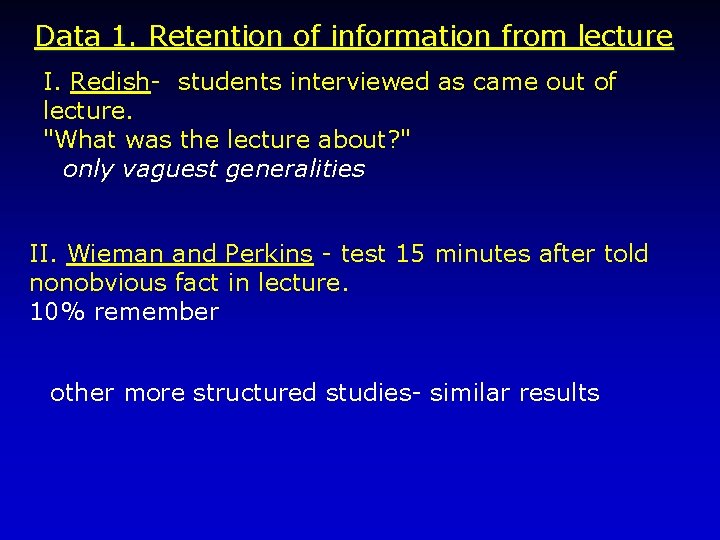
Data 1. Retention of information from lecture I. Redish- students interviewed as came out of lecture. "What was the lecture about? " only vaguest generalities II. Wieman and Perkins - test 15 minutes after told nonobvious fact in lecture. 10% remember other more structured studies- similar results
Does this make sense? Can it possibly be generic?
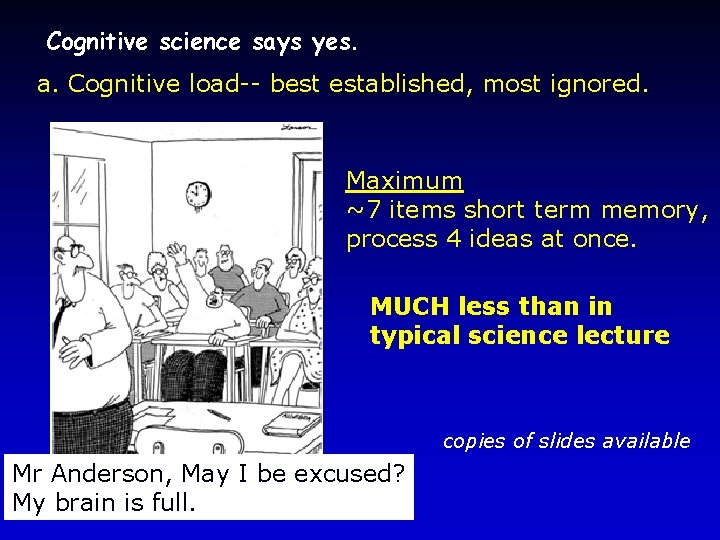
Cognitive science says yes. a. Cognitive load-- best established, most ignored. Maximum ~7 items short term memory, process 4 ideas at once. MUCH less than in typical science lecture copies of slides available Mr Anderson, May I be excused? My brain is full.
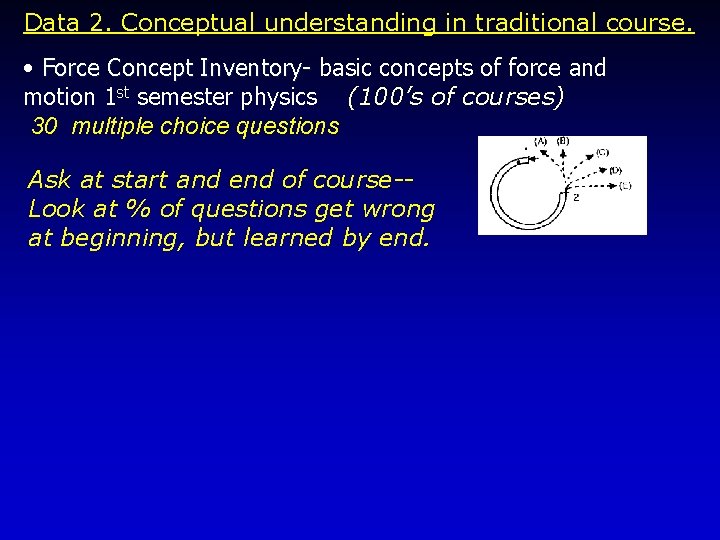
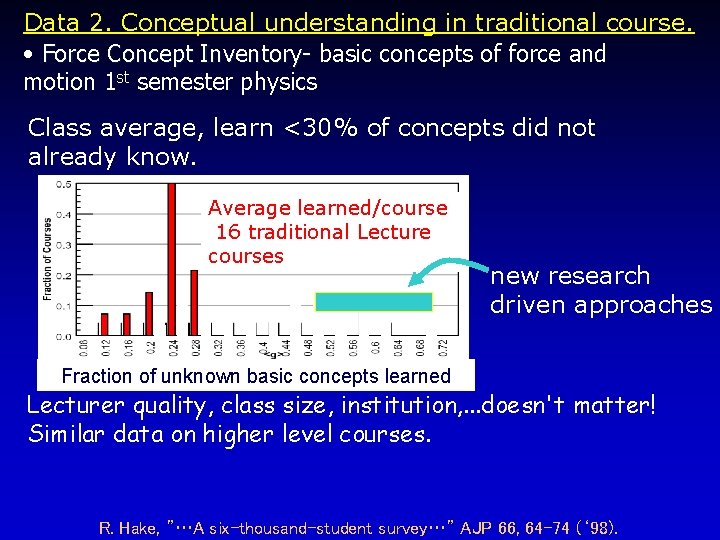
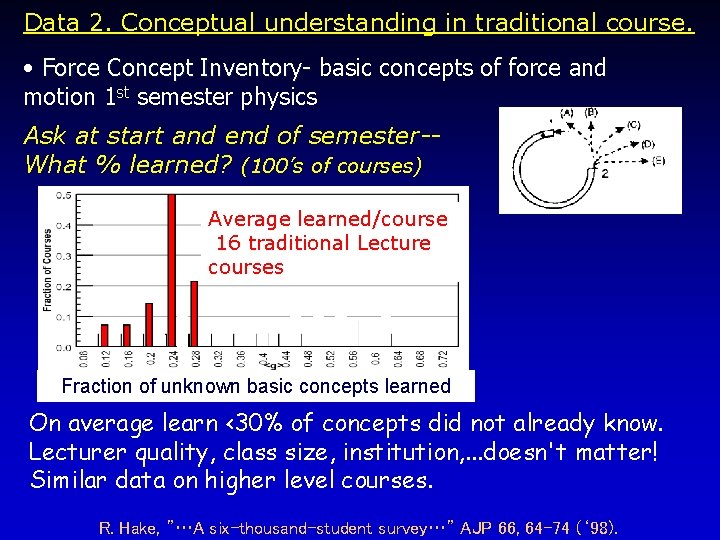
Data 2. Conceptual understanding in traditional course. • Force Concept Inventory- basic concepts of force and motion 1 st semester physics (100’s of courses) 30 multiple choice questions Ask at start and end of course-Look at % of questions get wrong at beginning, but learned by end.
Data 2. Conceptual understanding in traditional course. • Force Concept Inventory- basic concepts of force and motion 1 st semester physics Class average, learn <30% of concepts did not already know. Average learned/course 16 traditional Lecture courses new research driven approaches Fraction of unknown basic concepts learned Lecturer quality, class size, institution, . . . doesn't matter! Similar data on higher level courses. R. Hake, ”…A six-thousand-student survey…” AJP 66, 64 -74 (‘ 98).
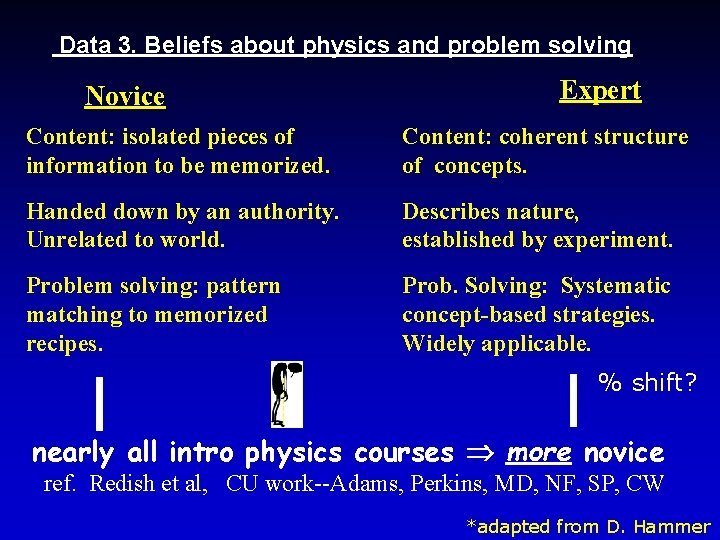
Data 3. Beliefs about physics and problem solving Novice Expert Content: isolated pieces of information to be memorized. Content: coherent structure of concepts. Handed down by an authority. Unrelated to world. Describes nature, established by experiment. Problem solving: pattern matching to memorized recipes. Prob. Solving: Systematic concept-based strategies. Widely applicable. % shift? nearly all intro physics courses more novice ref. Redish et al, CU work--Adams, Perkins, MD, NF, SP, CW *adapted from D. Hammer
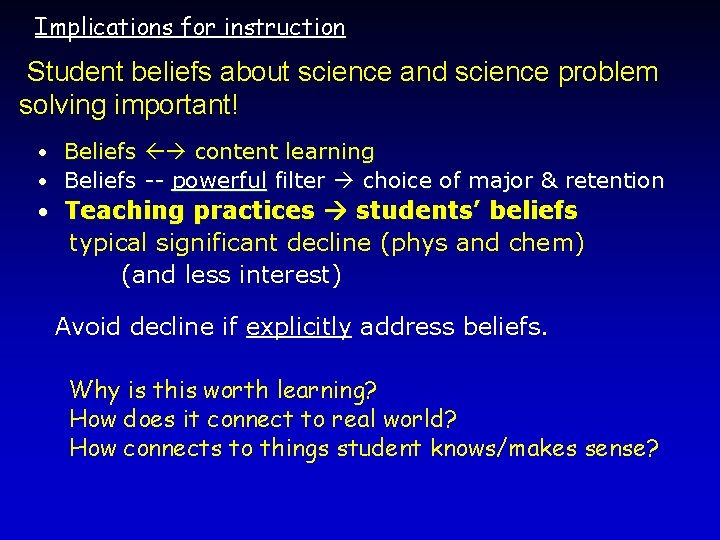
Implications for instruction Student beliefs about science and science problem solving important! • Beliefs content learning • Beliefs -- powerful filter choice of major & retention • Teaching practices students’ beliefs typical significant decline (phys and chem) (and less interest) Avoid decline if explicitly address beliefs. Why is this worth learning? How does it connect to real world? How connects to things student knows/makes sense?
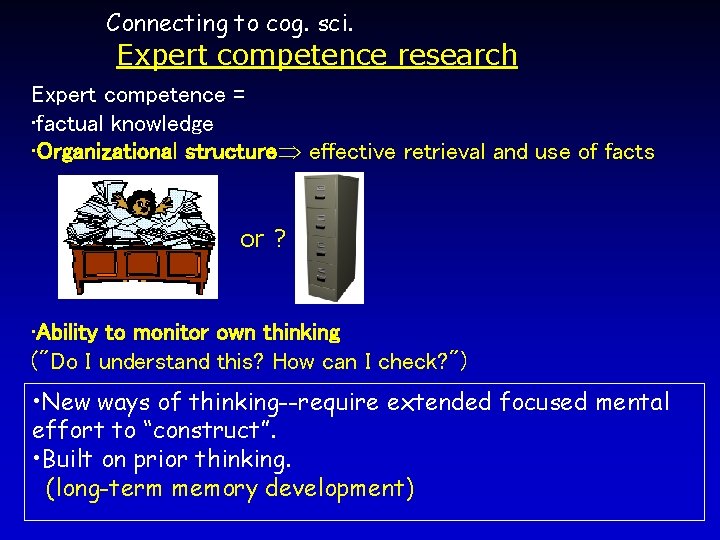
Connecting to cog. sci. Expert competence research Expert competence = • factual knowledge • Organizational structure effective retrieval and use of facts or ? • Ability to monitor own thinking ("Do I understand this? How can I check? ") • New ways of thinking--require extended focused mental effort to “construct”. • Built on prior thinking. (long-term memory development)
17 yrs of success in classes. Come into lab clueless about physics? 2 -4 years later expert physicists! ? ? ? Makes sense! Traditional science course poor at developing expert-like thinking. Principle people learn by creating own understanding. Effective teaching = facilitate creation, by engaging, then monitoring & guiding thinking. Exactly what is happening continually in research lab! guidance for improving classroom instruction
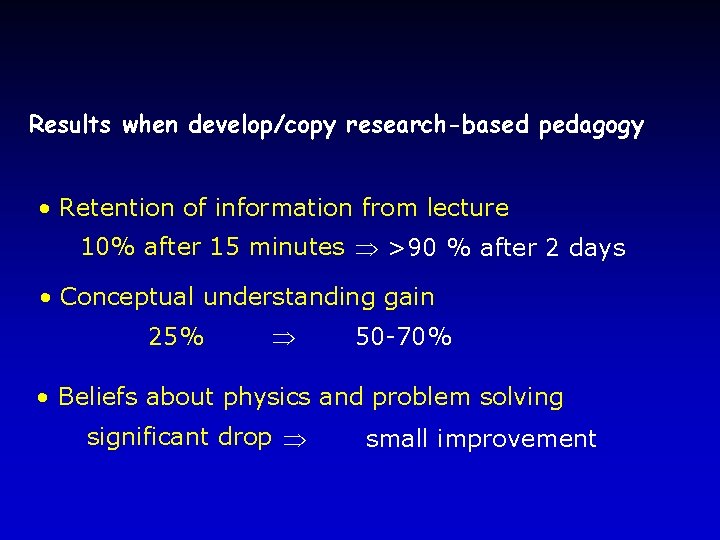
Results when develop/copy research-based pedagogy • Retention of information from lecture 10% after 15 minutes >90 % after 2 days • Conceptual understanding gain 25% 50 -70% • Beliefs about physics and problem solving significant drop small improvement
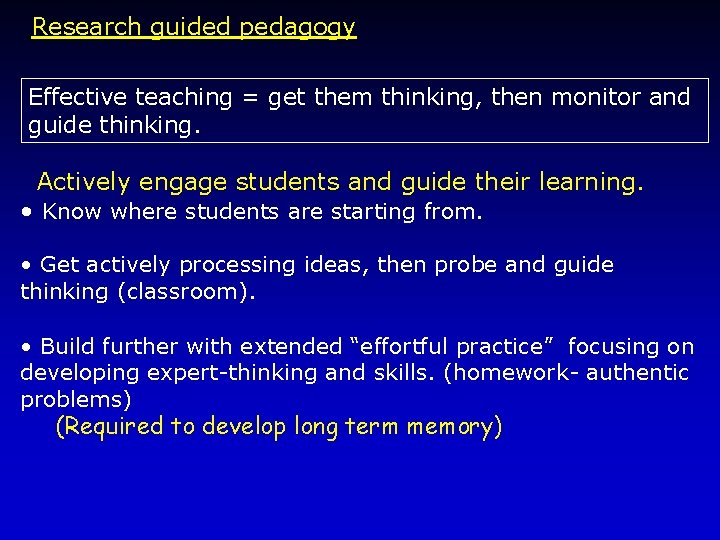
Research guided pedagogy Effective teaching = get them thinking, then monitor and guide thinking. Actively engage students and guide their learning. • Know where students are starting from. • Get actively processing ideas, then probe and guide thinking (classroom). • Build further with extended “effortful practice” focusing on developing expert-thinking and skills. (homework- authentic problems) (Required to develop long term memory)
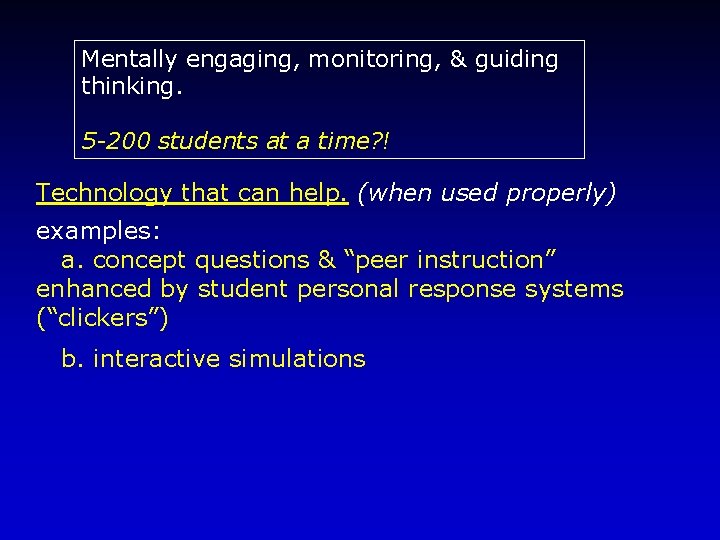
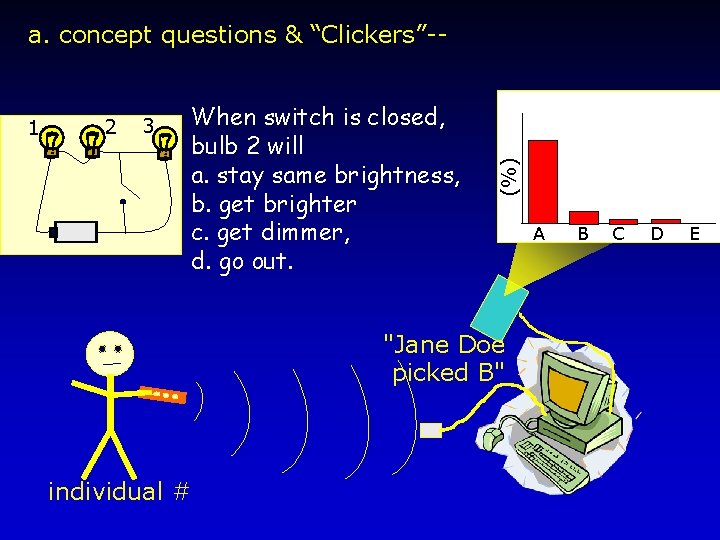
Mentally engaging, monitoring, & guiding thinking. 5 -200 students at a time? ! Technology that can help. (when used properly) examples: a. concept questions & “peer instruction” enhanced by student personal response systems (“clickers”) b. interactive simulations
1 2 3 When switch is closed, bulb 2 will a. stay same brightness, b. get brighter c. get dimmer, d. go out. (%) a. concept questions & “Clickers”-- "Jane Doe picked B" individual # A B C D E
clickers. Not automatically helpful-Only provides: accountability + peer anonymity+ fast response Used/perceived to enhance student mental engagement and feedback transformative Use guided by research on learning • challenging conceptual questions • student-student discussion (“peer instruction”) & responses • follow up discussion
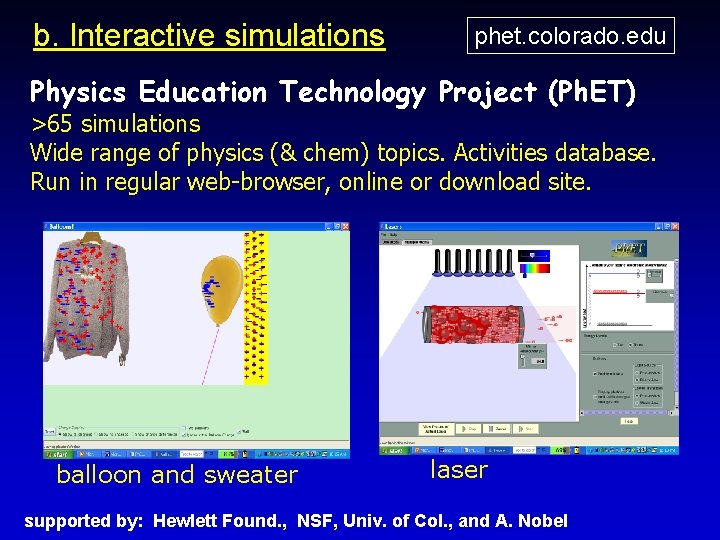
b. Interactive simulations phet. colorado. edu Physics Education Technology Project (Ph. ET) >65 simulations Wide range of physics (& chem) topics. Activities database. Run in regular web-browser, online or download site. balloon and sweater laser supported by: Hewlett Found. , NSF, Univ. of Col. , and A. Nobel
examples: balloon and sweater moving man circuit construction kit new feature- very easy to translate into Swedish data on effectiveness- many different settings and types of use
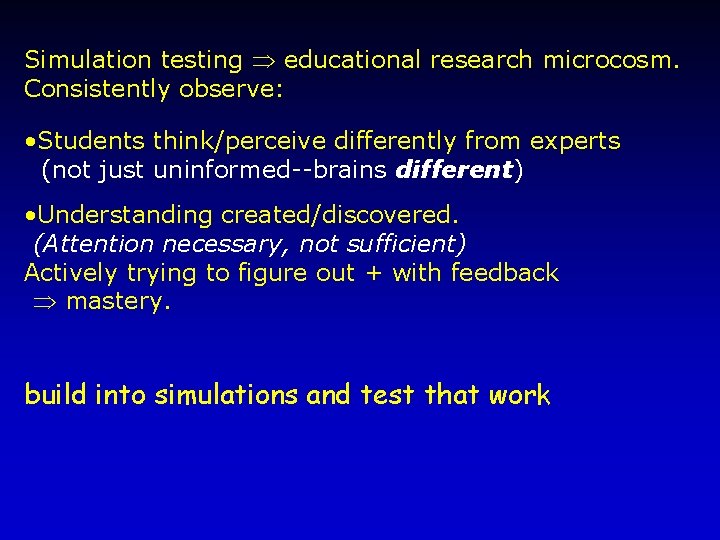
Simulation testing educational research microcosm. Consistently observe: • Students think/perceive differently from experts (not just uninformed--brains different) • Understanding created/discovered. (Attention necessary, not sufficient) Actively trying to figure out + with feedback mastery. build into simulations and test that work
IV. What am I doing at UBC? Widespread improvement in science education • University Departments -- widespread sustained change scientific approach to teaching, all undergrad courses • Focused $$$ and guidance All materials, assessment tools, references etc available on web CWSEI. ubc. ca
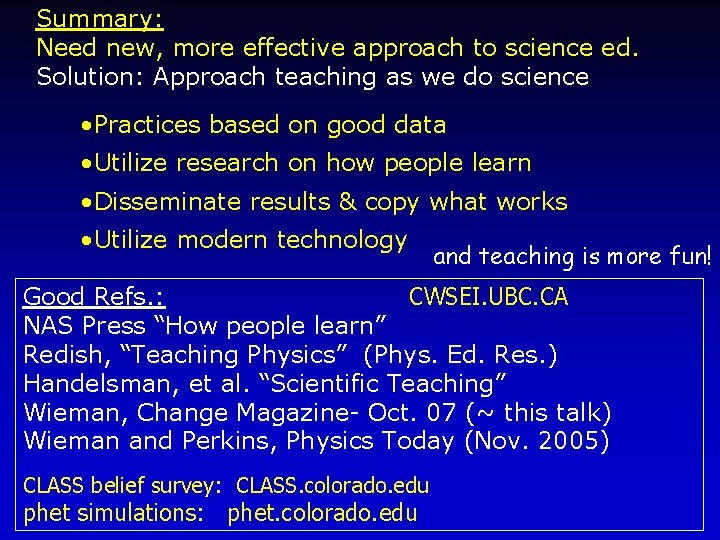
Summary: Need new, more effective approach to science ed. Solution: Approach teaching as we do science • Practices based on good data • Utilize research on how people learn • Disseminate results & copy what works • Utilize modern technology and teaching is more fun! Good Refs. : CWSEI. UBC. CA NAS Press “How people learn” Redish, “Teaching Physics” (Phys. Ed. Res. ) Handelsman, et al. “Scientific Teaching” Wieman, Change Magazine- Oct. 07 (~ this talk) Wieman and Perkins, Physics Today (Nov. 2005) CLASS belief survey: CLASS. colorado. edu phet simulations: phet. colorado. edu
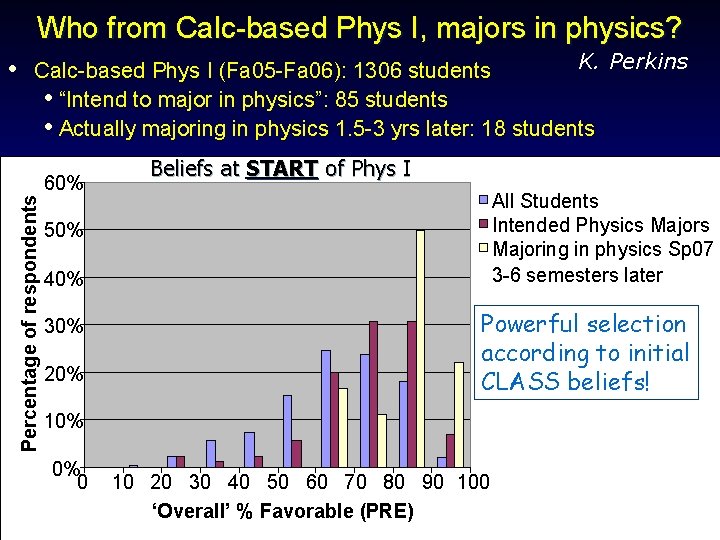
Who from Calc-based Phys I, majors in physics? Percentage of respondents K. Perkins • Calc-based Phys I (Fa 05 -Fa 06): 1306 students • “Intend to major in physics”: 85 students • Actually majoring in physics 1. 5 -3 yrs later: 18 students 60% Beliefs at START of Phys I All Students Intended Physics Majoring in physics Sp 07 3 -6 semesters later 50% 40% 30% 20% Powerful selection according to initial CLASS beliefs! 10% 0% 0 10 20 30 40 50 60 70 80 90 100 ‘Overall’ % Favorable (PRE)
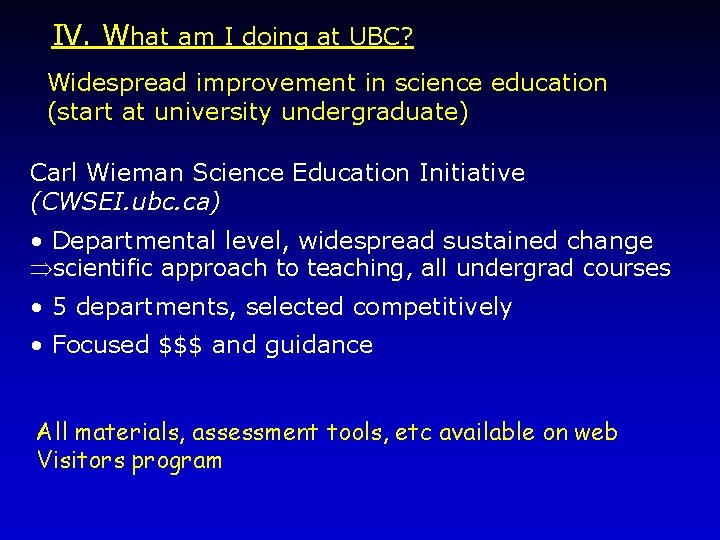
IV. What am I doing at UBC? Widespread improvement in science education (start at university undergraduate) Carl Wieman Science Education Initiative (CWSEI. ubc. ca) • Departmental level, widespread sustained change scientific approach to teaching, all undergrad courses • 5 departments, selected competitively • Focused $$$ and guidance All materials, assessment tools, etc available on web Visitors program
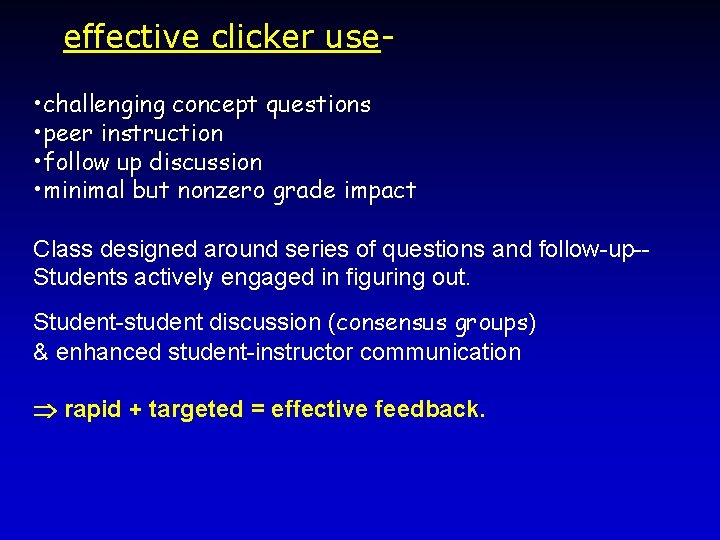
effective clicker use • challenging concept questions • peer instruction • follow up discussion • minimal but nonzero grade impact Class designed around series of questions and follow-up-Students actively engaged in figuring out. Student-student discussion (consensus groups) & enhanced student-instructor communication rapid + targeted = effective feedback.
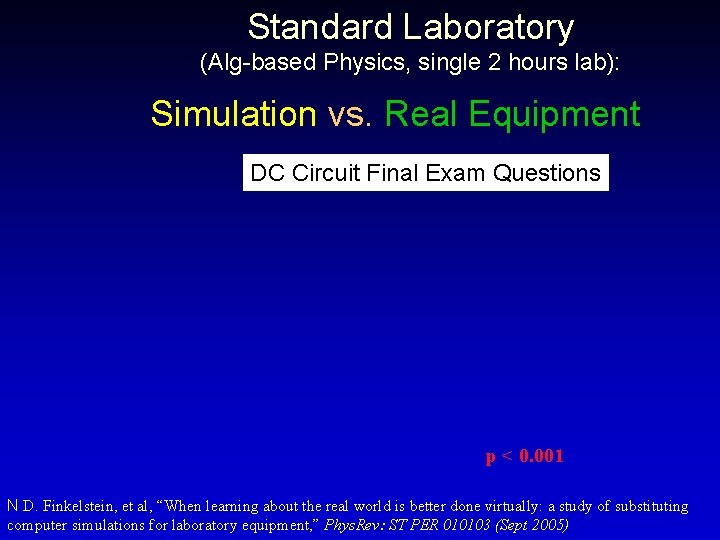
Standard Laboratory (Alg-based Physics, single 2 hours lab): Simulation vs. Real Equipment DC Circuit Final Exam Questions p < 0. 001 N D. Finkelstein, et al, “When learning about the real world is better done virtually: a study of substituting computer simulations for laboratory equipment, ” Phys. Rev: ST PER 010103 (Sept 2005)
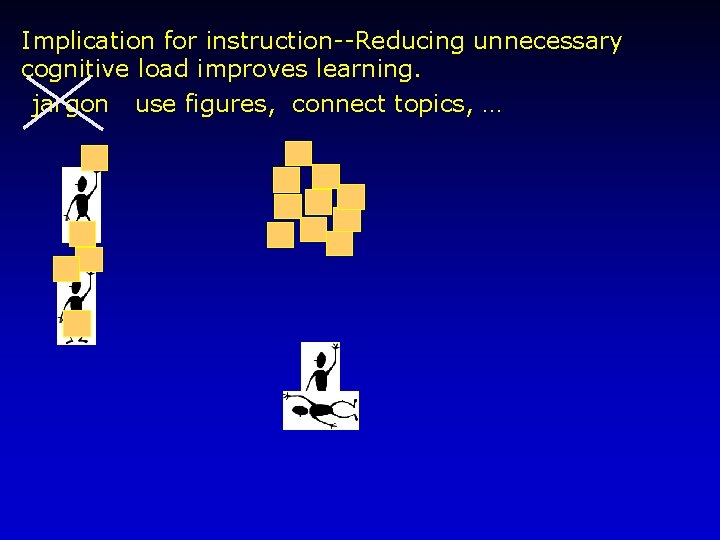
Implication for instruction--Reducing unnecessary cognitive load improves learning. jargon use figures, connect topics, …
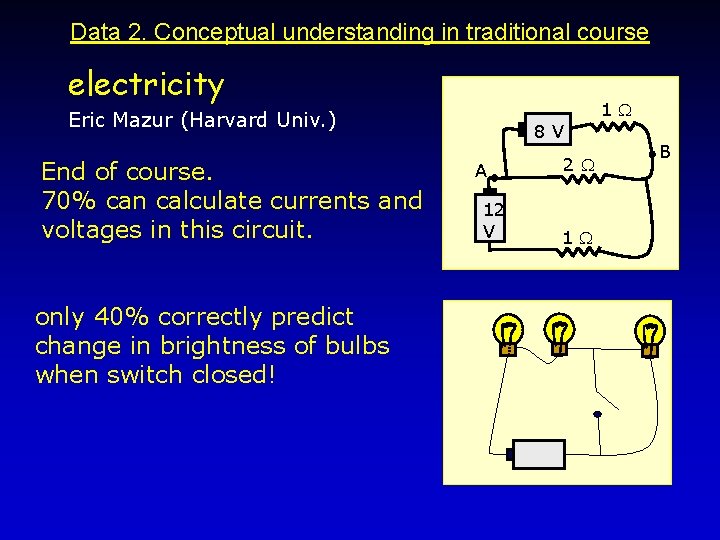
Data 2. Conceptual understanding in traditional course electricity 1 Eric Mazur (Harvard Univ. ) End of course. 70% can calculate currents and voltages in this circuit. only 40% correctly predict change in brightness of bulbs when switch closed! 8 V A 12 V 2 1 B
V. Issues in structural change (my assertions) Necessary requirement--become part of culture in major research university science departments set the science education norms produce the college teachers, who teach the k-12 teachers. Challenges in changing science department cultures- • no coupling between support/incentives and student learning. • very few authentic assessments of student learning • investment required for development of assessment tools, pedagogically effective materials, supporting technology, training • no $$$ (not considered important)
Data 2. Conceptual understanding in traditional course. • Force Concept Inventory- basic concepts of force and motion 1 st semester physics Ask at start and end of semester-What % learned? (100’s of courses) Average learned/course 16 traditional Lecture courses Fraction of unknown basic concepts learned On average learn <30% of concepts did not already know. Lecturer quality, class size, institution, . . . doesn't matter! Similar data on higher level courses. R. Hake, ”…A six-thousand-student survey…” AJP 66, 64 -74 (‘ 98).