
Using the Strategy Change Cycle to Meet Mandates
- Slides: 22
Using the Strategy Change Cycle to Meet Mandates, Fulfill Mission, and Create Public Value Leading Age Colorado 2018 Annual Meeting May 22, 2018
Disclosure of Commercial Interest I, Bob Lane, consult for and have a commercial interest in the following organization: BKD, LLP
Objectives Identify the steps in the Strategy Change Cycle Describe how to tailor the process to specific organizational circumstances Discuss how to apply the process across organizational sub-units, levels, and functions
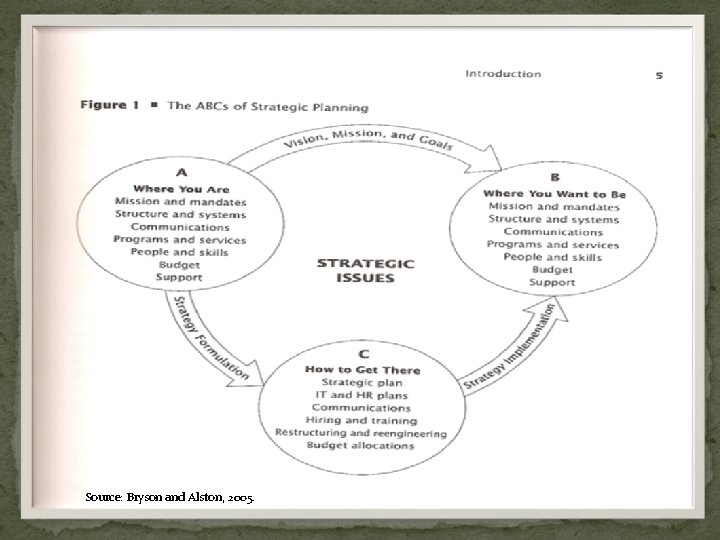
Strategic Planning Definition – “ a disciplined effort to produce fundamental decisions and actions that shape and guide what an organization (or other entity) is, what it does, and why it does it” (Olsen and Eadie (1982, p. 4)) Purpose Benefits
Source: Bryson and Alston, 2005.
Strategic Planning What it is…. . What it’s not…. .
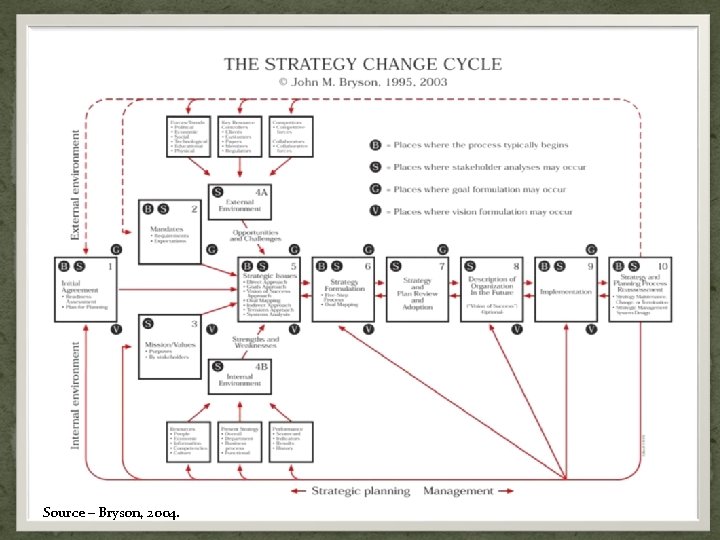
The Strategy Change Cycle More than just strategic planning Becomes a strategic management process Has its roots in considerable body of research and practical experience, primarily in public and nonprofits, but adaptable. 10 -step process
Source – Bryson, 2004.
Initiate and agree on a strategic planning process Involves internal (and perhaps external) decision makers Must be initiated by some person or group Identify the players to be involved (stakeholder analysis) Best when an effective policy making body is in place to oversee the effort
Identify organizational mandates Formal Legislation, policies, ordinances, charters, articles, and contracts Informal Typically political in nature Three fundamental mistakes organizations make
Clarify organizational mission and values In concert with mandates, provides the most important justification for existence Points the way toward creating public value Reduces unnecessary conflict Can serve as a “primary framework”
Assess the external and internal environments SWOT analysis Strengths and weaknesses – internally and present focused Opportunities and challenges – future focus Review of forces and trends (political, economic, social, educational, technological, physical environment) that pertain to the organization Important external stakeholder groups affecting resource flows
Identify the strategic issues facing the organization Seven approaches Direct approach Indirect approach Goals approach Vision of success approach Oval mapping approach Tensions approach Systems analysis approach
Formulate strategies to manage the issues Two possible approaches Five-part process Identify practical alternatives to resolve issues Enumerate barriers to achieving alternatives Develop major proposal to achieve alternatives Identify actions to be taken to achieve Detailed implementation plan for next year Strategic Options Development and Analysis (SODA) List multiple options for addressing issues Creation of action-to-outcome map
Review and adopt the strategies or strategic plan For smaller organizations, can sometimes be combined with step 6 Affirms desired changes to be made, and moves organization toward “refreezing” in the new pattern (Lewin, 1951; Dalton, 1970; Fiol, 2002) May require a champion or sponsor to secure approval from governing body
Establish an effective organizational vision Description of what the organization should look like once strategies have been implemented and achieved full potential Intended to inform organizational members about what is expected of them without constant managerial oversight Optional for many organizations, as marked improvement can occur without it
Develop an effective implementation process For small organizations, can be incorporated into step 7; strategy formulation Plans should incorporate: Roles and responsibilities of all parties Expected results and specific objectives and milestones Schedules Resource requirements and sources Communication lines Review and monitoring procedure Accountability lines
Reassess the strategies and the strategic planning process Completes the cycle Much of this step can occur as part of the on-going implementation process, depending on how experienced the organization is with strategic planning, and how much time has elapsed since the last cycle Prepares the organization for the next round Enhanced through organizational learning
Tailoring the Strategy Change Cycle to organizational circumstances Iterative, flexible, and action-oriented in practice Implementation usually begins before all planning is complete Action leads to real learning Don’t have to agree on goals to agree on next steps (Innes, 1996; Bryant, 2003; Huxham, 2003)
Application across organizational subunits, levels, and functions Strategic management system Integrated units of management Balanced Scorecard Important to create linkages All stakeholder groups represented (including external when applicable) Can initially take longer, but implementation occurs faster
Questions?
Contact Me Robert (Bob) Lane, MA, CNHA, FACHCA Director/BKD Health Care Group 211 N. Robinson Ave. Suite 600 Oklahoma City, Oklahoma 73102 405. 606. 2580 rlane@bkd. com