
Using the Stages of Implementation Completion Measure as
- Slides: 25
Using the Stages of Implementation Completion Measure as a Model for Health Policy Interventions Jennifer Leeman, Dr. PH Associate Professor, School of Nursing Kathleen Knocke, MPH Doctoral Student, Gillings School of Global Public Health University of North Carolina at Chapel Hill Allison Myers, Ph. D, MPH 2017 -2018 Health Policy Fellow, Robert Wood Johnson Foundation Executive Director, Counter Tools
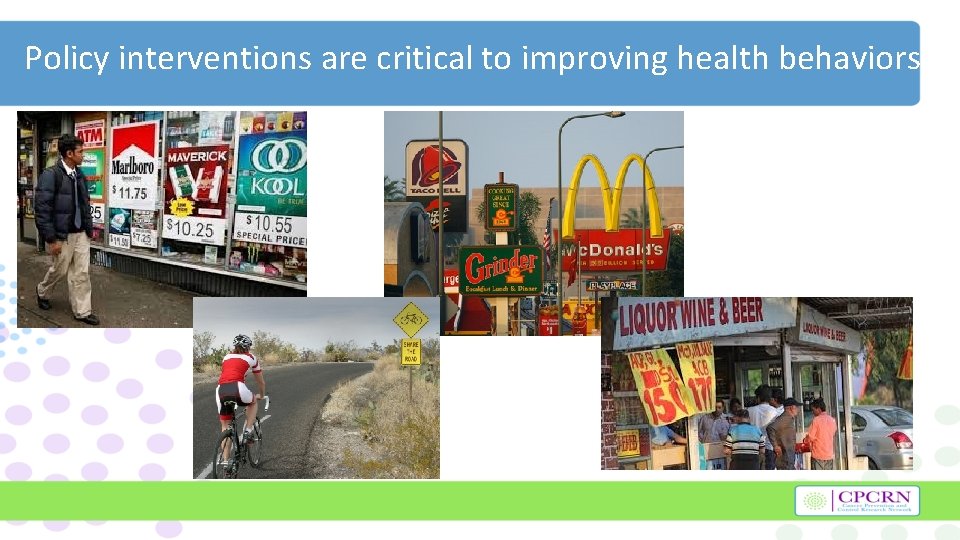
Policy interventions are critical to improving health behaviors
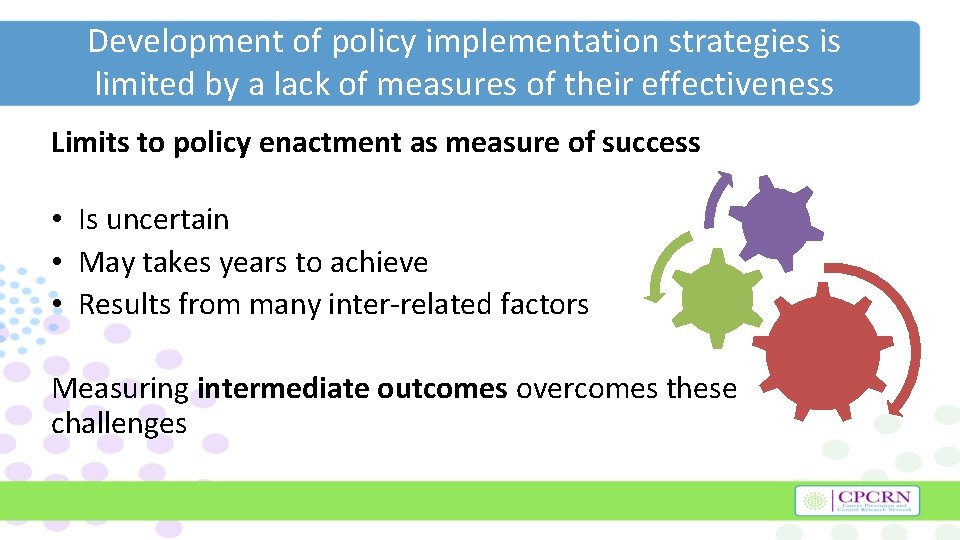
Development of policy implementation strategies is limited by a lack of measures of their effectiveness Limits to policy enactment as measure of success • Is uncertain • May takes years to achieve • Results from many inter-related factors Measuring intermediate outcomes overcomes these challenges
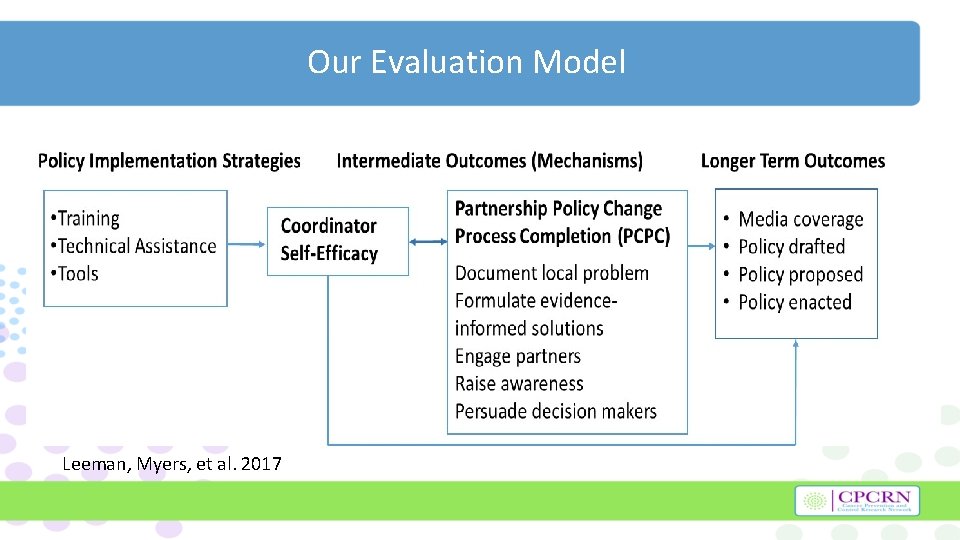
Our Evaluation Model Leeman, Myers, et al. 2017
Policy Change Process Completion: Measure Development Modeled on Saldana et al. ’s Stages of Implementation Completion Measure which • Assesses movement through stages: plan, implement, sustain intervention • Good reliability overall • Successfully differentiates groups that did or did not receive implementation strategies • Predicts full implementation when early stages are completed more quickly • Broad applicability across different programs/settings Chamberlain, Brown, & Saldana, 2011; Saldana et al. 2014; . Brown et al. 2014; Saldana et al. 2012
How we developed our measure of Policy Change Process Completion 1. Identified core processes 2. Conducted formative work to specify activities within each process 3. Pilot tested to refine 4. Developed proposal to assess construct and predictive validity
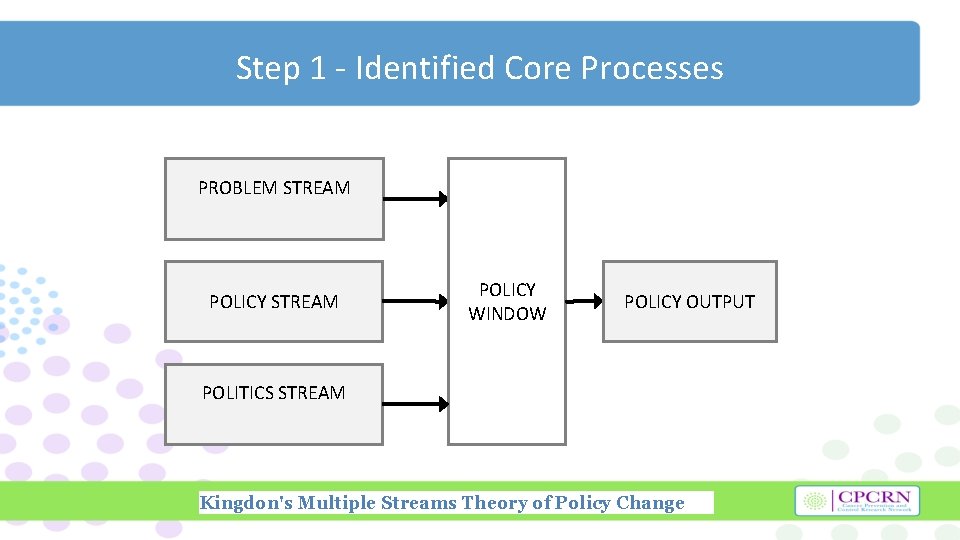
Step 1 - Identified Core Processes PROBLEM STREAM POLICY WINDOW POLICY OUTPUT POLITICS STREAM Kingdon's Multiple Streams Theory of Policy Change
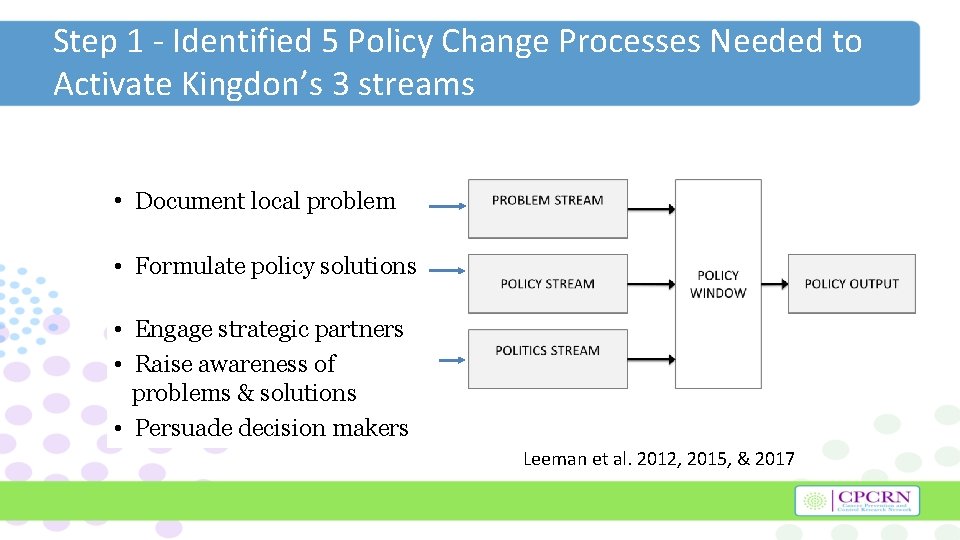
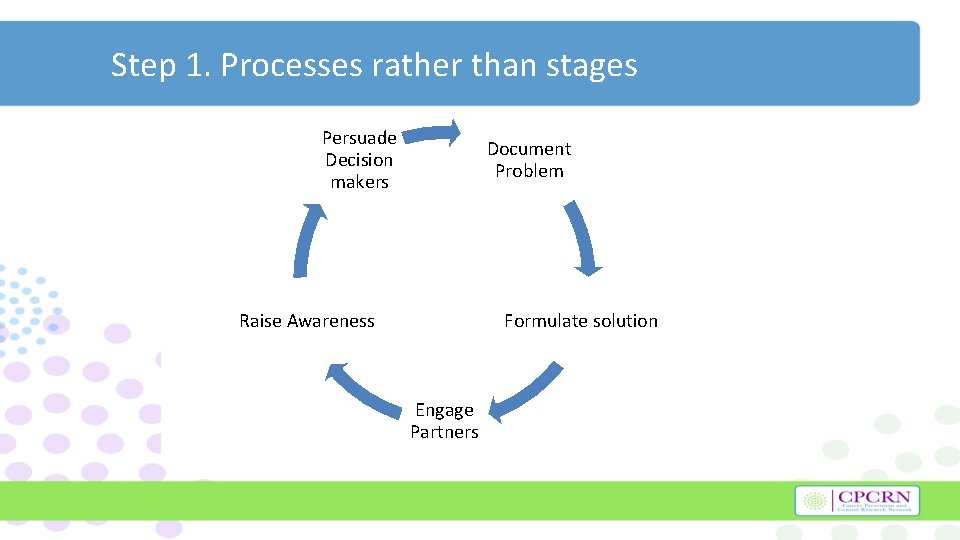
Step 1 - Identified 5 Policy Change Processes Needed to Activate Kingdon’s 3 streams • Document local problem • Formulate policy solutions • Engage strategic partners • Raise awareness of problems & solutions • Persuade decision makers Leeman et al. 2012, 2015, & 2017
Step 1. Processes rather than stages Persuade Decision makers Document Problem Raise Awareness Formulate solution Engage Partners
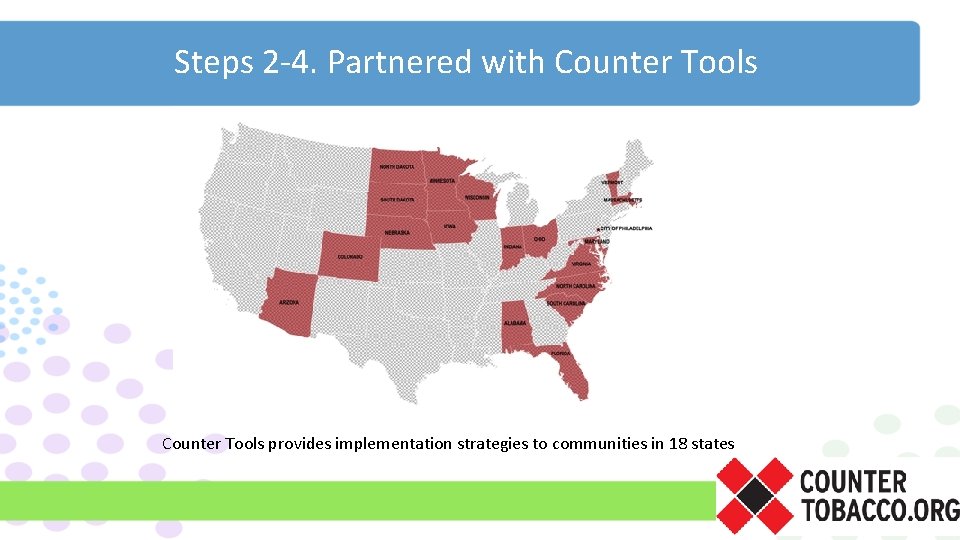
Steps 2 -4. Partnered with Counter Tools provides implementation strategies to communities in 18 states
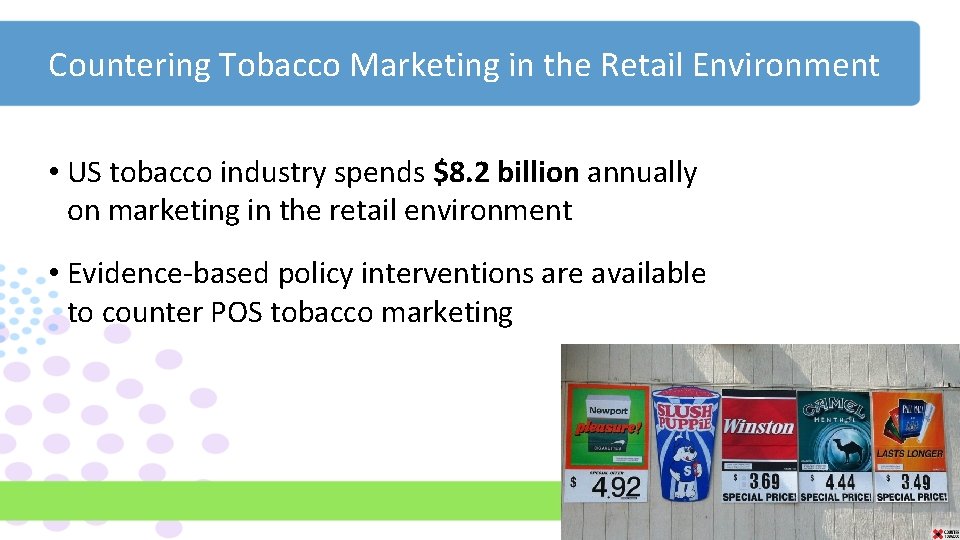
Countering Tobacco Marketing in the Retail Environment • US tobacco industry spends $8. 2 billion annually on marketing in the retail environment • Evidence-based policy interventions are available to counter POS tobacco marketing
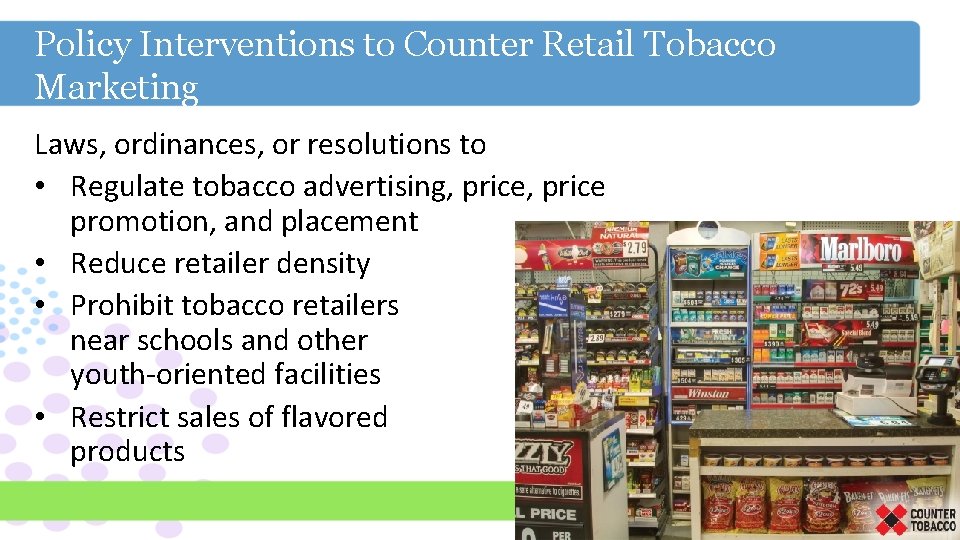
Policy Interventions to Counter Retail Tobacco Marketing Laws, ordinances, or resolutions to • Regulate tobacco advertising, price promotion, and placement • Reduce retailer density • Prohibit tobacco retailers near schools and other youth-oriented facilities • Restrict sales of flavored products
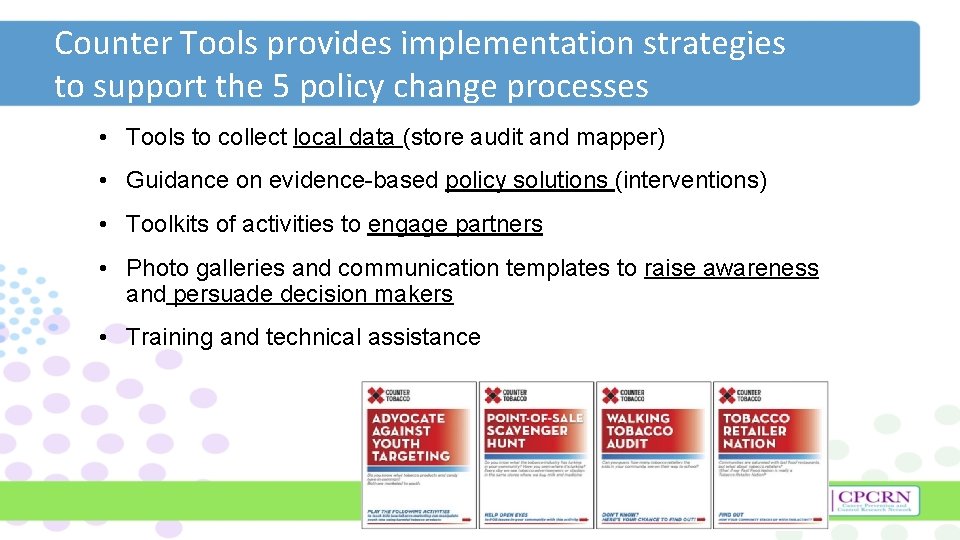
Counter Tools provides implementation strategies to support the 5 policy change processes • Tools to collect local data (store audit and mapper) • Guidance on evidence-based policy solutions (interventions) • Toolkits of activities to engage partners • Photo galleries and communication templates to raise awareness and persuade decision makers • Training and technical assistance
Step 2. Formative work to specify activities within each process • One Midwestern state • In-depth interviews with 30 individuals working to counter tobacco marketing at the point-of-sale • Iterative meetings with Counter Tool’s staff • Drafted lists of activities related to each process • Developed interview guide and refined through cognitive interviews with 8 tobacco control staff Myers et al. Unpublished evaluation report
Step 3. Pilot Tested to Refine • 30 tobacco control coalitions in one southern state • State provided funding for coalitions to work on POS tobacco marketing and contracted with Counter Tools to provide implementation strategies • Phone interviews of partnerships’ completion of policy change processes at 6 and 12 months (Dec. 2015, June 2016) • Coded activity completion (95% interrater reliability at 12 months)
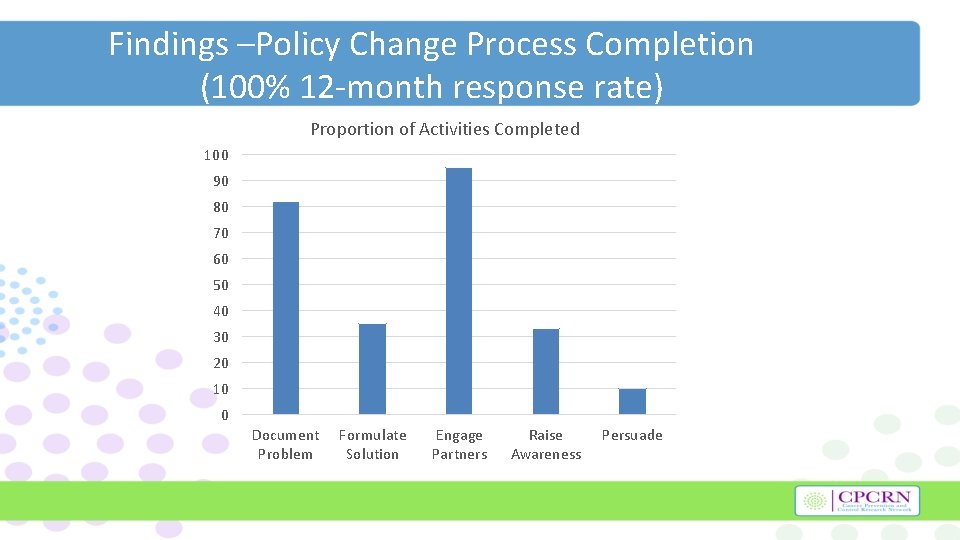
Findings –Policy Change Process Completion (100% 12 -month response rate) Proportion of Activities Completed 100 90 80 70 60 50 40 30 20 10 0 Document Problem Formulate Solution Engage Partners Raise Awareness Persuade
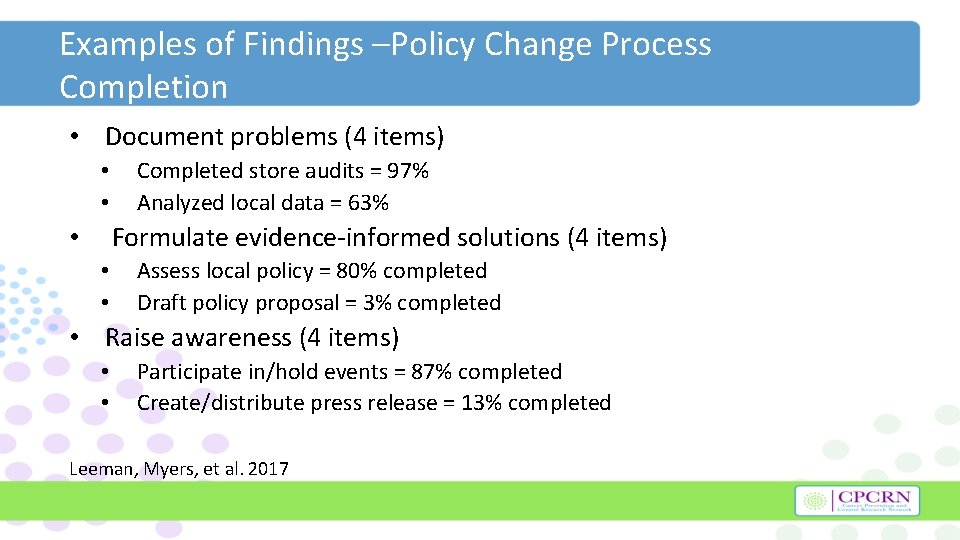
Examples of Findings –Policy Change Process Completion • Document problems (4 items) • • Completed store audits = 97% Analyzed local data = 63% Formulate evidence-informed solutions (4 items) • • • Assess local policy = 80% completed Draft policy proposal = 3% completed • Raise awareness (4 items) • • Participate in/hold events = 87% completed Create/distribute press release = 13% completed Leeman, Myers, et al. 2017
Year 2 of Pilot Study – Converted interview questions to an electronic survey
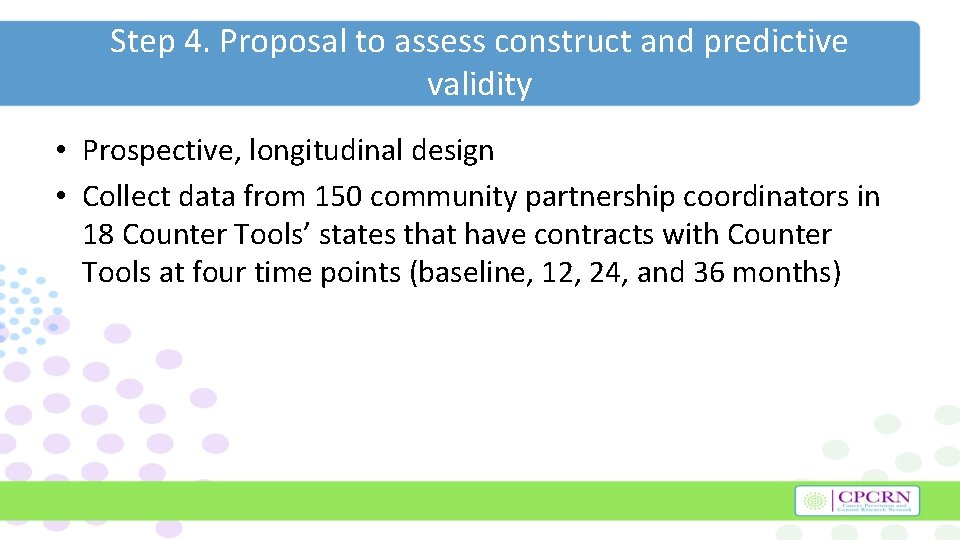
Step 4. Proposal to assess construct and predictive validity • Prospective, longitudinal design • Collect data from 150 community partnership coordinators in 18 Counter Tools’ states that have contracts with Counter Tools at four time points (baseline, 12, 24, and 36 months)
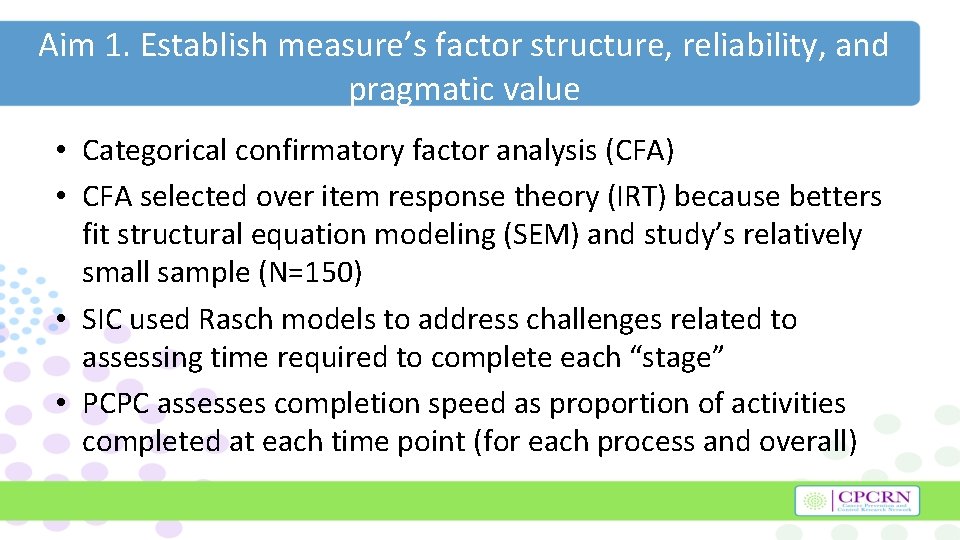
Aim 1. Establish measure’s factor structure, reliability, and pragmatic value • Categorical confirmatory factor analysis (CFA) • CFA selected over item response theory (IRT) because betters fit structural equation modeling (SEM) and study’s relatively small sample (N=150) • SIC used Rasch models to address challenges related to assessing time required to complete each “stage” • PCPC assesses completion speed as proportion of activities completed at each time point (for each process and overall)
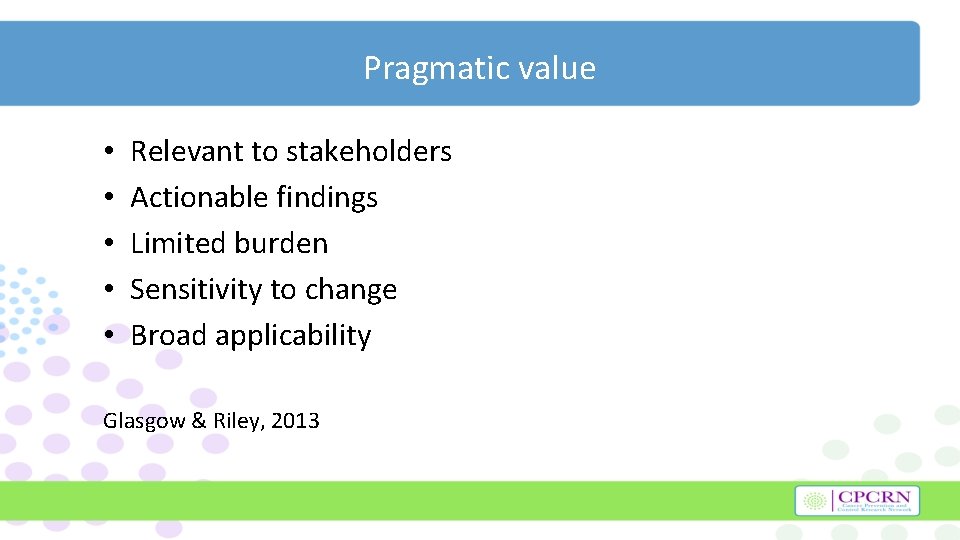
Pragmatic value • • • Relevant to stakeholders Actionable findings Limited burden Sensitivity to change Broad applicability Glasgow & Riley, 2013
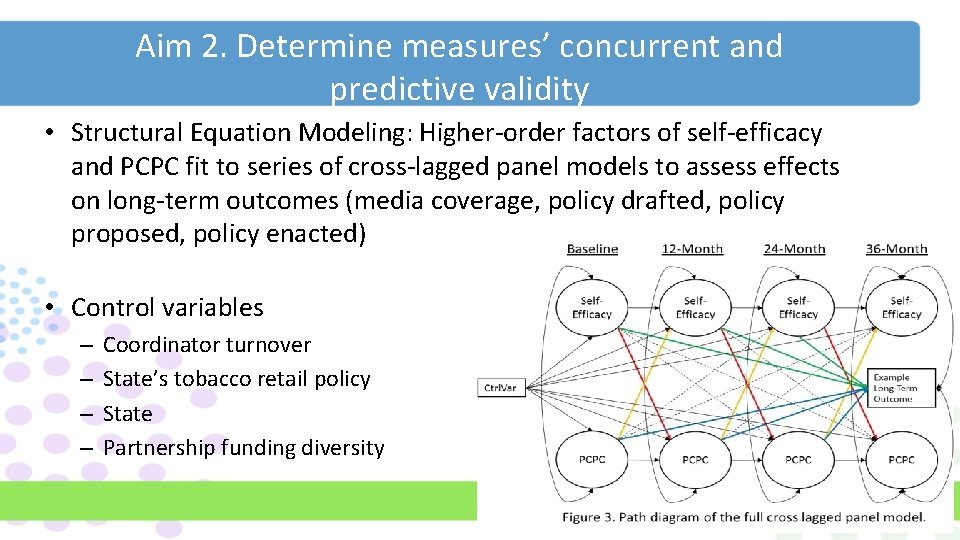
Aim 2. Determine measures’ concurrent and predictive validity • Structural Equation Modeling: Higher-order factors of self-efficacy and PCPC fit to series of cross-lagged panel models to assess effects on long-term outcomes (media coverage, policy drafted, policy proposed, policy enacted) • Control variables – – Coordinator turnover State’s tobacco retail policy State Partnership funding diversity
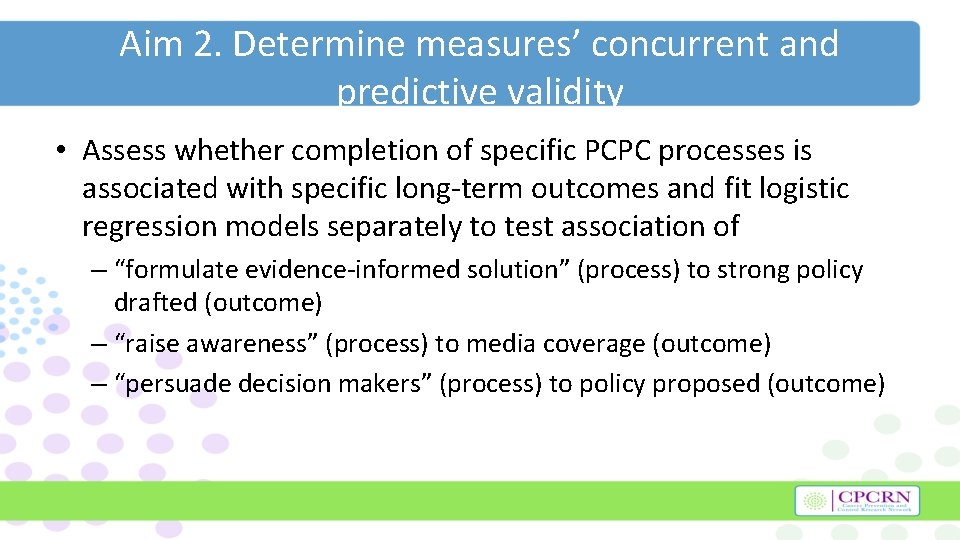
Aim 2. Determine measures’ concurrent and predictive validity • Assess whether completion of specific PCPC processes is associated with specific long-term outcomes and fit logistic regression models separately to test association of – “formulate evidence-informed solution” (process) to strong policy drafted (outcome) – “raise awareness” (process) to media coverage (outcome) – “persuade decision makers” (process) to policy proposed (outcome)
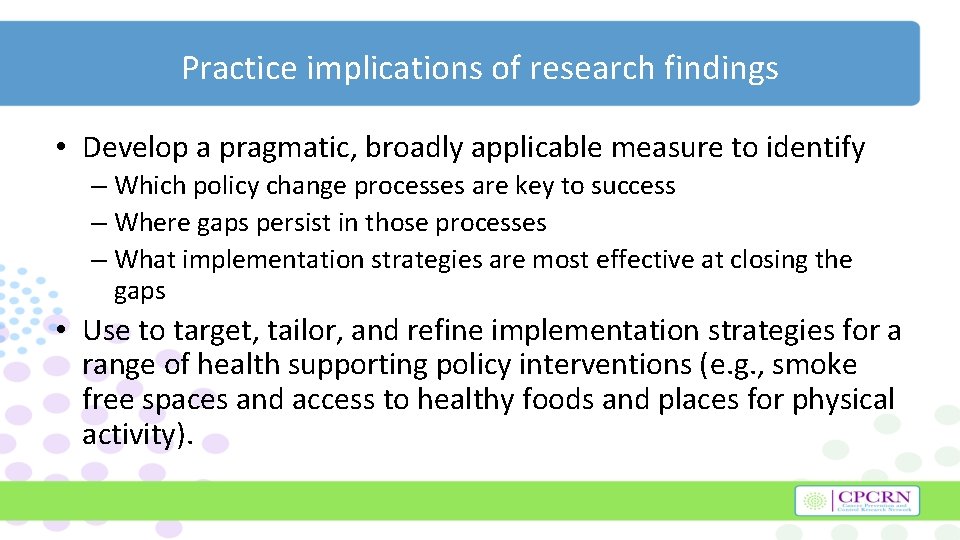
Practice implications of research findings • Develop a pragmatic, broadly applicable measure to identify – Which policy change processes are key to success – Where gaps persist in those processes – What implementation strategies are most effective at closing the gaps • Use to target, tailor, and refine implementation strategies for a range of health supporting policy interventions (e. g. , smoke free spaces and access to healthy foods and places for physical activity).
References to our most relevant work • Leeman, J. , Myers, A. , Grant, J. , Wangen, M. , & Queen, T. (2017). The effects of implementation strategies to promote community-engaged efforts to counter tobacco marketing at the point of sale. Translational Behavioral Medicine. Epub ahead of print • Leeman, J. , Myers, A. , Ribisl, K. , & Ammerman, A. (2015). Disseminating policy and environmental change interventions: Insights from obesity prevention and tobacco control. International Journal of Behavioral Medicine, 22, 301311. • Leeman, J. , Sommers, J. , Vu, M. , Jernigan, J. , Payne, G. , Thompson, D…Ammerman, A. (2012). An evaluation framework for obesity prevention policies. Preventing Chronic Disease, 9, E 120.