
Using the Solihull Approach in my EY Consultant
- Slides: 20
Using the ‘Solihull Approach’ in my EY Consultant role Penny
• The Solihull Approach is an approach that helps to understand what is being communicated by children through their behaviour. • Aim of approach was to promote reflective parenting as a means of developing family resilience. • Also applies to developing resilience and capacity to sustain change in the absence of support from LA • This approach asks us to observe, reflect and think about our interactions with others. It applies in all relationships and interactions, both personal and work related.
Impact on child and parent outcomes Evidence Early intervention Foundation Bateson, K. , Delaney, J. , & Pybus, R. (2008). Meeting Expectations: the pilot evaluation of the Solihull Approach Parenting Group. Community Practitioner, 81 (5), 28 -31. Reduced total scores on the Strengths and Difficulties Questionnaire – parent report. Reduced externalising scores on the Child Behaviour . Checklist – parent report The evidence for Solihull Approach also suggests a range of impacts for the parent, including reducing parental anxiety. Ottman (2010) examined the impact of SA on professionals within a multidisciplinary team. Professionals reported positive effects including increased confidence, better understanding of parent-child relationships and enhanced team closeness. NICE: Results showed attendance of the Solihull Approach Parenting Group was associated with decreased externalising child behaviour (i. e. aggression, defiance) over the age of two years and a decrease in parental anxiety. In addition there was a relationship between parental anxiety and the changes in child internalising behaviour.
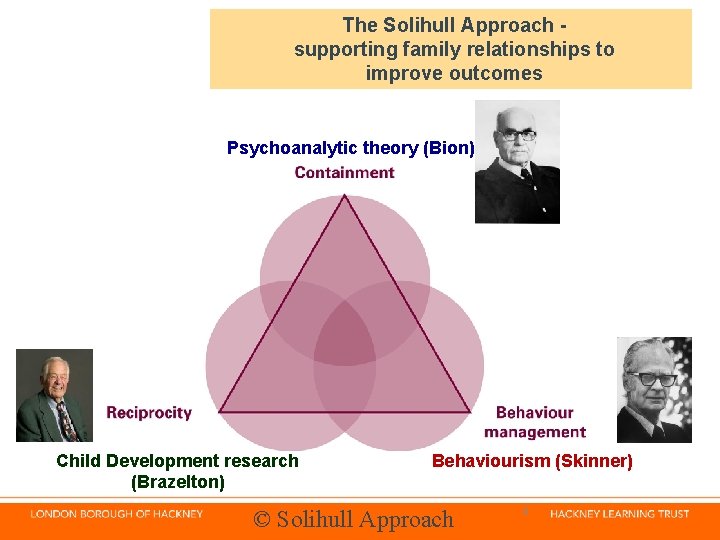
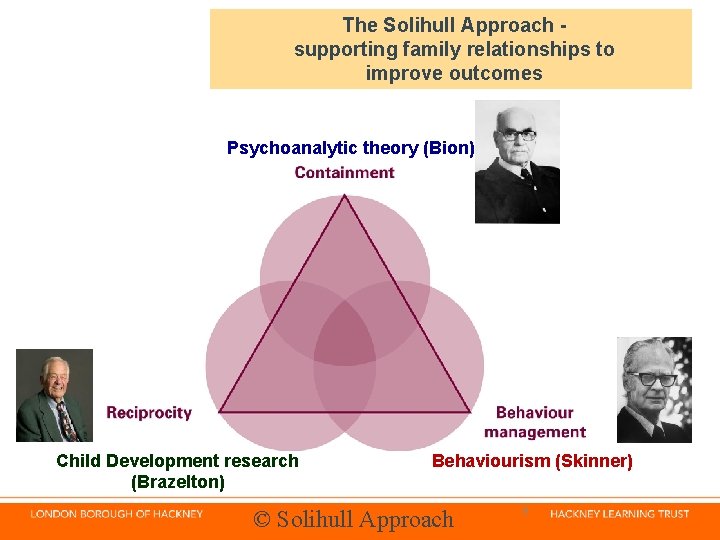
The Solihull Approach - supporting family relationships to improve outcomes Psychoanalytic theory (Bion) Child Development research (Brazelton) Behaviourism (Skinner) © Solihull Approach 4
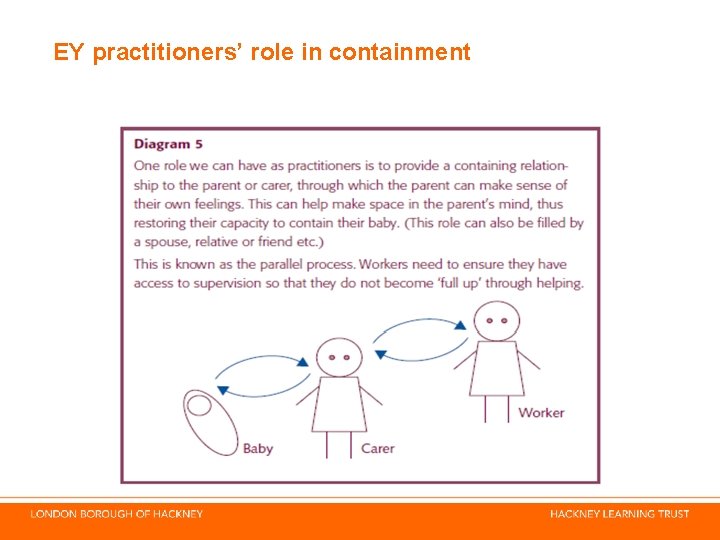
Containment The process of helping a person contain their own anxiety and emotion so they do not feel overwhelmed by these feelings and therefore have the capacity to think about the situation. This restores capacity to process emotions First proposed by Melanie Klein (1952) and developed by Bion (1959) Containment is the notion of another person being able to hold onto feelings and then give them back detoxified and bearable. This relies on self knowledge of what is ‘mine’ and what is ‘others’ Enables self regulation
Reciprocity Describes the process where the parent is sensitive to the needs and feelings of the child and the child responds to the parents in a two way flow of communication. Experiencing two way communication is the cornerstone for all future relationships The basis for the development of language and communication, patterns of eating or drinking, waking and sleeping and selfcontrol/regulation The ‘dance of reciprocity’ is critical to the idea that difficult things can be made positive again and hence the concept of ‘resilience’- still face experiment an example. Tuning into children’s development needs
Behaviour management Inadequate containment, reciprocity will equal behaviour problems This is a normal process where parents teach children self control so enabling them to participate in society This is achieved through positive attention and other rewards until the child is able to internalise both restraint and satisfaction for themselves. Children need consistent boundaries to feel safe and to try out new things
Containment Exercise in pairs: Think of a time when you were really upset, angry or full up with stress and you talked to someone who made you feel worse. What was it that person said and did that made you feel worse? Think of a time when someone made you feel better. What did they say or do which made you feel better?
The Solihull Approach - supporting family relationships to improve outcomes Psychoanalytic theory (Bion) Child Development research (Brazelton) Behaviourism (Skinner) © Solihull Approach 9
EY practitioners’ role in containment
What were the benefits to my settings? Gave practitioners knowledge and understanding of why certain parenting practices and children’s behaviour patterns occurred and also developed practice skills such as active and productive listening. Enabled them to explore behaviour management strategies in the context of greater understanding of family dynamics. Reflective parenting enables parents to think about their own life histories and how they might have impacted on their parenting practices as well as considering the immediate context and how this might be having an impact on the family. This applies to practitioners own experiences too. Numerous case examples given of ‘light bulb’ moments leading to parents/practitioners identifying and analysing problems and coming up with their own solutions.
What practitioners say: ‘. . . to remember to refocus work on building relationships rather than behaviour management with families who are in crisis’ ‘. . it helps to look at the wider picture with families and not just focus on the child. I try to avoid jumping in with advice. . . ’ ‘empowering for all involved. . . I have such satisfaction helping parents work with their children rather than against them’
Behaviour management The parent sets boundaries for the child and uses praise and rewards to encourage positive behaviours These are then internalised by the child The strategies work best when they provide containment and are based on an understanding of the meaning of a behaviour Behaviour is one of the ways that children communicate: What might the child be trying to communicate about what they are feeling? What does the child need at this time?
Behaviour as Communication Solihull Approach: 3 Key Questions What is the developmental age and stage of your child? What changes in the environment have occurred no matter how small? What is your child’s ability to communicate their needs (what is your child trying to tell you through their behaviour? )
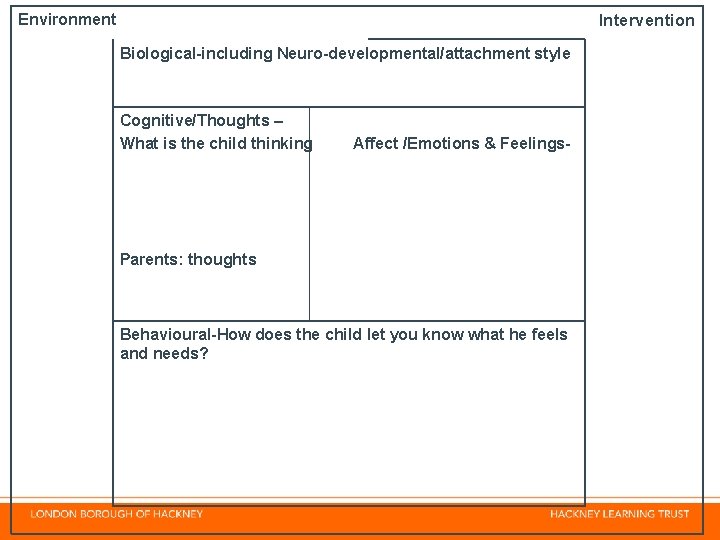
Environment Intervention Biological-including Neuro-developmental/attachment style Cognitive/Thoughts – What is the child thinking Affect /Emotions & Feelings- Parents: thoughts Behavioural-How does the child let you know what he feels and needs?
Environment: Including family circumstances and any recent changes? Sara’s mother works in the nursery in the school. Sara is used to having time with her mother most Fridays. This has changed. The Reception class is taught by two teachers in the morning and afternoon. This may well cause stress to a child Biological: Including what is the age and stage of the child? Starting ‘big’ school can be challenging as it is more demanding and structured.
Affect/Emotions & Feelings: child’s and parent/carer’s : hypotheses or in discussion I am frustrated angry. I am helpless and can’t do anything I want to control the adults I am anxious about expectations I feel bored Cognitive/Thoughts: child’s and parent/carer(hypotheses or in discussion) I don’t like sharing with other children-why should I? I don’t like sharing my teacher. I want to control everything as it is all too unpredictable. I am bored I don’t like school At home I have adults all to myself Parent: Worried about daughter’s care in school
Behavioural: What triggers? When and how often is the child managing impulse or behaviour in the setting? Has anything changed recently? Sara will often defy adult instructions. She likes to do things in her own way and shows a lot of initiative She is an only child-may be unused to sharing the attention of an adult with 30 other children!
Behaviour management: Adults may have to; • • • ensure they are very clear and consistent ensure compliant behaviour that ensures the child does not feel shame. ensure that child has one to one play time with key person ensure that ‘key person’ keeps a watchful eye on child. be positive to raise self esteem. Ensure that times of change, transition or separation are clearly warned Set up and monitor opportunities for social games-turn taking, sharing Give child a chance to learn new words for emotions such as anger and frustration and acknowledge these when the tantrum begins. Use puppets with the class to talk about conflict situations Use High/scope conflict resolution to support conflict-CPD meeting possible with Learning Trust Consultant First steps (tier 2) may be able to offer support to family
In an ideal world… • • Needs to be a commitment on the part of strategic leads to develop the approach and to train the workforce across and within teams, so that a shared language is used when discussing children and families and whole settings Time and money: time for reflective practice can be bypassed in busy teams. the need for supervision, largely unavailable to EY Consultants. Possible to create a space within a team but time constraints apply