
Using the Select Table to Model Mortality Rates
Using the Select Table to Model Mortality Rates of Domestic Immigrants Twelfth International Longevity Risk and Capital Markets Solutions Conference Sep 29, 2016 Hsin-Chung Wang Jack C. Yue Tzu-Yu Wang 9/29/2016 1

Outline l Motivation l Methodology l Evaluation of Graduation Methods l Empirical Analysis l Application l Conclusion 9/29/2016 2
Motivation l Ageing population Taiwan entered into ageing society since 1993 and ageing population will be over 20% of the total population in 2025 entering into hyper-aged society l Lower fertility rates The total fertility rate (TFR) of Taiwan is around 1. 2 for the past 5 years (2011– 2015) How to balance the losses of population and work force? population migration is one of the key factors l Population distribution inequality in city and county -Urbanization became more obvious -Fewer international immigrations in Taiwan 9/29/2016 3
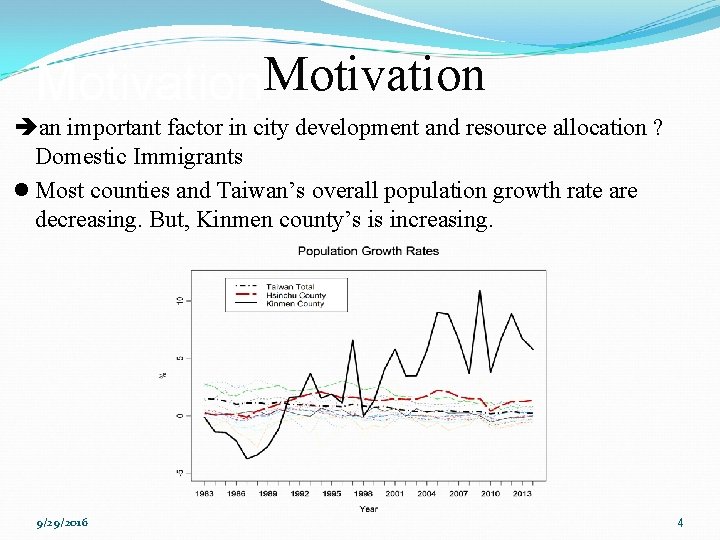
Motivation an important factor in city development and resource allocation ? Domestic Immigrants l Most counties and Taiwan’s overall population growth rate are decreasing. But, Kinmen county’s is increasing. 9/29/2016 4
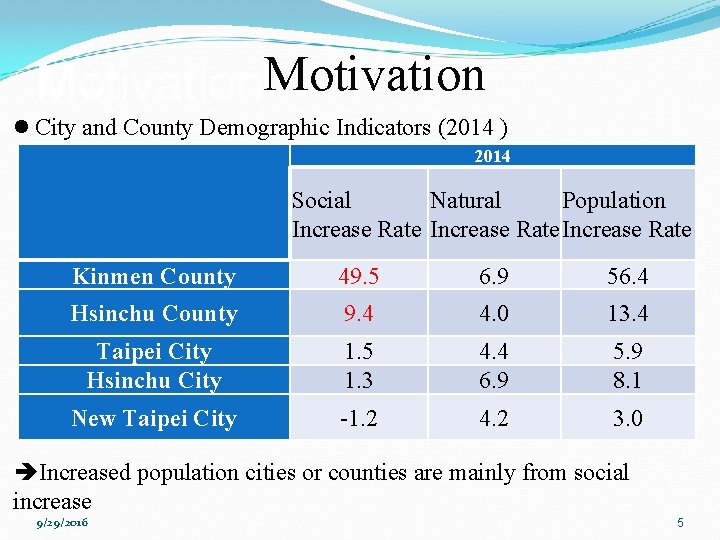
Motivation l City and County Demographic Indicators (2014 ) 2014 Social Natural Population Increase Rate Kinmen County 49. 5 6. 9 56. 4 Hsinchu County 9. 4 4. 0 13. 4 Taipei City Hsinchu City 1. 5 1. 3 4. 4 6. 9 5. 9 8. 1 New Taipei City -1. 2 4. 2 3. 0 Increased population cities or counties are mainly from social increase 9/29/2016 5
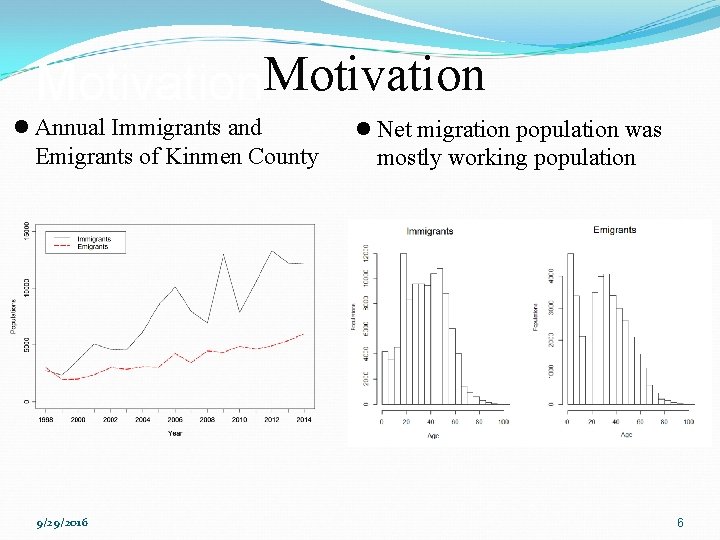
Motivation l Annual Immigrants and Emigrants of Kinmen County 9/29/2016 l Net migration population was mostly working population 6
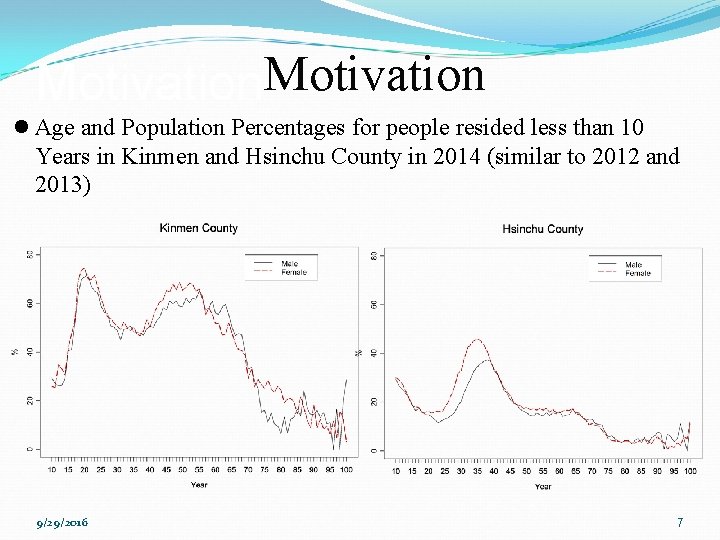
Motivation l Age and Population Percentages for people resided less than 10 Years in Kinmen and Hsinchu County in 2014 (similar to 2012 and 2013) 9/29/2016 7
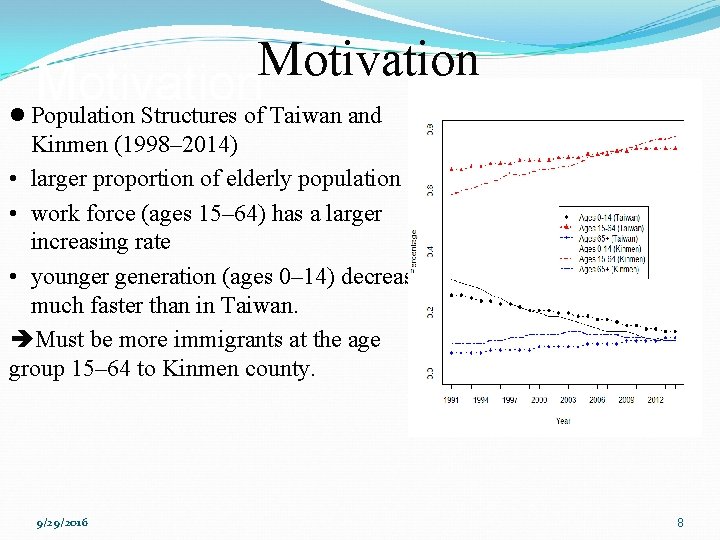
Motivation l Population Structures of Taiwan and Kinmen (1998– 2014) • larger proportion of elderly population • work force (ages 15– 64) has a larger increasing rate • younger generation (ages 0– 14) decrease much faster than in Taiwan. Must be more immigrants at the age group 15– 64 to Kinmen county. 9/29/2016 8
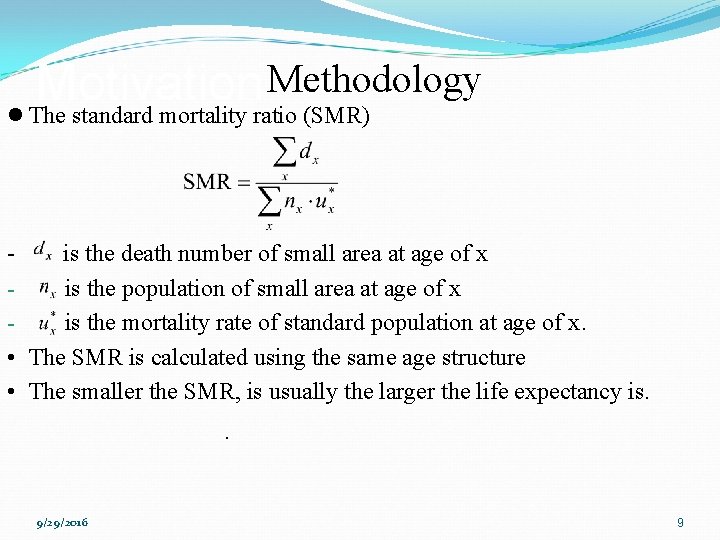
Methodology Motivation l The standard mortality ratio (SMR) is the death number of small area at age of x is the population of small area at age of x is the mortality rate of standard population at age of x. • The SMR is calculated using the same age structure • The smaller the SMR, is usually the larger the life expectancy is. . 9/29/2016 9
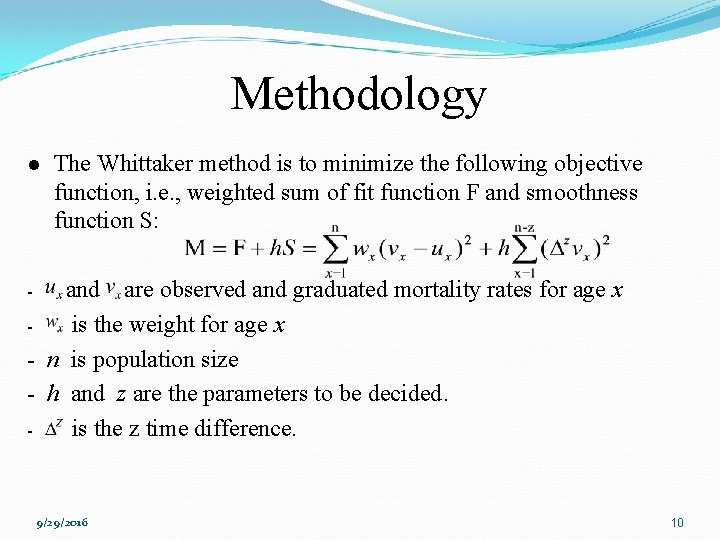
Methodology l The Whittaker method is to minimize the following objective function, i. e. , weighted sum of fit function F and smoothness function S: and are observed and graduated mortality rates for age x is the weight for age x - n is population size - h and z are the parameters to be decided. is the z time difference. - 9/29/2016 10
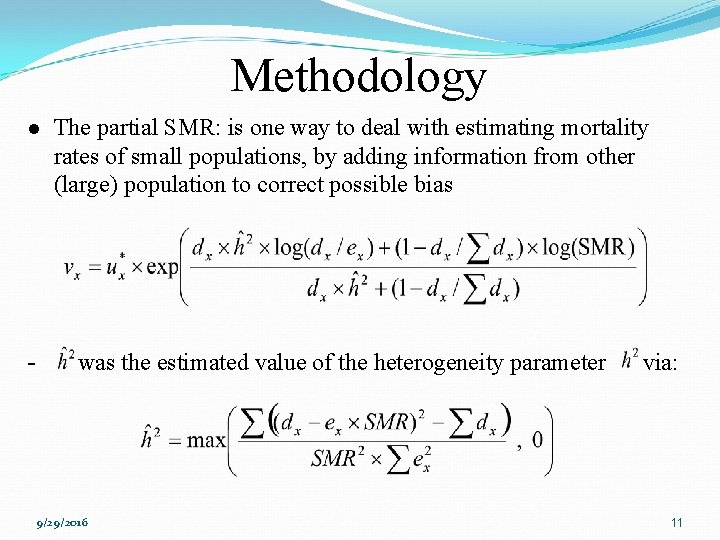
Methodology l - The partial SMR: is one way to deal with estimating mortality rates of small populations, by adding information from other (large) population to correct possible bias was the estimated value of the heterogeneity parameter 9/29/2016 via: 11
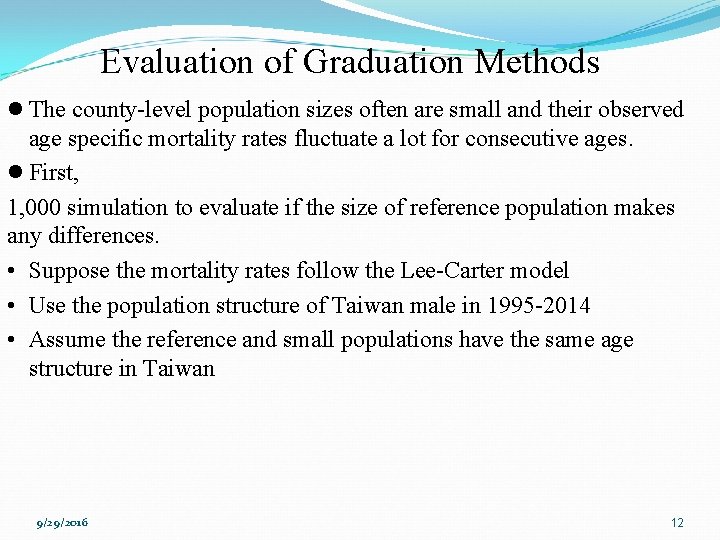
Evaluation of Graduation Methods l The county-level population sizes often are small and their observed age specific mortality rates fluctuate a lot for consecutive ages. l First, 1, 000 simulation to evaluate if the size of reference population makes any differences. • Suppose the mortality rates follow the Lee-Carter model • Use the population structure of Taiwan male in 1995 -2014 • Assume the reference and small populations have the same age structure in Taiwan 9/29/2016 12
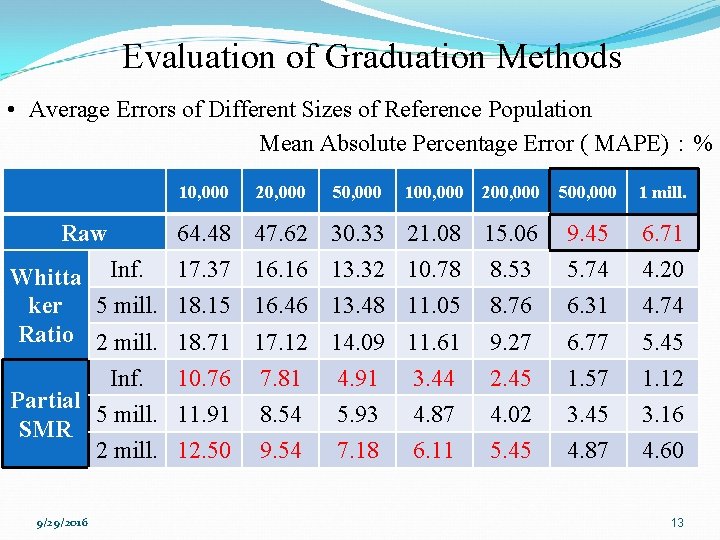
Evaluation of Graduation Methods • Average Errors of Different Sizes of Reference Population Mean Absolute Percentage Error ( MAPE):% 10, 000 Raw 20, 000 50, 000 100, 000 500, 000 1 mill. 9. 45 6. 71 8. 53 5. 74 4. 20 8. 76 6. 31 4. 74 9. 27 6. 77 5. 45 64. 48 47. 62 30. 33 21. 08 15. 06 Whitta Inf. 17. 37 16. 16 13. 32 10. 78 ker 5 mill. 18. 15 16. 46 13. 48 11. 05 Ratio 2 mill. 18. 71 17. 12 14. 09 11. 61 Inf. 10. 76 Partial 5 mill. 11. 91 SMR 2 mill. 12. 50 9/29/2016 200, 000 7. 81 4. 91 3. 44 2. 45 1. 57 1. 12 8. 54 5. 93 4. 87 4. 02 3. 45 3. 16 9. 54 7. 18 6. 11 5. 45 4. 87 4. 60 13
Evaluation of Graduation Methods • graduation methods can reduce the errors • The reduction rate decreases as the size of small population size increase. • The errors without graduation are smaller than 10% when the population size is over 500, 000 • It seems that 2 million is sufficient for the reference population. • Tthe partial SMR generally have smaller errors In practice, it is difficult to find (and confirm) the reference populations have identical mortality rates as the small population. 9/29/2016 14

Evaluation of Graduation Methods l Next, 1, 000 simulation again: • We treat the sum of historical data from small population as the reference population 10, 000 50, 000 100, 000 200, 000 500, 000 1 mill. Raw 68. 23 50. 59 32. 90 22. 88 16. 28 10. 27 7. 26 Whittaker 51. 54 38. 20 27. 62 22. 68 19. 82 17. 70 16. 88 Lee-Carter 33. 57 23. 67 15. 53 10. 97 8. 66 6. 05 4. 05 8. 70 8. 09 7. 50 7. 03 PSMR 20, 000 14. 31 11. 75 9. 68 • The partial SMR has better performance 9/29/2016 15
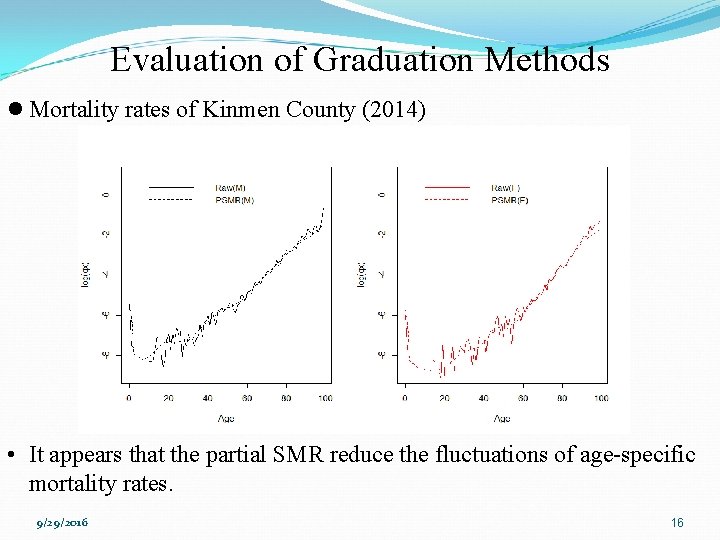
Evaluation of Graduation Methods l Mortality rates of Kinmen County (2014) • It appears that the partial SMR reduce the fluctuations of age-specific mortality rates. 9/29/2016 16
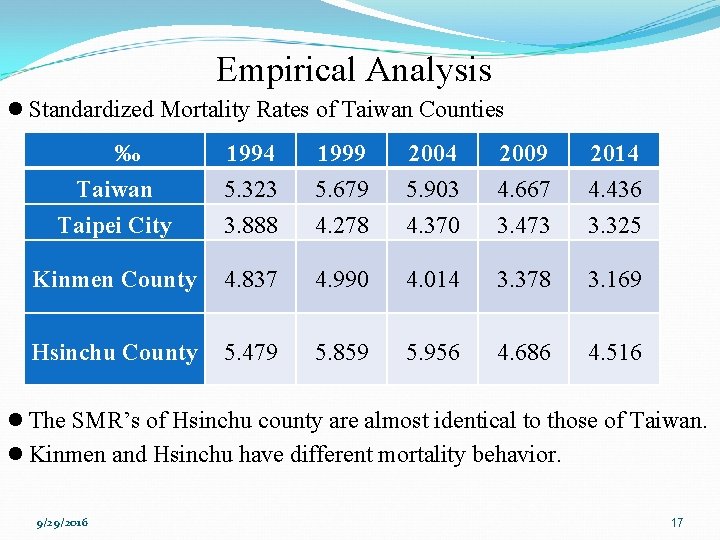
Empirical Analysis l Standardized Mortality Rates of Taiwan Counties ‰ Taiwan Taipei City 1994 5. 323 3. 888 1999 5. 679 4. 278 2004 5. 903 4. 370 2009 4. 667 3. 473 2014 4. 436 3. 325 Kinmen County 4. 837 4. 990 4. 014 3. 378 3. 169 Hsinchu County 5. 479 5. 859 5. 956 4. 686 4. 516 l The SMR’s of Hsinchu county are almost identical to those of Taiwan. l Kinmen and Hsinchu have different mortality behavior. 9/29/2016 17
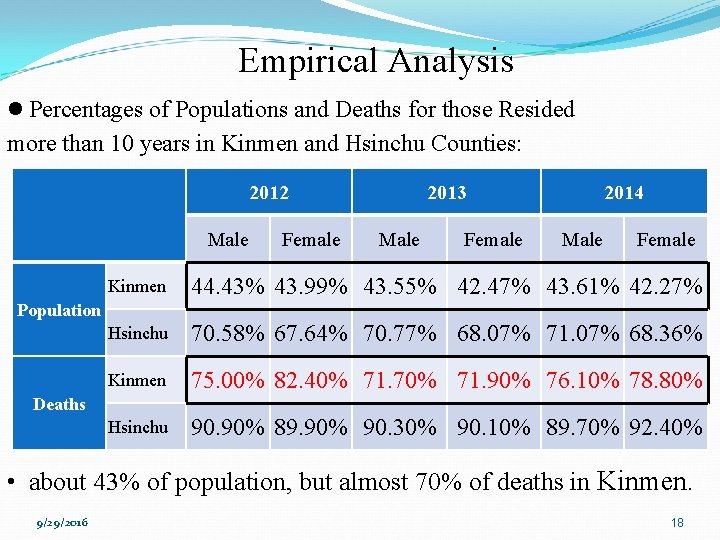
Empirical Analysis l Percentages of Populations and Deaths for those Resided more than 10 years in Kinmen and Hsinchu Counties: 2012 Male Female 2013 Male Female 2014 Male Female Kinmen 44. 43% 43. 99% 43. 55% 42. 47% 43. 61% 42. 27% Hsinchu 70. 58% 67. 64% 70. 77% 68. 07% 71. 07% 68. 36% Kinmen 75. 00% 82. 40% 71. 70% 71. 90% 76. 10% 78. 80% Hsinchu 90. 90% 89. 90% 90. 30% 90. 10% 89. 70% 92. 40% Population Deaths • about 43% of population, but almost 70% of deaths in Kinmen. 9/29/2016 18
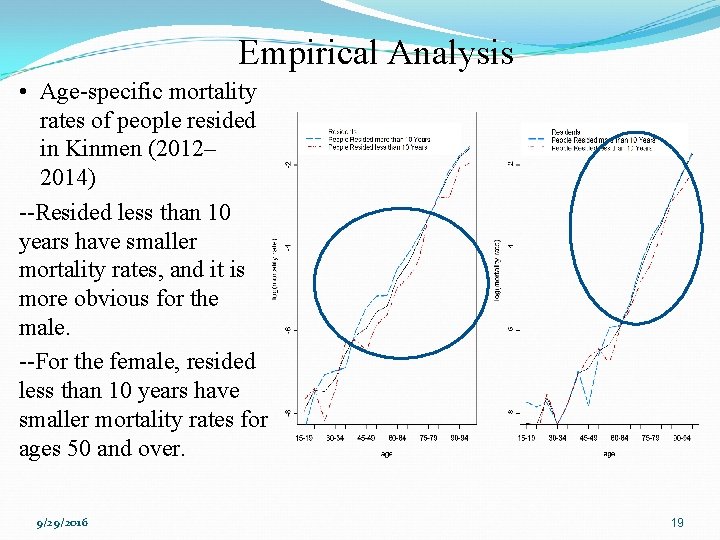
Empirical Analysis • Age-specific mortality rates of people resided in Kinmen (2012– 2014) --Resided less than 10 years have smaller mortality rates, and it is more obvious for the male. --For the female, resided less than 10 years have smaller mortality rates for ages 50 and over. 9/29/2016 19
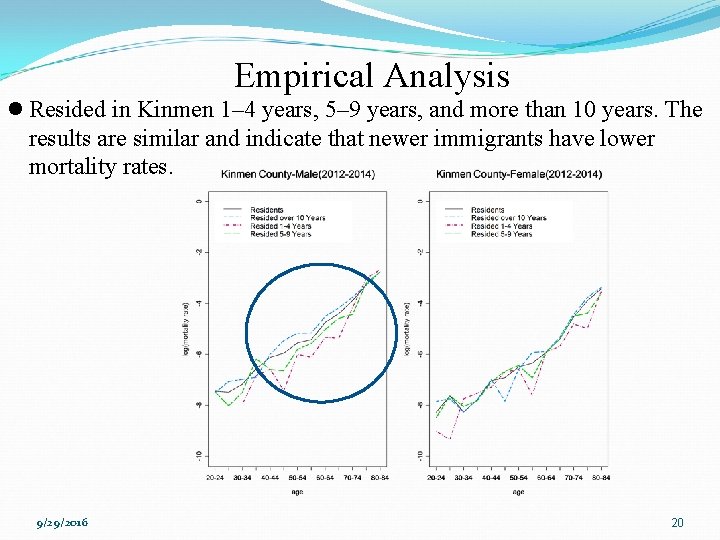
Empirical Analysis l Resided in Kinmen 1– 4 years, 5– 9 years, and more than 10 years. The results are similar and indicate that newer immigrants have lower mortality rates. 9/29/2016 20
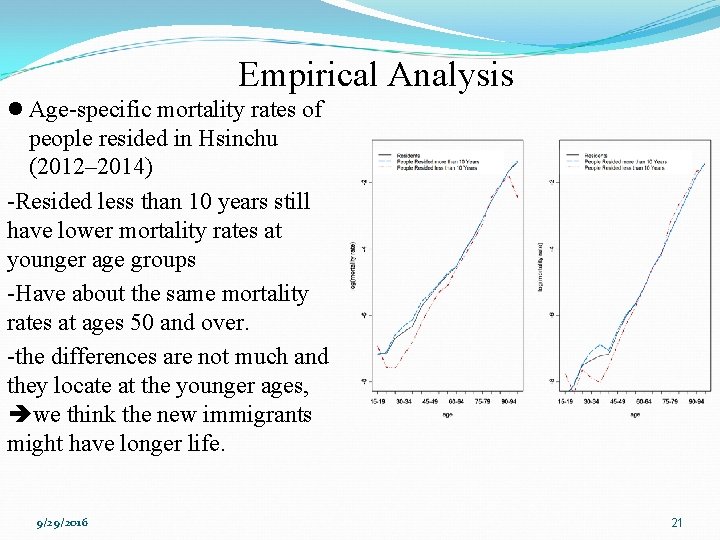
Empirical Analysis l Age-specific mortality rates of people resided in Hsinchu (2012– 2014) -Resided less than 10 years still have lower mortality rates at younger age groups -Have about the same mortality rates at ages 50 and over. -the differences are not much and they locate at the younger ages, we think the new immigrants might have longer life. 9/29/2016 21
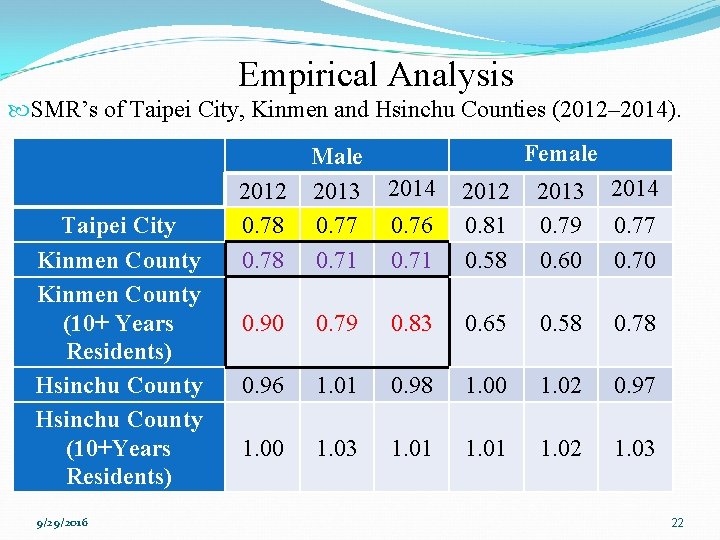
Empirical Analysis SMR’s of Taipei City, Kinmen and Hsinchu Counties (2012– 2014). Taipei City Kinmen County (10+ Years Residents) Hsinchu County (10+Years Residents) 9/29/2016 2012 0. 78 Male 2013 0. 77 0. 71 0. 90 Female 2014 2013 0. 79 0. 60 2014 0. 76 0. 71 2012 0. 81 0. 58 0. 79 0. 83 0. 65 0. 58 0. 78 0. 96 1. 01 0. 98 1. 00 1. 02 0. 97 1. 00 1. 03 1. 01 1. 02 1. 03 0. 77 0. 70 22
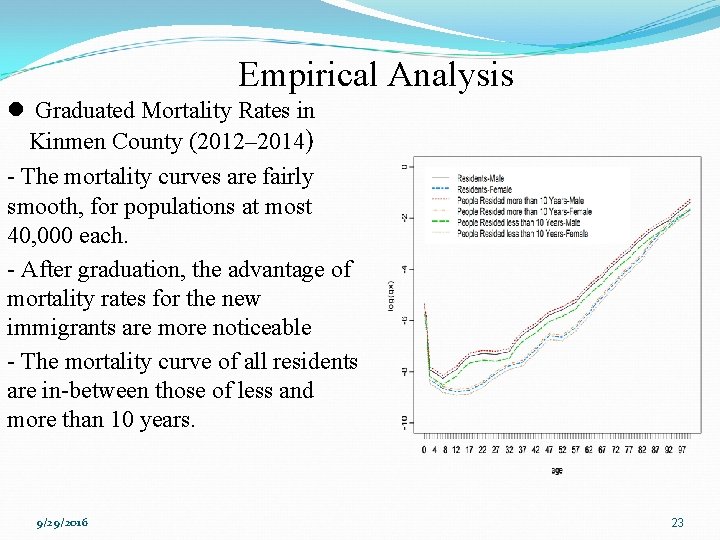
Empirical Analysis l Graduated Mortality Rates in Kinmen County (2012– 2014) - The mortality curves are fairly smooth, for populations at most 40, 000 each. - After graduation, the advantage of mortality rates for the new immigrants are more noticeable - The mortality curve of all residents are in-between those of less and more than 10 years. 9/29/2016 23
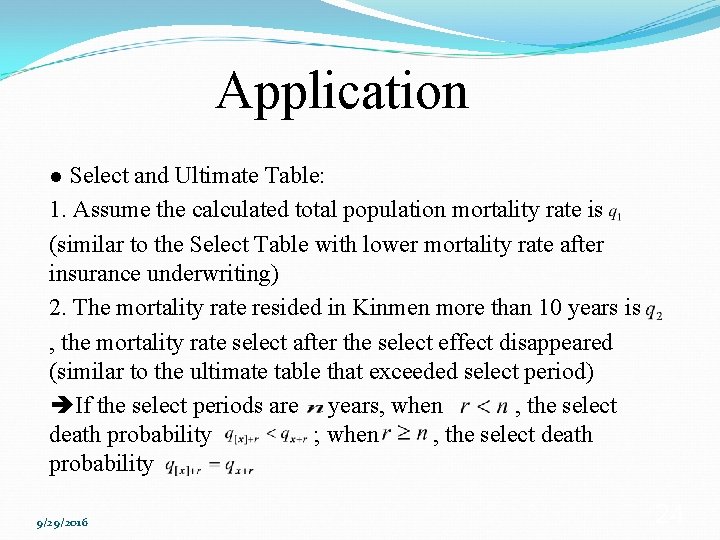
Application Select and Ultimate Table: 1. Assume the calculated total population mortality rate is (similar to the Select Table with lower mortality rate after insurance underwriting) 2. The mortality rate resided in Kinmen more than 10 years is , the mortality rate select after the select effect disappeared (similar to the ultimate table that exceeded select period) If the select periods are years, when , the select death probability ; when , the select death probability l 9/29/2016 24
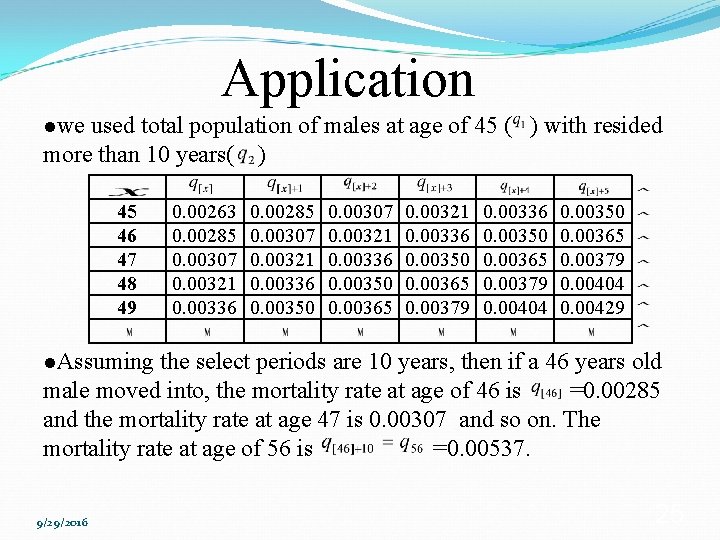
Application lwe used total population of males at age of 45 ( ) with resided more than 10 years( ) 45 46 47 48 49 0. 00263 0. 00285 0. 00307 0. 00321 0. 00336 0. 00350 0. 00365 0. 00379 0. 00404 0. 00429 l. Assuming the select periods are 10 years, then if a 46 years old male moved into, the mortality rate at age of 46 is =0. 00285 and the mortality rate at age 47 is 0. 00307 and so on. The mortality rate at age of 56 is =0. 00537. 9/29/2016 25
Conclusion l The top two counties with largest proportion of immigrants in Taiwan show that: --The immigrants do have lower mortality rates for Kinmen county but it is not the case for Hsinchu county. --This partly confirmed theory of Kibele and Janssen (2013), that the migration would significantly distort the mortality rates in that area. --The effect of immigrants cannot explain why the residents (especially the female) of Kinmen county have longer life than those of Taipei city. There should be other causes other than migration. l It is believed that at least three causes behind the longer life in Kinmen county: • “Mini Three Link”: A lot of people (ages between 40 and 60) move to Kinmen in order to enjoy the privilege to have direct 9/29/2016 26 trades.
Conclusion • Social welfare: local government gives monthly pension to the elderly residents and students of Kinmen University have waiver of tuition ( they must register to become residents of Kinmen County). • Island effect: is related to the residents of Okinawa who have longer life expectancy in Japan l It is still too early and not possible to come out a solid conclusion, with the limited data in this study l we found that the graduation methods can help to provide more stable estimates of mortality rates l if the mortality rates are related to the time of migration, then we can propose an approach by modifying the estimation of select and ultimate table from commercial insurance 9/29/2016 27

Thank you for your attention. 9/29/2016 28
- Slides: 28