
USING THE PERFORMANCE SPECIFICATION PROCESS IN HAZARD ELIMINATION



- Slides: 31
USING THE PERFORMANCE SPECIFICATION PROCESS IN HAZARD ELIMINATION AND CONTROL Pamela Wilkinson, MS Technical Director, System Safety ESOH
Agenda � Background � Requirements Analysis � Performance Specification � Conclusion � Questions
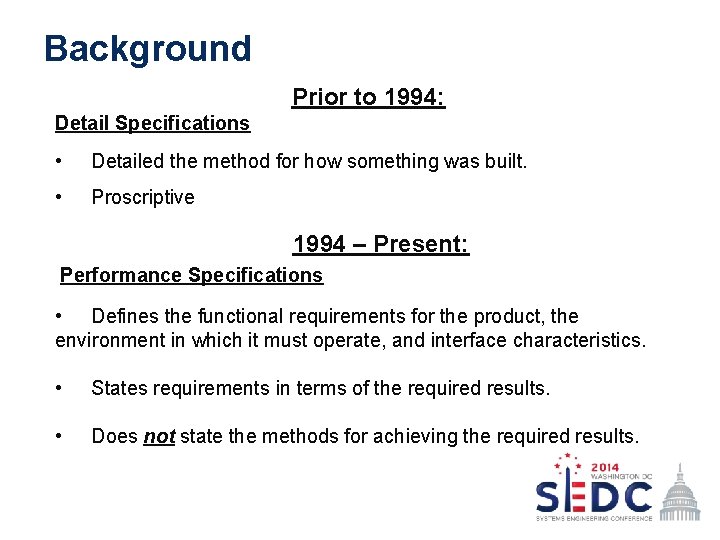
Background Prior to 1994: Detail Specifications • Detailed the method for how something was built. • Proscriptive 1994 – Present: Performance Specifications • Defines the functional requirements for the product, the environment in which it must operate, and interface characteristics. • States requirements in terms of the required results. • Does not state the methods for achieving the required results.
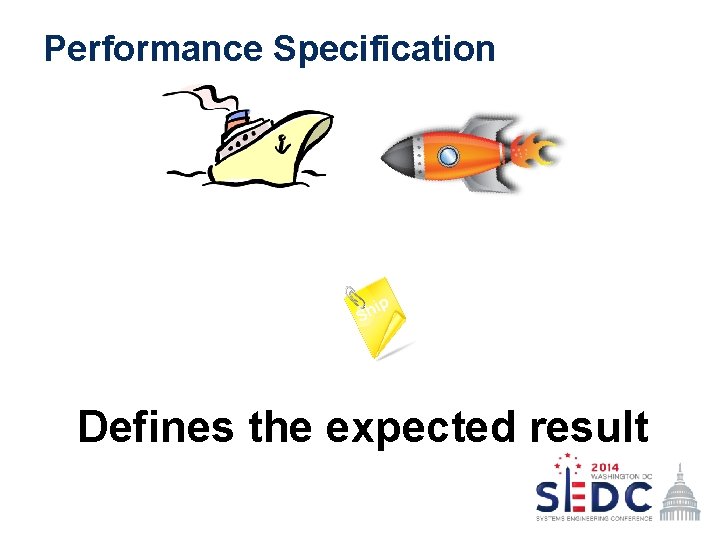
Performance Specification Sh ip Defines the expected result
Hazard Mitigation So how does this relate to mitigating hazards? Ø If the contractor is required to meet specified safety performance requirements, they will more carefully select equipment in the design phase that will do so.
Requirements Analysis JCIDS Documents • System Safety related requirements often vague or missing. • Requirements are rarely defined explicitly. • MIL-STD-882 is an mandatory Requirement per DODI 5000. 02.
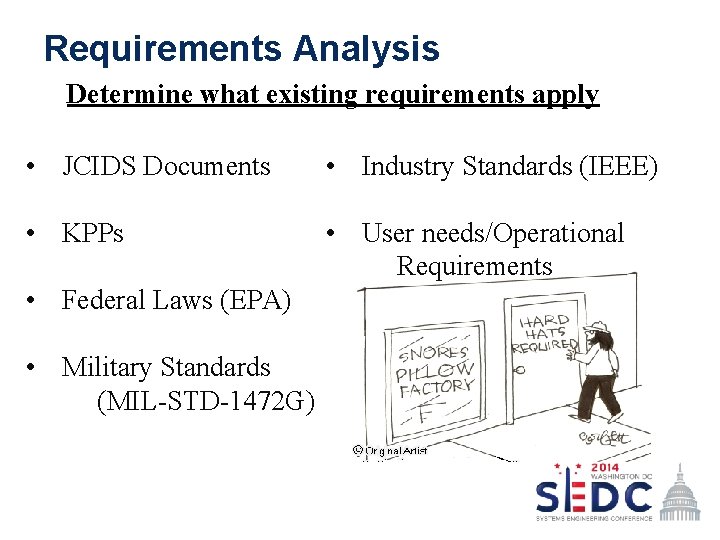
Requirements Analysis Determine what existing requirements apply • JCIDS Documents • Industry Standards (IEEE) • KPPs • User needs/Operational Requirements • Federal Laws (EPA) • Military Standards (MIL-STD-1472 G)
Requirements Analysis • Must be done in conjunction with other discipline’s Requirements Traceability Analyses • Expect there to be Trade-offs to eliminate conflicts. • Likely will need to adjust some requirements to meet Cost, Schedule & Performance Considerations
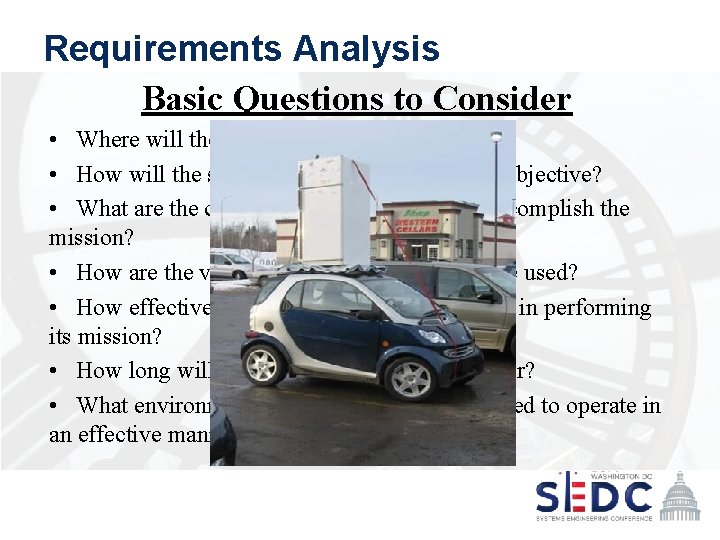
Requirements Analysis Basic Questions to Consider • Where will the system be used? • How will the system accomplish its mission objective? • What are the critical system parameters to accomplish the mission? • How are the various system components to be used? • How effective or efficient must the system be in performing its mission? • How long will the system be in use by the user? • What environments will the system be expected to operate in an effective manner?
Requirements/P-Specs Requirements must be Verifiable • Allows the contractor to know what the government meant by the requirement. • Allows the government to know the contractor has achieved user requirements.
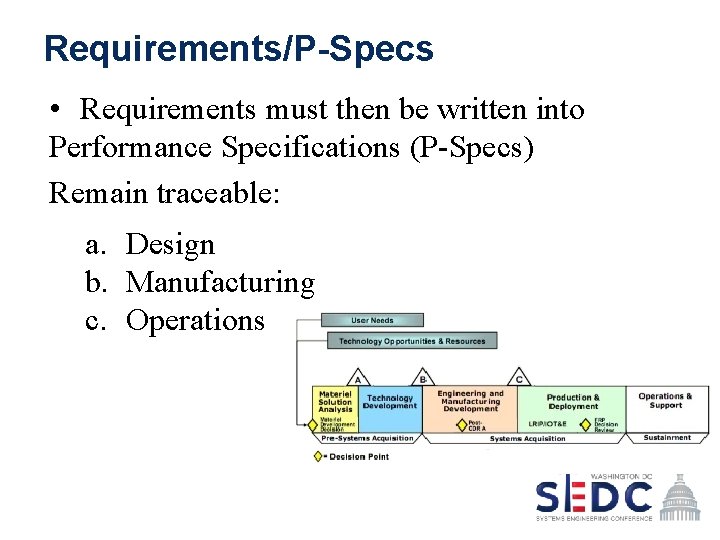
Requirements/P-Specs • Requirements must then be written into Performance Specifications (P-Specs) Remain traceable: a. Design b. Manufacturing c. Operations
Performance Specification A well written P-Spec: Articulates user needs in terms that are: a. Output oriented b. Operational c. Functional d. Performance based e. Measurable
Performance Specification
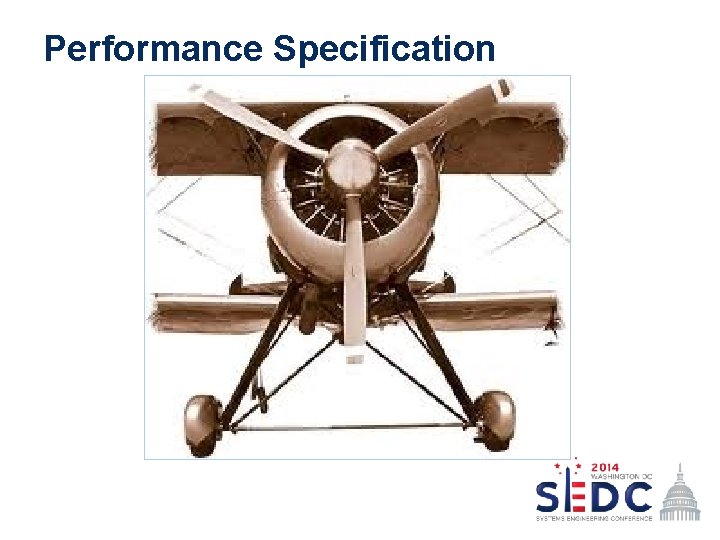
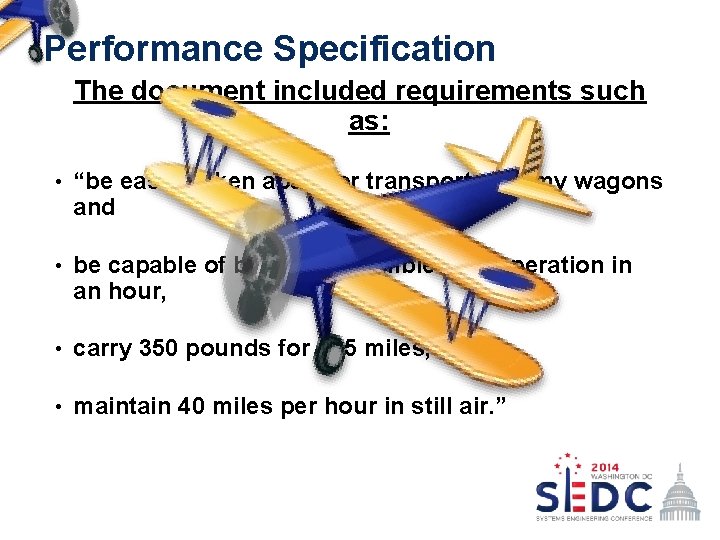
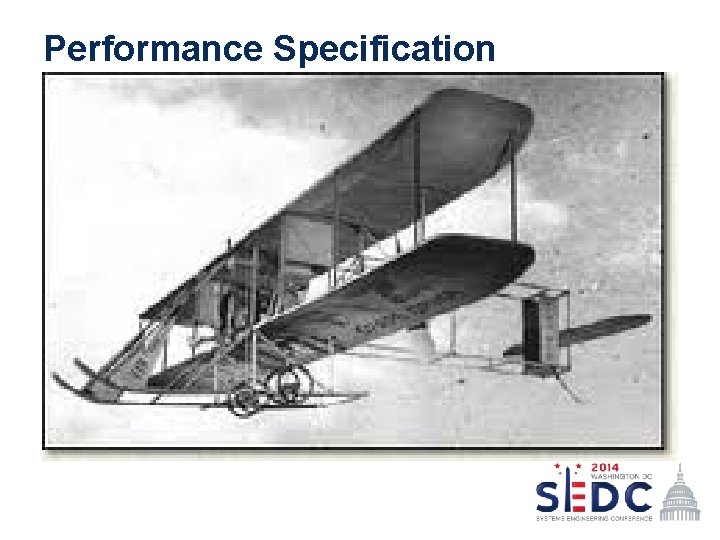
Performance Specification The document included requirements such as: • “be easily taken apart for transport in Army wagons and • be capable of being reassembled for operation in an hour, • carry 350 pounds for 125 miles, and • maintain 40 miles per hour in still air. ”
Performance Specification
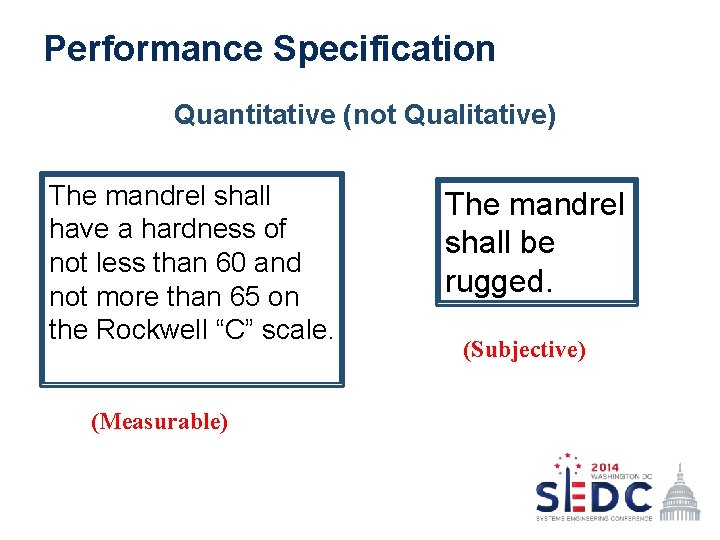
Performance Specification Quantitative (not Qualitative) The mandrel shall have a hardness of not less than 60 and not more than 65 on the Rockwell “C” scale. (Measurable) The mandrel shall be rugged. (Subjective)
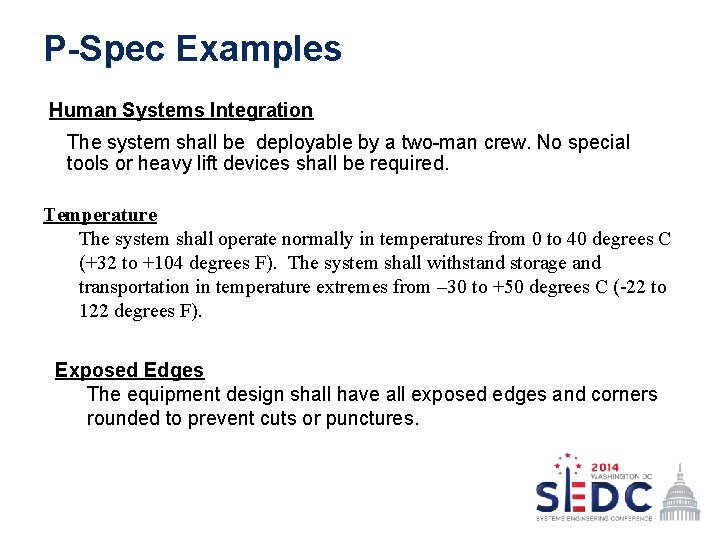
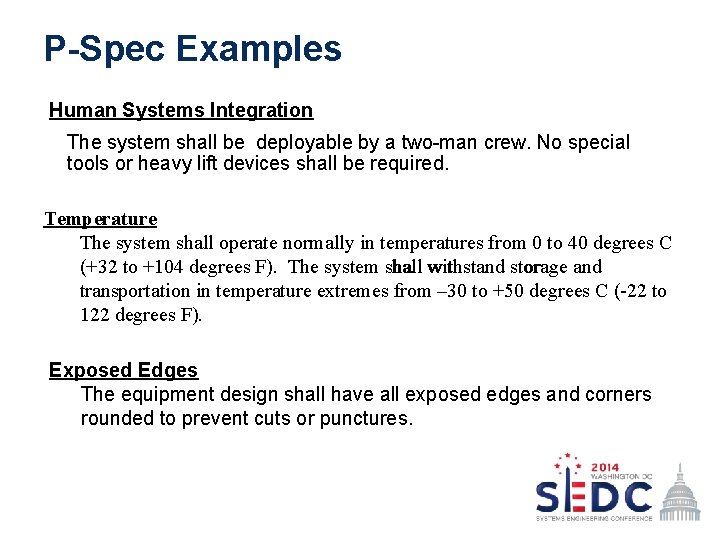
P-Spec Examples Human Systems Integration The system shall be deployable by a two-man crew. No special tools or heavy lift devices shall be required. Temperature The system shall operate normally in temperatures from 0 to 40 degrees C (+32 to +104 degrees F). The system shall withstand storage and transportation in temperature extremes from – 30 to +50 degrees C (-22 to 122 degrees F). Exposed Edges The equipment design shall have all exposed edges and corners rounded to prevent cuts or punctures.
P-Spec Examples ENVIRONMENTAL EXAMPLE: Lithium batteries in the system must be UL certified and be able to pass NOSSA requirements for shipment via Navy Vessel with no additional testing.
Verification/Validation • Analysis • Demonstration • Examination • Test
Verification/ Validation Verification • Ensures the system was built according to specification requirements
Verification/ Validation • Ensures the system operates according to those specification requirements
Verification/Validation Analysis • Technical models • Charts • Circuit diagrams • Documentation
Verification/Validation Demonstration • Actual Operation of the Product
Verification/Validation Examination • Simple physical manipulation • Sight • Touch • Smell • Hear • Counting
Verification/Validation Test Actual testing of the system or product Verified via the test report
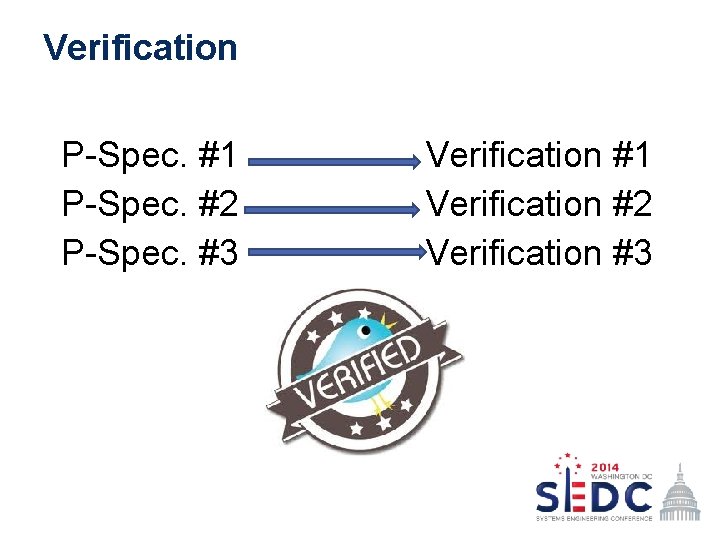
Verification P-Spec. #1 P-Spec. #2 P-Spec. #3 Verification #1 Verification #2 Verification #3
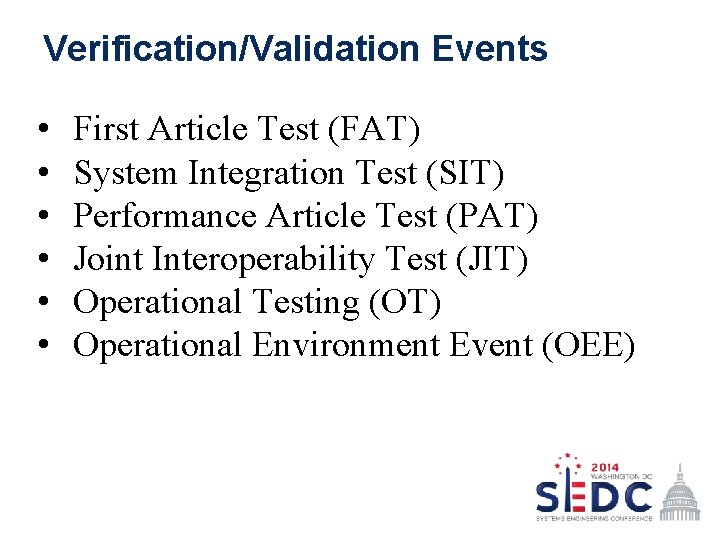
Verification/Validation Events • • • First Article Test (FAT) System Integration Test (SIT) Performance Article Test (PAT) Joint Interoperability Test (JIT) Operational Testing (OT) Operational Environment Event (OEE)
P-Spec Examples Human Systems Integration The system shall be deployable by a two-man crew. No special tools or heavy lift devices shall be required. Temperature The system shall operate normally in temperatures from 0 to 40 degrees C (+32 to +104 degrees F). The system shall withstand storage and transportation in temperature extremes from – 30 to +50 degrees C (-22 to 122 degrees F). Exposed Edges The equipment design shall have all exposed edges and corners rounded to prevent cuts or punctures.
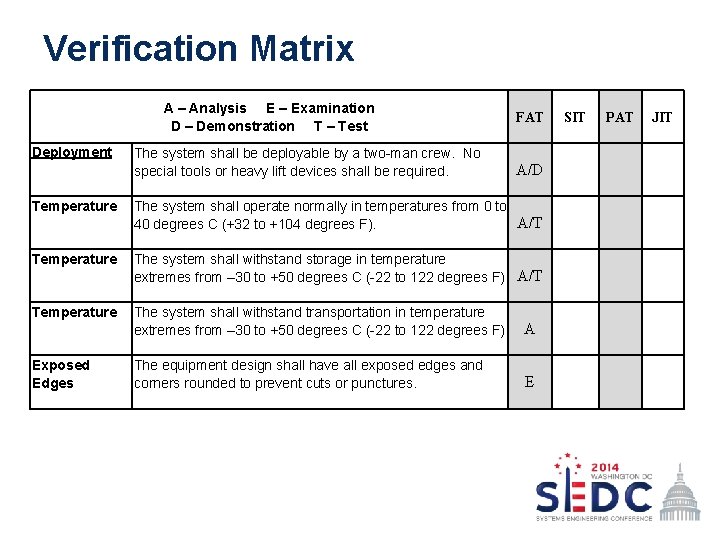
Verification Matrix A – Analysis E – Examination D – Demonstration T – Test Deployment The system shall be deployable by a two-man crew. No special tools or heavy lift devices shall be required. FAT A/D Temperature The system shall operate normally in temperatures from 0 to A/T 40 degrees C (+32 to +104 degrees F). Temperature The system shall withstand storage in temperature extremes from – 30 to +50 degrees C (-22 to 122 degrees F). A/T Temperature The system shall withstand transportation in temperature extremes from – 30 to +50 degrees C (-22 to 122 degrees F). A The equipment design shall have all exposed edges and corners rounded to prevent cuts or punctures. E Exposed Edges SIT PAT JIT
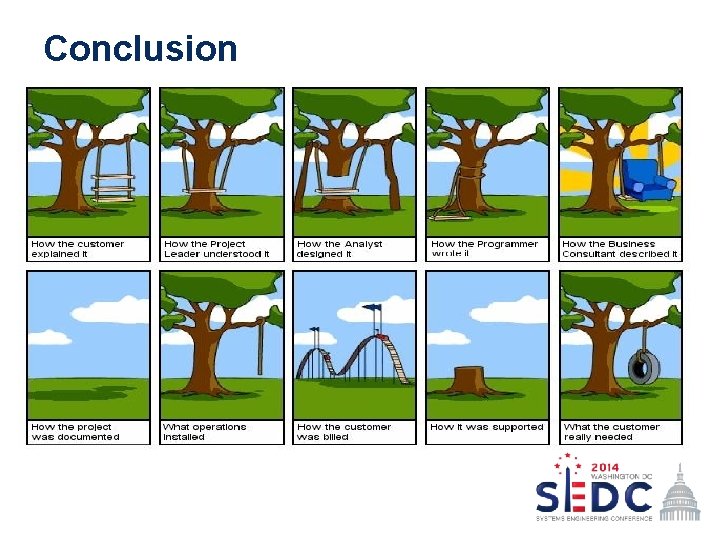
Conclusion
Questions