
Using the Index of Multiple Deprivation IMD to



- Slides: 21
Using the Index of Multiple Deprivation (IMD) to understand the drivers of deprivation in your district Presentation to Waikato Strategic Planners Network Rachael Mc. Millan – Waikato Plan Programme Manager and Associate Professor Daniel Exeter Friday 9 March 2018
Purpose Ø Understanding drivers of deprivation is important for: o Helping the Waikato Plan to determine our action priorities and areas to target o Promoting more effective engagement between the Waikato Plan and various community agencies in the Waikato o Helping local governments in the Waikato Region to further understand their communities to address their own unique mix of deprivation drivers o Harnessing government funding opportunities to help address inequalities
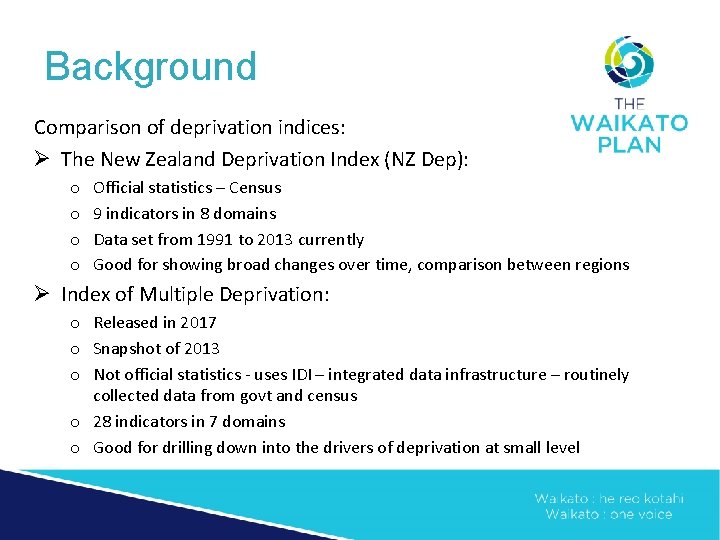
Background Comparison of deprivation indices: Ø The New Zealand Deprivation Index (NZ Dep): o o Official statistics – Census 9 indicators in 8 domains Data set from 1991 to 2013 currently Good for showing broad changes over time, comparison between regions Ø Index of Multiple Deprivation: o Released in 2017 o Snapshot of 2013 o Not official statistics - uses IDI – integrated data infrastructure – routinely collected data from govt and census o 28 indicators in 7 domains o Good for drilling down into the drivers of deprivation at small level
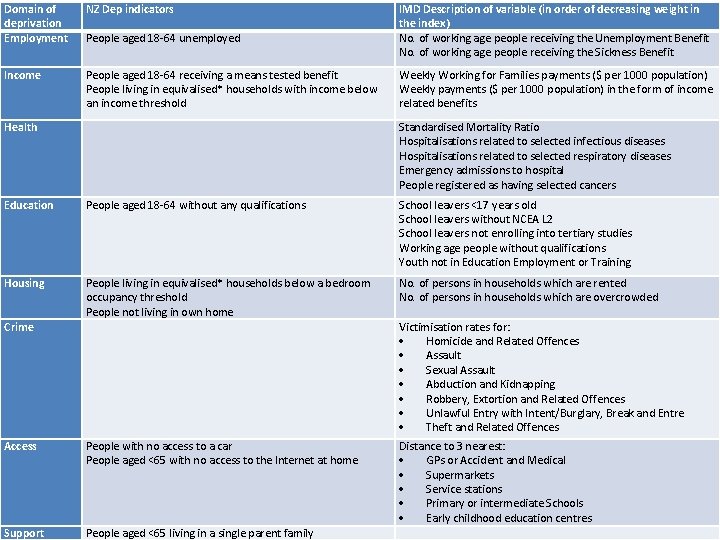
Domain of deprivation Employment NZ Dep indicators Income People aged 18 -64 receiving a means tested benefit People living in equivalised* households with income below an income threshold Weekly Working for Families payments ($ per 1000 population) Weekly payments ($ per 1000 population) in the form of income related benefits Health Standardised Mortality Ratio Hospitalisations related to selected infectious diseases Hospitalisations related to selected respiratory diseases Emergency admissions to hospital People registered as having selected cancers Education People aged 18 -64 without any qualifications School leavers <17 years old School leavers without NCEA L 2 School leavers not enrolling into tertiary studies Working age people without qualifications Youth not in Education Employment or Training Housing People living in equivalised* households below a bedroom occupancy threshold People not living in own home No. of persons in households which are rented No. of persons in households which are overcrowded Access People with no access to a car People aged <65 with no access to the Internet at home Support People aged <65 living in a single parent family Distance to 3 nearest: GPs or Accident and Medical Supermarkets Service stations Primary or intermediate Schools Early childhood education centres Crime People aged 18 -64 unemployed IMD Description of variable (in order of decreasing weight in the index) No. of working age people receiving the Unemployment Benefit No. of working age people receiving the Sickness Benefit Victimisation rates for: Homicide and Related Offences Assault Sexual Assault Abduction and Kidnapping Robbery, Extortion and Related Offences Unlawful Entry with Intent/Burglary, Break and Entre Theft and Related Offences
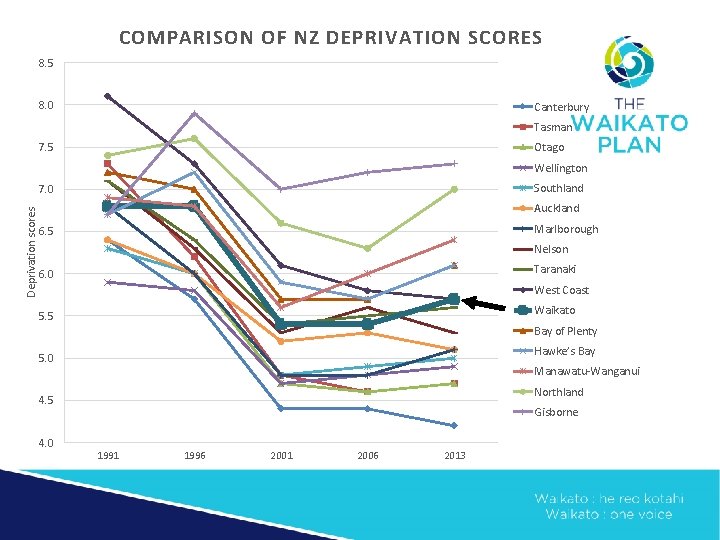
COMPARISON OF NZ DEPRIVATION SCORES 8. 5 8. 0 Canterbury Tasman 7. 5 Otago Wellington Southland Deprivation scores 7. 0 Auckland Marlborough 6. 5 Nelson Taranaki 6. 0 West Coast Waikato 5. 5 Bay of Plenty Hawke’s Bay 5. 0 Manawatu-Wanganui Northland 4. 5 4. 0 Gisborne 1991 1996 2001 2006 2013
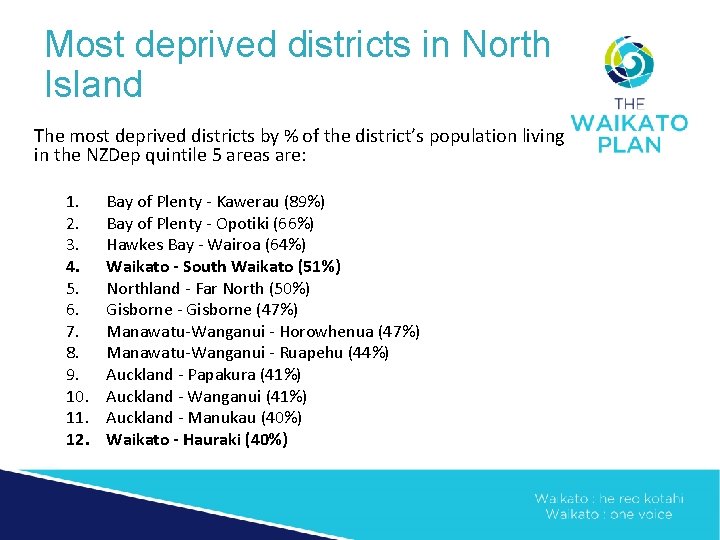
Most deprived districts in North Island The most deprived districts by % of the district’s population living in the NZDep quintile 5 areas are: 1. 2. 3. 4. 5. 6. 7. 8. 9. 10. 11. 12. Bay of Plenty - Kawerau (89%) Bay of Plenty - Opotiki (66%) Hawkes Bay - Wairoa (64%) Waikato - South Waikato (51%) Northland - Far North (50%) Gisborne - Gisborne (47%) Manawatu-Wanganui - Horowhenua (47%) Manawatu-Wanganui - Ruapehu (44%) Auckland - Papakura (41%) Auckland - Wanganui (41%) Auckland - Manukau (40%) Waikato - Hauraki (40%)
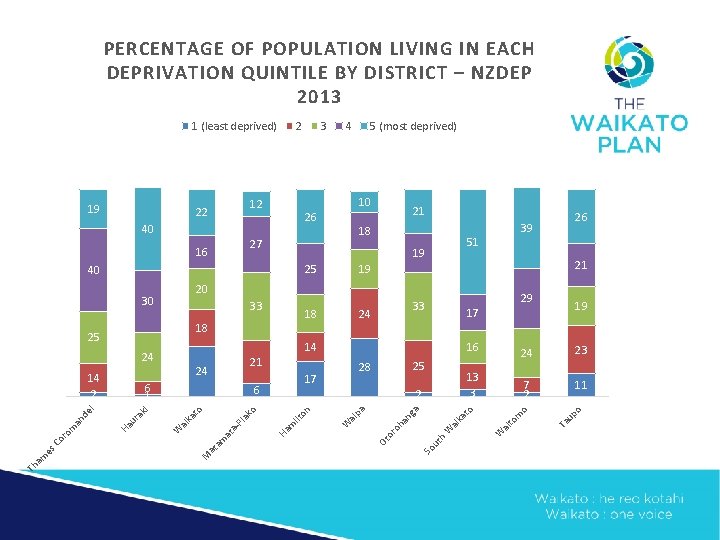
PERCENTAGE OF POPULATION LIVING IN EACH DEPRIVATION QUINTILE BY DISTRICT – NZDEP 2013 12 22 24 17 W h ut So Ot or 19 24 23 7 2 11 o m to oh ai an ka to ga pa ai W on ilt m Ha ak Pi aat am at M 13 3 2 o to ai ka W 25 28 17 6 29 16 21 24 ki ur a 33 14 6 1 Ha de l an 21 19 18 18 24 om 51 W ai 33 26 39 20 25 C or 18 25 30 es 21 19 40 14 2 5 (most deprived) 10 27 16 m 4 26 40 Th a 3 up o 19 2 Ta 1 (least deprived)
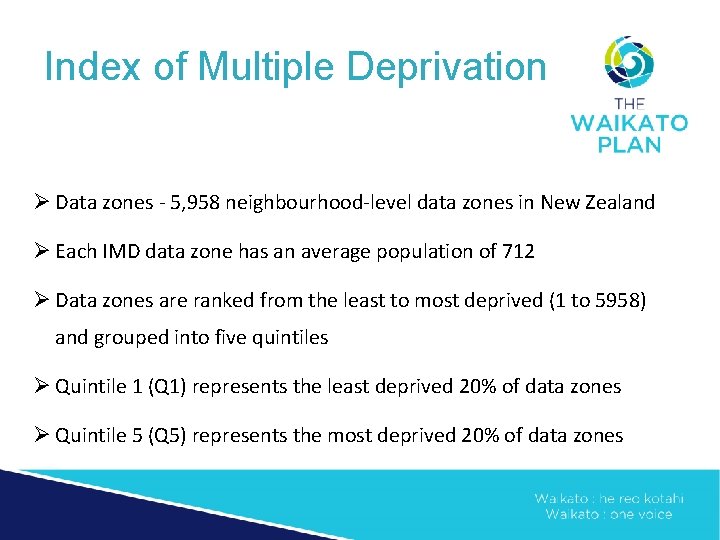
Index of Multiple Deprivation Ø Data zones - 5, 958 neighbourhood-level data zones in New Zealand Ø Each IMD data zone has an average population of 712 Ø Data zones are ranked from the least to most deprived (1 to 5958) and grouped into five quintiles Ø Quintile 1 (Q 1) represents the least deprived 20% of data zones Ø Quintile 5 (Q 5) represents the most deprived 20% of data zones
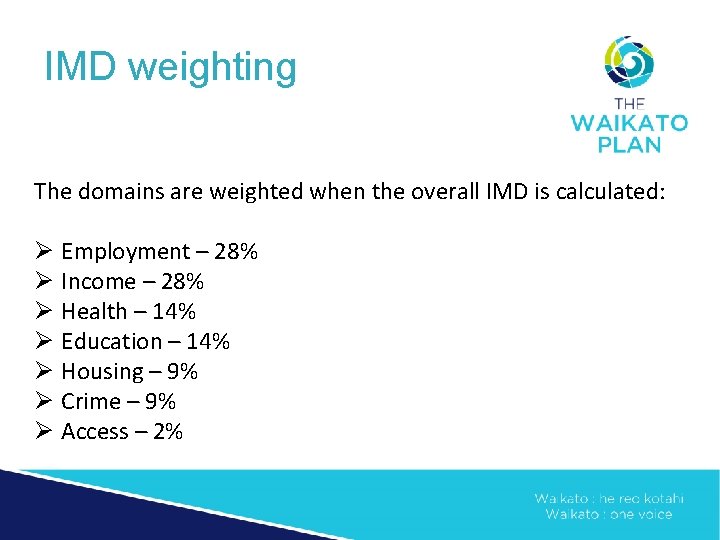
IMD weighting The domains are weighted when the overall IMD is calculated: Ø Employment – 28% Ø Income – 28% Ø Health – 14% Ø Education – 14% Ø Housing – 9% Ø Crime – 9% Ø Access – 2%
Waikato Councils comparison
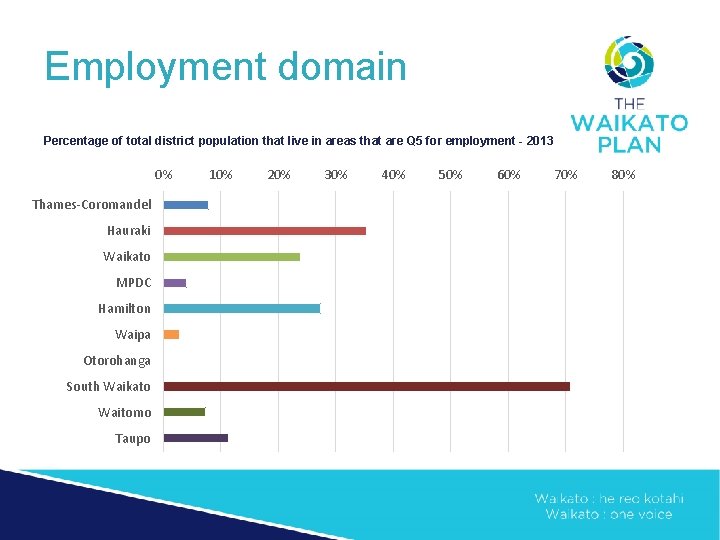
Employment domain Percentage of total district population that live in areas that are Q 5 for employment - 2013 0% Thames-Coromandel Hauraki Waikato MPDC Hamilton Waipa Otorohanga South Waikato Waitomo Taupo 10% 20% 30% 40% 50% 60% 70% 80%
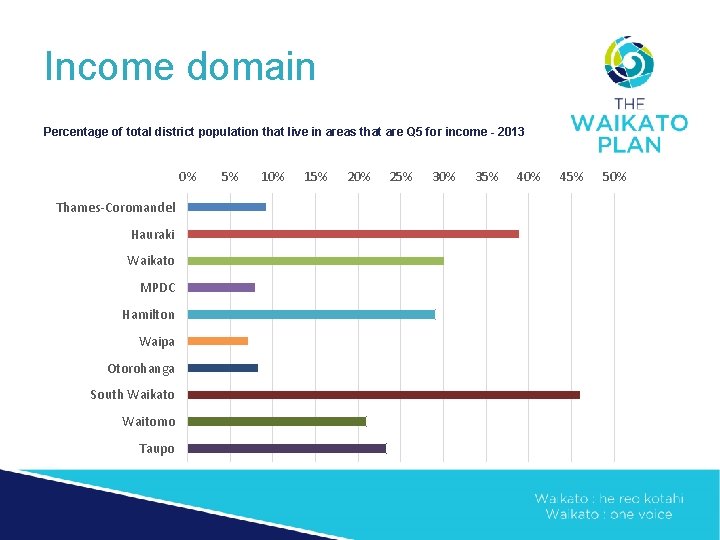
Income domain Percentage of total district population that live in areas that are Q 5 for income - 2013 0% Thames-Coromandel Hauraki Waikato MPDC Hamilton Waipa Otorohanga South Waikato Waitomo Taupo 5% 10% 15% 20% 25% 30% 35% 40% 45% 50%
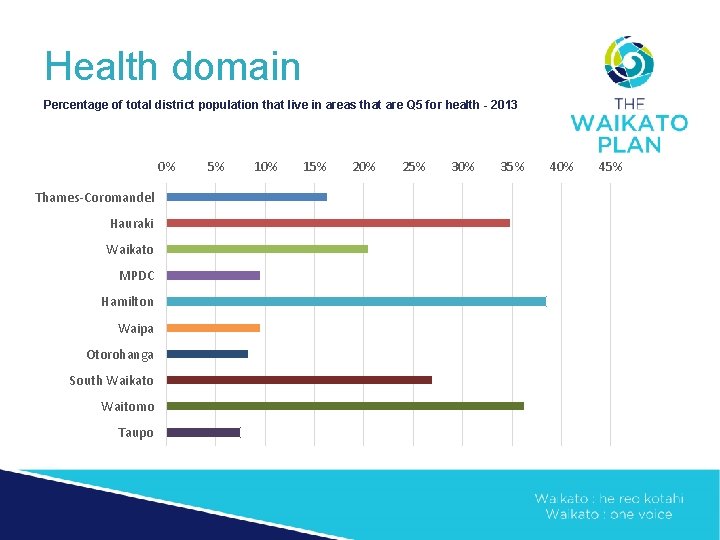
Health domain Percentage of total district population that live in areas that are Q 5 for health - 2013 0% Thames-Coromandel Hauraki Waikato MPDC Hamilton Waipa Otorohanga South Waikato Waitomo Taupo 5% 10% 15% 20% 25% 30% 35% 40% 45%
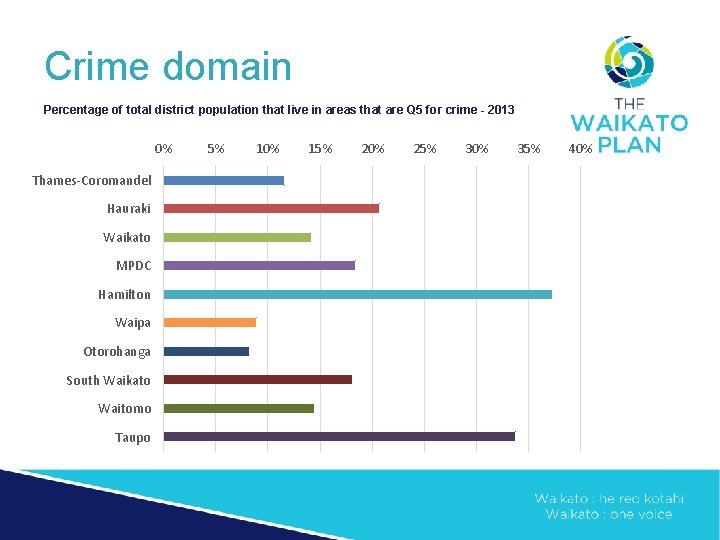
Crime domain Percentage of total district population that live in areas that are Q 5 for crime - 2013 0% Thames-Coromandel Hauraki Waikato MPDC Hamilton Waipa Otorohanga South Waikato Waitomo Taupo 5% 10% 15% 20% 25% 30% 35% 40%
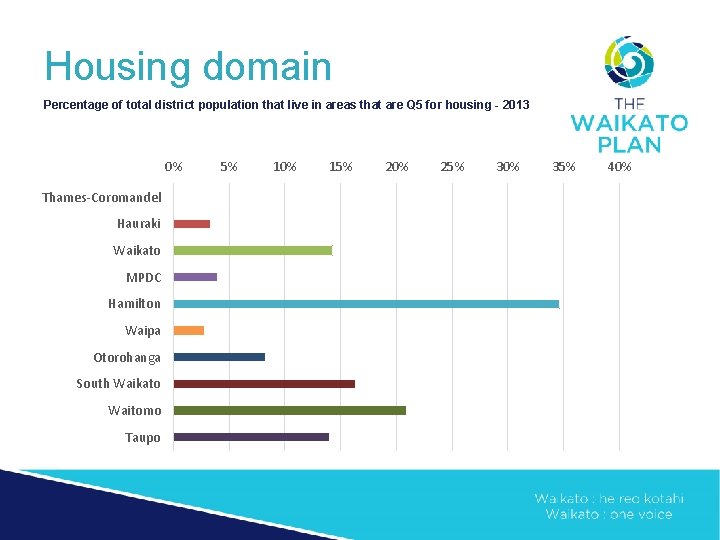
Housing domain Percentage of total district population that live in areas that are Q 5 for housing - 2013 0% Thames-Coromandel Hauraki Waikato MPDC Hamilton Waipa Otorohanga South Waikato Waitomo Taupo 5% 10% 15% 20% 25% 30% 35% 40%
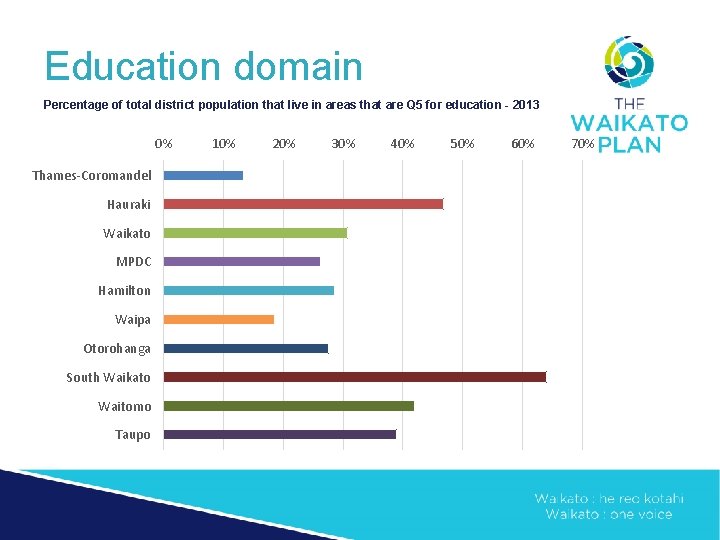
Education domain Percentage of total district population that live in areas that are Q 5 for education - 2013 0% Thames-Coromandel Hauraki Waikato MPDC Hamilton Waipa Otorohanga South Waikato Waitomo Taupo 10% 20% 30% 40% 50% 60% 70%
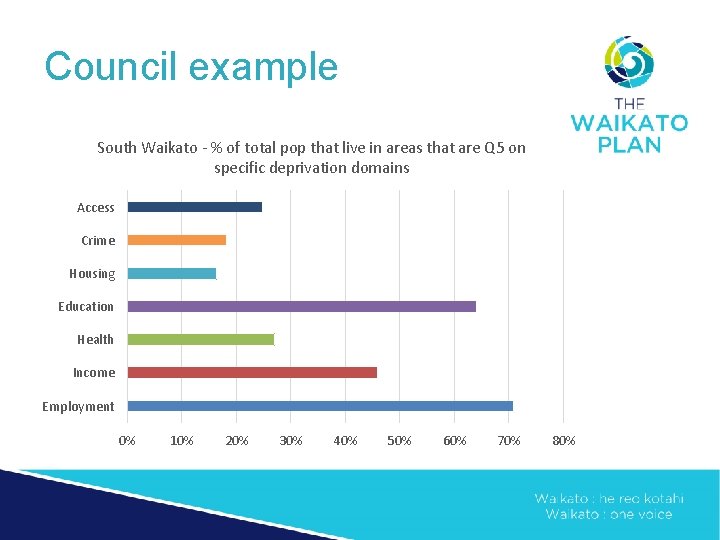
Council example South Waikato - % of total pop that live in areas that are Q 5 on specific deprivation domains Access Crime Housing Education Health Income Employment 0% 10% 20% 30% 40% 50% 60% 70% 80%
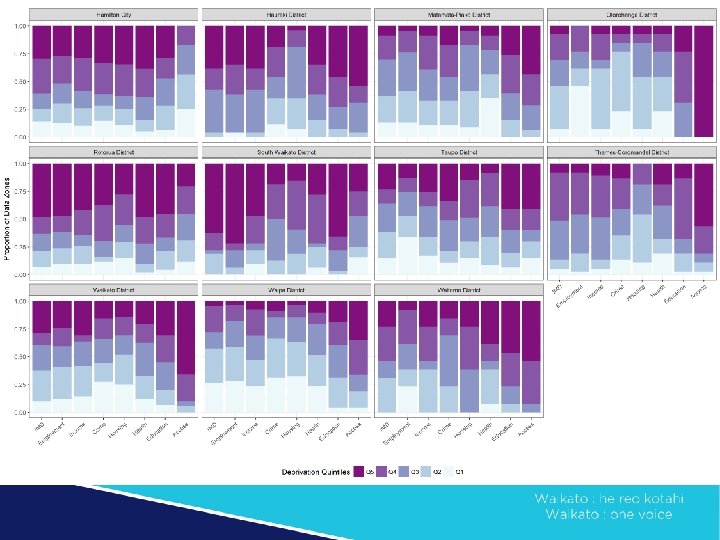
Data zone example
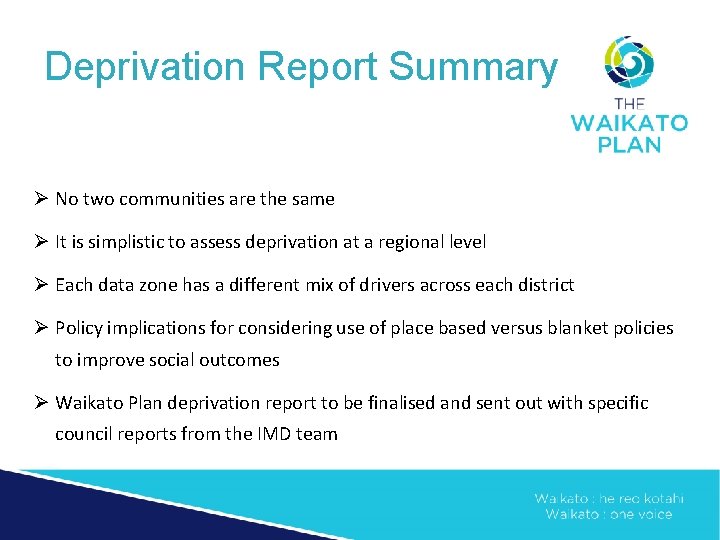
Deprivation Report Summary Ø No two communities are the same Ø It is simplistic to assess deprivation at a regional level Ø Each data zone has a different mix of drivers across each district Ø Policy implications for considering use of place based versus blanket policies to improve social outcomes Ø Waikato Plan deprivation report to be finalised and sent out with specific council reports from the IMD team
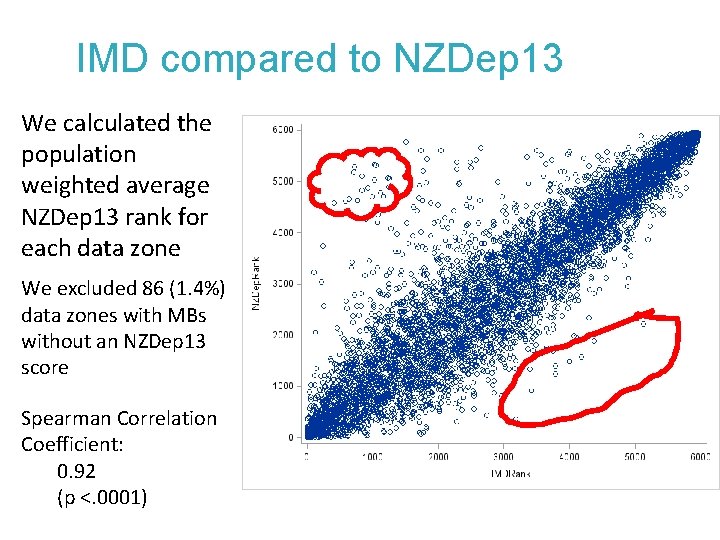
IMD compared to NZDep 13 We calculated the population weighted average NZDep 13 rank for each data zone We excluded 86 (1. 4%) data zones with MBs without an NZDep 13 score Spearman Correlation Coefficient: 0. 92 (p <. 0001)
Acknowledgements & Disclaimer Statement • Access to the data presented was managed by Statistics New Zealand under strict micro-data access protocols and in accordance with the security and confidentiality provisions of the Statistic Act 1975. Our findings are not Official Statistics. The opinions, findings, recommendations, and conclusions expressed are those of the researchers, not Statistics NZ, or the University of Auckland. • This research was funded by the Health Research Council of New Zealand. Thanks to the developers of zone design software for allowing us to use their data, and to the IDI and geospatial teams at Statistics New Zealand for their input and use of data. • The IMD and Data Zones were developed by Daniel Exeter, Jinfeng Zhao, Sue Crengle, Arier Lee and Michael Browne • Census boundaries used in this analysis are Crown Copyright