
Using the ICF as a framework to explore

- Slides: 17
Using the ICF as a framework to explore mental health users' experiences of activities, participation and environment: An international study Dr Elizabeth A. Mc. Kay, Abigail Henderick, MSc OT & Stephanie Doran, MSc OT: University of Limerick (Ireland ) Dr Thelma Sumsion: University of Western Ontario, (Canada) Kirsti Haracz, MSc BApp. Sc University of Newcastle, (Australia) (Australia
Overview The ICF (WHO 2001) has been used as a statistical, research, educational and clinical tool. n There has been a call for all health professionals to use and have knowledge of the ICF. n However research into the utility of the ICF in occupational therapy has been limited, particularly in mental health settings. n
Social inclusion is… one of the most cited concepts in mental health literature. It is a concept of equal opportunity, which allows for a person to take part in activities and roles within society (Repper and Perkins 2003). n Any difficulties participating in everyday activities will significantly impact upon an individual’s social inclusiveness. n
Research Question n Are the activities, participation and environment components of the ICF effective in identifying the barriers and facilitators to social inclusion?
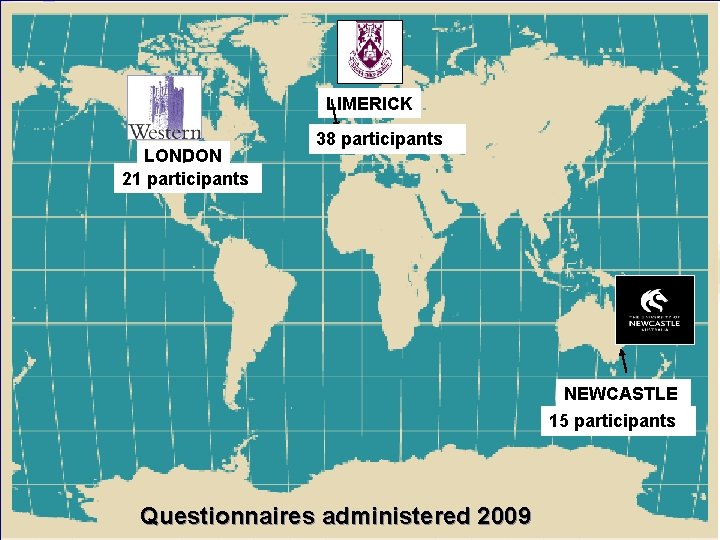
LIMERICK LONDON 21 participants 38 participants NEWCASTLE 15 participants Questionnaires administered 2009
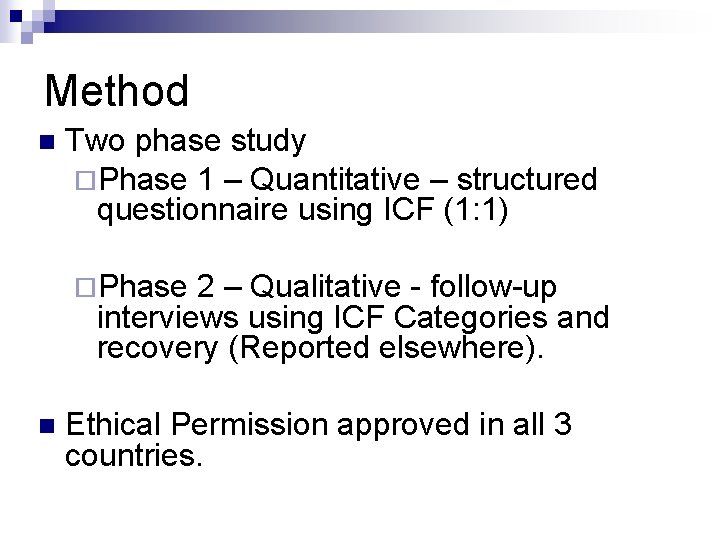
Method n Two phase study ¨Phase 1 – Quantitative – structured questionnaire using ICF (1: 1) ¨Phase 2 – Qualitative - follow-up interviews using ICF Categories and recovery (Reported elsewhere). n Ethical Permission approved in all 3 countries.
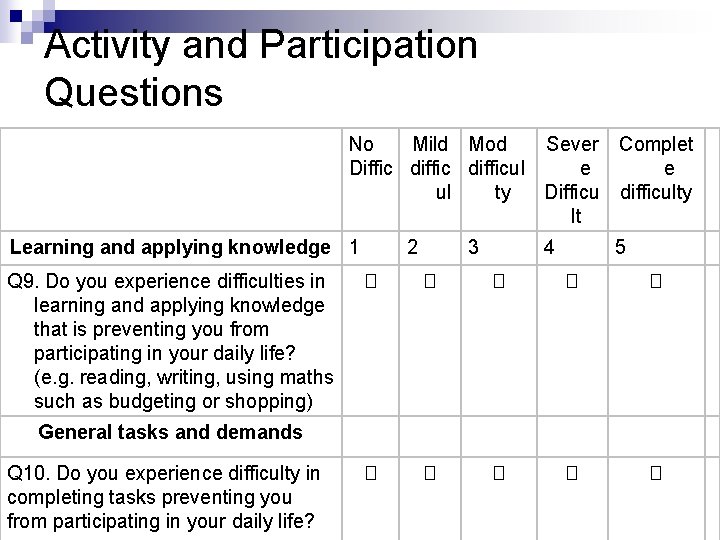
Activity and Participation Questions No Mild Mod Sever Complet Diffic difficul e e ul ty Difficu difficulty lt Learning and applying knowledge 1 Q 9. Do you experience difficulties in learning and applying knowledge that is preventing you from participating in your daily life? (e. g. reading, writing, using maths such as budgeting or shopping) 2 3 4 5 � � � � � General tasks and demands Q 10. Do you experience difficulty in completing tasks preventing you from participating in your daily life?
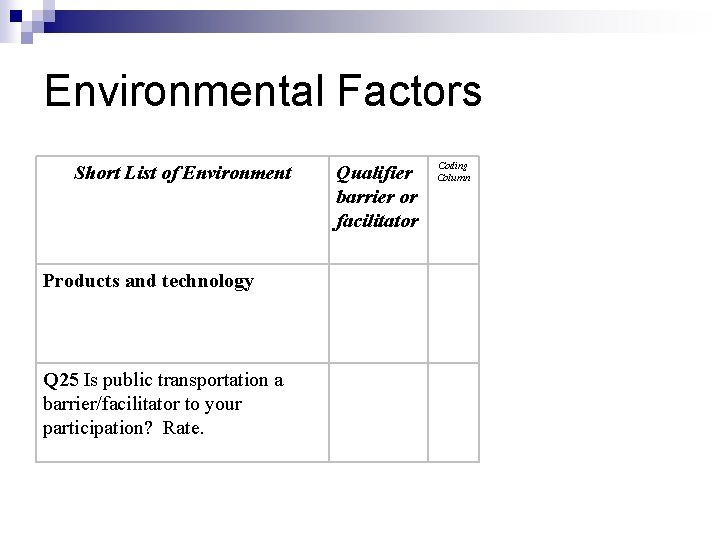
Environmental Factors Short List of Environment Products and technology Q 25 Is public transportation a barrier/facilitator to your participation? Rate. Qualifier barrier or facilitator Coding Column
Data Analysis n Cross-tabulated frequency tables were used to identify the frequency of barriers and facilitators. n Cramer’s V, Pearson’s chi-square (p=0. 05) and Fisher’s exact tests (p=0. 05) were conducted to analyse the relationship between pairs of variables.
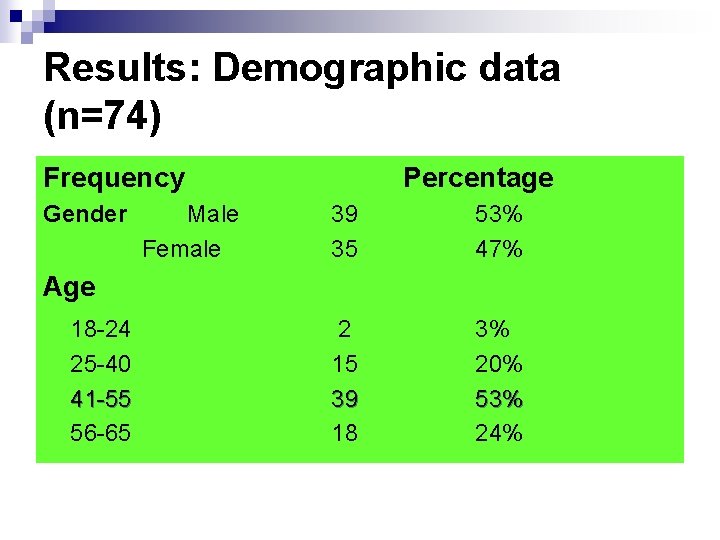
Results: Demographic data (n=74) Frequency Gender Male Female Percentage 39 35 53% 47% 2 15 39 18 3% 20% 53% 24% Age 18 -24 25 -40 41 -55 56 -65
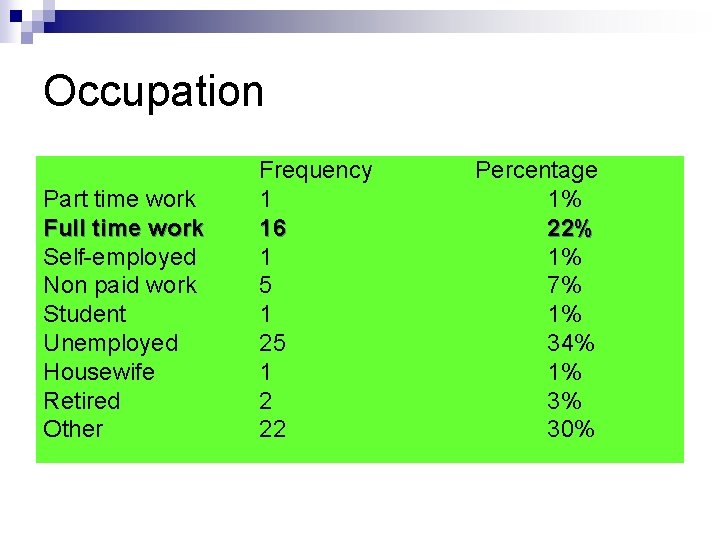
Occupation Part time work Full time work Self-employed Non paid work Student Unemployed Housewife Retired Other Frequency 1 16 1 5 1 2 22 Percentage 1% 22% 1% 7% 1% 34% 1% 3% 30%
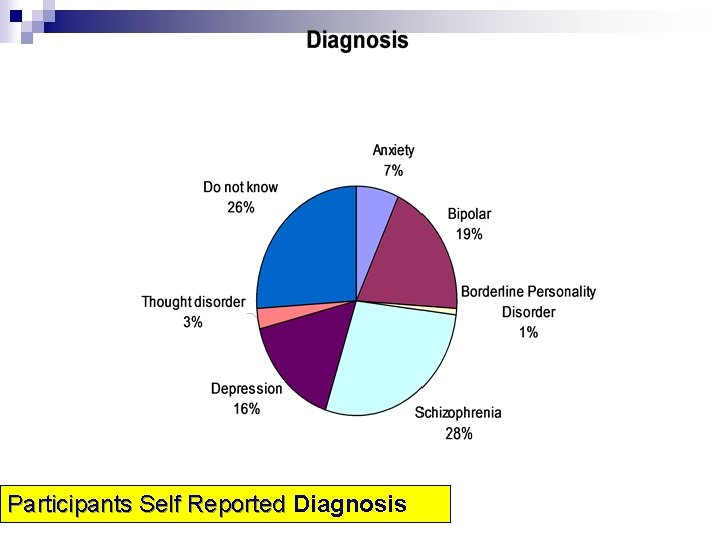
Participants Self Reported Diagnosis
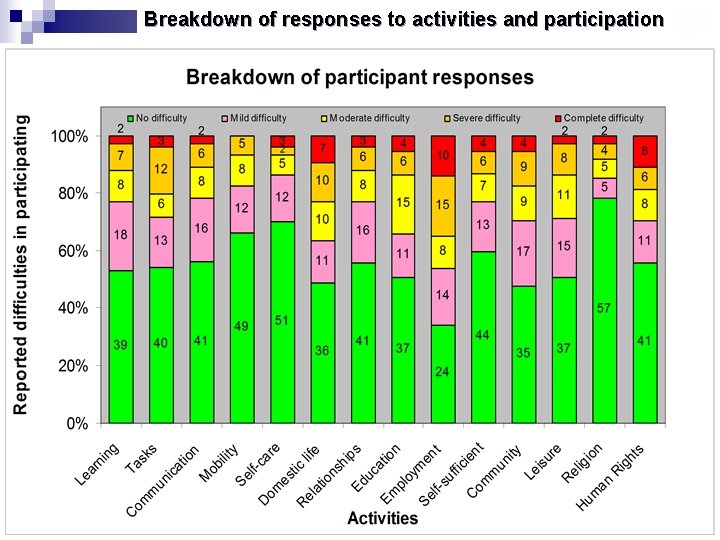
Breakdown of responses to activities and participation
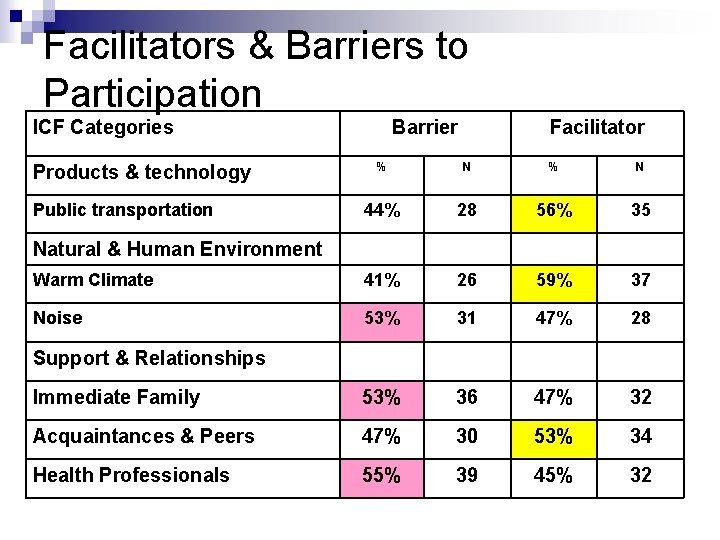
Facilitators & Barriers to Participation ICF Categories Barrier Facilitator % N 44% 28 56% 35 Warm Climate 41% 26 59% 37 Noise 53% 31 47% 28 Immediate Family 53% 36 47% 32 Acquaintances & Peers 47% 30 53% 34 Health Professionals 55% 39 45% 32 Products & technology Public transportation Natural & Human Environment Support & Relationships
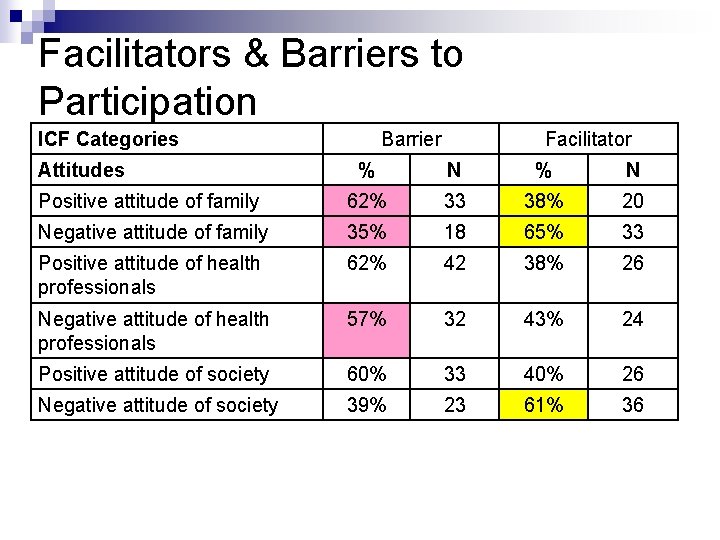
Facilitators & Barriers to Participation ICF Categories Attitudes Barrier Facilitator % N Positive attitude of family 62% 33 38% 20 Negative attitude of family 35% 18 65% 33 Positive attitude of health professionals 62% 42 38% 26 Negative attitude of health professionals 57% 32 43% 24 Positive attitude of society 60% 33 40% 26 Negative attitude of society 39% 23 61% 36
Implications n n n Practice ¨ This work highlights the possibility of using the ICF components as a screening tool. Education ¨ ICF should be an integral part of both undergraduate and postgraduate occupational therapy professional qualifications, to skill new practitioners in the use of this language and convert it into practice in context. Research ¨ Need for larger study to increase generalisability of the findings ¨ Both clients and therapists’ perspectives of using ICF.
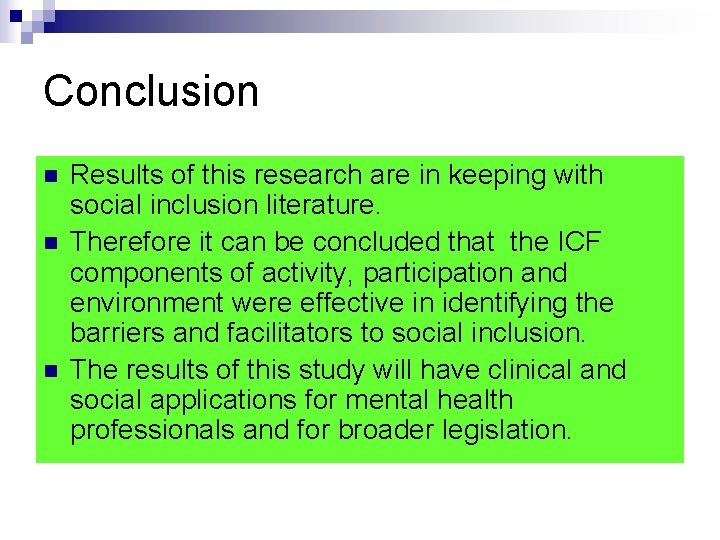
Conclusion n Results of this research are in keeping with social inclusion literature. Therefore it can be concluded that the ICF components of activity, participation and environment were effective in identifying the barriers and facilitators to social inclusion. The results of this study will have clinical and social applications for mental health professionals and for broader legislation.