
USING THE HEALTH BELIEF MODEL TO UNDERSTAND THE
USING THE HEALTH BELIEF MODEL TO UNDERSTAND THE “POURING ON THE POUNDS” MEDIA CAMPAIGN Brian Pochinski
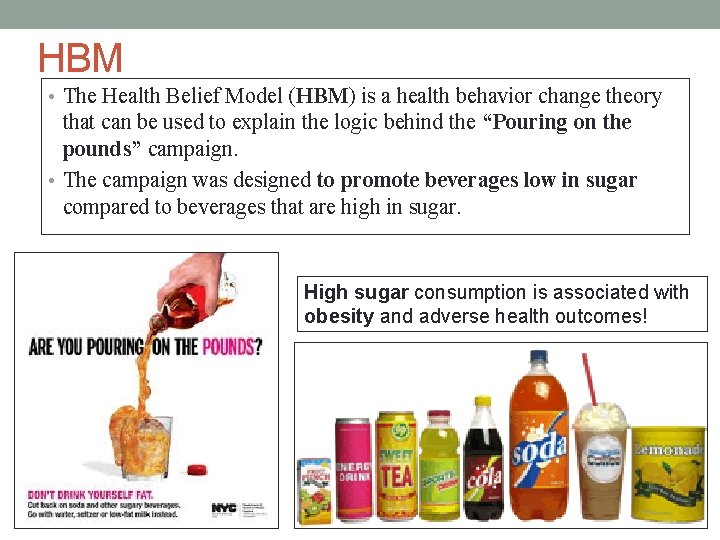
HBM • The Health Belief Model (HBM) is a health behavior change theory that can be used to explain the logic behind the “Pouring on the pounds” campaign. • The campaign was designed to promote beverages low in sugar compared to beverages that are high in sugar. High sugar consumption is associated with obesity and adverse health outcomes!
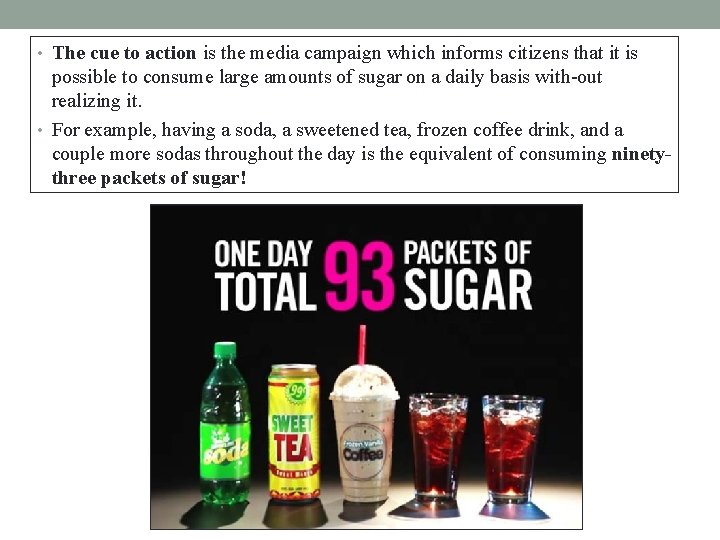
• The cue to action is the media campaign which informs citizens that it is possible to consume large amounts of sugar on a daily basis with-out realizing it. • For example, having a soda, a sweetened tea, frozen coffee drink, and a couple more sodas throughout the day is the equivalent of consuming ninetythree packets of sugar!
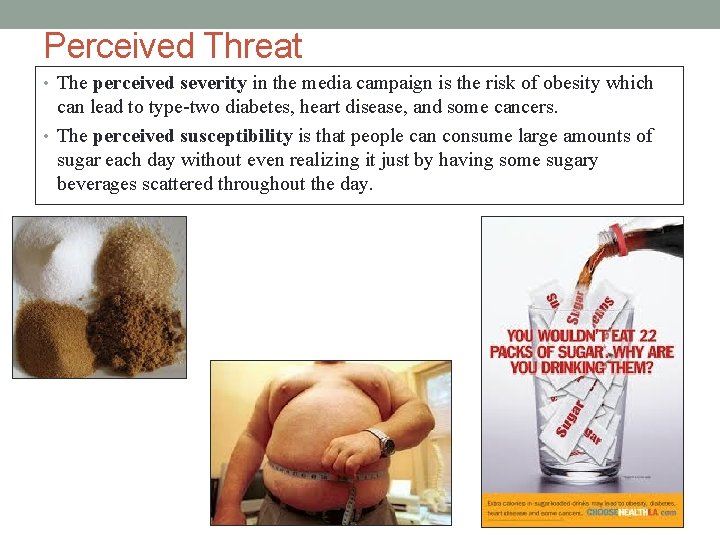
Perceived Threat • The perceived severity in the media campaign is the risk of obesity which can lead to type-two diabetes, heart disease, and some cancers. • The perceived susceptibility is that people can consume large amounts of sugar each day without even realizing it just by having some sugary beverages scattered throughout the day.
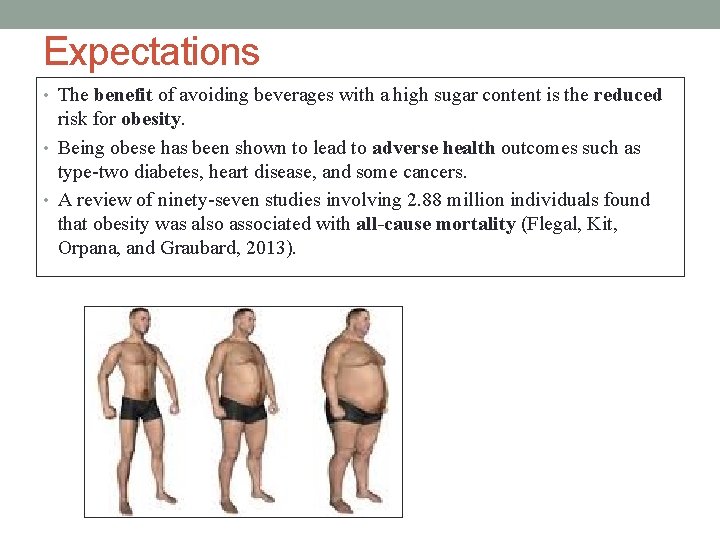
Expectations • The benefit of avoiding beverages with a high sugar content is the reduced risk for obesity. • Being obese has been shown to lead to adverse health outcomes such as type-two diabetes, heart disease, and some cancers. • A review of ninety-seven studies involving 2. 88 million individuals found that obesity was also associated with all-cause mortality (Flegal, Kit, Orpana, and Graubard, 2013).
Benefits – Barriers = ? • The barriers of socioeconomic inequality and the convenient availability of beverages high in sugar are largely absent in the media campaign. • Because self-efficacy is seen as analogous to perceived barriers (Rosenstock, Strecher, and Becker, 1988), it too is largely ignored in the “Pouring on the pounds” campaign.
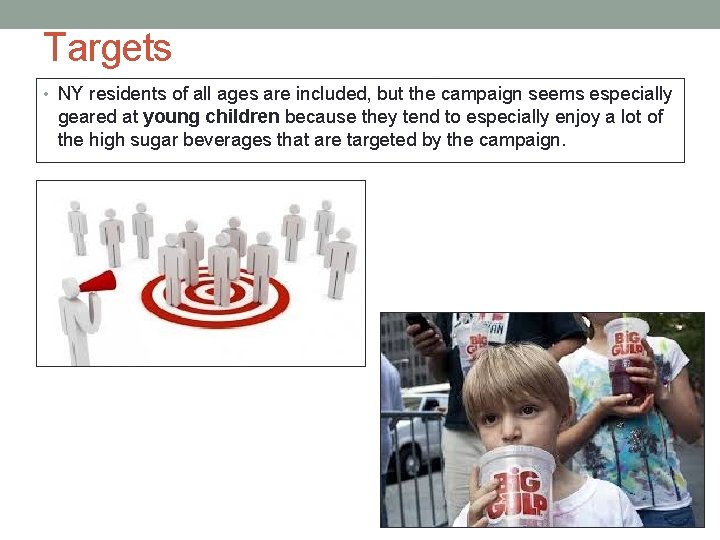
Targets • NY residents of all ages are included, but the campaign seems especially geared at young children because they tend to especially enjoy a lot of the high sugar beverages that are targeted by the campaign.
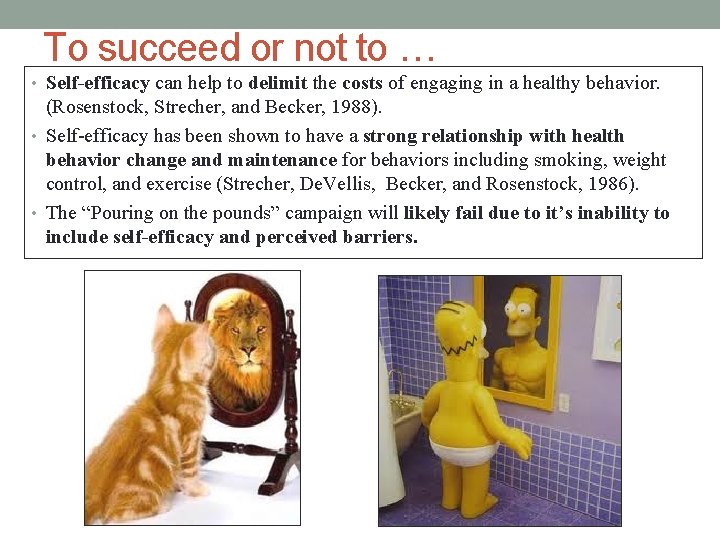
To succeed or not to … • Self-efficacy can help to delimit the costs of engaging in a healthy behavior. (Rosenstock, Strecher, and Becker, 1988). • Self-efficacy has been shown to have a strong relationship with health behavior change and maintenance for behaviors including smoking, weight control, and exercise (Strecher, De. Vellis, Becker, and Rosenstock, 1986). • The “Pouring on the pounds” campaign will likely fail due to it’s inability to include self-efficacy and perceived barriers.
- Slides: 8