
Using the FrailNH and The Rapid Geriatric Assessment
- Slides: 32
Using the Frail-NH and The Rapid Geriatric Assessment (RGA) in Long Term Care
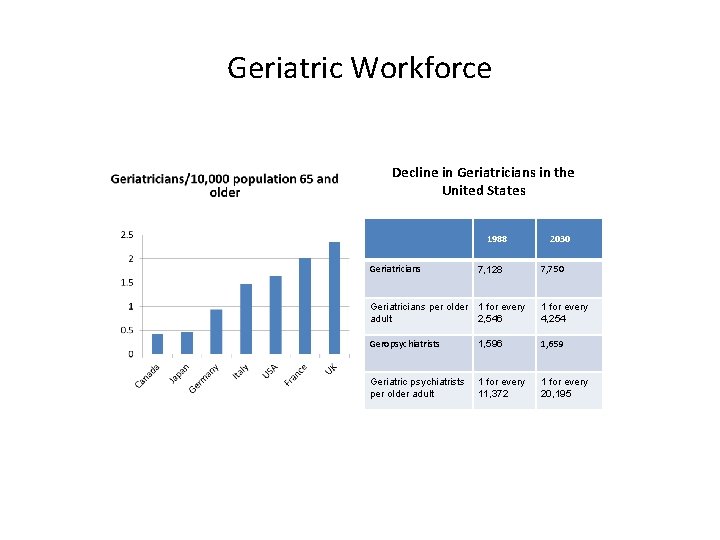
Geriatric Workforce Decline in Geriatricians in the United States 1988 Geriatricians 7, 128 2030 7, 750 Geriatricians per older 1 for every adult 2, 546 1 for every 4, 254 Geropsychiatrists 1, 659 1, 596 Geriatric psychiatrists 1 for every per older adult 11, 372 1 for every 20, 195
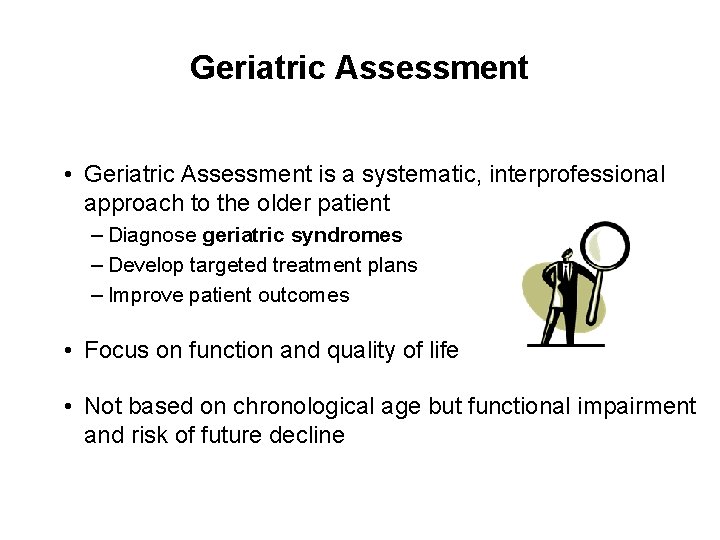
Geriatric Assessment • Geriatric Assessment is a systematic, interprofessional approach to the older patient – Diagnose geriatric syndromes – Develop targeted treatment plans – Improve patient outcomes • Focus on function and quality of life • Not based on chronological age but functional impairment and risk of future decline
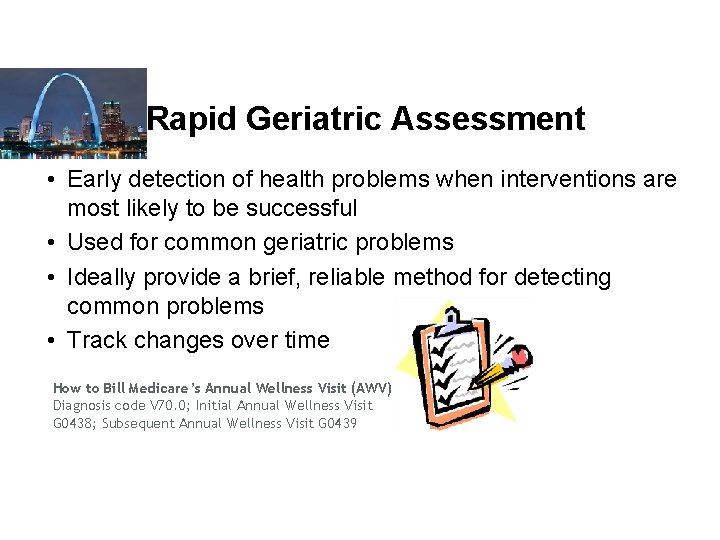
Rapid Geriatric Assessment • Early detection of health problems when interventions are most likely to be successful • Used for common geriatric problems • Ideally provide a brief, reliable method for detecting common problems • Track changes over time How to Bill Medicare’s Annual Wellness Visit (AWV) Diagnosis code V 70. 0; Initial Annual Wellness Visit G 0438; Subsequent Annual Wellness Visit G 0439
Modern Giants of Geriatrics Frailty Sarcopenia Anorexia of Aging MCI
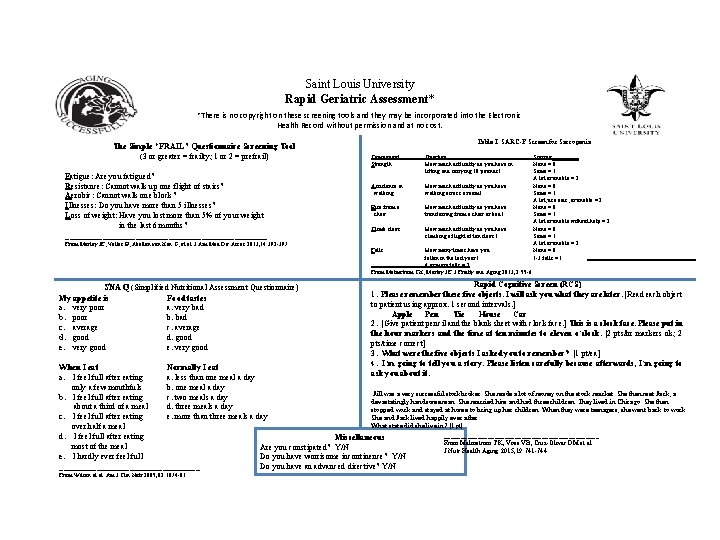
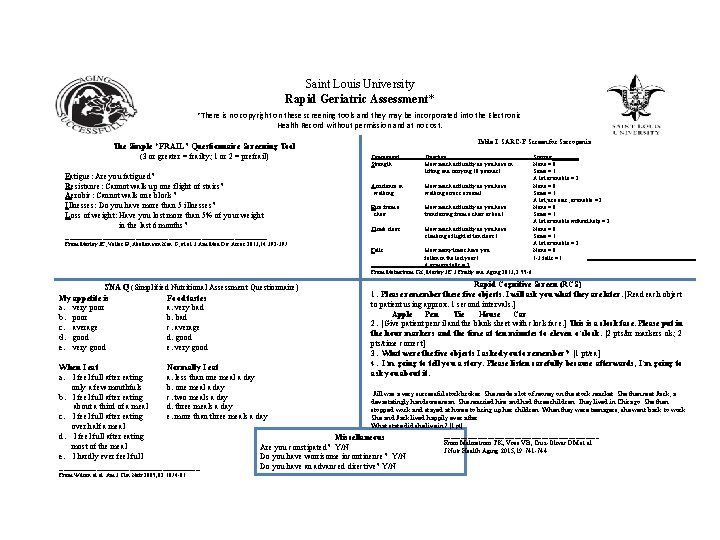
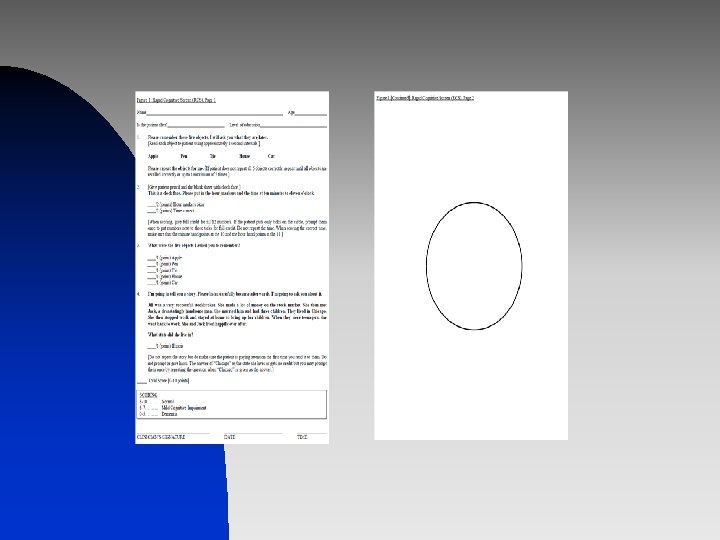
Saint Louis University Rapid Geriatric Assessment* *There is no copyright on these screening tools and they may be incorporated into the Electronic Health Record without permission and at no cost. The Simple “FRAIL” Questionnaire Screening Tool (3 or greater = frailty; 1 or 2 = prefrail) Fatigue: Are you fatigued? Resistance: Cannot walk up one flight of stairs? Aerobic: Cannot walk one block? Illnesses: Do you have more than 5 illnesses? Loss of weight: Have you lost more than 5% of your weight in the last 6 months? _________________________ From Morley JE, Vellas B, Abellan van Kan G, et al. J Am Med Dir Assoc 2013; 14: 392 -397. SNAQ (Simplified Nutritional Assessment Questionnaire) My appetite is a. very poor b. poor c. average d. good e. very good Food tastes a. very bad b. bad c. average d. good e. very good Table I: SARC-F Screen for Sarcopenia Component Strength Question How much difficulty do you have in lifting and carrying 10 pounds? Assistance in walking How much difficulty do you have walking across a room? Rise from a chair How much difficulty do you have transferring from a chair or bed? Climb stairs How much difficulty do you have climbing a flight of ten stairs? Falls Scoring_____ None = 0 Some = 1 A lot or unable = 2 None = 0 Some = 1 A lot, use aids, or unable = 2 None = 0 Some = 1 A lot or unable without help = 2 None = 0 Some = 1 A lot or unable = 2 None = 0 1 -3 falls = 1 How many times have you fallen in the last year? 4 or more falls = 2 From Malmstrom TK, Morley JE. J Frailty and Aging 2013; 2: 55 -6. Rapid Cognitive Screen (RCS) 1. Please remember these five objects. I will ask you what they are later. [Read each object to patient using approx. 1 second intervals. ] Apple Pen Tie House Car 2. [Give patient pencil and the blank sheet with clock face. ] This is a clock face. Please put in the hour markers and the time at ten minutes to eleven o’clock. [2 pts/hr markers ok; 2 pts/time correct] 3. What were the five objects I asked you to remember? [1 pt/ea] 4. I’m going to tell you a story. Please listen carefully because afterwards, I’m going to ask you about it. When I eat Normally I eat a. I feel full after eating a. less than one meal a day only a few mouthfuls b. one meal a day Jill was a very successful stockbroker. She made a lot of money on the stock market. She then met Jack, a b. I feel full after eating c. two meals a day devastatingly handsome man. She married him and had three children. They lived in Chicago. She then about a third of a meal d. three meals a day stopped work and stayed at home to bring up her children. When they were teenagers, she went back to work. c. I feel full after eating e. more than three meals a day She and Jack lived happily ever after. What state did she live in? [1 pt] over half a meal _______________________ d. I feel full after eating Miscellaneous From Malmstrom TK, Voss VB, Cruz-Oliver DM et al. most of the meal Are you constipated? Y/N J Nutr Health Aging 2015; 19: 741 -744. e. I hardly ever feel full Do you have worrisome incontinence? Y/N _________________ Do you have an advanced directive? Y/N From Wilson et al. Am J Clin Nutr 2005; 82: 1074 -81.
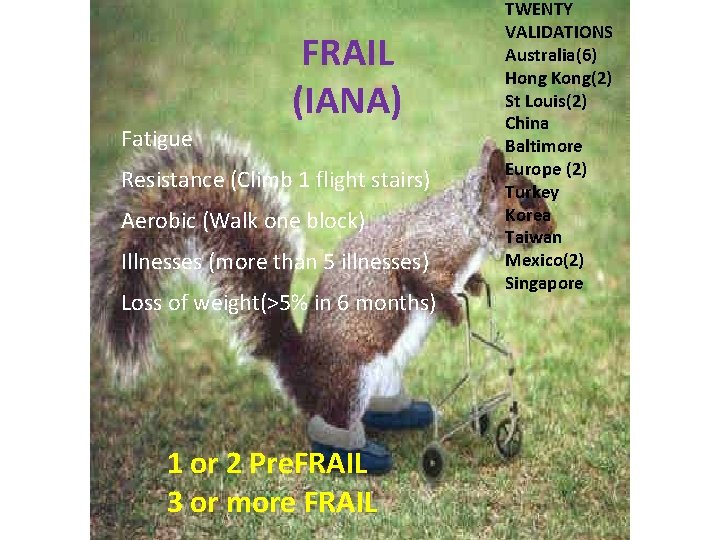
Fatigue FRAIL (IANA) Resistance (Climb 1 flight stairs) Aerobic (Walk one block) Illnesses (more than 5 illnesses) Loss of weight(>5% in 6 months) 1 or 2 Pre. FRAIL 3 or more FRAIL TWENTY VALIDATIONS Australia(6) Hong Kong(2) St Louis(2) China Baltimore Europe (2) Turkey Korea Taiwan Mexico(2) Singapore
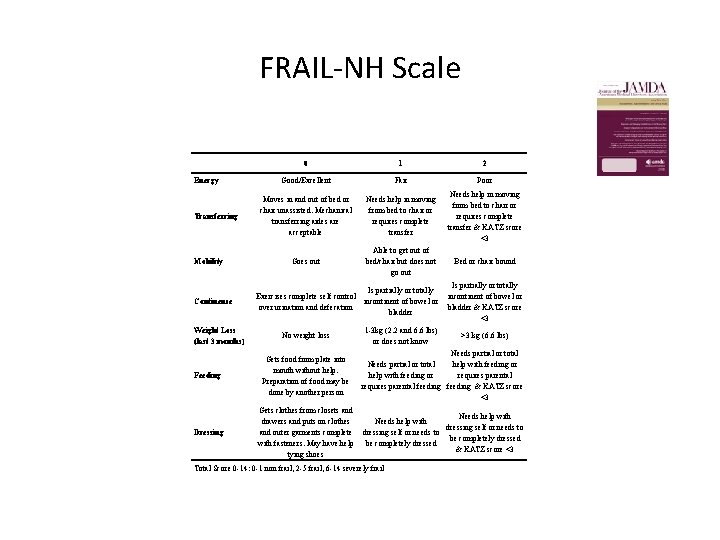
FRAIL-NH Scale Energy Transferring Mobility Continence Weight Loss (last 3 months) Feeding Dressing 0 1 2 Good/Excellent Fair Poor Moves in and out of bed or chair unassisted. Mechanical transferring aides are acceptable Needs help in moving from bed to chair or requires complete transfer & KATZ score <3 Goes out Able to get out of bed/chair but does not go out Bed or chair bound Is partially or totally incontinent of bowel or Exercises complete self control incontinent of bowel or over urination and defecation bladder & KATZ score bladder <3 No weight loss Gets food from plate into mouth without help. Preparation of food may be done by another person 1 -3 kg (2. 2 and 6. 6 lbs) or does not know >3 kg (6. 6 lbs) Needs partial or total help with feeding or requires parental feeding & KATZ score <3 Gets clothes from closets and Needs help with drawers and puts on clothes Needs help with dressing self or needs to and outer garments complete dressing self or needs to be completely dressed with fasteners. May have help be completely dressed & KATZ score <3 tying shoes Total Score 0 -14: 0 -1 non frail, 2 -5 frail, 6 -14 severely frail
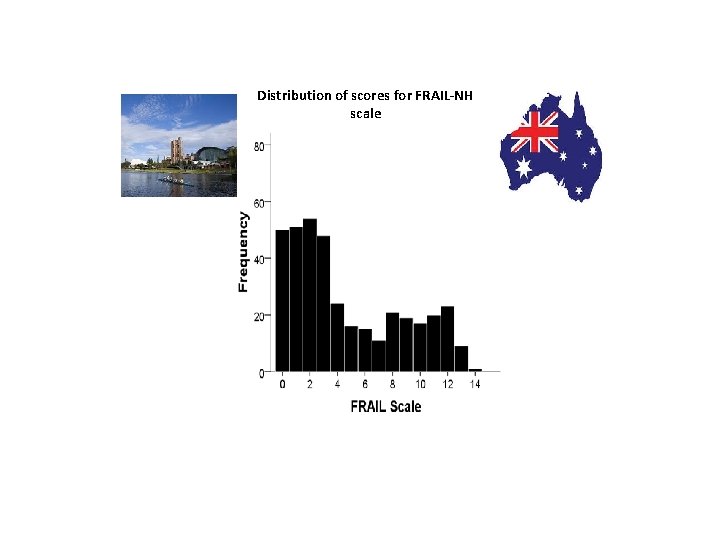
Distribution of scores for FRAIL-NH scale
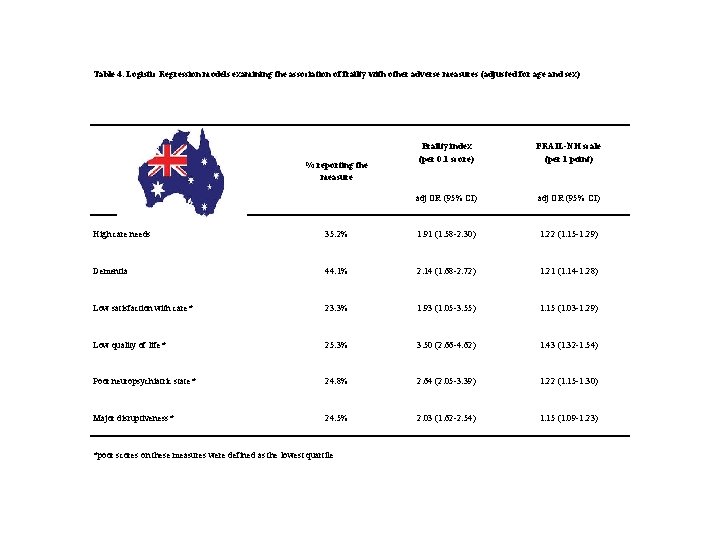
Table 4. Logistic Regression models examining the association of frailty with other adverse measures (adjusted for age and sex) % reporting the measure Frailty index (per 0. 1 score) FRAIL-NH scale (per 1 point) adj OR (95% CI) High care needs 35. 2% 1. 91 (1. 58 -2. 30) 1. 22 (1. 15 -1. 29) Dementia 44. 1% 2. 14 (1. 68 -2. 72) 1. 21 (1. 14 -1. 28) Low satisfaction with care* 23. 3% 1. 93 (1. 05 -3. 55) 1. 15 (1. 03 -1. 29) Low quality of life* 25. 3% 3. 50 (2. 66 -4. 62) 1. 43 (1. 32 -1. 54) Poor neuropsychiatric state* 24. 8% 2. 64 (2. 05 -3. 39) 1. 22 (1. 15 -1. 30) Major disruptiveness* 24. 5% 2. 03 (1. 62 -2. 54) 1. 15 (1. 09 -1. 23) *poor scores on these measures were defined as the lowest quartile
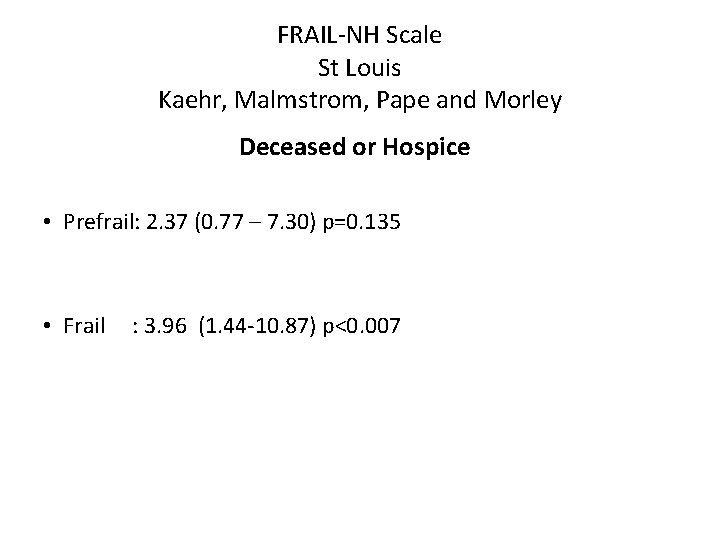
FRAIL-NH Scale St Louis Kaehr, Malmstrom, Pape and Morley Deceased or Hospice • Prefrail: 2. 37 (0. 77 – 7. 30) p=0. 135 • Frail : 3. 96 (1. 44 -10. 87) p<0. 007
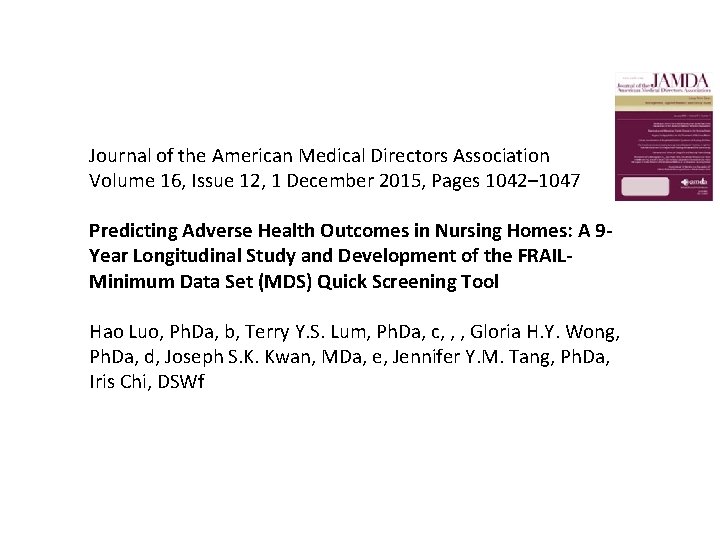
Journal of the American Medical Directors Association Volume 16, Issue 12, 1 December 2015, Pages 1042– 1047 Predicting Adverse Health Outcomes in Nursing Homes: A 9 Year Longitudinal Study and Development of the FRAILMinimum Data Set (MDS) Quick Screening Tool Hao Luo, Ph. Da, b, Terry Y. S. Lum, Ph. Da, c, , , Gloria H. Y. Wong, Ph. Da, d, Joseph S. K. Kwan, MDa, e, Jennifer Y. M. Tang, Ph. Da, Iris Chi, DSWf
Objectives • To examine the predictive validity of a quick frailty screening tool, the FRAIL-NH, for adverse health outcomes in nursing home residents, using variables from the Minimum Data Set (MDS). • The screening items were compiled from the MDS for potential direct application in long-term care facilities using this health information system.
Design Longitudinal follow-up study of nursing home residents with annual clinical assessment using the MDS and mortality data between 2005 and 2013.
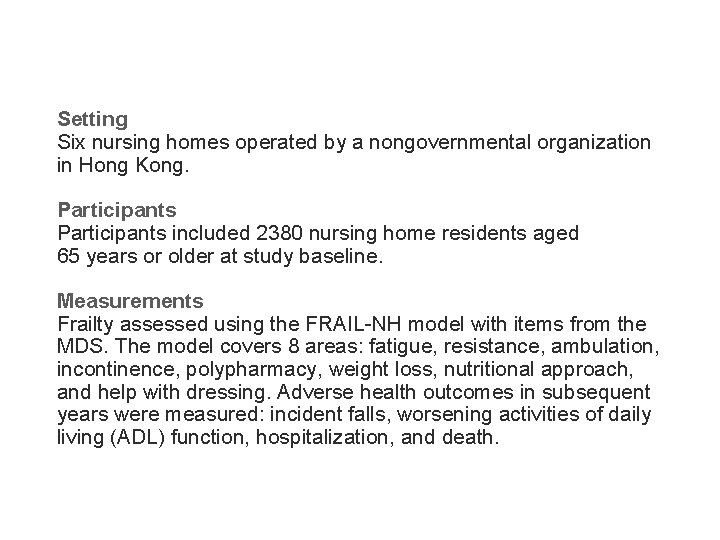
Setting Six nursing homes operated by a nongovernmental organization in Hong Kong. Participants included 2380 nursing home residents aged 65 years or older at study baseline. Measurements Frailty assessed using the FRAIL-NH model with items from the MDS. The model covers 8 areas: fatigue, resistance, ambulation, incontinence, polypharmacy, weight loss, nutritional approach, and help with dressing. Adverse health outcomes in subsequent years were measured: incident falls, worsening activities of daily living (ADL) function, hospitalization, and death.
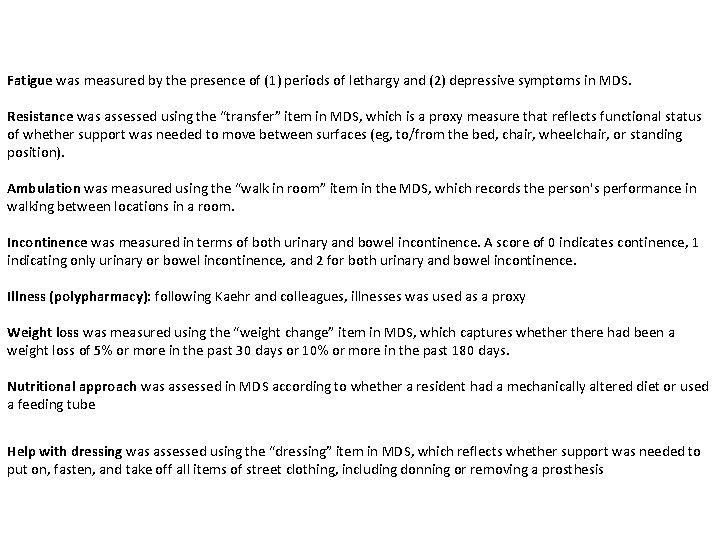
Fatigue was measured by the presence of (1) periods of lethargy and (2) depressive symptoms in MDS. Resistance was assessed using the “transfer” item in MDS, which is a proxy measure that reflects functional status of whether support was needed to move between surfaces (eg, to/from the bed, chair, wheelchair, or standing position). Ambulation was measured using the “walk in room” item in the MDS, which records the person's performance in walking between locations in a room. Incontinence was measured in terms of both urinary and bowel incontinence. A score of 0 indicates continence, 1 indicating only urinary or bowel incontinence, and 2 for both urinary and bowel incontinence. Illness (polypharmacy): following Kaehr and colleagues, illnesses was used as a proxy Weight loss was measured using the “weight change” item in MDS, which captures whethere had been a weight loss of 5% or more in the past 30 days or 10% or more in the past 180 days. Nutritional approach was assessed in MDS according to whether a resident had a mechanically altered diet or used a feeding tube Help with dressing was assessed using the “dressing” item in MDS, which reflects whether support was needed to put on, fasten, and take off all items of street clothing, including donning or removing a prosthesis
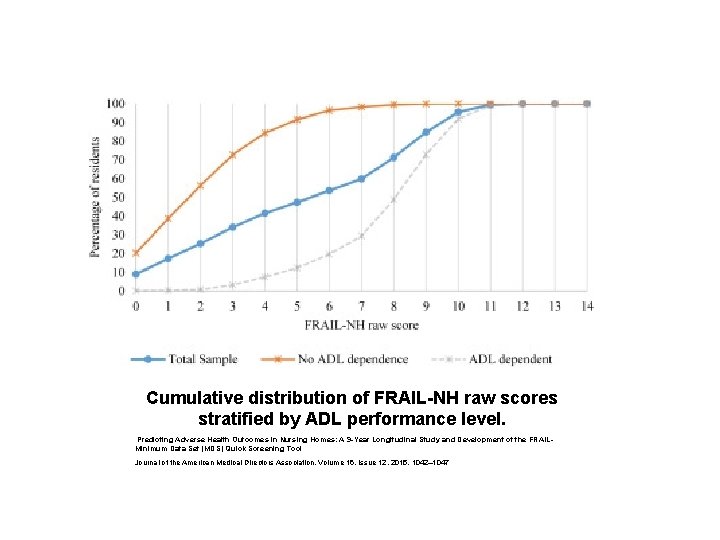
Cumulative distribution of FRAIL-NH raw scores stratified by ADL performance level. Predicting Adverse Health Outcomes in Nursing Homes: A 9 -Year Longitudinal Study and Development of the FRAILMinimum Data Set (MDS) Quick Screening Tool Journal of the American Medical Directors Association, Volume 16, Issue 12, 2015, 1042– 1047
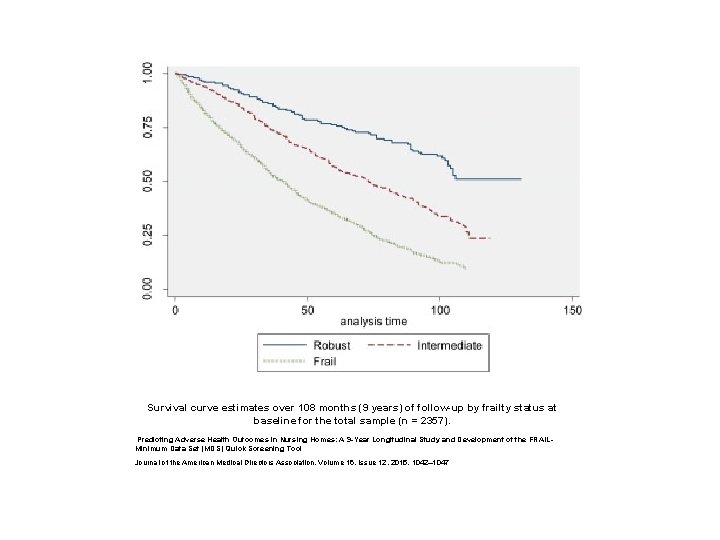
Survival curve estimates over 108 months (9 years) of follow-up by frailty status at baseline for the total sample (n = 2357). Predicting Adverse Health Outcomes in Nursing Homes: A 9 -Year Longitudinal Study and Development of the FRAILMinimum Data Set (MDS) Quick Screening Tool Journal of the American Medical Directors Association, Volume 16, Issue 12, 2015, 1042– 1047
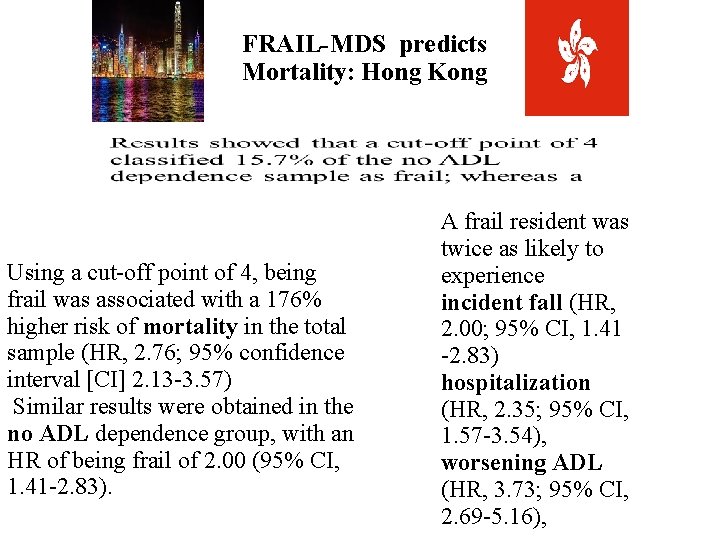
FRAIL-MDS predicts Mortality: Hong Kong Using a cut-off point of 4, being frail was associated with a 176% higher risk of mortality in the total sample (HR, 2. 76; 95% confidence interval [CI] 2. 13 -3. 57) Similar results were obtained in the no ADL dependence group, with an HR of being frail of 2. 00 (95% CI, 1. 41 -2. 83). A frail resident was twice as likely to experience incident fall (HR, 2. 00; 95% CI, 1. 41 -2. 83) hospitalization (HR, 2. 35; 95% CI, 1. 57 -3. 54), worsening ADL (HR, 3. 73; 95% CI, 2. 69 -5. 16),
FRAIL-NH Hong Kong Conclusions • The FRAIL-NH, has been validated with demonstrated predictive power for major adverse health outcomes. • The tool provides a simple solution to identify residents who are at risk of becoming frail, with minimal extra resources required or assessment burden in long-term care facilities using the MDS health information system. • This will allow timely intervention of the potentially reversible target of frailty. • Although it remains an open question as to what extent early indicators of frailty are reversible in a nursing home population, by identifying residents at the highest risk, interventions to prevent poor outcomes can be provided in a timely manner.
Modern Giants of Geriatrics Frailty Sarcopenia Anorexia of Aging MCI
Saint Louis University Rapid Geriatric Assessment* *There is no copyright on these screening tools and they may be incorporated into the Electronic Health Record without permission and at no cost. The Simple “FRAIL” Questionnaire Screening Tool (3 or greater = frailty; 1 or 2 = prefrail) Fatigue: Are you fatigued? Resistance: Cannot walk up one flight of stairs? Aerobic: Cannot walk one block? Illnesses: Do you have more than 5 illnesses? Loss of weight: Have you lost more than 5% of your weight in the last 6 months? _________________________ From Morley JE, Vellas B, Abellan van Kan G, et al. J Am Med Dir Assoc 2013; 14: 392 -397. SNAQ (Simplified Nutritional Assessment Questionnaire) My appetite is a. very poor b. poor c. average d. good e. very good Food tastes a. very bad b. bad c. average d. good e. very good Table I: SARC-F Screen for Sarcopenia Component Strength Question How much difficulty do you have in lifting and carrying 10 pounds? Assistance in walking How much difficulty do you have walking across a room? Rise from a chair How much difficulty do you have transferring from a chair or bed? Climb stairs How much difficulty do you have climbing a flight of ten stairs? Falls Scoring_____ None = 0 Some = 1 A lot or unable = 2 None = 0 Some = 1 A lot, use aids, or unable = 2 None = 0 Some = 1 A lot or unable without help = 2 None = 0 Some = 1 A lot or unable = 2 None = 0 1 -3 falls = 1 How many times have you fallen in the last year? 4 or more falls = 2 From Malmstrom TK, Morley JE. J Frailty and Aging 2013; 2: 55 -6. Rapid Cognitive Screen (RCS) 1. Please remember these five objects. I will ask you what they are later. [Read each object to patient using approx. 1 second intervals. ] Apple Pen Tie House Car 2. [Give patient pencil and the blank sheet with clock face. ] This is a clock face. Please put in the hour markers and the time at ten minutes to eleven o’clock. [2 pts/hr markers ok; 2 pts/time correct] 3. What were the five objects I asked you to remember? [1 pt/ea] 4. I’m going to tell you a story. Please listen carefully because afterwards, I’m going to ask you about it. When I eat Normally I eat a. I feel full after eating a. less than one meal a day only a few mouthfuls b. one meal a day Jill was a very successful stockbroker. She made a lot of money on the stock market. She then met Jack, a b. I feel full after eating c. two meals a day devastatingly handsome man. She married him and had three children. They lived in Chicago. She then about a third of a meal d. three meals a day stopped work and stayed at home to bring up her children. When they were teenagers, she went back to work. c. I feel full after eating e. more than three meals a day She and Jack lived happily ever after. What state did she live in? [1 pt] over half a meal _______________________ d. I feel full after eating Miscellaneous From Malmstrom TK, Voss VB, Cruz-Oliver DM et al. most of the meal Are you constipated? Y/N J Nutr Health Aging 2015; 19: 741 -744. e. I hardly ever feel full Do you have worrisome incontinence? Y/N _________________ Do you have an advanced directive? Y/N From Wilson et al. Am J Clin Nutr 2005; 82: 1074 -81.
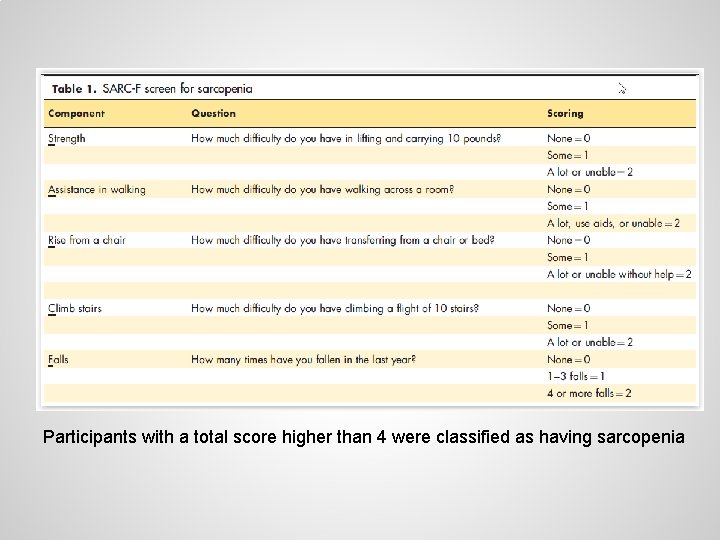
Participants with a total score higher than 4 were classified as having sarcopenia
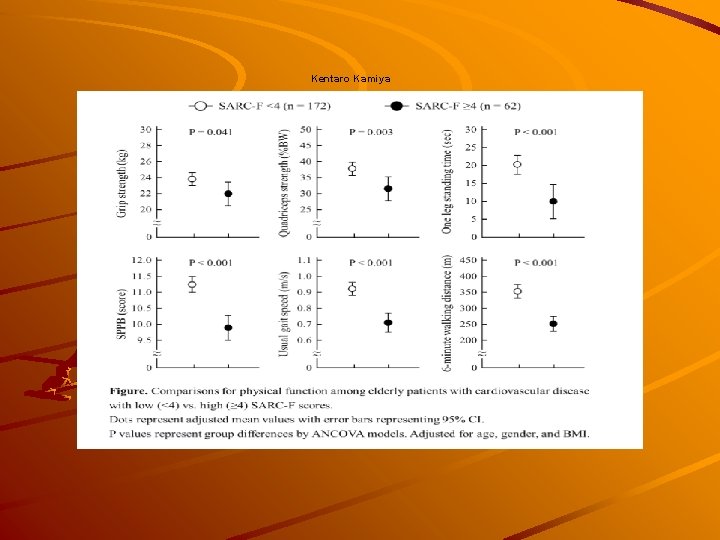
Kentaro Kamiya
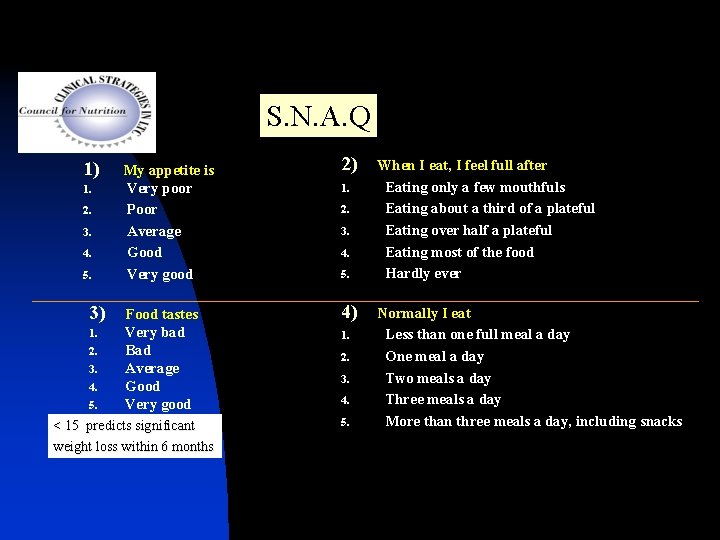
S. N. A. Q 1) 1. 2. 3. 4. 5. 3) 1. 2. 3. 4. 5. My appetite is Very poor Poor Average Good Very good Food tastes Very bad Bad Average Good Very good < 15 predicts significant weight loss within 6 months 2) 1. 2. 3. 4. 5. 4) 1. 2. 3. 4. 5. When I eat, I feel full after Eating only a few mouthfuls Eating about a third of a plateful Eating over half a plateful Eating most of the food Hardly ever Normally I eat Less than one full meal a day One meal a day Two meals a day Three meals a day More than three meals a day, including snacks
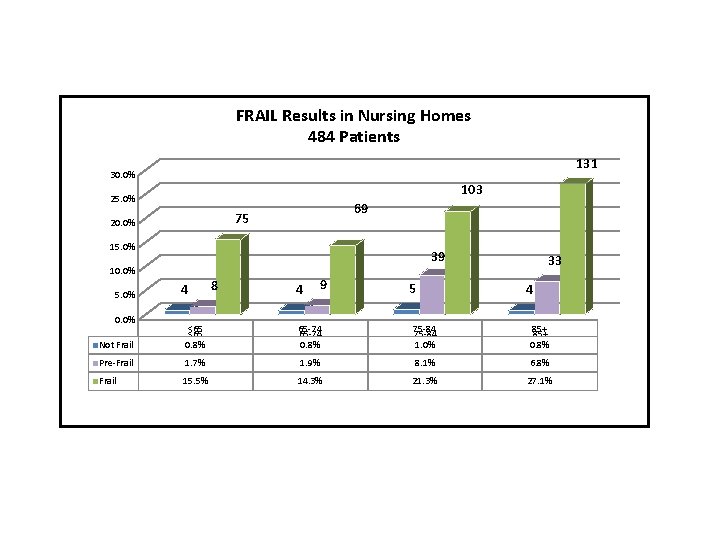
FRAIL Results in Nursing Homes 484 Patients 131 30. 0% 103 25. 0% 69 75 20. 0% 15. 0% 39 10. 0% 5. 0% 0. 0% 4 8 4 9 5 33 4 Not Frail <65 0. 8% 65 -74 0. 8% 75 -84 1. 0% 85+ 0. 8% Pre-Frail 1. 7% 1. 9% 8. 1% 6. 8% Frail 15. 5% 14. 3% 21. 3% 27. 1%
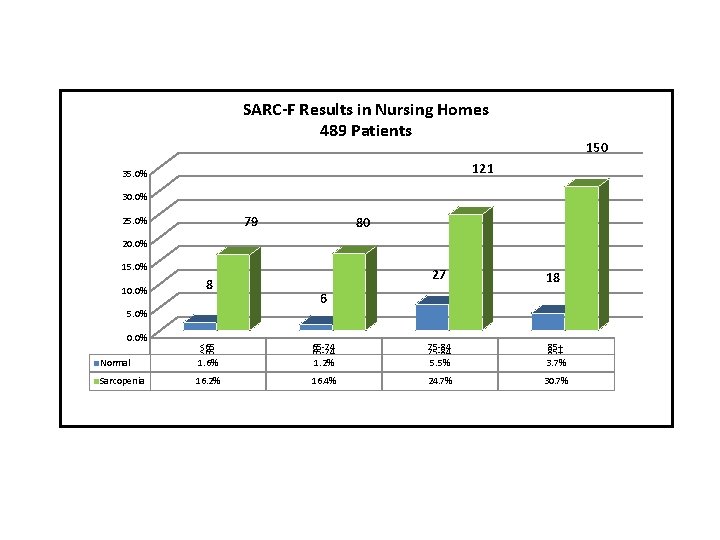
SARC-F Results in Nursing Homes 489 Patients 150 121 35. 0% 30. 0% 79 25. 0% 80 20. 0% 15. 0% 10. 0% 8 27 18 6 5. 0% 0. 0% Normal <65 1. 6% 65 -74 1. 2% 75 -84 5. 5% 85+ 3. 7% Sarcopenia 16. 2% 16. 4% 24. 7% 30. 7%
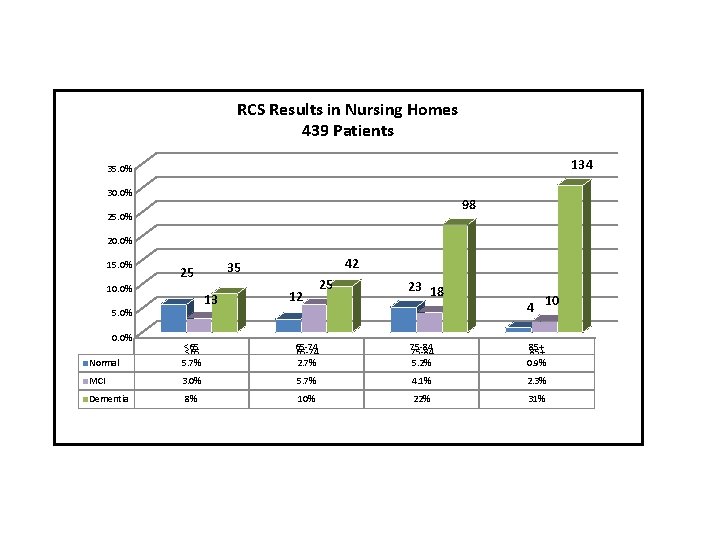
RCS Results in Nursing Homes 439 Patients 134 35. 0% 30. 0% 98 25. 0% 20. 0% 15. 0% 10. 0% 13 5. 0% 0. 0% 42 35 25 12 25 23 18 4 10 Normal <65 5. 7% 65 -74 2. 7% 75 -84 5. 2% 85+ 0. 9% MCI 3. 0% 5. 7% 4. 1% 2. 3% 8% 10% 22% 31% Dementia
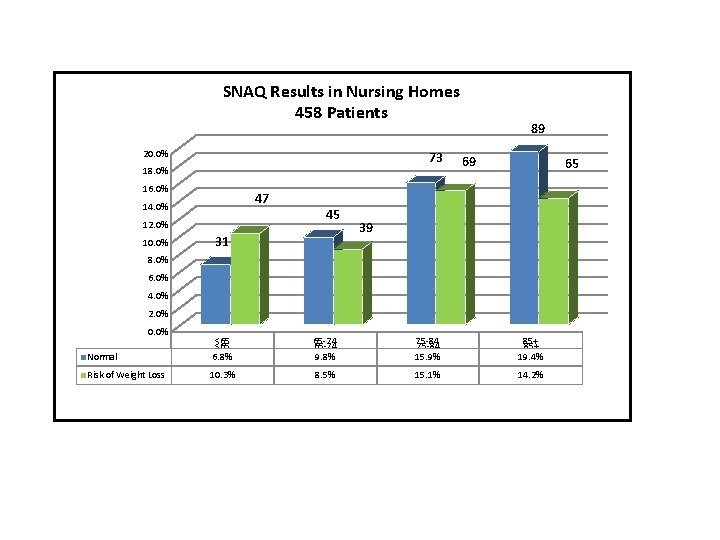
SNAQ Results in Nursing Homes 458 Patients 20. 0% 73 18. 0% 16. 0% 47 14. 0% 12. 0% 10. 0% 45 31 89 69 65 39 8. 0% 6. 0% 4. 0% 2. 0% 0. 0% Normal <65 6. 8% 65 -74 9. 8% 75 -84 15. 9% 85+ 19. 4% Risk of Weight Loss 10. 3% 8. 5% 15. 1% 14. 2%
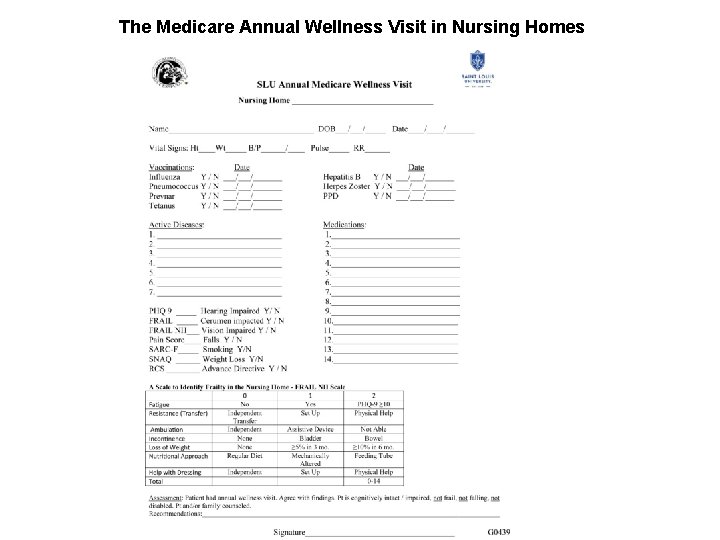
The Medicare Annual Wellness Visit in Nursing Homes
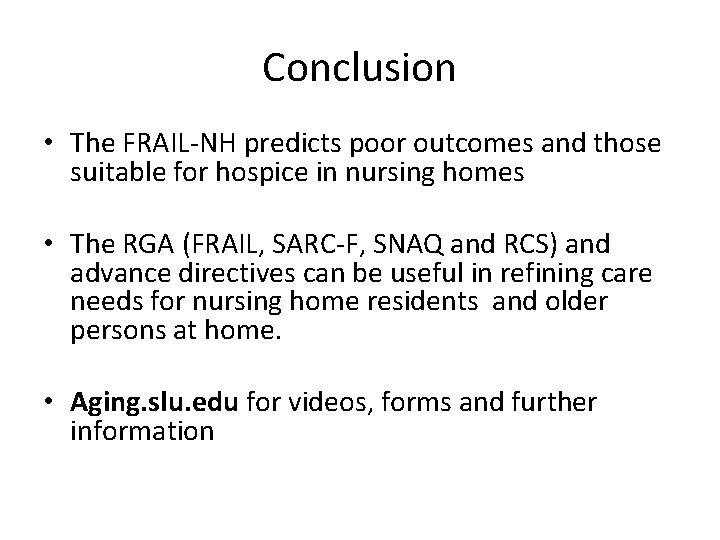
Conclusion • The FRAIL-NH predicts poor outcomes and those suitable for hospice in nursing homes • The RGA (FRAIL, SARC-F, SNAQ and RCS) and advance directives can be useful in refining care needs for nursing home residents and older persons at home. • Aging. slu. edu for videos, forms and further information