
Using the Experiential Learning Model to Transform an
- Slides: 18
Using the Experiential Learning Model to Transform an Engineering Thermodynamics Class Margaret Bailey, Ph. D. , P. E. (Assoc. Prof. ) John R. Chambers (4 th Year ME BS/MS) Rochester Institute of Technology Kate Gleason College of Engineering Mechanical Engineering Department 34 th ASEE/IEEE Frontiers In Education Conference T 2 F-1
Presentation Outline • • • RIT Description Experiential Learning @ RIT Classroom Learning Aids Course Assessment Conclusions, Acknowledgements, and Questions 34 th ASEE/IEEE Frontiers In Education Conference T 2 F-1
Rochester Institute of Technology • Kate Gleason College of Engineering (KGCOE) – 5 Departments – Ranked 6 th in Nation among non-Ph. D. (2002 U. S. News & Word Report) • RIT Enrollment – Fall 2003 - 2004 15, 334 – RIT Undergraduate 12, 994 (KGCOE: 1992) – RIT Graduate 2, 340 (KGCOE: 367) • RIT Academic Degrees – Certificate, Diploma, AAS, AOS, AS, BFA, BS, ACERT, MBA, ME, MFA, MST, Ph. D • Department of Mechanical Engineering • KGCOE Co-op Requirement 34 th ASEE/IEEE Frontiers In Education Conference T 2 F-1
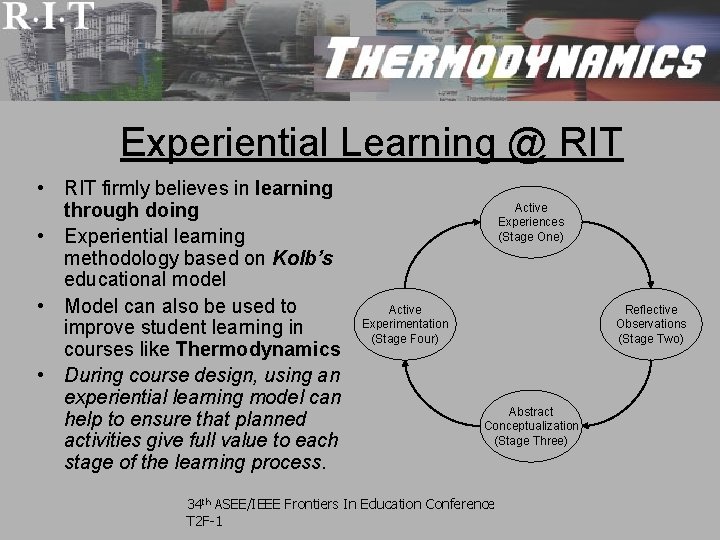
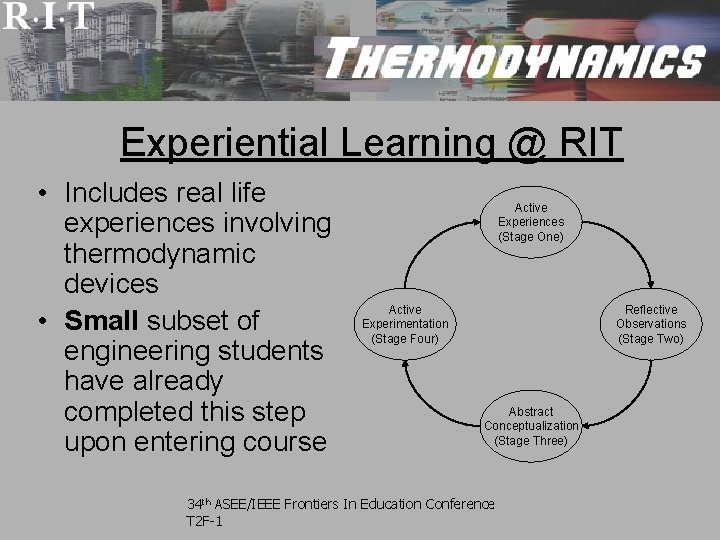
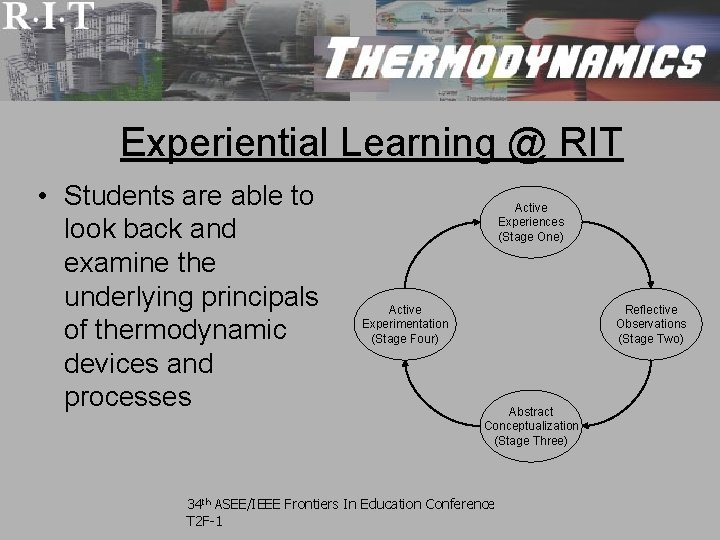
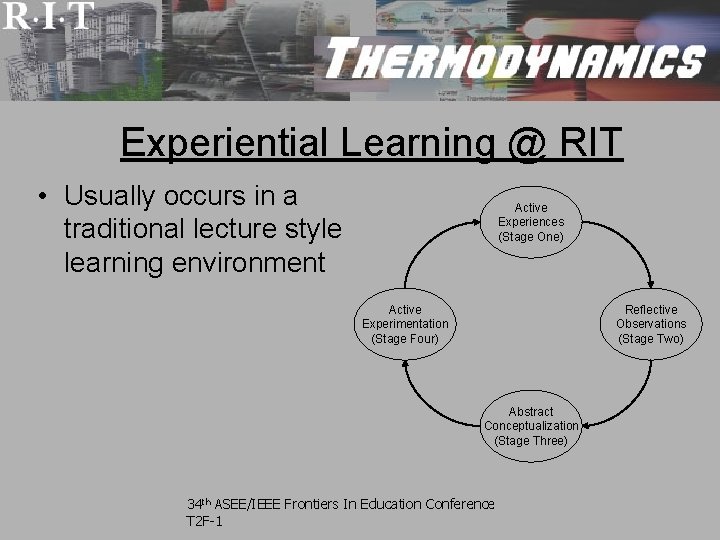
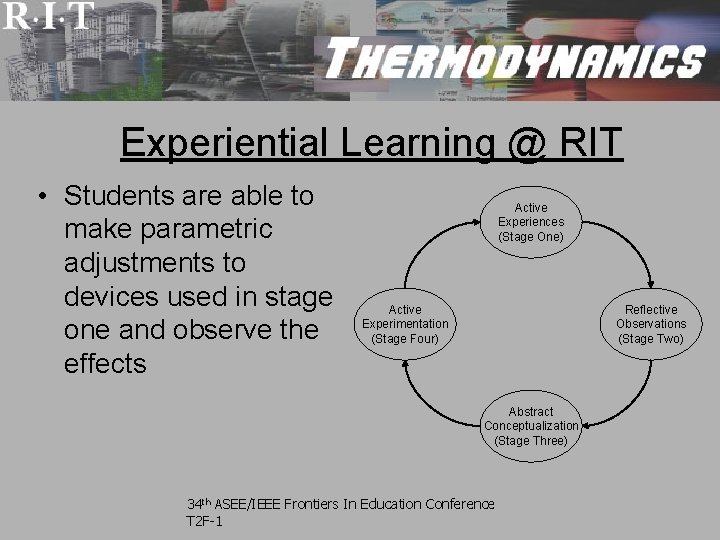
Experiential Learning @ RIT • RIT firmly believes in learning through doing • Experiential learning methodology based on Kolb’s educational model • Model can also be used to improve student learning in courses like Thermodynamics • During course design, using an experiential learning model can help to ensure that planned activities give full value to each stage of the learning process. Active Experiences (Stage One) Active Experimentation (Stage Four) Reflective Observations (Stage Two) Abstract Conceptualization (Stage Three) 34 th ASEE/IEEE Frontiers In Education Conference T 2 F-1
Experiential Learning @ RIT • Includes real life experiences involving thermodynamic devices • Small subset of engineering students have already completed this step upon entering course Active Experiences (Stage One) Active Experimentation (Stage Four) Reflective Observations (Stage Two) Abstract Conceptualization (Stage Three) 34 th ASEE/IEEE Frontiers In Education Conference T 2 F-1
Experiential Learning @ RIT • Students are able to look back and examine the underlying principals of thermodynamic devices and processes Active Experiences (Stage One) Active Experimentation (Stage Four) Reflective Observations (Stage Two) Abstract Conceptualization (Stage Three) 34 th ASEE/IEEE Frontiers In Education Conference T 2 F-1
Experiential Learning @ RIT • Usually occurs in a traditional lecture style learning environment Active Experiences (Stage One) Active Experimentation (Stage Four) Reflective Observations (Stage Two) Abstract Conceptualization (Stage Three) 34 th ASEE/IEEE Frontiers In Education Conference T 2 F-1
Experiential Learning @ RIT • Students are able to make parametric adjustments to devices used in stage one and observe the effects Active Experiences (Stage One) Active Experimentation (Stage Four) Reflective Observations (Stage Two) Abstract Conceptualization (Stage Three) 34 th ASEE/IEEE Frontiers In Education Conference T 2 F-1
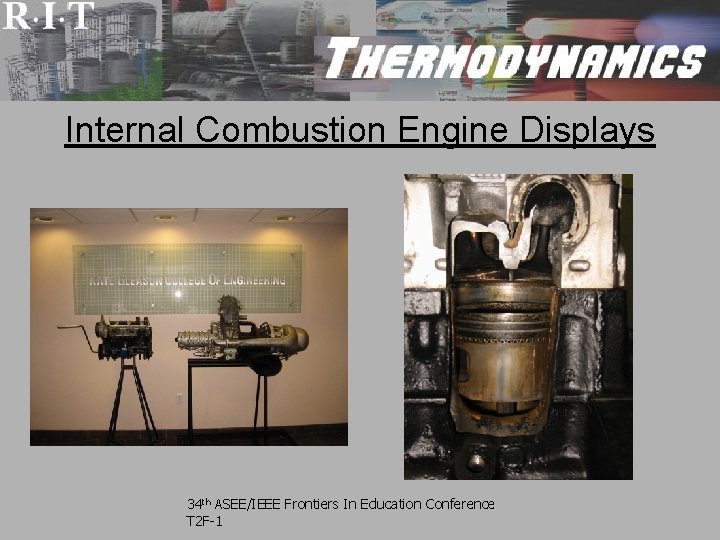
Classroom Learning Aids • Computer Simulation Packages and Available Animations – Auto Insight – Engineering Equation Solver (EES) – Example(s) of animations and clips available on the web (contact Authors for more detailed listings) • Physical Device Examples – – Absolute vs. Gage Pressure Set-Up Vacuum Boiling Bottle V 6 Chrysler Engine Gas Turbine Engine 34 th ASEE/IEEE Frontiers In Education Conference T 2 F-1
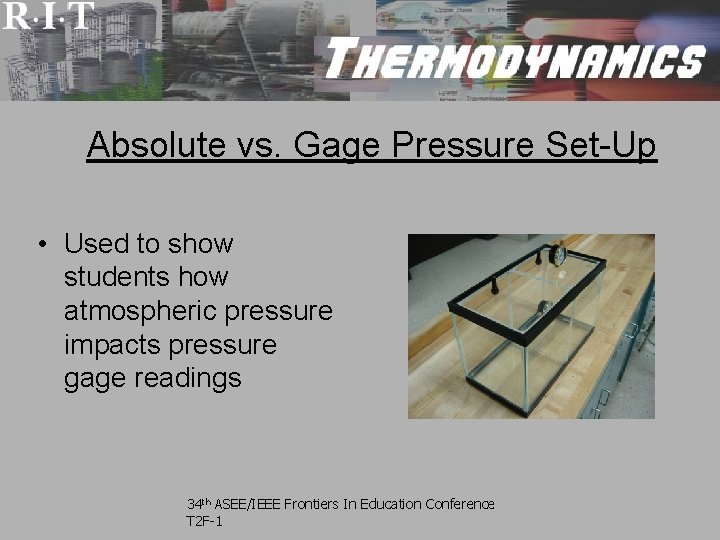
Absolute vs. Gage Pressure Set-Up • Used to show students how atmospheric pressure impacts pressure gage readings 34 th ASEE/IEEE Frontiers In Education Conference T 2 F-1
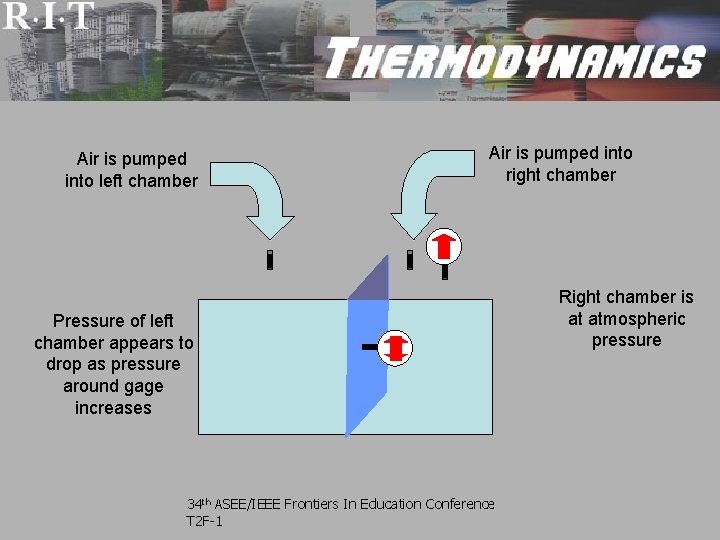
Air is pumped into left chamber Air is pumped into right chamber Pressure of left chamber appears to drop as pressure around gage increases 34 th ASEE/IEEE Frontiers In Education Conference T 2 F-1 Right chamber is at atmospheric pressure
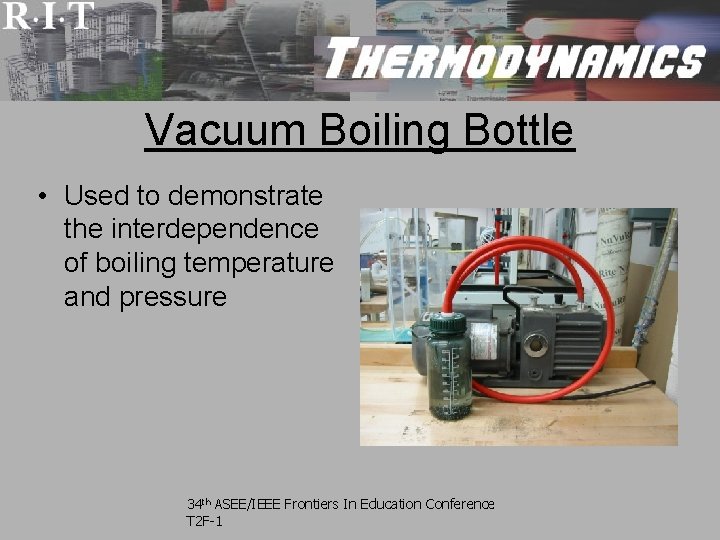
Vacuum Boiling Bottle • Used to demonstrate the interdependence of boiling temperature and pressure 34 th ASEE/IEEE Frontiers In Education Conference T 2 F-1
Internal Combustion Engine Displays 34 th ASEE/IEEE Frontiers In Education Conference T 2 F-1
Course Assessment • Course Learning Objectives: – Apply conservation of mass, conservation of energy, and the second law of thermodynamics to open and closed systems. – Apply thermodynamic properties and equations of state for an ideal gas, steam, and refrigerants. – Analyze the common ideal power generation cycles including the Rankine, Otto, Diesel, Brayton and their respective actual cycles. – Analyze the ideal and actual vapor compression refrigeration cycle. – Relate principles learned in thermodynamics with emerging technologies, cycles, and processes. – Improve engineering problem solving abilities. 34 th ASEE/IEEE Frontiers In Education Conference T 2 F-1
Course End Evaluation • Through course end student evaluation and review of written comments, the course appears to be achieving its learning objectives • Standard Course End Evaluation – Questions regarding the quality and effectiveness of the instructor, clarity of the course objectives, consistency of lesson preparation, adequacy of textbook, etc. – 2003 fall quarter class / 20 students – Overall course rating: 4. 64/5. 00 (highest among all courses taught within the ME department during the fall quarter of 2003) • In a separate survey, students were asked to assess their competency in achieving the course objectives. – Overall result: 4. 8/5. 0 34 th ASEE/IEEE Frontiers In Education Conference T 2 F-1
Conclusions • Course-end feedback results from experiential learning based course show improvements over the same course taught in previous quarters using the more traditional lecture style. Because of professor variance, a direct comparison is not included. • Future efforts to improve Thermo @ RIT 34 th ASEE/IEEE Frontiers In Education Conference T 2 F-1
Acknowledgements • Kate Gleason Endowment Fund • Mechanical Engineering Department Machine Shop Staff and Admin Staff • Mr. Richard T. Chambers 34 th ASEE/IEEE Frontiers In Education Conference T 2 F-1
Questions Author Contact Info: Margaret Bailey, mbbeme@rit. edu John Chambers, jrc 6353@rit. edu 34 th ASEE/IEEE Frontiers In Education Conference T 2 F-1