
Using the e Portfolio as an Student Learning
- Slides: 14
Using the e. Portfolio as an Student Learning Assessment Tool Dr. Debra A. Buchanan Associate Vice President Office of Academic Affairs and Student Life 2009 -10
What is an E-Portfolio? • A purposeful collection of student work that exhibits the efforts, progress, and achievements in one or more areas. • A virtual collection of student work 2
Why Use the e. Portfolio? • Pedagogical change in higher education, with greater emphasis on studentcentered active learning • Enhances users’ technological capacity as they become more proficient users of software and other tools • Demands for accountability in higher education • Transition between employment and education – “an education passport” that allows students to showcase or demonstrate their learning and transfer it to their professional career (i. e. integrative learning) • Flexibility (i. e. can be used for various purposes such as enriched learning, career development, and assessment, to name a few) 3
Who uses e-Portfolio Info? • Current students • Course instructors • Prospective students • Experiential learning sites • Prospective employers • Graduate school admissions committees and faculty • Professional organizations • Alumni • Grantors 4
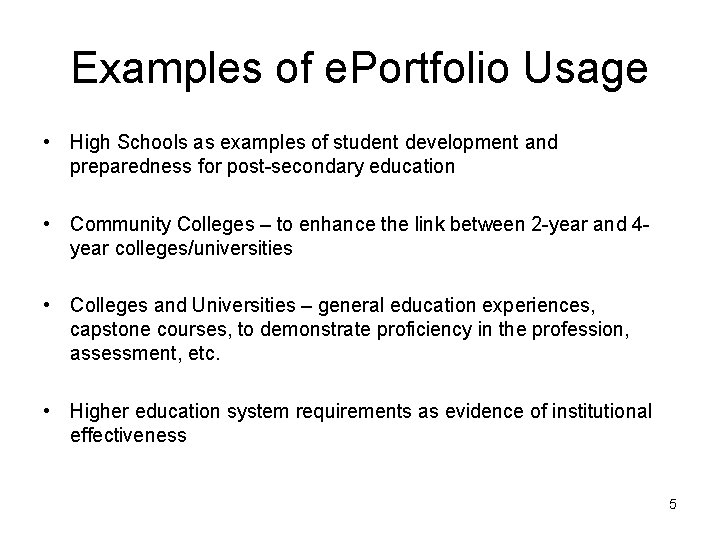
Examples of e. Portfolio Usage • High Schools as examples of student development and preparedness for post-secondary education • Community Colleges – to enhance the link between 2 -year and 4 year colleges/universities • Colleges and Universities – general education experiences, capstone courses, to demonstrate proficiency in the profession, assessment, etc. • Higher education system requirements as evidence of institutional effectiveness 5
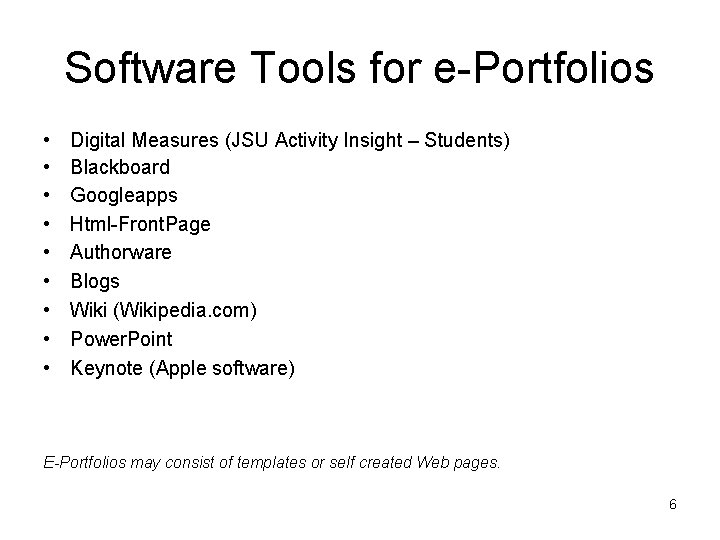
Software Tools for e-Portfolios • • • Digital Measures (JSU Activity Insight – Students) Blackboard Googleapps Html-Front. Page Authorware Blogs Wiki (Wikipedia. com) Power. Point Keynote (Apple software) E-Portfolios may consist of templates or self created Web pages. 6
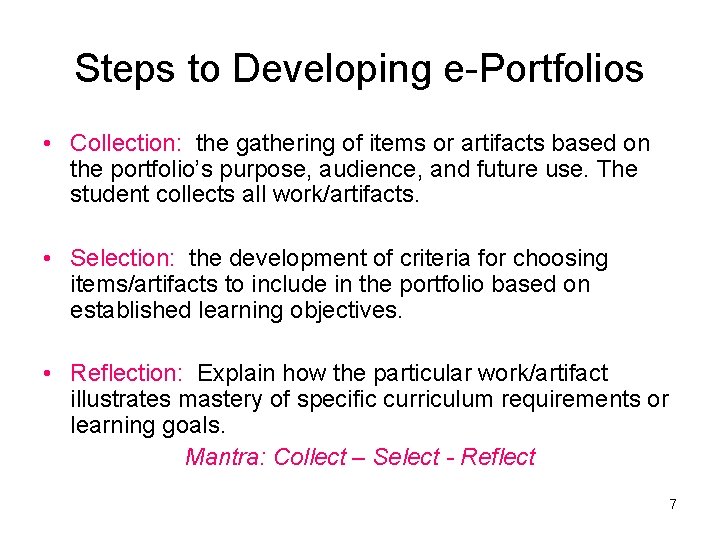
Steps to Developing e-Portfolios • Collection: the gathering of items or artifacts based on the portfolio’s purpose, audience, and future use. The student collects all work/artifacts. • Selection: the development of criteria for choosing items/artifacts to include in the portfolio based on established learning objectives. • Reflection: Explain how the particular work/artifact illustrates mastery of specific curriculum requirements or learning goals. Mantra: Collect – Select - Reflect 7
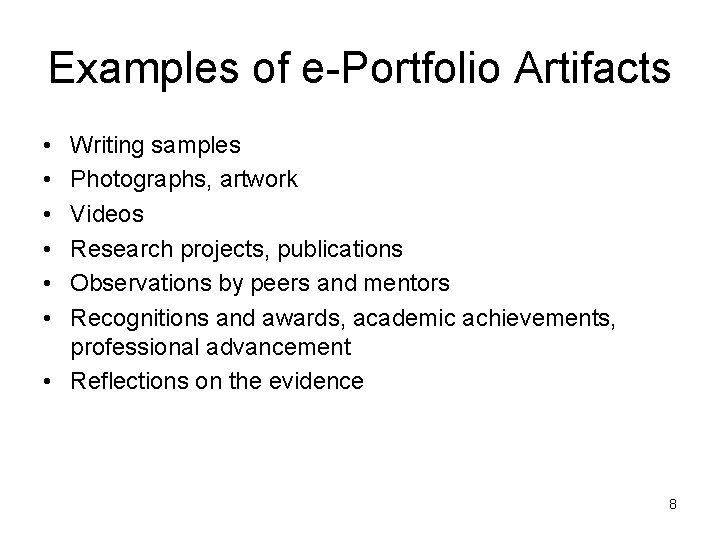
Examples of e-Portfolio Artifacts • • • Writing samples Photographs, artwork Videos Research projects, publications Observations by peers and mentors Recognitions and awards, academic achievements, professional advancement • Reflections on the evidence 8
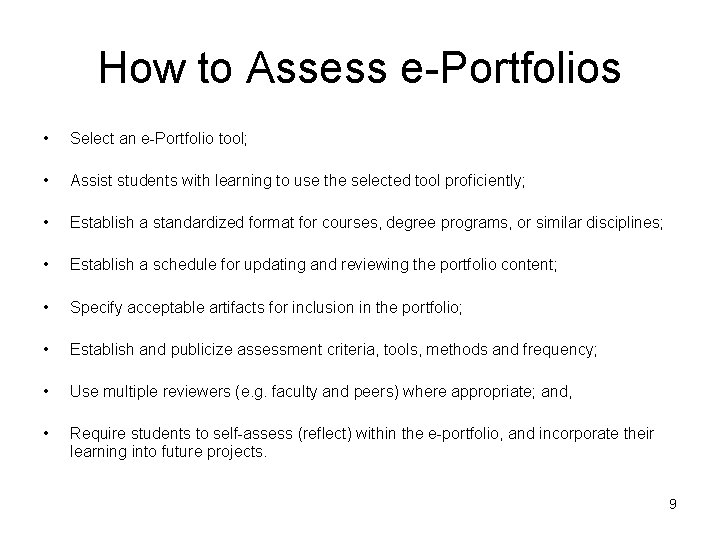
How to Assess e-Portfolios • Select an e-Portfolio tool; • Assist students with learning to use the selected tool proficiently; • Establish a standardized format for courses, degree programs, or similar disciplines; • Establish a schedule for updating and reviewing the portfolio content; • Specify acceptable artifacts for inclusion in the portfolio; • Establish and publicize assessment criteria, tools, methods and frequency; • Use multiple reviewers (e. g. faculty and peers) where appropriate; and, • Require students to self-assess (reflect) within the e-portfolio, and incorporate their learning into future projects. 9
Closing Comments This presentation is intended to serve as an introduction to the use of the e-portfolio as an assessment tool. The following sample sites demonstrate how other colleges and universities are currently using this exciting tool. 10
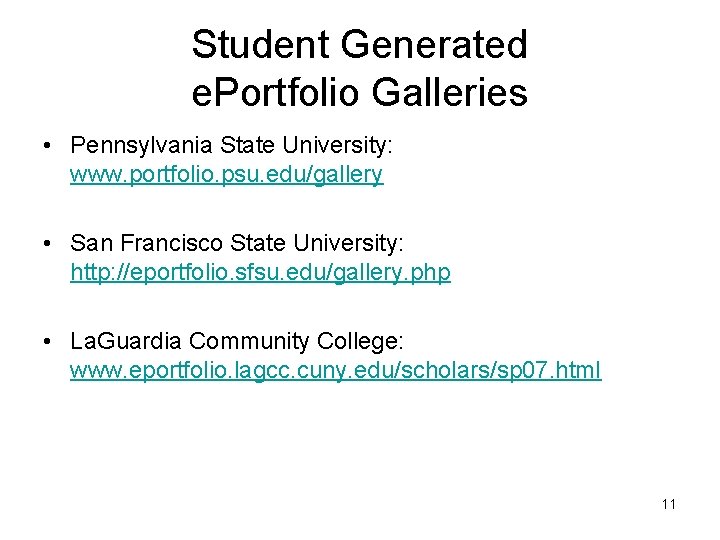
Student Generated e. Portfolio Galleries • Pennsylvania State University: www. portfolio. psu. edu/gallery • San Francisco State University: http: //eportfolio. sfsu. edu/gallery. php • La. Guardia Community College: www. eportfolio. lagcc. cuny. edu/scholars/sp 07. html 11
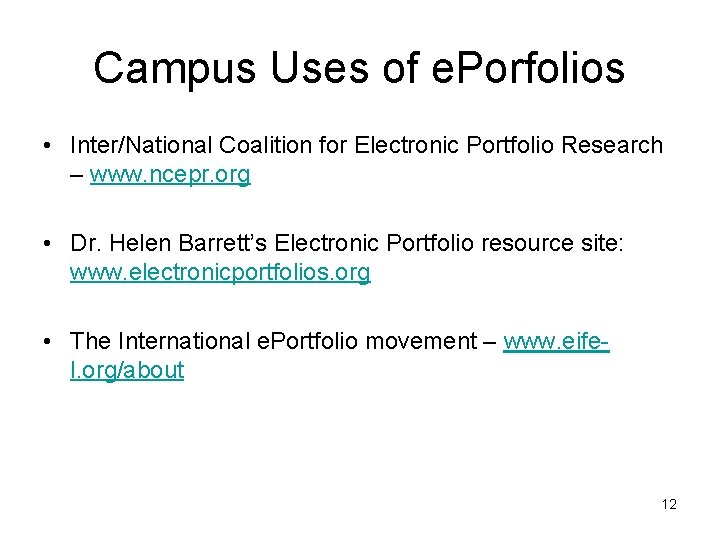
Campus Uses of e. Porfolios • Inter/National Coalition for Electronic Portfolio Research – www. ncepr. org • Dr. Helen Barrett’s Electronic Portfolio resource site: www. electronicportfolios. org • The International e. Portfolio movement – www. eifel. org/about 12
Campus Uses of e. Porfolios • IUPUI Assessment Conference – www. planning. iupui. edu/conferences/nationalco nf. html • Minnesota e. Portfolio project – www. efoliominnesota. com • California State Universities e. Portfolio project – http: //teachingcommons. cdl. edu/eportfolio/index. html • Spelman College http: //www. spelman. edu/spelfolio/forfacultytutorials. shtml 13
References Association of American Colleges and Universities, Valid Assessment of Learning in Undergraduate Education (VALUE) Project, 2009. Brown, Mary Daniels. Electronic Portfolios in the K-12 Classroom. Education Technology Center, 2002 http: //www. educationworld. com/a_tech/tech 111. shtml Clark, J. Elizabeth. E-portfolios at 2. 0 – Surveying the Field. AAC&U, Peer Review, Winter 2009. Gathercoal, Paul, et al. Web-Based Electronic Portfolios, EDUCAUSE Quarterly, No. 2, 2002, pp. 29 -37. White, Mary, et al. The E-Portfolio: An Assessment Tool for Institutional Effectiveness. A presentation during Assessment Spotlight, Jackson State University, October 27, 2009. 14