
Using the CMMI to Improve Contract Management Presented

- Slides: 19
Using the CMMI to Improve Contract Management Presented By: Gary Gumpright November 20, 2003
Outline • DCMA Overview • Why Focus on Process for Contract Management • The DCMA Environment • Benefits of CMMI for DCMA • Conceptual CMMI-Based Contract Management Framework • Sample Outputs • Benefits of DCMA’s CMMI Methodology 2
DCMA Overview • Independent combat support agency within Do. D • Contract manager for US Do. D & other Federal Agencies • Responsible for ensuring Federal acquisition programs, supplies, and services are delivered on time, within cost and meets performance requirements • Provides direct service on Do. D contracts at Contract Management Offices (CMOs) throughout CONUS and Overseas 3
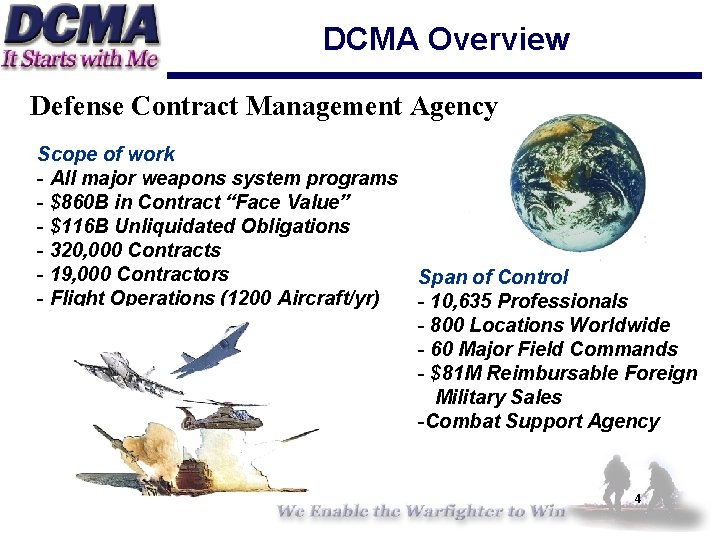
DCMA Overview Defense Contract Management Agency Scope of work - All major weapons system programs - $860 B in Contract “Face Value” - $116 B Unliquidated Obligations - 320, 000 Contracts - 19, 000 Contractors Span of Control - Flight Operations (1200 Aircraft/yr) - 10, 635 Professionals - 800 Locations Worldwide - 60 Major Field Commands - $81 M Reimbursable Foreign Military Sales -Combat Support Agency 4
Why Focus on Process for Contract Management • Process is a major determinant of future program Cost, Schedule and Technical performance • Process information (both process capability and process adherence) provides a leading indicator of future program performance shortfalls So why not use (aka Risk) process information as part of an integrated contract surveillance approach? 5
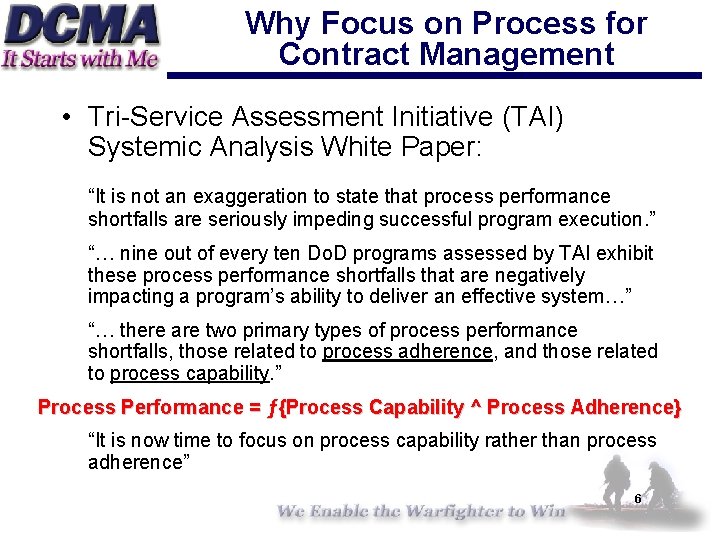
Why Focus on Process for Contract Management • Tri-Service Assessment Initiative (TAI) Systemic Analysis White Paper: “It is not an exaggeration to state that process performance shortfalls are seriously impeding successful program execution. ” “… nine out of every ten Do. D programs assessed by TAI exhibit these process performance shortfalls that are negatively impacting a program’s ability to deliver an effective system…” “… there are two primary types of process performance shortfalls, those related to process adherence, and those related to process capability. ” Process Performance = ƒ{Process Capability ^ Process Adherence} “It is now time to focus on process capability rather than process adherence” 6
The DCMA Environment • DCMA is not the “typical” CMMI user – Responsible for oversight NOT development • Not seeking a benchmark “Maturity Level” • Primary goal is risk management and predictive analysis. • CMMI as a tool to aid contract surveillance – Risk identification, handling and monitoring – Aid Variance Analysis – Support Predictive Analysis • Independent of supplier’s Process Improvement efforts (e. g. CMM, CMMI, etc) • Need to maintain delicate balance between “process” and “product” 7
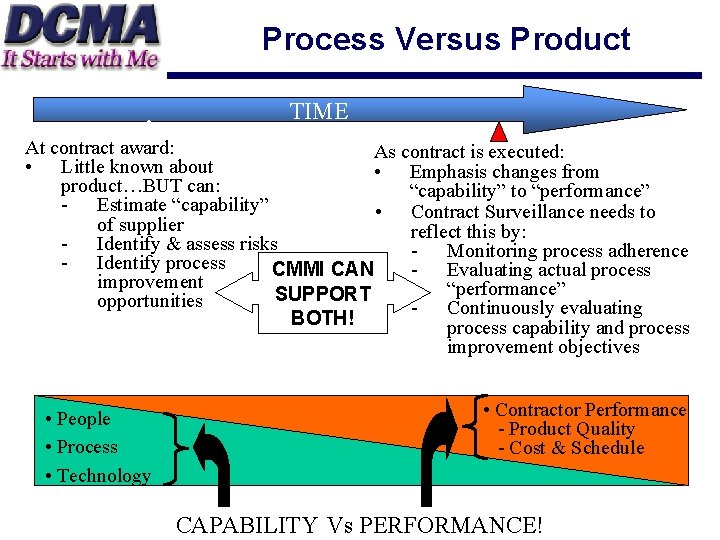
Process Versus Product TIME At contract award: As contract is executed: • Little known about • Emphasis changes from product…BUT can: “capability” to “performance” - Estimate “capability” • Contract Surveillance needs to of supplier reflect this by: - Identify & assess risks - Monitoring process adherence - Identify process - Evaluating actual process CMMI CAN improvement “performance” SUPPORT opportunities - Continuously evaluating BOTH! process capability and process improvement objectives • People • Process • Technology • Contractor Performance - Product Quality - Cost & Schedule 8 CAPABILITY Vs PERFORMANCE!
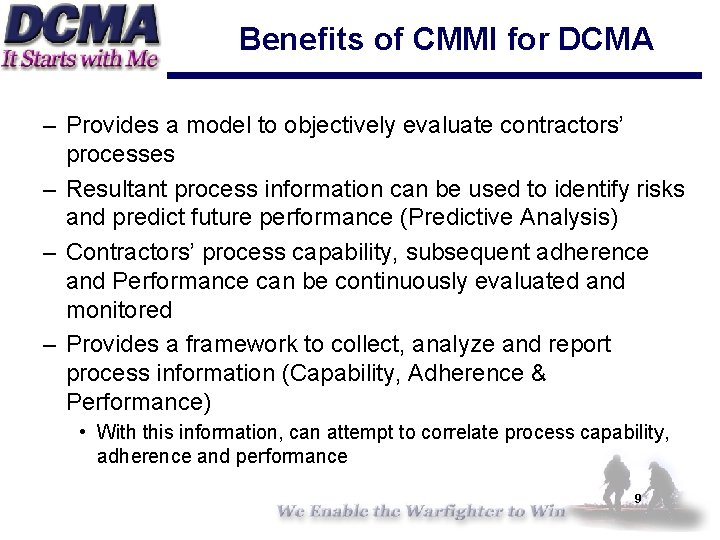
Benefits of CMMI for DCMA – Provides a model to objectively evaluate contractors’ processes – Resultant process information can be used to identify risks and predict future performance (Predictive Analysis) – Contractors’ process capability, subsequent adherence and Performance can be continuously evaluated and monitored – Provides a framework to collect, analyze and report process information (Capability, Adherence & Performance) • With this information, can attempt to correlate process capability, adherence and performance 9
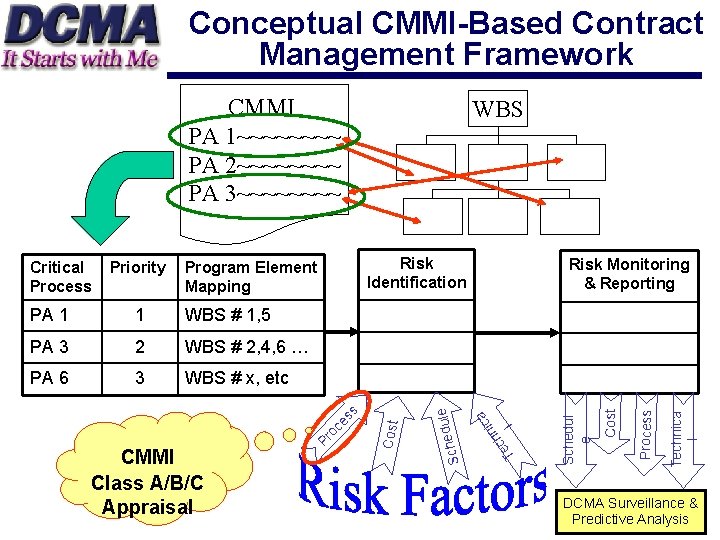
Conceptual CMMI-Based Contract Management Framework CMMI PA 1~~~~ PA 2~~~~ PA 3~~~~ 3 WBS # x, etc Pr oc CMMI Class A/B/C Appraisal Technica l PA 6 Process WBS # 2, 4, 6 … Cost 2 Schedul e PA 3 a WBS # 1, 5 Risk Monitoring & Reporting nic h c Te l 1 es s PA 1 dule Risk Identification Program Element Mapping Sche Priority Cost Critical Process WBS 10 DCMA Surveillance & Predictive Analysis
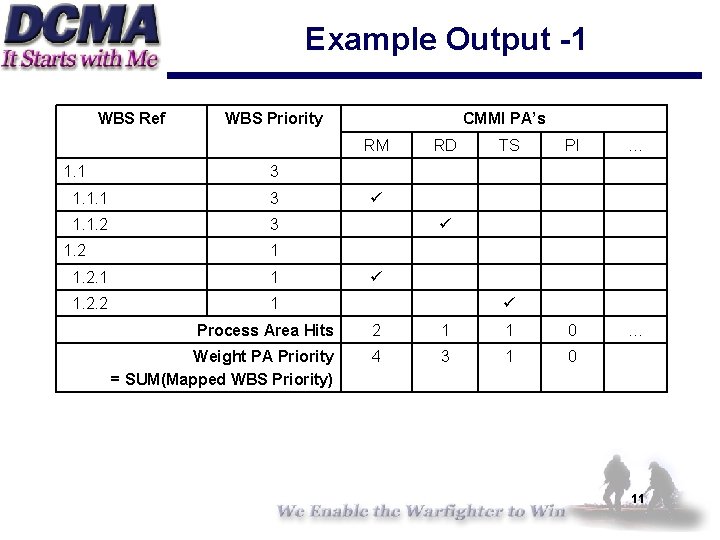
Example Output -1 WBS Ref WBS Priority CMMI PA’s RM 1. 1 TS PI … … 3 1. 1. 1 3 1. 1. 2 3 1. 2 RD 1 1. 2. 1 1 1. 2. 2 1 Process Area Hits 2 1 1 0 Weight PA Priority = SUM(Mapped WBS Priority) 4 3 1 0 11
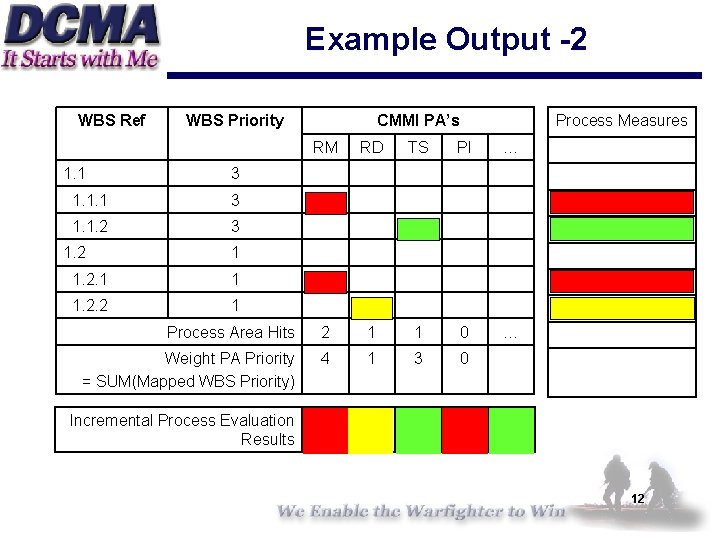
Example Output -2 WBS Ref WBS Priority CMMI PA’s RM 1. 1 TS PI … … 3 1. 1. 1 3 1. 1. 2 3 1. 2 RD Process Measures 1 1. 2. 1 1 1. 2. 2 1 Process Area Hits 2 1 1 0 Weight PA Priority = SUM(Mapped WBS Priority) 4 1 3 0 Incremental Process Evaluation Results 12
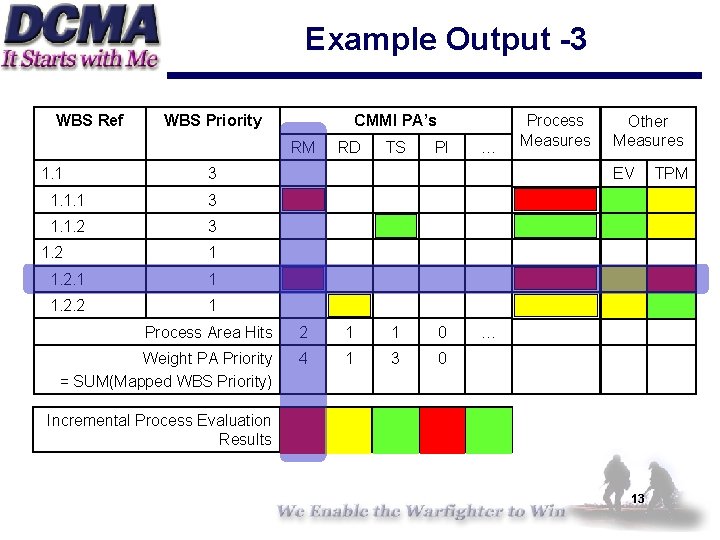
Example Output -3 WBS Ref WBS Priority CMMI PA’s RM 1. 1 TS PI … 3 1. 1. 1 3 1. 1. 2 3 1. 2 RD Process Measures Other Measures EV 1 1. 2. 1 1 1. 2. 2 1 Process Area Hits 2 1 1 0 Weight PA Priority = SUM(Mapped WBS Priority) 4 1 3 0 … Incremental Process Evaluation Results 13 TPM
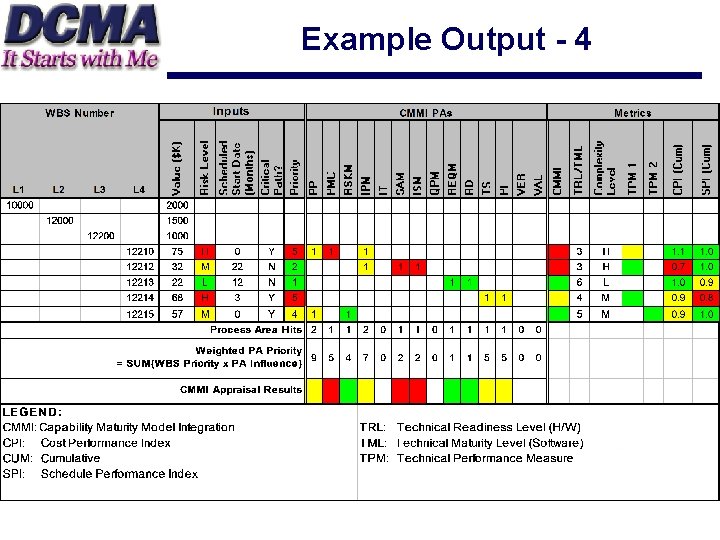
Example Output - 4 14
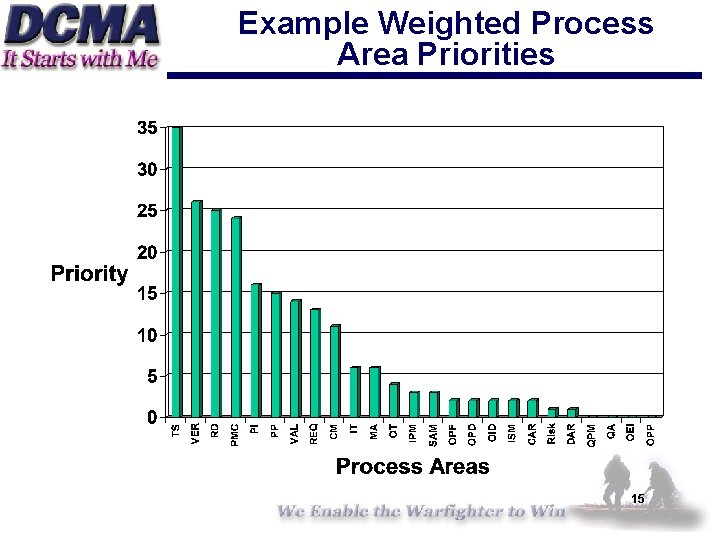
Example Weighted Process Area Priorities 15
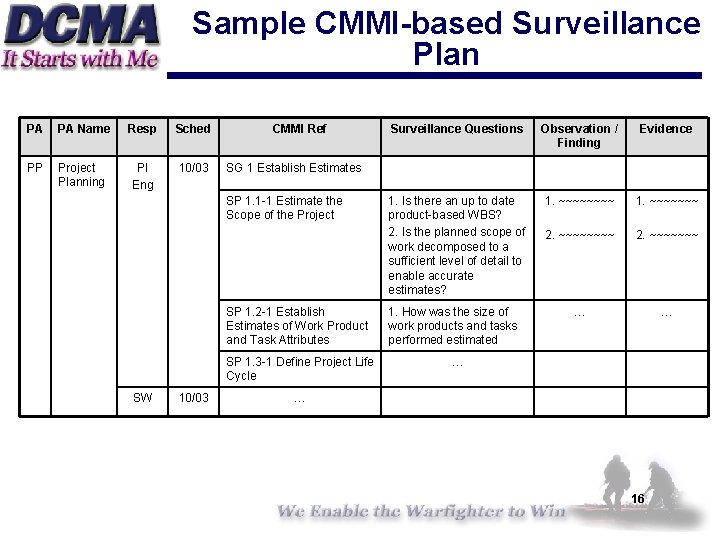
Sample CMMI-based Surveillance Plan PA PA Name Resp Sched PP Project Planning PI Eng 10/03 CMMI Ref SP 1. 2 -1 Establish Estimates of Work Product and Task Attributes SP 1. 3 -1 Define Project Life Cycle 10/03 Observation / Finding Evidence 1. Is there an up to date product-based WBS? 2. Is the planned scope of work decomposed to a sufficient level of detail to enable accurate estimates? 1. ~~~~~~~ 2. ~~~~~~~ … … SG 1 Establish Estimates SP 1. 1 -1 Estimate the Scope of the Project SW Surveillance Questions 1. How was the size of work products and tasks performed estimated … … 16
Benefits of DCMA’s CMMI Methodology – Aligns process surveillance and relates process capability to program objectives – More efficient use of resources by targeting effort on the higher priority processes – Process information is integrated with other key measures (such as EV, TPMs etc) – Improved program insight through analysis of process capability and its impact on future program performance (Risk) – Helps remove “Maturity Level Blinders” 17
Questions 18
Contact Information Gary Gumpright (617) 753 4130 gary. gumpright@dcma. mil Kathy Lundeen (703) 428 1830 kathy. lundeen@dcma. mil Matt Ashford (703) 428 1167 matt. ashford@dcma. mil Agency: www. dcma. mil 19