
Using the Building Blocks Model to Provide Specially
Using the Building Blocks Model to Provide Specially Designed Instruction in Inclusive Preschool Classrooms Ilene Schwartz University of Washington Ilene@uw. edu

Great resources on Head Start Center on Inclusion Website • http: //depts. washington. edu/hscenter/
Building Blocks • Educational practices • Designed to help teachers include and teach young children with disabilities and other special needs
Why Building Blocks? • To understand how teachers and teams create early childhood classrooms that enable all children to participate, interact and learn important and valued outcomes. • To understand what practices work in everyday classrooms. • To understand the instructional strategies needed to provide inclusive settings
Big Questions… • What does inclusion mean? • Individuals define inclusion differently. • Inclusion is about belonging and participating in a diverse society. • What does it mean for a young child to be successful in an early childhood classroom? • Sense of belonging • Genuine child learning • Opportunities to build friendships
Using the Building Blocks model can help all children participate, learn, and thrive in their classrooms.
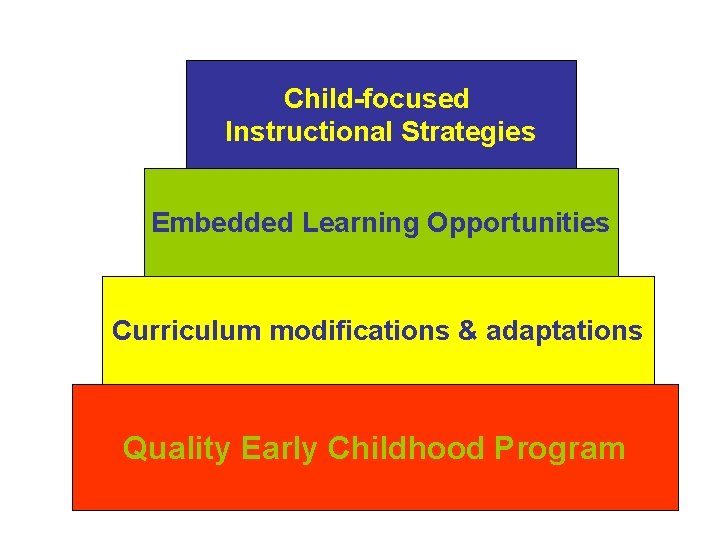
Child-focused Instructional Strategies Embedded Learning Opportunities Curriculum modifications & adaptations Quality Early Childhood Program
What is SDI • SDIs are important to help children with disabilities participate fully with their typical peers • SDI's fall into two categories: accommodations and modifications. Some people use the terms interchangeably, but legally they are not the same.
Accommodations • These are changes in the way in which the child is treated in order to best accommodate the child's physical, cognitive or emotional challenges
Modifications • These change the academic or curricular demands made of a child to better fit the child's ability.
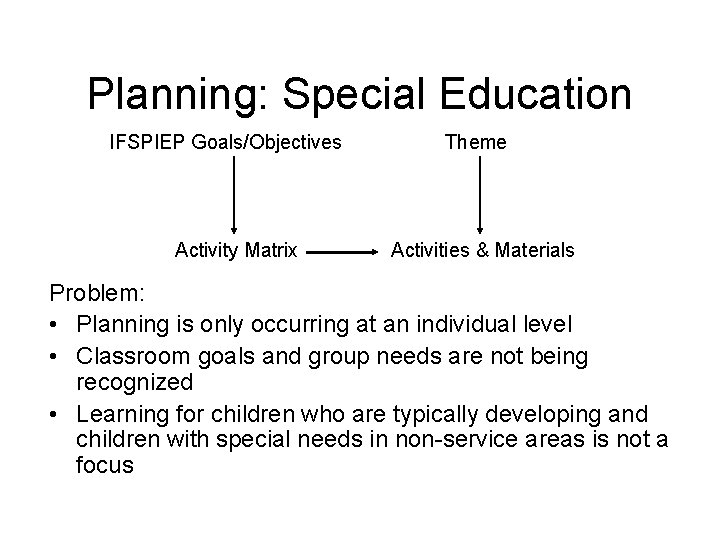
Planning: Special Education IFSPIEP Goals/Objectives Activity Matrix Theme Activities & Materials Problem: • Planning is only occurring at an individual level • Classroom goals and group needs are not being recognized • Learning for children who are typically developing and children with special needs in non-service areas is not a focus
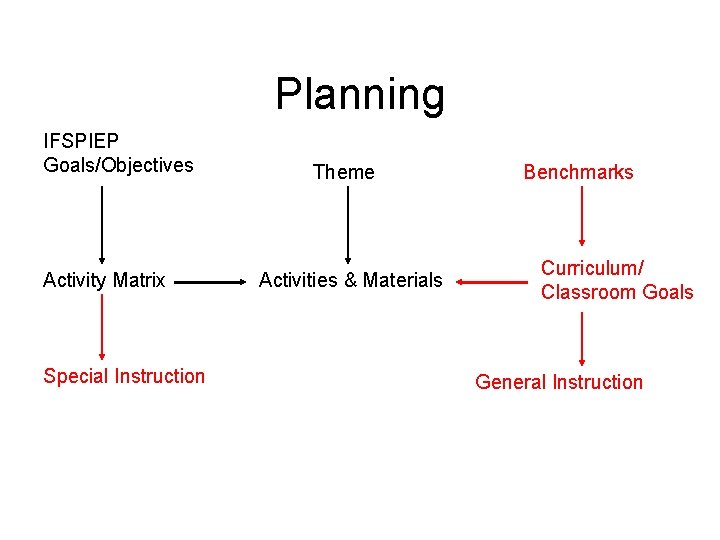
Planning IFSPIEP Goals/Objectives Activity Matrix Special Instruction Theme Activities & Materials Benchmarks Curriculum/ Classroom Goals General Instruction
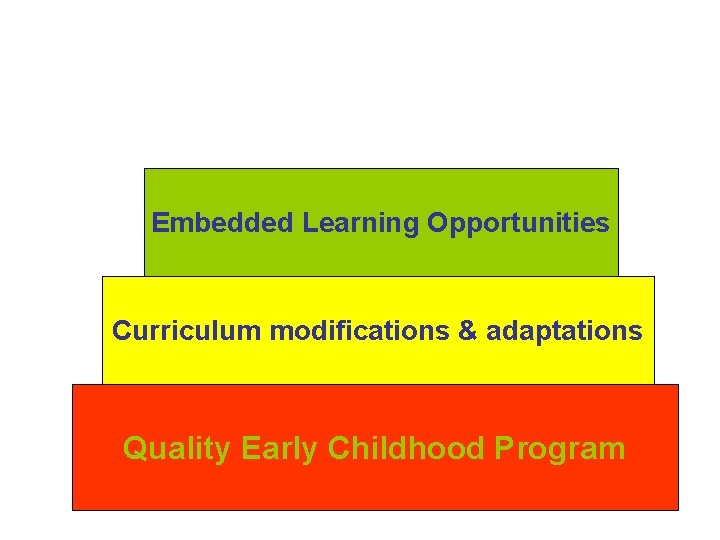
Embedded Learning Opportunities Curriculum modifications & adaptations Quality Early Childhood Program
Embedded Learning Opportunities • Teachers create short teaching episodes within ongoing classroom activities and routines. • Teaching episodes focus on a child’s individual learning objective.
Keys to Embedded Instruction ü Know the child’s objectives ü Plan materials and activities that give opportunities to work on objectives ü Give access to reinforcing consequences

Embedded instruction can be accomplished by: • Identifying the target behavior • Deciding when and where to apply embedded instruction • Using an individual Instructional Plan • Monitoring learning
Other Important Factors • Keep the activities simple • Plan the instruction (presenting an opportunity is not the same as teaching)
Activity Matrix – When/ where instruction will occur • Helps teacher ensure that instruction occurs • Reminds the staff of the activities and individual child objectives • Foundation for planning Individually Appropriate Activities
Developing an Activity Matrix Look at the child’s objectives and determine: • During what activities will we be able to provide instruction • Do we have adequate opportunities for instruction across all children on the matrix • When is it feasible to collect data on these objectives
Decide when and where to embed instruction • Develop an Activity Matrix – Individual – Classroom • Make sure sufficient opportunities occur




Difference between embedded instruction and teachable moments Embedded Instruction • Planned • Driven by child’s learning objective • Ensuring instruction occurs • Systematic progress monitoring Teachable Moments • Spontaneous • Driven by “the moment” • Taking advantage of an opportunity • Progress monitoring driven by opportunity
Instructional Plans – How will we teach the skills Based on: • Child’s Objectives • Activity Matrix • Individual Learning Styles • Modified based on data
Instructional Plan • • • Child’s name Date Current objective Toys, materials, other equipment Selected activities or routines Antecedents Target behavior Consequence Plan for data collection

Data Collection – How will progress be monitored • Must be sustainable (i. e. , able to maintain it over time) • Must be reasonable (i. e. , realistic endeavor allowing for instruction and evaluation) • Must be used by all staff
Embedded Instruction & Assessment • Assessment of functional skills in a natural environment • Opportunities to provide instruction and assess skills are planned and consistent • Addresses multiple skills or domains in single activities (time saver)
Embedded Instruction & Assessment • Performed in classroom and during the typical routine rather than a separate environment or one-on-one context • Provides natural motivation to encourage children to demonstrate skills • Aides in the assessment of generalization and maintenance of skills
Monitoring Progress • Keep track of each child’s progress • Keep track regularly – Counts – Notes – Products • Adjust as needed • Integrity checklists • Delight in your children’s learning!
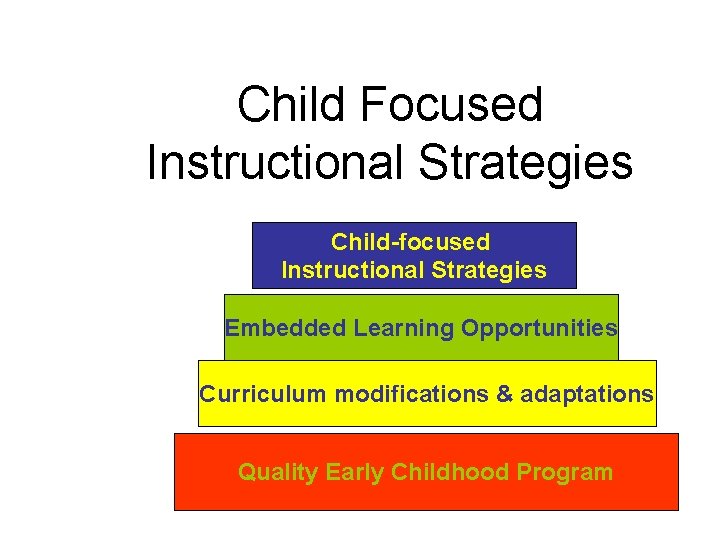
Child Focused Instructional Strategies Child-focused Instructional Strategies Embedded Learning Opportunities Curriculum modifications & adaptations Quality Early Childhood Program
Child Focused Instructional Strategies • Used when children need specialized instruction to make progress on a targeted goal • Involve use of evidence-based instructional strategies • Specific strategies chosen based on child strengths and areas of need
Prompting Techniques • Something the teacher does that increases the likelihood of correct responding by the child • Prompting happens BEFORE the child’s response • Allows you to get responses that you can reinforce
Menu of Prompts • Common prompts • • Model Gesture Verbal Partial and full physical • Other types of prompts • Pictorial • Mixed prompts
Prompt Fading • Once a prompt is added, it must also be systematically faded • Prompts can be faded by: – Time • Constant Time Delay - fading prompts by increasing the amount of time between direction and prompt
Prompt Fading • Amount of assistance provided – Most-to-Least - progressively less intrusive prompts until the child responds independently – Least-to-Most- Provide progressively more intrusive prompts until the child responds independently
Reinforcement • What is a reinforcer? – A reinforcer is a consequence you give to the child that increases the likelihood of a behavior happening again. It can include food, materials, activities, people, or words • Positive Reinforcement: – Helps children understand their behavior has an effect on their environment – Can help children build self-esteem
Use Reinforcement Effectively • Make reinforcement contingent on appropriate behavior • Give reinforcement immediately after the behavior you want to happen again • Use social praise that describes the appropriate behavior • Vary reinforcers • Reinforcers are individual to each child • Begin teaching new tasks with a continual reinforcement schedule • Thin the schedule of tangible reinforcement (do not discontinue praise) -- variable schedules of reinforcement build the most durable behaviors
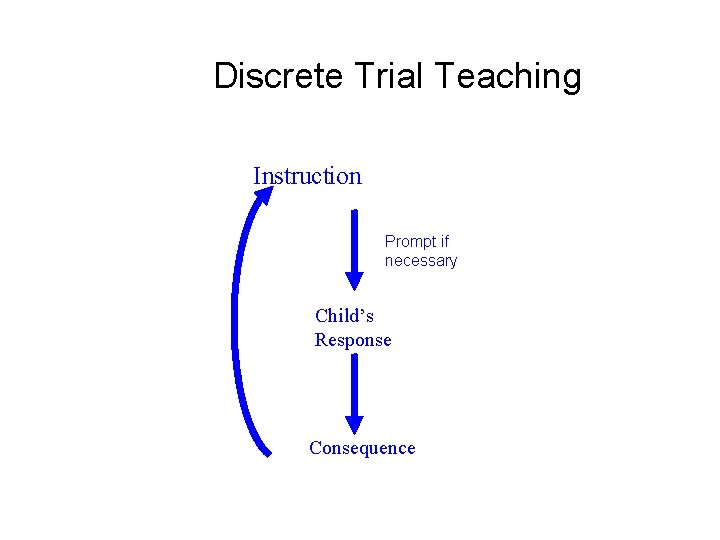
Discrete Trial Teaching Instruction Prompt if necessary Child’s Response Consequence
Discrete Trial Teaching • Break skills into smaller parts • Success with variety of skills • Addresses deficits – Attention – Motivation – Observational Learning – Communication
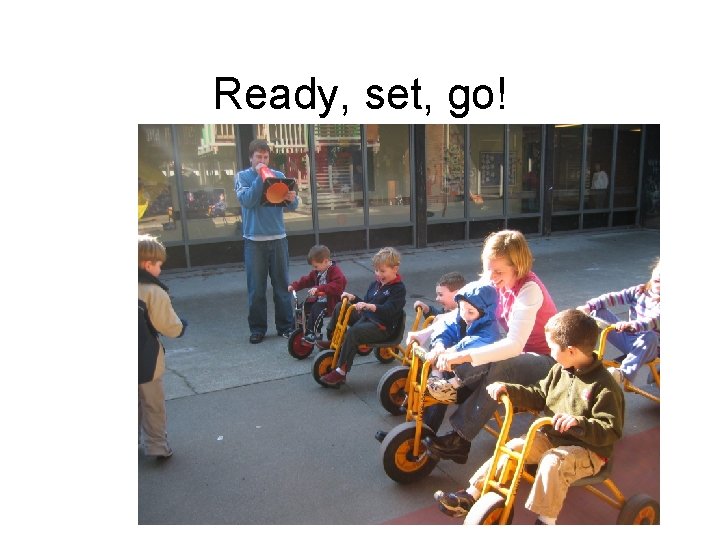
Ready, set, go!
- Slides: 43