
Using the Aerodynamic Particle Sizer to Measure PMcoarse
- Slides: 16
Using the Aerodynamic Particle Sizer to Measure PM-coarse Thomas Peters The University of Iowa Robert Vanderpool US EPA Sanjay Natarajan RTI International
Acknowledgements Thanks to Ricky Holm at TSI for useful discussions and to TSI for loaning the two APS units that were used during this study. Disclaimer Although this work was reviewed by EPA and approved for publication, it may not necessarily reflect official Agency policy. Mention of trade names or commercial products does not constitute endorsement or recommendation for use.
Aerodynamic Particle Sizer (APS) • Counts and sizes particles – Aerodynamic diameter from 0. 5 um to 20 um – Number concentration • Rapid, entire size distribution in seconds • Ideal for measuring coarse aerosols – Estimate PM-coarse Must convert from particle number to mass distribution
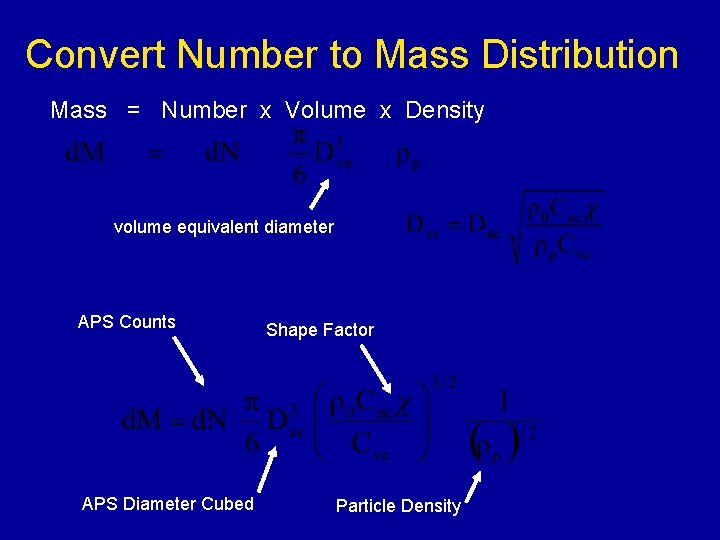
Convert Number to Mass Distribution Mass = Number x Volume x Density volume equivalent diameter APS Counts APS Diameter Cubed Shape Factor Particle Density
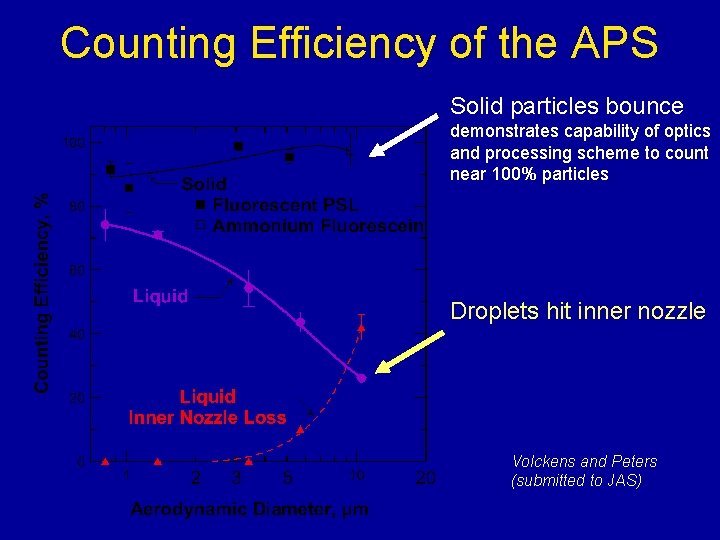
Counting Efficiency of the APS Solid particles bounce demonstrates capability of optics and processing scheme to count near 100% particles Droplets hit inner nozzle Volckens and Peters (submitted to JAS)
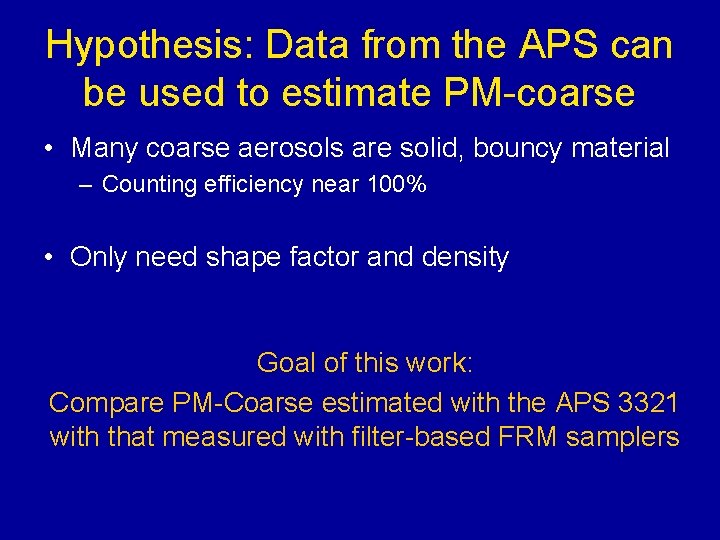
Hypothesis: Data from the APS can be used to estimate PM-coarse • Many coarse aerosols are solid, bouncy material – Counting efficiency near 100% • Only need shape factor and density Goal of this work: Compare PM-Coarse estimated with the APS 3321 with that measured with filter-based FRM samplers
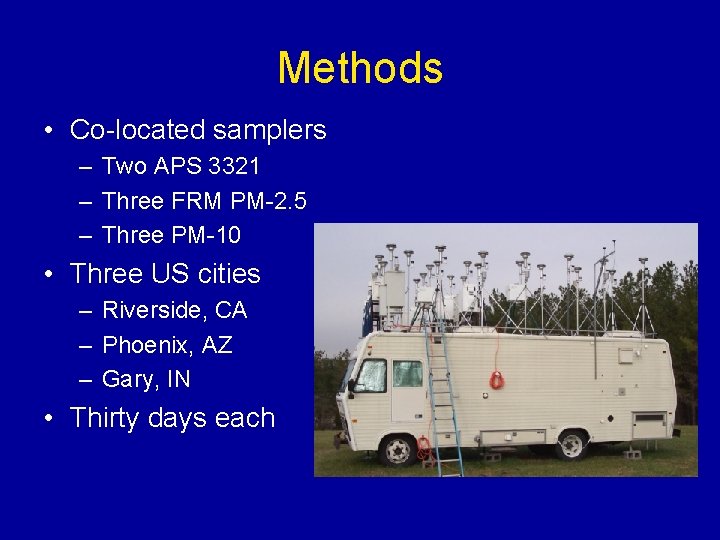
Methods • Co-located samplers – Two APS 3321 – Three FRM PM-2. 5 – Three PM-10 • Three US cities – Riverside, CA – Phoenix, AZ – Gary, IN • Thirty days each
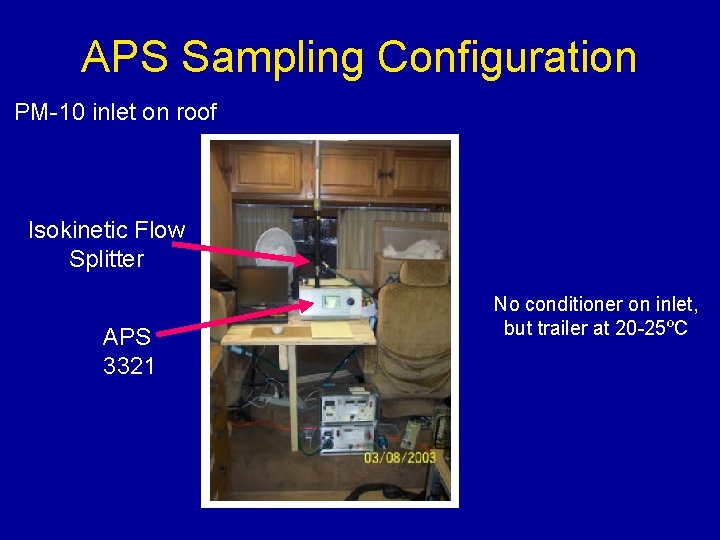
APS Sampling Configuration PM-10 inlet on roof Isokinetic Flow Splitter APS 3321 No conditioner on inlet, but trailer at 20 -25ºC
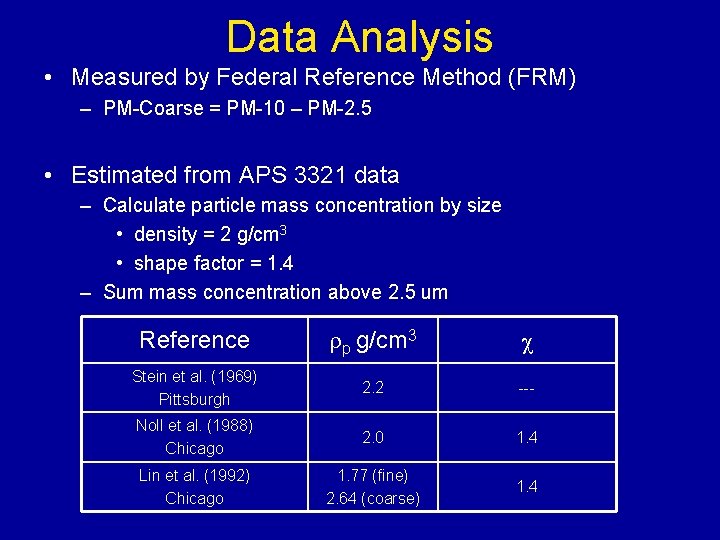
Data Analysis • Measured by Federal Reference Method (FRM) – PM-Coarse = PM-10 – PM-2. 5 • Estimated from APS 3321 data – Calculate particle mass concentration by size • density = 2 g/cm 3 • shape factor = 1. 4 – Sum mass concentration above 2. 5 um Reference rp g/cm 3 c Stein et al. (1969) Pittsburgh 2. 2 --- Noll et al. (1988) Chicago 2. 0 1. 4 Lin et al. (1992) Chicago 1. 77 (fine) 2. 64 (coarse) 1. 4
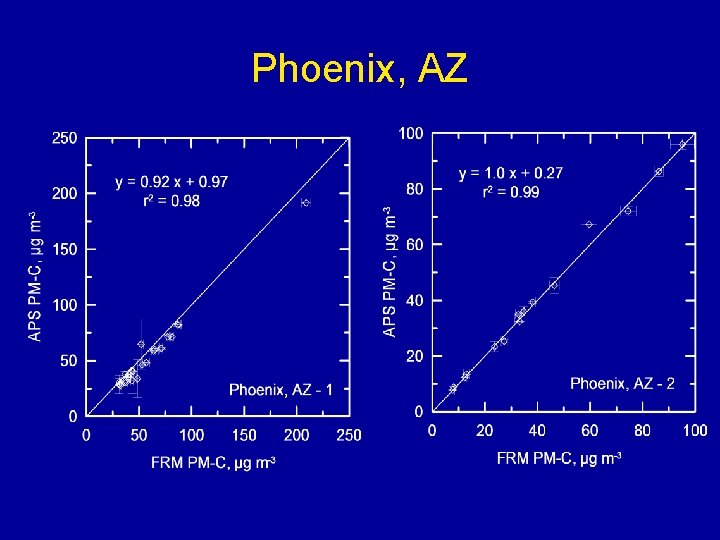
Phoenix, AZ
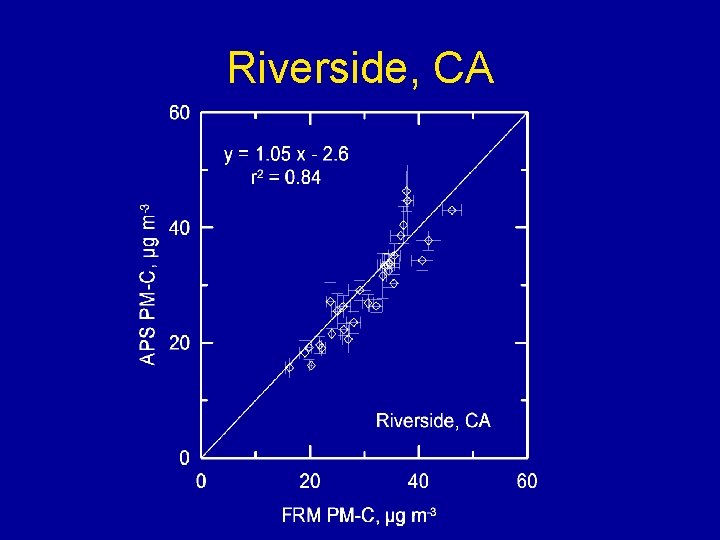
Riverside, CA
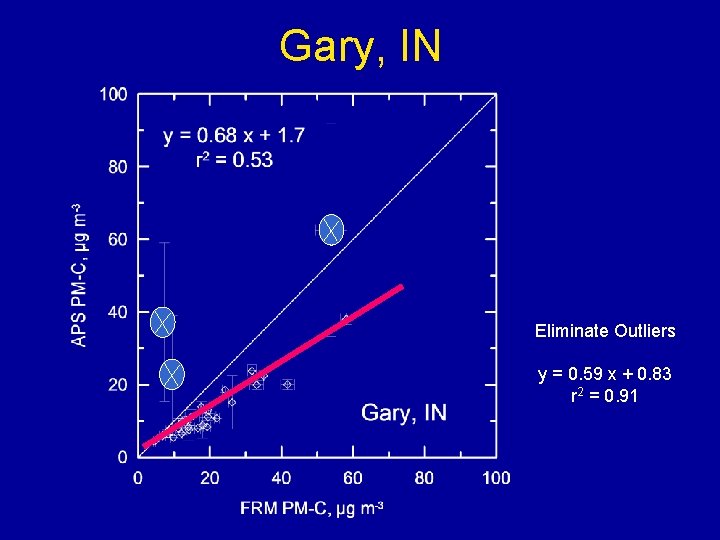
Gary, IN Eliminate Outliers y = 0. 59 x + 0. 83 r 2 = 0. 91
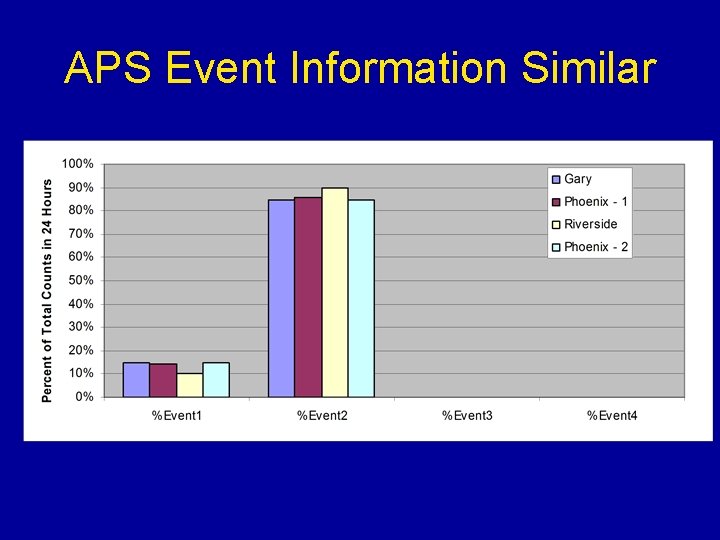
APS Event Information Similar
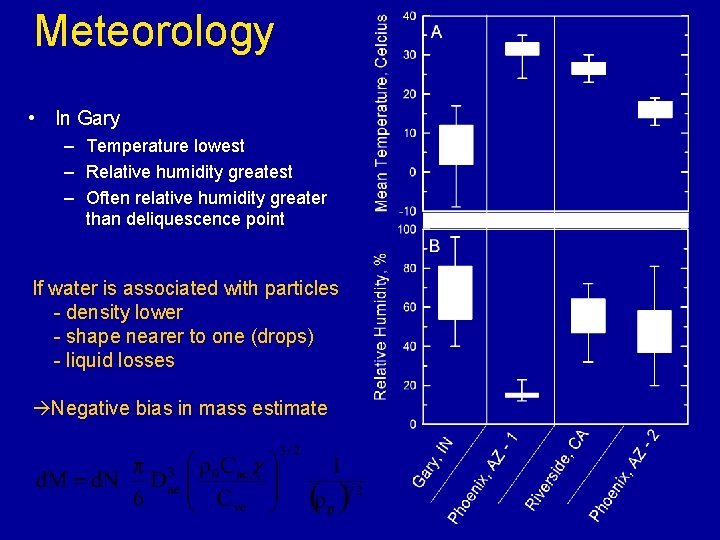
Meteorology • In Gary – Temperature lowest – Relative humidity greatest – Often relative humidity greater than deliquescence point If water is associated with particles - density lower - shape nearer to one (drops) - liquid losses Negative bias in mass estimate
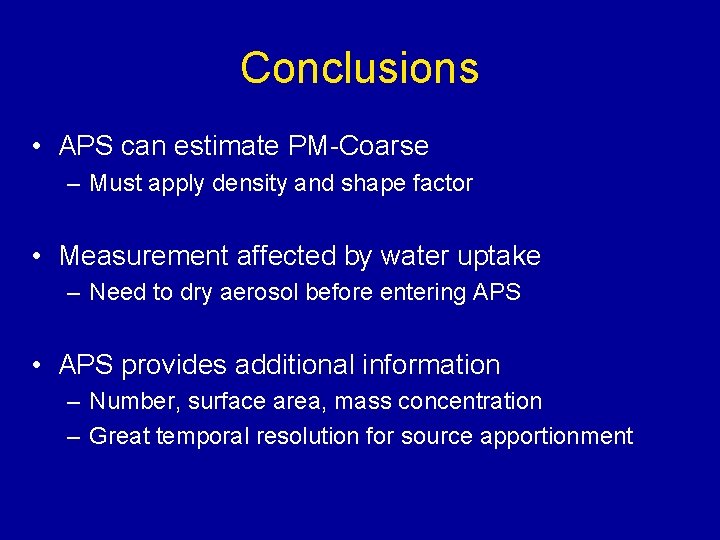
Conclusions • APS can estimate PM-Coarse – Must apply density and shape factor • Measurement affected by water uptake – Need to dry aerosol before entering APS • APS provides additional information – Number, surface area, mass concentration – Great temporal resolution for source apportionment
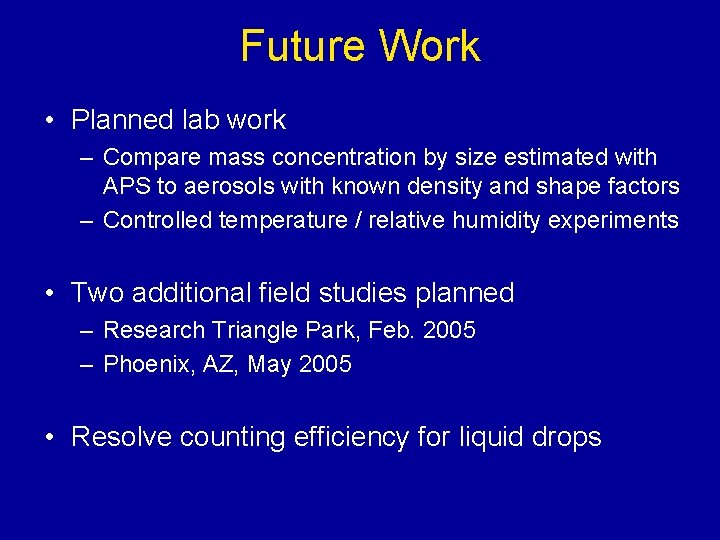
Future Work • Planned lab work – Compare mass concentration by size estimated with APS to aerosols with known density and shape factors – Controlled temperature / relative humidity experiments • Two additional field studies planned – Research Triangle Park, Feb. 2005 – Phoenix, AZ, May 2005 • Resolve counting efficiency for liquid drops