
Using System Dynamics to Improve Understanding of Police
- Slides: 31
Using System Dynamics to Improve Understanding of Police Performance Ian Newsome Head of Management Support West Yorkshire Police OR 46 8 September 2004
Introduction • Management Support = – strategic planning – performance improvement – performance management • WYP Interest in SD • The team – Ian Newsome – Martin Rahman – David Fitzgerald
West Yorkshire Police • Geography: – 2000 Km 2 – busy cities and towns, quiet villages and rural locations, (metropolitan districts of Bradford, Calderdale, Kirklees, Leeds and Wakefield) West Yorkshire Police • Population: – resident population = 2. 1 million – 11. 4% of population from Black and Minority Ethnic communities – 47% of Wards fall within the 20% most deprived in E & W • Resources: – around 5, 200 police officers and 2, 300 support staff Fourth largest Force in the country – annual budget £ 350 M
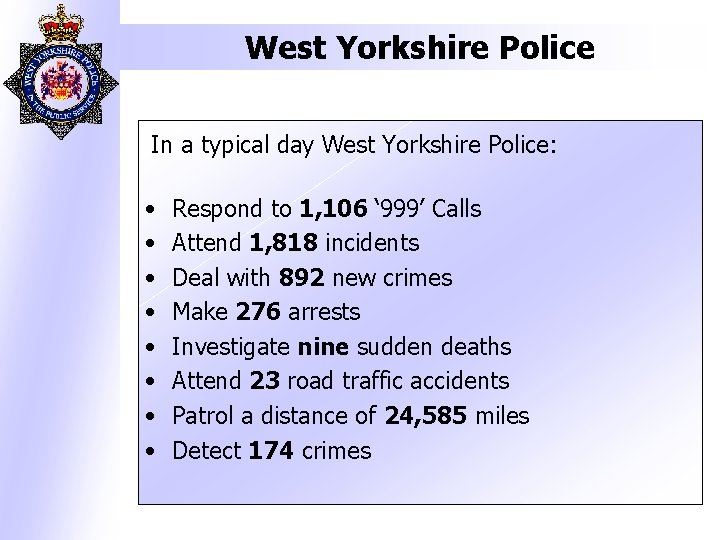
West Yorkshire Police In a typical day West Yorkshire Police: • • Respond to 1, 106 ‘ 999’ Calls Attend 1, 818 incidents Deal with 892 new crimes Make 276 arrests Investigate nine sudden deaths Attend 23 road traffic accidents Patrol a distance of 24, 585 miles Detect 174 crimes
Police Performance Measurement Historic Limitations • History of statistical returns to the HO - little used • Inconsistency in data collection • Comparison limited to year-on-year comparison and/or ‘league table’ approaches • Data collection cumbersome, includes duplication and is a huge overhead for Forces & HO • Lack of ‘joined-up’ thinking across government departments and within the Police service • Wide range of local PM systems exist in all Forces to supplement the national framework
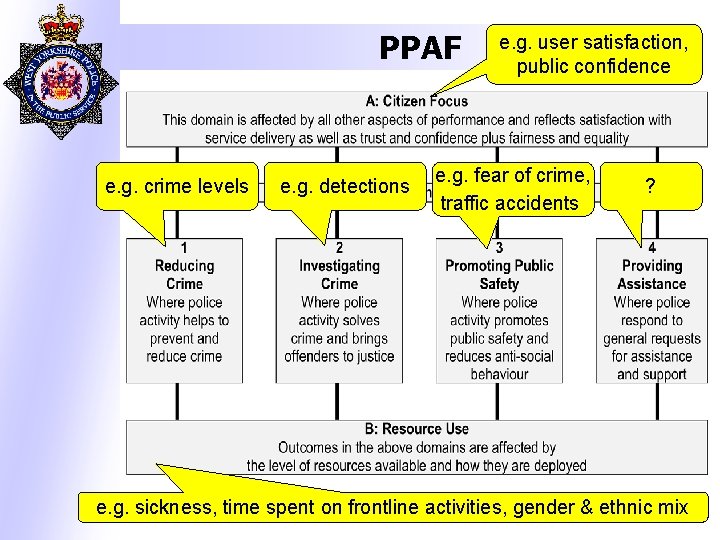
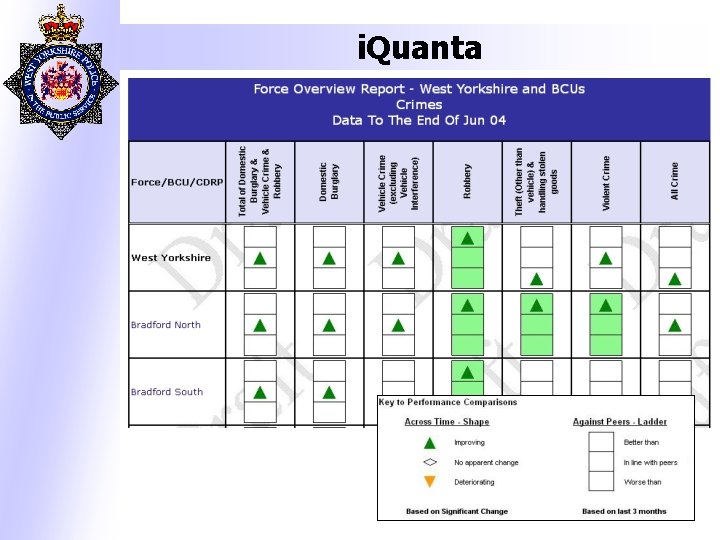
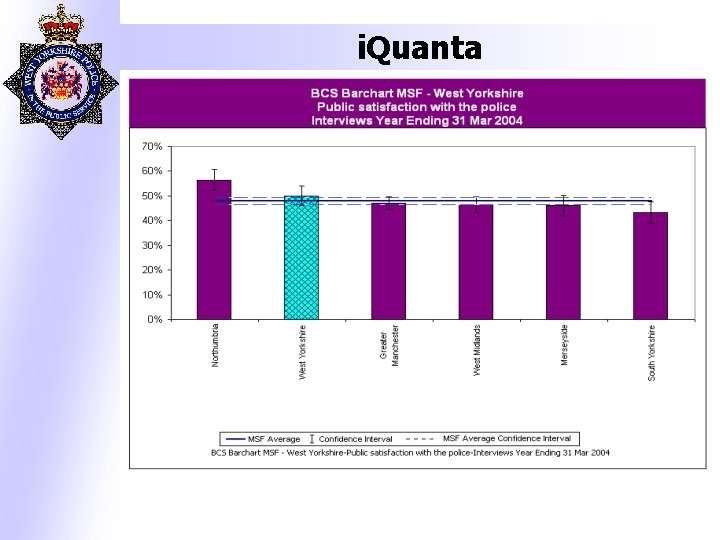
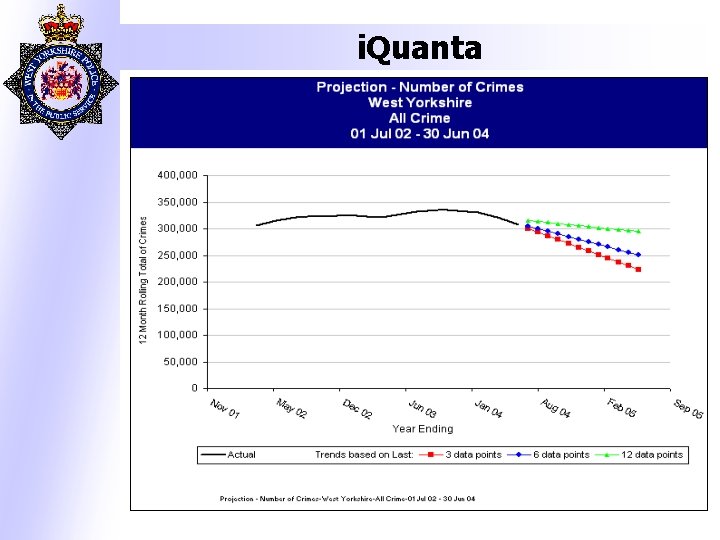
Police Performance Measurement Current Practice • National Policing Plan, Objectives & an agreed suite of Key Performance Indicators provides national focus • Joint work to create quality assurance mechanisms to establish data consistency • Police Performance Assessment Framework (PPAF) provides a more rounded model to link quantitative and qualitative measurement • i. Quanta system enables a more sophisticated approach to performance management - e. g. ‘performance over time’ and ‘performance against peers’
PPAF e. g. crime levels e. g. detections e. g. user satisfaction, public confidence e. g. fear of crime, traffic accidents ? e. g. sickness, time spent on frontline activities, gender & ethnic mix
i. Quanta
i. Quanta
i. Quanta
Police Performance Measurement - Current Practice • Performance Framework is now more rounded • Policing targets, policy and resourcing decisions are made in particular areas with the assistance of sophisticated modelling (nationally by HO and locally by individual Forces - e. g. CJS simulation modelling, SPC) But. . . • Limited understanding about how the components all link together (‘gut feel’ & ’professional judgement’) • Opportunities exist to better understand the dynamic cause/effect relationships • A need to recognise the wider impact of decisions (e. g. impact of ‘softer’ measures such as presence in the community on reassurance and crime)
Why System Dynamics in WYP? • To better understand the impact upon performance of additional resources and where these should be targeted - what causes better/worse performance? • Growing involvement of partners in policing solutions - what contribution do we all have? • Increased resource flexibility with wider ‘policing family’ (e. g. Police Community Support Officers PCSOs) - what’s the best mix? • Are we pulling in the same direction? We cannot tell - we don’t even have an acceptable ‘map’ of interrelationships
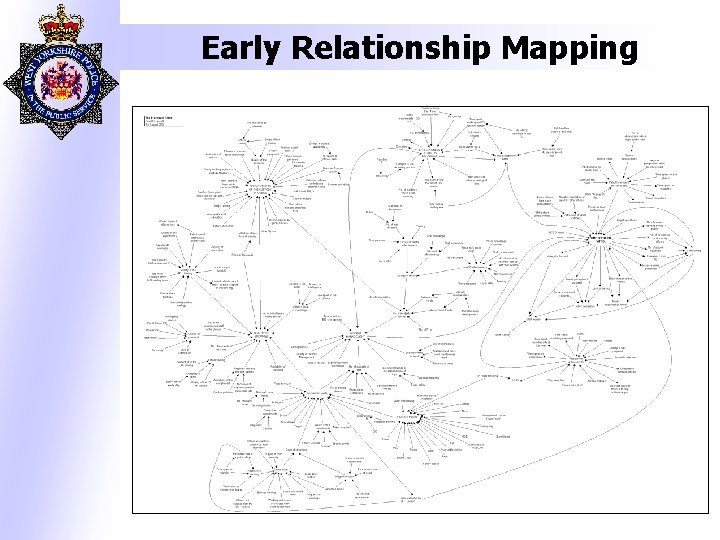
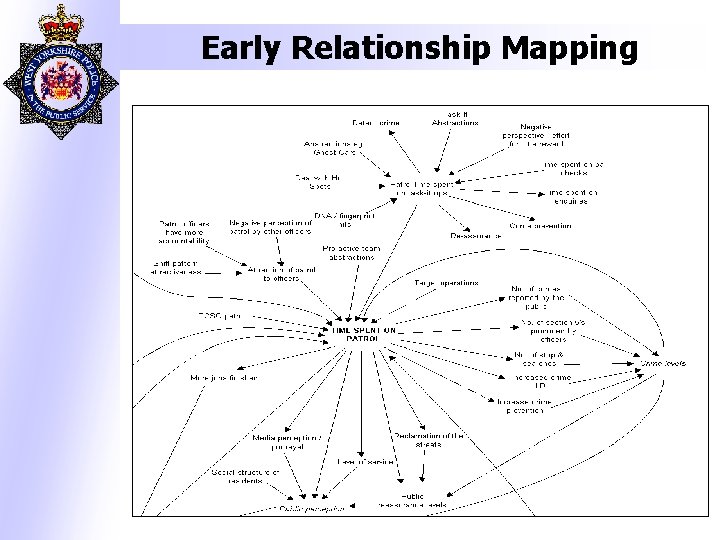
Early Experiences • Started ‘bottom-up’ through workshops with operational officers to build influence maps • Further modelling workshops started to build models showing dynamic relationships on the map components Outcome… • Complex maps and information overload • Difficulty working out the dynamics • Difficulty conveying meaning of models to decision makers and securing senior buy-in without a more coherent model • Need to incorporate sufficient detail while still enabling recognition of the wider components
Early Relationship Mapping
Early Relationship Mapping
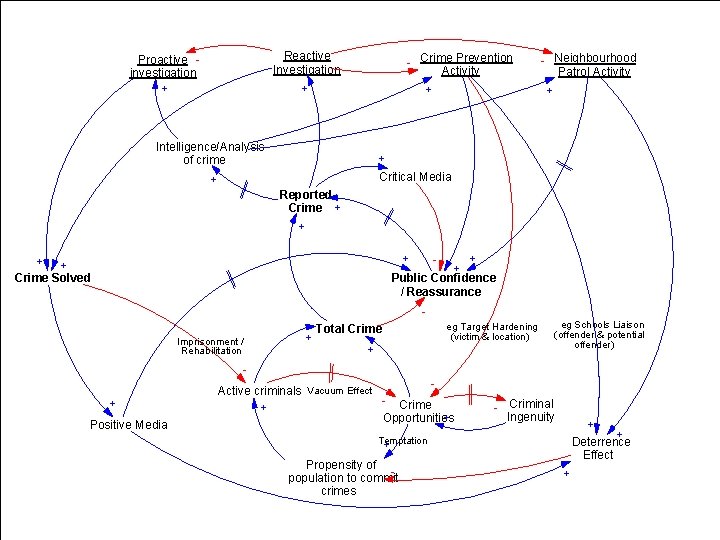
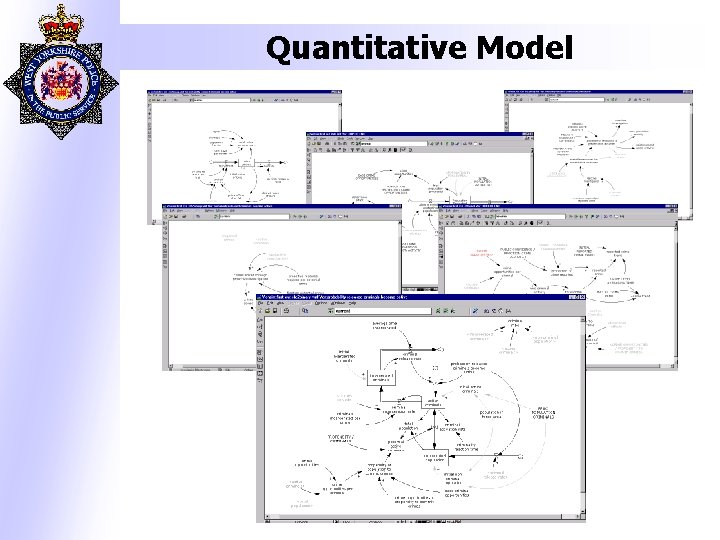
A Refined - High Level Model • Selected only a limited number of ‘variables’ within the model as a starting point (resource levels and impact on public confidence, crime levels & crime solved) • Built the high level dynamic relationships ‘top-down’ drawing upon the workshop data to model the causes of better/worse performance • Tested & refined model with a range of stakeholders (including those not involved in the original work) • Identified loops that provided interesting insights to help validate the logic and improve understanding • Started to build quantitative model to develop the emerging findings
Reactive Investigation Proactive investigation + - Crime Prevention Activity + + Intelligence/Analysis of crime - Neighbourhood Patrol Activity + + Critical Media + Reported Crime + + + Public Confidence / Reassurance + + Crime Solved - Imprisonment / Rehabilitation + eg Target Hardening (victim & location) Total Crime + eg Schools Liaison (offender & potential offender) + Positive Media Active criminals Vacuum Effect - Crime + Opportunities + - Criminal Ingenuity + + Deterrence Effect Temptation + Propensity of population to commit crimes +
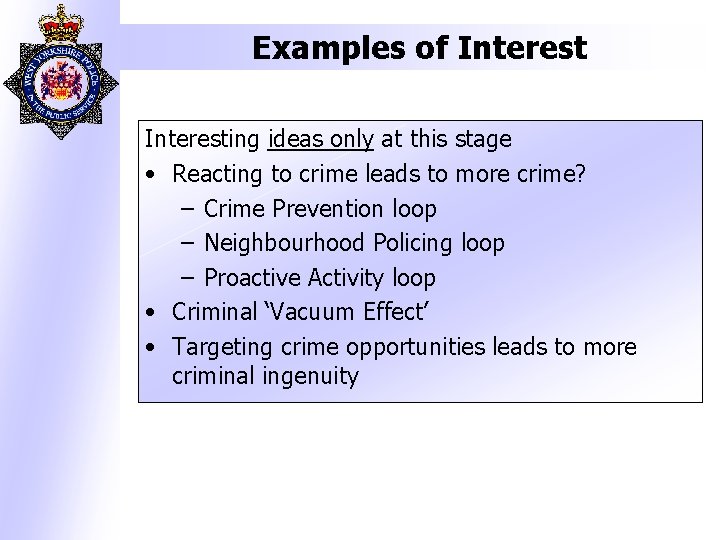
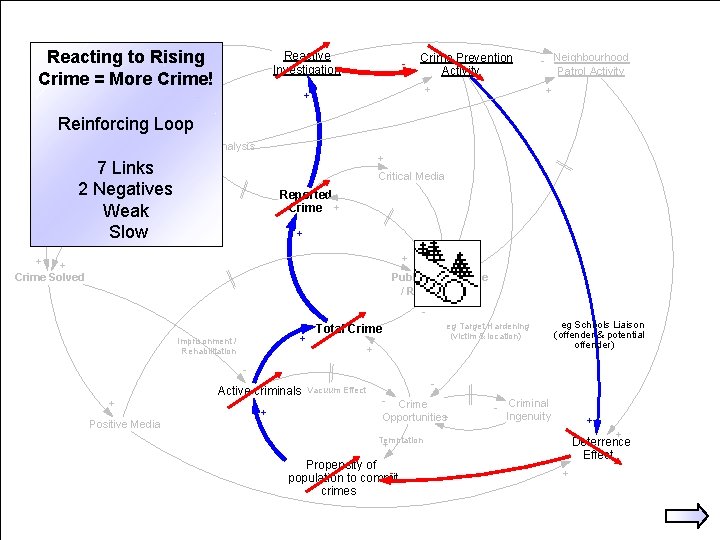
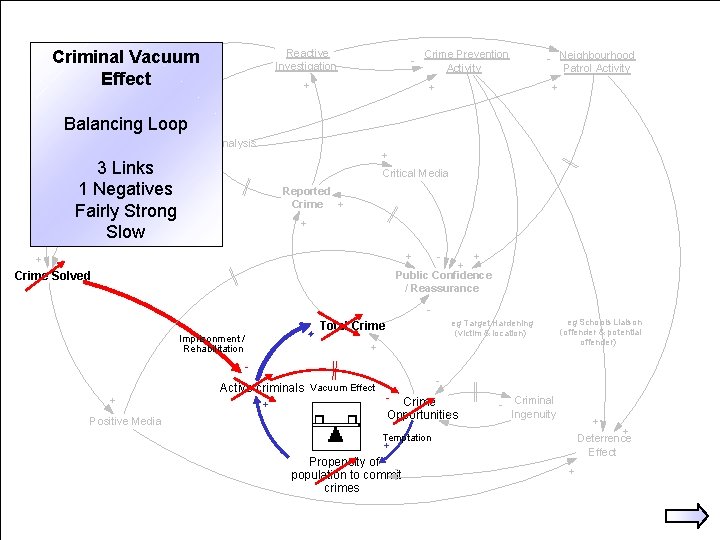
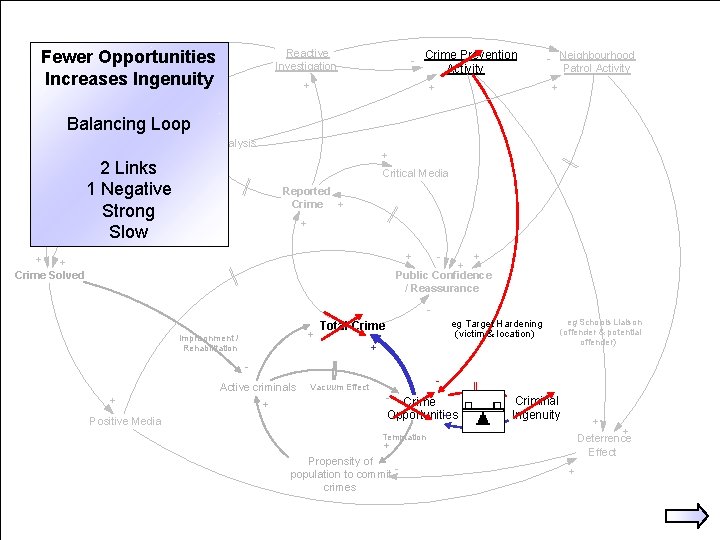
Examples of Interesting ideas only at this stage • Reacting to crime leads to more crime? – Crime Prevention loop – Neighbourhood Policing loop – Proactive Activity loop • Criminal ‘Vacuum Effect’ • Targeting crime opportunities leads to more criminal ingenuity
Reacting to. Proactive Risinginvestigation Crime = More Crime! + Reactive Investigation - Crime Prevention Activity + + - Neighbourhood Patrol Activity + Reinforcing Loop Intelligence/Analysis of crime 7 Links 2 Negatives Weak Slow + Critical Media + Reported Crime + + + Public Confidence / Reassurance + + Crime Solved - + Imprisonment / Rehabilitation eg Target Hardening (victim & location) Total Crime + eg Schools Liaison (offender & potential offender) + Positive Media Active criminals + Vacuum Effect - Crime Opportunities+ - Criminal Ingenuity + + Temptation Deterrence Effect + Propensity of population to commit crimes +
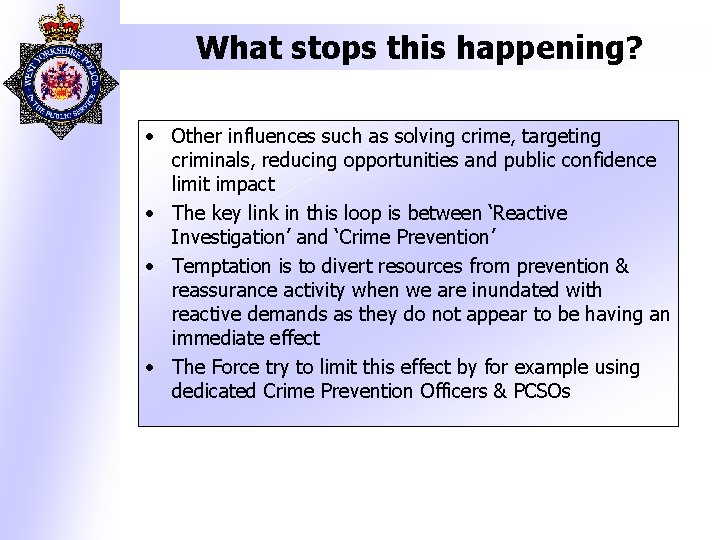
What stops this happening? • Other influences such as solving crime, targeting criminals, reducing opportunities and public confidence limit impact • The key link in this loop is between ‘Reactive Investigation’ and ‘Crime Prevention’ • Temptation is to divert resources from prevention & reassurance activity when we are inundated with reactive demands as they do not appear to be having an immediate effect • The Force try to limit this effect by for example using dedicated Crime Prevention Officers & PCSOs
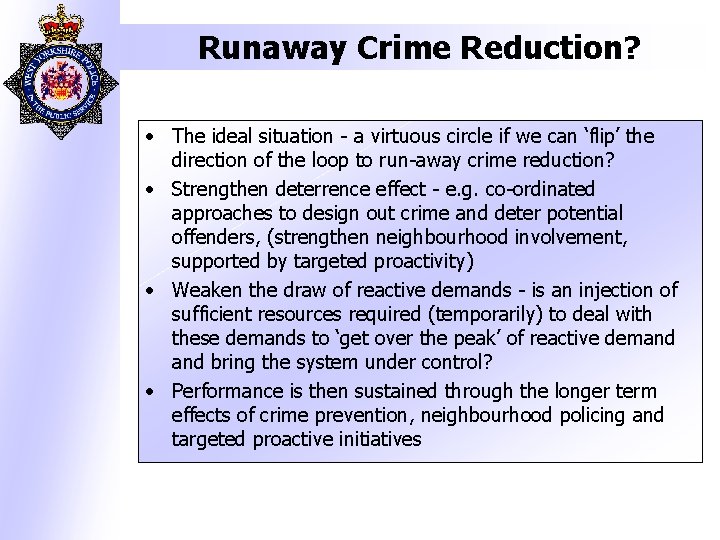
Runaway Crime Reduction? • The ideal situation - a virtuous circle if we can ‘flip’ the direction of the loop to run-away crime reduction? • Strengthen deterrence effect - e. g. co-ordinated approaches to design out crime and deter potential offenders, (strengthen neighbourhood involvement, supported by targeted proactivity) • Weaken the draw of reactive demands - is an injection of sufficient resources required (temporarily) to deal with these demands to ‘get over the peak’ of reactive demand bring the system under control? • Performance is then sustained through the longer term effects of crime prevention, neighbourhood policing and targeted proactive initiatives
Proactive Criminal Vacuum investigation Effect + Reactive Investigation - + Crime Prevention Activity - Neighbourhood Patrol Activity + + Balancing Loop Intelligence/Analysis of crime 3 Links 1 Negatives Fairly Strong Slow + + Critical Media + Reported Crime + + + Public Confidence / Reassurance + Crime Solved - ++ Imprisonment / Rehabilitation eg Target Hardening (victim & location) Total Crime + eg Schools Liaison (offender & potential offender) + Positive Media Active criminals Vacuum Effect + - Crime + Opportunities - Criminal Ingenuity + + Deterrence Effect Temptation + Propensity of population to commit crimes +
Proactive Fewer Opportunities investigation Increases Ingenuity + Reactive Investigation - Crime Prevention Activity + + - Neighbourhood Patrol Activity + Balancing Loop Intelligence/Analysis of crime 2 Links 1 Negative Strong Slow + Critical Media + Reported Crime + + + Public Confidence / Reassurance + + Crime Solved - + Imprisonment / Rehabilitation eg Target Hardening (victim & location) Total Crime + eg Schools Liaison (offender & potential offender) Active criminals + Positive Media + Vacuum Effect - Crime + Opportunities - Criminal Ingenuity + + Deterrence Effect Temptation + Propensity of population to commit crimes +
Quantitative Model
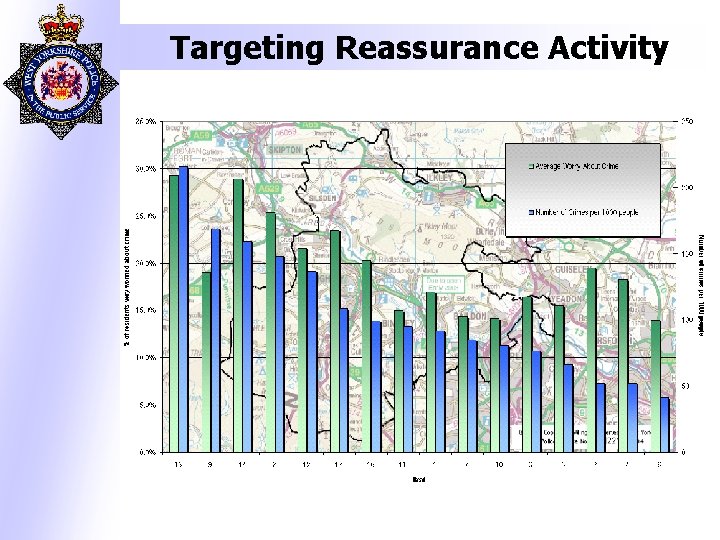
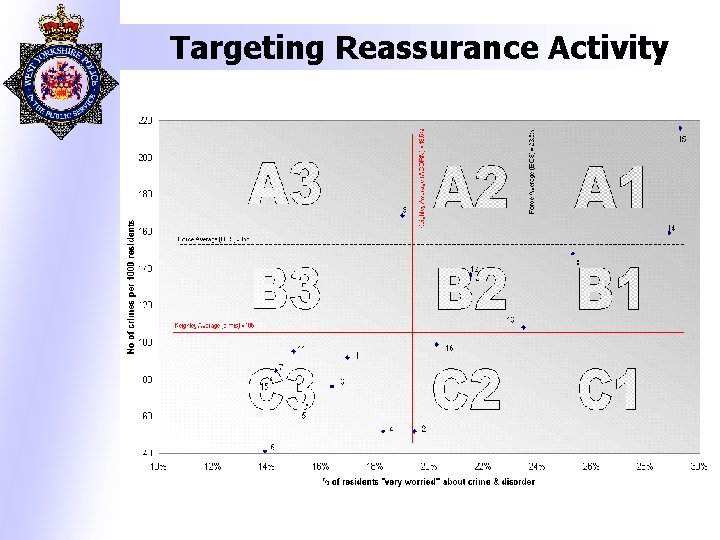
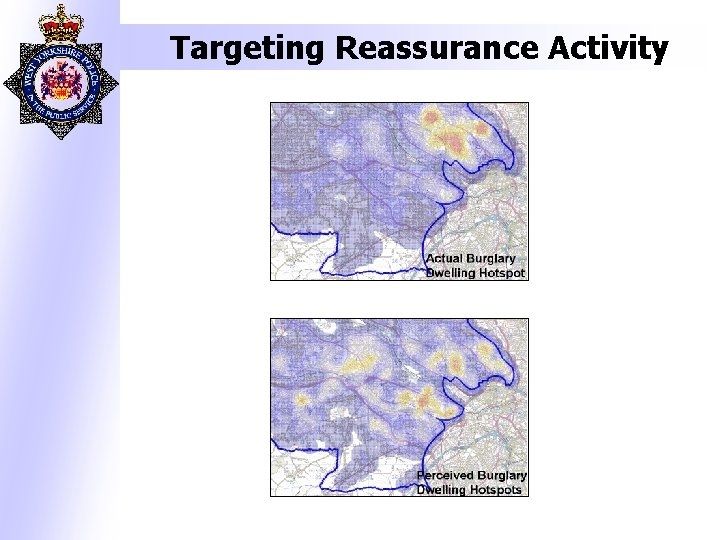
Early Insights • Modelling not intended to predict quantifiable cause/effect impacts but prevent the over-use of simplistic ‘route-one’ thinking & recognition of wider partnership impact/fit of decisions • However, may provide opportunity to quantify ‘relative impact’ of resourcing/policy decisions (e. g. invest in PCSOs or detectives & what is the relative impact on crime & reassurance? ) • High level model more effective in gaining buy-in and to identify aspects worthy of more detailed modelling • Modelling the impact of reassurance patrol on fear of crime (positive/negative impact) has led to the identification of potential new operational tools to support reassurance deployment (e. g. for targeting alternative approaches to reassurance in some areas)
Targeting Reassurance Activity
Targeting Reassurance Activity
Targeting Reassurance Activity
Future Application? • Significant further modelling work required – this has only scratched the surface • Nationally & locally the emphasis is on the importance of partnerships & community focused policing - SD could provide valuable insights into the fit of these aspirations • Opportunities to better recognise & measure the role of wider partnership responsibilities in policing to lever positive change (e. g. diversionary schemes) • Reflect the improved understanding of relative impact of resources in performance management and resource decisions (e. g. target setting)
Conclusion • An idea that was interesting now shows some real potential and needs developing • Better strategic understanding of the high level dynamics • Insights into how performance can be influenced by a range of levers • Potential for further quantitative work to link investments throughout the system to results, with obvious relevance to partnership work
Using System Dynamics to Improve Understanding of Police Performance Ian Newsome Head of Management Support West Yorkshire Police OR 46 8 September 2004