
Using Synchronization Primitives in C C and Linux


- Slides: 11
Using Synchronization Primitives in C, C++, and Linux Kernel CS-3013 Operating Systems A-term 2008 (Slides include materials from Modern Operating Systems, 3 rd ed. , by Andrew Tanenbaum and from Operating System Concepts, 7 th ed. , by Silbershatz, Galvin, & Gagne) CS-3013 A-term 2008 Using synchronization primitives 1
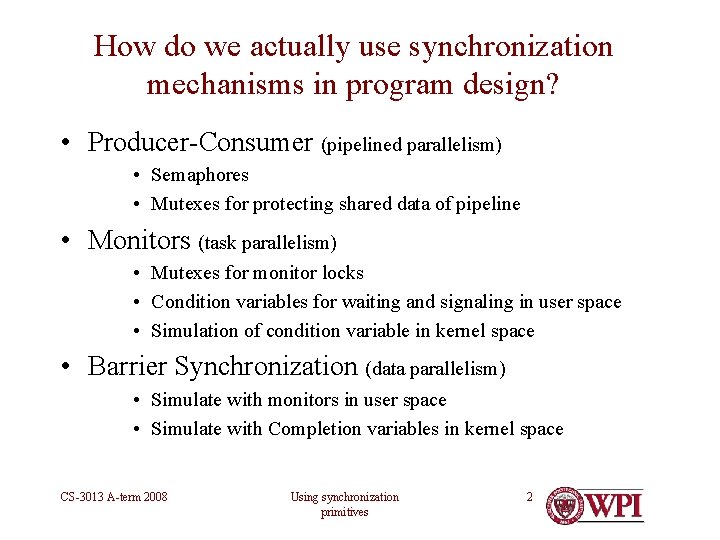
How do we actually use synchronization mechanisms in program design? • Producer-Consumer (pipelined parallelism) • Semaphores • Mutexes for protecting shared data of pipeline • Monitors (task parallelism) • Mutexes for monitor locks • Condition variables for waiting and signaling in user space • Simulation of condition variable in kernel space • Barrier Synchronization (data parallelism) • Simulate with monitors in user space • Simulate with Completion variables in kernel space CS-3013 A-term 2008 Using synchronization primitives 2
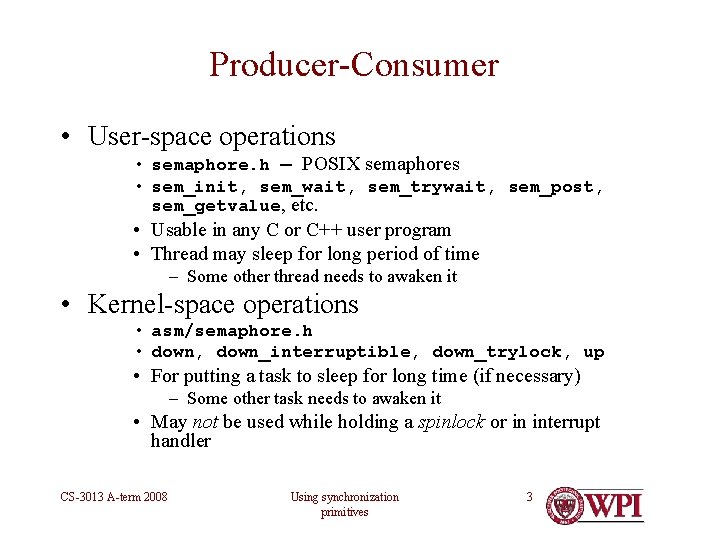
Producer-Consumer • User-space operations • semaphore. h — POSIX semaphores • sem_init, sem_wait, sem_trywait, sem_post, sem_getvalue, etc. • Usable in any C or C++ user program • Thread may sleep for long period of time – Some other thread needs to awaken it • Kernel-space operations • asm/semaphore. h • down, down_interruptible, down_trylock, up • For putting a task to sleep for long time (if necessary) – Some other task needs to awaken it • May not be used while holding a spinlock or in interrupt handler CS-3013 A-term 2008 Using synchronization primitives 3
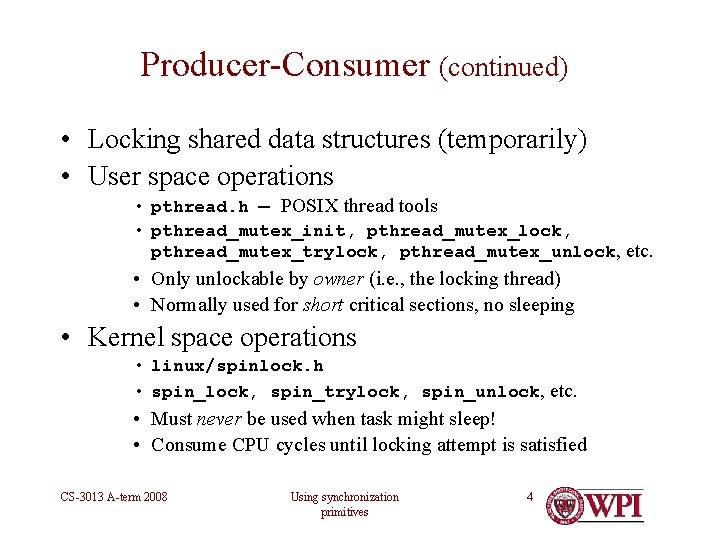
Producer-Consumer (continued) • Locking shared data structures (temporarily) • User space operations • pthread. h — POSIX thread tools • pthread_mutex_init, pthread_mutex_lock, pthread_mutex_trylock, pthread_mutex_unlock, etc. • Only unlockable by owner (i. e. , the locking thread) • Normally used for short critical sections, no sleeping • Kernel space operations • linux/spinlock. h • spin_lock, spin_trylock, spin_unlock, etc. • Must never be used when task might sleep! • Consume CPU cycles until locking attempt is satisfied CS-3013 A-term 2008 Using synchronization primitives 4
Questions? CS-3013 A-term 2008 Using synchronization primitives 5
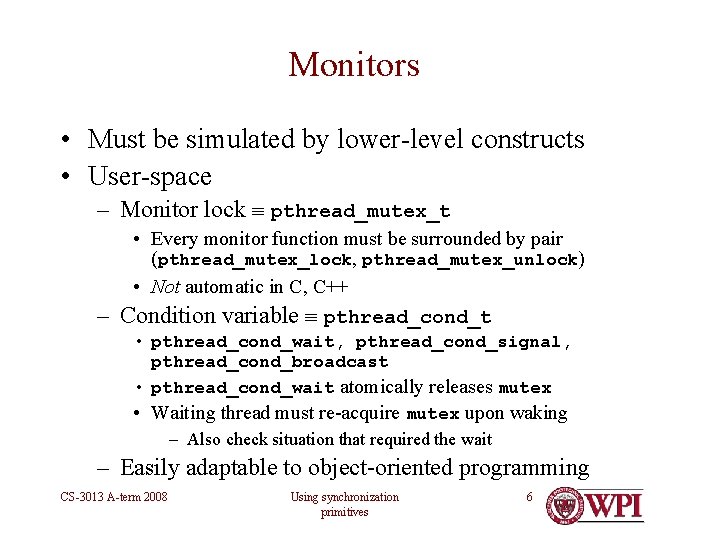
Monitors • Must be simulated by lower-level constructs • User-space – Monitor lock pthread_mutex_t • Every monitor function must be surrounded by pair (pthread_mutex_lock, pthread_mutex_unlock) • Not automatic in C, C++ – Condition variable pthread_cond_t • pthread_cond_wait, pthread_cond_signal, pthread_cond_broadcast • pthread_cond_wait atomically releases mutex • Waiting thread must re-acquire mutex upon waking – Also check situation that required the wait – Easily adaptable to object-oriented programming CS-3013 A-term 2008 Using synchronization primitives 6
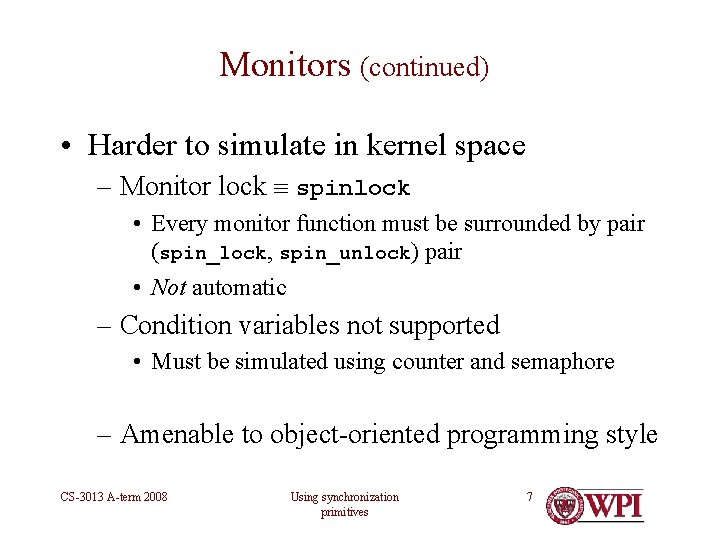
Monitors (continued) • Harder to simulate in kernel space – Monitor lock spinlock • Every monitor function must be surrounded by pair (spin_lock, spin_unlock) pair • Not automatic – Condition variables not supported • Must be simulated using counter and semaphore – Amenable to object-oriented programming style CS-3013 A-term 2008 Using synchronization primitives 7
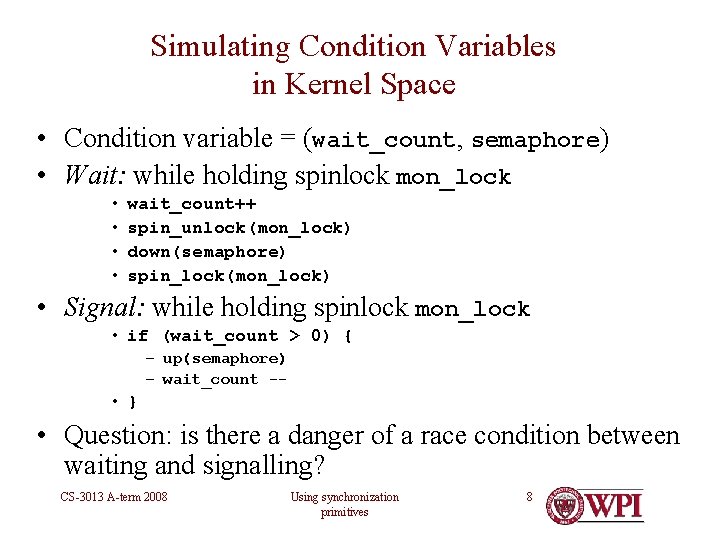
Simulating Condition Variables in Kernel Space • Condition variable = (wait_count, semaphore) • Wait: while holding spinlock mon_lock • • wait_count++ spin_unlock(mon_lock) down(semaphore) spin_lock(mon_lock) • Signal: while holding spinlock mon_lock • if (wait_count > 0) { – up(semaphore) – wait_count -- • } • Question: is there a danger of a race condition between waiting and signalling? CS-3013 A-term 2008 Using synchronization primitives 8
Questions? CS-3013 A-term 2008 Using synchronization primitives 9
Barrier Synchronization • User space • May be simulated with pthread_mutex and pthread_cond_broadcast • Kernel space • May be simulated with completion variables • See linux/completion. h and Robert Love, pp 148 -149 CS-3013 A-term 2008 Using synchronization primitives 10
Questions? CS-3013 A-term 2008 Using synchronization primitives 11