
Using Surface Syntactic Parser Deviation from Randomness JeanPierre

- Slides: 26
Using Surface Syntactic Parser & Deviation from Randomness Jean-Pierre Chevallet IPAL I 2 R Gilles Sérasset CLIPS IMAG
Outline • Monolingual track – French, Russian, Finnish – Deviation from randomness • Bilingual track – Bilingual Association Thesaurus for disambiguating Query Translation
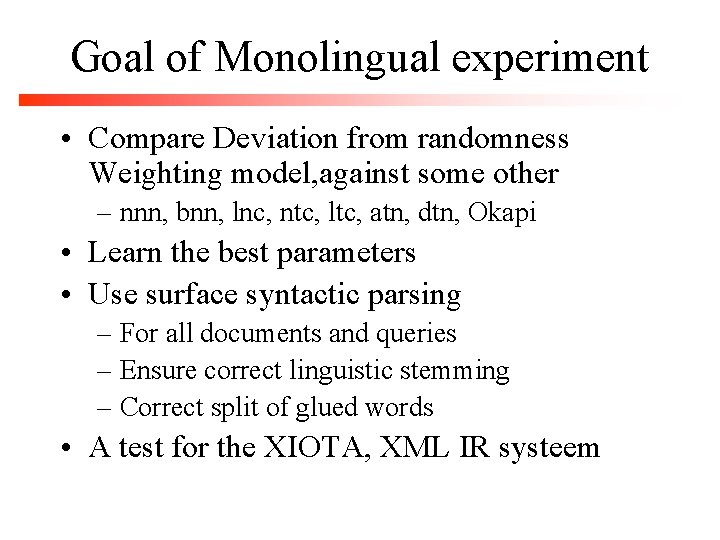
Goal of Monolingual experiment • Compare Deviation from randomness Weighting model, against some other – nnn, bnn, lnc, ntc, ltc, atn, dtn, Okapi • Learn the best parameters • Use surface syntactic parsing – For all documents and queries – Ensure correct linguistic stemming – Correct split of glued words • A test for the XIOTA, XML IR systeem
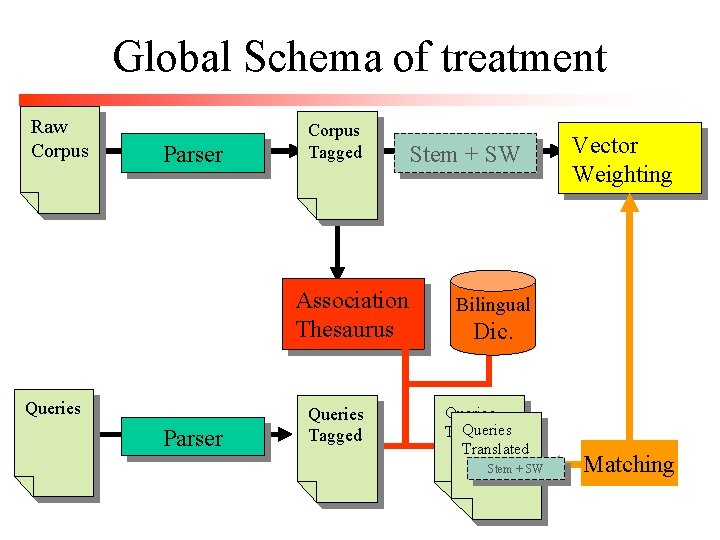
Global Schema of treatment Raw Corpus Parser Corpus Tagged Association Thesaurus Queries Parser Queries Tagged Stem + SW Vector Weighting Bilingual Dic. Queries Translated Stem + SW Matching
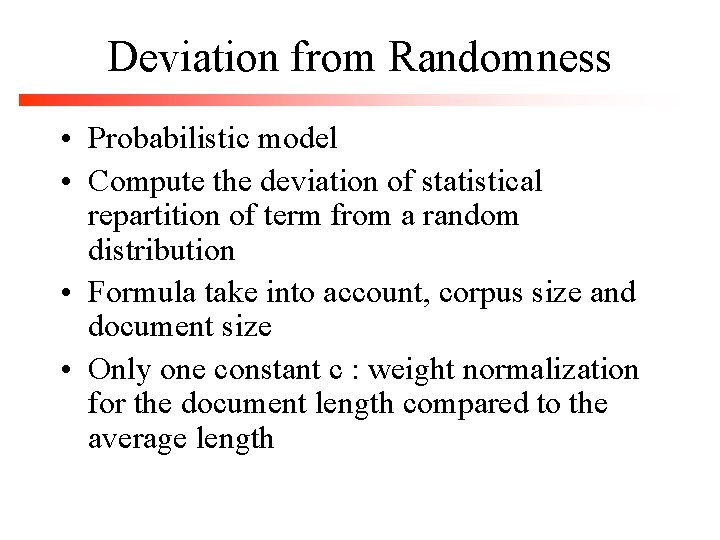
Deviation from Randomness • Probabilistic model • Compute the deviation of statistical repartition of term from a random distribution • Formula take into account, corpus size and document size • Only one constant c : weight normalization for the document length compared to the average length
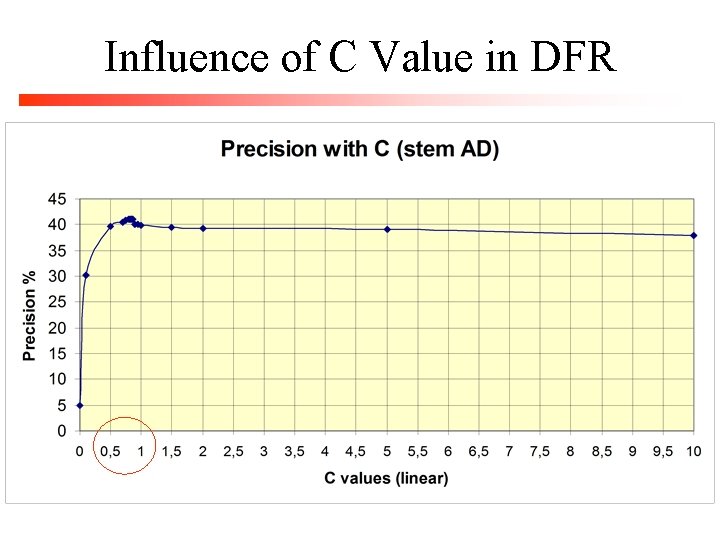
Influence of C Value in DFR
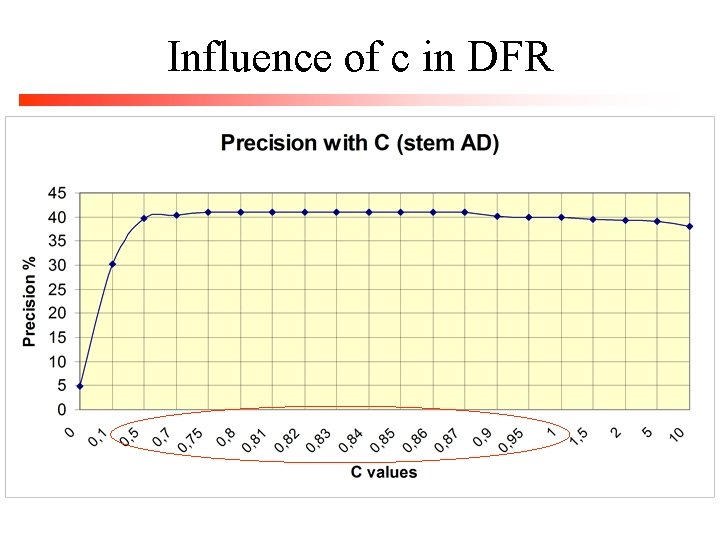
Influence of c in DFR
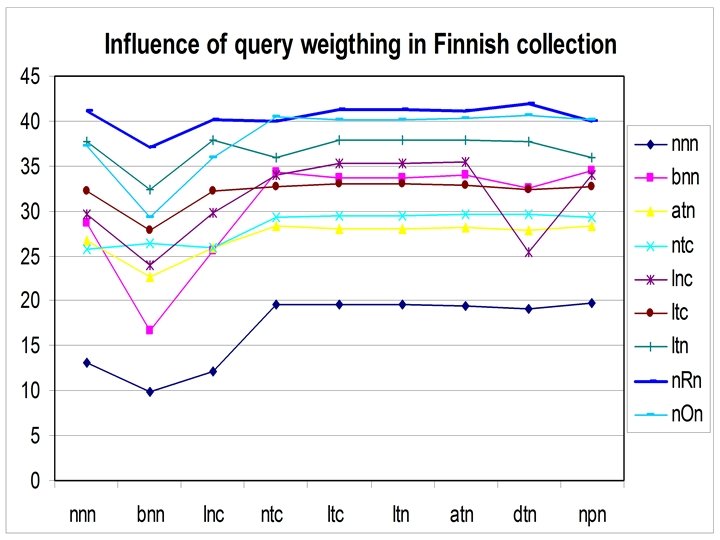
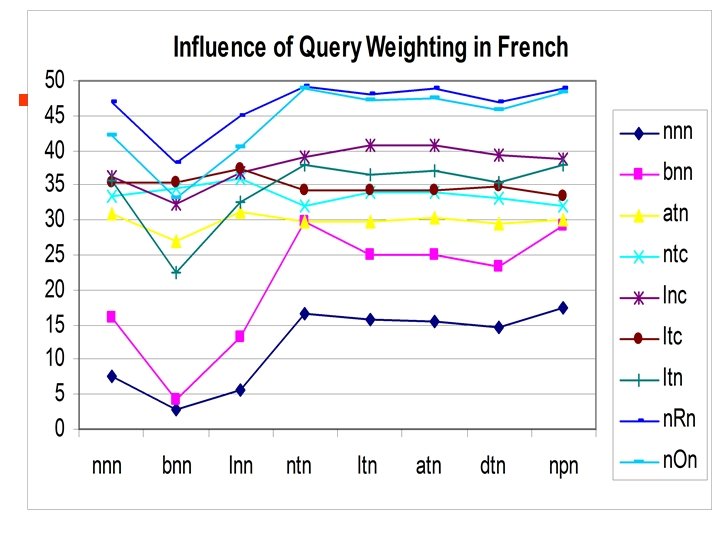
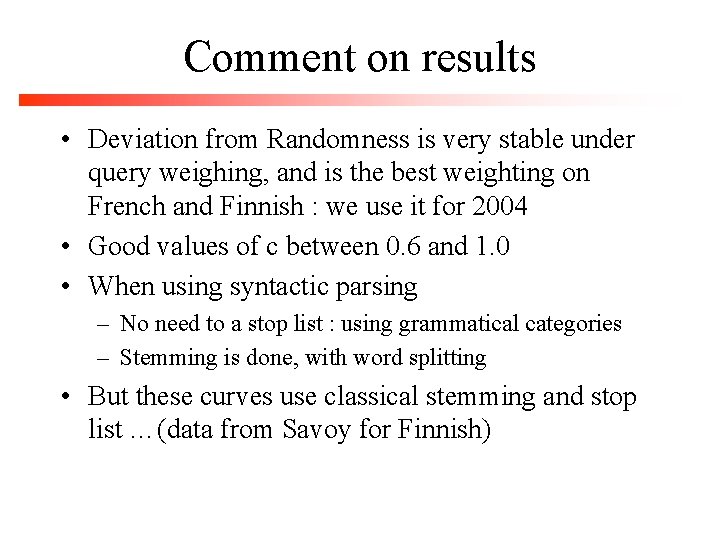
Comment on results • Deviation from Randomness is very stable under query weighing, and is the best weighting on French and Finnish : we use it for 2004 • Good values of c between 0. 6 and 1. 0 • When using syntactic parsing – No need to a stop list : using grammatical categories – Stemming is done, with word splitting • But these curves use classical stemming and stop list …(data from Savoy for Finnish)
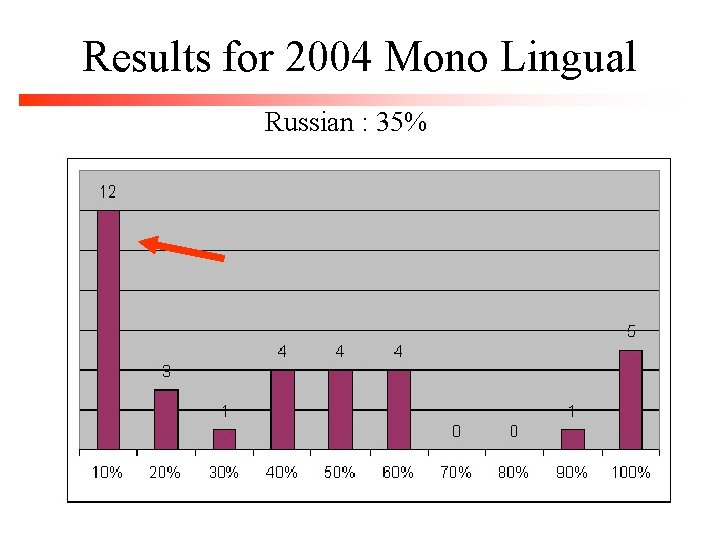
Results for 2004 Mono Lingual Russian : 35%
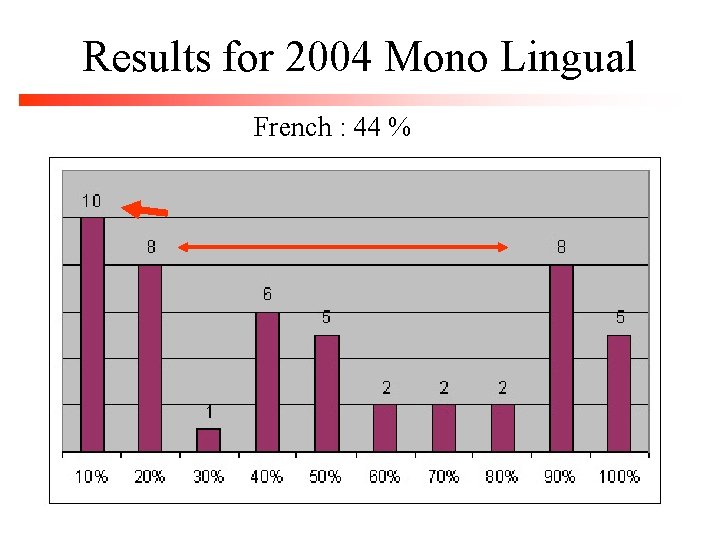
Results for 2004 Mono Lingual French : 44 %
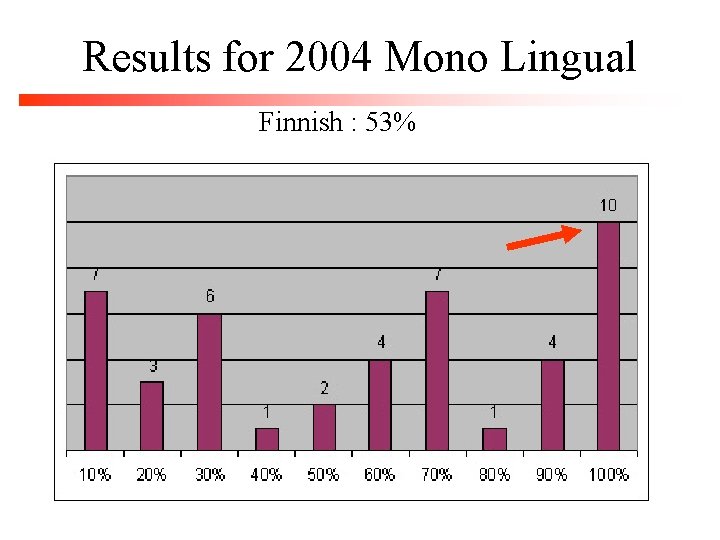
Results for 2004 Mono Lingual Finnish : 53%
Comments on results • Use of parsing for all 3 languages • Best absolute results on Finnish – Results are better than our training in 2003 – This is an agglutinative language, in our training we have not used the syntactic parsing • Results in French are lower than our training – we have used both parsing and stemming + stop list to recover possible parsing errors • There is still a lot on query under 10% of precision – We should examine closely why we cannot solve these queries : we probably need additional data like good thesaurus or dedicated knowledge base
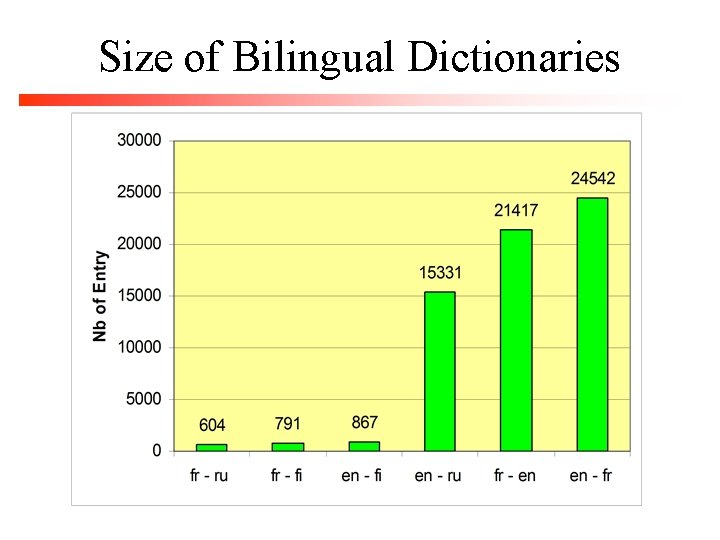
Topic Translation • Translation of query vectors • Building bilingual dictionaries available at CLIPS and online • French and English as topic language • Russian and Finnish use Logos web site but only for terms in the topic • All bilingual dictionary in the same XML file type
Size of Bilingual Dictionaries
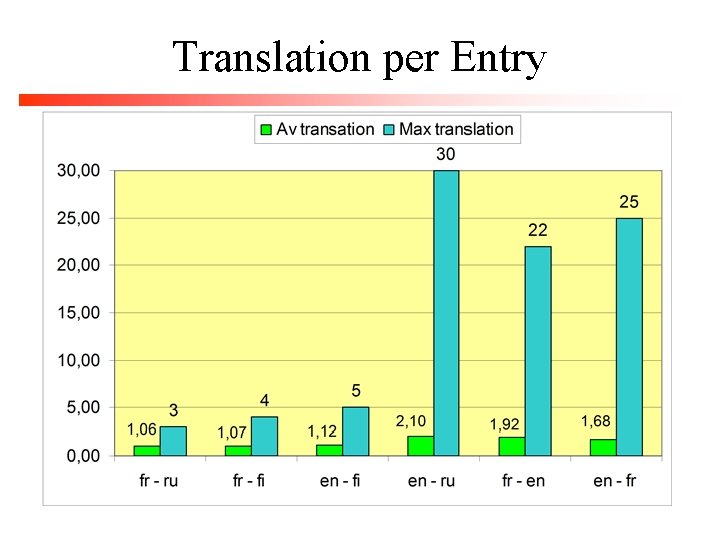
Translation per Entry
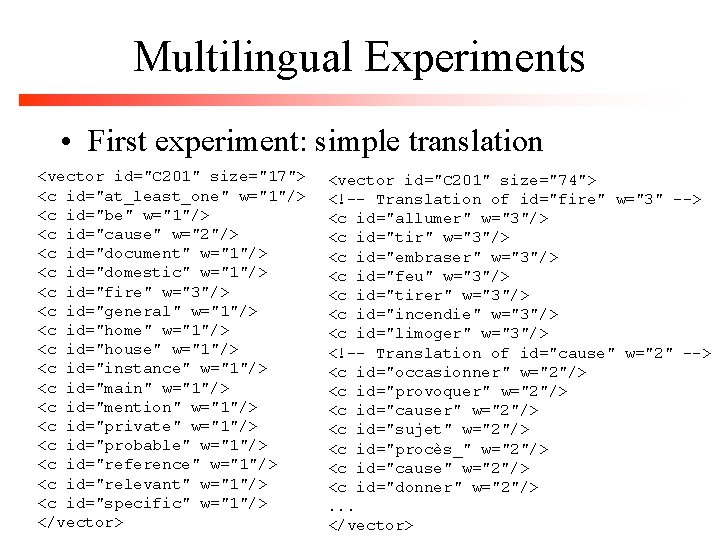
Multilingual Experiments • First experiment: simple translation <vector id="C 201" size="17"> <c id="at_least_one" w="1"/> <c id="be" w="1"/> <c id="cause" w="2"/> <c id="document" w="1"/> <c id="domestic" w="1"/> <c id="fire" w="3"/> <c id="general" w="1"/> <c id="home" w="1"/> <c id="house" w="1"/> <c id="instance" w="1"/> <c id="main" w="1"/> <c id="mention" w="1"/> <c id="private" w="1"/> <c id="probable" w="1"/> <c id="reference" w="1"/> <c id="relevant" w="1"/> <c id="specific" w="1"/> </vector> <vector id="C 201" size="74"> <!-- Translation of id="fire" w="3" --> <c id="allumer" w="3"/> <c id="tir" w="3"/> <c id="embraser" w="3"/> <c id="feu" w="3"/> <c id="tirer" w="3"/> <c id="incendie" w="3"/> <c id="limoger" w="3"/> <!-- Translation of id="cause" w="2" --> <c id="occasionner" w="2"/> <c id="provoquer" w="2"/> <c id="causer" w="2"/> <c id="sujet" w="2"/> <c id="procès_" w="2"/> <c id="cause" w="2"/> <c id="donner" w="2"/>. . . </vector>
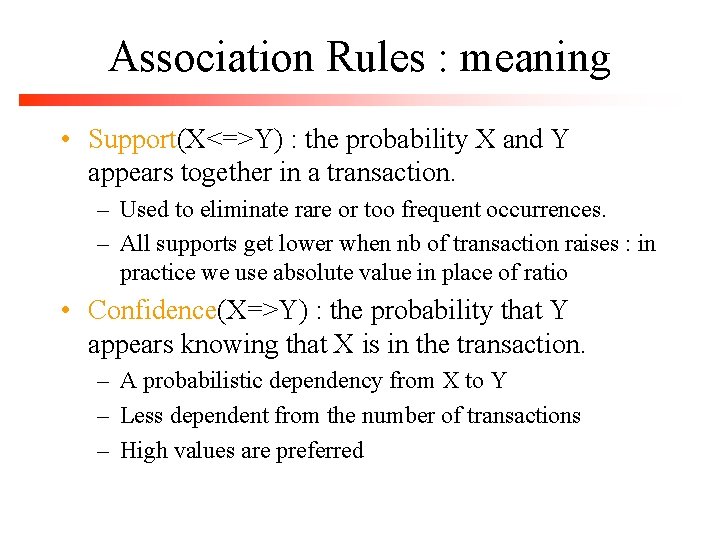
Association Rules : meaning • Support(X<=>Y) : the probability X and Y appears together in a transaction. – Used to eliminate rare or too frequent occurrences. – All supports get lower when nb of transaction raises : in practice we use absolute value in place of ratio • Confidence(X=>Y) : the probability that Y appears knowing that X is in the transaction. – A probabilistic dependency from X to Y – Less dependent from the number of transactions – High values are preferred
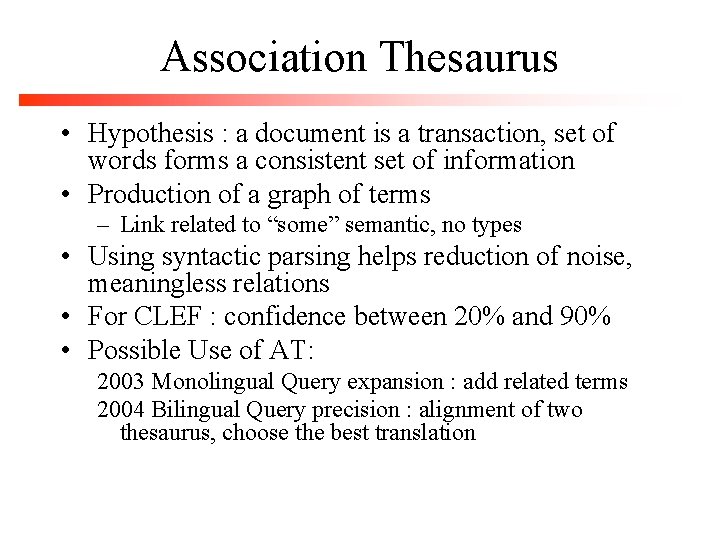
Association Thesaurus • Hypothesis : a document is a transaction, set of words forms a consistent set of information • Production of a graph of terms – Link related to “some” semantic, no types • Using syntactic parsing helps reduction of noise, meaningless relations • For CLEF : confidence between 20% and 90% • Possible Use of AT: 2003 Monolingual Query expansion : add related terms 2004 Bilingual Query precision : alignment of two thesaurus, choose the best translation
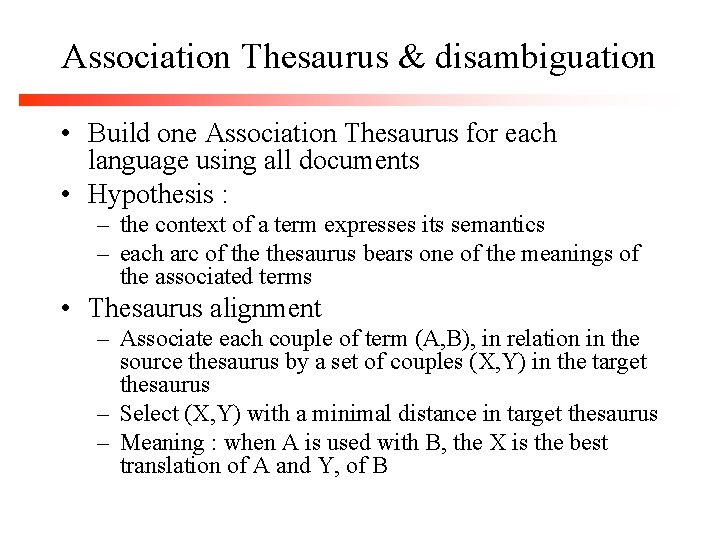
Association Thesaurus & disambiguation • Build one Association Thesaurus for each language using all documents • Hypothesis : – the context of a term expresses its semantics – each arc of thesaurus bears one of the meanings of the associated terms • Thesaurus alignment – Associate each couple of term (A, B), in relation in the source thesaurus by a set of couples (X, Y) in the target thesaurus – Select (X, Y) with a minimal distance in target thesaurus – Meaning : when A is used with B, the X is the best translation of A and Y, of B
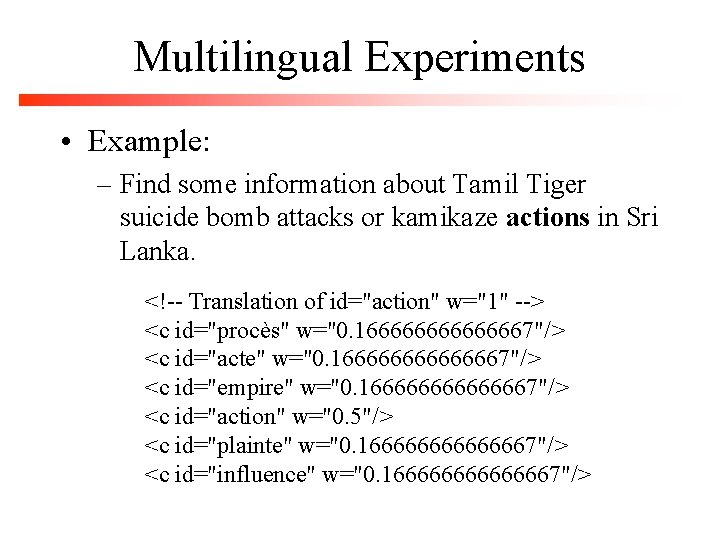
Multilingual Experiments • Example: – Find some information about Tamil Tiger suicide bomb attacks or kamikaze actions in Sri Lanka. <!-- Translation of id="action" w="1" --> <c id="procès" w="0. 166666667"/> <c id="acte" w="0. 166666667"/> <c id="empire" w="0. 166666667"/> <c id="action" w="0. 5"/> <c id="plainte" w="0. 166666667"/> <c id="influence" w="0. 166666667"/>
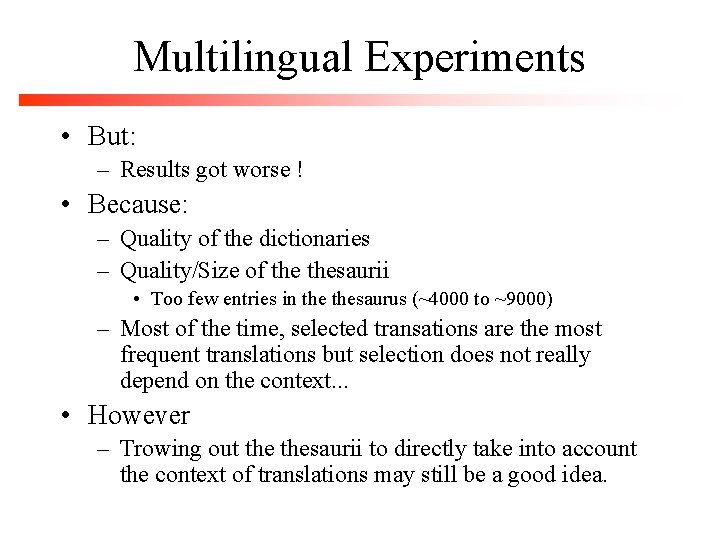
Multilingual Experiments • But: – Results got worse ! • Because: – Quality of the dictionaries – Quality/Size of thesaurii • Too few entries in thesaurus (~4000 to ~9000) – Most of the time, selected transations are the most frequent translations but selection does not really depend on the context. . . • However – Trowing out thesaurii to directly take into account the context of translations may still be a good idea.
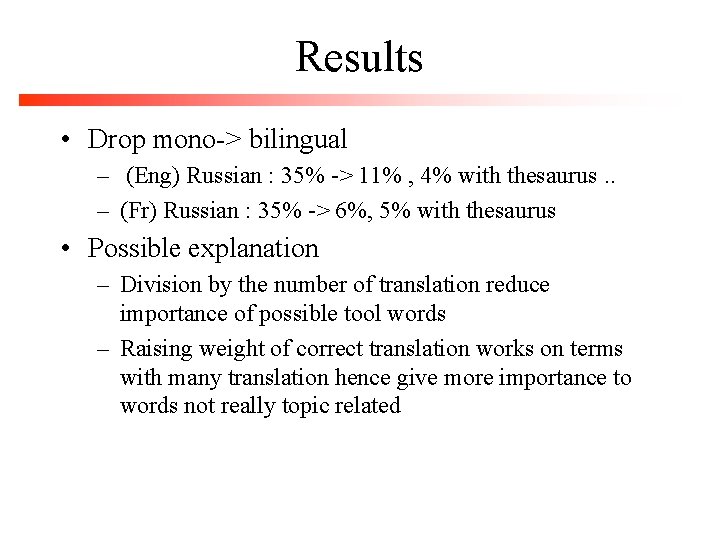
Results • Drop mono-> bilingual – (Eng) Russian : 35% -> 11% , 4% with thesaurus. . – (Fr) Russian : 35% -> 6%, 5% with thesaurus • Possible explanation – Division by the number of translation reduce importance of possible tool words – Raising weight of correct translation works on terms with many translation hence give more importance to words not really topic related
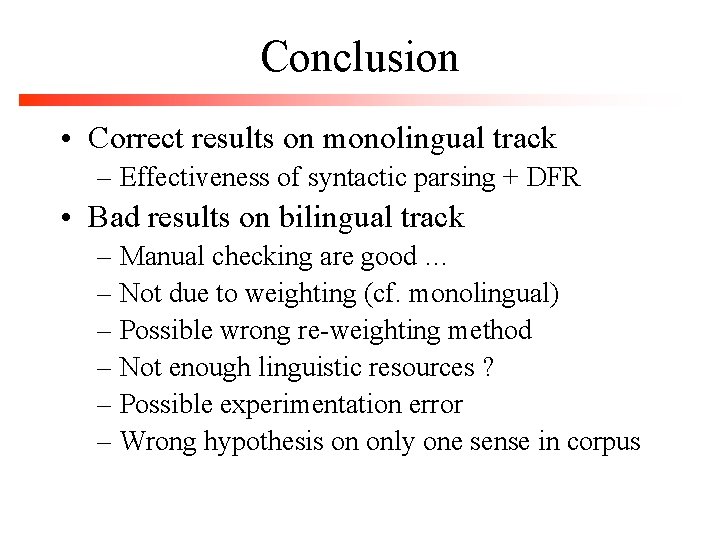
Conclusion • Correct results on monolingual track – Effectiveness of syntactic parsing + DFR • Bad results on bilingual track – Manual checking are good … – Not due to weighting (cf. monolingual) – Possible wrong re-weighting method – Not enough linguistic resources ? – Possible experimentation error – Wrong hypothesis on only one sense in corpus
What next ? • Redo the experiment of parallel bilingual thesaurus – Understand what is wrong – Have better linguistic resources (but how ? ) • Better use of the output of the parser – Using noun phrase to enhance precision