
Using Subtitles from Movie DVDs for in English
Using Subtitles from Movie DVDs for in English Language Teaching Kenji Kitao Doshisha University Kyoto, Japan S. Kathleen Kitao Doshisha Women’s College Kyoto, Japan 1
Introduction n n Good to teach English Movies (semi-natural conversations) n n information about context relationships among interlocutors nonverbal cues many dialogs (variety) 2
n Uses n n Teaching language Analyzing functions n n e. g. , requests, apologies, etc. Teaching concepts related to linguistic pragmatics 3
Dialogues n Obtaining texts n n Scanning subtitles from DVD Finding scripts on the Internet 4
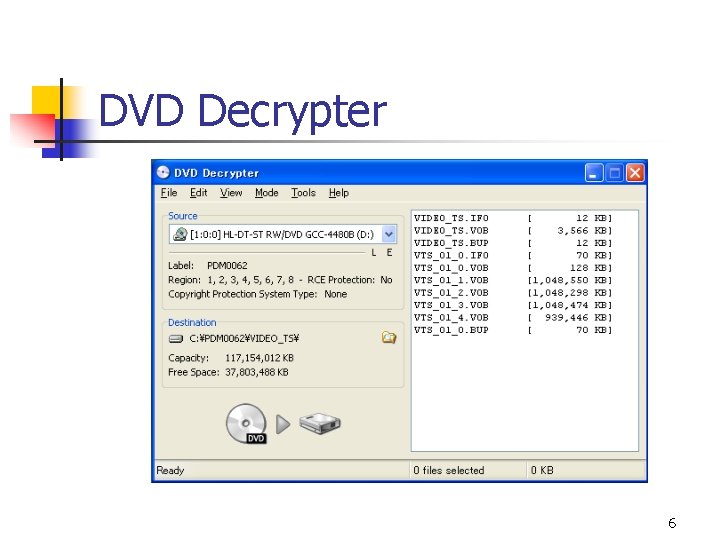
With Software DVD Decrypter n http: //www. mrbass. org/dvdrip/ n Download subtitles (image files) 5
DVD Decrypter 6
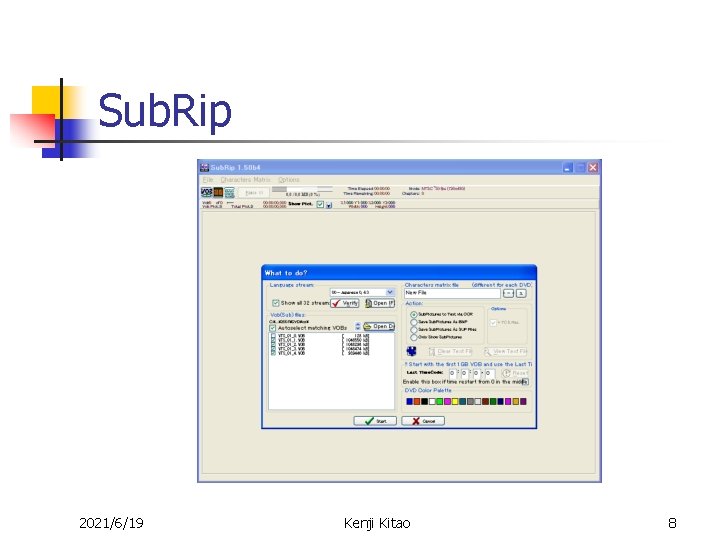
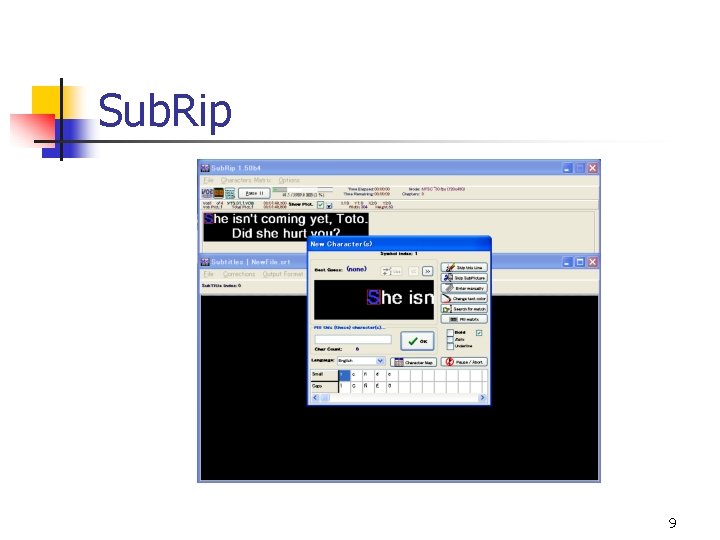
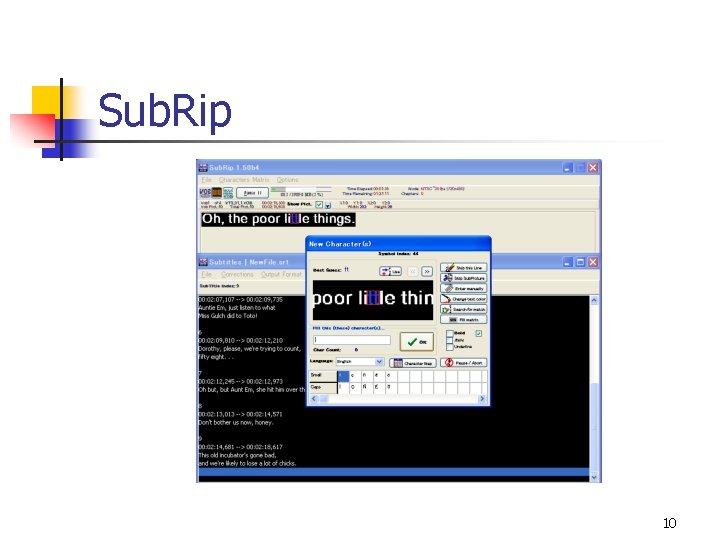
Scanning Subtitles n Sub. Rip n n http: //www. divxdigest. com/software/subrip. html Scanning texts from image files 7
Sub. Rip 2021/6/19 Kenji Kitao 8
Sub. Rip 9
Sub. Rip 10
n Subtitles are often different from the actual dialogue. 11
Scripts or transcripts available online n Drew’s Script-o-Rama n n Movie Scripts and Screenplays n n http: //www. script-orama. com/oldindex. shtml http: //www. moviescriptsandscreenplays. co m/ Scripts n http: //www. moviepage. com/movie_scripts. htm n Original scripts 12
n Simply Scripts http: //www. simplyscripts. com/ Note: Scripts and transcripts are available online. Original scripts, or early drafts of scripts, may be different from the movie. Transcripts are taken down from the movie itself, and they can be inaccurate. 2021/6/19 Kenji Kitao 13
n n http: //www. allsubs. org/ Allsubs. org 2021/6/19 Kenji Kitao 14
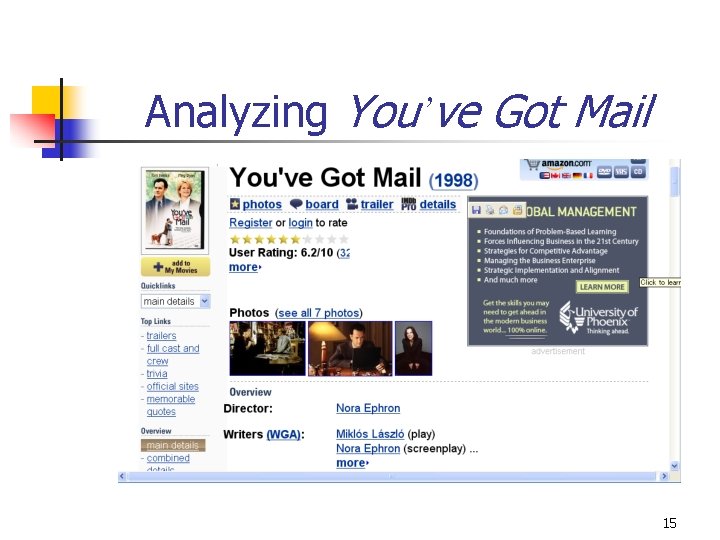
Analyzing You’ve Got Mail 15
n You’ve Got Mail n n 1998 movie Starring n Tom Hanks n n Joe Fox, whose family owns a large bookstore chain, Fox Books Meg Ryan n Kathleen, who owns a small independent children’s bookstore 16
n Reasons for choosing this movie n n n Students’ interest Natural, everyday dialogue Involves both men and women A variety of speech acts Same functions in a variety of situations 17
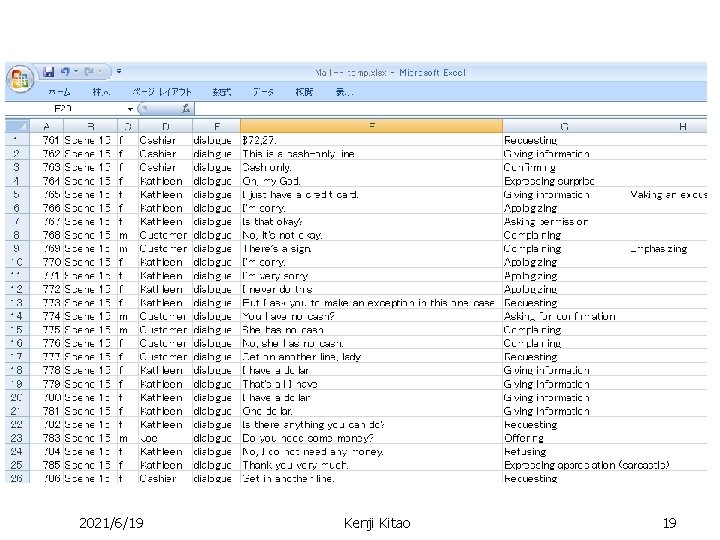
Procedure n n n Ripped subtitles from DVD Put each sentence on one line on Excel Added information about n n Who the speaker was Sex of the speaker Whether the sentence is dialogue, voiceover, etc. Function(s) 18
2021/6/19 Kenji Kitao 19
Statistics n n 1 hour and 54 minutes 10, 949 words (8, 512 words of dialogue) 1, 894 sentences (1, 578 in dialogue) Other n Email, Voiceovers, Song lyrics, TV 20
n n 5. 39 words per sentence Level of difficulty 2. 73 (3 rd grade level) 21
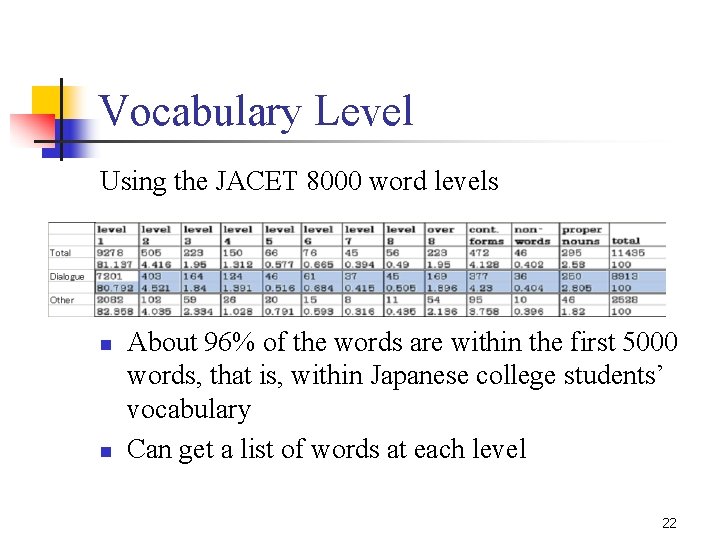
Vocabulary Level Using the JACET 8000 word levels n n About 96% of the words are within the first 5000 words, that is, within Japanese college students’ vocabulary Can get a list of words at each level 22
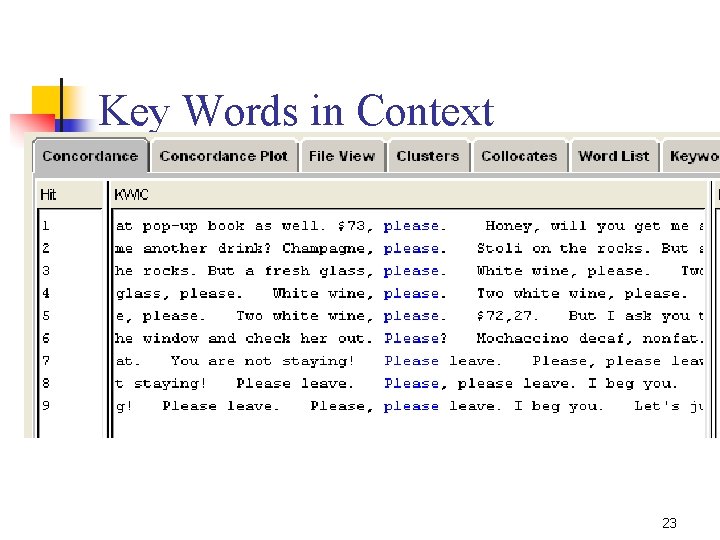
Key Words in Context 23
Looking at functions n n Seeing how one function is used in different situations, speaking to different interlocutors Comparing males and females, younger and older speakers, etc. 24
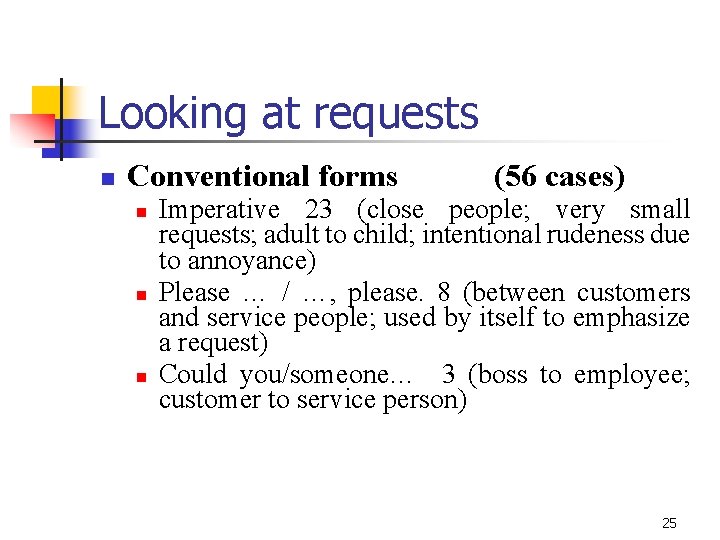
Looking at requests n Conventional forms n n n (56 cases) Imperative 23 (close people; very small requests; adult to child; intentional rudeness due to annoyance) Please … / …, please. 8 (between customers and service people; used by itself to emphasize a request) Could you/someone… 3 (boss to employee; customer to service person) 25
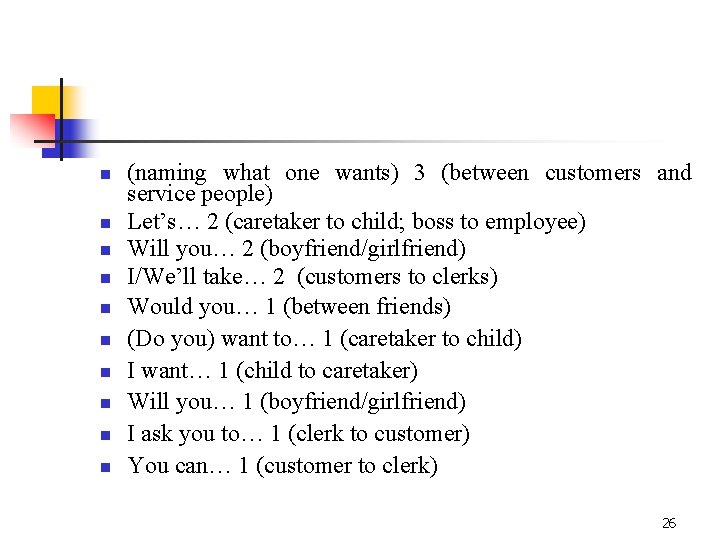
n n n n n (naming what one wants) 3 (between customers and service people) Let’s… 2 (caretaker to child; boss to employee) Will you… 2 (boyfriend/girlfriend) I/We’ll take… 2 (customers to clerks) Would you… 1 (between friends) (Do you) want to… 1 (caretaker to child) I want… 1 (child to caretaker) Will you… 1 (boyfriend/girlfriend) I ask you to… 1 (clerk to customer) You can… 1 (customer to clerk) 26
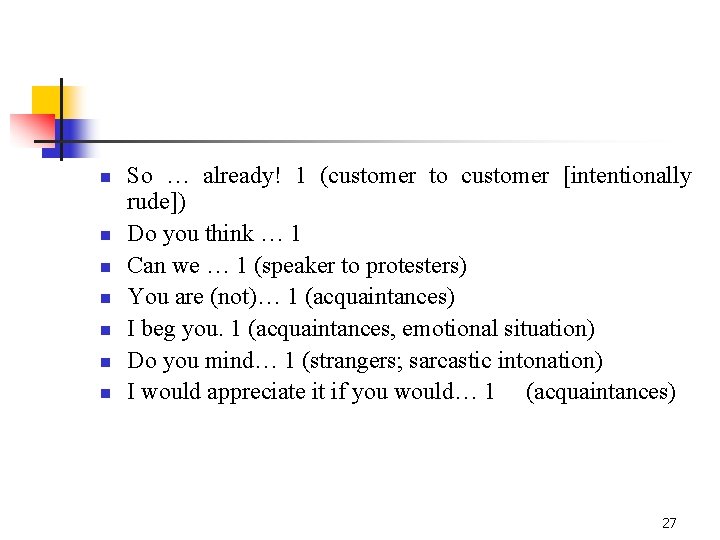
n n n n So … already! 1 (customer to customer [intentionally rude]) Do you think … 1 Can we … 1 (speaker to protesters) You are (not)… 1 (acquaintances) I beg you. 1 (acquaintances, emotional situation) Do you mind… 1 (strangers; sarcastic intonation) I would appreciate it if you would… 1 (acquaintances) 27
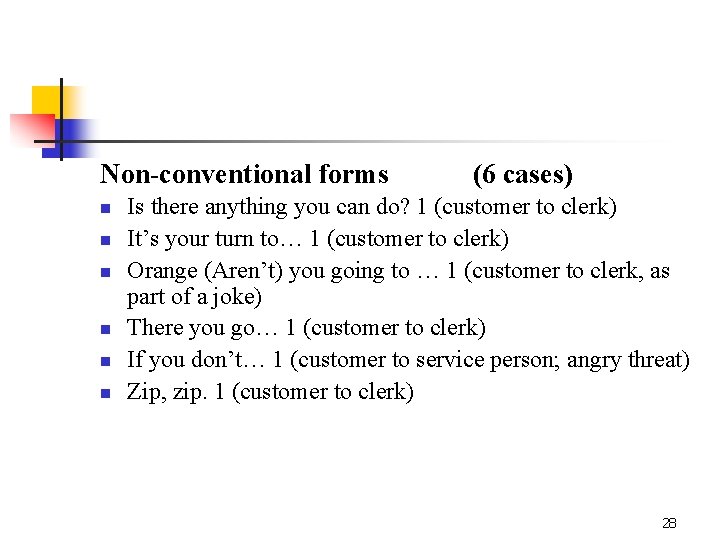
Non-conventional forms n n n (6 cases) Is there anything you can do? 1 (customer to clerk) It’s your turn to… 1 (customer to clerk) Orange (Aren’t) you going to … 1 (customer to clerk, as part of a joke) There you go… 1 (customer to clerk) If you don’t… 1 (customer to service person; angry threat) Zip, zip. 1 (customer to clerk) 28
Using Subtitles in the Classroom n Data-driven learning n Have students n Identify and analyze functions, find examples n Compare male and female language n Compare language of older and younger characters 29
n Giving examples of linguistic pragmatic or sociolinguistic theory Brown and Levinson’s positive and negative politeness 1. Bald on record – make a request directly 2. Positive politeness – meet H’s need to be liked and to feel included in the same group, e. g. , through showing interest in H, using in-group identity markers, using first name, joking n 30
3. Negative politeness – a show of respect for H and H’s desire to be unimposed upon, e. g. , by expressing request as a question, apologizing, not assuming, minimizing size of request 4. Off-record – make the request in a way that can be interpreted in more than one way, e. g. , by hinting 31
n n Negative and positive politeness difficult for students to understand Scene from You’ve Got Mail as example of contrast between negative and positive politeness n n Kathleen is shopping and sees Joe, a business rival, but avoids him Goes to register to pay for purchases 32
n The supermarket scene from You’re Got Mail on You. Tube http: //www. youtube. com/watch? v=q 3 t RKs 9 o_2 A 2021/6/19 Kenji Kitao 33
The cashier finishes adding up Kathleen’s purchases. Cashier: $72. 27. (The cashier requests the amount by stating it. Bald on record. task-oriented) (Kathleen holds out a credit card. ) Cashier: This is a cash-only line. Cash only. (The cashier refuses by stating a general principle. ) 34
Kathleen: Oh, my God. I just have a credit card. I'm sorry. Is that okay? (Negative politeness strategies: . Apologize, ask permission [not assuming]) Customer: No, it's not okay. There's a sign. Kathleen: I'm sorry. I'm very sorry. I never do this. But I ask you to make an exception in this one case. (Negative politeness strategies: Apologize; Indicate reluctance [“I never do this. ”] Minimize imposition [“in this one case”]) 35
Customer 1: You have no cash? She has no cash. Customer 2: No, she has no cash. Customer 3: Get on another line, lady. (Bald on record; annoyed and intentionally rude) Kathleen: I have a dollar. That's all I have a dollar. One dollar. Is there anything you can do? (Negative politeness strategies: Give overwhelming reasons; not assuming) 36
Joe comes up to her. He offers her cash, but when she refuses, he turns to the cashier. Joe: Rose. That is a great name. Rose. This is Kathleen. I'm Joe. This is a credit card machine. Happy Thanksgiving. It's your turn to say ”Happy Thanksgiving” back. (Positive politeness strategies: Claim common ground [notice and attend to H; exaggerate interest in H]; Use in-group identity markers [first names]; Complimenting) 37
Cashier: Happy Thanksgiving back. Joe: Knock, knock. Cashier: Who's there? Joe: Orange. Cashier: Orange who? 38
Joe: Orange you going to give us a break by zipping this credit card through the credit card machine? Come on. You can do it. Zip, zip. There you go. (Positive politeness strategies: Being optimistic [“Come on. You can do it. Zip zip. ”]; joking; involving both S and H in the activity [though the joke]) (The clerk runs Kathleen’s credit card. ) 39
n Using in class n n n Explain Brown and Levinson’s categories Show the scene from You’ve Got Mail Give students the script of the scene Ask students to work in groups to identify examples of positive and negative politeness in the dialogue Discuss with the class 40
The End 41
- Slides: 41