
Using Student Failure As a Pedagogical Tool In
![“I enjoyed all the assignments in this course. There was [sic] a lot, but](https://slidetodoc.com/presentation_image_h2/013497d83230e1fe06cd0b61ad901ebf/image-12.jpg "“I enjoyed all the assignments in this course. There was [sic] a lot, but")
- Slides: 14
Using Student Failure As a Pedagogical Tool In the History Classroom
Games and Learning Gee, James Paul. What Video Games Have to Teach Us about Learning and Literacy. New York: Palgrave Macmillan, 2003. n Humans learn from games because we are entertained by a challenge that is difficult but surmountable. In short, we accept failure in games knowing that we will eventually overcome. n
Failure in a History Classroom in the US Students are assigned generally 3 to 5 projects that determine their entire grade for the semester. n Failure on any one of these projects can be devastating. n Students are thereby required to figure out what the teacher wants to hear. n
A Different Class Design Many assessments n Varied assessments n Permit Second Effort (a re-do, or re-write) for the first time they have attempted a certain assessment n Fully disclosed individual gradebook n Prompt grading of assessments n Feel free to fail, and to learn from failure n
Student Comments n I asked several questions anonymously at the end of the summer session: 1. Which do you prefer: thirty smaller assignments or three to six large assignments? Why? n 2. What is your opinion of our “rewrite” policy? n 3. What do you think of the assignments? Too many? Too time consuming? Too difficult? n
Many Smaller Projects n 73% responded that they preferred many smaller projects. “I prefer 30 small assignments because it helps me to not forget what I have learned. It is also a way to keep the class active. ” n “I prefer 30 small projects rather than 3 -6 big ones. This makes it easier to learn from your mistakes each time. ” n
n “I prefer 30 small projects because having that many means they all will be short and easy to do. Also having 3 -6 would put more pressure on you because you have to get everything right. ”
“I prefer 3 -6 big projects because there is more time to complete the assignment. With more time the project can be more creative and better prepared. ” n “I would prefer 3 -6 big projects because usually you have more time to analyze and plan your work. ” n
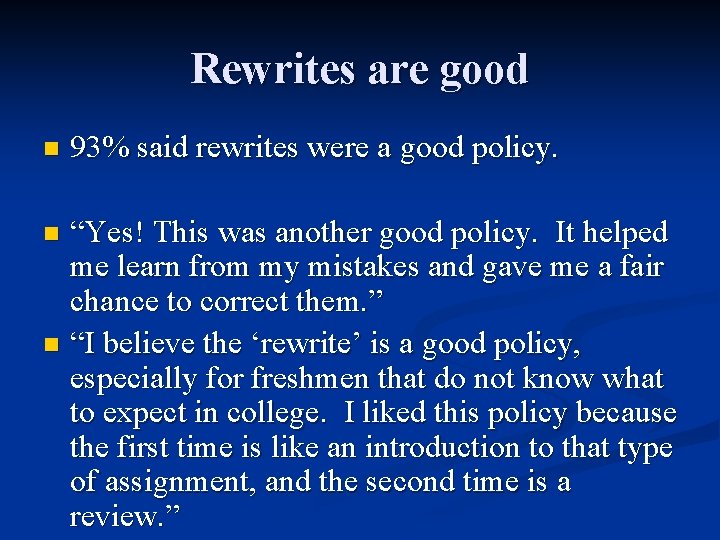
Rewrites are good n 93% said rewrites were a good policy. “Yes! This was another good policy. It helped me learn from my mistakes and gave me a fair chance to correct them. ” n “I believe the ‘rewrite’ is a good policy, especially for freshmen that do not know what to expect in college. I liked this policy because the first time is like an introduction to that type of assignment, and the second time is a review. ” n
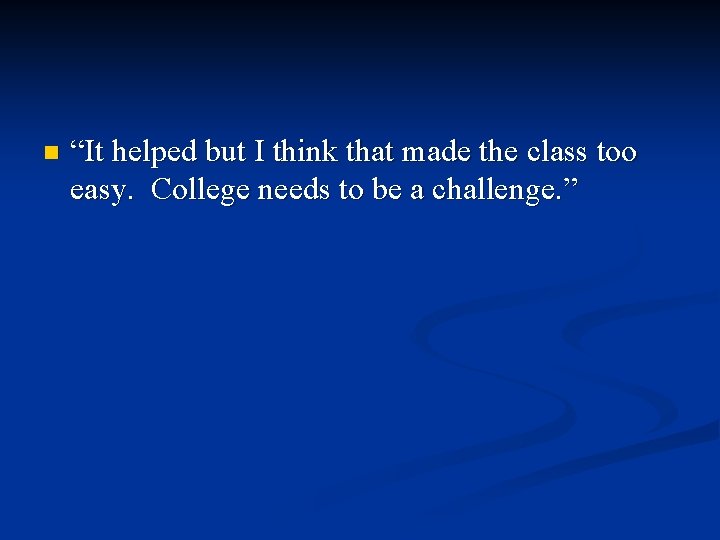
n “It helped but I think that made the class too easy. College needs to be a challenge. ”
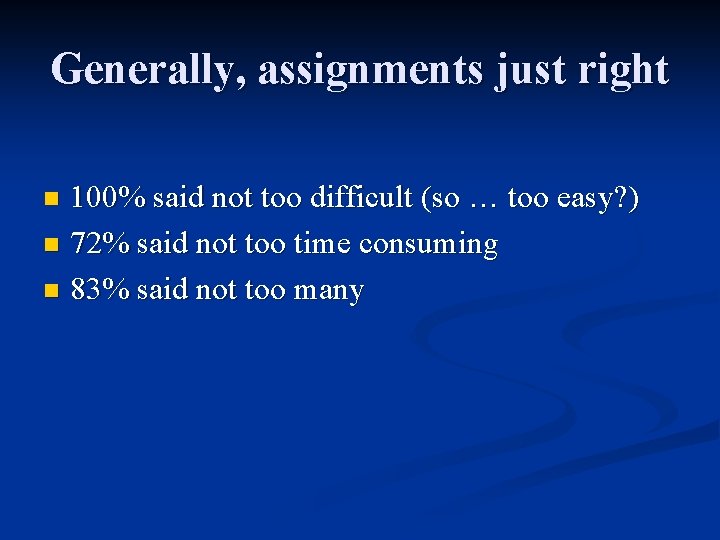
Generally, assignments just right 100% said not too difficult (so … too easy? ) n 72% said not too time consuming n 83% said not too many n
“I enjoyed all the assignments in this course. There was [sic] a lot, but they were small and I feel like these assignments helped bring the class together and connect with the teacher. ” n “The assignments were not difficult at all. Overall I did like them because they helped me think and although they did take up time, it was worth it and helpful. ” n
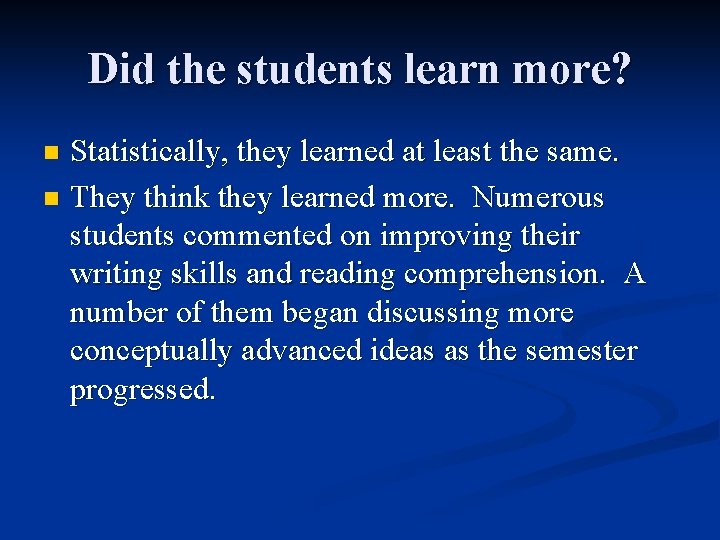
Did the students learn more? Statistically, they learned at least the same. n They think they learned more. Numerous students commented on improving their writing skills and reading comprehension. A number of them began discussing more conceptually advanced ideas as the semester progressed. n
What Did I Learn? This class helped with grade inflation. n Lower anxiety from students, but less effort? n Logistically much more grading. n This class design seems particularly suitable for beginning students. n