
USING STORYBOOKS TO BUILD VOCABULARY Adapted from Tamara
USING STORYBOOKS TO BUILD VOCABULARY Adapted from Tamara Stein, 2010 1
Objectives � � � Understand why vocabulary is important What is our role? Learn how to choose the right book for shared reading Understand how to step up the vocabulary Use the “Shoot for the SSTRS” strategy During books � During conversations & everyday routines �
What’s the big deal about words anyway?
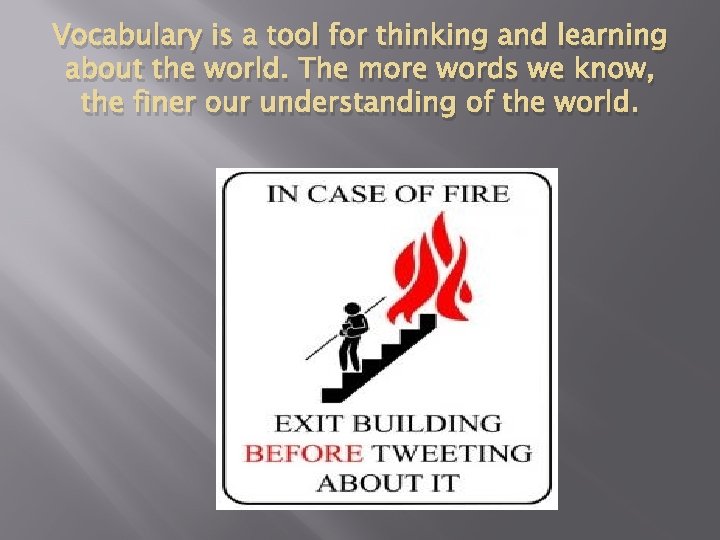
Vocabulary is a tool for thinking and learning about the world. The more words we know, the finer our understanding of the world.
Children with larger vocabularies more easily learn new words faster
Children's vocabulary in kindergarten is one of the best predictors of reading comprehension in grades 3 and 4

Vocabulary growth is directly linked to school achievement
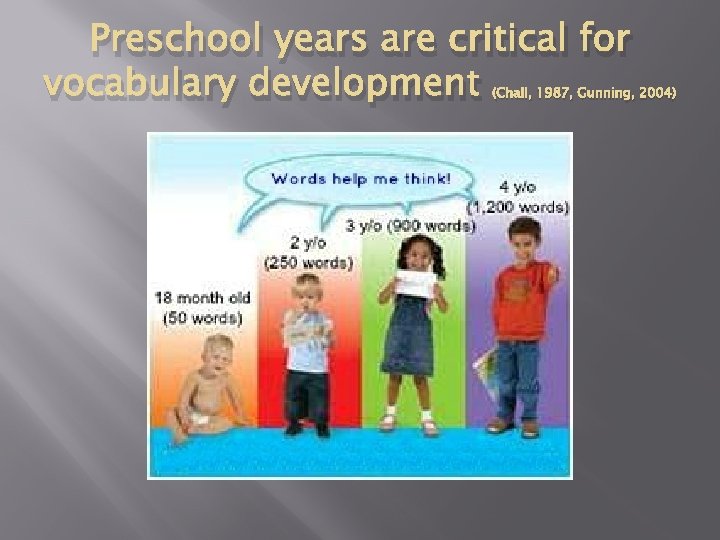
Preschool years are critical for vocabulary development (Chall, 1987, Gunning, 2004)
So what is our role?
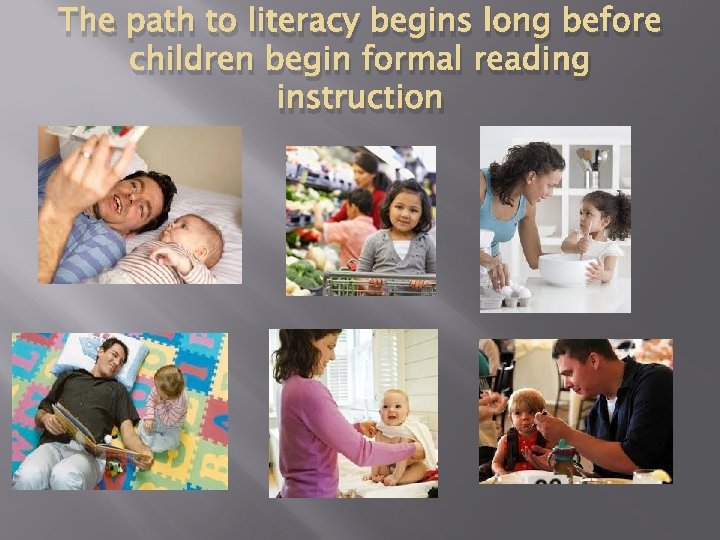
The path to literacy begins long before children begin formal reading instruction

Vocabulary acquisition is based on multiple exposure to words
Quantity is not the whole story! A child’s vocabulary at age 2 ½ was influenced by the quantity (number) of words a parent used a year earlier But that’s not all………. .
Quality matters… � A child’s vocabulary at age 3 1/2 was also influenced by exposure to a variety of sophisticated words one year earlier.

Quality matters… � Vocabulary at 4 ½ years was influenced by talk about things that happened in the past or in the future and explanations one year earlier.
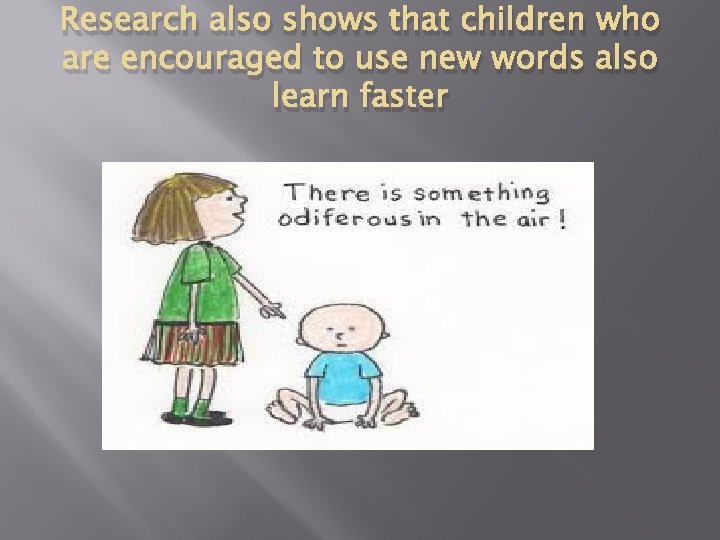
Research also shows that children who are encouraged to use new words also learn faster
How to Select First Words? � � � Understood by the child Initial sound in child’s repertoire Motivating for child to say Expressed as a gesture Action words (verbs) Occurs throughout the day Target Word Program by Cindy Earle
Step 1: Familiar Everyday Words �Wet �Cat �Table �Sleep �Mad �Dirty (Variety of nouns such a names of people, place, things (toys), verbs that are part of routine, and common descriptors)
Step 2: More sophisticated, precise words � � � Soggy Drenched Exhausted Filthy Furiously Involves a variety of word types (names, actions, descriptors, How words (ending in “-ly”)
Step 3: Specialized topic words � � Carnivore Technology Medication Saturated (Geography, Science, History, etc)
Where to find words?
Book reading provides fertile ground for growing vocabulary � � � High contextualized Exposure to novel words Authentic, familiar routine Motivating
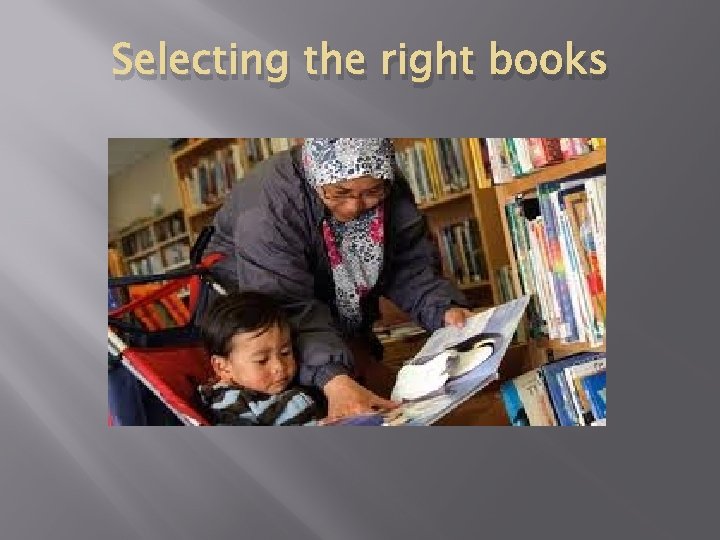
Selecting the right books
Now shoot for the SSTRS! � � Flexible, practical strategy that can be infused into shared reading and other daily activities and routines in early childhood environments and at home. Developed by the Hanen Center
How to start shooting for the SSTRS
Shoot for the SSTRS is an acronym that represents five strategies: � � � S-tress the new word S-how what the new word means T-ell what the new word means R-elate the word to the child’s experience, knowledge, and other relevant situations S-ay it again, again and again!
SSTRS: Stress � Before reading � Discuss the word in the introduction � Briefly discuss meaning � During the reading � Pause before and after the word to draw attention to it � Change volume � Point to illustration and word � Example: Lonely, Firefly
SSTRS: Stress � After the reading � Repeat word during the discussion � Refer back to illustrations during discussion
SSTRS: Show � � � Point to the illustrations Show a picture, prop or object Use facial expressions (sad face to represent lonely) Use actions or dramatic gestures Change how you say the word
SSTRS: Tell � � Name the words category �A firefly is an insect/bug Describe the words meaning �Lonely means he is sad because he has no friends
SSTRS: Tell � � Give specific details �A firefly is a beetle with wings and has a light on its body Describe what the word is and what it is not �A firefly is not an animal
SSTRS: Relate � � � To the child’s experiences To other contexts To other words
SSTRS: Relate with comments & open ended questions � Remember when you…. . � This reminds me of…. � Do you …. ? � Have you ever…? � Can you think of…. ? � Ex: Remember when we went to the butterfly farm? ; Can you think of other insects? This reminds me of your first day at school…
Why is “Relate” important? � � Drawing on ideas from the child’s background knowledge increases the likelihood of the child connecting the new word to old information Make it “stick” so that it’s more easy to remember
SSTRS: Say it again & again! � � � � Daily routines Creative activities Sensory activities Dramatic play Playtime Science Circle time Ex: Insect hunt in the backyard, model how to use the word lonely, such as bedtime)

Make and Take

- Slides: 36